

This will come as no surprise to anyone, but I built a lot of model car kits when I was young. Between the ages of six and thirteen, the model kit aisle at Toys R Us was the center of my universe. Any money I saved from my allowance, or received from relatives for birthdays and such, or earned from doing chores around the neighborhood, all went straight into a cash register at Toys R Us in exchange for a brightly-colored cardboard box full of plastic parts. But every once in a while, if I chose carefully, I could get a free model kit just by cutting off part of the boxes and mailing them back to the manufacturer.
I don’t remember what my first model kit was, but I know it was a snap-together kit. It wasn’t until I was eight or nine years old that I graduated to glue-together kits, assembled with that Testors non-toxic plastic model cement that smells like lemons. I made a terrible mess of the first one, a Ford Mustang; it ended up with glue oozing out of every joint and a huge thumbprint in the middle of the rear window. But I kept at it, because moving up to glue models opened up a whole new world of possibilities to me. Not many snap-together kits were offered, but if you could glue, the model car world was your oyster.


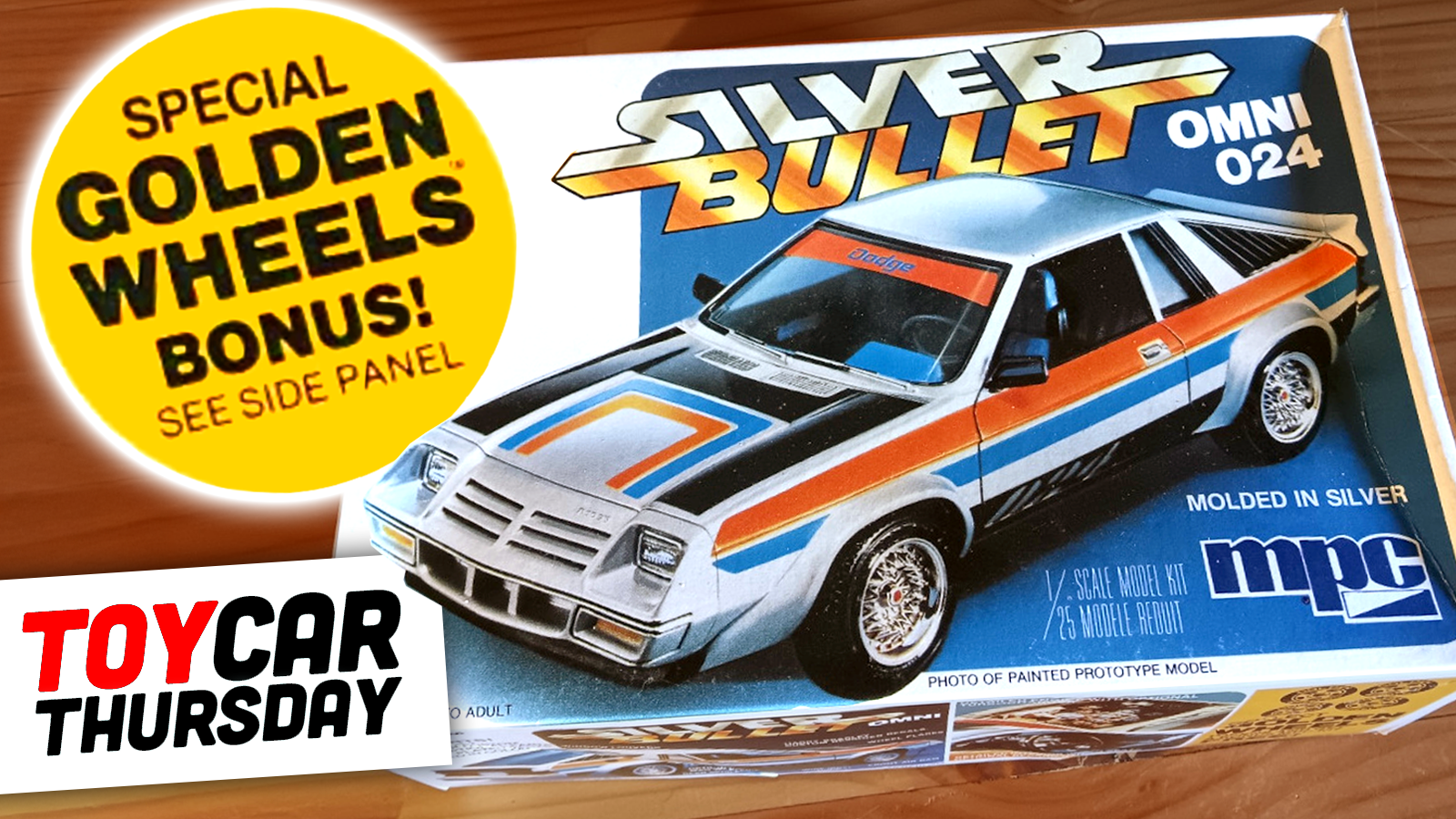
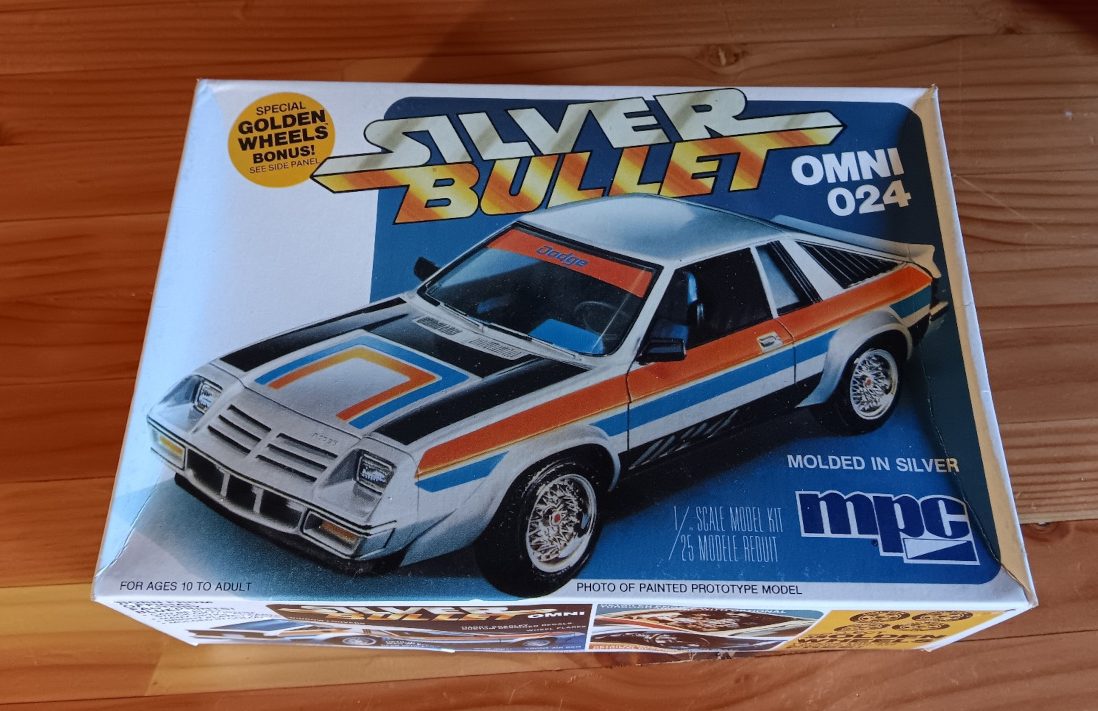
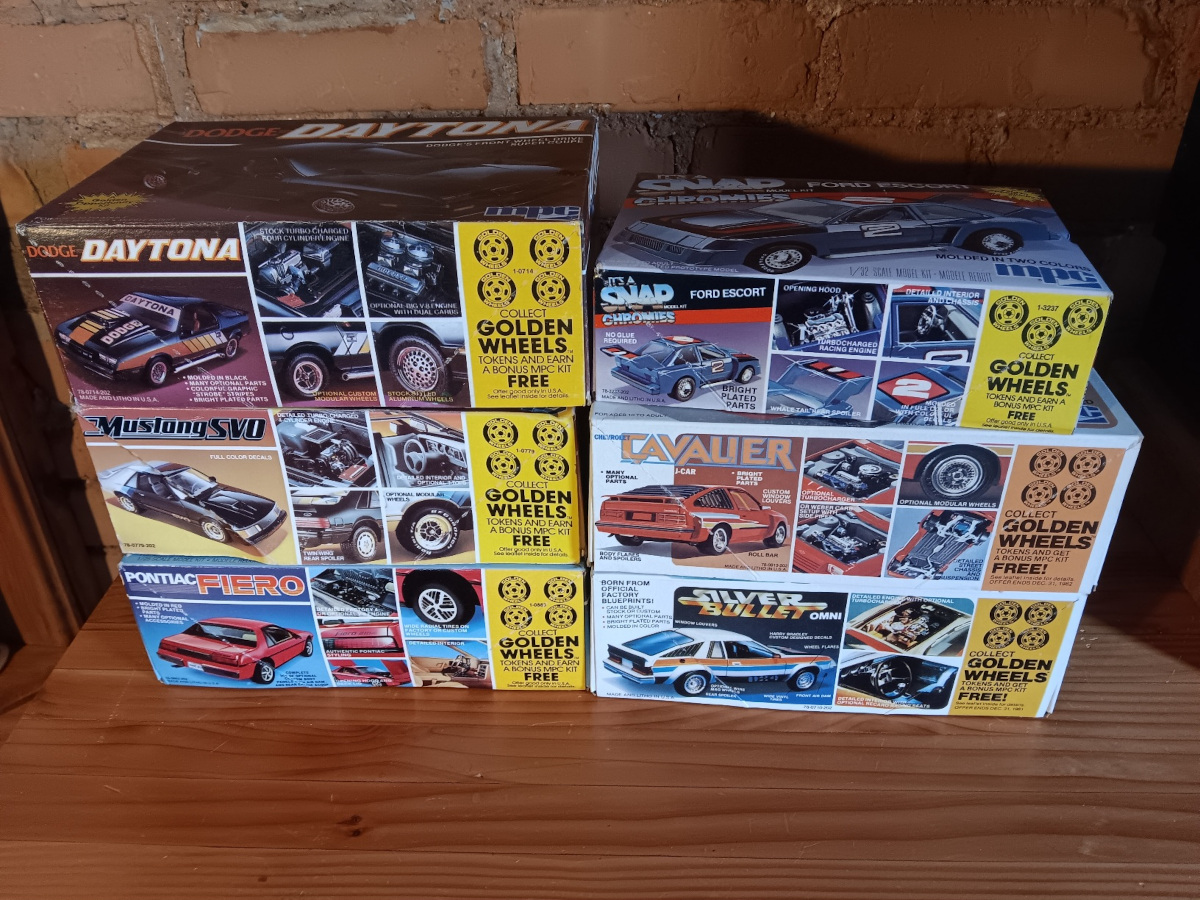
Model Products Corporation, MPC for short, was founded in 1965 by a former employee of AMT Models. Like AMT, MPC made its early name by producing promotional models for car dealerships, and offering kits of the same cars. MPC was sold in 1970 to General Mills, which sold model kits and other toys under its Fundimensions brand. Starting in 1980, the box lids of certain MPC car kits bore a new logo: “Special Golden Wheels Bonus!” I assumed, as others probably did, that this meant the kit contained special gold-plated wheels you could put on the car. MPC was well-known for including “custom” parts of dubious taste which could be installed on your model. But the actual meaning was so much better.
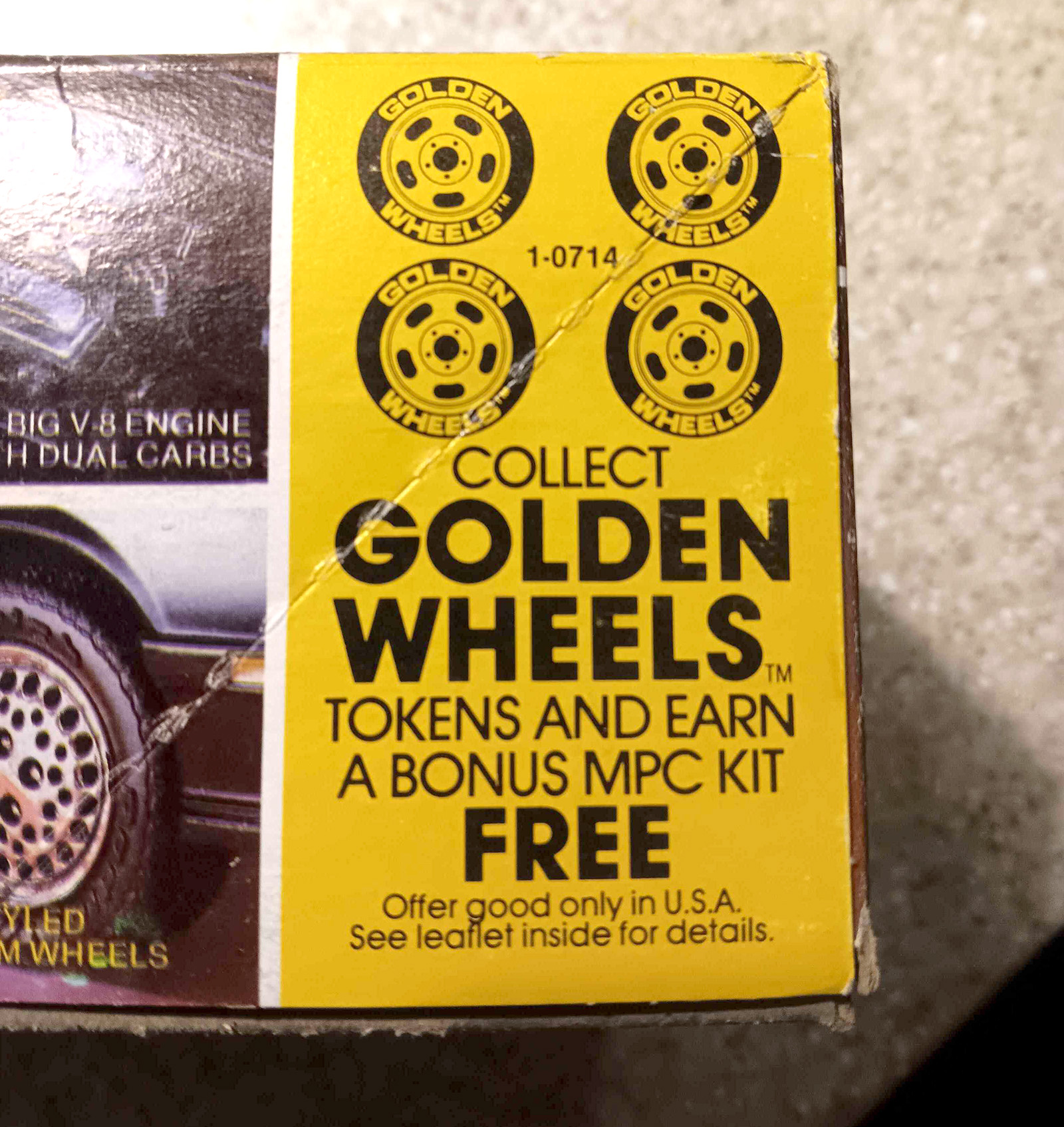
As the flyer inside the box explained, if you collected 20 of the Golden Wheels tokens from the side of the box, and mailed them back to MPC along with $1.50 for postage, they would send you a free model kit. There were four tokens per 1/25 scale kit, so it was essentially a “buy five, get one free” deal.
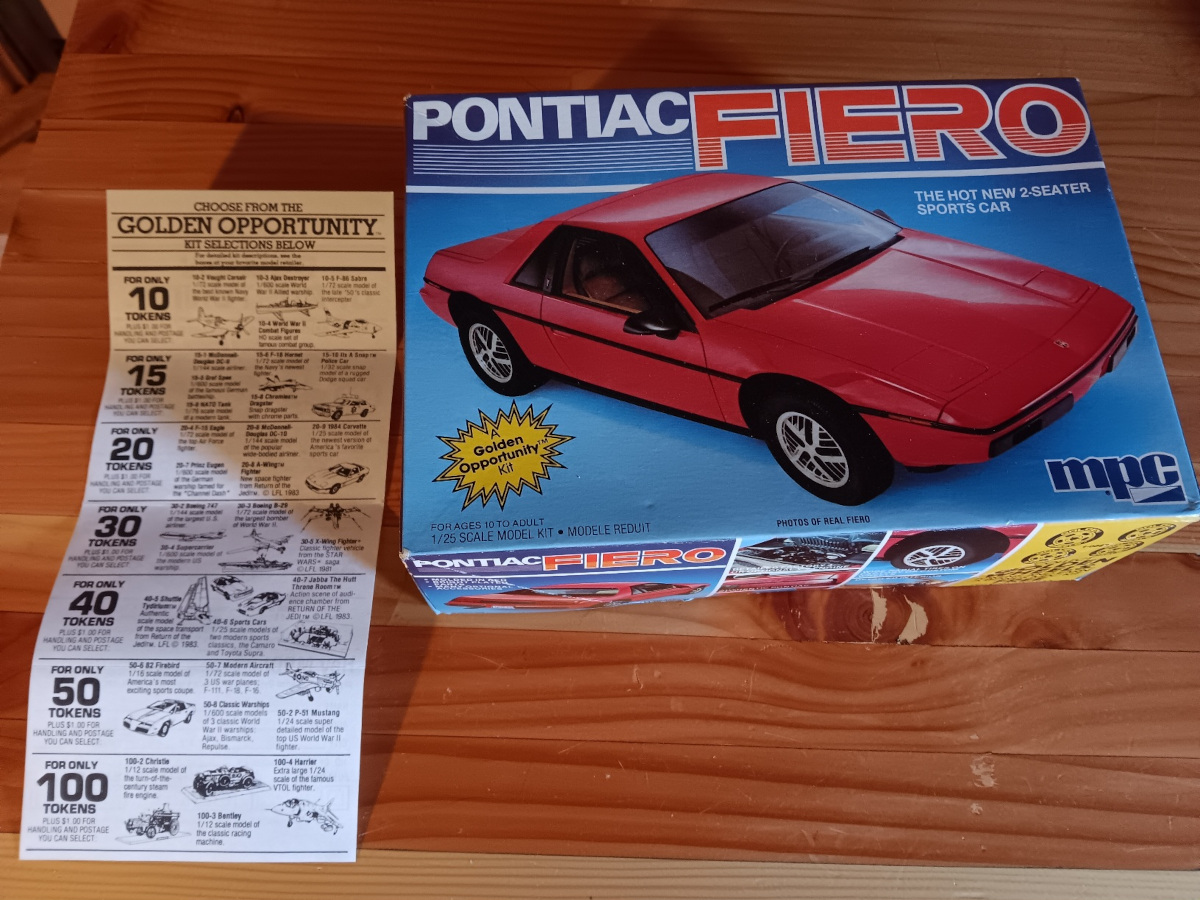
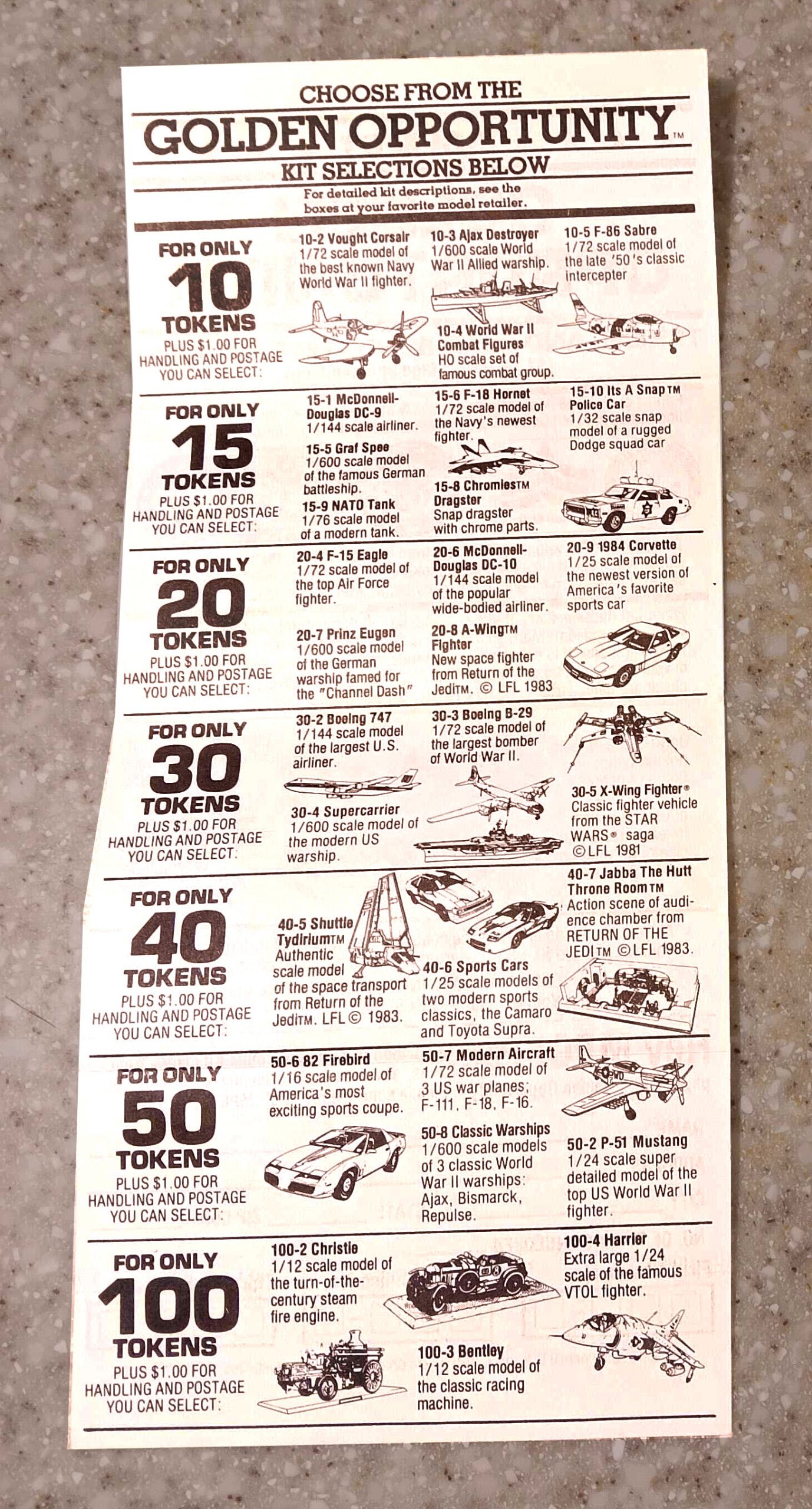
Later, the program was renamed “Golden Opportunity,” and expanded to include other subject matter: Golden Wings for airplane models, Golden Stripes for military models, and so on. And the choices were more numerous. As few as ten tokens could be redeemed for a small, simple kit, or if you managed to save up a hundred, you could get something really special, like a 1/12 scale Bentley. There was even a sweepstakes in 1984 in which MPC gave away a real Corvette, and you didn’t even have to put it together yourself!
MPC ran ads in Boys Life magazine and comic books as well, offering four Golden Opportunity tokens free to get you started. There was a catch: You could only redeem four of the magazine tokens per order. The rest had to come from model kit boxes.
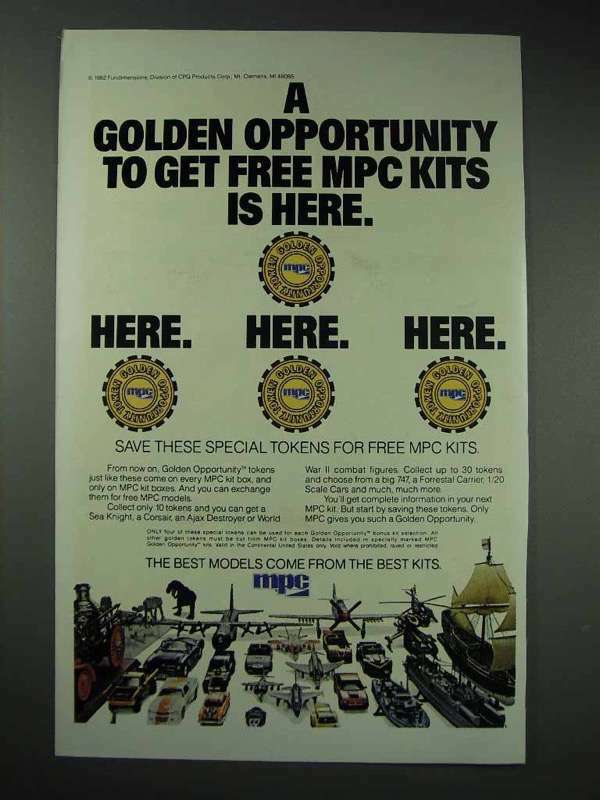
I know I took advantage of this program at least a couple of times. I remember getting a Pontiac Firebird model using tokens, and I think a Dodge pickup as well. The Golden Opportunity program ended in 1985, when MPC was sold to toy giant Ertl, which already owned AMT. Any tokens you hadn’t redeemed by then were of no use to you. Sorry, kid.
I do have several Golden Opportunity kits in my current collection, enough to score a free kit, if only the program were still running. I think I’d go for the Toyota Supra this time. I don’t think I ever built that one back then.
MPC is now owned by Round 2, and many of its old kits have been reissued. The reissues use the same box artwork as the originals, with a few changes: the panel where the Golden Wheels once resided is still yellow, but now houses some extra information about the kit. The new kits are very good quality, maybe better than the originals, but as hard as they try to capture the magic of the old ones, it just isn’t the same. I guess Robert Frost was right: Nothing gold can stay.

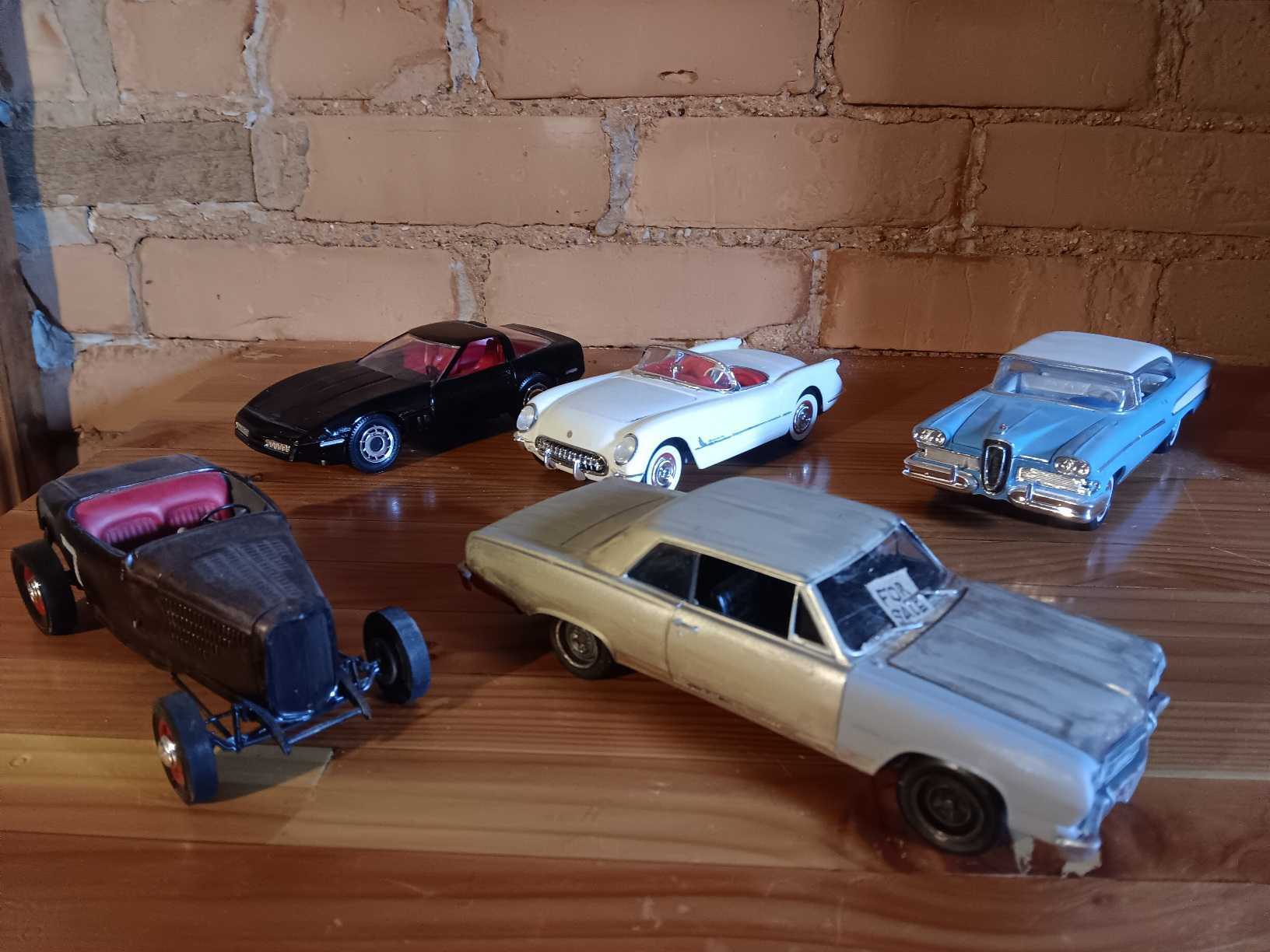
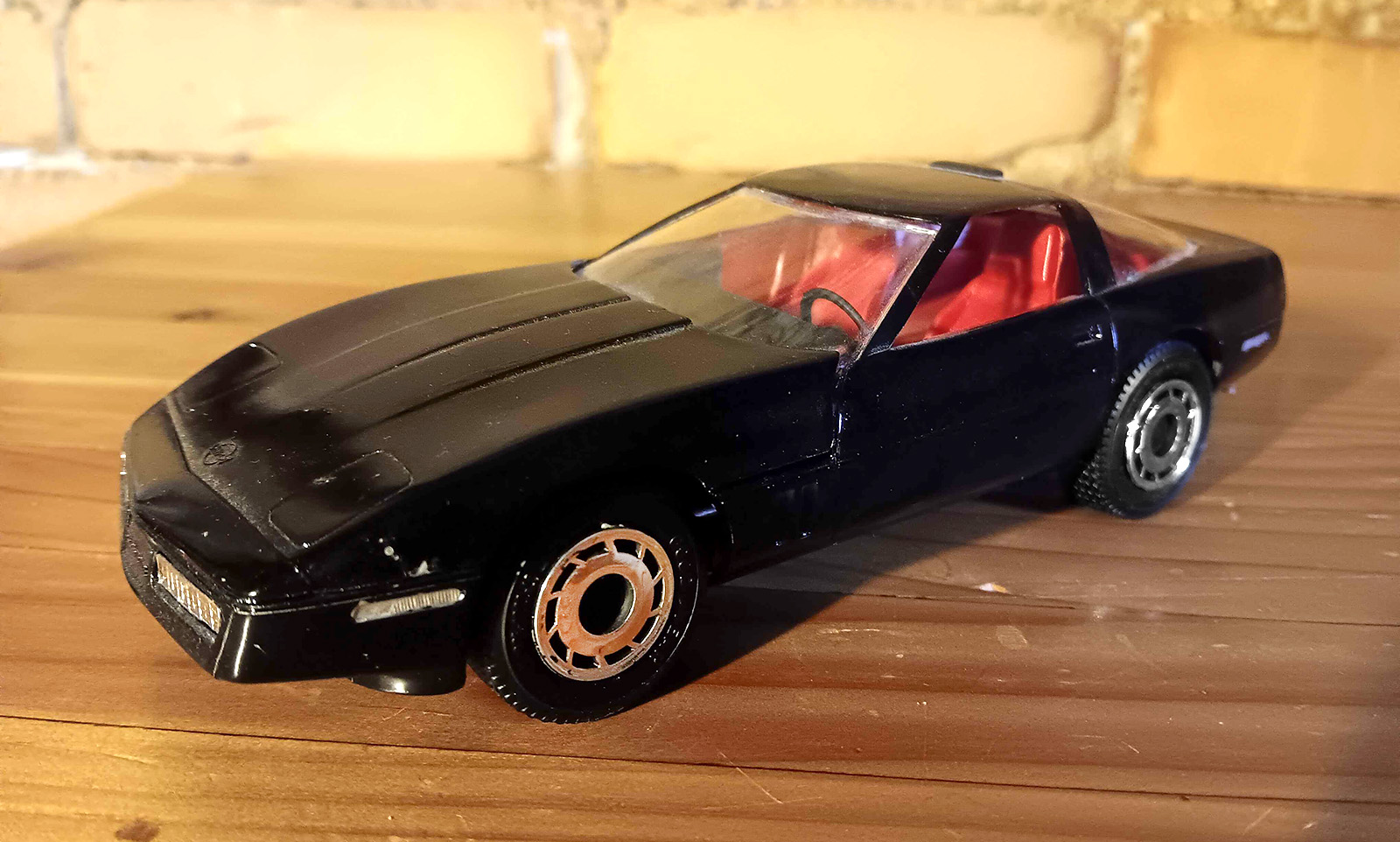
By the way, yes, I do still build model kits, or rather, I have started building them again. Here are a few of my recent efforts. The black Corvette is from a 1980s MPC kit.
Top graphic image: Mark Tucker



I am still building models in my 70s!
Finally have money for real ones too!
68 AMX is soon to be joined by a custom yellow
73 Super Beetle Convertible complete with surf board! We needed er wanted a Beach Car!
Shopgoodwill is a fun website where you can
find some htf model kits sometimes!
It’s a copy of the eBay site but with stuff that gets
donated to Goodwill. All the good stuff gets auctioned off now.
Just won an 85 Fiero kit. For some strange reason have always wanted one. At least it won’t catch on fire! Lol
Joined IPMS. Living Large in Paso Robles CA.
Car culture alive and well here.
Oh and we have an awesome military vehicle, air plane, helicopter, and….amazing auto museum here. Tomorrow will be my first day as
a docent!! Hoping to get involved with the monthly start up of the cars!
Can’t wait to hear the Cad Allard start up!
If you’re in the area check it out!
I’ve been trying to get back into model building, especially as a Ben Franklin store just opened in town, they have a plastic model section, and they’re conveniently located on the way home from work. Meaning if I don’t break out the Cyanoacrylate, I’m gonna be buried in boxes.
I almost bought an X-Wing kit. Because as well as cars, they have spaceships, And regular ships, landships (better known as tanks…)
I am doomed.
I also loved building model cars as a kid although I don’t remember this promotion. I’m guessing it was because of some bad experiences with MPC kits early on. They either didn’t go together right or some parts would be missing. AMT wasn’t all that much better. Monogram and Revell were my favorites.
I never actually put a Snap-Tite model together, instead starting with some really obscure, but simple old glue-together models of 50’s sports cars and WWII airplanes my grandparents found in their attic and gave to me. From there I was given a Monogram pro-street dragster that was just way too advanced for my skill level at the time (I was maybe six or seven). Yet, somehow I got it all glued together and it didn’t even turn out all that bad, except I hadn’t learned about paint, brushes, thinner, etc yet. The Old Man was impressed I had finished it and gave me one of his prized old models, a green deuce coupe of some sort.
From there I built a variety of old cars, mostly Monograms until I was around 14 or so. The last one was my masterpiece, a 1958 Chevy Impala from AMT with opening doors. I gave the body nine or ten light coats of paint – a black base followed by a translucent cherry red. Then I went nuts with the detailing – black thread for the plug wires and battery cables, all the little details painted with toothpicks or custom single-hair brushes, custom license plates, etc. I spent over six months building it and the final product turned out exceptionally nice. But then a few years later I noticed it was just gone from the large shelf of plastic models and die-cast I had on display in my room. Nothing else disappeared, just that one model car. I asked the parents and sister and no one had any idea. Never did find out what happened to it.
Was that black Corvette originally black? I may have bought the same kit for my daughter from a local hobby shop a couple of Christmases ago. I took the scale-windshield out and put it in a jewelry box for her “big” present that year. There was also a piece of paper with the appointment scheduled for a new windshield replacement on her actual C4, a present she greatly liked.
I’ve got quite a few old kits still in the box that I never got to. With the daughter headed off to college I may have to dust off a few and give that hobby a revisit.
Oh my goodness. Building model cars was my major hobby as a kid in the ’80s and early ’90s, and I have not remembered MPC golden tokens in *decades*.
Mine too! I was thinking of taking up the hobby again with aircraft models, but I don’t really have a place to display them, or a place to store all the supplies…
I’ve still got somewhere between 10 and 20 unbuilt kits waiting for that indeterminate future day when I make time for my old hobby again. Kits range from a JoHan ‘78 CdV promo and various Revell/Monogram 1:24 and 1:25 kits to a 1:16 Heller Citroen DS and 1:12 Tamiya 935, and an F150 I was in the middle of building opening doors for. Last kit I built was a Monogram ‘59 Cadillac in the early 90s. One day!
JoHan! I completely forgot about them – I only built one of their kits growing up. It was a Richard Petty Plymouth Belvedere. Turned out great. I also have both the convertible and the coupe versions of that Monogram ’59 Caddy still in the plastic.
At the risk of going all mega nerd, the last time I really engaged with model building when I was a teenager, I had built a couple of Zoids kits that were super high quality, imported from Japan. Gunpla sort of models. I have one unbuilt kit that I just never got around to, maybe I should give it a a go…
Around 15 years ago I finally started to appreciate military fighter jets and attack planes, and bought several model kits with intent to build them as unarmed airshow-type planes. I got stuck when I couldn’t decide on the first two whether to go with empty seats or whether to add the pilots. If I ever decide, I’ll spray them with glossy clear and add the decals, follow it with flat clear, then add the transparent canopies. I wonder if this is the summer to do that.
They will take up much less space after they are built.
As a way to pass the empty-nest evening hours, I got back into modeling a few years ago – this was after a hiatus dating back to 1991. Lots stuff has changed since then, but some hasn’t – namely kits like these. While it’s awesome to build many of the same kits I did in my youth, it would be really cool if there were more kits available for modern cars. Guessing that licensing is probably the thing that stands in the way of that…and the fact that modeling hasn’t really gone much beyond Gen-X. I am a much better modeler now than I was back then – part of that is because I have a lifetime of related skills that I can now apply to the hobby, another part is that most of the skills that I don’t have can be learned via YouTube.
One thing that I have found is that I rarely go back to car models. I’ve built 32 kits in the past four years, but only two of them are cars. The biggest reason for that is that (to me anyway) the painted finish on a car model has to be of the same quality that I have on my own cars. It’s a maddening process to get that (to me at least). I’ve found that you have to go through what amounts to the same process that is applied to actual cars in a body shop – primer, paint, clear coat, several rounds of very careful wet sanding in ever increasing grits to remove the imperfections and even out the clearcoat (no orange peel), rubbing compound, polishing compound, and finally plastic wax. It’s a hell of a process, but I love the results. I also wind up doing tanks and planes more often than not because of it.
I wonder if that is one reason why I didn’t go with model cars. They were common-enough for me to see how the models fell short in hue and realism.
Airplanes were my passion, mostly WWII.
You could always go the route of Mark’s Chevelle(?) and build a car up as a project car for sale.
I build models from the age of 10 (so 1977ish) until probably early high school, and would start the next one as soon as the current one was complete.
I started with a left-over early 70s Camaro my dad tried to use the body over a slot car chassis. Didn’t work, he gave me the kit. I made a mess of the glue and never heard the end of it. But every Xmas there were 3-4 kits under the tree for me anyway.
Now I want to collect 40 tokens, the Shuttle or Hutt’s Throne Room?
As a fellow scale modeler for over 40 years, this article brought back all the feels.
Grandma was uncertain which glue to get, but given the choice between ‘toxic’ or ‘non-toxic’ – the blue tube was always the choice. Did that stuff EVER dry completely?
I think that my very first glue-together model kit was an MPC Chevy Cavalier (possibly the hatchback pictured?) molded in an orange-ish yellow plastic.
I am also absolutely astonished that MPC (or any manufacturer) even OFFERED a plane kit in 1/24 scale in their rewards program. Even though the AV-8B is a small plane, it’s going to be nearly 2′ long with a 1.3′ wingspan model in that scale. Definitely worth buying 25 kits for that!
*firmly applied glue thumbprint to the middle of the windshield*
SHIT!
That corvette is pretty much the exact spec as mine is, though mine is 5 years younger.
About the time they ran this, I was discovering the Monogram sports car kits–the Aston Martin DB4, Maserati 3500GT, Ferrari 250 GTO, possibly a few others. If I understand correctly, they were reissues of Aurora kits from the ’60s. With features like opening doors and trunks, they were irresistible, so that’s where most of my lawn-mowing money was going. I did build that Fiero kit, though.
I have a stack of some of my favorite Tamiya models hanging around for when I ever have some free time to pick them up again. I have all the Group C favorites, the Sauber Mercedes C9, the Jaguar XJR-9, and of course the Mazda 787B.
You’re sitting on a 787B? I’d sell an auxilliary organ for one of those.
Tamiya makes the best model kits.
Actually, I’m sitting on two of them, the Le Mans winning #55 and the 6th place #18.
That promotion occurred right in my peak years of model building, meaning that I cashed in twice for free kits, one of which being the Harrier, not a bad kit at all. I modified the front landing gear to actually be spring-loaded.
The available models in the promotion varied at times, because the other that I received isn’t on that list, some space interceptor thing.
In the pic showing the six models you have currently, I know I did the three on the left. I have to admit, I have never actually seen a Daytona with a V8 in real life…
Been largely out of model building for a while, which is not to say that I don’t have a dozen or so kits in the closet awaiting “the right time.” I miss my stock of kit-bashing parts, but then again, I now have a 3D printer which opens up all new possibilities, among them designing and printing the Coast Guard version of rescue hoist for an MH-65 Dolphin helicopter. Somewhere along the way, I intend to construct the MFP Pursuit Special (the tri-colored one) from Mad Max, modifying a Nissan Skyline 2000 GT to match since I have never found a kit of the Falcon XB.
When this will actually occur remains to be seen…
There WAS a kit of the Interceptor from The Road Warrior/Mad Max 2! Fujimi did it many years ago. They were available at Hobby Lobby ONCE (the chain never restocked the kit once the two it shipped to every store sold out!) I never saw that kit at other hobby stores/chains. The model represents the Interceptor as it existed in the second movie, with the missing trunklid and front spoiler, and it does have the extra fuel tanks in the trunk.
Did we all go through a phase where we’d turn the kit that started falling apart on the shelf into an impromptu road warrior thing after a while, or was that just me?
Nope, not just you – with Thunderdome in the theaters, we did a bunch of those in summer camp arts n crafts! Some came out pretty boss.
I had a few ‘wasteland cruisers,’ as well as several non-junk models modified for combat, a la ‘Car Wars’ from Steve Jackson games. I even outfitted an ’80s Porsche 911 with the weaponry from the Spy Hunter arcade game. God I needed a life…
Yeah, Aoshima produced that, and you can still find them on eBay if you’re willing to drop $150+ on them (I’m not – I get kits to build, not as an investment.) I’m talking about the mostly yellow four-door from the first movie, the ones that spun a van and punctured a camper 😉
https://www.flickr.com/photos/dryasadingo/4322537715/
… though I probably should have just called it a ‘Pursuit,’ since there seems to be some disagreement whether the black one that carried into the next movie was a Pursuit Special or Interceptor.
The closest I could find to the ’74 XB model they used was this: https://www.hobbysta.pl/fujimi-04622/id-5-ken-mary-4door-nissan-skyline-2000gt-x-gc110
Needs a lot of modification, but the main body style seems pretty bang-on. Going to be lots of trial-and-error to get spoilers and hood scoops that fit.
I got my model kits from the hardware store in my small town. Toys R Us didn’t exist yet, and even if it had it would have been at least an hour away.
Then one day my grandmother brought down a box from the attic. A bunch of parts from when my dad put together car models. Nothing was complete but there were engines, frames, wheels, you name it. If you want to talk about questionable modifications, every single one of my existing models got modified with hood scoops, pipes coming from unnatural places, different wheels. Even built a sandrail type thing with one frame, etc.
It was glorious.
I have an 5th-generation El Camino kit in my basement that you can either build as stock or as a low rider. Now that I’m retired, I should build it.
Non-Toxic glue??? When did that become a thing. I still remember the orange tubes of death.
I think the early ’90s. It didn’t work as well, IIRC. I ended up moving on to some other kind of thinner glue that flowed like cyanoacrylate and had a really useful needle applicator, but didn’t dry out as soon as you opened it.
I just realized that I don’t have any cement at all if I want to put that model together. Good thing I can still get some Testers™ cement somewhat nearby.
https://www.landmsupply.com/testors-high-strength-plastic-adhesive-plastic-cement?
I mostly use Krazy Glue and if you’re getting dedicated modeling supplies, look for something called Micro Crystal Clear. It looks like thicker Elmer’s Glue but dries much clearer (enough I’ve used it as a replacement for missing headlight lenses). There’s nothing better for clear parts and it’s also helpful in places where you want a flexible bond since superglue tends to be brittle.
I used to use something similar for the glass area, too. A lot more forgiving on 1/48 WW2 aircraft canopies.
I love Kristal Klear. It’s great for trial assemblies and it’s my go-to for photoetched trim and emblems. It’s also excellent for gauge faces!
When I tried the orange-smelling stuff (it ironically came in a blue tube) I found that it made quite an effective lubricant for the eternity it took before it started to tack.
Never saw the orange-smelling stuff, either. Back in my day, the tubes were orange, the glue was clear, and it was pretty toxic smelling.
Same. And they were made of this odd thin flexible metal that I’m sure was toxic itself. I can still recall the tangy, don’t open in small enclosed rooms smell of that stuff.
Testors had it, usually on the shelf right next to the tube you’re describing here. There are apparenlty “better” options available now, and I’ve tried a few, but I find that they wind up starting to dry before I have the parts in position. As a result, I wind up going with the devil I know…the same Testors glue in the orange tube you’re describing here.
I remember the orange and the lemon smelling stuff, but started with the generic. And learned bad kids were doing other things with it when the drug store clerk didn’t want to sell me a tube unless I bought a kit as well.
OK, it wasn’t just me. I found it odd that the non-toxic stuff had an odd fruity smell.
Just reading the phrase “orange tubes” made me instantly think I can smell the stuff. Memory can be a powerful thing.
The MPC kits were just the gateway drug. I moved from MPC on to Monogram, then Testors’ captive import Fujimi kits and then onto that sweet, sweet Tamiya stuff. These days I’m on the hard stuff… mostly 1/12 scale Italeri and Tamiya with lots of scratchbuilt detail.
Don’t I know it. I love Tamiya kits, and I have a couple of Fujimi kits that I’m working my way up to, as well as a 1/8 scale Monogram Jaguar E-Type, and a Pocher 1/8 scale Testarossa.
When I built them, at least a decade before you considering that there was no such thing as non-toxic model glue (only the stuff that kills brain cells), I remember Revell being really good quality, MPC was good, and if I remember right Monogram was OK, and AMT was usually garbage, with flash all over the place and more likely to be missing parts. I did learn x-acto skills to trim flash, though, and to always check against the parts list before starting.
Mark you have to edit in a story about the buy here pay here 2 door multi color 1960s whatever
Oh, the Malibu? Yeah, I had some fun with that one. I wanted to try a technique to make rust: you paint dappled red and brown and black on the surface where you want rust, then sprinkle salt on the paint when it’s still wet. After it dries, spray it with the main color, and then scrub the salt off to reveal the rust-colored paint in irregular blotches. It looks surprisingly realistic. Who knew salt could “rust” plastic too?
Huh, the catalog doesn’t provide the scale for the Star Wars stuff. Disappointing, considering “relative to human pilot” is an easy reference point.
The scale for their star wars line was “whatever the hell we make it at”. I’m not sure that their X-wing and Vader’s Tie were even in the same scale, and I know that their snowspeeder sure as hell wasn’t. Their Falcon was pretty amazing for the day – impressively large, had transparent panels in back and the ability to hold batteries inside for lighting, the works. Weathering that thing was fun as hell.
That Falcon sounds like a heck of a project; have you posted photos anywhere? Or was that, like, a project lost to the last millennium?
That thing is long gone…probably trashed as of 1984. I did do two rounds with it though…the first assembly (1981) and then back on the bench a year later for extensive weathering (once I figured out how to do that). It was truly fun making it look like hell.
Now you made me look, and lo/behold, the kit that I built is still available! It was originally released by MPC but now it’s ERTL. They kept most of the original box art and features, and have improved a few details on it. I have no idea whether the engine lights are still a thing…something makes me think that they probably took them out because they were designed around D-cell batteries.
that Falcon kit is 1/72, according to the box – but how accurate it really is remains a question.
“Accuracy” with regard to a science-fiction prop/set is probably pretty fluid, but given that the real thing was constructed using found and repurposed stuff including, yes of course, plastic model kits, over a multitude of movies, any claim to (or attempt at) accuracy is probably out the window. And when you consider that ILM technicians are all a bunch of goofballs and intentionally hid easter eggs like Nolan’s Batman Tumbler in screen versions, we’re totally through the looking glass. But assembling any Millennium Falcon–even the Metal Earth one that I did–is fun no matter what degree of verisimilitude or even difficulty. I wonder how many people saw your post and went shopping (or digging through the attic)!
I’m reading a book on Lucas RN, and the parts about ILM are quite revealing. Always loved the fact that much of the stuff on the SFX craft of our youth was repurposed stuff culled from model kits of all types. The first time I realized this was in my youth as I was staring at a pic of Battlestar Galactica – the very tip of the nose on that thing had a very distinctive round-shaped component that I recognized immediately – it was the radiator shroud from a C3 corvette model. Only knew that because I built a model of one and remembered how odd the shroud was compared to others (due to it being canted forward in the front of the low-slung ‘vette).
Yeah it’s remarkable how much of the “Magic” in ILM is just repurposed stuff..More like “Industrial Light & Cannibalism,” amirite? They got away with a lot before HD freeze frame!
Have either of you seen the Bandai Star Wars kits? I was kind of blown away by the mold quality with the first one I tried. I still have 4 or 5 on the shelf waiting for when I have time (their release coincided with my son’s birth).
I’ve seen them in the hobby store, and they do look impressive. To that end, the toys (namely X-wing) that I bought for my then-young kids in the late 90’s were impressively detailed as well…especially when you compare them to what we had from Kenner (press Artoo’s head to make the wings open!)
I’ve seen a lot of model kits over the years and I can say they were probably the highest quality I’ve ever seen.
My old girlfriend’s father had a huge collection of these in fancy glass display cases and lining the walls and rooms and just busting out everywhere in the downstairs room. Must have been 100s. He had a little 10×10 room dedicated to making scale models. Mostly cars but a few other odds and ends too. It was fun to look at.
I should get back into models. I think 1988 was the last time I did one. It’s relaxing.
I used to do the ships and once a tank.
Great trip back Mark! I vividly remember that ad, as I loved the array of different (item and scale) models. I kept my Golden Wheels in an envelope in the drawer of my little kid’s desk, agonizing over whether to take a sure thing with a small Camaro or save for the mid level destroyer. I don’t think I ever did anything with them though, and I’m sure my mom threw them out after I started reading Bad Boys Life and wondered if x-ray specs removed just clothing.