

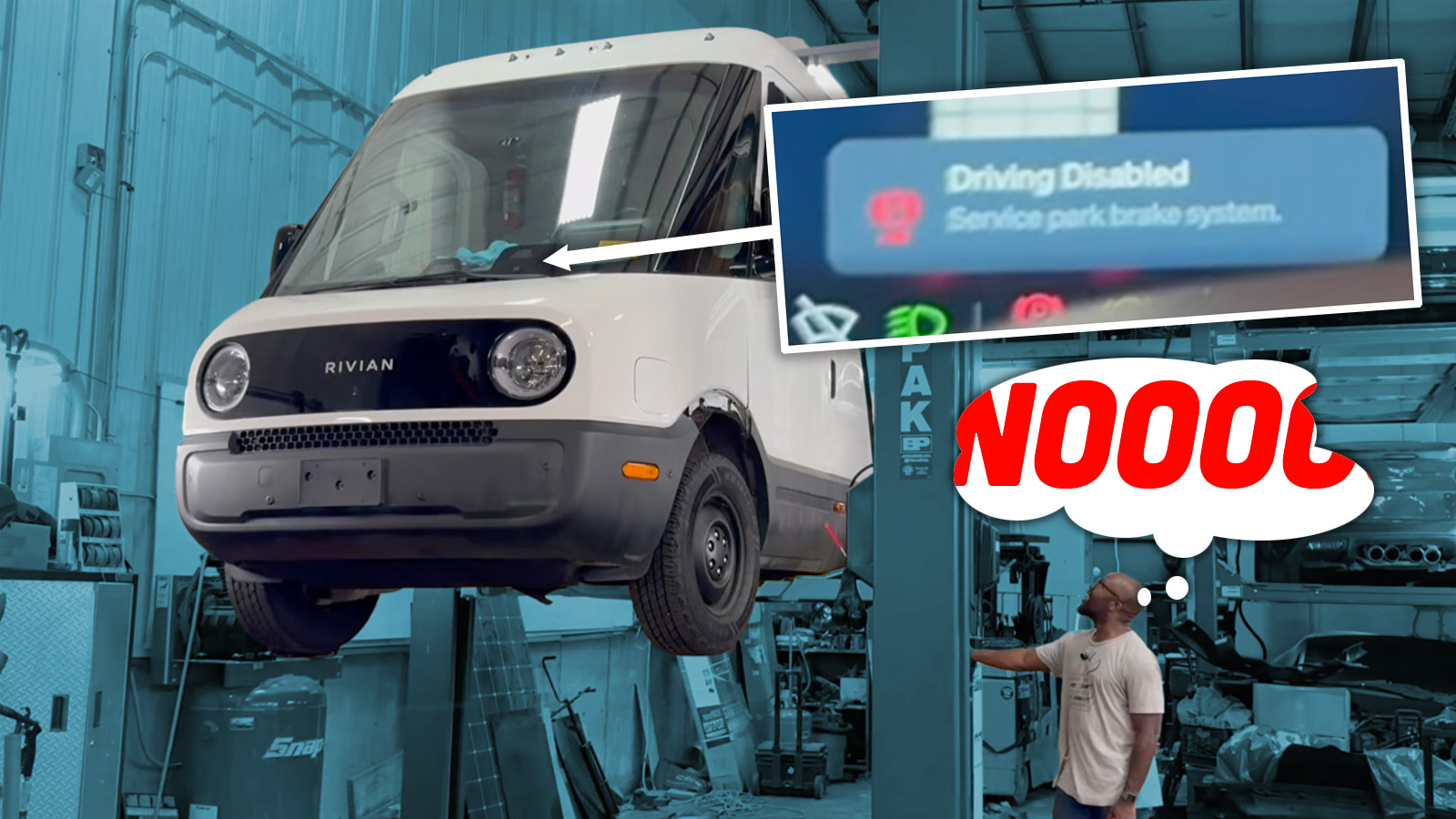
Do you like horror movies? I feel like most new movies that are coming out are almost all horror movies. But here’s the thing: a horror movie doesn’t have to deal with traditional themes to be terrifying, like re-animated corpses or people on all-sanguineous diets or monkey’s paw-related wish-grantery. Sometimes the horror is less imaginative and just, you know, crappier. Like the grim yet ever-present specter of a future where no one can fix and drive a used car.
This horrific idea was driven home for me when I watched a series – I think still ongoing – of videos from bigshot YouTuber (a title which, I just learned today, has nothing to do with other types of tubers, like yams or cassavas) Rich Rebuilds, who just spent $10,000 to buy one of those Rivian-built Amazon delivery vans.


Now, the van Rich bought may not actually have been part of Amazon’s fleet; in fact, I don’t think it was, because it doesn’t have Amazon livery on the outside and the center of the steering wheel reads “RIVIAN” instead of “AMAZON” like the ones delivered to Amazon seem to have. It’s the same type of van that Amazon uses, though, a Rivian Delivery Van, and these are electric delivery vehicles that start at around $80,000 and go up from there. Maybe $100,000 is a bit of an exaggeration, but not by much, once all is said and done. So getting one for $10,000 would absolutely seem like an interesting deal.
Of course, there’s a catch, because this is reality and everything has a catch. The catch here is that the van doesn’t, you know, move. Ordinarily, this is a pretty significant detriment to a van, or, really, almost any motor vehicle, but Rich felt the gamble could be worth it, because, come on, this thing is practically new! How hard could it be?
The van was marked not for sale, but despite that, somehow Rich managed to buy it, becoming possibly the first private – as in non-commercial – owner of a Rivian Delivery Van ever. It’s also worth noting that this van was in this position because it had been Lemon Law’d, which means that it was so broken from the get-go that the manufacturer had to buy it back. And from there, I guess it was sold to the dealer that Rich bought it from?
Anyway, the sellers of the unsellable van seemed to think it needed a whole new battery pack, but Rich didn’t think so. And it seems he was right! The problem is just that the real issue is, in many ways, worse.
These videos are somewhat long, but I think worth watching, if only to really absorb the full schadenfreude of frustration as they try fix after fix to try and get the van moving. It powers up fine; the battery works, all the displays work, the power doors open and close, all the lights work, but there’s one thing that refuses to cooperate, and it’s enough to transform the whole van from a vehicle into a shed: the parking brake.
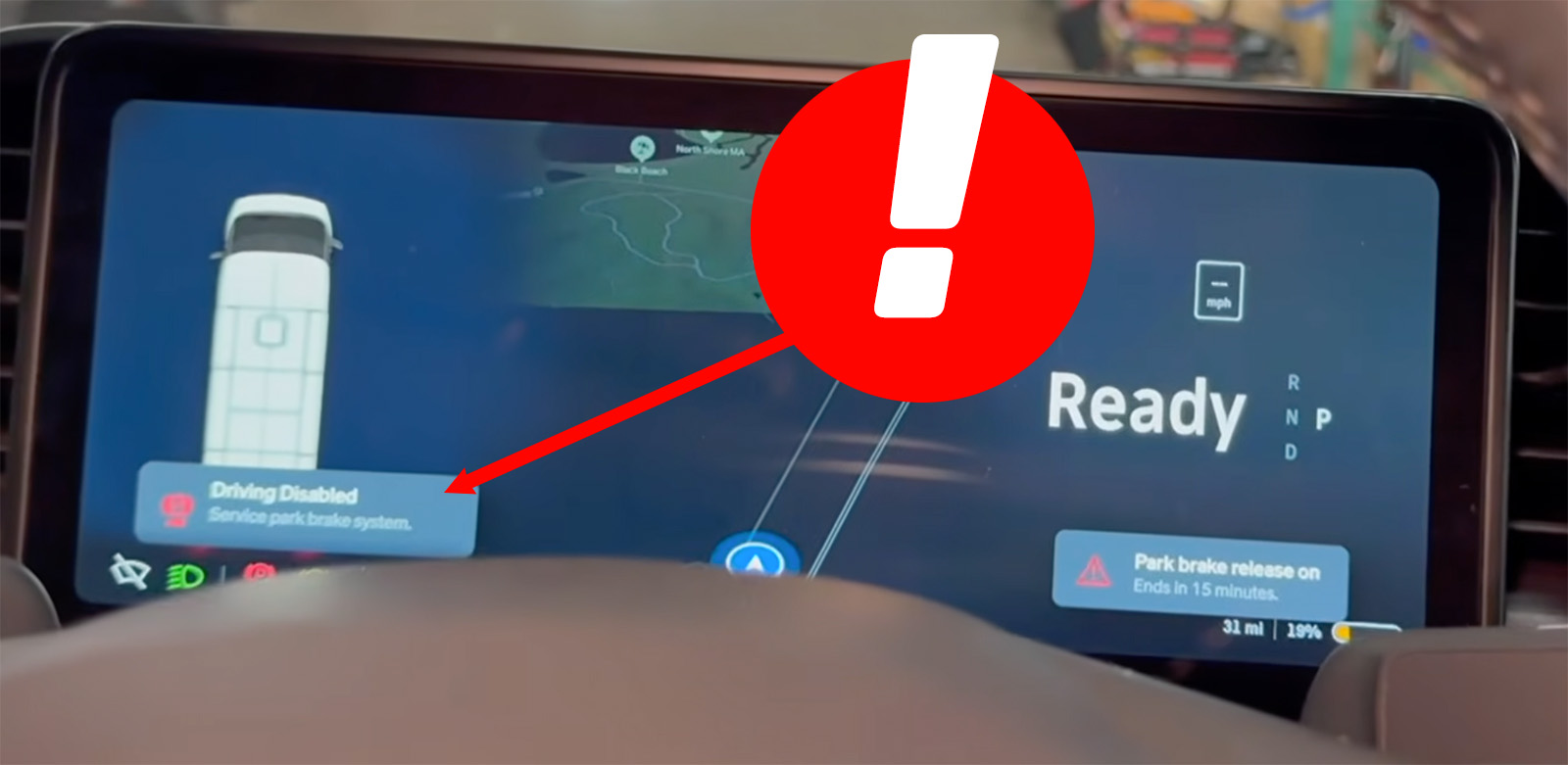
For whatever reason, the van’s computers think there’s some kind of fault in the parking brake system, and as a result, the van refuses to go into gear and drive. The whole electric parking brake system was inspected and seems fine, but the software refuses to accept that, and effectively bricks the entire van.
By the end of the video, Rich realizes his only recourse is to try and reach out to Rivian, who will very likely refuse to work on this vehicle, because it was marked as not to be sold. And, sure, he knew the risks when plopping down his ten grand, but the bigger issue here is that this should be an alarming warning for us all, especially those of us who like to buy broken used vehicles and then make them work.
That’s something this community does all the time. I know my co-founder and EIC David has done just that multiple times, contributors like our own Stephen Walter Gossin do it with shocking regularity, and even I, with my decidedly sub-par wrenching skills, managed to get a formerly yard-bound and shot-up old Citroën running and driving again.
All of these car-resurrections were able to happen because, at least up until this point, cars were very repairable things. You could take a car that hadn’t run in years and years and get it back on the road, and there’s never been a need to reach out to the company that made the car originally – if they still even exist – for anything.
What this attempted Rivian van repair painfully demonstrates is how that situation seems to be coming to an end. When software becomes the dominant driver of how a car works, then you no longer ever really own a car; the car company is just letting you use it, until such use ceases to provide them any benefit.
If this was a UPS delivery van from 1985 or 1992 or even 2019 that Rich bought, he’d have had it running and driving in no time, ready to be converted into a camper or a mobile opium den or a hauler for a dirigible or whatever. All the systems would have been understandable and repairable. Sure, there would potentially be considerable skill and cost and resources of all kinds involved, but it would be possible.
Is it possible to fix this Rivian van at all? 99% of the systems in that van seem to be working fine, but I am not even remotely confident that the thing will ever drive again. Maybe if Rivian agrees to help somehow and use their proprietary diagnostic tools to clear the fault, but that’s a huge if. Clever hackers could likely reverse-engineer what the Rivian computers and software are doing and make a replacement nervous system, but the effort to pull that off would be, well, considerable. Like moon-sized considerable.
All of this makes me deeply uneasy. I don’t want to live in a world where otherwise perfectly repairable used cars and trucks and vans are rendered inert, useless monoliths because of some lines of code I’m not allowed to access. If this is a harbinger for the way things are going to be – and I’m afraid it very much is, as we’ve seen many similar things before – then that does not bode well for the used car market or the world of independent auto repair shops or the ability for people to afford and use used cars, for regular life use or for enthusiasts.
Right to repair is important, and the story of this Rivian delivery van should be a big, loud warning to everyone who cares about repairing their own cars. We can’t let this become the norm.
Maybe he’ll fix it, though! There’s still the possibility of a happy ending here, so I’m going to reserve at least a little dollop of hope that in a future video we’ll see Rich driving this thing past Rivian HQ, flipping a glorious bird.
Top graphic images: Rich Rebuilds/YouTube


He will fix it. Right to repair is a big issue to him and he is doing right by using his platform to call out the wrong doing. I’m sure his fix will involve a $25 cable. A $75 part. Some software of questionable origin. The 3d printed tool he made to physically retract the brakes was a neat touch.
Yeah, these are all the buildup to the big, “I DID IT!” video drop, for sure. Great!
If it was a manufacturer buyback how did it get into the sales channel anyway?
Probably auction. Lots of them run though. Some smaller dealers specialize in fixing buy backs.
I see. I knew about that for stuff like used cars that are functionally worthless and salvage write-offs and the like but I assumed manufacturer buybacks just got destroyed.
I think they just drill a hole in one of the doors. Or maybe they brick the software?
It’s a bit surprising but all they do throw a sticker on the door saying it was a mfg buy back. The ones I’ve seen have clean titles. Most of the time they send them to the wholesale auction. But I’ve seen some franchise dealers who buy them fix the issue and sell.
I lemon’d my Ford Lightning and it was back in the used market with a branded title. You can see the title brand and the issue that caused the buyback in CarFax. You’d be surprised how many Lightnings were returned for “Doesn’t have range I expected” and other marketing/education failures.
Most buybacks have a branded title but are sellable, I wonder how this van was marked “Not For Sale”?
It was on a dealer lot. They have to put that on it or a buyers guide. Because it was broken it was not for sale.
OHHHH the dealer said it wasn’t for sale, I thought it was Rivian that VIN locked it or something. Thanks.
Really depends, I’ve seen many with out branded titles. You get the sticker. It will show up on a car history report but often have a clean title. Some states dealers or manufacturers might handle things different.
It’s Ritchie, I think he will figure it out, although it probably won’t involve rice
The Audi ev in rice was pretty funny
Ok hold on, wasn’t I just literally yelling and screaming about electric parking brakes being part of the decline and fall of the repairable car market in the other post about electric parking brakes?
I know I was.
Yes things like door latches and parking brakes should not need computers and software involved to use them at all.
I’ve watched the videos and this feels like a sensor issue to me, not a software issue.
Finding that bad sensor or broken wire can be a PITA, but I’m sure Rich can figure it out over the next several videos. Solving it in one video isn’t enough content.
Ha, you are correct, I bet. Then the fix will be a tutorial. He does have good resources
could also be this was the easiest way for Rivian to immobilize it…
I think it will be a sensor too. A wheel speed sensor went out on my 2020 Transit Connect and that turned off steering assist, parking sensors, cruise control, lane departure warnings, traction control, and several other functions. The van was still drivable but a $15 part disabled a lot of features.
I call minor clickbait here.
This is nothing different from any German for the last 25 years. The only difference is that a whole ecosystem of information and software, from cracked bootleg stuff all the way to aftermarket legit scanners is readily available for the Germans NOW. I’m quite sure it was different in 2005.
The XJ220 software discussed here recently is a prime example that these things eventually get figured out when the vehicle is worth it.
Also, if Humanity still exists 15 years from now AND this thing represents ANY interest then, aftermarket ecus running on an arduino or whatever will probably be able to drive herds of these Moscow Circus bear on a bicycle style.
I doubt any EV’s for sale here (golf carts excepted) are repairable by owners. Proprietary software running the entire vehicle via can-bus.
Whaa? You mean these computerized ICE cars don’t have proprietary software running the entire vehicle via can-bus? I mean, if so, then how can a module not related to the drivetrain disable the whole car?
Right to repair is indeed a really big deal.
One of the things that keeps me in the bmw ecosystem is that the software tools are widely available for diy stuff. Anyone can have factory level diagnostics right on their laptop.
This way, I can own a bunch of cars and work on them myself.
Enough enthusiasts own these cars that there are diys and guides for pretty much everything.
Right to Repair is only at the tip of the iceberg of legislation we need to be able to repair future vehicles. We also need standards for everything from battery sizes and connectors to some kind of common OS and basic instructions that future cars need to agree to. OEMs will fight it, but they will actually benefit in the long run as components become more generic.
I learned my lesson buying a not-THAT-modern Volvo that was highly wedded to the Mothership for anything electronic (which is nearly everything). Not only did you have to pay for ACCESS to the mothership, you had to pay for “software downloads” to replace or program anything. Nope, I’m out. I am willing to invest in the computer tools, as I have for my BMWs and Mercedes, but not that nonsense. I simply refuse to buy any more cars that are locked down that way. It’s also best to stick with cars that have huge enthusiast appeal – THOSE get this crap hacked in short order. But very few modern Volvo owners work on thier own cars, they just take them to the dealership and say “thankyou Sir, may I have another”.
I have no use at all for “software defined vehicles”. Being in IT, I know what “software defined” really means – you just keep paying, and paying, and paying.
If they can’t sell us on subscription services, they’ll force them on us? Sounds about right.
This isn’t even services – this is you can’t fix the damned car without dealer-level access. Which they WILL sell you, for a steep price of course. I am OK with needing a ‘make specific scan tool (preferably software you run on your own laptop or tablet)’, but not the rest of it.
I was really keen to buy a new Volvo wagon many years ago, but part of my purchasing deliberations include a check of available software and the cost of that software to perform repairs. Volvo came off the list. While not an inclusive list, I found that Honda, Mazda, Ford, BMW, and Volkswagen Group were among the easier for an owner to repair, software-wise. I’m not sure if that is still the case.
It’s definitely getting less true. I am not familiar with the Japanese makes at all (I’ve only owned two Japanese cars ever, an ’82 Subaru and an ’18 Fiata), but BMW for sure is FAR more locked down as of the latest generation cars. I think VWs are too, though my ’17 GTI was still wide open to VCDS etc. I assume the older platform cars are still pretty open, then the latest aren’t.
I could not agree with you more
And what happens when the oem goes bankrupt, or moves to a different software platform? You are so screwed
Indeed. It’s one thing to have a proprietary scan tool that can be hacked and/or replicated – that is basically what happened with Saab (and thier tool was a generic GM device with Saab software). It is quite another when you need a “software download” from the mothership’s servers to do things as Volvo does. Once they decide to no longer support that, you are likely screwed. There are work-arounds, there are companies like Xemodex who have figured out how to “clone” ECUs without the factory, but they can’t do everything that way.
This is real concern here, the vehicles constantly connected to the OEM. The specific issue Torch brings up here could probably be reverse engineered without too much effort by some clever people (not like the moon level effort Torch suggests). But then, even after getting around that issue, the OEM connection may find this change and flag it (for PNs not matching or something else), locking the vehicle down even further. They could essentially just brick the vehicle at that point.
Its the biggest concern I have with new cars. Legislation needs to be put in that if an OEM wants forever access/connection to cars then it us also forced to help with service etc.
The only upshot I see here is that OEMs also dont want to house data on 20 year cars so they might just cut the connection on those eventually but let them keep on running. Then the aftermarket is free to do its thing. Still not a great scenario.
Constantly connected is another even worse level of this. Bad enough to need the mothership to fix the car, be damned if I am going to buy something as expensive as a car that needs to phone home to let me even USE the car.
I live in that dystopia professionally enough as it is as an IT consultant.
Companies open-sourcing thier software when the cars are old and gray? Don’t count on that.
I didnt say they would open source it as I agree they never would do that, perhaps I unintentionally implied that. I could see where they just disconnect from older cars, not open source it, and just say “not our problem anymore”. I thought we kinda saw this a few years ago when the 3g towers all got turned off and people’s telematics modules just stopped working forever. Something about the OEMs largely just shrugging it off?
This is where I could see some aftermarket solutions come up, at least for enthusiast cars. I have seen this with my C6 vette where some companies have started supplying options to go around the traction control systems while keeping the rest of the car happy, or coming up with GM Tech II clones since GM phased out that tool years ago for diagnostic work. The sad part is this stuff will take on the order of decades before OEMs give up entirely on squeezing all the profit out of owners they can on older cars.
There is a vast difference between something as inconsequential as the telematics system no longer working, and things like needing “security access” and “software downloads” to fix things with the car. Or God Forbid the actual “car must connect or it doesn’t work as a car” future that the OEMs would LOVE to see happen. MAYBE the aftermarket steps in for cars where there is a large enough market – but maybe they don’t. Modern cars get more and more locked down every year.
In Robocop II, when Robocop got overhauled and a dumb committee gave him hundreds of crippling directives he had to follow in order to avoid shutting down, Robocop fixed the problem by grabbing onto a power transformer and shocking himself until they were all erased.
That was a stupid idea and a bad movie and I’m not sure why I brought it up. I hope he fixes the van.
This looks like a comment begun before lunch and completed afterwards.
So what you’re saying is that he needs to fabricate some arms for the van?
Right to repair is, of course, important.
Is nobody thinking of the truck?
What about the truck’s right to die? Stop the abuse and indignity – DNR!
We need some serious right to repair legislation as we enter the era of software defined vehicles. We also need serious data privacy legislation for similar reasons.
he just needs to break into a running amazon van and swap the ecu
This is the way. Or, a way.
And the 25-30 other computers in the thing.
Every single one of those vans around us look like they have been run into shit. All of them are seriously beat from what looks like running into tree limbs and other shit along their routes. I’m sure they get run hard and abused. Not sure I would buy one as a result.
I think that goes for 90% of all full-size vans. Try to find a 15-year old econoline that doesn’t have one, two or more scars down the sides. The one time (one time!) that we loaned out of 15-passenger van to someone, we came home to see it parked halfway in the garage hard against the garage door frame with a dent in the rear from the loanee backing it into our deck. She fortunately gave up on trying to get it in the garage rather than causing even more damage.
Most likely true. Because you know- its a commercial van. So naturally they get treated like a wheelbarrow. Its pretty amazing how many of those beat to smithereens Econolines I’ve ridden in that had a gazillion miles on them. One was a airport can and it had past 700,000 miles. Still rattled like a dumpster though.
Our secondary Econoline ambulance has 400,000 miles on it. The “nicer” one has 250,000 miles. They keep on trucking, barely.
Note: when you see the bus hauling ass with lights and sirens, take a moment to wonder at the bleeding edge of physics keeping that thing upright.
If I were Rivian, I’d fix it. Even if it was under the table (liability, etc.)
You’d think they’d jump at this learning opportunity. Maybe they’re not in business to learn what could go wrong with their vehicles?
Rich is one of the few YouTubers I actually watch regularly. He’s fixed all kinds of issues on a wide variety of cars, but this one may be a bridge too far. They’ve even tried manually resetting the parking brake, but it’s looking more like a software problem.
This is the guy who, with a bunch of friends, fitted an LS V8 into a Tesla Model S some years ago. That was a great series.
And a hellcat into a Dodge Caravan. It was a hack job, but still pretty cool.
That build was more of a Charger Hellcat with a Caravan body on it.I could see why, as the Caravan they used was FWD only and the platform probably had zero provisions for any sort of rear drive. Some other guys actually managed to do a proper Hellcat swap into a Chrysler Pacifica, which solved that issue, that could still be practically used as a minivan.
Man with horse and buggy mad he does not know how these new petrol powered horseless carriages work and does not know how to repair them.
Have you ever taken a horse apart and tried to get it running right after reassembly?
Even with the special chemicals and the lightning I could never get one to more than shamble.
You’re never a true gear head until you’ve rebuilt your own horse!
Hopefully David didn’t read that statement as a challenge.
I heard he’s already searching “project horse” on FB Marketplace. He’s gonna be so pissed when he finds out the saddle has to be coded to the horse.
Project Horses For Sale Here…
No rust, no interest.
“Even with the special chemicals and the lightning I could never get one to more than shamble.”
There is an aftermarket solution for that… the Iron Horse...
No horse shoe kickers I know what I got…
I’d like to take a moment to extend a shoutout to John Deere for, you know, screwing over America and ruining the ability to repair your own vehicle.
Nothing runs like a Deere – unless we say otherwise. ™ (c)
Interesting how new Deere irreparability has, unsurprisingly, driven older Deere (and other older brands) prices through the roof. Low hour 55-series tractors are consistently worth more than their new price. I wonder if the extension of that is, in the automotive sector, the ability to own shitboxes as a status symbol reserved for the wealthy. If so, I’m ahead of the curve.
It will be eventually. Jay Leno’s quotes about cars and horses seems prophetic.
It was like this before then. My Uncle was a dairy farmer and even back in the day there were certain tractors that were worth more simply because they had a better engine or were more reliable or were easier to work on. I’m not at all good with remembering models but he had a few from the 60’s John Deere tractors that according to him were worth in excess of $10,000. And it was for the engine in it alone.
This is exactly what I was saying a few days back when commenters were flaming people for spending $50,000+ for mint condition OBS F-350s.
It’s worth noting here that Rich is the founder of Electrified Garage, probably the largest EV repair company out there. If he can’t fix it, it can’t be fixed.
I’ve been following a youtube series by Sean from Bikes and Beards about a Harley Livewire EV motorcycle that he bought non-running. Harley Davidson has been completely unable to fix it – after multiple attempts over several years.
The TLDR is that it got parked with a low battery, and then the battery voltage dropped past the threshold where the charging module disables charging.
It’s completely bricked and needs a new battery. $17k from Harley, for a $3500 motorcycle. You can buy a brand new discounted Livewire for $12k.
These vehicles are disposable.
Granted, if you buy a new Tesla, it’s going to work for a good long time. But by the time these EVs depreciate to the price point of someone like me, they’re financially totaled.
I’m not familiar with the beards and bikes video, but a specialist (or hobbyist with some YouTube research time) should be able to manually charge the cells one by one. They’d have to disassemble the pack to some degree, but extremely low voltage batteries have been resurrected before. It just requires a lot of time and patience.
I’ve followed that bike too and I dunno about multiple times/years OP mentioned, I’m only aware of just once they diagnosed and Harley decided not to mess with it seemingly because of licensing issues between the original battery manufacturer they worked with and them no longer working together on newer models of the livewire.
the YouTube guy has just been messing with it for several months working through things before he finally does just try to get into the battery pack. which is completely sealed with security screws and not meant to be opened/serviceable.
To all you out there who want government to keep you safe – this is what happens when the government keeps you safe.
That statement just illuminates the issue. If the government is protecting the interests of corporations more than people, then yes we can end up here. If it is protecting the interests of the majority, then it would not have gotten here.
Agreed 100%.
Dismantling consumer protections led to manufacturers only following their obligation to shareholders. This is an unusual case, in that it was never a product for the public, and proprietary protocols are expected. The old saying “regulations are written in blood” has always been true. Not to say all CEOs are evil per se, but their minds are on their money. What Royally Sucks, is many of these EV components Should be standardized (greatly reducing costs, while increasing availability, and repair ability.), but everyone in the game seems hell bent on keeping it all proprietary.
I have been using that phrase “regulations are written in blood” a LOT more lately.
Many things are no longer built for consumers, but for regulators. Unlike many, I don’t have all the answers.
It indeed illuminates. In my mind, there is no government that is not immediately captured by the powerful.
Please explain. I am not aware of the government regulations that lead to this.
The current ” government” is just a cult and does whatever the fat orange guy wants. Keeping the public safe is absolutely not in their agenda.
Unless there’s some dosh to be made on the deal.
It is a basic problem that so much we complain about is due to the fact cars are not built for customers, but for regulators.
Pretty sure Rivian and Amazon are private corporations, probably need some actual government regulation so that things like this don’t happen
This has nothing to do with the government keeping you safe, and everything to do corporations placing long term repair last on their priority list.
And the only thing that will prevent this from being the norm in the future is in fact some sort of government action to protect consumer interests.
When we have to fight for the “right to repair” what we pay to own, and when we cannot have manuals because of the extra costs of certifications, and when I cannot buy another Geo Metro, with a warning sticker, to toss around because it doesn’t meet crash tests – but I can buy a motorcycle, the government has gotten out of control and is killing our hobby.
When you fight for “right to repair”, you are asking the government to create regulations to protect you.
Companies make the choice not to certify manuals because the market is too small and they are less efficient than multi speed automatics. They are slowly disappearing worldwide, not just in the US.
I sort of agree with you on the Geo Metro VS Motorcycle issue, at least under certain circumstances, but that calls for refining safety regulations not a wholesale abandonment and return to 1950 road death levels.
Do you plan to wear a helmet like a motorcyclist while driving your new Geo Metro?
We should be free to decide what level of safety we want.
I’m not an AI guy at all and I know this website is predominately AI-hostile, but without real right to repair legislation (the goal we should be striving for) and/or open-source vehicle control software, I’m predicting that Claude is going to be the only possible savior of this project.
That’s if they can even get it to talk to a computer in the first place. And it sucks! I don’t want vibe coded delivery trucks rolling down the street, but what else are you going to do? This isn’t an EV1 and Rivian as an auto manufacturer doesn’t have an incentive to help outside of possibly building some customer goodwill through followers of a niche YouTuber. They might even be legally barred from helping. Maybe an engineer in their off hours will contribute, but it all seems rather unlikely.
You just typed up the exact comment I was, but you hit publish first.
* AI is probable the only hope
* AI can only help if it can both access and change the code
How ironic that AI could be a savior for automotive enthusiasts in the future.
AI has its place, like sorting through code, analyzing huge volumes of data etc. I think I can state with decent certainty that most people feel that it does not belong in every sector, like creative fields. In such, it has been used to perpetrate the greatest mass theft in history with a corrupt court allowing them to steal IP and commit plagiary on an unprecedented scale. Something that would have gotten a student kicked out of university or someone sued into oblivion just a few years ago is now deployed casually and legally. It’s like Stalin said about killing: one death is a tragedy, the death of millions a statistic. Like the parasite billionaires, ethics and morality weren’t important to him, either, and they’d probably take the comparison as a compliment.
Don’t mistake my comments on what AI can do as support for it in the broader sense. My wife had to shut her small business down because AI use made it impossible to compete with talentless people who would do what she did for pennies with AI help.
I think it is a net negative for the human race at this point. At least until a universal basic income is ever established due to productivity gains. But that will never happen because billionaires want more billions.
Apologies for seeming like I assumed that! Seriously, I’d see being thought of as an AI fanboy (whatever the term is) as a grievous insult.
I agree. On a persona note, as an author, I’ve seen the industry get absolutely buried by AI slop “written” by parasites (that they then sell “how to” courses on!) so that it’s almost impossible to get noticed. Sure, it’s been that way for a while, especially with the accessibility of self publishing, but I didn’t mind when they were humans writing something that presumably matters to them (whether it’s well written or not, which AI never is) and I’ve gone that route myself after some issues with a publisher in the past. But, I also don’t need it for income (thankfully!), so I can enjoy the freedoms of self-publishing, like illustrating and designing the covers, choosing typeface (highway gothic, the older typeface of the interstate system), etc. that I’m happy with rather than something I might hate that’s considered most salable according to some marketing group. Plus, if people hate it, there’s no question about who’s to blame.
All good! I’m just glad that there seem to be more and more people figuring it out.
Even my father, a Trumper in his early 70s, just commented to me the other day about the OpenAI (I think?) commercial where a lady was relaxing at her desk while AI did work creating presentations and her coworkers all danced around. He said the same thing I did out loud to myself when I saw it – those people won’t be dancing in the office, they will be unemployed while that lady sits by herself with 10x the amount of work to do at the same pay.
I’m with you. AI might be able to help get it movin but god knows what it might mess up
Can someone explain to me like I’m five how AI helps solve this?
“Hey ai, I hooked up a USB to my ECU and I want you to read it. My truck doesn’t go forward because it thinks the brake is broke. Can you find the piece of code that tells my truck not to go forward and help me disable it?”
But wouldn’t the AI need the source code for this to work? Maybe this is all based on the assumption that such code is available, though.
Yes, that is the USB to ECU. Drastically oversimplifying, because you are 5 :). The real ECU is possibly? probably? potentially encrypted. Interfacing with it is easier said than done, but the software gets on there somehow and they do over the air updates somehow, so there is a way to push code to the truck and to perform diagnostics on the truck.
Yep. Without the source code AI isn’t going to be much help. Also, the Rivian internal documentation is likely not exposed to the internet so AI scrapers were never able to get ahold of it.
I think this thing is hopeless bricked.
AI is really good at analyzing existing code that you can give it access to, and being able to suggest/implement changes to that code with verbal prompts.
For example, you could provide it code for a personal finance phone app, and tell it “Review the code for the Transaction tab to understand how it works. Review all links to other areas of the application so you know how to update it without breaking anything else. Then add a new column to the transaction list table called “Reviewed” with a checkbox in the column for the user to manually check or uncheck”. Current AI dev tools could easily provide the code change and explain where to insert it.
So theoretically, if an AI could be given access to the code that runs this van, it could diagnose where the parking brake check is being done, find what variables are triggering the error, and explain the variables to a human. The human could then further use the AI to figure out why those variables are set how they are (ie, parking brake sensor 1 = state X) and then the human could go tackle the physical thing behind the error. Or the human could instruct the AI to make code changes to ignore the variables if that seems safe enough, and the van will start working again.
Without an AI, you’d need to get a human developer and pay them for weeks if not months to understand the complex code running this van, and then longer to make changes to it and regression test what they did. An AI agent could do this in a fraction of the time, although with potentially lower quality so you’d really want to test the heck out of it. Which is problematic for something you are driving on the road and could, you know, kill someone.
Anyway, that’s the explain it like I’m 20 version, so take it with a grain of salt.
I HATE Ai. Because I am a graphic designer/ creative director and this shit is taking those jobs away. But at the same time my side hobby is restoring vintage electronics. Ai is really good at gathering up answers to dry technical and medical questions. My Dad has cancer and we were told and have found that getting answers for specific medical questions is pretty good. Because the available data is more accurate by nature of it needing to for the sake of human health. I’ve found that I can ask questions about completely obsolete and difficult to find answers to archaic technical questions. So I can see how it might be similar here for same reasons.
AI could turn the van into a killer robot that wants to destroy all humans. That solves the parking break issue! It creates a killer robot issue, but yolo!
Hello I am a professional computer breaker. LLMs have gotten good enough at command line harnesses that it’s pretty easy to give them “grug tasks” that are robotic in nature.
Know the “movie hacking” spinning-numbers-until-unlock Macguffin that gets plugged into High Security Computer Door in every heist movie ever? That, only with “what happens when I send this CAN packet” and juuuust enough Smart Human Authored scaffolding to correctly interpret the result.
It is highly likely that hooking a laptop in place of the offending module, attaching a fuzzer like AFL to the interface, and allowing an LLM to read the results will enable reverse-engineering the protocol, and at that point you just need a cheap ESP32 that can send the correct pinouts to emulate the parking brake.
Was going to be my answer to the problem but you beat me to it. Haven’t watched the vid, but sniffing the can is the best approach
I dock you 5 points for not explaining like I’m 5. However, I give you 100 points for what I have determined to be the objectively correct answer. You can collect in your winnings at the cashier.
Is Rich using AI to create his title screens on YouTube since his van is not an actual Amazon van?
I am the last person to know the ins and outs of Youtube video thumbnail ethics, but this feels ingenuous at best
do you mean disingenuous?
You keep using that word. I do not think it means what you think it means.
I don’t have an eye for catching slop, but he surely could’ve just gotten a real picture of an Amazon van he didn’t own on a trailer, right? You don’t need AI for that.
As for his van not being a true “Amazon van”, I think it’s a reasonable simplification. People know and care about them more as “Amazon vans” than “Rivian vans”.
Right to Repair is unlikely to ever mean Right to Hack.
Right to Repair or Riot!
Is that going to help though? In this case it would just be them supplying the source code. That’s a start, but you still have to figure out which module has the glitch. And once you start reflashing things, other gremlins will emerge. Like now the windshield wipers don’t work when you turn on the headlights and you don’t know why. Troubleshooting all that sounds like a friggin nightmare.
Oh, no doubt, it will be a friggin’ nightmare. But, it’s got to start somewhere and I tend to believe that if enough monkeys with keyboards get a hold of it, something might be possible.
In an ideal world, right to repair would mean that manufacturers have to document how to send and receive commands from each component, not release their proprietary source code that sends those commands.
Telling us that you can read variable X from module Y to get the parking brake sensor data isn’t terribly helpful, because the DMCA would still prevent you from doing that. Telling us that pins 4 and 6 of the red cable running from A to B carry sensor data encoded as Z would give you both control over and visibility into the parts you bought. Admittedly, that wouldn’t do a lot for the average owner today, but it would make it much easier to build aftermarket tooling and fully compatible replacements.
You can get there with extreme levels of finicky investigation and reverse-engineering effort, but that shouldn’t really be necessary.