

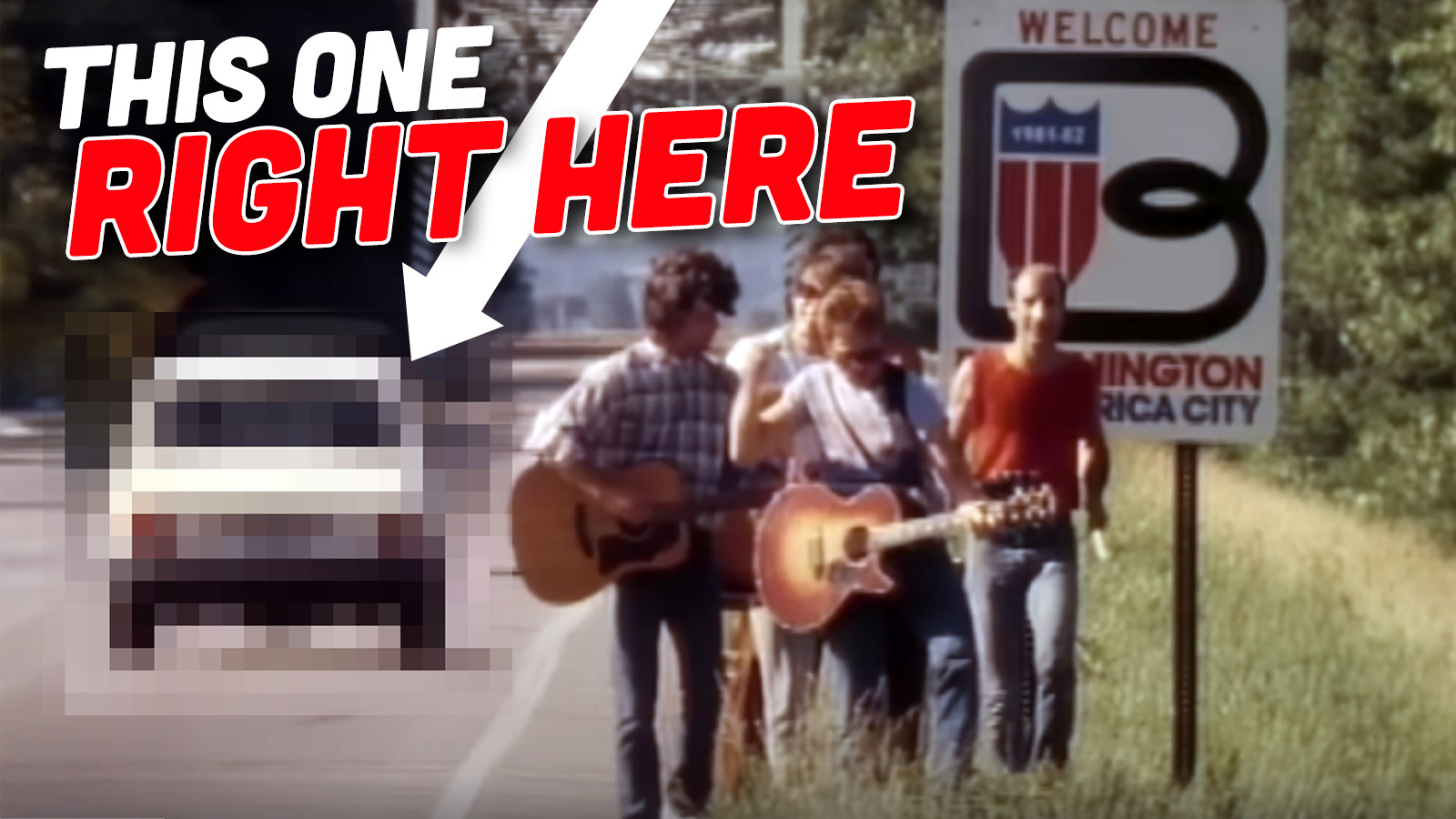
I’m not sure why I’m so obsessed with pointing out anomalies in forty-year-old rock videos, but I figured that after all these decades, I finally have a soapbox from which I can make them known. These likely-high-on-cocaine directors thought that they were pulling the wool over our eyes, and we can’t let them get away with the ruse forever. A little while back, I looked at such a gross transportation inconsistency in a Huey Lewis video, but there are many more. One in particular involves a certain “heartland rocker” with imagery that seems quite at odds with the lyrics of his song, including an automotive enigma that at first seems to make no sense.
By his own admission, Indiana native John “Cougar” Mellencamp is a bit of an ornery sumbitch, but you can’t deny that his rock hits make up the fabric of our GenX Reagan-era youth. The videos also gave us East or West Coasters a glimpse of life in the center of the nation.



With songs like Little Pink Houses and Jack and Diane, he really doubles down on the blue-collar middle America visuals that appeared hourly on MTV at the time.

These images naturally included all sorts of domestic iron like Chevy “box” trucks and Camaros.

They’re well-done visuals of bucolic rural America that you rarely saw in rock videos, so much so that conservative political campaigns wanted to use them as promotional materials.

Obviously, staunchly liberal Mellencamp protested. Like Springsteen with Born in the U.S.A., he marveled at how they totally misinterpreted the song’s meaning about the seemingly futile plight of salt-of-the-earth middle America that missed out on much of the go-go eighties, particularly farmers that Mellencamp spearheaded “Farm Aid” for.

It’s not an overdone caricature: when I moved to Illinois years later, I realized that his videos were about the most accurate interpretation of this area that I’d seen (and that The Blues Brothers was the most true-to-life depiction of Chicago). Well, there was one notable exception.

His 1985 album Scarecrow is a collection of tunes primarily about the so-called heartland, including a track called “Small Town.” In fact, he sings that phrase 18 times in three minutes (actually “small” is uttered 19 times and “town” is sung 20).
Mellencamp hails from Seymour, Indiana, which is a classic small town in anyone’s book, but during the video, John and his band are posed in front of a sign outside of Bloomington, Indiana. This was where John was supposedly living at the time, and, just on population alone, it’s a bit of a stretch to dub this place a “small town.”

Big-city snobs often tend to unfairly characterize tiny Midwestern locales as culture- and diversity-free fly-over wastelands full of uneducated, low-skilled laborers. As a scenic home to Indiana University with a vibrant art community, Bloomington is very, very much none of those things. Seriously, within a three-block area in Bloomington, you could have a Tibetan meal (Anyetsang’s), maybe some Turkish pies (Turkuaz café), or even Burmese noodles (Kimu), just to name a few.
The fact that Bloomington might be a poor choice to show for an archetypal “small town” could have been hidden to most people on the American coasts who never ventured inland (like me as a kid in 1985), except for one mistake. During filming of the last scene of the video, the director cuts the scene with the absolute wrong car in the shot: a white US-spec Peugeot 504 sedan.

There are plenty of vehicles that are the antithesis of a “small town” car, but a French-built diesel sedan is on a different level that even surpasses Saabs. Typically diesel-powered with a sublime ride and excellent build quality, it was a prime choice for college deans or doctors who could afford a costly sedan but couldn’t justify the immense expense of a Mercedes. Despite the positive aspects, they typically floundered in America with sales of around 10,000 to 20,000 cars a year before throwing in the towel in 1991.

It’s absolutely the last car anyone in a traditional “real” small town would ever own and drive. You couldn’t even say that the car was someone “passing through” since Peugeot owners would likely never even venture off the freeway into a typical tiny hamlet for fear of the place lacking proper wine or imported beers.

Making the video, if they’d just waited a few more minutes for a Ford “Dentside” or a Nova to drive by instead, we never would have known that John was filming in a place with several Indonesian restaurants. Most people would have bought the whole “small town” thing; he could have gotten away with it if not for some pesky young car geek like me watching his video.
After forty years, the world finally knows the truth. Anyway, Mellencamp resides less than four hours from me; if I get my ass kicked in the next few weeks, you’ll know who probably did it.
Top graphic image: Riva/Mercury Records (screenshot)




In my small town, it was pronounced “Pew-Gott”. My RX-2 was mistaken for one more than once.
Ahh… you could not be more wrong, I am sorry to say. My small town, at that exact moment in history, sure did have foreign cars, such as Peugeot. I even went to high school with a gal whose parents gave her a VW thing, and our school had maybe 120 students. Now… did we tease them, and make endless Fix It Again Tony jokes? We sure did. But we could not have; if those cars weren’t present in the first place.
Please consider for a moment just how many folks in the midwest were from, or descended from, French, German, Polish, Hungarian stock…
pretty sure that “small town america” isn’t really as great as the romanticized version of it on tv. i live in the LA metro area, and we have a LOT of problems, but I can head up angeles crest for a drive, hit the beach, car meets pretty much any day of the week any time of the year, get any type of food from almost anywhere in the world, get my same day amazon deliveries, shop at stores besides walmarts. Yes it is pricey to live in a metropolitan area, but you get a lot of conveniences.
When I moved to university, the first time my brother visited he insisted on ordering a pizza to be delivered, because growing up in the countryside we’d never had food delivered.
was pizza delivery just not available or was it to be frugal? I still don’t like to get things delivered if I can get if myself within 10 minutes drive.
Where we grew up is about 30mins from the nearest town, and back then only a few places had delivery drivers. These days I think a few places will deliver up there, but it’d probably be cold by then.
If Hazzard County, GA can attract Peugeot-driving types, Indiana surely could as well.
https://www.theautopian.com/who-the-hell-was-driving-a-peugeot-in-hazzard-county/
Also, I know it’s VW rather than Peugeot, but Pfaff Motorsports (from IMSA) started with selling Beetles in a town of ~10k people. Pretty sure my grandparents bought an Audi Fox from them.
College small town? Creative Writing professor could have driven that.
Counterpoint: I grew up in a small town in Illinois, and our cars included a Fiat 128 and a VW Dasher diesel. Sure, damn near everybody else drove a Ford or a Pontiac, since those were the two dealerships in town, but us weirdos did exist.
In the pixelated head shot, my guess was a Saab 99 or 900. Which is also a little incongruous for Small Town America.
When I lived in a rural area (Fire district 400 sq. miles and 950 people), there was a Peugeot dealer 30 miles away. I had several Peugeots. So did several friends.
Rural folks tend to put a lot of miles on cars, and a Peugeot diesel wagon was a great car. One friend was a logger who often drove more than 100 miles a day to and from work. He and three buddies could ride in his Peugeot 504.
No, you didn’t put dyed untaxed fuel in it, but you could keep 500 gallons of diesel on hand.
Oh… I grew up in what used to be a farm town that happened to have a university on the outskirts. When I was born, what is now UC Davis was the University Farm, essentially a field station for UC Berkeley’s College of Agriculture. It became a full-fledged UC campus in late 1959, when I was two. My dad started his agronomy studies there in 1955.
Coincidentally, twenty years later, I bought a (gas) Peugeot 504 which had been picked up in France and owned by a UCD professor, although he taught art.
Anyway, I knew more than a couple of farmers that had Mercedes and Peugeot diesels they ran on untaxed offroad diesel (at least until the tax man started dying it). Largely unenforced for cars (commercial highway patrol officers are busy with bigger fish), I wouldn’t be surprised if some continued to do so after it was dyed. You could always remove the “Diesel” badge on Peugeots or the “D” on a Mercedes if you were really paranoid.
Nothing wrong with the 504. Just paint the mother pink.
The population of the rural town where I grew up hovered at about 5,500 until the early ’90s, yet there were some unusual cars in the neighborhood. Our neighbors across the street were a really cool older couple. He was a retired policeman (hence the custom EX CU plates on his D-series International pickup) and she was an artist who continued to personally change the oil and belts on her 505 diesel sedan well into octogenarian widowhood.
Ironically a 504 would’ve been the epitome of a small-town car in Argentina back then
Name:
John Glenn
Occupation:
Cartoonoshly Gee-Golly Hayseed, Spacemonkey, Senator
Hometown:
Cambridge, Ohio (pop. 10,000 in 2020)
Car:
NSU Prinze
So here’s the thing. 40 years ago, I’m pretty sure that all that climate diversity didn’t exist in Bloomington. I grew up in Nashville, also not a small town, and sure today you can find all kinds of culinary delights. When I was growing up in the 80s, not so much. Had to drive all the way to Atlanta to try Indian food for the first time, and it was a huge deal when the first Thai restaurant opened. Also, let the record show, I learned to drive stick on my brother’s very abused hand me down gas 504. That car was cool, I wish it hadn’t had such a tough life before I got to drive it.
Well, in my version of a small town, I grew up in a square-mile city just across the Hudson River from NYC with about 50,000 residents! New, old, odd, rare, and customized cars were regular sites. Heck, the U.S. headquarters of British Leyland (which had closed by the mid-80’s) was about 10 miles north in Leonia, NJ.
People may like farmers and small-town folk, I do too. But farmers and small-town folk are mostly Republican voters. And even more disappointingly they are willing to ignore their values and support a felon conman just to own the libs.
Wow. Ok.
Hi, welcome to the site. We try to keep this corner of the internet free from tribal politics. I encourage you to explore the site – I think you’ll like it enough to become a paying member and get rid of those pesky ads!
Yeah I see that that was harsh and stereotyping people. I’ve just been frustrated by so many “Farmers for Trump” signs and people I formerly liked and respected spouting their MAGA hate.
Hmm, grew up in the middle of the country and a relative of a high school friend had a Peugeot diesel sedan (not sure if it was a 504 or not). One of the great things they extolled about it was that for road trips, they were more limited by bladder capacity than car tank capacity in terms of when they had to stop.
I’d also go with the previously mentioned idea that it stops being a small town when the population hits 5 figures.
And university towns tend to have more of a mix of most everything compared to other similarly sized Midwest towns. And there are a ton of small colleges/universities in the Midwest (at least there were).
Ah Bloomington in 80s, back when it normal to sling chairs on basketball courts when your team failed to make the Big Dance.
Ahhhh…waiting for a Bobby Knight reference in the comments.
I grew up in small Iowa town and while the Pug would’ve been unusual (I certainly never saw one), there were a few unusual early Volvos, one of those tiny ancient Hondas, and a few other oddities floating about. Plus, The Old Man loves talking about the BMW Isetta one of his “weird” high school teachers drove everyday.
The standout for me in those above images is that C4 Corvette. I never got to see anything like that. A new IROC Camaro and a C3 were the closest vehicles that ever came close to something that decadent. That would’ve been considered Big City Money and even the most loaded nearby hog farmer would’ve shunned something along those lines, instead opting for a cushy Cadillac or maybe a diesel Monte Carlo he could run on the red fuel.
I’m guessing the C4 was Mellencamp’s own car.
I saw the C4 and it stood out.