

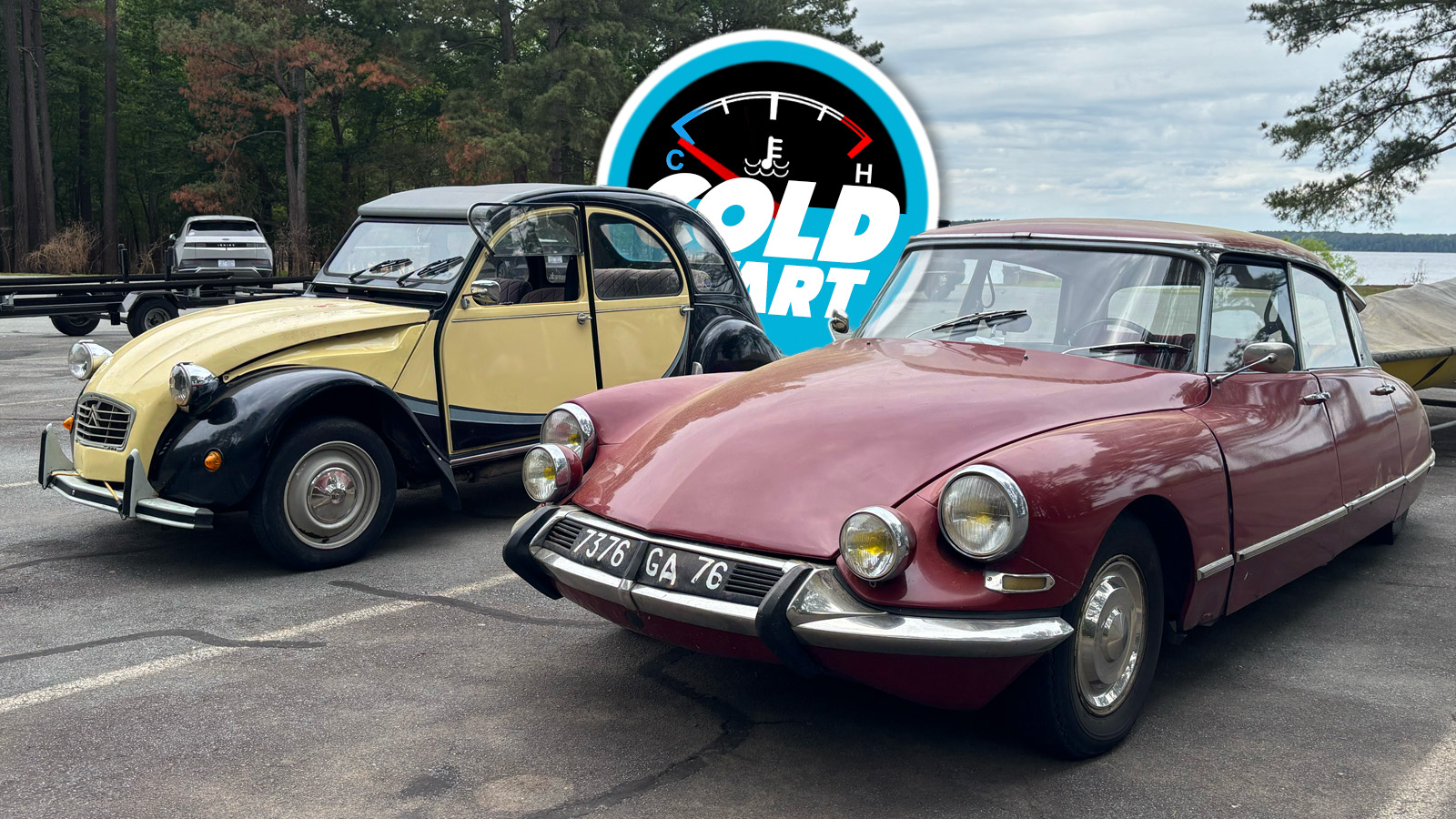
I realize that I haven’t really given you an update on my Citroën 2CV in a few weeks, and I also realize that means many of you are either desperately angry, flinging glasses at kitchen walls in rages, or are perhaps resorting to finding out information via methods like augury, but watching bird behavior is notoriously inaccurate when it comes to automotive maintenance and usage unless you have a large population of crows, which seem to have at least a passing interest in cars.
The good news is, I’ve been using the 2CV as a daily driver pretty regularly since I got back from the Lemons Race at Carolina Motorsports Park and the milestone journey it made, and this past weekend I took it to a little gathering of our local French Car Club, which has a surprising amount of cars and people for a small college town nowhere near France.


The highlight of the meetup was local Citroën guru Til’s beautiful deep-red DS19, which rolled in towing a small sailboat. It’s a stunning car, and while I can’t recall exactly what year it is, it’s a Series 2 car (1962-1967), and has a unique taillight detail I think it’s important to discuss:
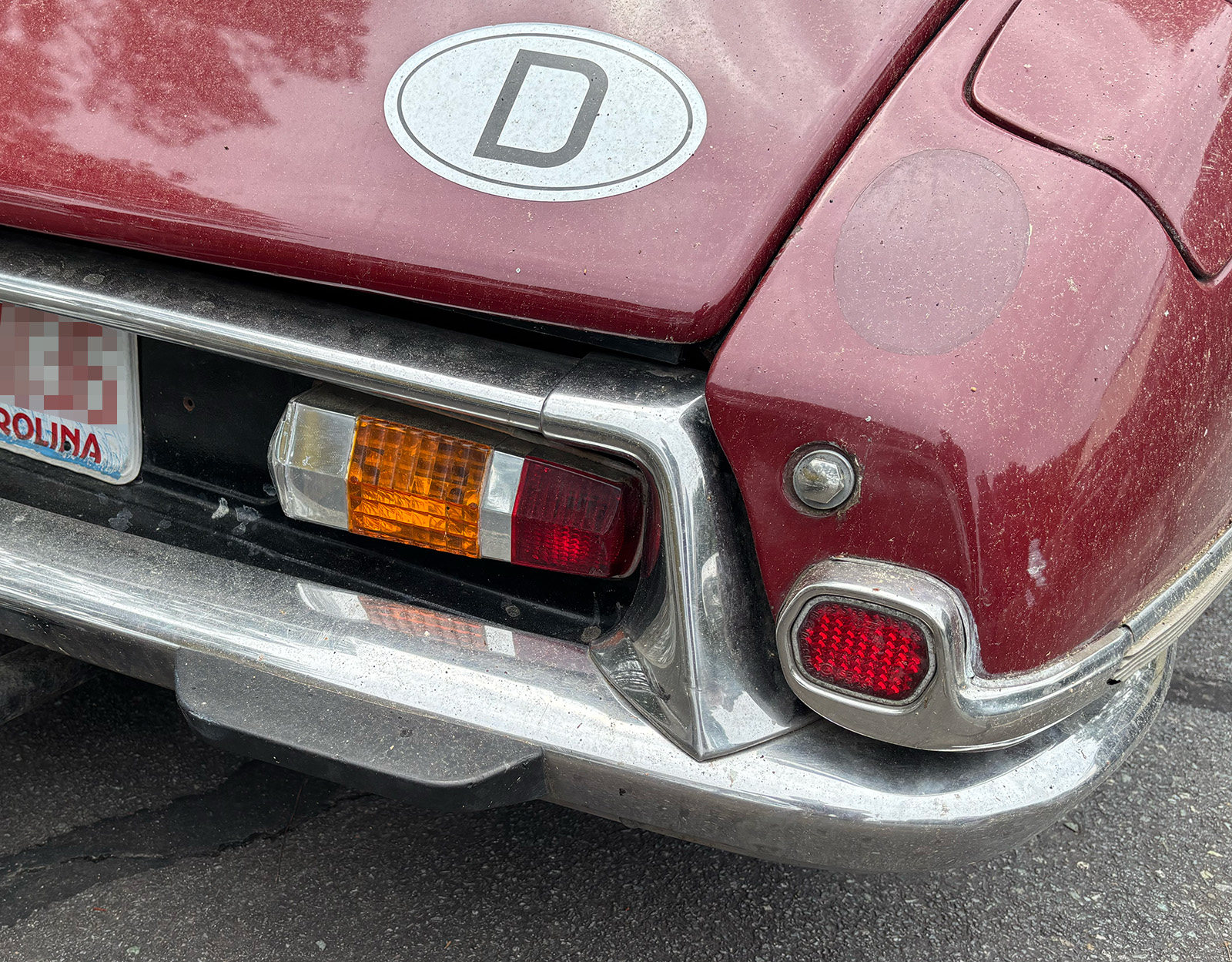
See the amber section of the taillight? That’s not the turn indicator: those were in those wonderful trumpet-like housings by the roofline that I’ve discussed before:

No, those are brake lamps!
The amber brake lamps weren’t used on all DS models; there were actually a number of subtle variations of DS taillights used:

The amber brake lamps were not legal in Italy and Germany, it seems, but were used in other European markets, though if I’m honest, I’m really not entirely clear where they were legal, or how they co-existed with red brake lamps. It does seem that by 1967, brake lights were standardized to red across Europe, so these really are an interesting relic for the true taillight connoisseur.
While I was at the meetup, Til helped me sort a few other minor issues with the 2CV – he found a hose clamp on the fuel filler neck I neglected to tighten, explaining why the car often smelled gassy (not the same manner that sometimes afflicts me), and noticed a few wires that need insulating. Oh, and I left the ignition on and learned a lesson about the coil heating up too much, too.
(I was asked to elaborate on this in the comments: I left the ignition on, car not running, for about 20 minutes; the current running constantly through the coil, as opposed to being pulsed when the engine is in operation, combined (perhaps) with no airflow, got the coil too hot to work.
We held cold-packs from a cooler on the coil for a bit, and it eventually cooled down enough to work. But this is something I need to remember.
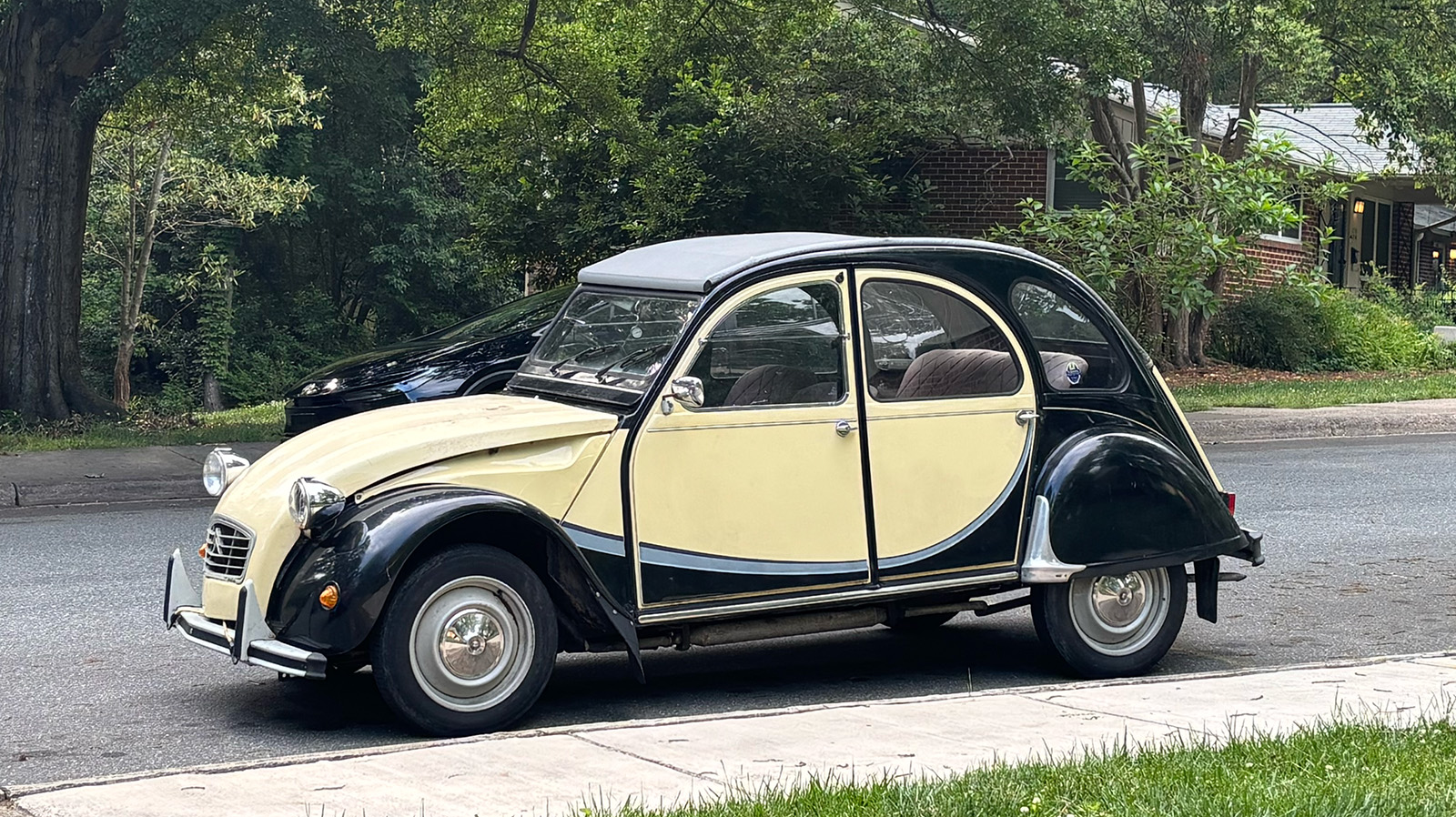
Still, despite these flaws (and many others I still need to address), the car has been a blast to just drive around. Oh! And I also was able to take care of another issue, one with significant safety implications: my absurdly dim headlights.
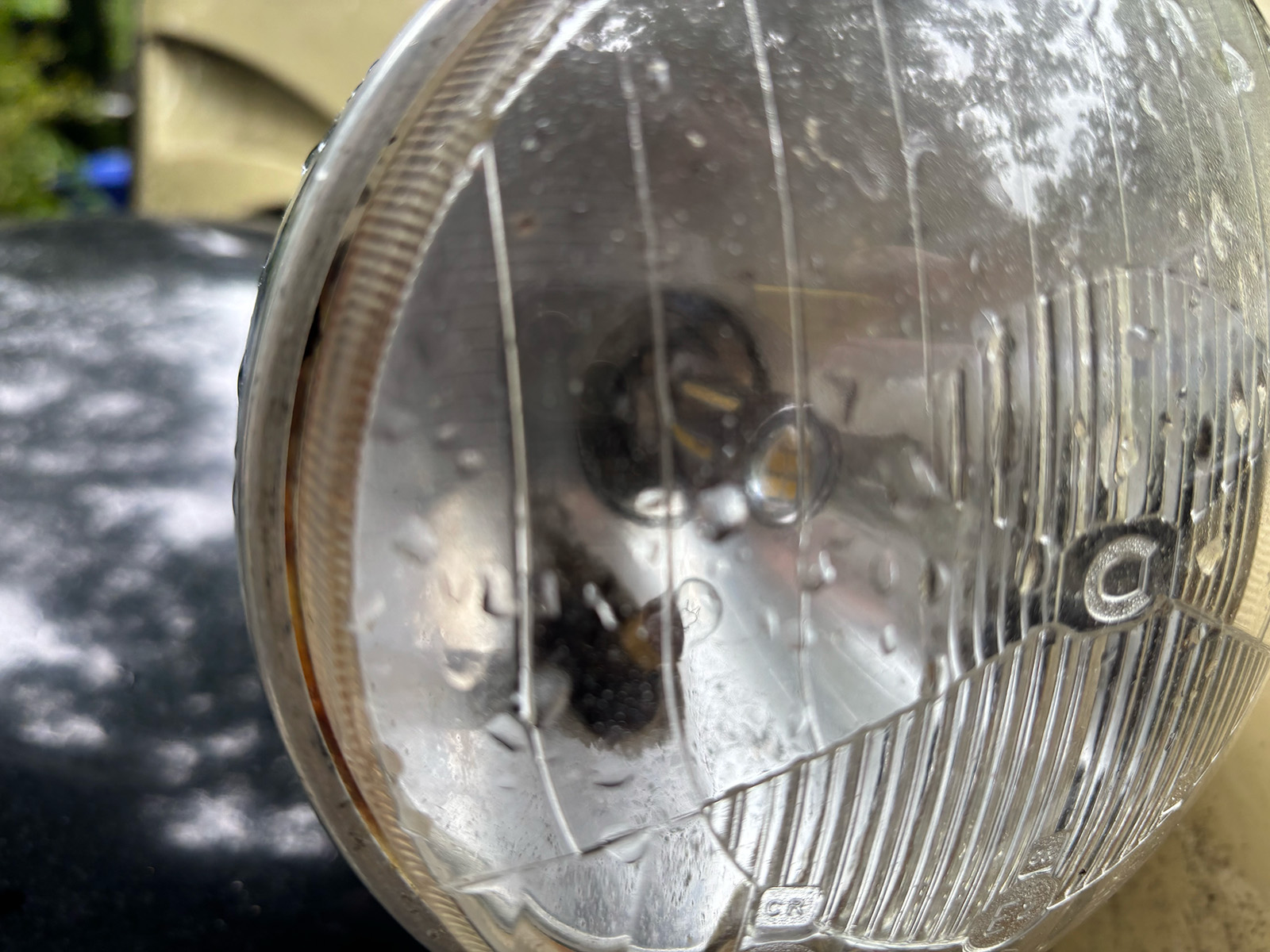
Thanks to my fellow 2CV-owning local friend Lars, I was given a set of LED headlight bulbs; Lars, who has standards of quality acres above mine, had replaced these with a set of LED bulbs for his 2CV that had a better low-beam pattern; the ones he no longer needed he gave to me, and I was thrilled to have then as they are actually bright enough to be useful.
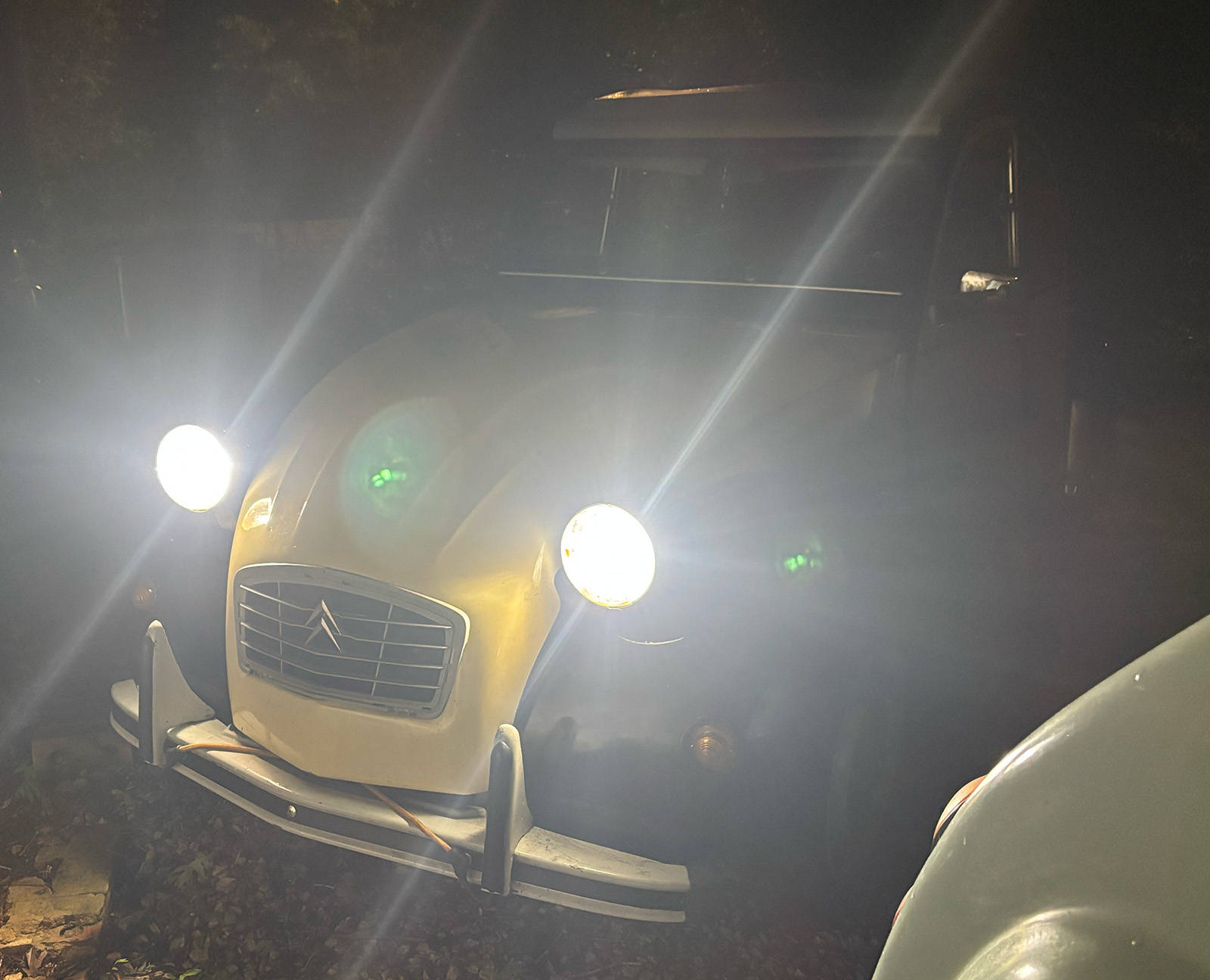
The difference they make is, um, illuminating! The old lights were like jogging with a pair of candles in your hands; these are like, well, actual headlights. And, to make sure I don’t just become another douche with too-bright lights right in your face, I did use the little headlight-adjusting knob to point them a bit down and keep them out of people’s eyes.
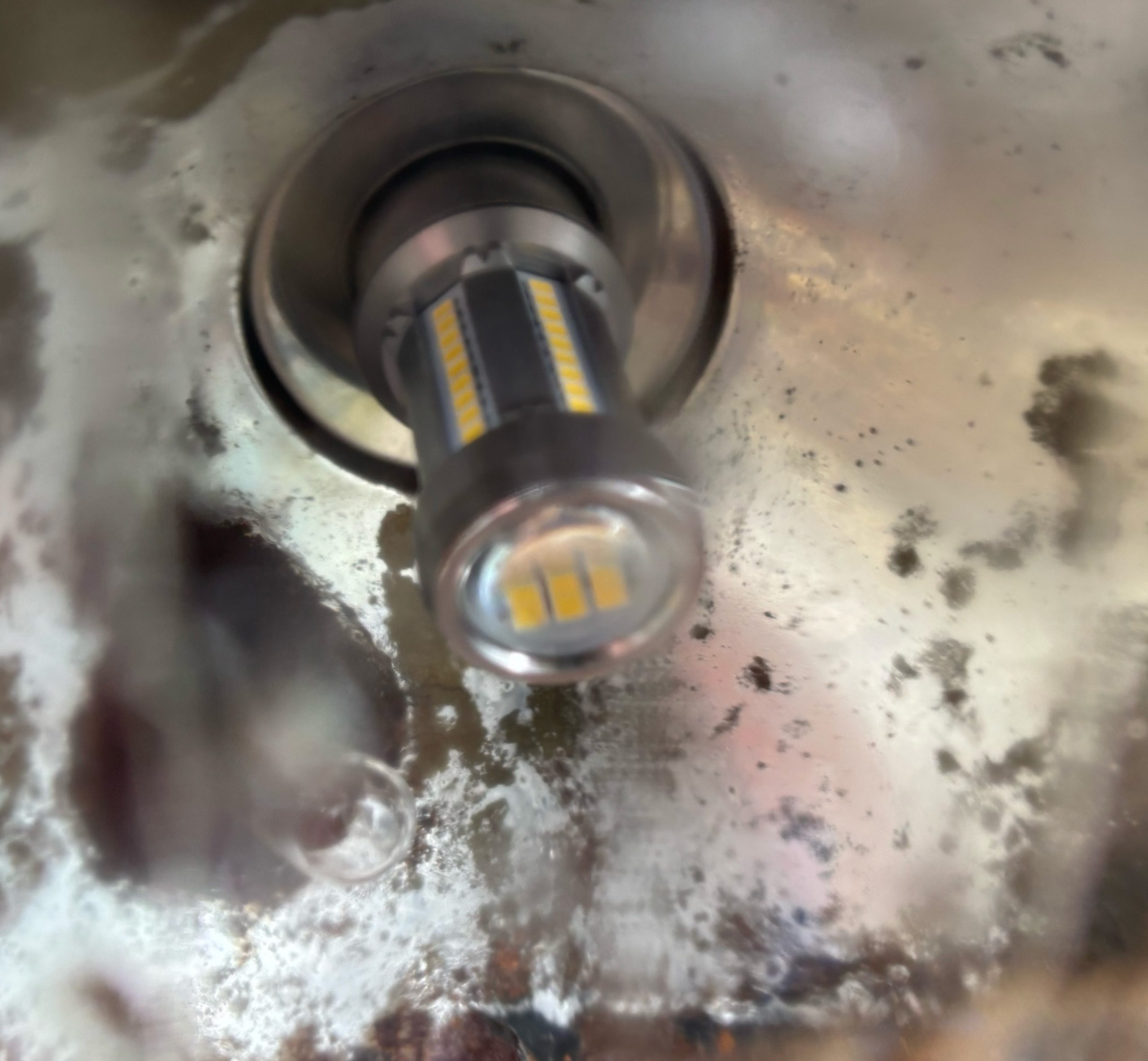
There’s also something I appreciate about combining modern, high-tech components into such an archaic car. I’m not really interested in making this into any sort of full restomod, crammed full of modern tech, but a few bits of modernity here and there not only can help usability in the modern world, but also let the outdated charm of the car shine a little brighter – in this case, literally.
I also need to play with the idle of the car; it’s still not exactly right. I think the float level in the carb needs adjusting, so I should address that. Oh, and Till noticed my parking brake adjustment was all off, too. There’s always something.
Every little mundane errand in the 2CV takes on a little more charm and joy; sure, sometimes driving a modern car like the Tiguan sitting in the driveway could be easier, and that car has luxuries like air conditioning and an ambient noise level well below a 747 taking off, which the 2CV does not offer.
But I’m happy to choose the sweatier and louder joys of the 2CV every time.
Top graphic image: Jason Torchinsky




LED bulbs in headlamps designed for incandescent bulbs are not a great idea. The reflector and lens are designed for the geometry of the light source. Replace those crap reflectors and put the correct bulbs in, and they will be fine.
Otherwise, I am fine with using more modern bits that make classics more usable. My Spitfire has proper Cibie H4 headlamps with added relays (better than many modern car headlights, even with 55/60w bulbs in them), an electric fuel pump, and electronic ignition. Mechanical fuel pumps and points ignition are for masochists, IMHO.
Augury. “unless you have a large population of crows, which seem to have at least a passing interest in cars” Over the years, I have found that most avian species have much more than a passing interest in cars.
Oh it’s passing all right.
“Oh, and I left the ignition on and learned a lesson about the coil heating up too much, too.
(I was asked to elaborate on this in the comments […]”
Also!! If you’ve retrofitted an electric fuel pump to supplement or replace the original mechanical fuel pump some brands such as Carter and Facet specifically warn about not leaving the ignition on without the engine running because sometimes the wiring, especially on older cars, is such that the electric fuel pump will potentially overheat and burn out from continually trying to pump fuel without any fuel actually passing through with its cooling effect.
Amber brake lights?
So there would have been a time when a french car would have had amber headlights and brake lights?
I guess it really added to the ambiance in a foggy Paris
Speaking of headlight upgrades: Toyota sells a kit with two 7” round H4 Koito (made in Japan) headlights, bulbs, and a harness with relays. You can buy it online from Toyota dealers for under $30! It’s a helluva deal! The part number is 81110-60P70.
I don’t know if you were originally the person to suggest this a year ago, but thank you. I did this for my 280ZX last year and it was, dare I say it, a night and day difference.
I just got really excited when I read this, only to realise the RHD equivalent is about 4x the cost.
Bugger.
Wonder if this would work on my motorcycle.
That is an amazing deal! Just a middling quality relay harness costs more than that. Assume these are for LHD?
I’m tempted to get one for my next Alfa Spider. Which of course, there is a STUNNING example of for sale locally at a great price, right when I am completely, utterly, dead flat broke finishing my new house. Sigh. Never fails.
Yes, this is a US part number for LHD. Just buy the kit now and stash it in the garage. That’s what I did – I don’t even own a car that uses 7” round headlights!
I did indeed – found it on eBay for $35 shipped.
Thanks again! Now I NEED to find another Alfa Spider, LOL. My Spitfire has Cibies in it already.
Have added a 3.5mm aux and built in USB port to the oldest car. I have upgraded to quality LED bulbs in the projector housings (I realize this is a hot topic on the site) to all cars. Now have a solar battery tender on the seldom driven SUV.
But what kind of boat? It looks like it might be a bit bigger than a Laser.
To stick to the French theme, I hope it’s a 420…