

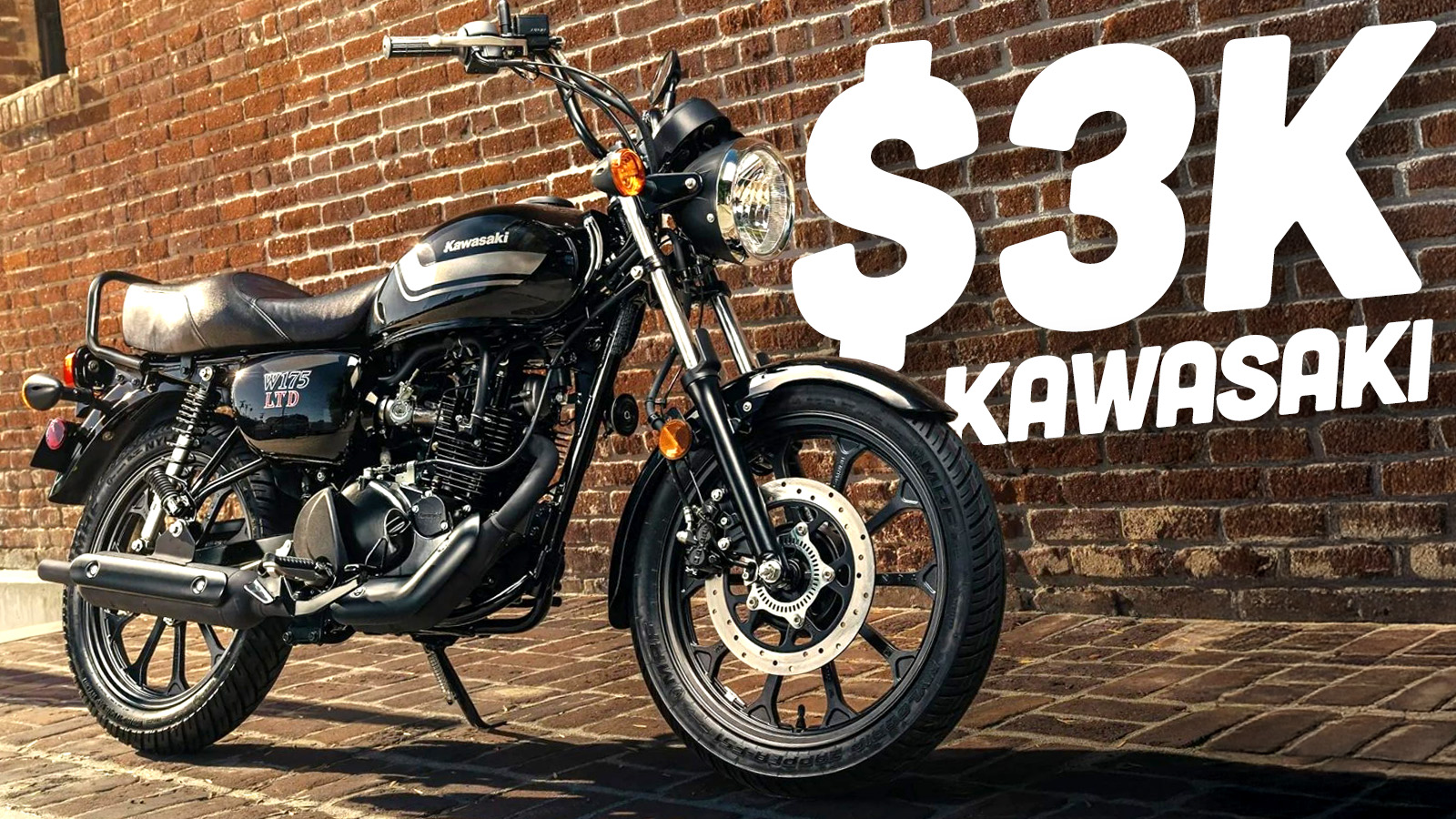
Riding a motorcycle can be one of the best ways to spice up an otherwise boring commute or summer drive. But the new market can seem daunting if you’re not flush with cash, as far too many bikes have price tags starting in the high four figures or even higher. There has been a movement of affordable steeds spreading across America, and now a new cheap motorcycle has entered the ring. Meet the 2026 Kawasaki W175 LTD. This motorcycle looks absolutely stunning, has usable performance, and the best part? It’s only $2,999 before fees.
I first wrote about the Kawasaki W175 LTD back in November. At the time, the little bike had just received approval from the California Air Resources Board and the United States Environmental Protection Agency. Usually, this means that sales are impending, but Kawasaki was quiet about the W175 LTD. The company did not respond to my request for comment, which sought to confirm whether the baby Kawi was coming to America or not.


While CARB and EPA filings and approvals are a good sign that a company is moving to sell a new product in America, it doesn’t always work out that way. Sometimes, subject vehicles never go on sale, or they come here, but aren’t sold to the public. That was the case with the Harley-Davidson X350RA. Harley cleared a restricted and derestricted version through the EPA, but has since only used the restricted version within the confines of its training courses.

I was beginning to think that the W175 LTD was going to be another one to fall through the cracks, but Kawasaki just delivered. The W175 LTD went on sale in America just yesterday, in time for summer. Somehow, Kawasaki even hit a price so low that this motorcycle could be one of the best deals on two wheels of the year.
A Global Sensation
While America is just now getting the W175 LTD, much of the rest of the world has seen it since 2017. As I wrote back in November, the W175 is a member of Kawasaki’s famous W Series family. The W story started in the 1960s with lots of fanfare.
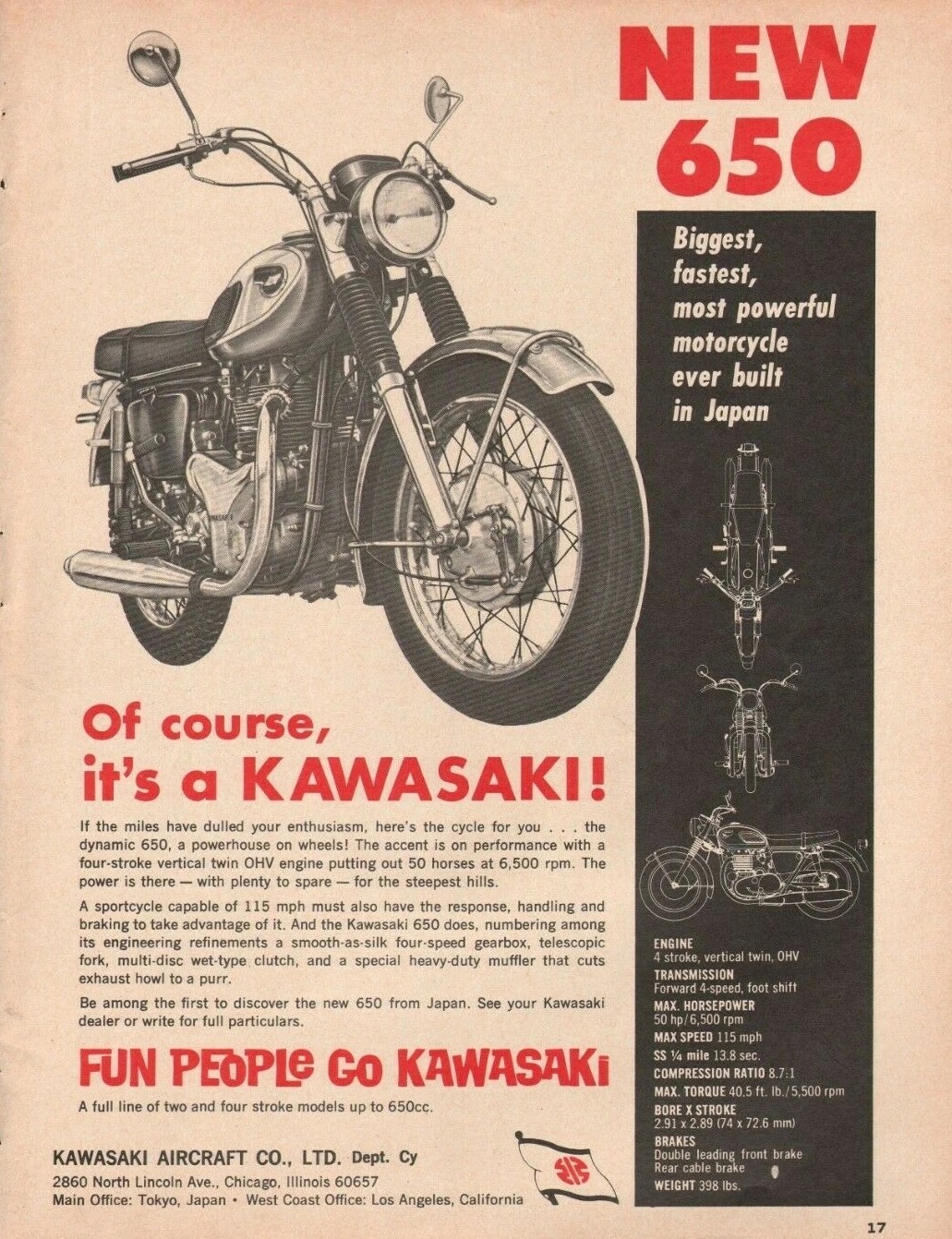
From Kawasaki:
It was an era when all but a few Japanese motorcycles were small-displacement machines. Kawasaki was one of the first to introduce a big bike, powered by a 496 cm3 OHV Parallel Twin, the world standard of the time. The engine’s roots could be found in the Twin engine of the same displacement produced by Meguro Manufacturing Co. Motorcycle Works, a well-known bike manufacturer established in 1927. Kawasaki absorbed Meguro in the 1960s, inheriting the motorcycle technology they had been developing since before World War II. The 1965 K2 was based on the Meguro’s K Series models and redesigned by Kawasaki Aircraft Co. Ltd. to increase its durability and top-speed performance. A prototype model based on the K2 evolved into the W1 released the following year.
Of all the export markets, America was of particular importance. Kawasaki had already broken into the US market with its 125B8, but to tackle America’s big-bike market they began to prepare a larger-displacement version of the K2. The 496 cm3 engine’s bore was increased by 8 mm, bringing displacement to 624 cm3. A prototype model with the larger displacement was displayed at the 12th Tokyo Motor Show in 1965. Meanwhile in Kawasaki’s Akashi Factory, mass production of the new W1 was already underway, with new units rolled off the line and arranged neatly, ready for sale. Compared to the K2’s 165 km/h top speed, the W1 could exceed 180 km/h, and in the 0-400m, it recorded a time of 13.8s. Selected with the American market in mind, the fuel tank – often considered the centrepiece of a motorcycle – was coloured a brilliant candy red and complemented by high-quality chrome pieces. The novel design was a bold statement, in stark contrast to the subdued tones of other Japanese motorcycles. It was unveiled to great acclaim at events all across America in February 1966, with orders pouring in before sales even began. With the W1, Kawasaki gained worldwide recognition as a big-bike manufacturer.

Today, the most recognizable member of the W Series is the W800 (above). Riders can’t get enough of the W800’s beautiful pairing of classic British lines with modern Japanese engineering. Unfortunately, at a price of $11,384 (including destination), it’s a motorcycle that many riders, especially younger ones and those living in developing countries, cannot afford. Kawasaki’s solution was to scale the beauty of the W800 down and put it into a package that many more riders can afford.
In 2017, the W175 launched in Jakarta. The motorcycle, which is built in India, has since spread across the world, reaching Thailand, the Philippines, Uruguay, Bolivia, and more. The W175 has a cult following in Indonesia, where custom bike builders chop them up to create something new.

It has even reached North America by way of Mexico. Selling the W175 in the United States makes a ton of sense, given the popularity of small-bore motorcycles right now. Younger buyers just getting into motorcycles might not be able to afford a Harley-Davidson, but they could produce the coin for a Honda MiniMoto, a CFMoto, a Royal Enfield, or maybe this Kawasaki.
So, now it’s here. What are American riders getting?
Delightfully Simple
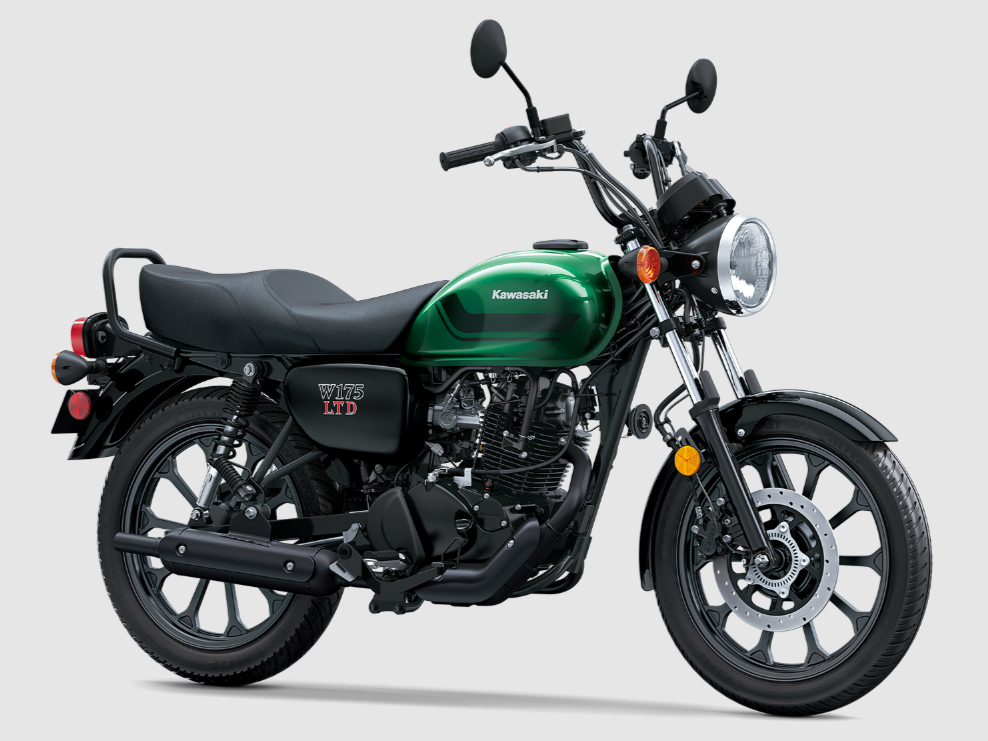
The W175 starts as a platform that seems to have been ripped right out of the 1980s. The machine rides on a tubular steel semi-double cradle frame, sports a simple swingarm in the rear, and uses dual rear shocks. There’s a 30mm conventional fork up front, a 3.2-gallon fuel tank, and a wet weight of 297.7 pounds. There’s nothing amazing here, just proven technology that has worked for decades.
The engine is a 177cc air-cooled short-stroke two-valve single, which sips from a Mikuni VM24 carburetor in its international version. Stopping power is properly vintage, with a 220mm rotor up front and a 110mm drum in the rear. The W175 didn’t even get a tachometer or fuel gauge at launch, but did have 17-inch cast wheels.

The version that launched in Mexico in 2025 was modernized with fuel injection, anti-lock brakes, a digital fuel gauge, and a larger 245mm front brake disc. Indeed, that’s the version we’re getting in America. Our W175 LTD spits out 13 horsepower and 9.7 lb-ft of torque, which reaches the rear wheel through a five-speed transmission. That’s good for 0-60 mph in about 16 seconds and a top speed of about 68mph. That makes the W175 LTD a little faster than the slightly more expensive 9.7 HP Honda Grom, but slower than a still more expensive 20.2 HP Royal Enfield 350.
The W175 has been sold globally as a cafe version, a dual-sport, a standard, and a mini sport-tourer. The LTD model throws in some classic style like a slightly reclined seating position, a thick stepped seat, a teardrop tank, a sweptback handlebar, a round headlight, and a peashooter exhaust. Really, it looks like a Kawasaki LTD from the 1980s, only scaled down.

The W175 LTD should be a great little machine for the urban commuter, the small-bore bike fan, and the beginner. It has an accessible 30.7-inch seat height, not too much power, and should be relatively agile. The biggest selling points, I think, will be how much style you get for the price.
Something Actually Affordable In 2026
I didn’t anticipate Kawasaki pricing the W175 LTD as low as it has. Here’s what I said in November:
The current smallest W Series for sale in America is the Kawasaki W230, which comes in at $5,699. Kawasaki’s minibike, the Z125 Pro, is $3,799 in America. It would only be logical to conclude that, if the W175 were to sell here, it would be cheaper than the W230. I think the baby W175 will have to land at well below $5,000 before fees to even have a chance against the might of the $4,299 Royal Enfield Hunter 350 or other beginner bikes like the Yamaha V Star 250.

The W175’s current pricing, which is $2,999 plus a destination fee of $435, makes it cheaper than every Honda MiniMoto save the slower and smaller $2,199 Navi. It’s also cheaper than a CFMoto Papio SS and every new Royal Enfield for sale in America. Honda Navi aside, the only way you’re buying a cheaper road-legal bike is to buy a no-name Chinese bike from Amazon or something.
Yet, the W175 LTD benefits from having Kawasaki’s dealer network, nearly a decade of production, and comes from a reputable brand. Add in the spectacular looks, and I think Kawasaki has a winner here. The Kawasaki W175 LTD should be hitting dealers right now in two colors, Ebony and Candy Emerald Green.
Of course, this isn’t a bike that you will take touring. You also won’t win any races on it. Also, $2,999 can get you some cool vintage full-size motorcycles that’ll go much faster than the W175. But if you’re shopping for a new bike, don’t have a lot of cash, but don’t want to give up on looks, I could see this being a pick. I might have to waltz down to a Kawasaki dealer and take a spin on one for myself.
Top graphic image: Kawasaki



I keep trying to justify a Royal Enfield 350 for a grand more, knowing I probably wouldn’t take it on the highway anyway. This wee fella would do nicely for all the other stuff I’d want to do with a motorbike.
This bike reminds me of my old KZ250 LTD. I had some good times with that one.
I can’t believe that they couldn’t spend an extra 75 cents to route the clutch cable in a tidier fashion. Aside from the general cluttered look of something taken apart and put together without the benefit of the manual. Draping it over the exhaust port and pipe seems to be adding potential injury to insult.
Love the idea, and don’t mind small displacement bikes but I generally prefer at least a 250. It’s nice to be able to hop on the interstate for a few exits if you have to. I currently have a Chinese clone of a Honda making similar power, and it is fine, good for the price, but not compared to what I could have gotten on the used market. I want a retro-style small bike, but I wish the Suzuki VanVan was still available, those chunky tires and big fat seat look so nice.
I had the same thought – why not a 200-250cc engine? Then again, I think about the small bikes I see puttering around town at speeds that never exceed 45mph and realize this would be perfect for that scenario. But as you say, being able to safely do highway speeds would be nice for adding flexibility, especially in cities with parkways that are 55+mph.
This probably makes more sense in another market that requires a different license for a larger displacement bike. I am just making excuses now though, honestly this is probably great for an around town bike and it looks good to boot. If it gets more people into riding I am all for it! Please these should be extra cheap second hand!
I’ve owned four Japanese motorcycles over the years ranging from 650cc to 1.5L and have thousands of hours/miles under my belt.
What is the rider (plus passenger or load) weight limit of this bike?
Not to sound elitist but “0-60 mph in about 16 seconds” seems like it removes one of the advantages of a bike being able to get out of the way.
I d never do it but, can it burn E10?
I’m pretty sure by law it must be able to burn E10. I can’t remember the last time I even saw the option for ethanol-free gasoline. But I do spend a lot of time in the Plains states.
To add to younork’s comment, I’ve been running my F900 XR on 93 (E10) for 3 years now and it’s way higher strung.
E0 is common near lakes.
I love little bikes. Let’s be real: that’s not a $3k bike, it’s a $4k bike. I’m pretty sure I’ve never seen motorcycle dealerships waive setup/shipping/whatever fees. <Edit: OK, maybe a $3400 bike. I got overzealous.> Still a pretty good deal for a legit new machine from a reputable brand today.
I bought a Honda metropolitan in 2022, list price $2499 I think? Actual out the door price? $3700+tax I could have ordered one for $3300, but 3700 was the lowest I could find within about 300miles. “Set up fees” for taking it out of the box and putting mirrors on.
Perhaps I was more correct at $4k!
I hope it sells but the Kawasaki retro bike I really want is twice the price. OTOH there are thousands of used KLR 650s
KLRs, alongside Corollas and Yaris (Yarii?), be the primary mode of transportation in a post-apocalypse world until fuel runs out.
Pretty sure even after the fuel ran out you could mod them to run on some kind of homebrew.
Cool bike. Cheap bikes are great. Nice cheap bikes are even better.
My only complaint is that manufacturers charge the same setup/delivery/document fees for a $3k bike as a $20k bike. A $3,400 bike usually ends up being closer to $5000 out the door and I presume this will be no exception. Still, a bike that is $5,000 out the door is still way more affordable than a bike that is $15,000.
My total for fees on a $4300 bike was $500 last year. It all depends on the dealer.
As a manager for an insurance company, motorcycles can be an exciting way to spice up your commute to wherever you go.
However, it’s also an excellent way to get maimed or killed while you are doing it. Most of the time the motorcyclist does nothing wrong, but the Darwinian antics of drivers along with my job keep me from ever riding a motorcycle.
Most of the time the motorcyclist does nothing wrong
Doesn’t the data show that around half of motorcycle fatalities/injuries are solely the fault of the motorcyclist? For the other half, the motorcyclist is often at least partially at fault due to excessive speed, intoxication, or otherwise. Yes, some motorcycle fatalities involve factors entirely outside of the rider’s control, but the majority do not. I have seen numerous fatal motorcycle accidents during my career and, at least in my experience, most of these involve rider intoxication and/or truly excessive speed (i.e. not just 5 mph above the limit).
It is telling that the fatality/injury rate of a Honda Gold Wing is considerably lower than that of other motorcycles. If motorcycle accidents weren’t heavily influenced by rider behavior, I don’t see why Gold Wings would be any safer than other large bikes.
I am only seeing it from the liability side (3rd party injuries and property damage) not 1st party claims where the motorcyclist hurts himself and the bike.
That aligns with the data I’ve seen as well that there is a disproportionate number of motorcycle crashes due to intoxication.
I’m sure it’d also be higher in cars if they had to balance on two wheels when drunk.
you can’t file a claim if you are dead.
Your estate/next of kin can, though. I don’t think I would mind if my NOK filed an insurance claim if I died – my insurance company can’t raise my rates when I’m dead! Ha!
Maybe Gold wings are more commonly used on isolated back roads instead of crowded urban streets?
No more than Harley touring bikes. The biggest difference is rider demographics. Gold Wings tend to be ridden by older individuals as well as people who are less inclined to risky behavior (my Harley dealer will give you a free beer while your bike is being serviced – that alone says a lot about the kind of riders Harley is trying to appeal to). I’ll admit I considered a Gold Wing before I bought my Road Glide and decided I wasn’t quite ready for the Gold Wing image.
Plus, touring bikes from all brands have substantially lower fatality rates than sport bikes. Sport bikes aren’t geared toward the urban transportation crowd, so difference in riding locations can’t account for that.
Is that beer thing true?! That is absolute batshit. BMW stocks non alcoholic beer for some reason, but at least that’s responsible.
I know you won’t get above .08 on a beer, however fractions of seconds of reaction time matter on a bike. I don’t know how much 1 beer will make a difference, but it sure as hell won’t make you perform better. I don’t ride at night and I don’t drink in the day so it’s not an issue for me.
The beer thing is 100% true. It doesn’t seem like a great idea to me either.
Like with planes, there are bold riders and there are old riders but there are no bold old riders.
I was just thinking about this. I think there’s a perception bias: the idiots on the highway doing wheelies (inevitably in a T-shirt and flip flops) give riders a bad name bc they’re the ones that get seen.
Two days ago I went on my usual ride through a twisty back road. I think 4 cars got to see me. And I passed by at least twice as many other riders all riding the same way I was (sanely).
I think in the case of the Gold Wing it’s where and when they’re riding. They do long stretches of highway miles a few times a year, as opposed to a daily commute in a crowded city.
No. Again, riders of Harley touring bikes are doing the same kind of riding as those who ride Gold Wings. Very few people are using a Road Glide for their daily commute, much less for commuting in a dense city.
I don’t understand why people are arguing against the idea that rider behavior substantially influences safety.
I’ve always wondered why ppl who work in ERs say the same thing. It’s not like ppl don’t show up with horrific injuries from auto accidents.
Bikes are absolutely waaaaay more riskier than cars any way you look at it, however, if you don’t drive drunk or at night, are over the age of 20, and have made it through your first year of riding, your odds of injury/death get cut in half (still way higher than if in a car).
Now that’s a cutie! Wonder how hard it is to swap it to the cafe racer version?
The biggest competition this bike has is probably all the electric bicycles out there that are even cheaper to buy and operate and often don’t need licenses to operate.
I’m not sure there is much crossover interest between ebikes and small motorcycles.
There are a lot of reasons someone might want a small bike aside from low price (small rider, new/less confident rider, older rider looking for a lighter/less physically demanding bike, preference for lighter bikes, etc). I highly doubt these will be bought by people who are just looking for cheap transportation. If nothing else, 50 cc scooters have always been cheap transportation and they aren’t very popular even though some (a lot?) of states allow you to ride one with a standard drivers license.
electric bicycles … don’t need licenses to operate.
I have to imagine there will be substantial regulations coming to ebikes at some point. The performance of many current ebikes already technically violates laws. I have started to see the topic of ebike injuries/fatalities come up in the news; regulation/enforcement of existing laws can’t be far behind.
It is odd a fast ebike still only needs a bike helmet but a slow(er) scooter needs a motorcycle one.
Legislation moves slow. Ebikes have existed for a while, but until a few years ago they were slow (most advertised 15 mph or less with pedaling) and expensive so few people bought them. I think the days of the current ebike free-for-all are limited. Legislation doesn’t exist because this is a new problem, but laws will catch up.
It’ll be interesting to see how it’s enforced since, to the uninitiated, they all look the same. Maybe more severe consequences for going 30+ mph in the bike lane?
Reminds me of the Suzuki TU250X, but it appears that Suzuki quit importing that a while back. Probably because it still had a carb, and couldn’t meet emissions, and Suzuki didn’t want to upgrade it to FI.
Hmm, while emissions might have been a barrier, the TU250X was fuel injected. (And the Kaw isn’t, which is certainly a turn off; I’d had enough of carb-fiddling with my old Vespa.)
Stares in the dealers in the greater Nashville area who add on mandatory “uncrating fees”, “battery fees”, etc. These will wind up with final sales invoices of ~$5500 guaranteed locally, and sadly, people will pay them.
This is why I buy the more expensive motorcycles. At least it doesn’t seem like the price of the bike doubled with all the add-on fees.
It’s not just Nashville. In Vegas a Honda Navi is over $5k OTD.
Even better when they charge those fees on a $15k bike and don’t even give you more than a gallon of gas. Cheap bastards.
In defense of dealers, they do less volume than auto stores and gotta keep the lights on. There’s not much profit on a $3000 bike…
I don’t think there’s a need for a purpose built economy bike. There are so many good used bikes for sale that you can pick what you want, decide what you’re willing to pay for it, and you’ll find it. I ride a 19 year old Honda. A brand new bike wouldn’t come with any new features that I actually need. Warranty? I’ve had it for five years and it’s needed exactly one repair.
Motorcycles are so different than cars with this.
I used to think the same, but the fact that small-bore motorcycles keep selling suggests that there is demand for them. Besides, someone has to buy these bikes new so they can end up on the used market in 19 years.
There are a lot of people who don’t want to deal with the problems that come with buying a decades-old bike. You have no idea how it was taken care of over those years.
In a different article, one reader pointed out that there are a lot of riders who don’t work on their own bikes as I do. That then brings on more questions, like parts availability and finding a mechanic.
So, I can see the appeal in buying a new cheap bike. You don’t have to worry about whether someone else has beaten it up, you can get a warranty, you can get dealership support, and you can get a modern feature or two like ABS.
I agree, I started on hand me down and $2-300 bikes and ended up enjoying a cheap new bike without tons of work needing to be done. Some people would rather not roll the dice with an old bike. People seem to think that the used vehicle market is limitless.
There needs to be a steady stream.
In 10 years, we all want someone to refresh the pool of 10yearold used motorcycles.
I don’t think this bike will sell based on economy alone. Small, lightweight, low power bikes are fun in their own way. I currently own a Road Glide and a Monkey and like them both, albeit for different reasons. There are times I genuinely prefer riding the Monkey to the Road Glide, even if the Harley is far more powerful and comfortable.
It is a nice bonus that small bikes are also cheap, though. It is also easier much easier to justify a $5,000 toy than something more expensive.
At least old bikes tend to hold their value. So yeah you’ve locked up your money but, when it comes time to sell, you’ll get most of it back.
There is a huge need for such bikes in the developing world. Might as well bring them here too.
An ebike seems like it would be more practical in most cases.
Mercedes, you missed the cute W650, a knock off of a British twin, it was available in North America from 1999-2008.
Kawasaki W650 – Wikipedia
.
You take that back!!
.
What’s that thing in the lower left of the LCD display if not a fuel gauge?
I mean, it’s right there…
D’oh! I forgot to say that a fuel gauge was added later on. I’ll fix that. Edit: Done!
Haha, thank my sister, who pointed it out to me 🙂
So it still doesn’t have a tach?
Just in time for the gas crisis!
I wonder if the Honda XR150L is work the $300 more?
The styling on this seems to be more like the early to mid 80s KZ550 LTDs.
This almost makes me care about motorcycles. This is all the bike I’d ever need and I bet it’s a hoot. Damn. I kinda actually want one, and I have never in my life wanted a motorcycle.
Just remember, you’re gonna drop the bike as you’re learning (and after…). Some ppl don’t care but I’m glad I started on a bike that was already beat to shit.
I wonder why Yamaha stopped bringing the SR400 into North America 5 years ago. They might have been ahead of the market, or they lost their emissions certification.
Little 400 thumpers are definitely getting popular (or I just see them more ’cause I bought one last year.) I’m not sure if the scooter kids are itching for a motorcycle shaped 175, or who else might be the target market. Stiff competition for the Suzuki VanVan?
SO tempting as I would not motorcycle on a highway again.
The package seems a lot like what the Buell Blast was going for, just with more retro style and less fiddly operation I’m sure. I bet it’s a hit, esp at that price point.
except the Buell Blast was a 500 and could sort of keep up with traffic. the W650 was a better bike in this cheap bike realm, but ultimately did not sell that well either. Guess time will tell.
I mentioned the W650 too.
The Blast was a horrible attempt to make a cheap bike. Although I will say what they lacked for speed they made up for in (the right hands) handling. I once “chased” a woman in our riding group and every straight I got her in sight, but once the twists came, she was gone again.
I hear you. I chase women too. Same result.
I often wonder what the Blast could have been with a Rotax rather than half of a Sporty engine.
Also, years ago, Erik told me that the reason Blasts eat rear tires is that when the engine is being lugged, as might be the case with a beginner rider or a more conservative riding style, the engine’s torque causes the rear tire to skip an amount that’s imperceptible to the rider, but is enough to wear the tire faster. No idea how true that was, but who am I to say Mr. Buell himself is wrong?
It’s absolutely true. Thumpers are harder on tires than multi cylinders, particularly if lugged at low RPM. Infrequent, hard pulses of torque wear the tire much more than more frequent, smaller ones as you’d get on multi cylinder bikes. I’m not sure if the tire actually “slips” – that’d be interesting to see really close up on a super slow motion camera, but it definitely results in more wear.
Even on dirt, 4 stroke bikes tend to go through rear tires faster than 2 strokes of similar power for the same reason.
That’s the argument made for why Ducati dominated WSB years ago with the 916/999/1098 – spacing out the power pulses was argued to provide better grip between each than an inline-4.
The real reason, I’m sure, was likely the higher displacement afforded to the twin, which may also be the case with the blast of a large single thumper leading to similar wear of a 1200 Sportster.
I mean to be fair there are few problems a Rotax couldn’t fix.
Within the confines of engines that is..