


The name “Mack” is an icon in the trucking world. You don’t have to look too far to see a Mack hauling gravel, garbage, or cruising down a highway. Macks have been fire engines, buses, and even movie stars. Less well-known is Mack’s short foray into light-duty trucks. Back in the 1930s, Mack built its own pickup truck to go up against the best of Detroit. This is the Mack ED, one of the rarest, hardest-working vintage pickup trucks you probably haven’t heard of.
Last week, I visited the Mack Experience Center in Allentown, Pennsylvania, to ride and drive in Mack’s latest Anthem and Pioneer tractors. While I was there, the volunteers who run the non-profit Mack Trucks Historical Museum opened their doors to take us on a journey through Mack’s history. This was one of the more impressive museums I’ve been in because it wasn’t just a collection of preserved vehicles.


The Mack Experience Center was originally built in 1975 as the Mack Engineering Development and Test Center. There, Mack’s engineers drove the company’s latest rigs on a test track, put them on a dyno, and even shoved them into a room capable of simulating some of the hottest and coldest temperatures on Earth. The Mack Engineering Development and Test Center even had a special sound room that engineers used to pinpoint specific sounds on tractors.

Some of the original test center has been converted into the Mack Experience Center, which gives current and potential future Mack customers the ability to ride and drive Mack’s best. However, an incredible chunk of the original building has been preserved just as it was when Mack’s engineers last used the building in the 2010s. The equipment inside dates back to the 1970s when the building was constructed.
Nestled right in the middle of it all is a great hall that showcases Mack’s most important milestones and historically significant vehicles. It was in here that I found Mack’s beautiful gas turbine prototype truck and pieces from the Mack that starred in the film Convoy. Then there was this, the Mack Model ED.

While this truck isn’t Mack’s only pickup truck in history, it is the only Mack pickup designed and built mostly in-house. This relatively unknown rig was perhaps one of the toughest pickup trucks you’re unlikely to see today due to its rarity.
(Full Disclosure: Mack Trucks invited me out to Allentown, Pennsylvania, to check out its Experience Center as well as take a ride and drive in its latest rigs. Mack paid for my travel, lodging in a vintage hotel, and food that included a crab omelette, the best breakfast I’ve ever had.)
‘The First Mack Was A Bus And The First Bus Was A Mack’
While Mack is known for its heavy-duty trucks today, the company’s portfolio used to be quite diverse, especially prior to World War II. The company’s first vehicle wasn’t even a truck, but one of America’s first buses.
The Mack story started with brothers John M. “Jack” Mack, Augustus F. “Gus” Mack, and William C. Mack. In 1889, Gus joined the Fallesen & Berry firm in Brooklyn, New York, in building carriages and wagons. Jack joined the concern a year later. By 1893, Jack and Gus purchased the Fallesen & Berry factory. Meanwhile, William operated a wagon manufacturer in Pennsylvania. He’d join his other brothers at Fallesen & Berry in 1894.

At first, the men continued their trade of building horse-drawn carriages and wagons, but like many visionaries of this era, the promises of using engines to have these carriages propel themselves were too tempting to ignore. The Mack Brothers Company was incorporated in 1900, and Mack explains the story behind its famed slogan about pioneering American buses:
John Mack had already spent years researching and experimenting with his own design for a motorized wagon by the time he and his brothers opened their first bus manufacturing plant in 1900. The work paid off the same year, when the brothers introduced their first successful vehicle — a 40-horsepower, 20-passenger bus. The Mack bus, built for sightseeing concessionaire Isaac Harris, operated in Brooklyn’s Prospect Park for eight years before being converted into a truck. The success and acceptance of “Old No. 9” initiated a history of truck development unparalleled in the industry, and established a company whose reputation for tough, high-quality products has since become “part of the language.”
The brothers were also doing automotive repairs at this time.
Mack used a slogan in advertisements for many years, especially when we produced buses…”The first Mack was a bus and the first bus was a Mack.“

That bus, which was built in 1904, was called the Manhattan. Just a year later, the Manhattan was converted into delivery vehicle, creating Mack’s first-ever motor truck. According to Mack, Jack got the inspiration to make a truck after riding in a two-cylinder Winton car. He found the engine’s performance to be so great that it had to go into the body of a truck.
The Mack brothers became obsessed with heavy-duty trucks. They didn’t just build trucks, either, but actively sought to solve drivers’ many pain points in the 1900s. Mack built its trucks to have better outward visibility and better maneuverability. Augustus even worked to solve the issues with the grinding and gear-stripping transmissions of the 1900s with a constant-mesh design.
The company was also a diverse one, and soon found itself building fire apparatus, switcher locomotives, streetcars, and interurbans in addition to heavy trucks and buses. Mack has been a staple of Allentown, Pennsylvania, since 1905. Click here, here, and here to read more about Mack’s history.
Mack Goes Light
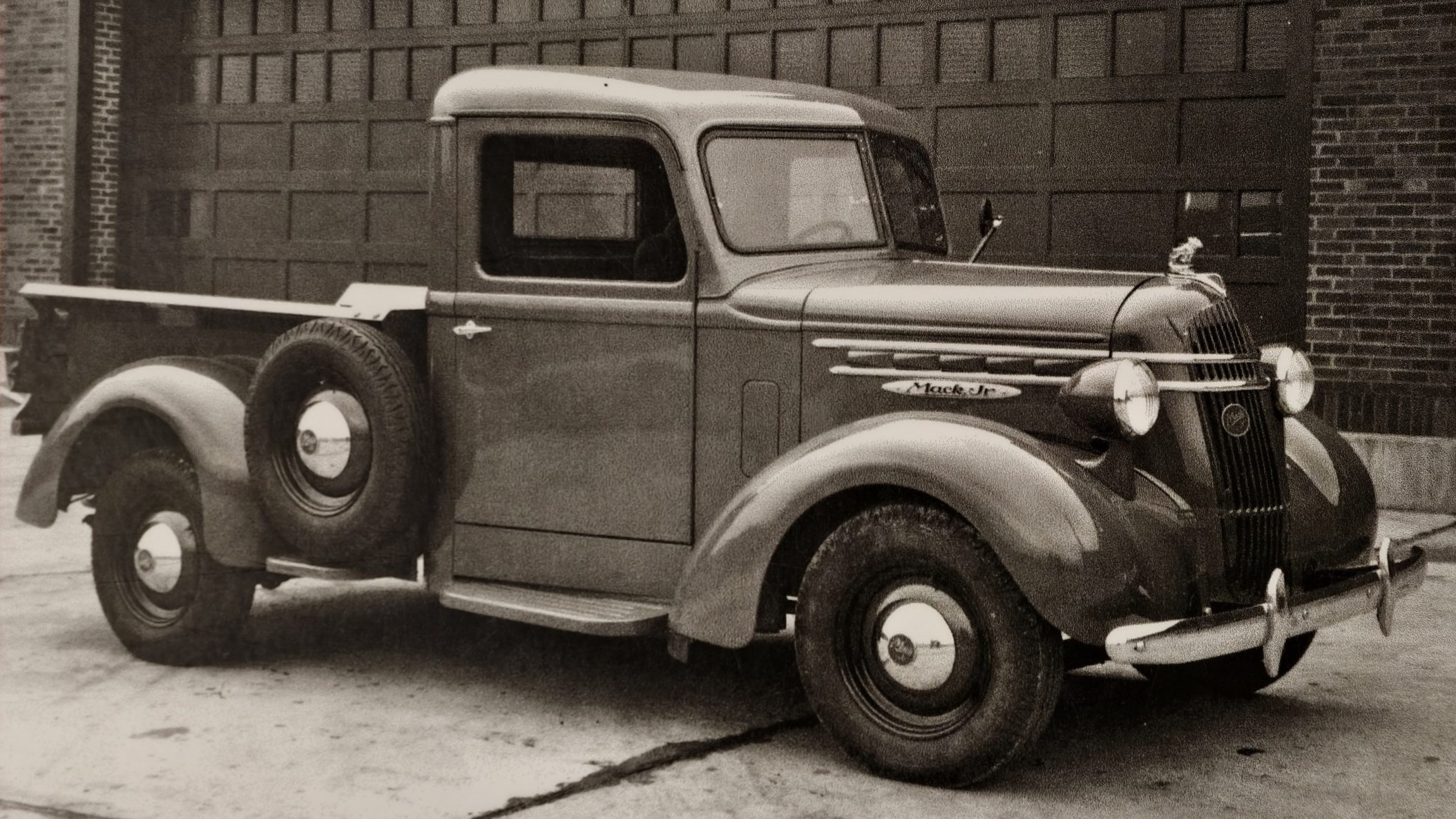
While Mack put its name on a wide variety of working vehicles, there have been only a couple of times when the company has ventured into the light-duty market. While a Mack buyer could have optioned their truck with a pickup-like bed, the company stayed away from competing with actual pickup trucks.
That was until the Great Depression struck. Mack was no different from everyone else and suffered through hard times in the 1930s. Thankfully, public works contracts kept Mack afloat, but far fewer customers darkened the doors of retailers. By the mid-1930s, Mack sensed that, while heavy trucks struggled, there was a competitive market for light-duty delivery trucks. Instead of trying to build its own pickup truck, Mack joined forces with another company that was just trying to survive the 1930s: the Reo Motor Car Company.
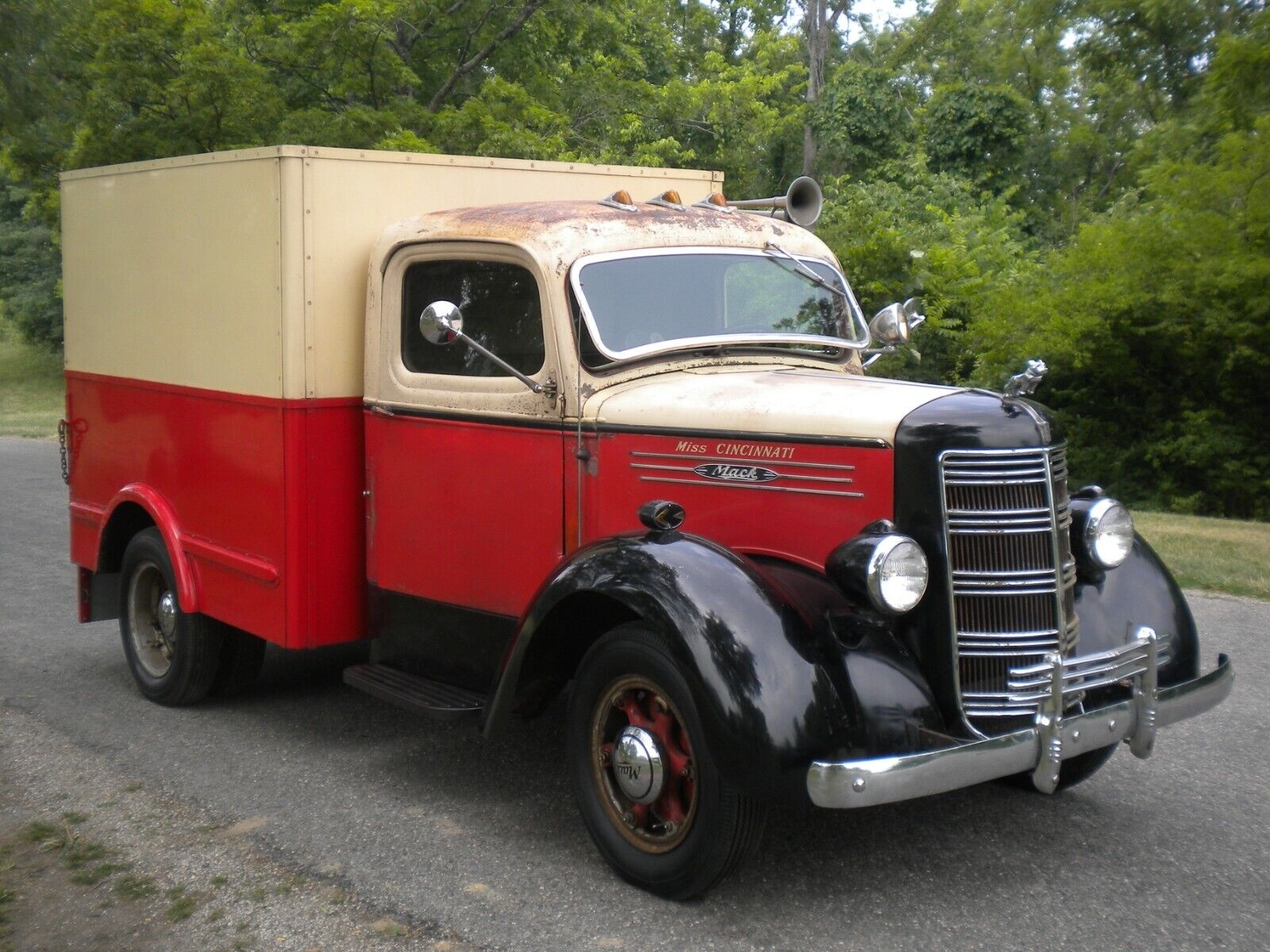
In October 1934, Reo and Mack inked a deal for Mack to rebadge and sell a Reo light and medium truck as a Mack. This new truck was called the Mack Jr., which isn’t to be confused with the Mack Junior, which was built in 1909. The Mack Jr. was a Reo inside and out, with only minor changes coming in the form of double-spear decorative trim up front and Mack badging. Otherwise, Mack didn’t really hide the fact that its pickup truck wasn’t a Mack.
Mack Jr. trucks were sold as the half-ton Model 1M, the one and a half-ton Model 10M, the two-ton Model 20M, and the three-ton Model 30M, and shipped with either pickup, panel delivery, bus, or cabover bodies. The Mack Jr. half-ton retailed for $535 ($13,183 in 2026) before options, while the three-ton version was $1,035 ($25,503 in 2026). Power in the half-ton version came from a 209 cubic inch straight-six with alloy iron cylinders and 72 HP on tap. The Model 20M saw this engine upsized to 228 cubic inches with an output of 74 HP. Finally, the Model 30M had a straight-six with chrome-nickel cylinders and 85 HP.
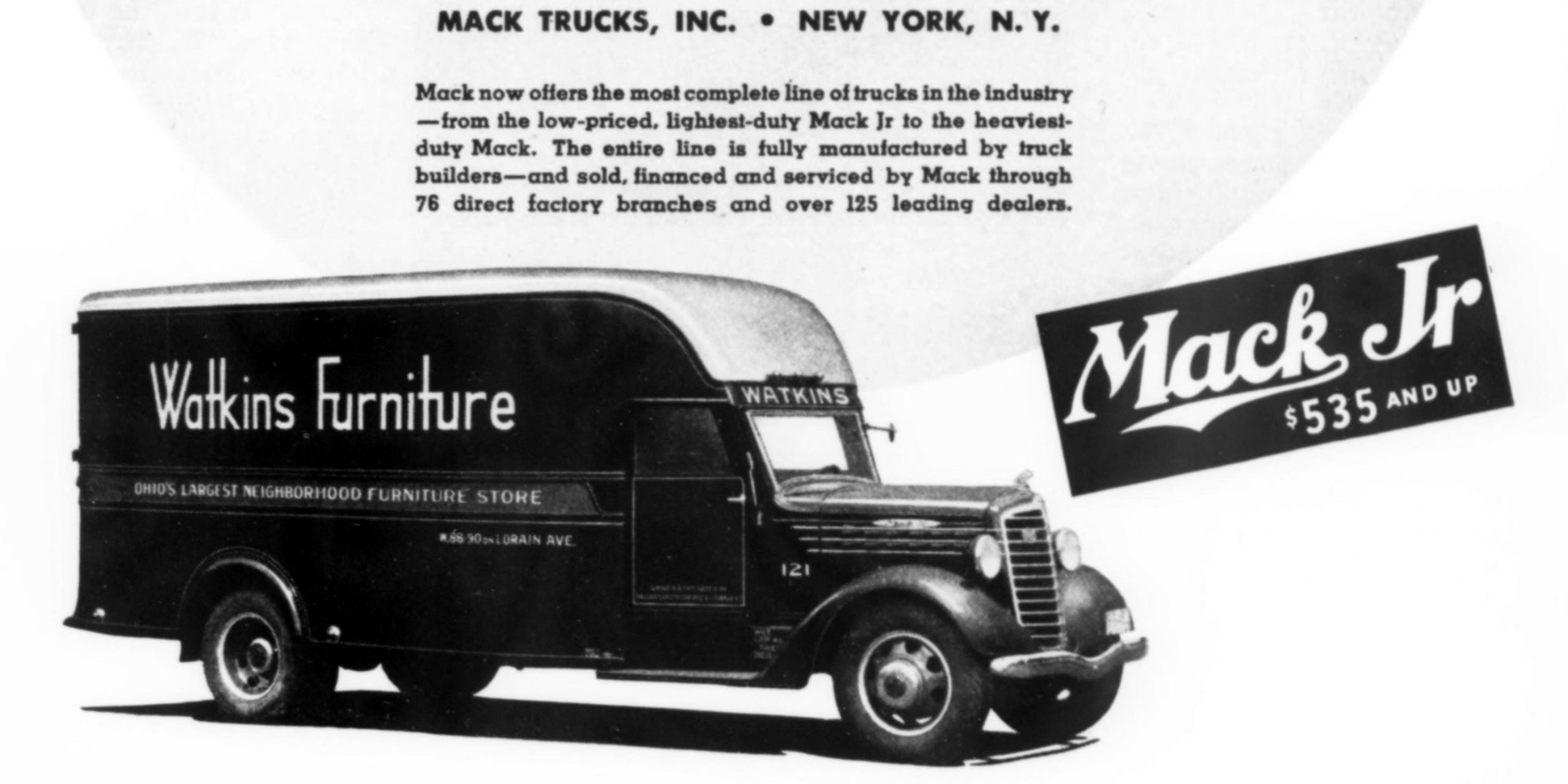
Mack used its reputation as a heavy truck producer to market the Jr. as a hard-working pickup. This marketing worked, and Mack sold 4,226 trucks in 1936, of which 2,343 units were Mack Jr. trucks. This breathed some fresh capital into Mack, allowing it to weather the Great Depression on sturdier ground. Unfortunately, the Jr. was a bit of a one-hit wonder. Mack added its own touches to the Reo-built truck with a new, heavy-duty frame, heavier axles, and a more Mack-like front-end design.
Unfortunately, the Mack Jr. was also more expensive than the competition. A half-ton Ford was only $470 ($11,581 in 2026), and Ford had been building light-duty trucks for longer. To counter, Mack tried to market the performance and beauty of the Jr. models. Sadly, this didn’t work. Mack Jr. Sales fell slightly to 2,226 units in 1937 before cratering to only 405 units in 1938.
The Model ED

But Mack didn’t give up. The pickup truck experiment was initially a success, so clearly there was interest in the truck market for such a vehicle. That year, Mack would launch another pickup truck, but this time, it eliminated the Reo middleman and built nearly the whole thing in-house.
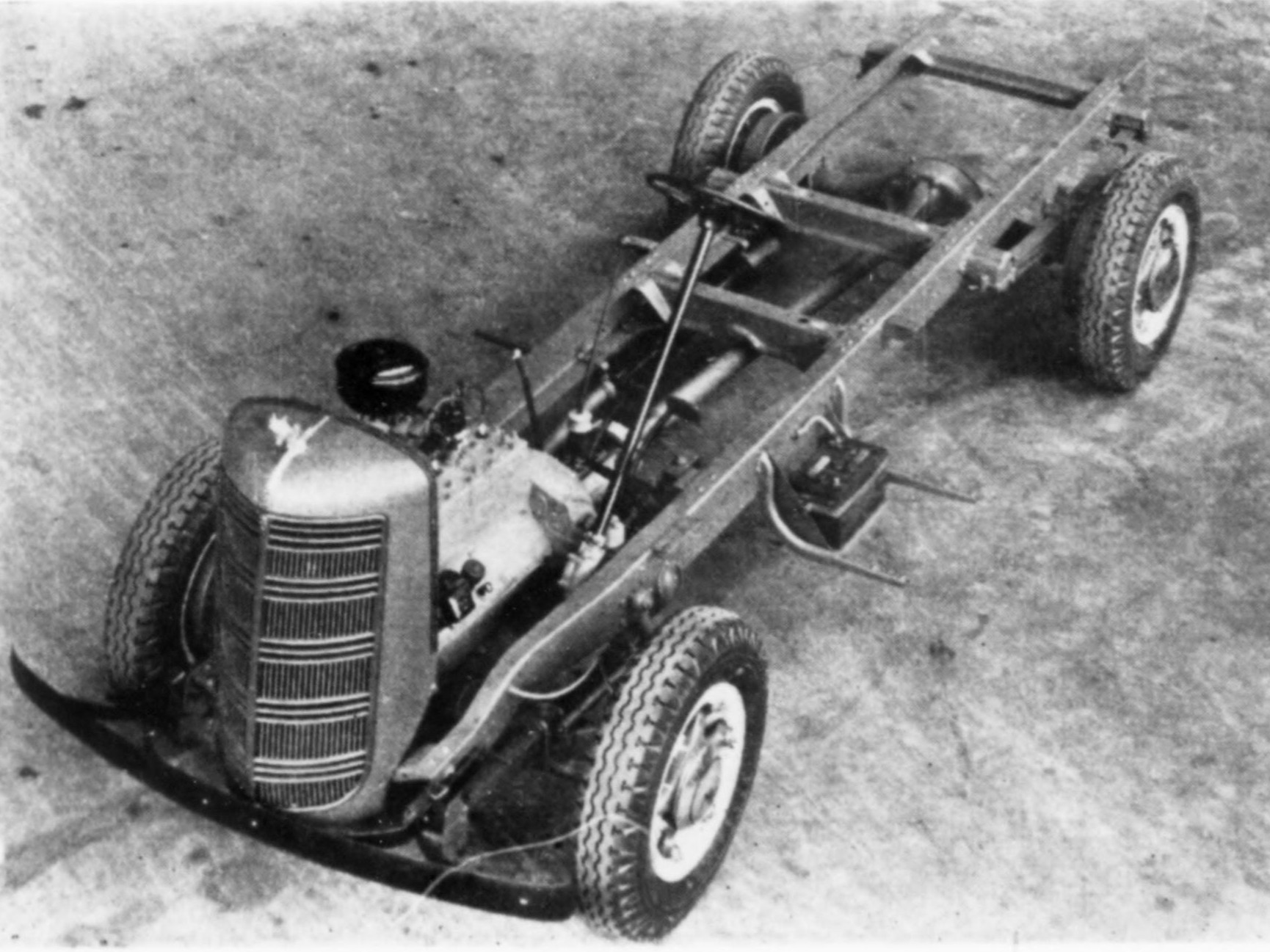
For $675 ($16,632 in 2026), you got a bare chassis that weighed 3,100 pounds empty and had a gross weight of 8,500 pounds. That means you had 5,400 pounds in reserve to fit a body and for payload. In 1940, Mack reduced the Model ED’s base price to $625 ($15,400 in 2026).
Here’s what a 1938 issue of Fleet Owner said about the Model ED’s design:
According to the Mack Company’s announcement, the Model ED is in reality a small-scale heavy-duty truck, every part of which is new, and which was designed especially for this particular model and for the work it is expected to do. In appearance Model ED follows the same refined type of streamlined styling offered on all other light capacity Macks introduced during the past year. It will be built, along with all other Mack models, at the Mack factory in Allentown, Pa. Offered in a standard wheelbase length of 120-1/2”, the Model ED accommodates 8-ft. body lengths and in the case of panel types, 9-ft. bodies. On the special Wheelbase of 136-1/2”, 10-ft. regular bodies and 11-ft panel bodies are accommodated. Mack-built and with all-metal roof construction, the de-luxe streamlined cab is equipped with such interior fittings as indirectly-lighted instrument board with clock-type instruments, ash-tray, cigar-lighter, domelamp, arm-rest, chrome windshield, safety glass, floormat, and chrome rear-view exterior mirror.

Model ED is powered by a six-cylinder engine with bore and stroke of 3-3/16” x 4-3/8”, developing 67 h.p. at 2800 r.p.m. Total piston displacement is 210 cu. in. Cylinders are cast in one block with detachable one piece head, bolted down by 32 cylinder-head studs. Valves are of the L-head type, with exhaust valve-seat inserts. Pistons are of nickel cast iron, tin-plated. The counterbalanced crankshaft has four main bearings. Drive on the new Model ED is from a dry, single plate clutch, 10” in diameter, through a heavy-duty, truck-type, three-speed selective transmission, built as a unit with the engine. Four speed transmission is available as an extra. Final drive is of the single reduction type, with full-floating axle. Standard gear ratio is 5.571 with optional ratios of 5.125 and 6.333.
Four-wheel foot brakes are of the internal-expanding hydraulic tvpe, with total braking area on all four wheels of 237 sq. in. Chassis frame is of pressed carbon steel with side members 7” deep, 3/16” thick with 2-7/8” flange. Cross members are five in number, three being of the box-girder type and two of the channel type. Springs are 40-1/2” x 2” in front, 51” x 2-1/4” in the rear and are suspended in exclusive Mack rubber “shock insulators,” a feature found on no other make of truck. Rear springs are of the progressive type, whereby the truck, when empty or when under a light load, rides on the upper half of the spring. As more load is taken on, the upper part of the spring straightens out, coming in contact with the lower half, on the ends of which are mounted hardened steel rub-plates. In this way the spring capacity is progressively increased to take care of the full load.

According to the Antique Truck Club of America, early Mack EDs came with wood-framed cabs with metal panels. Hence, the story above only notes that the roof is all-metal. It’s believed that the Model ED’s cabs became truly full metal in late 1939 or early 1940. What the Mack announcement doesn’t say is that the 210 cubic inch 67 HP Mack EN11 six wasn’t a Mack engine, but was made by Continental. But unlike its Reo-based predecessor, the rest of the Model ED was designed and built by Mack.
Mack doubled down on marketing its pickup truck as a “small-scale heavy-duty truck.” Trucking journalists hailed the Model ED as the lightest and lowest-priced Mack ever – I suppose the journalists didn’t count the Jr. as a real Mack –- while Mack itself touted the Model ED as having the stamina and durability of a big truck, but in a small size. Mack also used the Model ED to advertise that it sold a truck for every need, with capacities ranging from one ton to 30 tons. In 1939, Mack claimed that 97 percent of the trucks it had built in the 10 years prior were still doing hard work.

The Mack Model ED was a bulldog in a crowded market. Its competition included trucks from Chevrolet, Dodge, Ford, International Harvester, and more. Reo was also a competitor for Mack’s pickups, even back when Mack’s pickup was just a rebadged Reo.
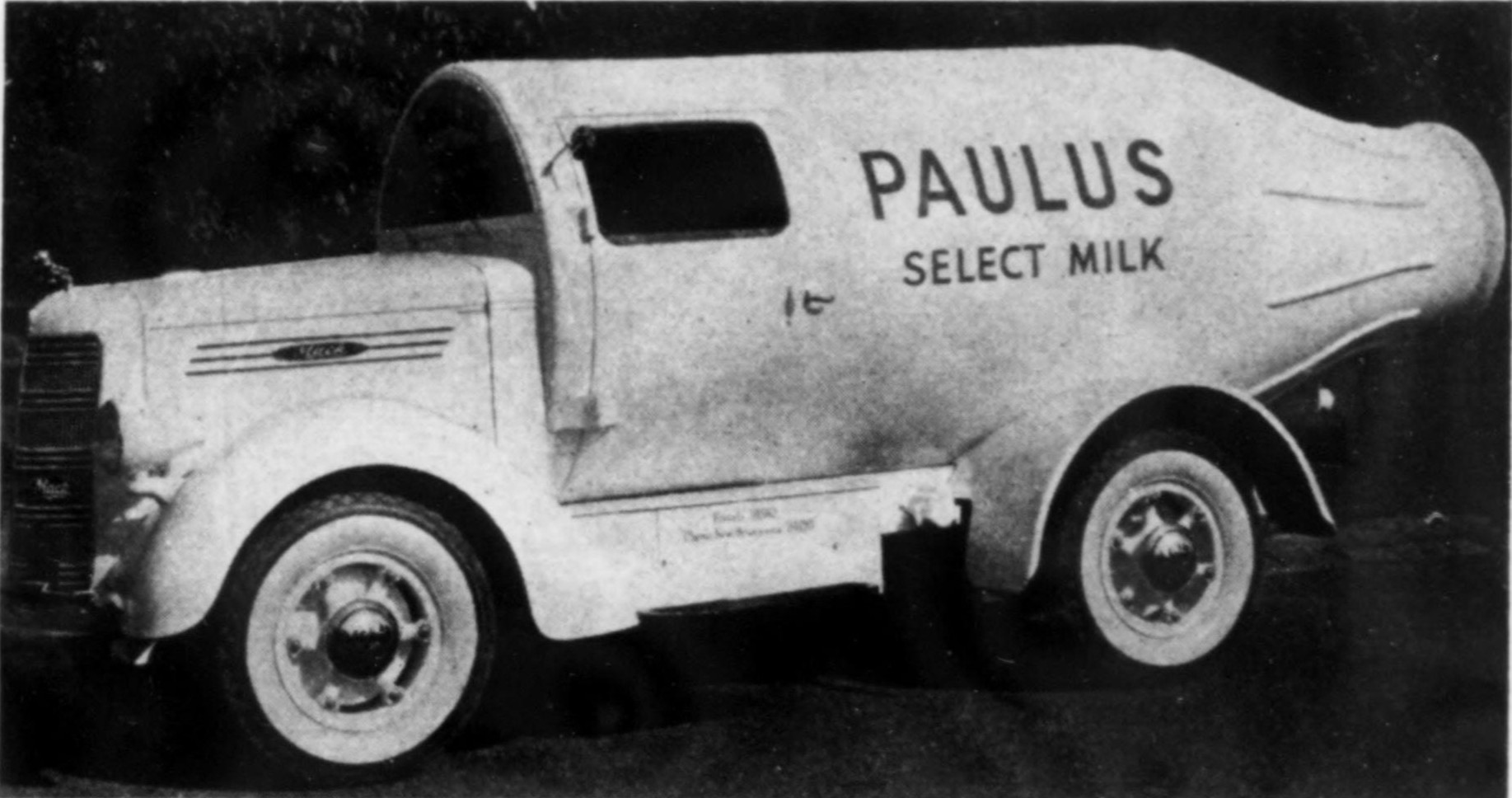
Still, Mack found some customers who wanted delivery trucks with that fabled bulldog hood ornament. One of the more bombastic Mack Model EDs was the one of the Paulus Dairy of New Brunswick, New Jersey. Instead of a typical delivery truck body, the Paulus Dairy made its truck look like a milk bottle. This was all the way back in 1940!
The Model ED found in the halls of the Mack Trucks Historical Museum is chassis ED152193. It was built on July 29, 1940, at the Allentown plant, and was delivered new to the Delaware Compressed Gas Co. of Wilmington. When the father of the current owner, Ron Smith, bought the truck in 1968, it came from the M&G Cockerham Co. of Malvern, Pennsylvania, for only $250 plus $12.50 in sales tax ($2,456 and $122.85, respectively). At the time, the truck was just a cab and chassis, with its box or bed having been removed long ago. The truck remained in this state until 1981, when Ron decided to restore the truck.
The restored truck features parts from a total of three Model EDs. The original engine had internal damage, so a Model ED with a rougher body but a good engine gave up its heart to the project. The rear axle, which was originally a dually setup with helper springs and a 6.33 to 1 gear ratio, was swapped out for a single rear wheel setup with a 5.12 to 1 rear axle. This Spicer axle came from the third Model ED. Thanks to the better gearing, the restored truck runs at 45 mph to 50 mph compared to the roughly 35 mph top speed of the original truck.

The beauty is currently on loan to the Mack Trucks Historical Museum, where I got to see it in all of its glossy blue glory.
Sadly, Ron’s Model ED is a rare beast. Just 2,686 units were built between 1938 and 1944. That means Mack sold fewer units of these than it sold the Reo-based Mack Jr. trucks. After World War II ended, Mack did not restart Model ED production. Instead, Mack ended its light-duty line and focused on its true bread and butter in the heavy-duty market.
An Obscure Part Of Pickup History
While the Mack Jr. and Model ED are just blips in Mack history, they were important ones. These trucks got Mack through a tough time when the whole nation and much of the world were struggling. Selling pickup trucks made sense when it was hard to sell heavy-duty rigs. Building a pickup truck like a scaled-down big rig also meant that Mack probably had one of the beefier pickup trucks on the market at the time.
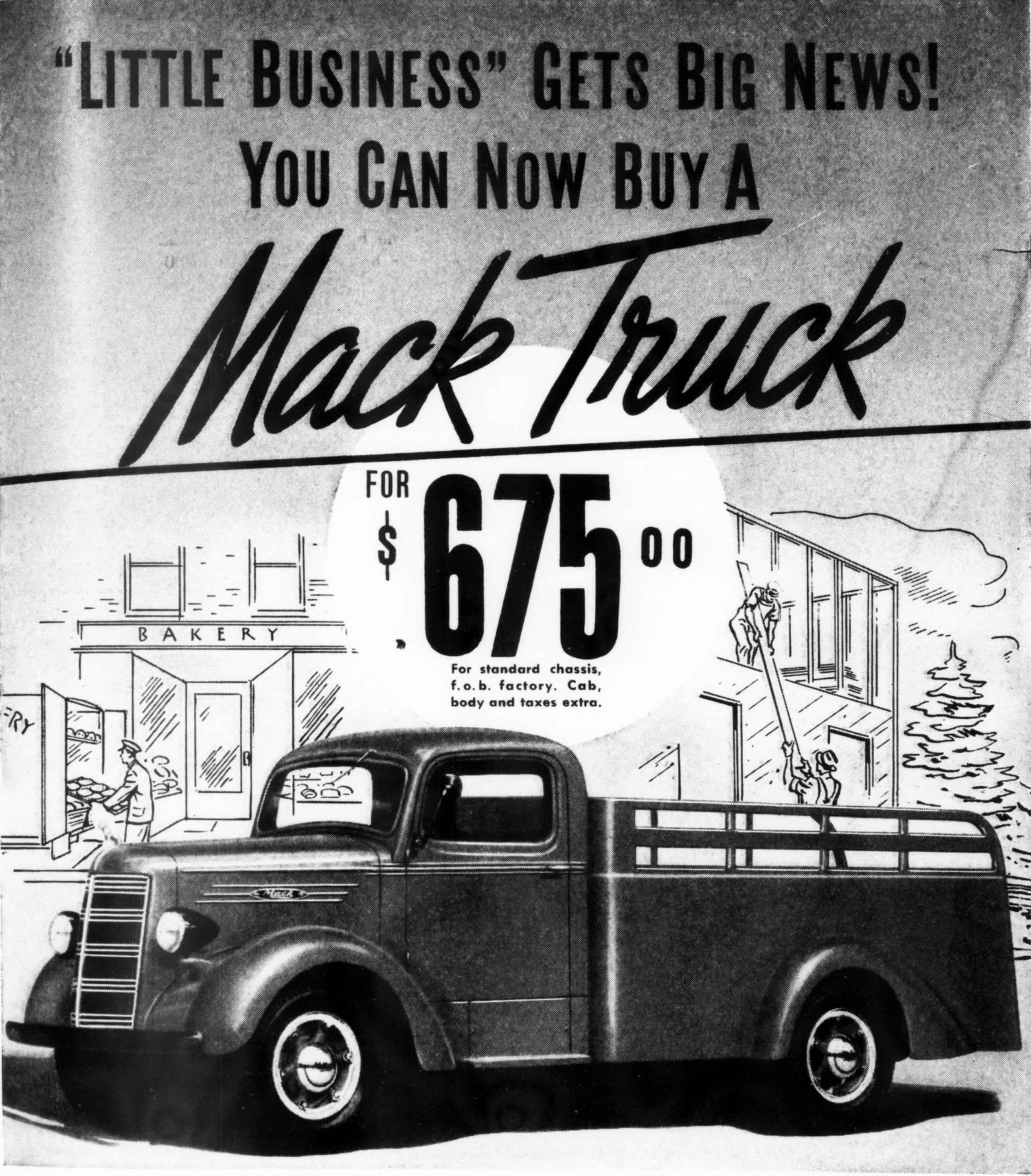
Pickups weren’t really Mack’s forte, however, and eventually, it left the light-duty markets to the likes of Chrysler, Ford, General Motors, and International Harvester.
Today, it’s believed that 50 or so Mack EDs survive. It’s not hard to find AI slop renders of Mack pickup trucks on the Internet, but the ED is the real deal, and they’re way cooler than anything a computer might generate from a prompt.
If you want to see one of the last surviving Mack Model EDs in person, I highly recommend heading to Allentown, Pennsylvania, and paying the Mack Trucks Historical Museum a visit. You, like me, probably won’t have enough time to pick your mouth up off the floor as you geek out about all of the history and engineering around you.
Top graphic image: Mercedes Streeter


They need to start building light-duty trucks again. The return of the Mack!
“Mack Jr., which isn’t to be confused with the Mack Junior”
Yeah, but which one is the Big Mac?
Now I want McDonald’s…
“Model ED as having the stamina and durability of a big truck, but in a small size.”
ED…ha ha ha ha ha ha ha ha ha ha
Thanks Mercedes! You have a great knack for resetting my memory on cool obscure things I saw once or read about long ago. In this case, it was simply one of these “Mini-Macks” I was able to see at a car show a number of years back. I can’t say if it was a Mack ED or Mack Jr. for sure, but it definitely looked a lot like the ED pics shown. There was a big crowd around it, with lots of people assuming it was some kind of custom-built outfit and the owner proudly pointing out that nope-it was factory original.
are you writing an article about the turbine mack or the space shuttle mack?
I’m mad that my former colleagues in Allentown made no mention of this, or made any effort to show me around.
I had never heard of this! This was a really cool article. The obscure pick-ups of this era are some of the most fascinating from a design standpoint. I think this is right up there with the Hudson Big Boy as far as a pretty design goes. This is definitely more practical, but they really didn’t have to make that cab look THAT good for it to be marketed as a work truck.
Dear Ms Streeter,
Thanks for the article on the Mack Jrs and the the Mack ED. My grandfather worked at the Allentown plant from the mid 1930s to the 1960s.
About 20 years ago, I saw some Mack Jrs and Mack Ed’s at a truck show in Macungie. I asked my grandfather about them. He said they were not very successful in the market place. Still, I am somewhat intrigued about a a Mack truck that could fit in a garage.
Neat! I had no idea that Mack once rebranded Reo Speedwagons and then had a medium duty like that of it’s own. Pretty little truck too!
That bulldog ornament is incredible.
The Mack Jr came out way too early. Imagine how well they’d sell today.
That is some cool, old iron.
Now THAT is a good looking truck!
Seems like they left the light duty market when they were making the best light duty trucks to concentrate on a more profitable semi market.
Thanks for the article – I always thought Macks were just pullers. Never knew about the history, buses and wagons. You are a total gem! Greetings from the independent state of Scotland (give it time.)
“The Mack Model ED was a bulldog”
Good one
So like the other ED, this one had all the right stuff, but just couldn’t deliver the goods in quite the best way.
It’s ok. It happens to all the truck manufacturers once in a while.
What a good-looking truck! While I’d heard of the Jrs, I wasn’t aware of the ED models. Thanks for the story.