

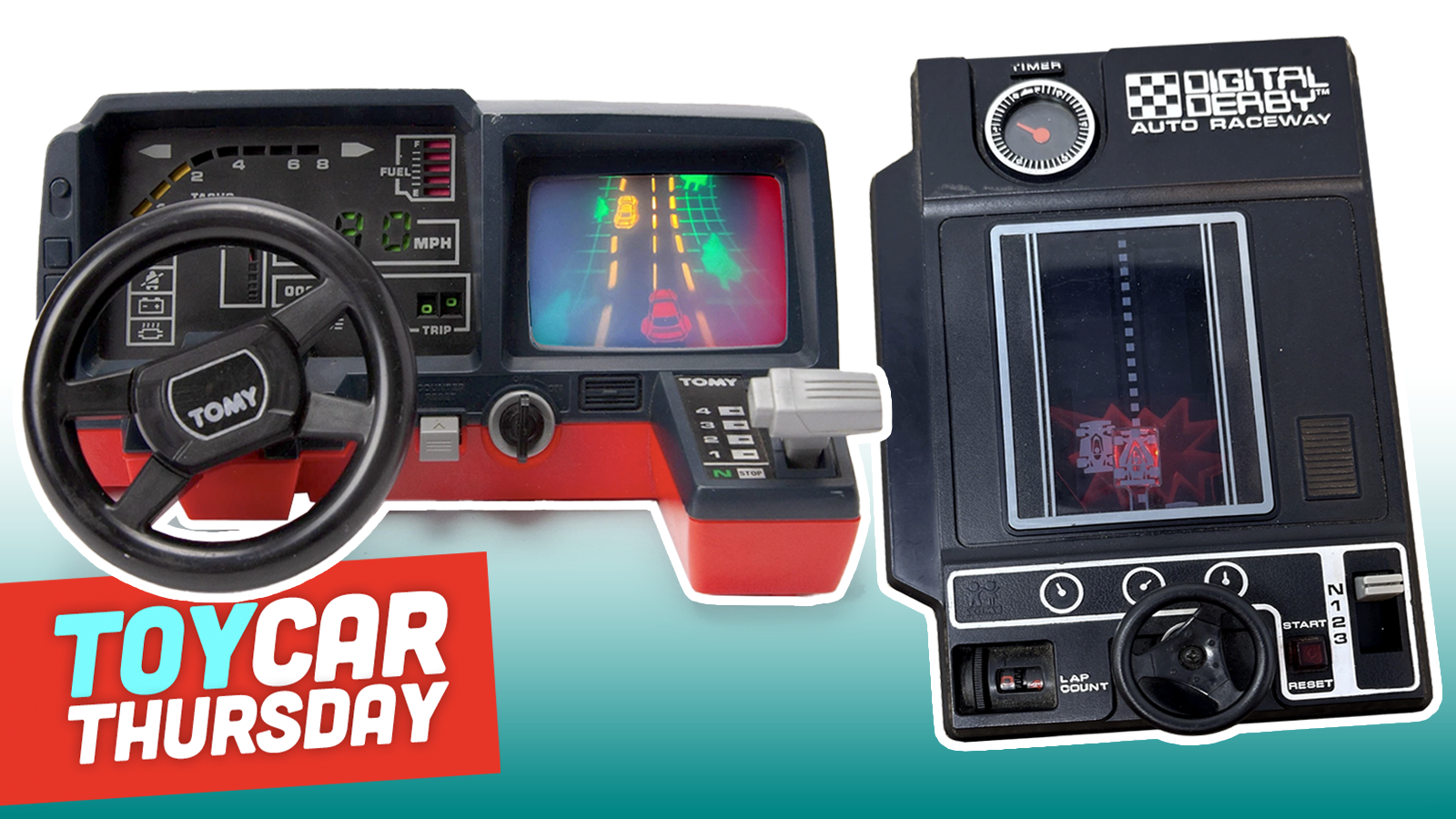
Back in 1976, the pop-culture zeitgeist was dominated by Dino De Laurentiis’ King Kong remake and Rocky in theaters, Queen’s Bohemian Rhapsody on the radio, Happy Days and Laverne & Shirley on television, and all things bicentennial everywhere else as the good ol’ USA celebrated its 200th birthday. As for car-toydom, 1976 was all about Hot Wheels, Evel Knievel, and slot car sets from Tyco and Aurora. And for the first time, auto racing play went electronic, with Mattel’s Auto Race.
I never knew Auto Race existed as a kid; I always thought the first electronic handhelds were Mattel’s Football and Baseball games. I was, however, keenly aware of Tomy’s electro-mechanical games that appeared in the years after Mattel made portable electronic gaming a massive hit with kids and adults alike.


I did not appreciate these toys at the time.
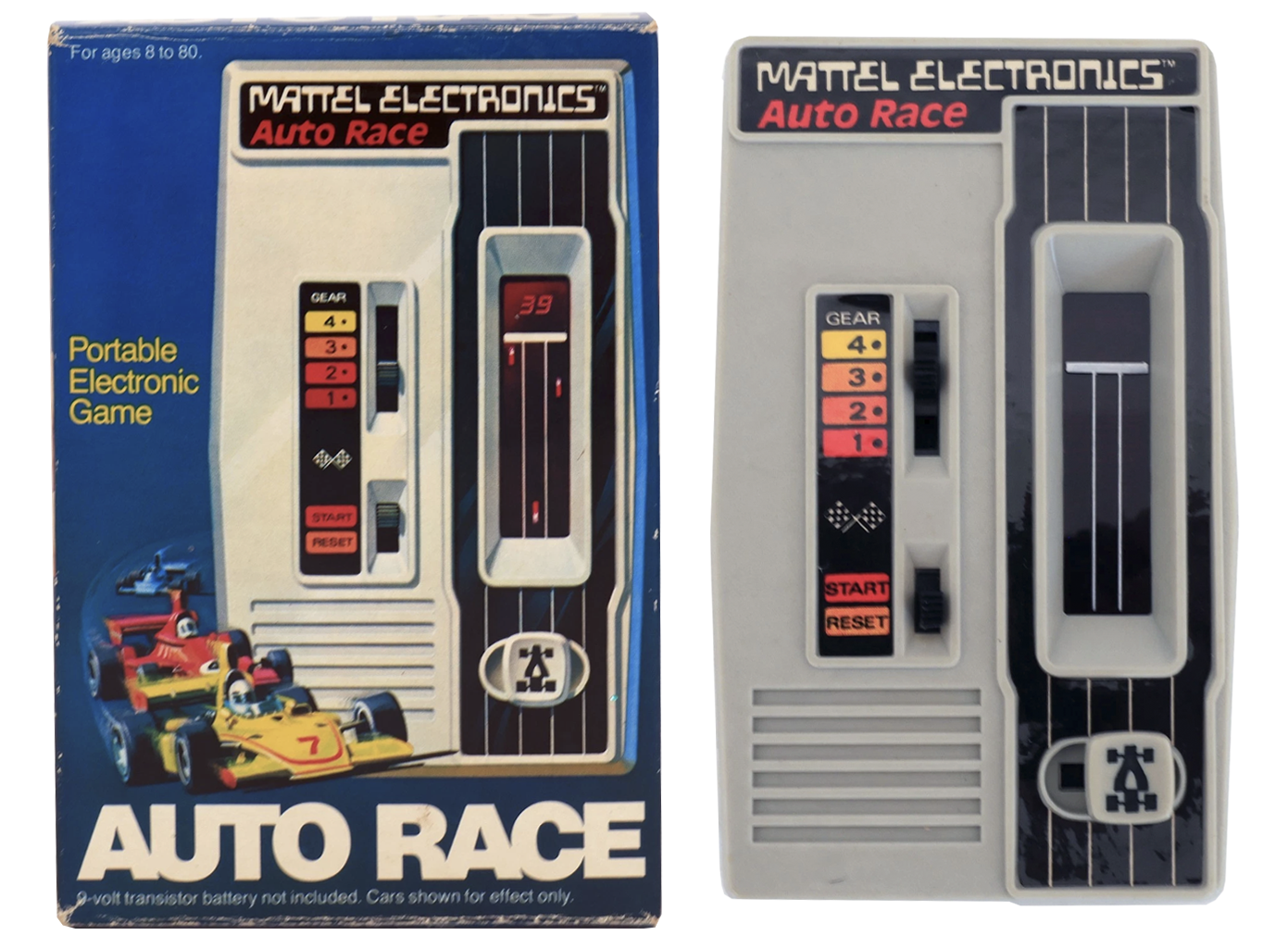
Like Mattel’s sports games, Auto Race had the player maneuver tiny LEDs to simulate on-field or on-track action. There wasn’t much fidelity to any real sporting, and the “resolution,” for lack of a better word, was ridiculously low; a screen might have three columns of ten LEDs, for example. And yet, the gameplay was lively, and electronic sounds and seven-segment LED scorekeeping felt like futuristic stuff.
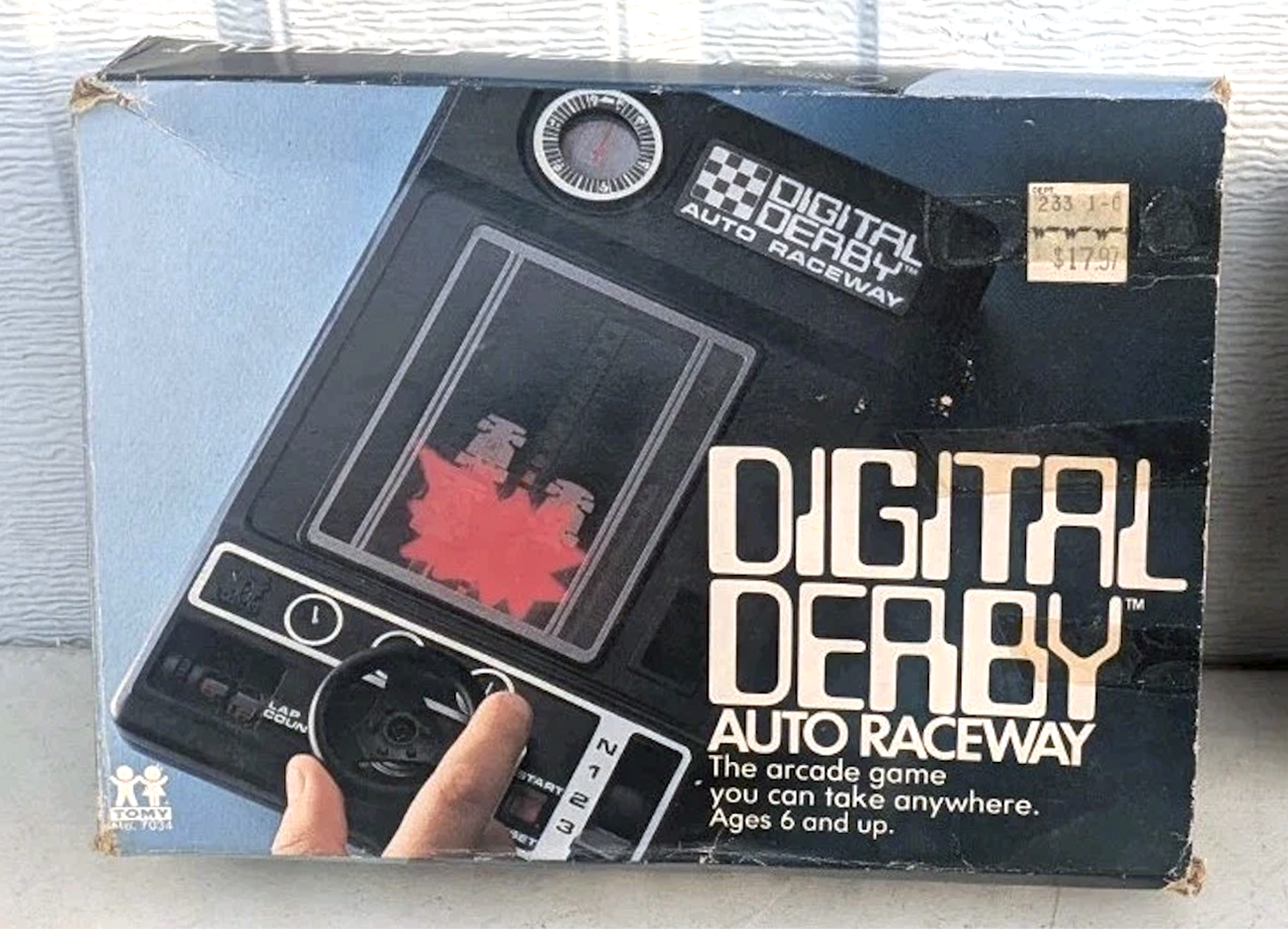
Decidedly unfuturistic was Tomy’s Digital Derby, which was most assuredly not digital. Kid-me wondered why the heck Tomy was bothering with a mechanical simulation of an electronic game some two years into the electronic revolution, but there it was: a noisy plastic box of wires, gears, film strips, and light bulbs that simulated a top-down, endless-road driving video game.
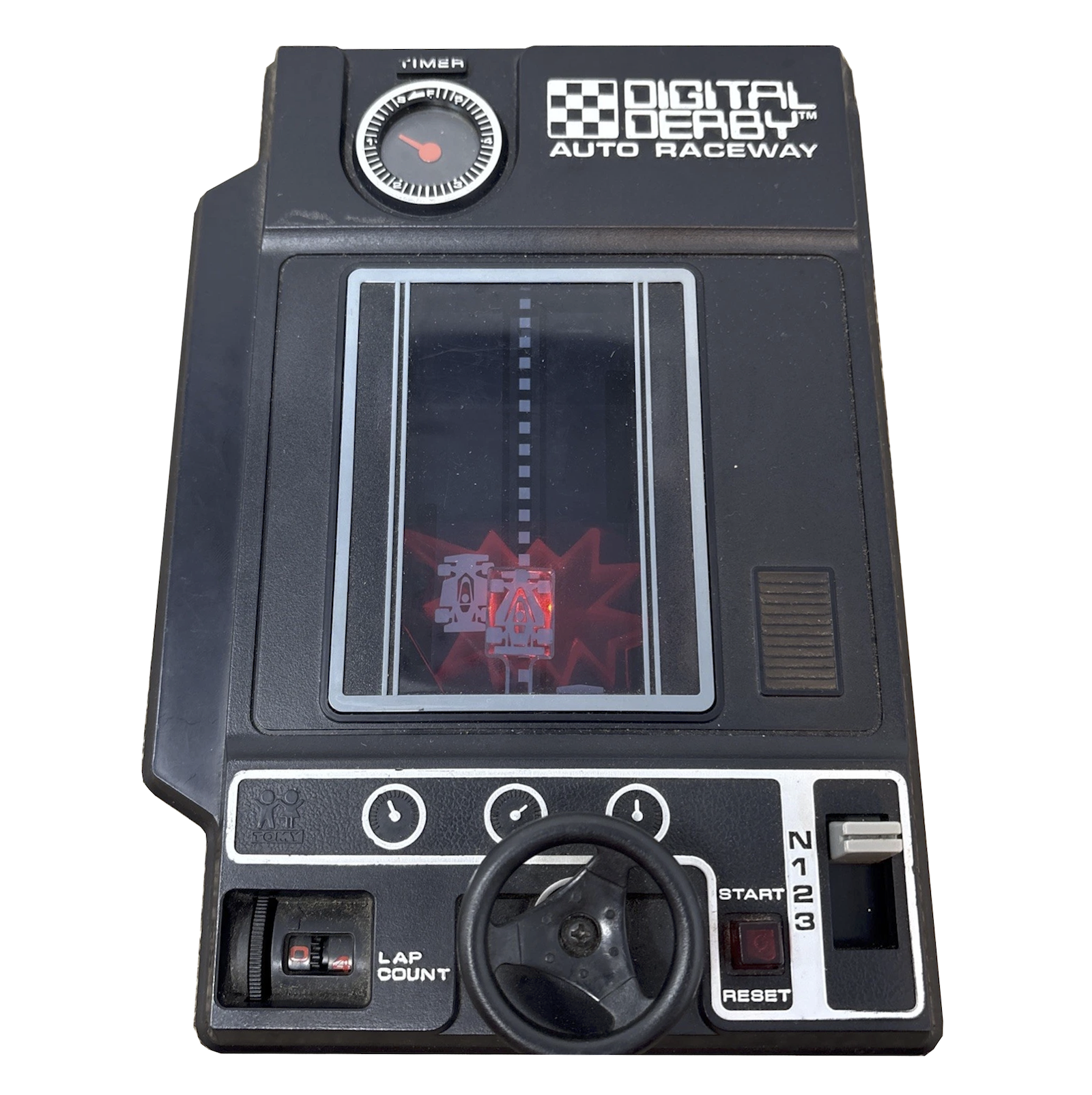
As the video below shows, Digital Derby racing is a straightforward if slightly weird affair. The steering wheel slides the image of your car from lane to lane, and your only job is to avoid the slower cars that you overtake endlessly. “Collide” with a car, and the action stops for a moment as a bulb lights up a translucent red “explosion.” Here’s where it gets really interesting: each lane is a looped film strip with the opponent cars printed on it. The speed of the strips is controlled via the N-1-2-3 lever, which, when applied skillfully, allows you to open a gap between side-by-side cars that would otherwise represent an unavoidable wreck.
And what exactly is going on inside Digital Derby to achieve this? Behold!
Yeah, that is a lot. Kid-me would have never gotten that thing back together once curiosity took hold and the screwdrivers came out. Adult-me is very impressed at the ingenuity of the design and how well it works, and I find the gameplay’s funky analogness that kid-me scoffed at to be fascinating and charming today.
Even as Tomy released solid-state electronic games in the early 80s and later, the brand still moved ahead with electro-mechanical driving games. Here’s Turbo Dashboard from 1982, which – true to its name – is equal parts driving game and dashboard simulator.
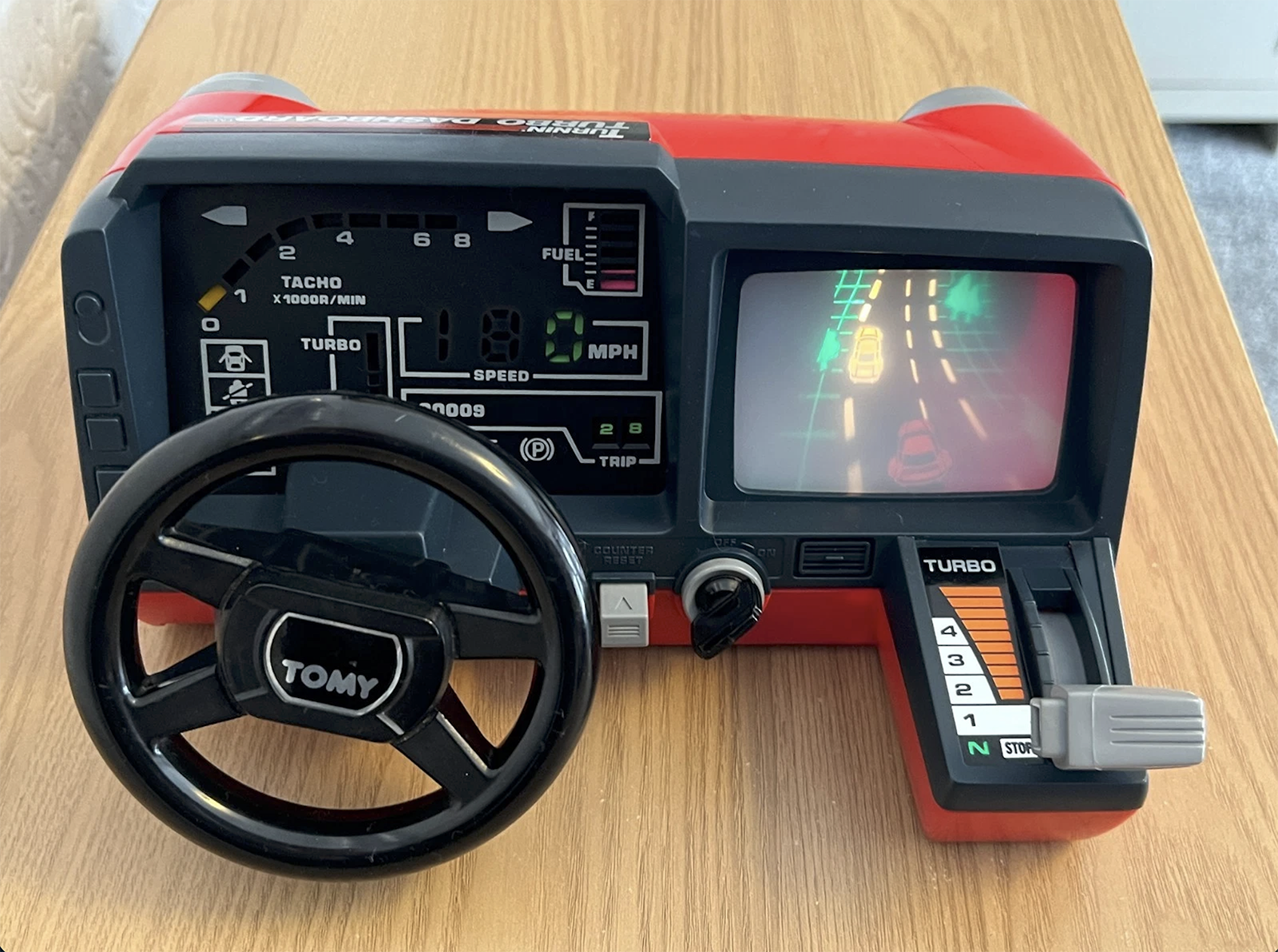
The gameplay on this one isn’t really a game at all, you just freestyle your way through an endlessly rolling street scene projected onto a curved screen behind a frosted panel that hides the workings within. There’s a car to avoid, but if you don’t swerve to avoid it, you’ll just roll right over it. If you want to teach kids that driving requires no responsibility and there are no consequences, this is your toy.
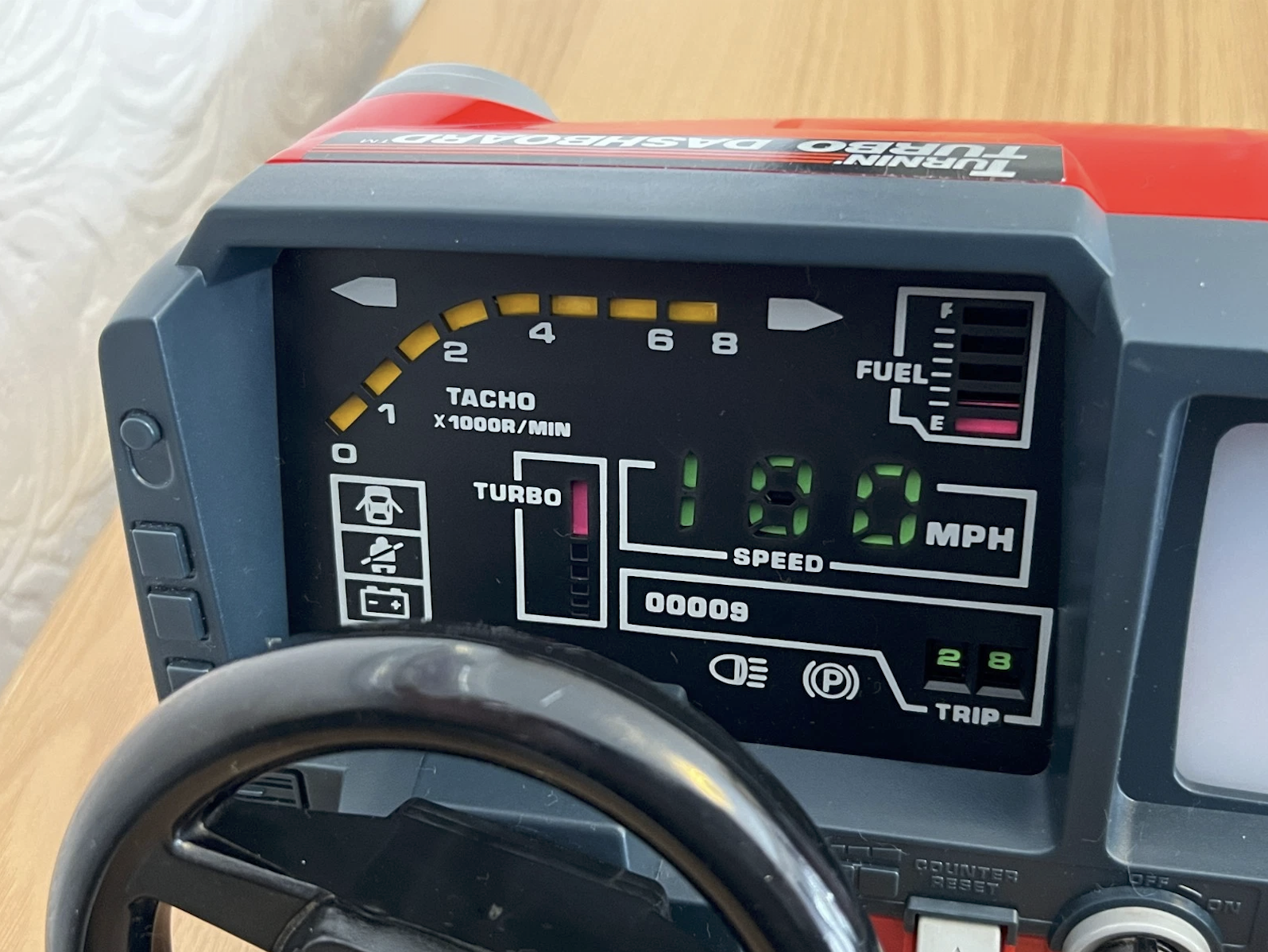
Amusingly, the dash’s “LED” representations are just openings in the display panel, with colored flats that move into position behind the openings to simulate LEDs lighting. The chunky ignition key turns the game on, and the large button next to it resets the trip meter. The display layout is entirely fanciful, but the Turnin’ Turbo Dashboard is trying very hard to remind you of a real car:
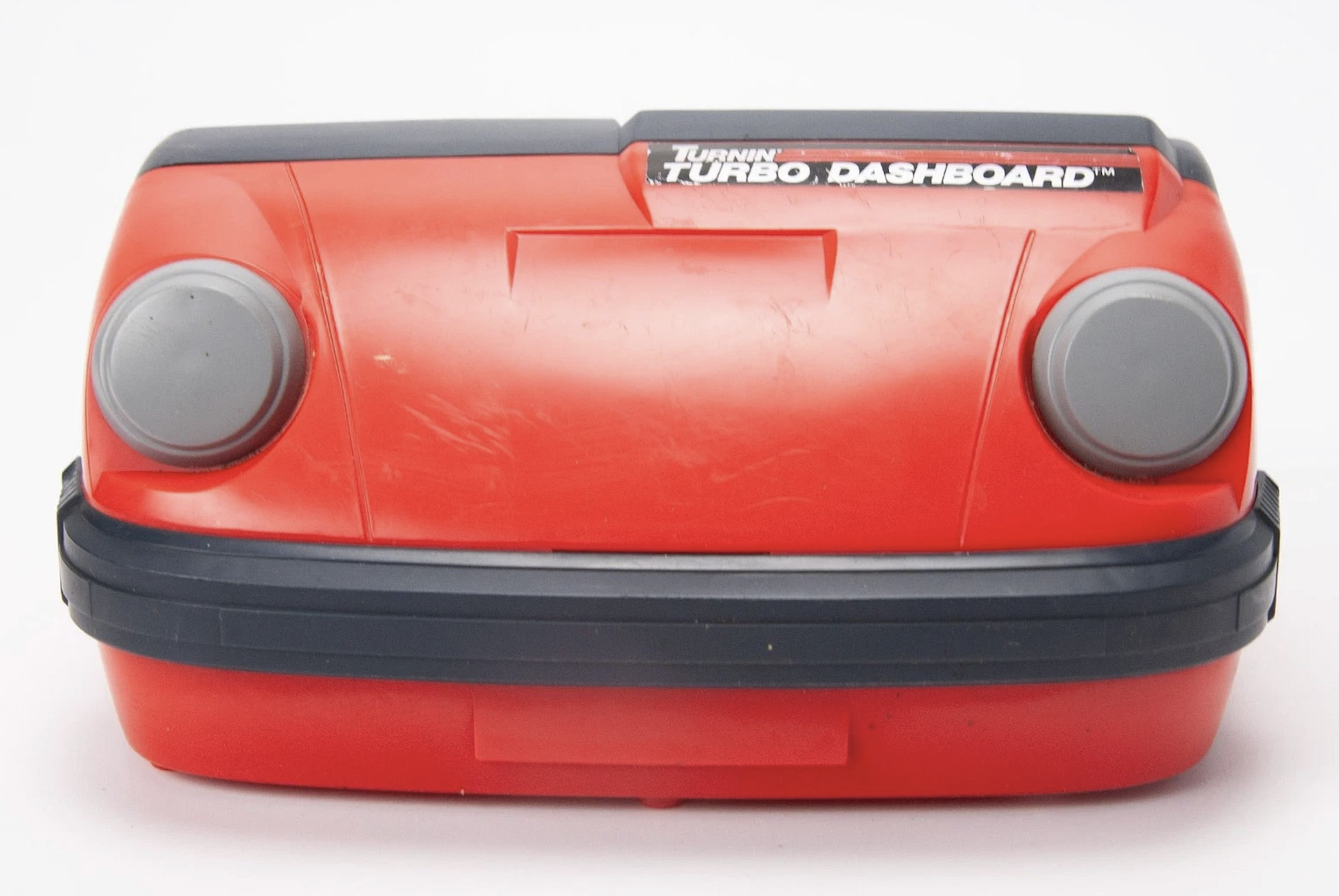
Yeah, that’s a Porsche 911. Obviously.
The most fascinating Tomy electro-mechanical driving game to me is Daring Driver from the 1982 Mini Arcade series. I love that it’s styled as a miniature stand-up cabinet, and the mechanism inside is truly inspired. And electronic! There’s an actual circuit board inside that controls LEDs flashing in sequence to simulate road markers at night. Increasing speed is simulated by the flashing sequence speeding up. The LEDs shine onto a curved mirror that appears to bend the “road” left and right as you steer. If you crash, a moire pattern is created mechanically and projected onto the screen to indicate fire. Or an explosion? Use your imagination.

… And that wraps up this brief look at just a few Tomy electro-mechanical games. Tomy made many others representing other sports subjects, each as ingenious as the last. Surely it would have been easier just to, you know, make electronic games, but would they be anywhere near as memorable or imagination-provoking as these contraptions? I don’t think so.
Top graphic images: eBay sellers


I had the Digital Derby, when I was super young, but I totally forgot until I saw that photo at the top. I think I really liked it, but it’s easy to impress a seven year-old.
The computer typeface is doing some heavy lifting on those vintage handheld games. You believe it’s high tech because it looks the part!
And Daring Driver isn’t bad; the action looks comparable to Pole Position or Turbo. But a 1:6 scale arcade game isn’t going to hold my attention for very long.
But definitely not cheaper to mass produce. LEDs and the logic chips chips to control the gameplay were not nearly as cheap as they are today. Moore’s Law dropped prices of semiconductors from the 80s to today way faster than plastic moulding.
IIRC, I got the Digital Derby because it was cheaper than the Mattel games.
wow. I had the the Tomy Dashboard Turbo and Digital Derby when I was growing up.
Incredibly enough, I had both the Digital Derby and the Turbo Dashboard as a kid in the 80s. Most of my toys had something to do with cars, and when I got Legos those all became cars too. 🙂
The availability of toys for kids these last few decades is mind-boggling.
100 years ago kid in the US probably just played with sticks and rocks between chores.
In my profession the preferred term for that is geology.
That’s a nicer term than rocklickers.
“sticks”
At least they were pro manual…
Also dogs: “Save the sticks! Save the sticks! Save the sticks!”
I had one of those Fun-To-Drive Corvette toys and I would beg my parents to let me sit between them in our Mercury Sable wagon so I could pretend I was driving on our long road trips. I enjoyed it more when my mom was driving as she was way more aggressive than my dad.
https://www.reddit.com/media?url=https%3A%2F%2Fi.redd.it%2Fv8b1kqsipzg21.jpg
I still have a Digital Derby in a drawer, I believe it still works. Now I have to go check.
I had digital derby too. I spent soooo much time playing that thing – seeing and hearing it again was a trip!
I had the Sears version of Digital Derby, the imaginatively named….
…Sears Driving Game. That’s some serious marketing moxie right there.
I forgot about that. Now that you mention it, I might have had the Sears version too.
Didn’t Sears have a driving school?
I’m 94% certain I picked up the digital derby game in the mid 80s when I was about 7 at a garage sale. I don’t think it ever worked quite right during my ownership. Probably long in a landfill at this point.
I had the Digital Derby. It was something to bide my time until Pole Position and my Atari 2600. (Dad did buy a tank game first.)
Pretty sure the tank game came with the 2600. Either that or it was one of the few games available at launch.
No, this was a stand-alone tank game. Two sticks on left and two on the right to control the tank. Four games that changed with a sliding switch that was basically light or dark colored playing field. Only two player, which kinda sucked for me. Came out about the same time as Pong.
Found a photo: pic
Ah, I see! I don’t recall ever seeing that game before, very cool, even if limited game play.
I wanted one of these so bad as a little’un.
Then, some years later, we got a Playstation, something my brother and I actually saved up to buy. And I discovered Gran Turismo. And that was that.
When I win the lottery I will have a row of Sega Rally II arcade cabinets
I had the Turbo Dashboard too. I remember building a “car” out of boxes and some random junk in the basement so you could get in, fire up this dash, and then “drive” to the next location.
Hah, good times. Life was simpler in ’83.
Auto Race was my jam as a kid…I can still hear the sounds in my head.
I had a Turbo Dashboard when I was a kid. Possibly it still somewhere in my mother’s apartment.
My folks ruined these for me. With a home PC since 1980 (when I was 6), I always found these handhelds to be far too primitive to be interesting/enjoyable for longer than about 45 seconds. Games for the Atari 800 (and our older, 2600 console) were vastly superior to these. In the 80s, once we had access to “Pole Position” and later OutRun at home, or something like “Test Drive” on our 286, these handheld racing games felt like they were for toddlers.
On a side note, our 486 had a “turbo” button which basically makes it an electric Porsche.
Electric Porsches also have Turbo badges, making a nice circularity there.
Not to brag, but I had three out of the four of these way back in the day (I never knew about the Mini Arcade Daring Driver). The Turbo Dashboard looked the coolest, but the Digital Derby was the most fun, followed closely by the Auto Race. Putting it into high gear turned up the difficulty and made for some intense competition against my brother during road trips.
My grandparents had the Tomy Turbo Dashboard. Seeing it raised memories of 4-5yo me playing it from the dark recesses of my mind. This must have been around 1994-95, so it would have been a hand-me-down from one of my older cousins.
Good times.
“There’s a car to avoid, but if you don’t swerve to avoid it, you’ll just roll right over it. If you want to teach kids that driving requires no responsibility and there are no consequences, this is your toy”. So this is like having a car from that one electric car company that has “Full Self Driving”?
Tomy made all sorts of cool stuff back then! And eventually, other companies took notice and copied them, because, of course.
That Turbo Racer dashboard toy had a Corvette counterpart made by Playmates. It’s very similar, but it has working pop-up headlights! I have one in the original box awaiting a “restoration”; it’s not getting power due to some unfortunate battery corrosion.
I loved Digital Derby as a kid! Good times.
Digital Derby was pretty ingenious. I remember how like most kids, my original goal was get to the highest gear and brute force things through. Then you learn that won’t work and actually figure out how to strategically use the different speeds.
Autorace was just boring. Football was way more fun.
I had a Digital Derby handheld as a kid, too. Using the “gearshift” to adjust speed for overtaking strategy definitely made it more fun — probably because the analog setup was given to being more random anyway. Unlike a lot of truly digital games of the day, there was really no clear repeating pattern to the game that you could memorize to work around.
I had that dashboard one as a kid. Played with it so much, it broke. My dad took it apart and fixed it with a soldering iron.