

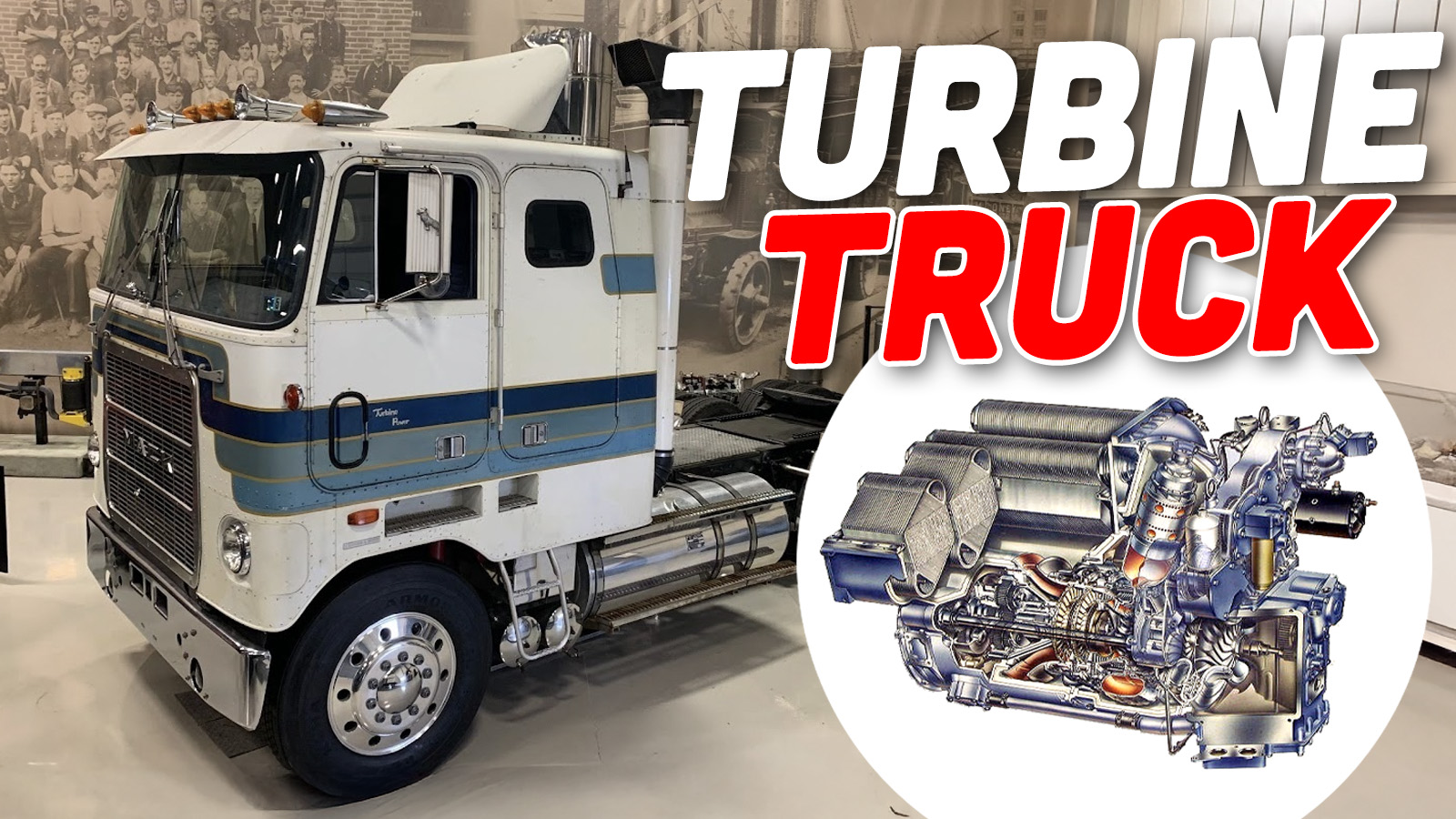
Since the 1930s, the diesel engine has proven itself to be a reliable and powerful workhorse in much of the world’s industries. Peek under the hoods of semi-tractors, open the service doors of a locomotive, or fire up a bulldozer, and you’ll hear the familiar clatter of the engine that changed the world. But for everything the diesel engine has given the world, it isn’t perfect. Back in the 1950s through the 1980s, engineers and companies all around the world tried to find the next thing in propulsion, and many were enchanted by the promises of the gas turbine engine. In the 1970s, Mack Trucks built what was probably the best turbine truck of the era, which actually made more power than a comparable diesel while weighing less. But there’s a reason why you don’t see turbine trucks thundering down America’s highways today.
Diesel power might have fallen out of favor in passenger vehicles, but Rudolf Diesel’s invention remains the king of the open road. Trucks of the distant past utilized gasoline engines that guzzled fuel, needed frequent repairs, and sometimes fell short of power demands. The diesel engine was a revolution with its mountain of torque, high efficiency, and ability to rack up some ridiculous miles. But there’s no such thing as a truly perfect engine.


Like most reciprocating engines, diesels have lots of moving parts that can fail, and they aren’t as efficient as some engineers would like them to be. The diesels that live in heavy trucks also tend to be mammoth units that, on their own, can weigh as much as a small car. The engineers at truck manufacturers and automakers are always looking for the next big thing, and for a period in about the middle of the 20th century, there were two technologies that captivated the world of transportation. Car engineers and motorcycle builders were obsessed with the promises of the Wankel rotary. Over in trucking, it was the gas turbine.
Turbines had proven themselves to be a great technology in aircraft during World War II, and it wasn’t long before engineers wanted to see what the gas turbine could do here on the ground. If you believed some companies in those days, piston engines were too complex, too unreliable, too inefficient, and not powerful enough for their roles. Multiple diesel-electric locomotives had to be lashed up to pull heavy trains, and semi-tractors suffered with mid-single-digit fuel economy.
The potential advantages of the gas turbine were too great for many of the world’s engineers to ignore. Research had shown that gas turbines could produce the same power as a piston engine that was twice the size and twice the weight, and the turbine would do it with fewer moving parts. There was also a belief that a turbine could be made to be cheaper to run and more reliable than a diesel. Then there was the sweetener in that gas turbines could run on practically any fuel, even coal dust. It’s easy to see why people thought these engines were the future. As such, pretty much all of the world’s largest truck manufacturers tried to make gas turbines work, including Ford, General Motors, International Harvester, Leyland, Magirus-Deutz, MAN, Berliet, Freightliner, Chrysler, Kenworth, Peterbilt, and Autocar. Even Boeing got into the turbine truck madness.
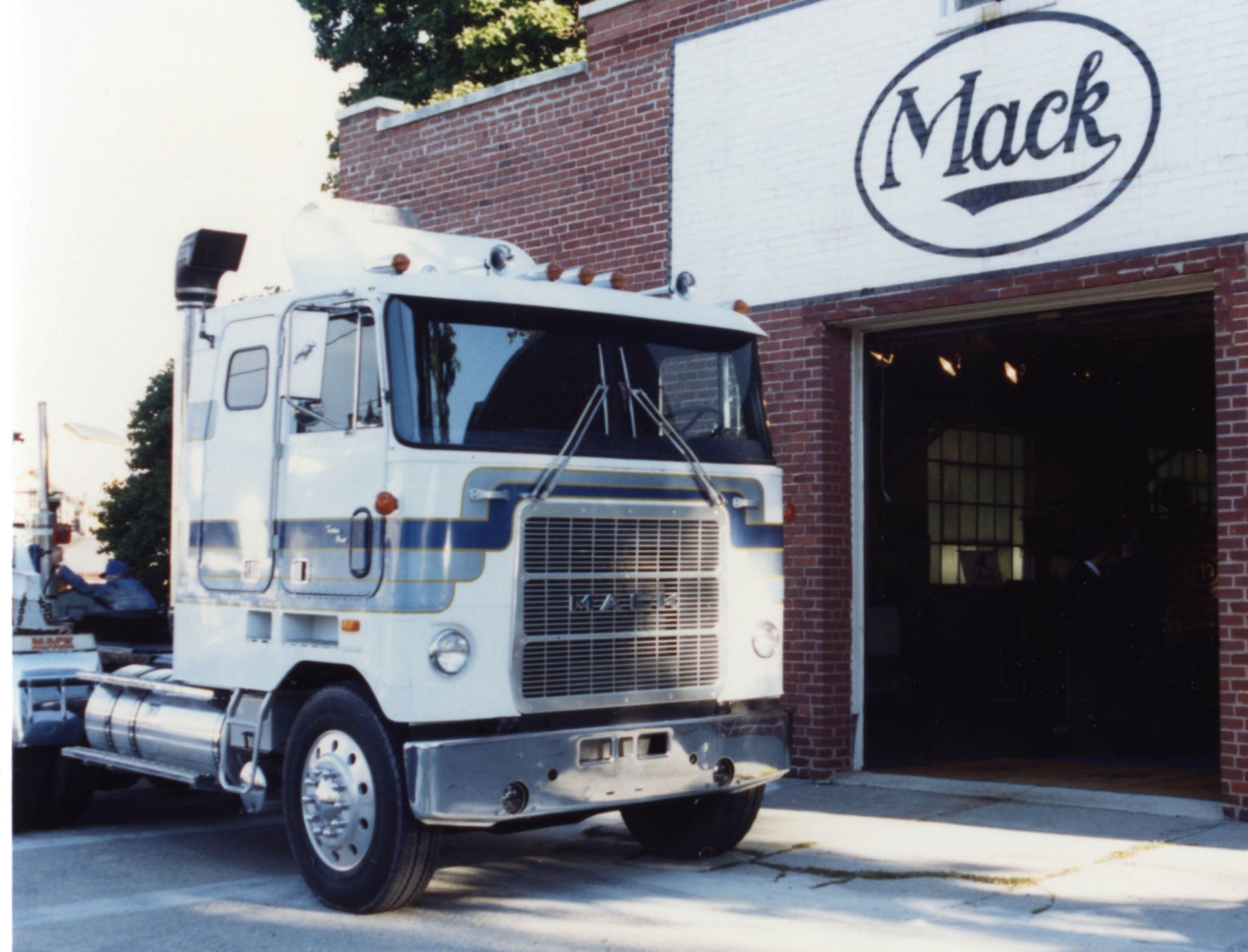
Many truck manufacturers tried and failed to put gas turbine-powered semi-tractors into production. Some companies came closer than others to creating turbines that matched the promises. Perhaps one of the greatest turbine trucks of the era was the Mack WS760LST, a cabover that came swinging for the fences with 550 horsepower, or hundreds of ponies more than some other projects.

The Quest For Power
In June 1969, Commercial Motor magazine reported that something was brewing over at Mack Trucks. The truck manufacturer, which was owned by The Signal Companies Inc. at the time, joined forces with another Signal brand, Garrett AiResearch, to kickstart research on a gas turbine semi-tractor project. At the time, there was already a flurry of interest at Garrett in putting turbines in road vehicles. In December of the year before, Garrett inked an agreement with Cummins to explore the feasibility of turbine power in trucks and construction equipment. Both companies planned to put a gas turbine truck into production at some point in the future.
Sadly, Mack gave no details about the turbine test truck it built in 1969, other than saying that the engine powered an F-model cabover rig with a modified Allison transmission. As Mack Trucks Historical Museum historian Doug Maney says, there was another event that motivated Mack to go to turbine power. The federal government was looking to reduce the speed differential between slow trucks climbing long grades and the passenger vehicles that could go faster up those hills. The gas turbine was seen as a potential solution.
As the project progressed, Mack and Garrett learned that the crowd of truck manufacturers that wanted to put turbines into production was vast. In 1972, the pair would link up with AB Volvo of Géteborg, Sweden, and Kléckner-Humboldt-Deutz (KHD) of Cologne, West Germany. Together, the quartet of companies sought to pool their resources and capital to see one unified turbine project to completion. They didn’t just work together, either, as they formed an entire joint venture, Industrial Turbines International (ITI), to develop gas turbines. Volvo would reportedly leave the project in 1975.
The companies decided to go big with their first project, a gas turbine engine with an output in the range of 450 HP to 650 HP. These engines would be used in trucks here in America, plus trucks and buses in Europe. If the engine worked out in those applications, they dreamed of going even bigger by placing turbines in ships and as stationary generators. In other words, ITI was supposed to be a one-stop shop for turbine power. Their engine wasn’t just going to have fewer moving parts than a piston diesel, either, as ITI wanted its turbine to outclass diesel in every respect.
The addition of Kléckner-Humboldt-Deutz wasn’t entirely random. The company, formed in a 1938 merger of Deutz, Humboldt, and Klöckner-Werke, had been building gas turbines since 1956. KHD had a little bit of everything in its portfolio, from industrial equipment and engines for construction and farming to aviation engines. This meant that the ITI concern would gain additional turbine expertise. ITI figured that it could get a production turbine truck on the road by the mid-1980s.
According to a paper published by the American Society of Mechanical Engineers by G. D. Woodhouse, who was then a staff engineer at Garrett, ITI spent much of its time from 1972 to 1976 researching, designing, and optimizing a new gas turbine engine. The first real sign of life from the project came in 1977, when ITI built three prototype gas turbine engines. These engines were bench tested, then, in 1978, one was fitted into a Mack R700 conventional tractor. The MkI test engine demonstrated that the basic design of the gas turbine was adequate, and ITI greenlit the creation of five more test engines and two more turbine test trucks.
ITI conducted extensive research that looked at some previous gas turbine efforts in the aviation, industrial, and automotive sectors. Through it, ITI found out that diesel engines that make a little power cost a lot to build on a dollars per horsepower basis, but the cost per horsepower goes down as more power is added. Somewhere between 200 HP and 500 HP, however, adding more power to a diesel engine made it cost more.
Gas turbines tended to be more expensive per horsepower until a crossover point after 500 HP and before 1,000 HP where a theoretical gas turbine would cost the same as a diesel that makes the same horsepower. This was some of the reasoning behind targeting a high output. ITI also studied different gas turbine designs, factoring in cost to build, efficiency, durability, and other parameters.
The Most Ambitious Turbine Truck Engine
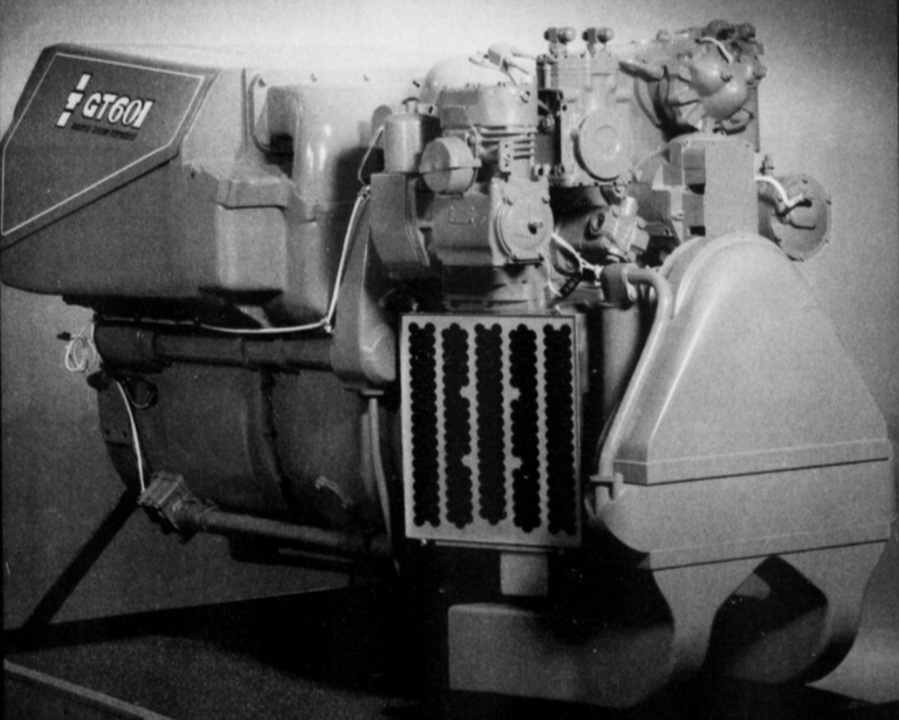
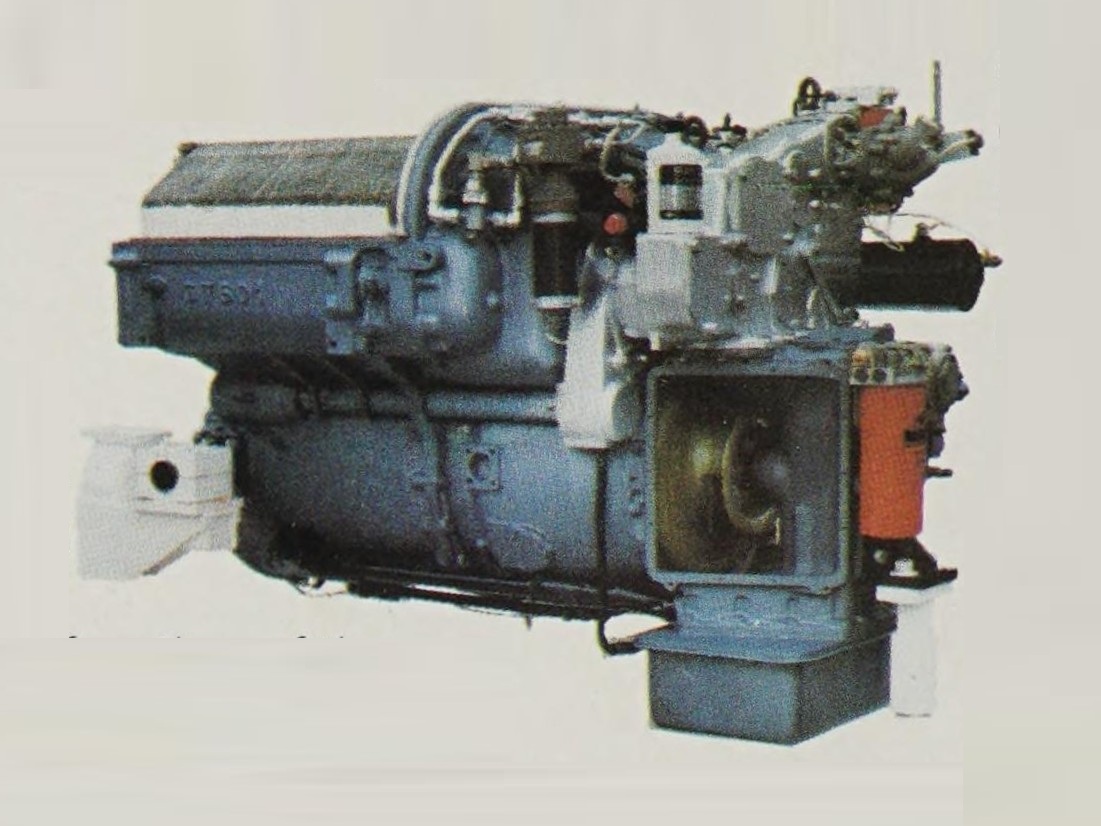
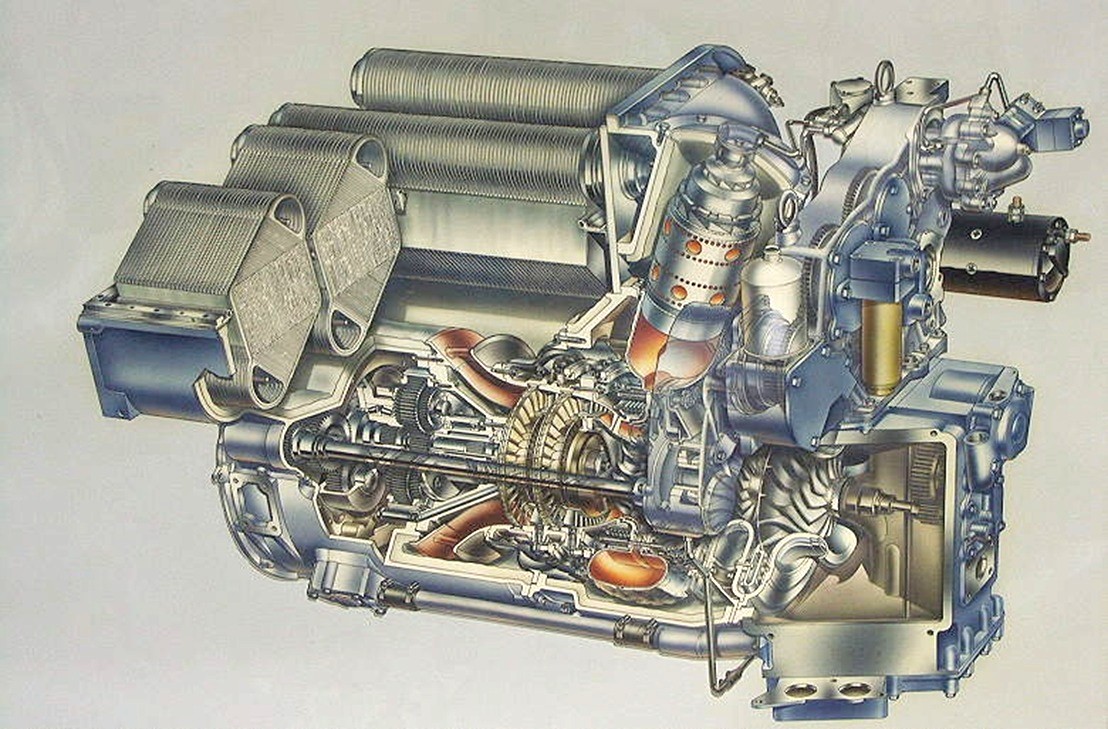
ITI came out of the other side of its research with the 550 HP GT-601 gas turbine, and I’ll let G. D. Woodhouse of Garrett explain the design:
The GT601 is a medium-pressure-ratio, recuperated-cycle, free-turbine engine. […] The engine comprises a two-stage centrifugal compressor, a four-module recuperator, a single-can combustor, a radial-inflow gas generator turbine, and a two-stage power turbine utilizing variable geometry stators. The engine is controlled by a hydromechanical fuel metering system. Start-sequencing and control-trimming is handled by an electronic control module. A brief description of the major components is given in the following paragraphs with some of the rationale for the component selection.
The two-stage compressor design evolved from a detailed parametric study involving stage work split, efficiency, flow range, diffuser exit Mach number, castability, stress levels, and vibratory conditions. Power density considerations, kW/m3 (hp/ft 3 ), and the demand for best specific fuel consumption at part power (circa 85-percent power) dictated a pressure ratio in the 6 to 7:1 range. Single-stage centrifugal designs were explored, but the envelope penalty of the greater diameter, with lower efficiency and reduced range, was considered a disadvantage that out-weighed any potential manufacturing cost benefit. This is one of many examples where system optimization affected a component selection. The acceptability of the various compressors studied for this power unit was considered, with the interrelated aspect of control system sensitivity and complexity. Thus, the considerably greater surge-free range and the location and shape of the efficiency islands in the two-stage solution reduced the demands placed on the control system. In summary, system complexity and, hence, fabrication cost and long-term durability and reliability favored the two-stage configuration. The selected design utilizes all cast rotors; the first-stage is K01 Aluminum, and the second stage is 15-5 Steel. Extensive aerodynamic and manufacturing studies were performed in the evolution of the low-cost interstage crossover duct. Rig tests verify that no performance penalty is incurred by this considerably lower manufacturing cost solution.
One of the ways to increase the fuel efficiency of a gas turbine is to add a recuperator. In the most basic gas turbine designs, waste heat from the engine is exhausted into the atmosphere. However, engineers have seen that as wasted free energy. A recuperator heat exchanger recovers some of this heat to fire back into the intake air stream before it reaches the combustor. This pre-heats the combustion air.
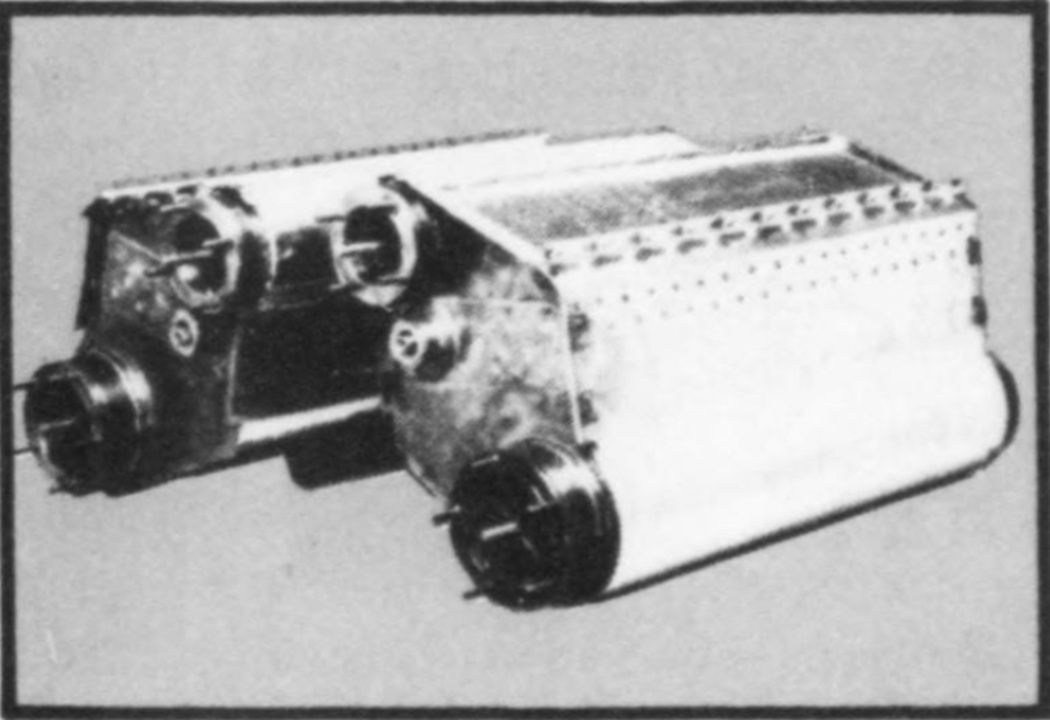
In theory, a recuperator done right can result in double-digit efficiency gains in a gas turbine. Some of the gas turbines I have written about had horrifying fuel efficiency in part because they didn’t efficiently reuse some waste heat. Anyway, Garrett continues about the GT-601’s design:
Four identical modules are mounted above the rear of the engine barrel. Early installation studies examined the performance/envelope/fabrication cost tradeoffs associated with one-, two-, and four module approaches. Despite the more complex ducting associated with the four-module concept, overall packaging of the modules was determined superior to the other arrangements. Stress levels in the plates or “tubesheets” and the manifolds of the various designs favored the smaller modules. Over 2 years were consumed in the optimization of the recuperator design. The conflicting “demand triangle” of performance manufacturing cost and durability resulted in a complete revision to previous Garrett designs in terms of materials and methods of construction. Prior to the GT601 and in the early proposed GT601 designs, a traditional “log cabin” construction was utilized. The configuration is shown in comparison with the evolved design utilizing formed plates. This design has been extensively rig tested, using a pressure/thermal cycle based on vehicle operating cycle and has proved to be failure-free in either rig or engine operation.
Performance goals of the GT601 are met by this relatively straightforward recuperator design. During the design evolution, several concepts were examined that would permit higher recuperator inlet gas temperatures, albeit at a material cost penalty. From this, the inference is that engine performance improvements based on higher cycle temperatures need not be inhibited by current recuperator temperature limitations.
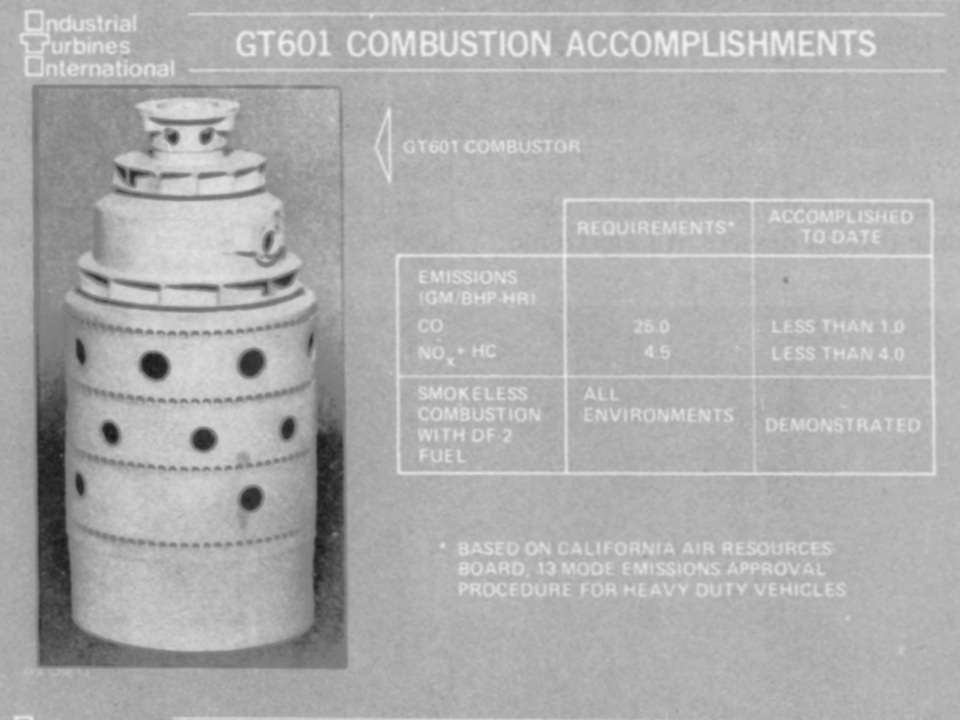
The GT601 combustor is a relatively simple single-can design. Fuel is introduced by a conventional air-assist/air-blast atomizing nozzle. The engine specification requires the ability to burn the customary range of hydrocarbon fuels, but the primary operating fuel was identified as DF-2 diesel. The engine must start and operate smoke-free from sea level to 3500 m (11,483 ft). Moreover all emissions requirements must be met. Prior to selection of the present fixed-geometry system, studies and tests were conducted on various prechamber designs, using fixed and variable geometry. Although further reductions in allowable emissions might dictate the complexity of variable geometry, results of both rig and engine tests indicate that the present simple system is capable of meeting all projected emissions requirements.
Garrett continues that the GT-601 has a gas generator turbine that is designed to combat the corrosion that is normally caused to hot-end turbine components by running high-sulfur fuel in a salty environment. Where might a truck end up in such an environment? Garrett points to trucks that operate in northern states during wintertime.
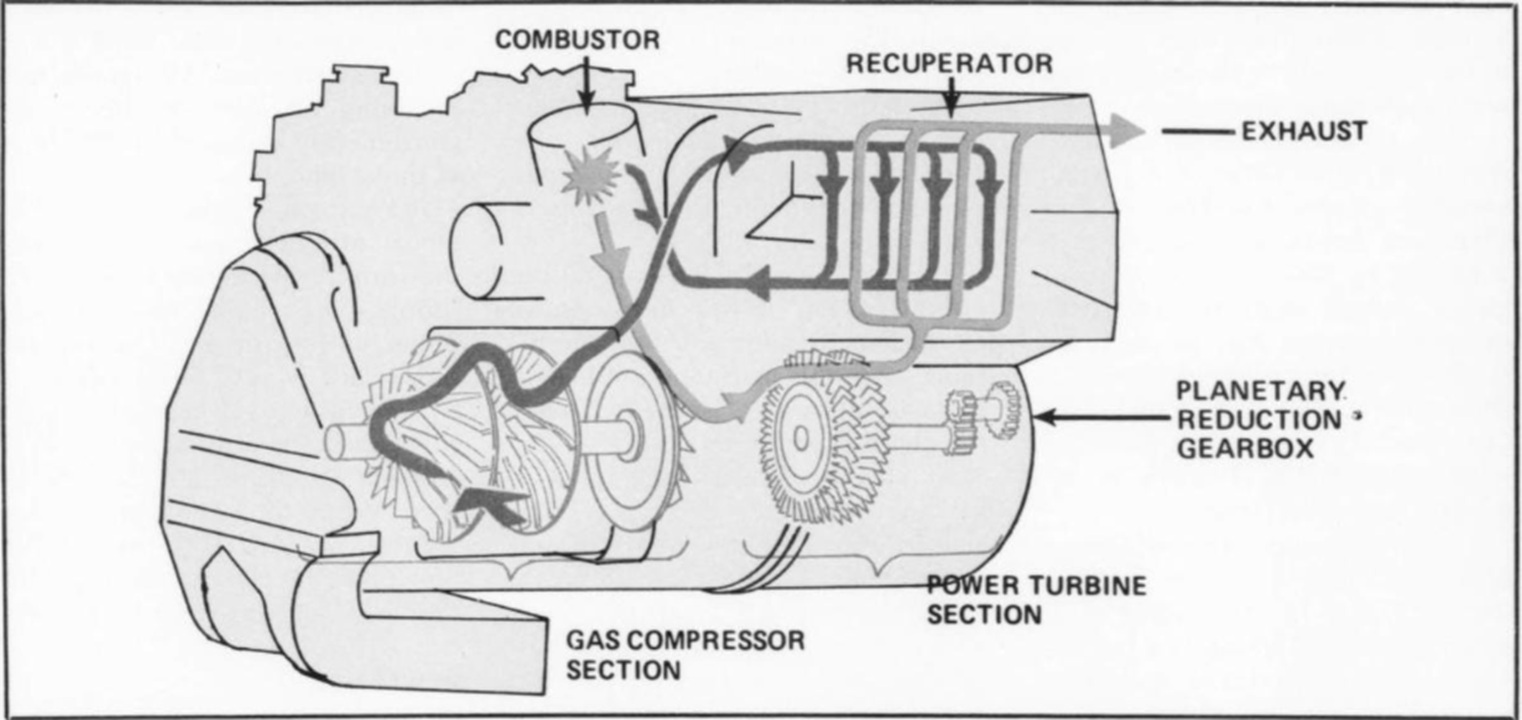
Garrett also noted that the engine has a two-stage variable-geometry power turbine and that, while an automatic transmission would normally be required for a turbine, research had shown that sticking with a manual transmission has a cost advantage. As an additional upside, the manual transmission was the standard of the trucking industry, so a driver wouldn’t have to do anything different.
The GT-601’s fuel system utilized a hydromechanical fuel pump and metering system. An ECM was the brain of the engine and provided automatic start sequencing and used its internal logic to tune the engine in real time to burn as little fuel as possible. The ECM also has safety controls that can flat-rate the engine and cap its torque.
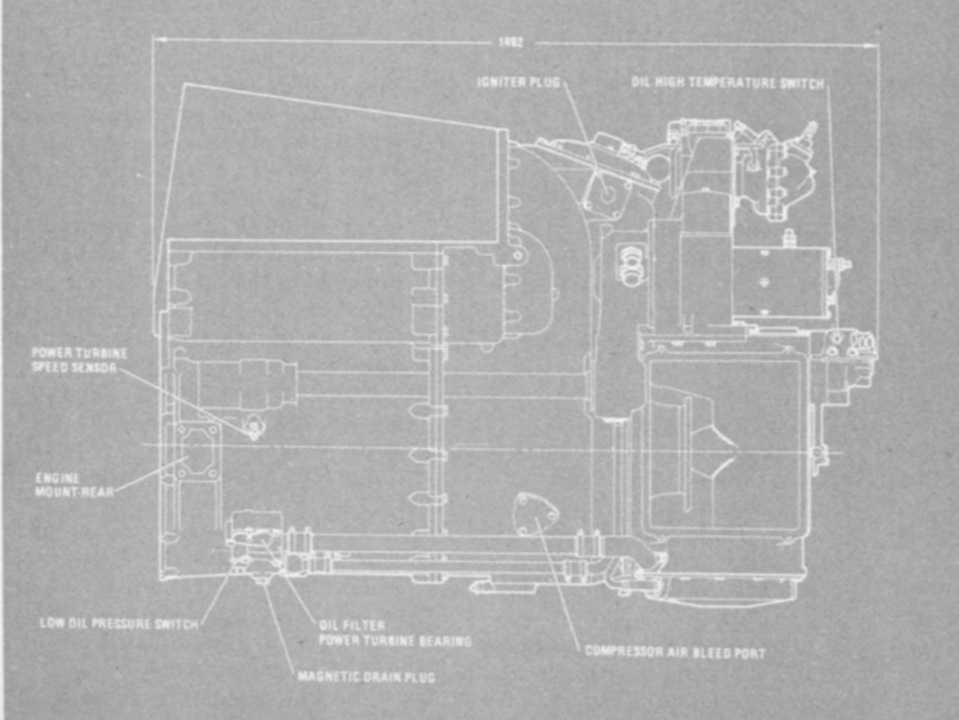
As a form of redundancy, ITI ensured that a computer failure would not strand the truck. Apparently, the turbine will run entirely mechanically, with the main detriment being increased fuel burn until the computer can be restored. The engine’s starter, fuel pump, alternator, and Freon compressor are gas generator-driven, while the brake compressor is power-turbine-driven. The oil pump and power steering pump are driven from either turbine through what Garrett calls an overrunning clutch, where the “highest wins”.
The GT-601 also had an engine braking function that used a clutch to lock the power turbine to the gas generator. The ECM would then cut fuel flow to a minimum. Garrett found that, at an output shaft speed of 3,000 RPM, the engine was capable of producing 600 HP of braking power.
Promising Tests
A complete GT-601 weighed 2,178 pounds (Garrett noted that an equivalent diesel would weigh 3,000 pounds), and Garrett touted the engine’s lack of a belt drive for accessories as a benefit. Another proposed benefit was that since the GT-601 was air-cooled, the cooling system could be eliminated, saving on weight, complexity, and cost. The engine also had an estimated time before overhaul of 10,000 hours. The turbine engine was said to be smaller than an equivalent diesel at 58-3/4 inches long, 41 inches wide, and 44 inches tall.
The output shaft turned at 2,600 RPM when the power turbine was at a speed of 26,000 RPM, and the gas generator was at 37,000 RPM. Gas temperatures were 1,200 degrees Fahrenheit before the recuperator, 600 degrees after the recuperator, and 1,900 degrees at the turbine inlet.
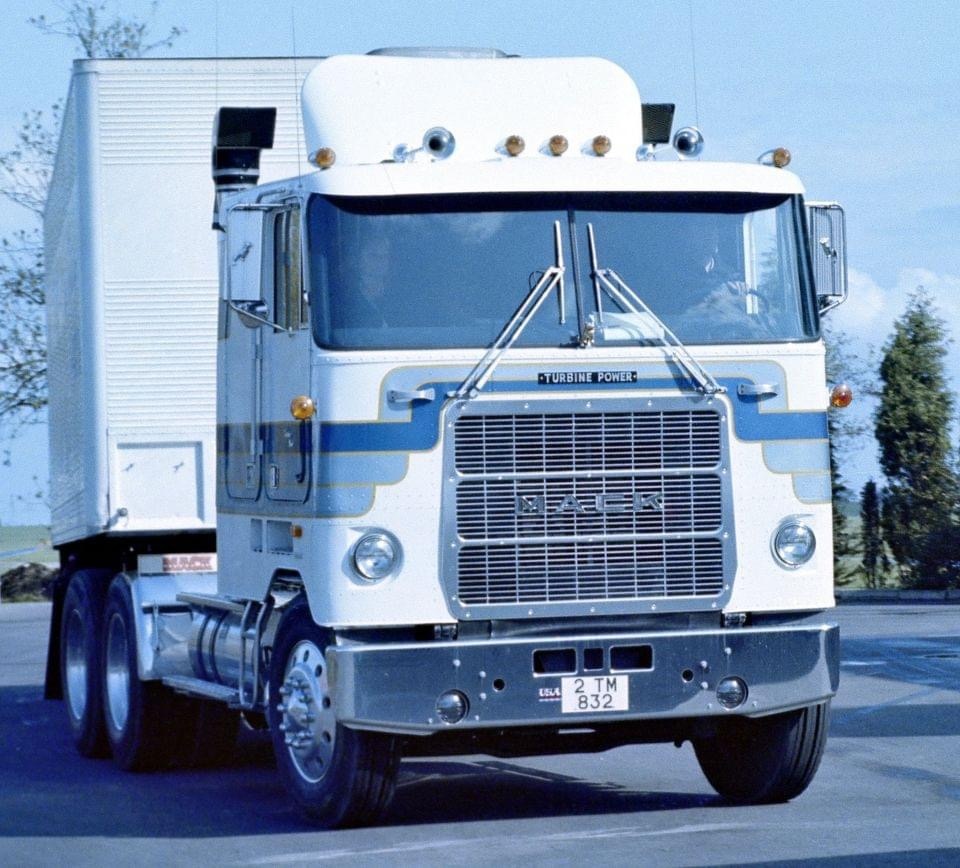
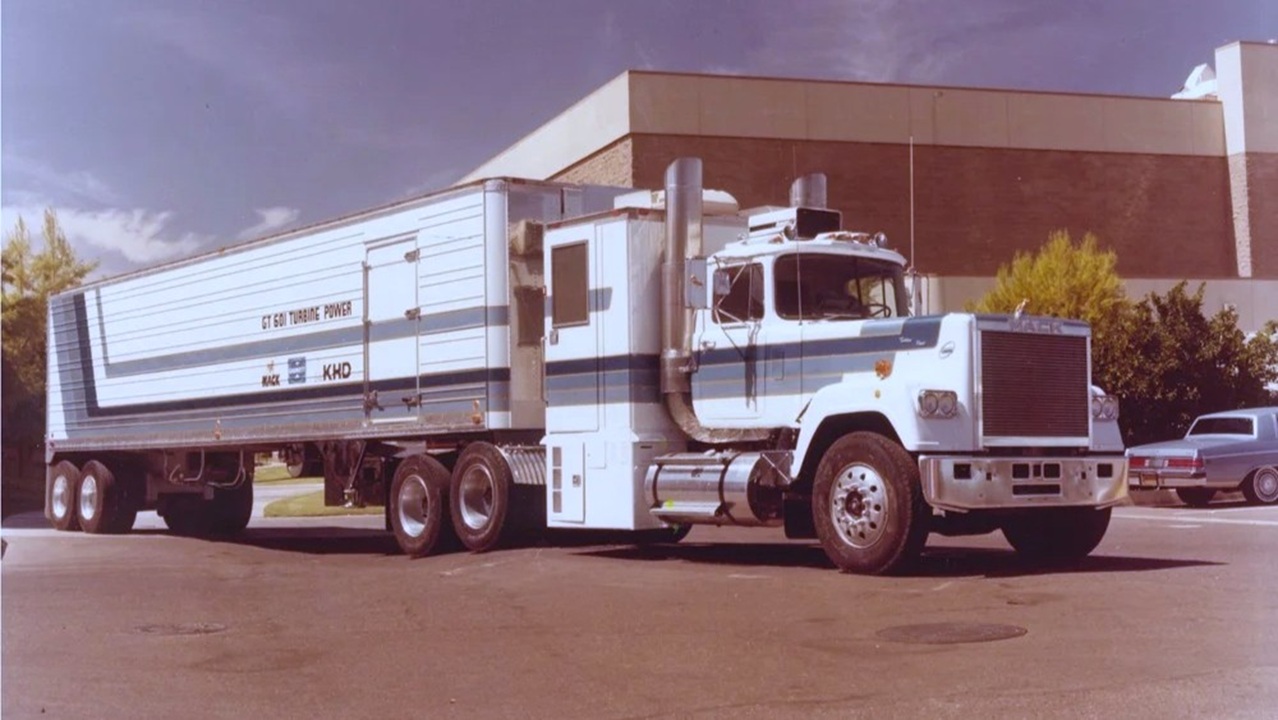
In 1979, Mack would place a GT-601 into an R-795S conventional tractor and a Cruise-Liner (WS760LST) cabover. A year later, another turbine was fitted to a Super-Liner (RWS760LST) tractor. ITI would conduct over 2,000 hours of testing the three trucks by taking them down highway routes carrying actual loads. Engines also made their way over to Europe.
In one test, a turbine-equipped Mack was driven 394 miles with a 52,500-pound payload. The truck averaged 4.05 mpg at 52.5 mph. Then, for comparison’s sake, ITI took a Mack with an equivalent diesel engine on the same route. That truck, which had a 50,000-pound load, averaged 3.83 mph at 51.8 mph.

In another test, a Super-Liner loaded to 80,000 pounds got 5 mpg, then scored 4.5 mpg at 100,000 pounds and 4 mpg at 120,000 pounds. The Mack R-795S test truck had a five-speed manual transmission, and according to period reports, the gas turbine was strong enough to accelerate an 80,000-pound truck from a dead stop in top gear without issue.
In all instances, ITI claimed, the gas turbines outperformed equivalent diesels while getting better fuel economy and better reliability. Garrett said that the GT-601 got nine percent more payload ton-mpg than high-horsepower diesels, four percent better payload thanks to the engine itself being lighter and requiring no cooling system parts, and six percent better fuel economy than an equivalent diesel. ITI even said that its turbine was so robust that the engine could even stay running after ingesting debris.

Militaries Also Took A Peek
In 1979, ITI caught the attention of the U.S. Army Tank Automotive Research, Development, and Engineering Center. Militaries around the world loved the idea of an engine that had a high power-to-weight ratio that required less maintenance and didn’t have a cooling system to maintain. According to Army magazine, A German M48 tank was fitted with a GT-601 turbine, and the results were astonishing. The test tank ran 2,174 miles around a proving ground in Europe, where the engine required only a fraction of the maintenance of a diesel.
The mil-spec GT-601, which made 750 HP, tested well, reportedly beating diesels in every metric while consuming the same amount of fuel. The military also liked the GT-601’s smaller size, which meant that a tank could carry either extra fuel or extra munitions. Further, the Army loved how the GT-601 could run on more fuels than even a multi-fuel piston engine.

Further military testing involved mounting a 628 HP GT-601 into an XM723 mechanized infantry combat vehicle, where no engine problems were reported. Other GT-601 units were fitted to the General Dynamics Land Systems Division Electric Vehicle Test Bed, an FV4201 Chieftain tank in the United Kingdom, an AMX-30 tank in France, a T-55 tank, an M-109 self-propelled howitzer, and a Wiesel Armored Weapons Carrier
It seemed that ITI had finally cracked the code. Its engine got better fuel economy than a diesel, had better reliability, and even managed to captivate the militaries of Britain, France, Germany, Israel, and the United States. ITI even figured that the engine could be mass-produced for a cost comparable to an equivalent diesel.
Even ITI Couldn’t Beat The Turbine Truck Curse

As for the trucks, test drivers loved them. The turbines were buttery-smooth, vibration-free, quiet at their idle speed of 16,000 RPM, and offered bountiful power. The gas turbines were even compatible with standard manual transmissions with only some modifications. The Cruise-Liner, for example, has a 10-speed Mack TRDL1070. So, what happened? If Garrett and Mack had perfected the gas turbine truck, why aren’t America’s highways littered with trucks that sound like Airbus A320s?
Unfortunately, even the bulldogs of trucking discovered a dark side to turbines. While Mack’s turbine trucks beat the fuel economy of the hungry diesels of the 1970s, they were no match for the more efficient trucks of the 1980s.
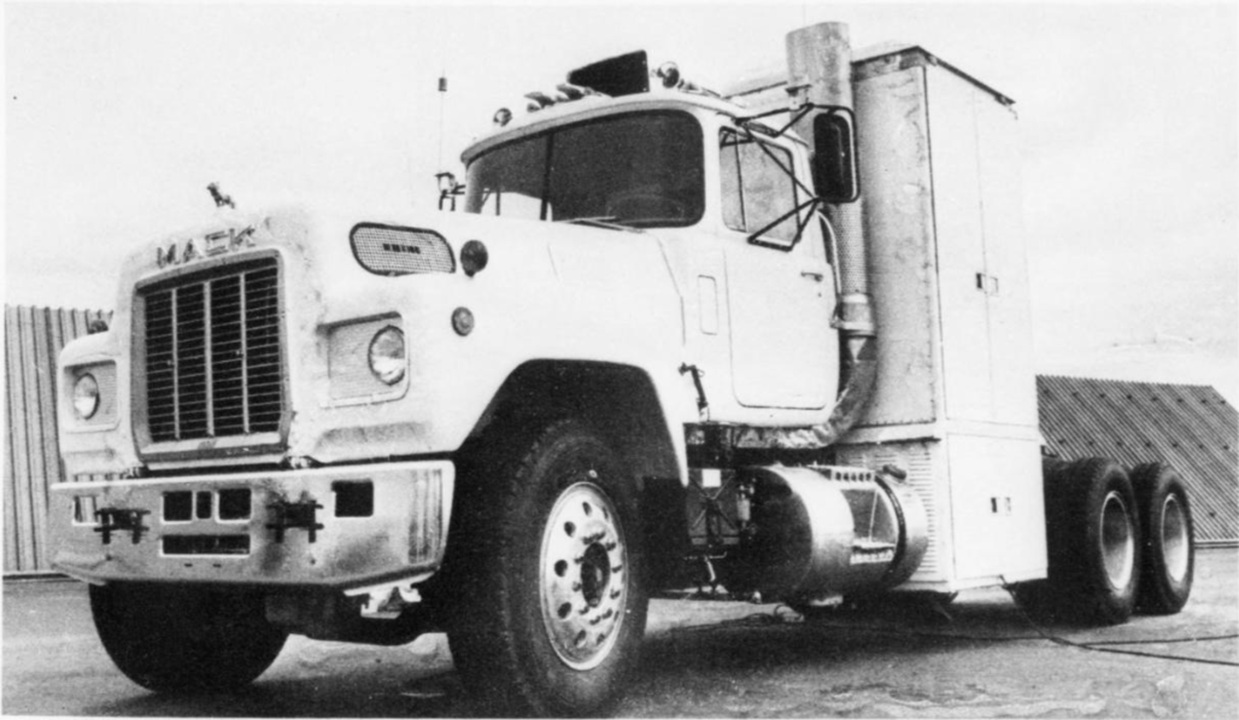
But it got worse. The turbines had super-hot exhausts. ITI and Mack were smart to fire the outlet of the turbine straight up. But this also meant that the exhaust could cook a tree if a semi parked under one with the turbine still running. Mack Trucks Historical Museum historian Doug Maney also noted that the trucks also sounded like you were standing next to a commercial jet.
Another major issue was economics. According to Garrett, the gas turbines were most efficient when allowed to run hard. However, federal weight limits of 80,000 pounds and speed limits of only 55 mph meant that the turbines had to be restrained. Garrett figured that the turbines would be uneconomical for operators unless they could somehow carry 97,000 pounds or more. Given less weight, a 1980s diesel would win on a cost basis.

ITI tried adjusting its expectations. Since selling GT-601s to the on-road market wasn’t going to work, it targeted logging and mining operations with the hopes of getting a production truck in the dirt by the mid-1980s. Ultimately, this never happened, either. In 1984, Mack retired the turbine-powered Cruise-Liner, and it was donated to the Mack Trucks Historical Museum. The other two late prototypes continued driving until 1986, making appearances all over America and across the Atlantic.
By 1987, ITI had 16 GT-601 engines running all over the world, and collectively, they logged over 60,000 miles of testing. The company largely gave up on selling turbines to the trucking world and instead hoped to score a deal refitting M-47s, M-48s, M-109s, AMX-30s, and German main battle tanks with GT-601 turbines for $250,000 per unit. There was also some hope that some companies would pick GT-601s up for use in stationary power generation. Ultimately, this fell through, too.
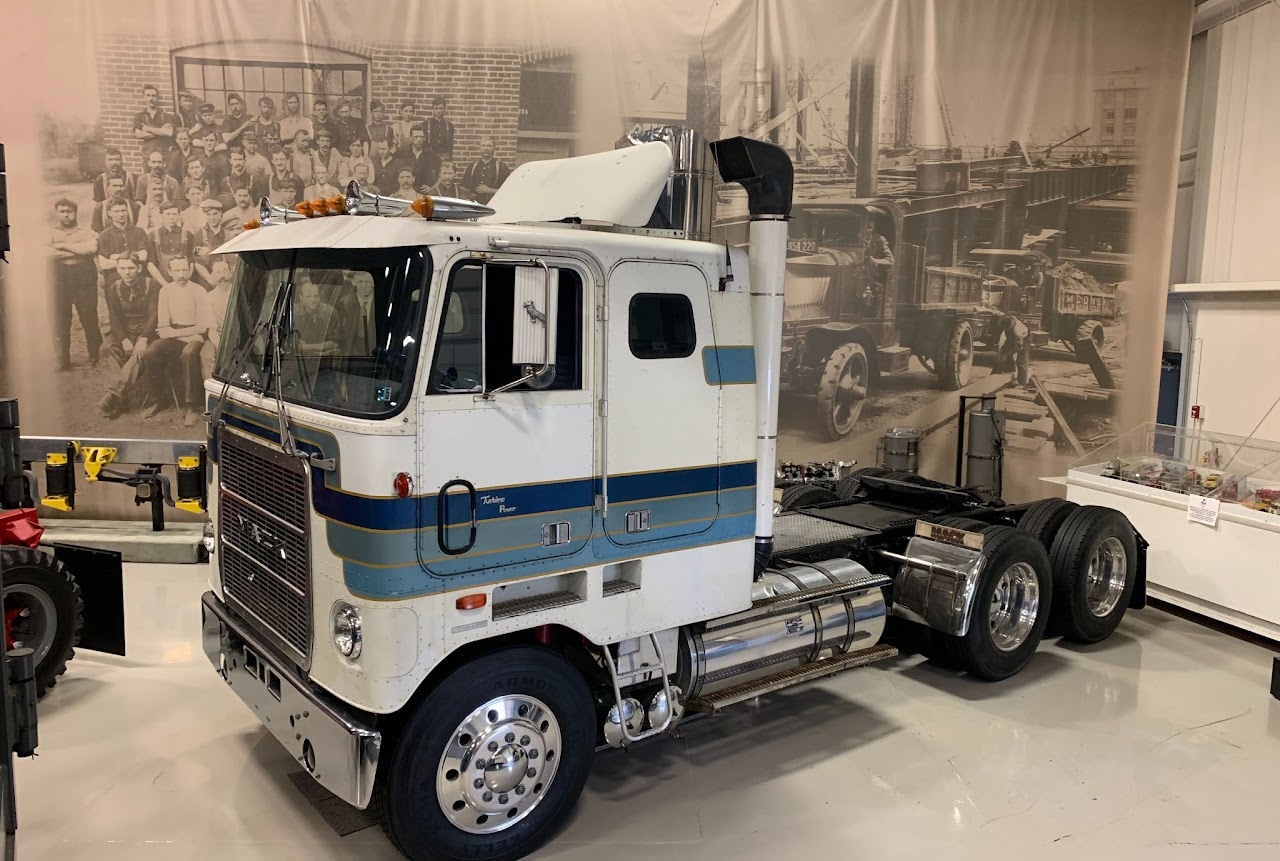
Today, the Mack WS760LST in the Mack museum is one of the only surviving reminders of this ambitious project. The truck still runs and occasionally gets taken outside to let its turbine run. It’s also perhaps the best example of a dead-end.
So many truck manufacturers tried their hands at turbine power, and not a single one in America succeeded in reaching production. Instead, every manufacturer figured out the hard way that their turbines were either too loud, too hot, too expensive, too experimental, or just too plain thirsty to make sense. Even Mack, which had one of the most powerful turbines put into a prototype truck, couldn’t figure out how to make it work.
Thus, the imperfect diesel remains largely undefeated. Even as electric Class 8 trucks slowly creep their way onto the roads, diesel shows no sign of stopping. Still, it’s commendable what ITI was able to achieve. Their engine was powerful and, at least for a moment, economical. Either way, the engineering is a sight to behold and it’s awesome it happened in the first place. If you want to see the Mack WS760LST turbine truck in person, I highly recommend paying the Mack museum in Allentown, Pennsylvania, a visit.
Top graphic images: Mack Trucks Historical Museum



Great article, Mercedes…we can always count on you for truly educational articles.
My first squadron in the USAF was the last flying F15s using f100-pw-100 engines, designed around the same time period. It also was an electronically controlled hydro-mechanical fuel control that would fall back to mechanical only (sec mode) if there was any fault. Huge pita to work on
It has been brought up before but …look how many years of development the ICE and diesel have had. If the gas turbine had enjoyed 100 years of development?? Things that make you go hmm…
The fact remains that diesel piston engines are thermodynamically efficient than turbines when used for powered shaft uses.
The reason we see turbines in most helicopters and larger propellor aircraft is weight and size, not fuel efficiency.
For example, a 400-500lb PT-6 can output 2000+ HP.
The modern M-1 Abrams tank uses a gas turbine, originally sourced by Avro-Lycoming (now Honeywell). It provides most of the benefits described here along with the drawbacks.
I love these deep dives into dead ends!
(Less the chance of spinal injury)
Interesting that ITI went with a heat exchanger recuperator instead of the rotating recuperator that Chrysler settled on for their turbine car. I wonder if the higher HP rating of this engine meant that a rotating recuperator would have been excessively large in comparison.
Australian Road Trains seem like an ideal use case.
Might not be enough road trains to make it worthwhile, economically.
Sounds like that Mack needs to be added to Mercedes’ must-drive bucket-list. Imagine a 26,000 RPM turbine connected to a 5-speed manual?
Heck, even I would love to get a chance to drive something like this.
“The turbines had super-hot exhausts. ITI and Mack were smart to fire the outlet of the turbine straight up. But this also meant that the exhaust could cook a tree if a semi parked under one with the turbine still running.”
Seems like the solution there is a more efficient recipe favor or taking a page from rocket motors and cooling the exhaust system with fuel which also returns heat to the combustion chamber.
I was thinking a sterling generator before the recuperator
Or some combined heat and power, and direct the exhaust down at the road and only run in winter in cold climates, melting any snow/ice as you drive
Pretty sure you’d just get a slip ‘n slide.
Your reference to cooking a tree answered my question about whether this thing would roast a bird like turbine locomotive you wrote about a few months ago.
This was a good read. I often read articles here about old technology and wonder that even if it failed does anyone look at it and see if modern science could solve the problem? I’m not saying they can since I can only follow half the science but I’m thinking it might help freeing old parents up and let people investigate. I myself am working on a version of the Slinky that actually walks down stairs alone or in pairs and makes a slinkety sound.