

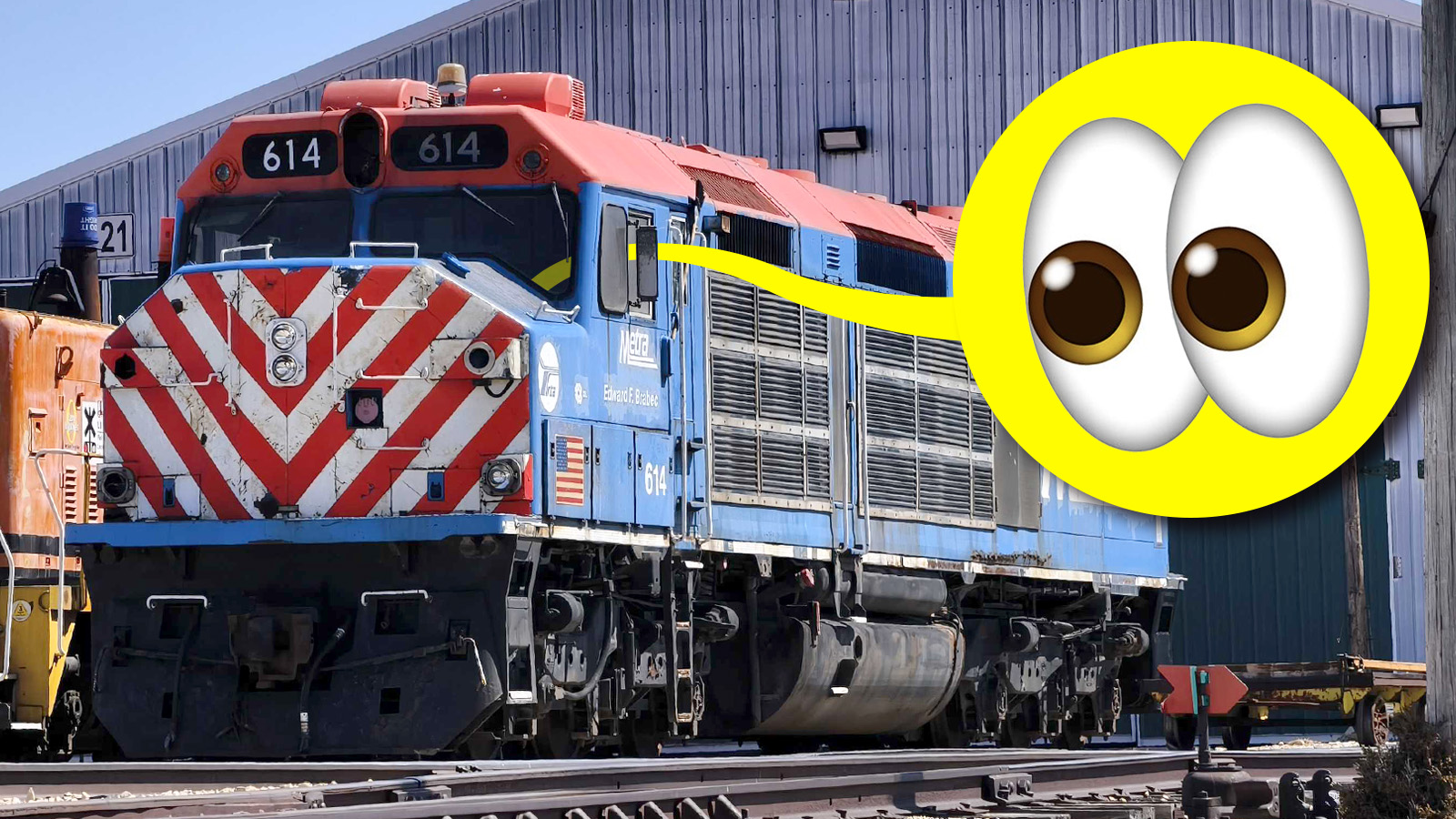
Trains are a daily part of life for millions of Americans. Trains get you to work, deliver raw materials, support space exploration, and keep the nation’s power grid alive. But it’s rare for someone to actually get inside of one of the colossal locomotives that keep America moving. I just got the rare chance to get inside of one of the coolest vintage passenger locomotives to ever run in America.
Last year, the Illinois Railway Museum – America’s largest train museum – rescued an incredible part of Chicago railroad history. For four decades, the mighty EMD F40C was a staple of commuter rail in Chicagoland. Then, the locomotives were retired, with all but two of the 15 examples getting scrapped. One of these beasts, Metra EMD F40C No. 614, sat abandoned for over a decade, rotting in a train yard as Metra robbed it for parts. Now, the locomotive is in the hands of the Illinois Railway Museum, and it’s getting a second life of wowing railfans and teaching generations about railroading.


Last week, IRM’s F40C was one of the highlight locomotives of the museum’s Diesel Days event, which celebrated over a century of diesel power in railroading. IRM is unique in that over half of its 60-plus diesel-electric locomotives are functional every year. Most of them come out of hiding to put on a show for an entire weekend.

This year’s Diesel Days was especially exciting for me because of all of history on display. Check out the locomotive below:

Yes, that’s a locomotive! Built in 1926 by a consortium of the American Locomotive Company, General Electric, and Ingersoll-Rand, the Ingersoll-Rand No. 91 (formerly the Delaware Lackawanna & Western No. 3001) is an example of what switcher locomotives looked like in the 1920s. It just came out of IRM’s paint shop in the same paint scheme that it wore for the 1976 United States bicentennial. When IRM gets it functional again, it will be the oldest running diesel locomotive in America!
The locomotive that drew me in the most was Metra EMD F40C No. 614.

Unlike most of IRM’s equipment, I have a personal connection to this unit. The last hurrahs of the mighty F40Cs were in the early 2010s when I was a young adult, and I watched the two last F40Cs thunder down the tracks that connected Fox Lake, Illinois, to Chicago’s Union Station. I even rode behind one on a trip to Chicago.
I had long feared that No. 614 would become a pile of scrap. Yet, here it was in its faded glory. Even better was how IRM was giving tours of its interior!

How Passenger Rail Used To Work
I wrote about the history of the General Motors Electro-Motive Division‘s F40C locomotives over a year ago. If you missed that article, which you can see by clicking here, I’ll make it quick.
Most American transit operations run locomotives featuring a quartet of axles. Quad-axle locomotives are great for maneuverability around tight curves while having lower unit weights and lower costs than larger locomotives. EMD’s own F40 has been a star of passenger rail travel in America since 1975, and many units remain in service today. In addition to the aforementioned benefits, the F40 has proven to be a reliable workhorse that has long enough legs to run between major cities at relatively high speeds.

But the road to get to the F40 was somewhat experimental. In decades past, America’s commuter rail wasn’t handled by regional transportation authorities like they mostly are today. Instead, the trains you rode into a city were run by a private railroad. Commuter rail to Chicago was operated in large part by the Chicago, Burlington and Quincy, the Chicago and North Western, and the Milwaukee Road. Other roads that have served Chicagoland were the Minneapolis, St. Paul, and Sault Ste. Marie, the Louisville and Nashville, Penn Central Transportation, the Monon Railroad, Illinois Central, the Baltimore and Ohio, and so many others.
If you think that’s an insane number of railroads for one region, it was. However, Chicago was unique in that it was essentially the railroad hub of America. Chicagoland is roughly in the middle of the country with flat, arable land that is perfect for laying down thousands of miles of trackage. Meanwhile, Chicago’s direct connection to the Great Lakes permitted America’s railroads access to a vast number of industries. Even today, six of the seven largest railroads run through Chicago, as do 1,300 trains daily.

Railroad competition was brutal through most of the 20th century, and if that wasn’t harsh enough, private car ownership and later, air travel, chipped away at passenger rail ridership numbers for decades. Some railroads folded while others merged. After May 1971, Amtrak absorbed a lot of America’s long-distance passenger rail operations, allowing the private railroads that survived to focus on lucrative freight.

In many cases, local commuter rail fell to regional authorities. In the mid-1970s, the predecessors of Metra still ran Chicago’s commuter rail. The iconic Chicago, Milwaukee, St. Paul and Pacific Railroad, better known as the Milwaukee Road, served Chicago via the Milwaukee North. This line ran from Chicago to Fox Lake in the far northern suburbs before continuing to Walworth, Wisconsin. Milwaukee Road also ran the Milwaukee West line, which took passengers west of Chicago to Elgin.
Since commuter rail was still in the hands of private companies, your Chicagoland passenger rail experience varied depending on where you lived. Each local railroad had its own ideas for how to advance commuter rail. In the 1950s, the Chicago & North Western introduced its famous heated and air-conditioned bi-level coaches. I’ve pictured those below.
The Mighty F40C

Milwaukee Road responded with a similar design in 1960, boasting improvements in comfort, capacity, and speed. My retrospective continues:
In 1973, Amtrak began taking delivery of a new type of locomotive to replace the aging and broken fleet it inherited from private railroads when it opened a couple of years prior. The EMD SDP40F was the first new diesel-electric built specifically for Amtrak, and the railroad intended the meaty six-axle beast to be used on its long-distance routes. Based on the EMD FP45 passenger locomotive and the EMD SD40-2 freight locomotive, the SDP40F promised durability and more than enough power to pull long passenger trains at high speeds. These bulky locomotives were powered by EMD 16-645E3 169.6-liter V16 prime movers good for 3,000 HP.

As Trains.com writes, the private railroad predecessors to Metra didn’t like asking for government funding to upgrade equipment. Instead, each railroad is expected to fund the acquisition of new locomotives and improved carriages through fare hikes. Unfortunately, this practice was unsustainable.
In an effort to get government assistance to improve rail, four Chicago area districts were formed. The North Suburban Mass Transit District and the Northwest Suburban Mass Transit District worked to improve the service offered by Milwaukee Road. By joining these two districts, Milwaukee Road gained access to federal and state funds that it used to upgrade the railroad’s decades-old locomotives and passenger cars.

Finally, with the funding to replace aging locomotives, the Milwaukee Road made a technological upgrade, from Metra:
The F40Cs were derived from the SDP40F six-axle locomotives built in 1973 and 1974 and purchased by Amtrak. Though the two locomotives are relatively similar, a key difference between the SDP40F and the F40C was the way in which the locomotives heated their railcars. The SDP40F operated with a steam generator for climate control which, approaching the last quarter of the century, had become outdated. Increased interest in a new way to heat passenger cars resulted in the development of head-end power (HEP), and the new version of the six-axle locomotive adopted the trend.

The absolutely massive F40Cs featured huge alternators to generate electricity for head-end power (more on that later), which finally left the steam generators of older passenger locomotives in the past. The F40Cs had the same power output as the SDP40Fs, but were smaller and, for a bit of flair, Milwaukee Road gave the units distinctive corrugated panels. Milwaukee Road’s livery featured a swooping white and red on sky blue design which made the F40Cs as beautiful as they were powerful. Sadly, this paint was lost when the F40Cs transferred over to Metra, and gained that railroad’s red and blue scheme.
In service, the F40C even proved to be the better version of the SDP40F, and not just for passenger comfort, either. The SDP40Fs gained notoriety for derailing, but the smaller and improved F40Cs didn’t suffer the same fate. But for all of what was good about the F40C, its benefits were short-lived.

The F40Cs were delivered only a year before the launch of the EMD F40PH, and once those locomotives were out in the wild, the F40Cs became antiquated quickly. At 364,000 pounds and more than 68 feet long, the F40C is 164,000 pounds heavier and 12 feet longer than the F40PH. The F40C struggled to negotiate tight curves in city environments. Add in all of that, plus the higher running costs of six axles over four axles, and the F40C struggled to find a market outside of Chicago. The F40PH arguably did the F40C’s job better, as it was essentially the F40C’s technology implemented into a smaller package.
As time carried on, the Milwaukee Road eventually collapsed, Chicago’s suburban mass transit districts were dissolved, and commuter rail to Chicago ended up in the hands of Metropolitan Rail, or Metra. The railroad stacked up a roster of EMD F40PH locomotives, many of which remain in use today. Yet, despite its limited appeal, the F40C refused to die.

Metra kept F40Cs running until 2003 and 2004, when they were effectively replaced by new MPI MP36PH-3S locomotives. Metra then sold off 12 of its F40Cs to Helm Leasing and another to National Railway Equipment. Kansas City Southern signed a lease for the 12 that went to Helm. Metra kept the last two F40Cs, Nos. 611 and 614, as part of its reserve fleet.
In a weird twist, it wasn’t long before both locomotives needed to be pressed back into service. In 2005, the new MPI locomotives were having teething issues, and to ensure reliable service, both F40Cs were put to work until 2006. Their break would last only two years, however, because in 2008, Metra began rebuilding its oldest EMD F40PHs. Once again, both surviving F40Cs were put back into service. These locomotives might have been old and outdated, but they were hard workers even four decades after they were built.
The F40Cs Were Abandoned, Then Rescued

Unfortunately, even the reliable F40Cs couldn’t beat Father Time, and by 2012, enough issues had cropped up that Metra parked the F40Cs and never used them again. Metra loved the F40Cs enough to try to refurbish them, but no company took Metra’s bid for the project. So, the locomotives just sat. As the F40PHs needed parts, Metra’s shops began robbing them from the F40Cs, practically sealing their fate that they’d never pull a train for Metra ever again. Metra’s shops raided No. 614 of its turbo, aftercoolers, ducts, radiators, diode banks, and other miscellaneous parts. Per Metra, so many bits were taken that the locomotive was unable to even start anymore.
The F40Cs had become legends. Many Chicagoans can recall taking a ride behind one of these rumbling beasts, and railfans have countless images of the F40Cs and their shiny cladding storming down the rails. One of the more endearing parts about the F40C was that its fame wasn’t limited to the borders of Illinois. While the F40C was mostly a Chicago legend, it was the locomotive stepping stone that led to the famous F40PH, which is known by railroads and railfans worldwide.

Train fans have spent years advocating for the rescue of the F40Cs. So many awesome locomotives are scrapped to the point where none are left in existence, and they’re remembered only in memories, documents, and images. It was feared that the fate of the F40Cs was similar as they sat, rotting away in a yard. By 2020, the only F40Cs that weren’t scrapped were Metra’s two units.
In a delightful twist, the futures of the surviving F40Cs were changed in 2025 and 2026. That year, Metra donated No. 614 to IRM. Then, in March, No. 611 was donated to Railroading Heritage of Midwest America in Silvis, Illinois.
I got to see No. 614 in person during the opening weeks of IRM’s 2025 season. I snapped many of the pictures you see here, but did not write about the visit.
Inside Of An F40C

Since then, IRM’s army of volunteers has been hard at work integrating the locomotive into the museum. The IRM Diesel Shop has replaced the missing lights and some other visual parts. They’ve also hooked the locomotive up to vintage Metra cars for display. Sadly, whenever No 614 needs to be moved, another locomotive needs to do the work, and it could be a while before that changes.
I got to see the condition of No. 614 myself as part of a tour that IRM’s volunteers were giving as part of Diesel Days.

The tour started inside of Chicago Rock Island & Pacific No. 4506 (above), which is a 1952 EMD GP7R. Yes, this blue beauty is from 1952! This locomotive is a road switcher – a locomotive that can both handle switching duties and haul freight – with 1,500 HP from an EMD 16-567BC, a 148.8-liter V16 prime mover. 4506 is restored, operational, and was a great way to start a locomotive tour. It was fun fitting in the engineer’s chair and then strutting down the catwalk.
I’ve always wanted to do that!

What was also interesting to learn is that, while this locomotive had some minimal sound deadening, it’s still so loud that, without hearing protection, a crew would go deaf after operating one of these locomotives for years.
The chaser was the F40C, and this was so fun because it doesn’t have a catwalk. To get from the rear of the locomotive to the front, you have to go through the engine room!

The first thing I saw at the rear of the F40C was this gigantic air compressor. Diesel-electric locomotives use air for bells, braking, controls, horns, sanders, and even the windshield wipers in some designs. The compressor is driven from the prime mover and provides 130 PSI or more for the locomotive’s systems.

Also in this room was the cabinet for the head-end power system. Head-end power, or “hotel” power, is how the passenger cars receive their electricity, heating, cooling, and lighting needs. In the past, carriages were heated from steam generators on the locomotive, while electrical power was handled by small engines or generators attached to the rolling axles. Modern locomotives draw power from the prime mover to run a generator or alternator.

In the F40C, this alternator is located in the space between the engine and the air compressor.

What I was blown away by is just how big the rear of the engine room of the F40C was. There was plenty of room to move around, and even tall people weren’t exactly banging their heads in there. You should be able to see light coming through the ceiling in my images. That’s from the prime mover cooling system that was removed by Metra’s shops.
The main engine room was a sight to behold.

The F40C gets its power from an EMD 16-645E3B, a 169.6-liter V16 turbodiesel with 3,200 HP on tap. This absolute unit of a prime mover takes up the vast majority of the space in the engine room, and IRM’s volunteers graciously opened one of the engine’s covers so we could see inside. It was amazing to see parts that you might see on cars and trucks, but scaled to a hilariously huge level.

If you’re not into trains, I will point out that this colossal mass of metal doesn’t actually drive the locomotive. Instead, the prime mover functions as a titanic generator for the head-end power, as well as the six EMD D77 DC traction motors that actually propel the locomotive forward.

The final stop was the cab of the unit, and this was a great way to finish. In there, I got an engineer’s-eye view of what it must have been like to operate this locomotive back in the 1970s, and I was impressed by just how much visibility there was. The engineer’s chair was surprisingly cushy, too.

The IRM volunteer told us that, like a freight locomotive, the F40C has a nose that contains electrical connections and a lonely toilet for when you just have to go on the rails. He described the room as rather dreary, and didn’t even want to show us what horrors were behind the door.

Another note from the IRM volunteer was that, during the 20 years between the EMD GP7 and the EMD F40C, sound deadening had improved, and those who operated these locomotives in the 1970s probably still have some of their hearing today. The train crew also got not just one, but two air conditioners in the cab to battle heat from the locomotive itself and from the outside.
IRM’s volunteers say that they fully plan on getting 614 running again, but it will probably be a while. The museum runs on donations, ticket sales, merch sales, and the volunteers who fix everything for the love of the game. Whenever you see a restored locomotive at IRM? That was put back together by teams of volunteers donating their time and skills just for the fun of it. Unfortunately, that means that projects happen as both money and labor come in for it.
The good news is that IRM’s F40C is not totally static. It’s in good enough shape to run down the tracks right now. IRM is a bit clever with it and uses the F40C like a cab car. Check out this video:
Preserved For Generations To Come
For now, railfans are just stoked that both of the last F40Cs in existence are in good hands and will run again one day.

If you’re interested in seeing Metra No. 614, the Illinois Railway Museum will be open every day for the rest of the summer. Tickets are no more than $20 and memberships, which allow you to visit as many times as you want, are only $50. If you’re interested in supporting IRM’s mission, the museum does take donations and, if you’re willing to get greasy and dirty, you can even volunteer to work on a steam locomotive or a diesel-electric locomotive.
Work like this keeps museums like IRM alive so it can continue saving pieces of railroad history from the scrapheap. If it weren’t for museums like IRM and Railroading Heritage of Midwest America, the F40Cs would have faded into the past, with only stories and pictures to remember them by. Now, they will provide smiles to generations of people for years to come. I bet just seeing a little kid smile at the sight of the F40C and older people remembering riding behind one is probably worth whatever it took to get 614 to the museum alone.
All images: Author, unless otherwise noted.


Hey, Mercedes, I dunno if you’ve seen it but there was a recent series here in the UK with Chris Harris (ex-Top Gear) and a guy called Francis Bourgeois (who is adorably geeky), helping to restore a BR Class 37.I have no idea if it’s viewable in the US, but here’s the youtube link: https://www.youtube.com/watch?v=N_34rVkKdMQ
Rail stuff isn’t usually my cup of tea, but I ended up watching all of this 🙂
Please,
One day get them to pay you a railroad trip through Europe to test the trains we have (Eurostar, ICE, AVE, TGV, FrecciaRossa, and the night trains [normal stuff here, not the exclusive Orient Express)
And do the same thing with Japan/Korea (I’d add China, they copied the TGV/ICE)
And then tell us how it compares to long distance car travel, plane travel and American train travel.
Trust me, we know our rail system sucks.
You got a good shot of an injector link assembly too! It’s definitely the old style (not that there was any doubt about that).
I know I say it every time, but I love reading about vintage EMD 645’s, and I’m glad you got to see one in person.
Mercedes, I have to thank you again for turning me in to the IRM. Time for another visit to see this new addition!
Great article!
We moved our youngest to Chicago (Edgewater) a few weeks back, and stayed in the city for a week to help her get settled.
We were able to ride a bunch of CTA trains and Metra while we were there.
The Metra locomotives are interesting, in that the prime movers must run at full-tilt continuously, since they are running the AC generator for hotel power.
Slowing to arrive at the platform, stopped to load, accelerating to depart? RPMs are constant. “Excitation” of the generator is used to control current to the traction motors.
Enjoyed the article Mercedes! Someday I hope to visit the museum.
IRM member here. Father in-law was part of the steam crew that put Frisco 1630 back on the rails 12 years ago (sadly, she is down for repairs as of 4/25).
After he passed, the crew ran black flags and let us “ride” (hang on) in the cab, and shovel Dad’s ashes into the firebox – as he had requested. They gave her a little extra steam that day – and rattled one of the black flags right off during the outbound run. (I have video of the run. LMK)
https://drive.google.com/file/d/1coxDwU6z4Kyk6MyAWs8wucV9aCf4cPJZ/view?usp=drive_link
https://drive.google.com/file/d/13PiT4wjt90Dt_E_T1Srm5XME3vaDpRv7/view?usp=drive_link
In the 90’s, I’d organize autoX’s in EMD’s parking lot.
What a great way to honor your dad!
Still need to make my first visit to the IRM.
I did manage to make a trip on the East Troy Electric Railroad earlier this year, but we had a Journey concert to go to later that day, plus we skipped the British Car Field day that day to do the train ride.
So much to see, so little time.
Great piece as always Mercedes and very nostalgic – I grew up riding behind these guys, and they were my first, formative experience with trains and public transportation. Good thing too, as that positive experience likely got me through my teenage bus days.
That distinctive front end was so easy to spot in the distance from the platform!