

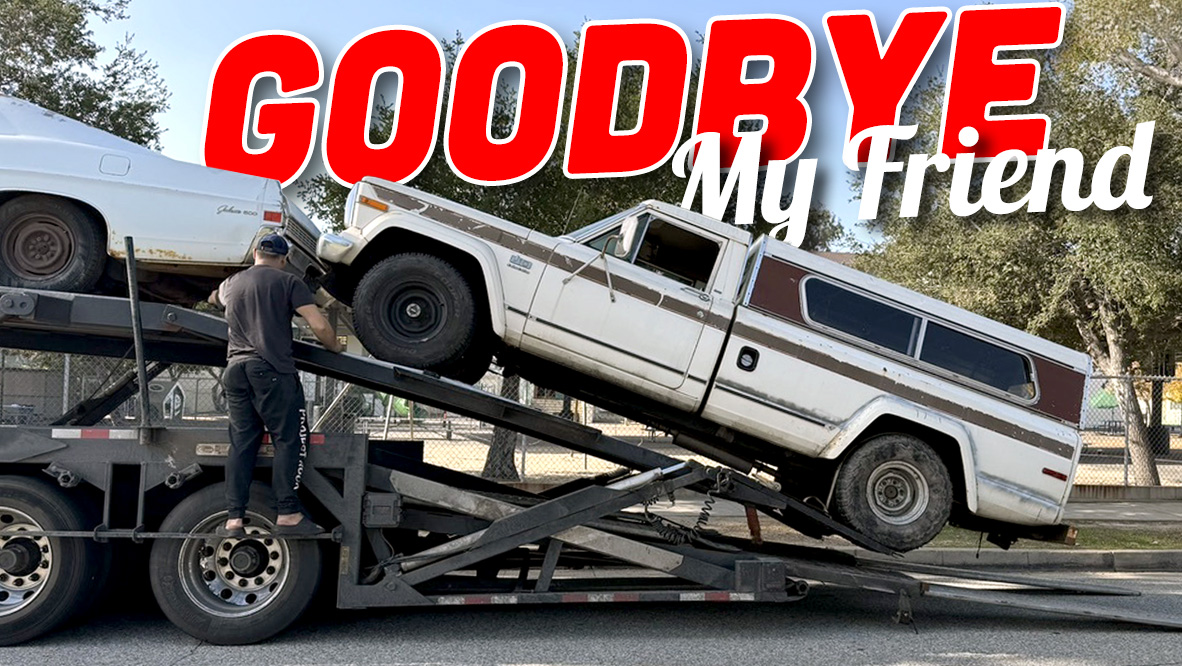
If California’s Governor Gavin Newsom has any aspirations for higher office, he’d better not screw this up (OK, maybe it won’t make a difference and this bill only matters this much to us car-nuts). On his desk sits a bill that would allow smog-era cars from the late 1970s and early 1980s to bypass smog tests that are often extremely difficult to pass, thus bringing more vintage automotive glory to California’s roads. Unfortunately, after Leno’s Law failed last year, and after decades of enforcing a silly 1975 smog exemption instead of a rolling exemption for cars of a certain age, far too many people have had to sell their beloved 1970s/80s automobiles. Including me.
I always thought I’d keep my 1985 Jeep J10 forever. It was the perfect spec of the Jeep pickup I always wanted: It had the inline-six, the four-speed manual, the tall 2.73 gears for road tripping, the eight-foot bed, a stamped tailgate, a gun rack, bench seat, a regular cab, four-wheel drive, manual locking hubs — it was truly a truck’s truck. And with only 85,000 miles on it and a manual transmission that I myself had rebuilt, the thing was the most reliable machine I’d ever owned. The only problem was, I moved to California, and California’s smog rules required that I have all the components in place: The EGR, the original carburetor, the vacuum hoses, the secondary air injection pump, a fresh catalytic converter, and on and on.


Over the past few years, there has been hope in the air, and so I held onto my J10, just waiting to see if long-awaited relief for these smog-era cars was finally coming. A bill, championed by Jay Leno, seemed like the answer to my problems, as I wrote in my article California’s Smog Rules Are Pushing Me To Sell My Beloved 1985 Jeep J10, And The Improbable ‘Leno’s Law’ Is My Only Hope.

But then this happened: Leno’s Law Is Officially Dead, Which Means Classic Car Owners In California Will Continue to Suffer. I later wrote about how, because there are so many great pre-1976 cars, and because fuel injection became prominent in the mid 1980s, there are still so many amazing options for enthusiasts in California (this was met with readers rightly pointing out that the cars in that 10-year span represent so few vehicles, why even bother making it hard for their owners?). I also went out and bought my truck’s replacement, the Jeep J10’s successor, the Jeep Comanche, configured in exactly the same way — long bed, regular cab, bench seat, stickshift, 4×4, inline-six:

But even if I had a replacement, and even if I still think there are plenty of awesome cars on the road in California, I’m still bummed I had to sell my J10, and I agree with readers that making it hard to smog cars in this small span of model-years — cars that aren’t really daily drivers anyway — seems pointless. Which is why I hope Governor Gavin Newsom doesn’t screw this up.
The New York Times breaks the bill down, writing in its piece Jay Leno’s Classic Car Bill Passes in California Legislature:
The bill would exempt some cars made before the model year 1981 from the standard smog checks that determine whether the pollutants they emit are within safe limits. Car collectors say that the current rules in California — which generally require gasoline-powered vehicles from model year 1976 onward to undergo a smog check every two years — are overly restrictive.
“Most of these cars that we’re talking about, they get driven to a car show on a Saturday,” Mr. Leno said. “The car’s parked all day, and then it’s driven home at night.”
The exemption, which applies only to qualifying collector cars, would take effect in January 2028 and be phased in over five years, eventually exempting collector cars made before model year 1986 from smog checks. To qualify, owners must either have collector-car insurance or prove that the vehicle is driven fewer than 1,000 miles per year.
You can read the whole story on The New York Times. It’s a bit slanted, focusing on the fact that these old cars could produce 20x the emissions of a new car, and even though it’s not going to account for a lot of vehicle-miles, it’s still a step in the wrong direction, public-health-wise. I get where they’re coming from, but we as a society have to decide what we think is acceptable from an emissions standpoint, because absolute zero-emissions isn’t going to happen. We have to make compromises, and I, a car enthusiast who daily-drives an electric car, think getting more of these cool cars on the road is worth the small tradeoff, especially if these cars and their repairs can be taxed in a way that offsets some of those emissions.
Governor Gavin Newsom will decide by September 30th whether to sign the bipartisan bill. I hope he does, even though I no longer have a horse in this race, for my beloved Jeep J10 fell victim to the draconian fixed-1975 SMOG exemption. I’m sure many tens of thousands of other 1970s and 1980s cars were either scrapped or sold out of state due to their owners’ inability to get them through SMOG; it’s time for California’s eradication of one of the coolest automotive eras to come to an end.
Top graphic image: David Tracy


I’m surprised that the bill was not linked directly. Here it is if you want to read the source.
I think the probability of a “no sign” is the highest of the 3 outcomes. Check the assembly vote–55 ayes, 4 nos, 20 (!) no vote recorded. In the last days of the current legislative session, all those people were there, and chose not to put their name on the record one way or the other. It reads to me as a reasonable compromise and a well written law that few want to be known as being on either side of.
On that final note… just wait until ACA7 hits the ballot box in 2028.
Thank you for the context!
Why capitalize smog? It’s a word, not an acronym.
It’s actually a portmanteau, sir! Please give it the credit it deserves.
I apologize, I was focused on my frappuccino at brunch and omitted that important fact.
Here fucking here!
I would just make it a rolling 30 years, so my 1994 is exempt, selfishly.
This state is both excellent AND horrible for car enthusiasts.
Hear*
i r eginear
Me too :p
Cali is cleaner than before because of laws, have some respect
I would rather that cars that pollute excessively vs stock when new attracted fines. I would rather that not be implemented by requiring the vehicle to be stock in every respect, and I would prefer that facilities to test emissions were readily available and test prices were capped.
I can’t get too upset at not requiring smog for vehicles doing less than 1000 miles per year, though.
I am raising an eyebrow at David describing the time from 1976 to 1986 as “one of the coolest automotive eras”, though. This is basically Malaise Era, and I expect if you polled the community it would rate as close to the least cool automotive era. I have a lot of respect for David and he is certainly entitled to his opinion, and I know he likes his XJs, but this is still just weird.
Idk land yachts are pretty dang cool.
You know I’m a big truck/SUV guy, and that era may have been the smog era for cars, but the trucks remained awesome.
They are junk. I owned plenty of them, worked on lots of them as a mechanic, Chevy, Ford, Toyota, and Datsun pickups.
All junk.
I can’t believe what people are paying for dentsides and square bodies. Do they know it’s a giant turd that was garbage when new and has aged like a crack addict?
The young guys at work dream of buying these crapwagons.
Might as well pile your money up and set fire to it.
“This is basically Malaise Era”
I lived through this era. Owned the cars when new, US, German, Japanese.
All junk. All.
Even the Japanese ones.
Into the crusher they can go.
The SMOG argument is no longer valid argument for scrapping classic heritage cars over 30 yrs old. There are not many of them out there, and even fewer endure daily use. You want proof? Look at the LA Air Quality Index (AQI) since the 1990s and it goes from mostly red, then orange in the 2000-10s and in the 2020s every day is a shade of green.
The remaining offenders needs to be kept for historical and cultural reasons.
Scroll down and look for “History” to see previous years:
https://www.aqi.in/us/dashboard/united-states/california/los-angeles/historical-analysis
The only issue here is that the original equipment for his J10 has been removed. If he aquired the parts and reinstalled, he could register and drive the J10 in California. I don’t think that’s too much to ask if you want to keep a historic vehicle on the road.
Actually, the acquiring of these parts is the big problem.
I checked and all the parts are available for ~$2k. Catalytic, EGR, Air Injection Pump, etc. Heck I bet there’s Jeep heads on a forum with this stuff sitting on a shelf.
This is the risk of bringing a vehicle with removed emissions equipment to California.
Umm, 2k is wholly unreasonable to pay to get a car that isn’t driven regularly past emissions. My state has a $200 exemption on emissions testing (really a CEL test.) Once you’ve spent $200, you pass emissions that year.
Parts available, big problem is Tracy broke the law removing/not repairing anti-pollution parts,Tracy is a crook
I get the sense that he purchased the vehicle with the equipment already removed. I don’t think Tracy is a crook at all.
Could have repaired it then, tracy seems to relish driving polluting vehicles and bragging about the oil loss, he’s a menace on the highway
I have personally purchased catalytics for cars that were straight piped when I aquired them. To me it seems like the right thing to do.
But there’s always someone that’s thinks there’s a higher standard. Someone out there must think i’m a crook for keeping a 36 year old car in the garage. Or driving a car at all. I prefer not to call people crooks for the small stuff and instead encourage people to think about how they can do better.
That jeep had no business being brought here. It was a rusty POS and he could easily have found a better one that would have passed smog once he arrived. Emotions got involved.
I know it’s not much of a consolation, but for what it’s worth: that’s a beautiful Comanche, and you have my respect and envy alike.
I’m happy with my choice. Thing just needed a new $350 cat and it passed with flying colors!
If it passes the exhaust sniff test for the baseline year vehicle, then it should pass.
Unfortunately sniff test doesn’t catch fuel or oil vapor emissions.
“…he’d better not screw this up.”
Bless your politically naive little heart…
I think the more obnoxious part of California smog checks is that the requirement for CARB approved equipment overrules any actual test results. Your car can run squeaky-clean but if it’s got an off-brand air intake, too bad, no registration for you.
There’s an argument (not one that I agree with, but a legitimate argument) that the benefits of the right to own a rolling museum piece do not beat the public interest of limiting pollution. But banning a vehicle that actually meets the practical requirements, but does it the “wrong way”, is just asinine.
A local smog station check is nowhere near as comprehensive as a real emissions test cell. The purpose of a EO is to say that “this product has been through the full test cycle and does not affect emissions so you don’t need to test it again”
If you want to run something that doesn’t have an EO, you’re welcome to run your car through the full test which will take several days and consume over $10k. A smog station just checks that a warm vehicle meets a narrow range of operation.
Source: have been involved in obtaining EOs, including being in the car during the high speed test portion.
Is that something that’s actually available to individual owners? I casually looked into emissions approval once (in the context of hypothetically importing a car that falls under the 25-year rule but was not sold in, and therefore never CARB approved, in the USA) and it was not obvious that someone could do that, even if one was willing to spend the money.
I have a friend with a 100% legal Lancia Delta Integrale in California – it’s even modified. BAR is involved, I don’t know the specifics. But he went through the full test regimen.
He’s currently having a Delta S4 replica built so there is some money available in his case.
CARB EO requirement only applies to performance parts, not direct replacement, but I agree with your point.
No, they definitely apply to direct replacement emissions related parts. I had to replace an exhaust pipe on my RAV4 that contained a secondary catalytic converter in it. Living in NY, all my options had to meet Cali emissions. But looking up the scrap price for CARB EO aftermarket cats vs federal cats, the CARB cats fetch a bit more than federal cats. Doesn’t make up for how a CARB cat costs twice as much brand new. Thanks, Toyota and NY, for designing the part like that. It took an otherwise inexpensive repair and made it cost quite a bit due to regulatory compliance.
You are correct, catalytic converters are the one glaring exception to what I stated.
It’s weird that the states with the worst pollution have the strictest laws. Almost as if something else was causing the problem
Sigh. Go look up a history of California smog problems. It’s amazing how the air of Los Angeles is cleaner today than back in 1976 despite having far more cars and vehicles. All due to environmental regulations.
It’s the opposite of weird. It’s entirely expected. If you have a pollution problem, you enact laws to deal with it. If you don’t have that problem, no laws are needed.
California’s environmental laws made the air quality go from disgusting and carcinogenic to pretty good (other than during wildfire season). You can see the improvement in photos, and in healthcare records.
I grew up in San Diego. Went on a school field trip to Pasadena’s Huntington Library around 1985 or so. It was a particularly smoggy day, and the only time in my life it physically hurt me to breathe. I ended up moving to L.A. permanently about ten years later, have lived in the Pasadena area since 2006, and I saw the air clean up before my very eyes. Sure, there are still smoggy days, even without wildfires, but they’re nothing like they were in the 70s and 80s, even though there are millions more cars on the road.
I do support Leno’s Law, for the logical reason that there aren’t all that many vehicles left of that vintage, but my own contributor to the smog is from 1970, smog exempt since I first bought it. I too think it’s a tad weird to call the malaise era particularly cool. Build quality sucked. Fuel efficiency sucked. Performance sucked. With a few exceptions, the whole aesthetic sucked. But y’know, just like with music and movies, what you dug when you were 13 tends to still be what you dig today, and David is considerably younger than I am.
I first went to LA in ’95 and took photos from Griffith Observatory. I moved to LA a few years later and took similar photos. You can easily see the difference. ’95 looks like cappuccino with brown foam on top. Early 2000s has almost no brown cover. It’s startling. People who claim California’s environmental policies are failures or overreach or whatever just doesn’t know what they’re talking about. It’s literally obvious.
I’m glad I wasn’t there during the times when it hurt to breathe. That sounds horrible.
I love Pasadena. If it weren’t so far from other places I needed to go to regularly, I would have considered it. A friend commuted from Pasadena to Torrance every day for years and I don’t know how he survived it.
I knew a guy that commented everyday for 15 years from Palmdale to Culver City. He said it was and hour or two each way depending on traffic. I know people that work in Arlington,Va or DC and commute a minimum of 90 minutes each way. It’s probably closer to 2 hours to 2 hours 30 with traffic. Insane stuff.
Pasadena is fabulous.
California’s pollution issues are mostly because is has the biggest population by far. Just the gap between California’s population and #2 Texas’ population is approximately the sizeas the 8 least populated states.
Something like 10 million more cars than the next state too.
It’s weird that the people with the most illnesses take the most medicine.
l believe ya read that upside down and backwards
Living in a state that doesn’t give 2 Fs if the car is over 30 years old, and next to a state that doesn’t give 2 Fs at all(the Carolinas), it does seem a bit overkill.
That said, growing up in the 80s, anytime they showed LA it was smog, just all smog. It was actually a plot/subplot of a lot of sci-fi movies. If you live there and you enjoy being outside and breathing the air, I feel like that’s partly due to going overboard on emissions, and sticking to it.
They still have the smog
Not like in the 60s
Or even the 90s.
Not even REMOTELY like it used to be. I started going to LA for work in the mid-90s, and even compared to 30 years ago the air is dramatically better today – and that is despite there being FAR more cars on the roads today as the population has continued to explode. I can’t even imagine what it was like before emissions, though I have seen the pictures.
That said, I am all for this law. It’s stupid to require old collector cars to meet draconian emissions requirements when they are barely driven at all.
I’ve seen major improvements in the 35 years I’ve lived in SoCal.
It’s nothing like it used to be. Not even close. It might as well be a different planet.
That’s absurd.
No, they don’t.
It’s a minor issue now. I remember brown clouds of “fog” blowing down Telegraph Road with visibility at 100 feet. My eyes burned all the time. Blowing your nose and out came black crud.
The sky is blue now, you can see the mountains. The air no longer smells.
My understanding of Leno’s Law is that only cars registered as “collector” vehicles are exempted. I want my project car to be a full backup driver for when my daily is in the shop.
I have a 1976 that I want to upgrade with fuel injection and swap in an overdrive transmission to save gas. I cannot do that because it would fail the visual inspection part of the smog check. The only way I can keep general use plates on my 1976 is to keep the car bone stock. Leno’s Law is useless to me.
You can legally swap in any engine from a newer vehicle in the same weight class as long as all emissions equipment is carried over from the donor vehicle. So it’s possible, albeit not easy.
The problem then becomes finding an inspection station that will touch an engine swapped car. I think the term for that type of inspector is “referee”. But nobody reads corrections, so they will only see you being right and me being wrong.
You have to go to the referee to get a BAR engine change certification at which point you’ll get a sticker under the hood with a bar code that any smog tech just has to scan and then it’s like any other smog check for the year and model of the engine donor car. As I said, possible albeit not easy.
I just don’t want to deal with a 30-year-old ECU required for my chosen donor engine to pass.
Fair, but rebuilt ECUs exist
Newsom could also just ignore it so he doesn’t have to give his “approval” but it still becomes law 30 days after it is delivered to the governor, unless he outright vetos it.
“It’s a bit slanted, focusing on the fact that these old cars could produce 20x the emissions of a new car”
I’m not sure that particular observation qualifies as slanted. Reads a bit more like a statement of fact. I think maybe calling an old machine a “friend” and expecting other people to breathe in the exhaust from an object of personal attachment is slanted.
I do get the personal attachment to an old vehicle, particularly when it is handy like this one, but these old Malaise-era trucks and big sedans (and aging GMT400s, I’m sorry to say) are miserable to share the road with.
The New York Times article is indeed slanted. Clearly the author is not in favor of the bill. Which is OK, they just weren’t explicit about their stance like I was, so I was pointing that out.
(And I think your viewpoint is fine).
I’m going to set myself up for a flame war here, but I think this is worth considering. All these emissions rules are a good idea, but they only apply to registered vehicles. They do not cover all the offroad and racing vehicles. It’s not like those activities happen in another atmosphere. Add to it the habitat harm of offroading and the tire pollution at race tracks, all for yahoos as opposed to actually performing transportation duties and it exposes a poorly executed effort.
Now counterpoint. Some will say the yahoos are in the minority and don’t really travel as many miles as commuters etc. so contribute little to the problem. Fair point. If that’s excepted, then the minority of ‘classic’ vehicles allowed to go out for a Sunday drive should also be a non issue.
I’m in the camp of don’t do carve outs, but if you are doing carve outs for non-registered recreational gas wasters, then you might as well for this small cohort of vehicles too.
But in the utopian world of California they are also banning the off road engines, per google search:
2035 Target: California has a goal to transition off-road vehicles and small equipment completely to zero-emission technology (like battery-electric or hydrogen).
So yeah, they thought of that, soon all restaurants will be Taco Bell.
And then the atmosphere will still be polluted with noxious fart fumes
Off highway engines have long had emission controls here in California, decades really. Nothing new and it’s all good.
Oh and I gave up on gas powered yard equipment long ago. Battery stuff is best.
And my motorcycles all have cats and FI and are great. Engines without cats stink, literally.
Yahoos? I resemble that remark!
Mostly, I wonder if the decline of pre-OBD II testing sites eventually forces California’s hand with regards to emissions testing.
I can’t imagine the 30+ year old fleet (OBD-II started in 1996) – or more accurately, the 1976-95 fleet – is very large, even in a state in which cars last a long time.
I’m not a California resident though, so perhaps I’m wrong in my assumption?
That’s part of the argument being made to support Leno’s Law. The equipment to smog test older cars itself is now getting old and hard to repair which means it’s getting harder to find a place which will smog a pre OBD-II car at all.
There are still quite a few pre-’95 cars on the road here.
It really is difficult to get older cars smogged now. I live in CA and have a 1985 Chevy C10 with an electronic carb (cringe for me). Smog checks with dynos now cost $100+, and that’s IF you can find a smog place with a functional dyno. Most places removed dynos years ago and don’t smog Pre-OBDII cars anymore. The ones that do have dynos are broken for 6 months at a time waiting on parts or certification from the government.I can never use the same smog place twice as the dyno is always broken or removed 2 years later. *sigh*
I’m very thankful to have a local smog guy who I’ve been going to for 20+ years who actually just invested into new dyno equipment. He does things by the book but isn’t afraid of older cars. I think I paid $75 last time. I’ve recommended several people to him.
I recall those carbs. They were bad news.
There’s talks of centralized locations for 95 and older vehicles. A bill called the BAR sunset bill was signed a few years back that gives the BAR the authority to do it. Which I guess makes a little bit of sense but I don’t see it happening for a few years.
This has been the exact problem. Smogging pre-OBDII vehicles is getting harder and harder, and the last time I had to do it my smog check cost me $110 instead of the $60 it should have because of a dyno surcharge. This was all for a car that gets driven maybe 500 miles a year and runs very clean compared to the smog check requirements. The smog check stations don’t really want the business as it’s a lot of hassle to maintain the equipment so a lot of them will just tell you the dyno is broken because they don’t want to deal with it.
Unfortunately my car is an ’88 so Leno’s Law won’t help me anyway.
Once it becomes nearly impossible to smog anything pre-OBD2 due to lack of smog stations that can do it, I imagine some combination of lobby pressure and lawsuits will get them exempted. Unfortunately so many cars will have been given up by then.
I don’t have actual numbers, but in rust-free Los Angeles, between old-car fans and broke people, you see 80s cars fairly often.
I see a fair number of late 80s cars, with FI. But carb cars from 86′ to 76′ are rare.
Yeah, for sure. Those have been gone for a long time. Flat at the bottom of the stack in San Pedro.
Right where they all belong!
Nice, hope it passes. Since Washington dropped its inspection/testing program in 2020, this bill would leave Portland Metro with the strictest emissions testing on the West Coast.
Oregon has two DEQ areas with different eligibility rules. Rogue Valley (SW part of state) only requires testing for 20 years and newer, Portland Metro requires testing for 1975 and newer like California does now. I wish they’d harmonize Portland with Rogue Valley, they could drop all the sniffer testing at this point.
The benefit of the Oregon system though is that all they care about is the emissions out of the tail pipe while in CA, there is no wiggle room to get a car to pass. I have an 86 4Runner that failed its first smog test in Portland with an exhaust leak and then passed after fixing the leak. The EGR delete is an auto fail in CA. I do wish we had the rolling 20, because it definitely takes a lot work to keep a 40 year old truck on the road, let alone have it pass smog every other year.
EGR delete would likely negatively affect tailpipe NOx readings, but yeah, instant visual fail.
Biennial SMOG checks are county-by-county in CA; a fact I learned when I moved to a county that doesn’t require them after living in San Francisco for decades. I’ve never smogged the truck I bought new in ’23.
All title transfers and new titles (brought in from out of state) require a SMOG check in all counties, so David bringing his J10 in from wherevs triggered an inspection. Get it to pass once and register it in the right county and you don’t have to worry ever again (except the next buyer will want it to pass!)
The supremely idiotic CA DMV thing I noticed when I sold my ’91 Econoline and bought a brand new Ranger was that the new truck, despite being the same weight and riding on the same tires, but polluting the atmosphere half as much, was twice as expensive to renew the registration! No one has ever been able to explain to me why a new, clean burning Ford is somehow more of a burden on the DMV than a old, dirty one, and thus requiring higher fees. Is the paperwork they push around heavier?
Charging more to register newer, cleaner burning vehicles dis-incentivises people from getting rid of their old clunkers. No one expects the CA DMV to make sense, though.
It’s actually zipcode by zipcode. Half of San Diego County falls under enhanced, whereas the other more rural half doesn’t.
The Ranger is considered a commercial vehicle in CA and there are additional weight fees associated with that. The Econoline could be considered a passenger vehicle.
Nope. The Econoline had a commercial plate, as did the ’63 Scout. The DMV charges more for those, too, so anything that remotely resembles a light truck gets dinged for commercial registration.
As I said, the Econoline and the Ranger (and the ’91 C1500) weighed in under 5000 pounds; the upper limit for that class of reg. (A Mach-e Mustang barely squeaks by at 4595 lbs!)
The only rationalization I can think of is that newer vehicles can be expected to be on the road longer than older vehicles, and therefore have a greater impact on the roads and environment over decades.
Huh. Well then I have no explanation.
The market value of the Ranger was probably more than twice much as the Econoline.
Registration in California is based on the Base Registration Fee (A flat statewide fee of $74 for standard passenger vehicles), plus the California Highway Patrol (CHP) Fee (Around $29 to $34 to fund highway patrol operations), and the Vehicle License Fee (VLF) (Calculated as 0.65% of the vehicle’s depreciated purchase price or market value, which decreases over the first 11 years of ownership), the Transportation Improvement Fee (TIF) (A tiered road-repair fee ranging from roughly $32 to $231, determined by the current market value of your vehicle), County and District Fees (Local environmental, service authority, or transit fees ranging from $5 to $25+ depending on your specific city or county) and finally the Alternative Fuel / ZEV Fees (Zero-emission or electric vehicles may include an additional road improvement fee (e.g., around $100–$121))
“A tiered road-repair fee ranging from roughly $32 to $231, determined by the current market value of your vehicle”
That’s where they break from reality in my mind. How does a $30K new pickup truck do more damage to the roads than a $3K 30 year old van of the same weight and contact patch?
“Vehicle License Fee (VLF) Calculated as 0.65% of the vehicle’s depreciated purchase price or market value”
So when I paid the sales tax… that didn’t include my ‘vehicle license’? WTF even is a ‘vehicle license’ other than a way for them to say, “Ooo, you can afford an expensive car? We charge you people more than those punks in beaters. Because we said so. Pay up, sucka!”
Presumably the new truck is used more?
This
If it’s like Colorado (I have no idea whether it is or not) part of the registration is a property tax based on the value of the vehicle. Since the Ranger was newer, it was probably more valuable, resulting in a higher tax. Like I said, not sure if this applies, but it’s a possible explanation.
I think it’s along those lines, for example my sister in Missouri has to pay, along with her house property tax, an annual tax on the value of her car, but her car registration cost is much less than mine in California. Here in California, it’s added into the DMV registration fees, based on the (estimated) value of the car. So if you own a vehicle for a while, the registration cost goes down each year.
I do occasionally feel a little nostalgic for the days when I could register my old VW in Iowa for $15 a year. But that was decades ago.
Vehicles newer than 8 years don’t need a smog check.
They still do for ownership transfers.
New light duty diesels need a bi-annual check no matter what.
Because of a $30 billion dollar high speed train that has no track and has no train
Meh, it keeps people employed. I have no moral panic over so called government waste. All that money goes back into the economy.
Is it going to scrap, or is someone buying 2 old slightly rusted white vehicles?
Someone bought it and is towing it to a nice ranch where it can live out the rest of it’s life.
Thank you, that’s comforting
I support whatever law makes it so I can drive behind an old car and not get choked out if the recirc isn’t on or the windows are down. Choking out blocks of neighborhoods as you drive by is incredibly selfish.
If you can just slap a new cat on the exhaust and it passes a smell test then people can drive whatever old thing they want.
I’m with you.
I’ll add that I don’t want to inhale the fumes of a modern car that the owner decided not to maintain and/or bypass all the emissions either.
Sadly just slapping a cat on in CA is an expensive ordeal in itself, and still may not be enough to pass a tailpipe test.
Older cars can be retrofitted with fuel injection and catalytic converters. The problem is, in California, you’re not allowed to do that. DT’s Jeep needed to have all the original equipment – even if that made it pollute more – and that stuff is unobtainable nowadays.
It really should be, if you pass the sniffer then you pass the test. And if it’s OBDII+ and the CEL if off, you pass. New cars test their own emissions.
You ARE allowed to retrofit newer technology on an older car, but it is heavily restricted and not easy.
My ’85 Ford LTD has an EFI swap and is now BAR certified to be smogged as a ’94 Mustang.
CA smog checks on 2000+ cars is just an OBD scan. It’ll be 1996+ soon to cover all OBD-II.
When is OBD scan only coming for 1996+?
I have a 1997 that passes OBD scan, but just barely squeaked by the dyno tailpipe test last time.
IIRC the change has been approved but hasn’t been implemented yet, so I’m not sure.
Hopefully before October 2027 when it comes up for smog next.
*crosses fingers*
I’ve always wondered why they don’t have it so you can fit a minimum level of efficacy catalytic converter to old cars that didn’t come with them. Seems like a no brainer to be able to keep them on the road and clean up the emissions.
That’s completely fine on any pre-1976 car, and irrelevant to the topic of smog checks
Most 1976+ cars were already factory equipped with a cat.
Seriously. If it tests better than stock than it’s a net win!
I was recently around a gathering of 1st-generation Ram Cummins diesels…the haze was just incredible.
Of course, you go on Facebook and all of the comments are, “These are the best, no stupid emissions equipment! Freedom!” Sigh.
A dude in my neighborhood drives one and I have to hold my breath when I see him coming while walking the dog.
David Tracy, I assume you still have an out of state driver’s license. You could have just kept the car registered in another state. I doubt cops would have picked on your jeep to pull over when there are tons of R32 GTRs rolling around LA now with Montana plates.
California wants the license updated within 10 days of moving here.
While this is a notable step forward and the ONLY advancement of smog exemptions we’ve seen here in over 20 years, which I applaud, they narrowed the scope of eligible vehicles in the bill so much that this isn’t going to help many people. My 1985 Ford which is on a collector car insurance policy would be eligible, but not until 2031, and as of now the bill ends exemptions at model year 1986 in 2032.
I’m an admin of the Californians For Classic Car Smog Exemptions group which has been working hard with everyone to push this forward, so I’ve closely been following this over the years. Frankly all of the people licking their chops and saying they can’t wait until the law goes into effect so their older car which doesn’t pass smog can be put back on the road are doing everyone who has been pushing the bill a disservice and playing right into the New York Times’ narrative. Their narrative is factually accurate, but I agree there needs to be compromise made somewhere. Sadly I doubt Newsom will sign this version into law.
Why do you think they’ll do others a disservice? People whose cars don’t pass smog stand to benefit here; isn’t that the point?
Optics.
The main opposition to this bill is that it will introduce more air pollution. That’s the slant the NYT has, and objectively I find it hard to argue. If we no longer smog test older cars there is a higher chance that said cars will have a component or system failure that won’t get caught which will result in more air pollution.
I am actually an example of that – my ’85 Ford LTD which has a BAR ref’d 5.0 and 5-speed swap has passed the sniffer test every time except once. It failed once and sure enough I found my fuel pressure regulator vacuum hose had popped off. Fixed it and it passed no problem. I wouldn’t have caught that without a smog check (although the car has an AFR gauge now).
For years I’ve seen tons of posts online about Leno’s Law from people salivating at the thought of being able to register their poorly V8 swapped *insert Malaise era American car* here, and that is precisely what opponents of the bill are concerned about. The people being vocal about putting a vehicle that would otherwise fail smog back on the road are basically proving the point of the opponents. That’s why the collector car insurance or 1000 mile requirements were added to the bill to appease everyone, and are the primary reasons why it cleared more hurdles this time.
Those people are the driving force behind this bill. And I think letting those 10 years worth of cars drive with bypassed emissions equipment is fine. It’s limited mileage, 1975 and back cars already do it, and you can try to make up for some of the emissions through taxes on those vehicles.
They may be the driving force behind the bill, but as I said their vocal desire to put polluting vehicles back on the road is playing right into opponents’ narrative.
That’s why the bill was neutered to only allow collector cars. Collector car insurance policies usually require a car to be garaged and have mileage limitations, so it’s clear the intention is now to benefit well maintained garage queens, not your Tio’s ’79 Nova with a random 350 swap.
I’ve seen a ton of blowback from gearheads that this bill will only benefit rich collectors and that it’s now a big nothing-burger for average guys. Over and over the admins of the Californians for Classic Car Smog Exemptions group have to remind people that this is a first step, and it’s the biggest win we’ve had in many years, so they should be appreciative of the work that lots of people have put in to get to this point.
Well put, LTDScott. Love having such an authoritative voice on this topic here in the comments.
It’s been tough to remain objective on this topic. On the one hand I’m a gearhead, I love cars, I race cars, and I don’t like my hobby being restricted.
On the other, I’ve lived in SoCal for most of my life and have seen how air quality has greatly improved over the years, and as someone who had asthma as a kid, my right to a hobby doesn’t overrule someone else’s right to breathe.
There are so many knee-jerk anti-California bluster comments in the group I admin from people who seem to think they should be able to do whatever they want, consequences be damned, and I’m getting pretty tired of seeing petulant attitudes like that, even if what they want would also benefit me.
Yeah, I’ve got a kid and I want him to have clean air. I just don’t think it’s that big of a deal pushing the rule from 1975 to 1985, especially with all these restrictions.
Objectively and factually I’m not sure that is true. If cars from that era emit 20X the amount of a new vehicle, then allowing just 5000 cars to be exempt (which I think may be realistic at first given the ownership requirements) is the same as 100,000 new cars.
Of course this is an oversimplification and in reality the emissions from 100K new cars may not truly add up to much in the grand scheme of things, but regardless it’s bad optics for anyone who doesn’t care about cars as much as we do.
It depends on how you define “big deal,” I suppose. It’ll definitely be worse. Just as allowing pre-cat cars on the road is worse than not allowing them. Just as not requiring all people to drive EVs is versus requiring it. We just gotta decide where the line is. Michigan, for example, has no line — let all cars on the road. I liked that, but I get that California is very different.
I concur on the optics of it all, even if the emissions don’t make much of a dent. And optics are everything.
If it were me, I’d let all 1970s and 1980s cars on the road, so long as they were converted to multipoint fuel injection (they’d need to meet smog requirements of a similarly-sized vehicle with MPI, and there’d be other requirements, etc.).
Michigan, especially southern Michigan is pancake flat and all the pollution blows east into Canada. I didn’t think about emissions or smog when I live in Michigan either.
Then I moved to states with mountains and inversions and other weather conditions where pollution just sits and sits until you can see the air and my wife can’t go outside. Suddenly, I didn’t take clean air for granted anymore.
Is it actually possible for you to get an inspection on a pre-96 car? Supposedly, most smog test locations are OBDII-only and go that way once someone retires or if their dyno stops working.
They should at least make it 96, so every smog check test shop can be OBD2 only.
I’ve been going to the same shop for 20 years and the owner recently told me he invested in his dyno smog equipment, so I’m lucky. However I’ve heard it’s getting hard elsewhere.
Hopefully your J10 and that Galaxie 500 are off to less restrictive places to be loved and not the crusher.
It’s a Michigan Rust Free ™ J10. It’s returning to the earth on its own.
It’s a start, but just make it a rolling exemption like they had before. It used to be 30 years rolling exemption.
And of course, I’m sure people register their cars out of state like Michigan 😉
Some people don’t like being reminded that it was a Republican governor who froze the rolling exemption back in 2005.
Yeah, that too
It has a rolling exemption but not a permanent one.
The auto dealers lobby will fight HARD against it. As soon as it becomes even slightly easier to keep older iron on the road, their new stock is both worth less and harder to move.
And I would part with serious coin for that bright red Comanche. With the straight four and 4WD, I’d…
…well, I wouldn’t get rid of the truck I have. I don’t get married and then start looking forward to the divorce. It’s only been 39 years.
But I’d park the Comanche right next to it!
I really doubt dealer lobbies would be fighting anything that only impacts 40+ year old cars and even then only those driven very few miles.
I think you’re right. Almost nobody would cross-shop anything on a dealers lot against something 40+years old that can only be driven 1000 miles a year.
There’s a per-year mileage limit? I missed that detail.
Well heck, people put more miles on their golf carts in a year. That’s not even a rounding error to affect dealer volume.
There is a 1,000 mile a year limit but there is no enforcement mechanism. I’d be fine with this if the cars had to be taken for inspection but only the mileage checked.
Very similar to how side-by-side dealers are working hard to ban Kei cars and trucks. Any purchase that isnt through a dealer is against us.
David’s J10 didn’t take a sale away from a current truck dealer.