

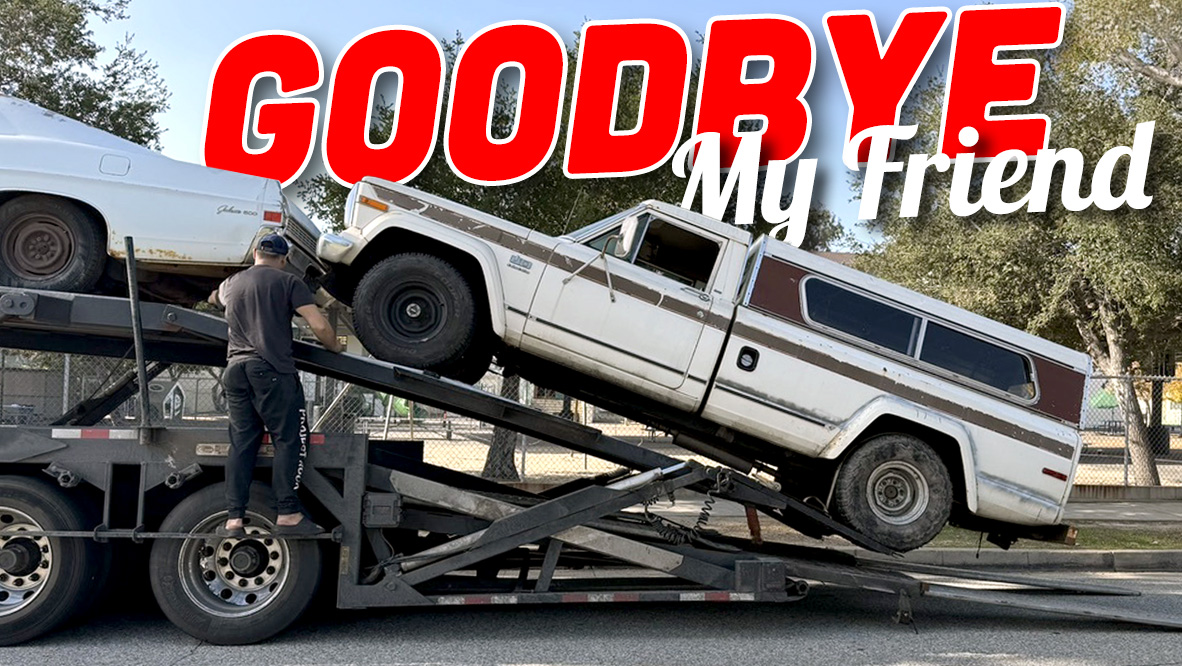
If California’s Governor Gavin Newsom has any aspirations for higher office, he’d better not screw this up (OK, maybe it won’t make a difference and this bill only matters this much to us car-nuts). On his desk sits a bill that would allow smog-era cars from the late 1970s and early 1980s to bypass smog tests that are often extremely difficult to pass, thus bringing more vintage automotive glory to California’s roads. Unfortunately, after Leno’s Law failed last year, and after decades of enforcing a silly 1975 smog exemption instead of a rolling exemption for cars of a certain age, far too many people have had to sell their beloved 1970s/80s automobiles. Including me.
I always thought I’d keep my 1985 Jeep J10 forever. It was the perfect spec of the Jeep pickup I always wanted: It had the inline-six, the four-speed manual, the tall 2.73 gears for road tripping, the eight-foot bed, a stamped tailgate, a gun rack, bench seat, a regular cab, four-wheel drive, manual locking hubs — it was truly a truck’s truck. And with only 85,000 miles on it and a manual transmission that I myself had rebuilt, the thing was the most reliable machine I’d ever owned. The only problem was, I moved to California, and California’s smog rules required that I have all the components in place: The EGR, the original carburetor, the vacuum hoses, the secondary air injection pump, a fresh catalytic converter, and on and on.


Over the past few years, there has been hope in the air, and so I held onto my J10, just waiting to see if long-awaited relief for these smog-era cars was finally coming. A bill, championed by Jay Leno, seemed like the answer to my problems, as I wrote in my article California’s Smog Rules Are Pushing Me To Sell My Beloved 1985 Jeep J10, And The Improbable ‘Leno’s Law’ Is My Only Hope.

But then this happened: Leno’s Law Is Officially Dead, Which Means Classic Car Owners In California Will Continue to Suffer. I later wrote about how, because there are so many great pre-1976 cars, and because fuel injection became prominent in the mid 1980s, there are still so many amazing options for enthusiasts in California (this was met with readers rightly pointing out that the cars in that 10-year span represent so few vehicles, why even bother making it hard for their owners?). I also went out and bought my truck’s replacement, the Jeep J10’s successor, the Jeep Comanche, configured in exactly the same way — long bed, regular cab, bench seat, stickshift, 4×4, inline-six:

But even if I had a replacement, and even if I still think there are plenty of awesome cars on the road in California, I’m still bummed I had to sell my J10, and I agree with readers that making it hard to smog cars in this small span of model-years — cars that aren’t really daily drivers anyway — seems pointless. Which is why I hope Governor Gavin Newsom doesn’t screw this up.
The New York Times breaks the bill down, writing in its piece Jay Leno’s Classic Car Bill Passes in California Legislature:
The bill would exempt some cars made before the model year 1981 from the standard smog checks that determine whether the pollutants they emit are within safe limits. Car collectors say that the current rules in California — which generally require gasoline-powered vehicles from model year 1976 onward to undergo a smog check every two years — are overly restrictive.
“Most of these cars that we’re talking about, they get driven to a car show on a Saturday,” Mr. Leno said. “The car’s parked all day, and then it’s driven home at night.”
The exemption, which applies only to qualifying collector cars, would take effect in January 2028 and be phased in over five years, eventually exempting collector cars made before model year 1986 from smog checks. To qualify, owners must either have collector-car insurance or prove that the vehicle is driven fewer than 1,000 miles per year.
You can read the whole story on The New York Times. It’s a bit slanted, focusing on the fact that these old cars could produce 20x the emissions of a new car, and even though it’s not going to account for a lot of vehicle-miles, it’s still a step in the wrong direction, public-health-wise. I get where they’re coming from, but we as a society have to decide what we think is acceptable from an emissions standpoint, because absolute zero-emissions isn’t going to happen. We have to make compromises, and I, a car enthusiast who daily-drives an electric car, think getting more of these cool cars on the road is worth the small tradeoff, especially if these cars and their repairs can be taxed in a way that offsets some of those emissions.
Governor Gavin Newsom will decide by September 30th whether to sign the bipartisan bill. I hope he does, even though I no longer have a horse in this race, for my beloved Jeep J10 fell victim to the draconian fixed-1975 SMOG exemption. I’m sure many tens of thousands of other 1970s and 1980s cars were either scrapped or sold out of state due to their owners’ inability to get them through SMOG; it’s time for California’s eradication of one of the coolest automotive eras to come to an end.
Top graphic image: David Tracy


I’m surprised that the bill was not linked directly. Here it is if you want to read the source.
I think the probability of a “no sign” is the highest of the 3 outcomes. Check the assembly vote–55 ayes, 4 nos, 20 (!) no vote recorded. In the last days of the current legislative session, all those people were there, and chose not to put their name on the record one way or the other. It reads to me as a reasonable compromise and a well written law that few want to be known as being on either side of.
On that final note… just wait until ACA7 hits the ballot box in 2028.
Thank you for the context!
Huh, I guess my comment got deleted? Or maybe it’s lost. I’m not sure
Key points:
– likely has little to do with Newsom getting elected to higher office
– disingenuous for David, a wealthy man, to lump himself in as a victim of smog
– the labeling of the Nytimes piece as slanted wasn’t backed up by the obvious figures one might expect to see in response
I’m a bit surprised that nobody has mentioned that David’s truck wouldn’t be exempt under this new version of the bill until 2032.
It starts exempting 1981 and older in 2028 and then adds another model year per calendar year until 1986 in 2033. At that point adding any more years would require a new law.
I have mixed feelings regarding this law. While it’s great on paper, like so many laws that my state passes, it’s never really good enough.
What arbitrary excuse are they using to choose that year? I mean, OBD1 was phased out in the 90’s so it would make sense to include cars from at least the first part of that decade.
This is where my conspiracy hat goes on. You touched on this a little in your story.
The date feels like it’s targeting modern enthusiasts. 1986 predates just about every popular “tuner” car of the last 30 years, eliminating a large portion of enthusiasts from the benefits of this bill despite many of them driving their slightly newer cars just as little as pre-1986 models. This includes genuine imports that already have to go through a stringent CARB process to obtain California registration.
This, I sold my 95 obd1 wrx because even though it was significantly cleaner after my swap to a newer motor, it could not pass inspection. It was an auto fail. Old enthusiasts seem to get a free pass but anything in the obd1 is screwed just because it was made in the 90s.
That sucks, which inspection did it fail?
Was the swap a USDM motor with all the smog components?
I hope the bill goes into effect (I’m not holding my breath) even though it won’t benefit me personally since my oldest car is an ’89.
The hassle and expense of getting my 20ish, 30ish, and almost-40ish-year-old cars to pass smog every two years, even though I drive each of them less than 1,000 miles per year is a royal PITA, I’m not gonna lie.
Michigan with no checks at all is still here. You chose to go live in that emission hellhole dust-bin because it is where all the “happening” stuff is going on right? Don’t ask them to change now. Otherwise you are no different than those who move near a race track after it was built *then* complain about the noise.
CA sucked and we all knew that before you left your automotive wrenching utopia here in Michigan to go there. Here things rust but you can run what you want. There things don’t rust but it’s a nazi nanny-state. The poison was chosen. Now you get to look at all those old beautiful non-rusted vintage cars that you can’t actually practically drive unless you are rich like Beau.
Is this why you aren’t doing many wrenching articles anymore? Still waiting for something besides ebay-build-a-new-car-in-my-garage wrenching. What happened to welding junk? Oh you can’t drive it. Got it.
California is the greatest state in the nation, in my opinion. (And I LOVE Michigan).
I moved here so I could build the site you’re now reading. I did not do it because things are “happening” (anyone who has read my work knows I’m not much of a city boy).
With that said, I did meet the most wonderful wife I could ever have imagined. And “besides the [WWII Jeep]”? That was more wrenching than probably all my Michigan Moab projects combined. I need a break!
Actually, I don’t. I already have the rustiest, crustiest Jeep project in the works!
I love it out here; there are rules, and like everyone else out here, I abide by them while simultaneously complaining about them.
“there are rules, and like everyone else out here, I abide by them while simultaneously complaining about them“
Feels like a very relatable and universal truth.
Also I never lived in CA (after a couple visits it’s hard to deny the appeal) but I loved living in Michigan. The lack of vehicle inspections there probably helps to elevate car culture a bit, but it does a lot more to promote straight up neglect… it’s nothing to be excited about.
We just miss you here, man. Still salty you left.
“I love it out here; there are rules, and like everyone else out here, I abide by them while simultaneously complaining about them.”
Except when you don’t abide by them, which is whenever you feel like it, as we learned with your freeloading with the Jeep truck.
Thank God I’m here to pay your road taxes.
But as Ruby Rod said, “Who cares! ”
Now, onto the meat of the matter.
I’m as big of a critic of Cali as you’ll find, and I can best that Michigan guy any day of the week listing the problems here. He doesn’t know the half of it.
But…
My long life and travel to all four corners of Uhmerica has taught me a great truth, it doesn’t get any better than California.
There’s a reason 40 million souls planted their stakes here.
As Michigan guy said, which he meant as an insult but I say with conviction, it’s all happening here.
California: the best of America.
Flame away…
I like California, it’s nice there. Michigan is fine, I guess.
Such ringing praise for Michigan.
Wow dude, who pissed in your Corn Flakes today?
There are many people who have hard-ons for California.
This guy is the reason Michigan sucks. Without him, it’s a great state.
Measures to clean up the air worked, in the face of many who said any attempts would be disastrous. The population more than tripled, the number of vehicles almost quadrupled, and contrary to certain economists predictions, the state’s GDP grew at a stellar rate. All of these current collectible vehicles that would be future exempt are already here and passing smog. It’s what we see going to car shows and on Sunday drives. Most importantly, they’re not daily drivers. They’ll remain as such.
The London low emissions zone made a measurable improvement to children’s lungs.
The politics works slightly differently here though, because any improvements to the health of the general population reduce strain on the NHS.
Yes. Cali air when I was a kid was horrific.
Then, starting in the late 90s and accelerating in the 00s, the air cleaned up.
The smog controls, which we pioneered globally, worked.
“To qualify, owners must .. prove that the vehicle is driven fewer than 1,000 miles per year.”
“…focusing on the fact that these old cars could produce 20x the emissions of a new car, and even though it’s not going to account for a lot of vehicle-miles”
So for the 999 miles you might drive that Jeep in one year you’d be putting out as much pollution as someone else might create in 20,000 miles – which is generally around two years worth of pollution for everyday commuting.
As someone who enjoys breathing while driving a well-maintained convertible – and also remembers how eye-searing the smog was in CA (as well as Tokyo in the early 90’s where I’d blow my nose and it would come out black)
Sorry – No sympathy for you and Jay Leno’s gross polluters.
Jay’s got like what, 5 cars he’s actually modified from original? And he doesn’t seem the type of person to delete factory emissions equipment…. on top of how rarely he drives them all?
Is Leno and the people like him really a problem? Especially with the other polluters that either still haven’t gotten, or just recently gotten, a set of emissions standards set for them?
“Jay’s got like what, 5 cars he’s actually modified from original?”
He can keep them unregistered and on his private property too – nobody is coming to take them away.
That doesn’t even factor in the amount of hydrocarbons these old cars without evaporative emission system leak every day whether or not they are driven.
You *could* have spent the money to make the J10 CARB compliant. You instead wisely chose to sell it and buy a very similar truck that already did comply. Part of the bargain is that you get to live in SoCal at a time when the air isn’t a major health hazard to you and your family.
Someday I’ll just buy a 1975 J10 with no smog equipment and run that.
An easy workaround for many is to utilize your employer address if it has a branch presence out-of-state to circumvent the “green” laws in Kalifornia.
Just register it with your name and add your middle name (or delete it if you use your middle name in Cali) to the registration paperwork in, pick a state, say Connecticut if your employer has a branch office there and you are set.
Unless you daily our classic car you will pretty much never get caught.
Not condoning this however but Delaware has a lot of corporate entities there.
what happens if you daily drive the car?
Well, it gets seen more and the potential of the many Karen-types seeing it increases… ????
so what you are saying is that this is not a smart move if you plan on ever driving the car?
Probably not depending on where in California you live. It is a large state.
You missed the article a few months back regarding a few states now cracking down on this practice.
But it is technically legal.
No it is not. It is not legal to register and insure a vehicle in a state you do not live. At least not in California and other states that have decided to crack down on the “Montana” loophole.
Has a lot to do with the judge presiding your case if it gets that far and the defense you present.
It’s never been legal.
See above.
See what? Your comment about lenient judges? That doesn’t change the legality of it.
TLDR – Cheat the system. Got it.
If you have ever engaged in driving over the speed limit on a given roadway you have also cheated the system?
Logic fallacy: false equivalence.
Understood.
I’ve already “cheated” the system by hot smogging street-driven track cars in my past life, but I’m not going to pretend like what I did was justified via some sort of self-righteous indignation.
This is illegal in California. Read the laws. I used to ticket people for this.
Random thought, why doesn’t California just seccede from the union? I mean sure sometimes they’d have to try occupy the colorado damn and influence vegas but otherwise it’d be sweet right?
Most Californians would be happy to secede these days.
Or join forces with Canada and/or Mexico.
Canada should annex the West Coast and the East Coast down to Virginia, so that on a map Canada looks like something from Space Invades attacking the US.
Ugh, Space Invaders. Space Invades sounds like the poorly translated title to a bootleg copy of the criminally underrated Mars Attacks.
Where’s my Slim Whitman records when I need to kill aliens?
As a long term resident of California who remembers what living in the 1970s LA smogbowl was like I very much appreciate all that California has done to clean up the air. I don’t see any problem with the laws as they are now. Old cars only have to meet the standards of the year they were built, not to modern standards as a lot of people seem to think. That’s not a big ask except for your Jeep which wouldn’t have met ANY standards:
“The problem is that my J10, which was legal to drive in Michigan despite missing emissions control devices (since they’re so failure-prone and hard to replace), is not legal to drive in California, where I now live. For me to get the vehicle back into compliance would cost me far too much money and time. To avoid this, I either have to sell the vehicle, register it elsewhere (California is cracking down on this, I’m told), or work with a California “referee” on an engine swap. And, with a new child in my home, I don’t have time for that.”
You brought a non California market vehicle that could never have passed emissions here even when new, and certainly never would with all its emissions equipment missing to California; what did you expect would happen? This is exactly the reason these laws still exist.
You more than most people could have brought it into compliance, maybe even gotten content out of the process, maybe even gotten eBay, RockAuto or Galpin to pay for it. Instead you made a choice to get pass the Jeep on to someone else. That IMHO was the right call. I hope in the future you’ll find another J10 in better shape and that is California emissions compliant that you can enjoy.
My sense is that the CARB excuse was just pretext to get rid of a vehicle that he should have never brought to California. How many other Jeeps does he have that haven’t been on the road in years that are in fact CARB complient. At least two.
I second this sentiment. David could have made a little docuseries about the process, maybe even get into what can be upgraded along the way (injection conversion, modern high-efficiency catalytic converters, etc), but he made the choice that it wasn’t worth it, and gave up on the car. I understand the logic that sometimes the work costs more than the vehicle is “worth”, but David of all people should be able to separate a vehicle’s worth from its resale value.
Never sell your treasure for the price of another man’s trash.
My wife’s first car is probably worth $2-3k now, we’re probably about $4.5k into it on maintenance, and will probably more than double that in the next several years, but that car’s not going anywhere. It’ll get new control arms, quarter panels, hood, driveshafts and even a rebuilt transmission eventually. We’ll NEVER get our money back, but this car isn’t actually worse than the more-expensive cars we could get for the cost of maintenance, it’s just older, smaller and cheaper, and to an oil-stained Autopian, those aren’t reasons to get rid of it.
I understand that David had multiple projects, and this is a factor that bumped this one down the priority ladder a couple rungs, but CARB didn’t single-handedly obliterate this J10’s chances, it only nudged it over the edge.
What did I think would happen? I was hoping this Leno’s Law would pass, but since it didn’t, I sold the car out of state. Since getting the vehicle complaint would have been such a pain in the arse, I chose to maybe someday buy a 1975 that has no smog equipment. It’ll pollute as much or more than my 1985, but that’s how the rule is written (unless this Leno’s Law passes, and I hope it does), and I’m a law-abiding citizen.
“I chose to maybe someday buy a 1975 that has no smog equipment. It’ll pollute as much or more than my 1985”
I don’t see how a ’75 with no smog equipment could be any worse than an ’85 never designed to meet California emissions in the first place with its emissions equipment removed.
And given the potential health and environmental impacts I dunno why you would do such a thing.
It’s my understanding that GM ’75 model year light trucks would have had not only emissions equipment but a catalytic converter:
“Basic Federal (i.e. non California) emission laws are as follows for gasoline fueled vehicles:
For 1973 to 1978 all passenger cars and light trucks under 6,000 lbs GVWR must meet stringent light duty emission standards. All trucks heavier than 6,000 lbs GVWR must comply with heavy duty emission standards, which are much more lenient. For 1979 through the current day, the dividing line between light and heavy duty emissions was raised from 6,000 lbs GVWR to 8,500 lbs GVWR, forcing more trucks to comply with the stricter emissions standards than previously.
California emission history is identical with one exception: that state raised the heavy duty emission threshold for California-sold vehicles from 6,000 lbs GVWR to 8,500 lbs GVWR a year earlier, for 1978. (I.E. the Federal Government followed California’s lead a year later, for 1979.)
A few other general facts:
Catalytic converters were introduced into the auto industry for the 1975 model year. From 1975 on, catalytic converters were used on ALMOST all light duty emission standard vehicles (all states) but were not used on any heavy duty emission standard vehicles. When auto manufacturers adopted fuel injection in their light and heavy duty emission class vehicles, they adopted the use of catalytic converters across the line. (GM adopted fuel injection and cats essentially across the line for 1987.)
What all of the above means for 1973 to 1987 Chevy C/K series trucks follows:
For 1973 thru 1974, no converters on any models, anywhere.
For 1975 thru 1977, catalytic converters were used on all C/K 10/15 trucks nationwide with GVW’s under and up to 6,000 lbs, except 1976 and 1977 C10/15’s with the 454 V8.”
https://73-87.com/7387info/7387emislevel.htm
Please correct me if I’m mistaken but wouldn’t that have been true of ’75 Jeeps as well? If so that would mean you have the options of buying a ’75 Jeep with its original emissions equipment intact, restoring the originality of a truck missing its equipment or restomodding.
1975 vehicles are exempt and require no emissions equipment whatsoever. My 1985 still had some emissions equipment.
Vehicles made for California in 1975 were required to have emissions equipment when new. What’s changed is they are now exempt from inspections which isn’t the same thing as if they never had such equipment in the first place. Whether they are still legally required to have that emissions equipment still intact depends on whether you believe Wikipedia:
“Although vehicles 1975 and older or diesel vehicles 1997 or older are not required to get a smog check, owners of these vehicles must still ensure that their emissions systems are intact.[citation needed]”
https://en.wikipedia.org/wiki/California_Smog_Check_Program
Yep, this is an important distinction. They’ve never enforced this but they could.
I love when Cheap Bastard logs in to the chat!
Yes, it remains technically illegal to remove any original emission equipment on any car in Calif.
Even 75′ and older ones.
However, as there is no inspection at all ever, lots of folks yank the equipment off and throw it in the dumpster out back.
Is also illegal to modify any exhaust system on any Calif car of any age.
Ha ha ha ha ha. My town sounds like a durn race track.
It’s a quagmire I doubt someone like Newsom will sign. Especially as it could anger a very loud vocal minority that has an aversion to empirical data, facts, or reason.
It would probably help if other states has a consensus on what a historic or antique vehicle is. 20 years ago many states defined it as 20 or 25 years old. It’s turned to 40 to 45 years old. Probably logical as the US fleet age has increased. Many people were using historic or antique plates to bypass various requirements including in some states insurance. States often require a person to have a normal registered vehicle before they will register a vehicle as historic or antique. Sometimes there are limits on use. Any vehicle that has historic status shouldn’t be required to pass emissions. It’s just not practical. But trying to get that though a state like California good luck.
New York, which follows CARB pretty well, has a pretty good consensus on Historic/Antique vehicles. I also learned that the state has a 25-year limit for OBD2 inspections: once a vehicle is 25 years old, it’s exempted from emissions testing. It’ll only need safety inspections. Historical plated cars also get exemption, as well as 1 year old vehicles.
Now that’s something I could live with!
Alot of the states that have follow or historically filled carb have kept 25 years. And automatically stop asking for testing for registration. That might be too logical for CARB though. I know that VA, NY, CT,CO do. NJ requires all odbii cars to do emissions testing pre odbii don’t have to . That seems like something that would work for California. You can blame it on the machines.
The 25 year rules are better. But some people can’t be dealt with logically. ESome states have raised the age of historic to 25 from 20 others it’s 40 a few are 45. Some have gone to 45 then down to 30. It seems crazy but if you look at from fleet age it might not be.
Here in Oregon the cutoff is 35 years in the Portland Metro. I could get behind a bill to drop emission testing for vehicles older than 1996 OBDII but still require them to visit to confirm that mileage is less than 2,000 miles per year.
I can’t get behind a rolling 25 year exemption in a state where cars don’t rust and the contractor down the road working on a neighbor’s house is driving a carbureted F-150 as his work truck.
I wouldn’t be surprised if something like that is the CARB compromise. NJ was having issues with the machines as are everyone else. 25 year works for most states. I bet gas prices will end up working for the rest.
Look buddy, this is Calif, we don’t need no stinkin safety inspections.
A vehicle only needs to pass CARB standards for the year that it was produced? Why isn’t that practical? Pull into the station and test just like any other vehicle.
The impractical part of that is that the old testing equipment is rare and often in a state of disrepair. Only a small portion of shops have the equipment to SMOG test a pre-OBD car, and at the ones that do, the equipment spends a lot of time inoperable, sometimes for maintenance and other times because the one old technician who knows how to run it isn’t on shift that day. The issue isn’t with the standards themselves, but with how they’re tested.
To emissions-test a pre-OBD car, first there’s a visual inspection to make sure all the original equipment is there. Even if you’ve retrofitted a more modern system that burns cleaner and gets better fuel economy, you can be failed if an obsolete, vacuum-controlled piece of equipment is absent. Then, they have to put the car on a chassis dyno, a tool that takes up an entire lift’s worth of space, requires frequent upkeep and would almost never be used outside of the rare occasion where a 1976-1986 car rolls in for a check. Then, the tailpipe sniffer, which has to be affixed just-so to the exhaust pipe’s outlet, and is sensitive to damage, clogging, ambient temperature and electronic component aging.
The letter of the law is that the vehicles must comply with the regulations from their year of manufacture, and those old regulations all specify their testing procedures, so there’s no way around this whole song and dance without somehow writing a new standard for old cars.
My smog guy still had the dyno and it still works. Back in the 90s when I first started going to him that was the norm. I’ve not seen it used in years, but he claims once in a blue moon he rolls it.
Parts for both the vehicles and the older dyno smog equipment are getting difficult to find.
Try to find a rebuilt smog pump if you can it’s probably going to be $400. Rebuilt working Smog era carburetor also expensive and good luck. Smog pump is a joke anyway. Having an aftermarket pump or a electric blower would do the same thing not much. But it wouldn’t pass the visual inspection.
The last I saw the most popular TBI conversion on the market wasn’t able to get CARB cert. The Holley Terminator. A system that can reduce emissions, increase efficiency as well as reliability.
Also good luck finding a station with the pre odbii testing equipment it’s old has to be fixed and certified. The people doing that are retiring and dying off. Plus there isn’t as much call for it.
The vehicles aren’t use much they need a way to operate as a “Sunday car”. It’s not hard to understand yet a vocal minority will never understand because they have been fed nonsense for decades.
There’s a rebuilt smog pump on ebay right now for $245 and carbs are $50-$150 on ebay. Toss in another $40 for the rebuild kit. All in $2k makes this vehicle CARB compliant. A choice was made to bring a rusty J10 with removed emissions gear into California. Not sure we need to change laws everyime people make poor choices.
There’s 2-3 places with a smog dyno within 1/4 mile of Galprin. (Precision Smog. etc. It’s LA – there’s a lot of old cars still on the road there.
I don’t think wanting to breathe clean air is the interest of a vocal minority.
That’s one specific case. The majority of those affected are cars that have lived in the state their whole life. It’s a bad example. There are late 60s early 70s cars where the parts don’t exist haven’t for some time. It’s either let it sit find someone who can maybe rebuild it or sell or register in another state.
Current California law requires testing for 76 model year and newer.
They just need to undo what they did in 05. I can remember people trying to find parts for the car still in the 30 year rule and couldn’t.
Not without verification that the cars aren’t being used as daily drivers.
The reality is that by the time a car is 30 years old it is generally used up and needs to head to the scrapyard. No reason to have people daily driving gross polluters. 1996 is still EPA Tier 1 and allows 27x more NMHC+NOx vs Tier 4
Historic plates work for that. Not sure I would be egging on mass surveillance state though.
No they don’t. California doesn’t not check or record mileage when tags are renewed. Once someone applies for and receives historic plates they can drive as much as they want.
If the supporters of this bill really wanted it to only apply to cars driven 1,000 miles or less per year they would have required verification. No reason this could not be done at any smog station on the same schedule as the emission test.
Many states require you to have a regular registered vehicle and say you aren’t using the historic vehicle everyday. That California doesn’t do that yet is uncharacteristic and I’m sure will be coming. Especially in the quagmire of regulatory experiments both California and Texas compete in. Texas does in infact have restrictions on antique plates.
This article is about a specific California law that will eliminate emission testing for 6 model years of cars and does nothing to prevent them from being driven on a daily basis.
That said, even if someone has another car and other car they own that exchanges regulatory requirements in exchange for a mileage limit should have a way to enforce that mileage limit.
That said it ain’t hard to disconnect the speedo cable on most 80’s and older cars and GPS speedos are cheap…
So make people work a bit to break the law.
Today some people mod their cars and then put them back to stock to pass inspection. That doesn’t mean California should just give on inspections.
It’s a law that Newsom isn’t going to touch. CARB will do CARB and do some kind of administrative action when there palms are greased enough.
We need to stop nanny state behaviors it’s leading to population that doesn’t have a clue. Restoring public trust is a two way steet. The states that do have that requirement essentially act in faith. If it’s obvious someone is offending just like someone who doesn’t keep up with registration they will eventually get found out and penalized.
I’m of the mind that there is no reason to make a law and then not enforce it. That just breeds contempt and the idea that people can ignore any law they don’t agree with.
I feel the same way about things like speed limits. Set the real limit and then enforce the law. Don’t set the limit at 55 mph and then ignore anyone going less than 75. That leads to contempt on one side and harassment by selective enforcement on the other.
There are always laws on the books not enforced. Either old or bad most of the time both. The population tends to be over regulated and corporations and high wealth individuals can find loop holes or completely bypass regulations.
Reactionary legislation and corporate interests along with outdated and short sighted ideas make a mess of things. What might have been an ok law 50 or 75 years ago doesn’t fly anymore. Regulations with agencies that always get mission creep don’t help the situation.
Exemptions in laws need to exist as well as good judgement from all of involved in enforcement. But as a society we have lost that. The metrics on which those involved are rated need to change.
There is some thought that those that have been raised by the a nanny state are now in power and enforcing for the nanny state. There is no thought just mindless compliance. Where the American systems were always designed with free thought.
The idea that there could be an enforcement action is enough to keep most people honest. It also helps be a bellwether if the law is or regulatory action is agreed upon by the public. Slapping a speed limit a road without studying how people are using it isn’t in the public interests. Just like massive regulations on vehicles that is no longer used in same way as others.
Having agencies administrators not follow judicial action or ignore legislators is a much bigger issue then a few people skirting a law.
“That California doesn’t do that yet is uncharacteristic”
It’s in character for here. We are the car culture center of the universe, our laws reflect that. Smog laws were created from dire need, but we really don’t regulate much on cars past that.
I’m not so sure. If there is one thing I’ve seen working in the industries I’ve worked in. There is always some place you would never think of, probably never heard of, doing amazing things extremely well.
The California refugees I’ve talked to all over the country over often talk about being over regulated in everything including cars. There are a quite a few of them Nevada and Arizona that fled California for how they were harassed for their vehicles.
Still plenty of ~1996 cars on the road because they’re pretty modern on the grand scheme of things.
<1999 is about 8% of registrations and dropping
“If California’s Governor Gavin Newsom has any aspirations for higher office, he’d better not screw this up.”
In the event that Governor Newsom makes it to a national election for a higher office, I would hope that this issue wouldn’t even rate next to so many things that matter so much more. Voting based on a politician’s kindness to classic cars is wild.
Absolutely. I would totally vote against the own best interests of my hobby for the sake of much more important topics.
Single issue voters like you described are bonkers to me.
You must not live in California.