

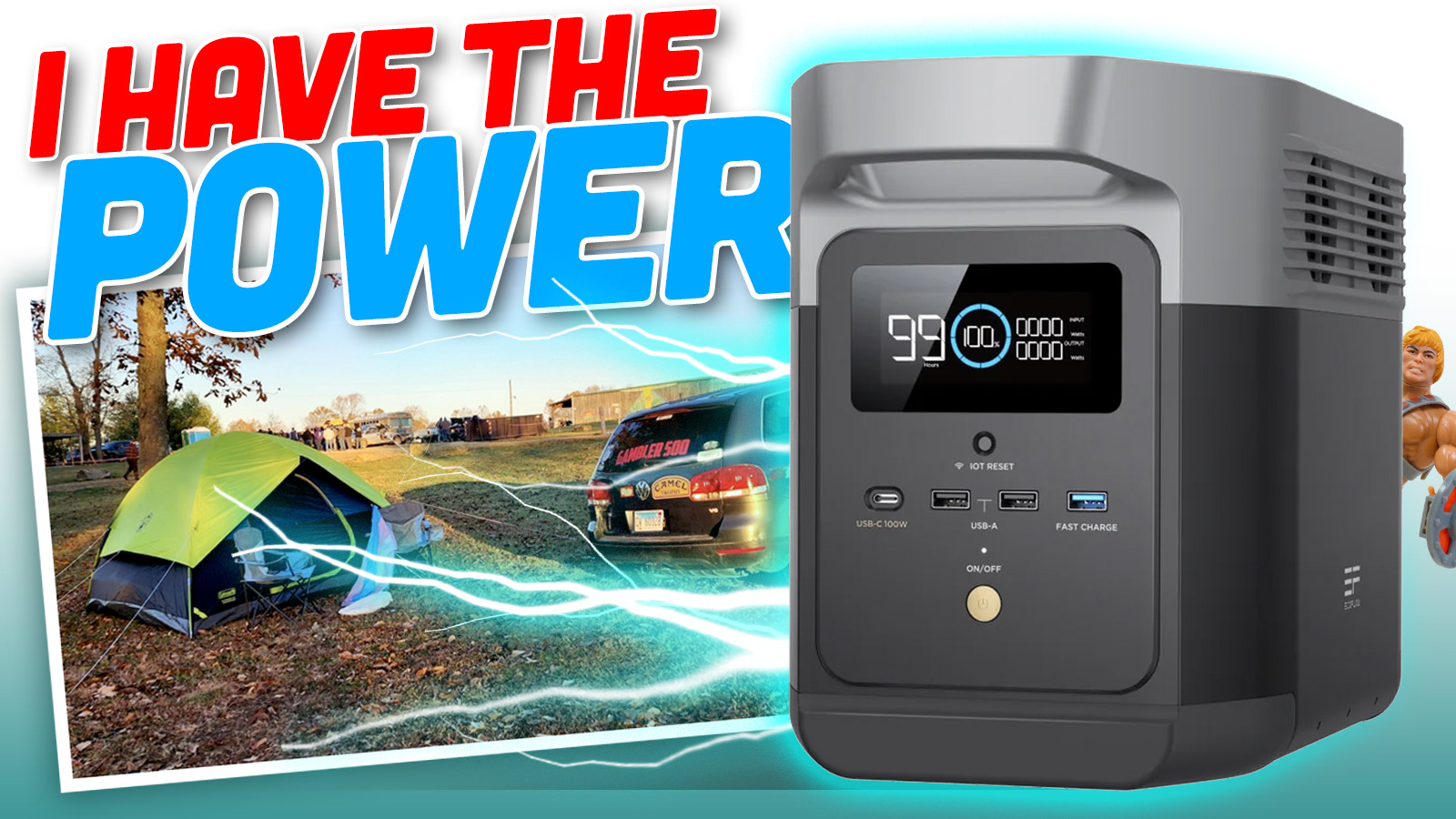
Life is full of occasions when you’d have an easier time doing something if you just had access to some electricity. Maybe you’re camping in a tent and need to blow up an air mattress or charge some batteries. Maybe you’re fixing your car’s broken air conditioner, and you want to evacuate the lines. Perhaps your home has lost power, and you just want to run a few lightbulbs. For the past five years, I have owned a tool that has been my rock on endless projects. My EcoFlow Delta Mini has been so dependable and so infinitely usable that I think everyone should get a lithium power station.
Back in 2021, the friendly folks at EcoFlow sent me a Delta Mini to review. As someone who had always burned gas to generate power, a giant lithium “battery generator,” as EcoFlow incorrectly called it back then, was mind-blowing. I went on to use the Delta Mini to power corded tools and to juice up my tent, making it feel nearly as luxurious as an RV. I recall writing an entire review of the device for Jalopnik, but for some reason, many of my old articles have been deleted or otherwise lost over time.


Something I find lacking in product reviews is that, often, the reviewer never follows up their initial article with an update after long-term use. There are a lot of products out there that work great just long enough for a positive review, but fail over time. I learned this the hard way after writing my review of the Pioneer NEX car stereo. My wife bought a NEX unit based on my review, and within six months, her unit began boot-looping. My demo unit started doing the same about a year after my review. There was no fix, and since I don’t work for Jalopnik anymore, there was no way I could update the review.

Since then, I have tried to write about how using a tool or device has worked out in the long term. That’s why I wrote reviews about my lithium jump packs, my lithium motorcycle battery, and my solar panel battery tenders years after I got them. If you’re like me, you’re not buying a tool to use for six months. You want it to last for years.
I am now reaching the five-year mark with the EcoFlow Delta Mini, and it is, without equal, the best tool I have ever owned. After all this time, I’m still finding new uses for it, too. This device has gone far beyond my original use of powering angle grinders and blowing up air mattresses. I’ve lost count of how many cars and motorcycles it’s helped me to fix. Now, this gray box of a battery is powering my entire garage, and I’m not exaggerating.
A Powerhouse Of Energy Storage

EcoFlow is currently one of the larger names in power stations. The company was founded in Shenzhen, China, in 2017 by Eli Harris, Hannah Sieber, Fan Zheng, and Dr. Bruce Wang Lei. While the company is based in China, two of its founders are Americans. All of its founders cut their teeth working at DJI, which is one of the first names in camera drones and small camera systems.
EcoFlow was founded with the mission to replace the gasoline generator. As I wrote recently in my review of the Harbor Freight Predator 5000 Inverter Generator, the typical generator is loud and generates foul fumes. It sort of ruins the quiet beauty of the wilderness. Inverter generators are a lot better on the noise front, but don’t solve the issue with fumes. You also cannot use a generator indoors; they tend to weigh a lot, they aren’t particularly efficient, and they aren’t that clean, either. The engineers and entrepreneurs behind EcoFlow believe there’s a better way.

In 2017, the company launched with a campaign on Indiegogo for its debut product, the EcoFlow River Smart Solar Charging Station. The River wasn’t much of a “generator,” so to speak, with its 412 Watt-hour capacity and only 500 Watts of output, but it was clearly something that people wanted. The campaign cleared $1 million in short order, and EcoFlow hit the ground running.
Today, the company is an energy-storage titan. EcoFlow now sells whole-home power stations with up to 180 kWh of storage and up to 36 kW of output. EcoFlow’s portable power stations are equally impressive, with capacities up to 36 kWh and outputs as high as 4 kW. It’s gotten to the point where if you have the right solar panel and power station setup that you really can go camping or outlast a power emergency without ever firing up a generator.
My Power Station

My EcoFlow Delta Mini sort of represents where EcoFlow came from.
It launched in September 2021 as the more affordable version of the larger Delta and Delta Pro units that helped put EcoFlow on the map. Back then, the EcoFlow Delta Pro had an impressive 3.6 kWh of storage and up to 7.2 kW (surge) output into a gray plastic box, but also cost a whopping $3,599. The regular Delta was still pricey at $1,399. The Delta Mini started at a more approachable $999, and then quickly dropped in price from there.

EcoFlow marketed this device as being an ultra-portable way to get electricity to places where it normally wouldn’t be, and into places generators cannot go. The Delta Mini has an 882 Wh Nickel Manganese Cobalt Lithium-Ion battery (NCM) with a 1,400 Watt AC 120V pure sine wave output and a 2,100 Watt surge. It comes equipped with five AC output ports on the rear, four USB ports on the front, a 12-volt DC socket, and inputs to charge the power station from a wall, a car, or solar panels. At 23.6 pounds, it can be easily carried in one hand.
In my experience over the past five years, the station takes about two hours to charge from completely dead through a wall plug, around 10 hours to charge from a car, and over 12 hours with the two 110-watt solar panels that I have on hand.
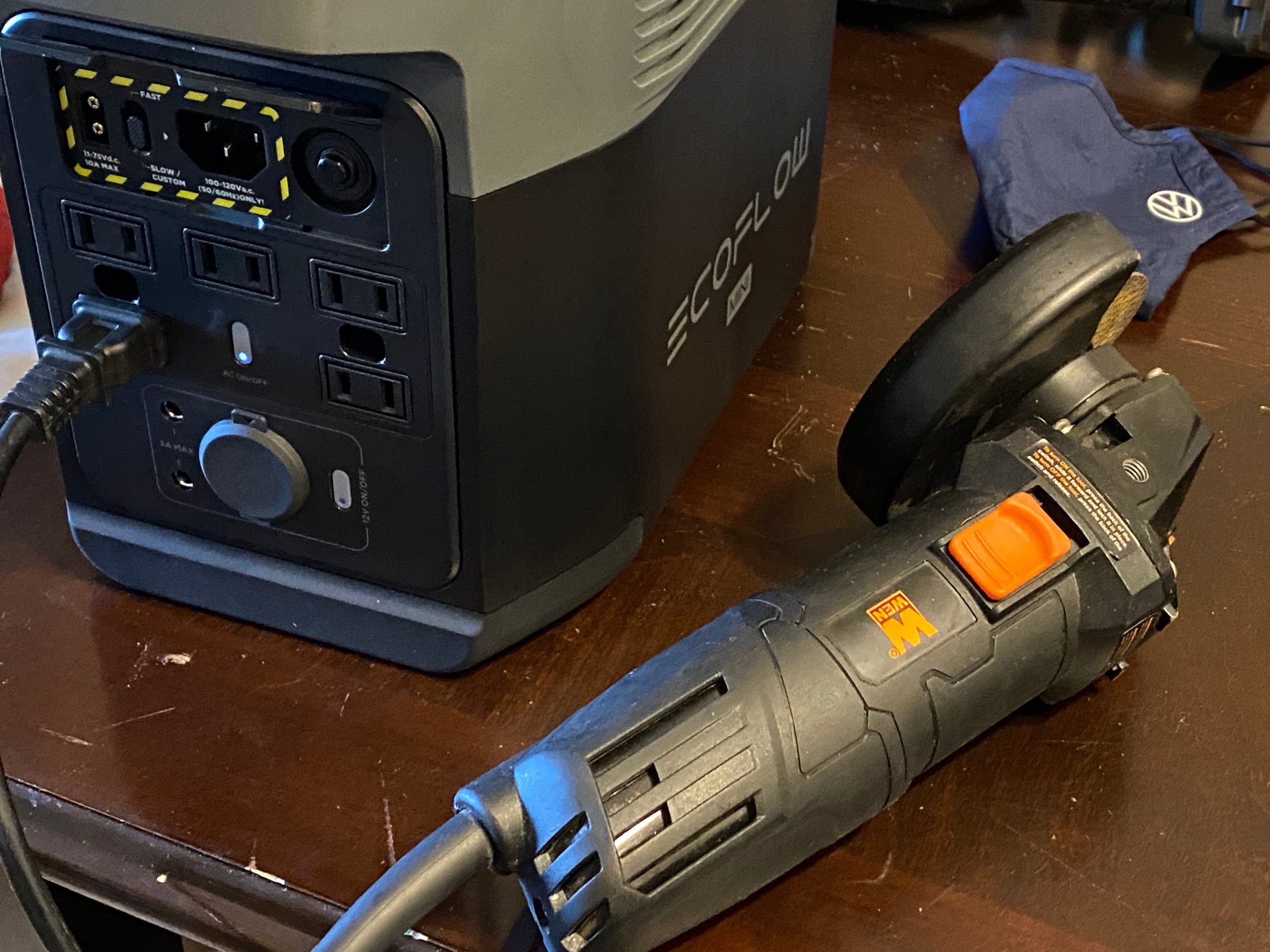
To give you an illustration of what 882 Wh of capacity looks like, I performed a bench test with the Delta Mini powering a heat gun on full blast. This is basically a torture test, as using electricity to generate heat sucks up a lot of juice. The heat gun’s power usage averaged 1,400 Watts, which meant that it guzzled down 33 percent of the power station’s charge in only 18 minutes. There wasn’t a chance of the power station even lasting a full hour.
Thankfully, it’s rare that I ever need to use a heat gun for anything, and even rarer that I’d need to use a heat gun outside of my home. What the Delta Mini was amazingly useful for, however, was using corded tools out in the field. I manage a rather large fleet of cars. This means that I’m fairly regularly pumping tires up, doing small repairs, and am generally keeping myself occupied just doing things.
It’s Endlessly Usable

In recent years, I have used the Delta Mini to power a corded drill, which spun an abrasive wheel that helped me erase the business decals from my old Smart Fortwo project car.
I used the power station to spin up my angle grinder, which I used to cut slots into the horribly rusted bolts that secured my old Volkswagen Jetta SportWagen TDI’s fuel filter. Recently, I used the Delta Mini and the grinder to cut the corroded rear wiper from my wife’s Volkswagen Jetta SportWagen TDI. This is the second time I’ve used these tools for that, as my own old SportWagen TDI had the same issue with its rear wiper.

What I’ve loved about using the Delta Mini to juice up corded tools is that, in my experience, the Delta Mini’s runtime is longer than any of the batteries I have for my cordless tools. I never have to worry about running out of juice during a long day of fixing my broken stuff.
My mechanic recently used my Delta Mini to power the machine he uses to evacuate and fill a car’s A/C lines. Normally, he’d have to go into a garage or drag out some super-long extension cord, but he was able to fix my wife’s air conditioner right there in a parking lot.

But what I’ve enjoyed the most about this power station is its flexibility. Sure, it can power tools. That’s not going to surprise anyone. But to me, the real value in this device is the fact that I could start a day by using it to help me wrench, then I could toss it into my backseat and use it for generous power when I’m camping.
If I’m sleeping in a tent, I will not leave home without the Delta Mini. When I get to camp, I’ll use the Delta Mini to power lights, blow up an air mattress, then charge up phones and other devices. During one camping trip, I even had it run a fan all night and an electric cooktop for every meal. It lasted an entire weekend without needing to be topped up. Back when I used to run old minivans in the Gambler 500, I’d sleep in the back, using the Delta Mini as my source of power.

The Delta Mini is so good at what it does that when I went on the Autopian Watkins Glen camping trip and forgot to bring it, I felt like I had been thrust into the Stone Age. I had to rely on a broken campsite shore power stall to charge my phone, and other electronic devices that I brought with me just had to wither and die.
Then there’s how instantly the power is available. Sometime last year, a van carrying the La Picosa Hernández Banda traveling band crashed into a local power pole, zapping electricity to my entire neighborhood. It was so easy and quick to dust off the Delta Mini and provide basic power to some lamps, a television, the refrigerator, and the Internet router.
The Delta Mini has even revived my garage. I lost access to my garage about a month ago. Apparently, there’s an underground cable that feeds electricity from the grid to the box at the garages, and it blew apart.

This has been a massive headache because it means that a couple dozen garages in my neighborhood are inaccessible. Some residents have been able to fish a hook into their garage to engage the manual override. But since these garages are over 30 years old, nobody has the keys for the locks anymore, so those who have gotten in have had to leave their doors loose and unlocked. Making matters worse is that the condo board has to get permits from the city to fix this, and the whole process could take months.
My garage currently houses four motorcycles, most of my tools, and the Plymouth project. I don’t want to leave the door unlocked. Complicating things further is that, coincidentally, the spring above the door broke, so it takes some grunt to open the door by hand right now. Luckily, an electrician came by and briefly restored power to the garages using a gas-powered generator.

I used that sliver of time to open my garage and then disconnect the opener and my shop lights from the currently dead power outlet. Now, both the lights and the opener are fed by a cord that reaches outside. Whenever I need to get into the garage and work on something, I hook the EcoFlow up and use the garage as normal. As of right now, I’m the only person with an operational garage opener on my block.
Thanks to the EcoFlow, I was able to take my first motorcycle ride in over a month, and I did it from my cheap and cheerful Italian-Indian-American Vespa that remains the coolest bike I’ve ever purchased for $500.

My Favorite Tool
This was the event that convinced me that the EcoFlow Delta Mini is the greatest tool in my employ. I have lots of tools that I love, like my solar panel battery tenders, my jump packs, and my diagnostics tool. I could make the case for all of them being my best tool. But I think the sheer versatility of the power station is what makes it my absolute favorite. It’s the tool that makes other tools work!
I’m happy to report that the power station still works brilliantly after five years. Nothing has ever broken or malfunctioned on it, and capacity still seems to be pretty close to factory levels. Even the body has held up well with no more damage than some scratches, and it’s not like I’ve been gentle with the thing. As Bethesda Softworks’ Todd Howard would say, it just works.

I have more good news. A lot has changed since 2021, and nowadays, there are about a zillion brands that sell power stations, and you don’t have to pay anywhere near $1,000 for them if you don’t want to.
I know some of our readers use Jackery power stations in their camper builds. You can currently get a Jackery Explorer 1000 V2 power station with 1070 Wh of capacity and 1500 Watts of output for only $499. That’s more juice than my EcoFlow Delta Mini for half the price my unit was five years ago.
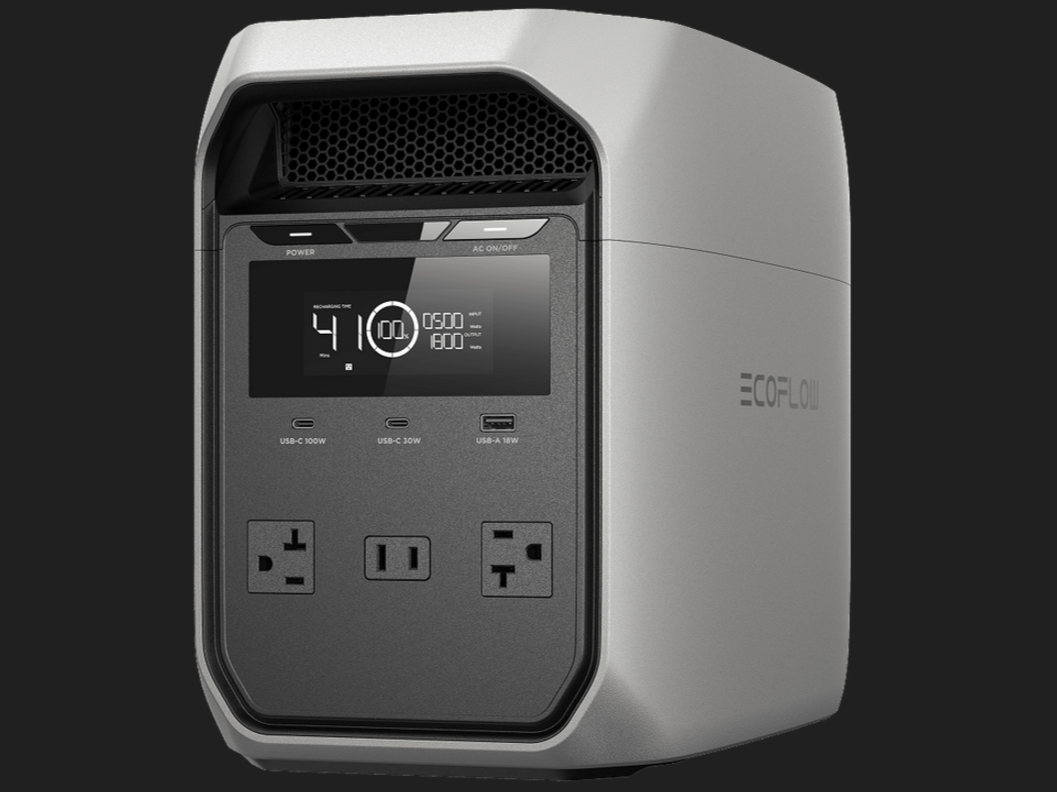
EcoFlow no longer sells the Delta Mini, but you can get a Delta 3 Classic for $529, which offers 1024 Wh of capacity and a 2600 Watt output for $529. Of course, that’s just to get you a power station that would be somewhat comparable to mine. There’s a whole world of power stations out there big and small, expensive and cheap. You don’t have to choose an EcoFlow or a Jackery. But definitely make sure that the one you do choose is well-reviewed and, hopefully, even has some long-term reviews.
If you do buy one of these things, you’ll probably wonder why you didn’t do it sooner. I didn’t know much about power stations in 2021, so I didn’t get that feeling back then. Today, I can’t imagine my toolkit not having a power station.
If you have a power station, what do you use it for? Have you ever used it in a creative way to get something done?
[Ed Note: We have embedded Amazon affiliate links, which means if you buy a power station or anything else using those links, we might get a commission. – ED]
Top graphic images: EcoFlow; Mercedes Streeter; eBay seller


Thanks for the follow up review, my home improvement plan for next year is to hang some solar panels on the roof my my garage and power it with something similar. The previous owners opted to gut the electrical int 4eh garage instead of bringing it up to code; and I don’t want to spend the time or money to trench a new service line to the garage, upgrade the panel in my basement, and re-wire the whole garage as new. One of these should power some LED lights and a garage door opener pretty well.
My sons’ high school marching band just got a Jackery they are using to power their sound equipment, replacing a Honda generator. It’s bigger than your EcoFlow (probably 12″ x 18″ x 30″, with built in handle and wheels), and testing over multiple practices over the summer shows it should be able to handle a full contest day (practice, prelims performance, more practice, abd finals performance) on about 70% of its capacity.
I don’t have a power station, per se, but I do have a 20Ah LFP battery with a 12V charging station strapped to it. It won’t do 120V, but it will run my laptop all day, charge all the things while I’m camping, run a 12V jack for working on my cars, and run a little electric paddle boat all the way around the lake by my family’s cabin. I probably wouldn’t have gotten it at all except I got a screaming deal and it’s a relatively reputable brand (although I’m hearing that the 20 Ah batteries from good brands might still be junk, so buyer beware). I’m really glad I pulled the trigger though, it’s been far more useful than I expected.
I have an Anker C1000 that’s been great during power outages. If the power stays off for more than 10 min or so I plug my fridge and other things into the Anker. It will run the fridge about 14 hours, a microwave for briefly heating things up, lights, charge phones, and lots of other little things. The fridge is the big thing, it completely removes the anxiety of not opening the fridge during a power outage and worrying about the food spoiling. If the power stays off too long I hook up the generator, but the Anker is quicker and neater.
I also charge the Anker with solar panels and run my desktop computer off it a few days a week, cuz why use not free electricity?
It’s just nice it still works 5 years later! Must have a decent quality BMS then.
I’m also not an all-in-one solution type of person, but for people who are and have enough money, it’s good these boxes exist. And that someone can make a living from selling them, go capitalism! 😉
Assuming its using LiFePO4-based chemistry for the cells, 5 years is nothing. You be able to get somewhere between 10 and 30 years of daily cycles, and as long as you charge it every 3-6 months, basically infinite shelf life between those cycles. Source: spent 10 years designing BMS software and hardware for mobile robots.
It’s not, it’s using NMC cells according to the article. However, it’s also 5 years old. I would bet the new ones are LFP.
Sooooo I don’t want to be a Debbie Downer, but I haaattttteeee these “all in ones” so much; they are rarely a good deal, and the way they are marketed is super misleading, borderline criminal.
What do I mean by that? Okay, let’s say you’re shopping for lithium batteries, to build house system in your car/boat/rv/cabin. You will see batteries advertised as AMP hours, usually at 12 volts. Now I get that “Watt Hours” is a better way to look at it (volts X amps = watts), BUT… I feel like these “all in one” companies use Wh because it’s a bigger number and sounds impressive to people that don’t understand electricity.
Example, your EcoFlow Mini has an “iMpResSive” 882 Wh. EIGHT HUNDRED! DANG!
Except once you convert that to the standard way lithium batteries are advertised, you realize it is a puny 73Ah (12v).
Yup, your $900 all in one has less than a 100Ah battery, and those are available for as low as $110 on Amazon.
Edit: I just realized the ecoflow uses inferior NMC batteries, not Lithium Iron Phosphate, which is even crappier:
https://www.evlithium.com/Blog/lfp-vs-nmc-batteries-comparison.html
Bbbbbuttt it has an inverter! I don’t care. You can get a 2000w pure sine wave inverter for under $100.
These companies are predatory imho. They take bargain basement components, get them even cheaper than you can because economies of scale, throw them in a ‘premium’ looking plastic box, and then charge people 5-10x what it would cost if you built the system yourself. Speaking of ‘building’, dude it’s like 2 wires, a red and a black one. Go from positive and negative into pos and negative of the inverter. That’s it. If you want to add a charger, same thing, take two wires from the charger to the battery posts. It’s all low voltage, it cannot hurt you, and it’s so simple a 5th grader could probably build one without issue.
All of these companies are run by marketing majors who want to take advantage of people that don’t know any better.
Watt-hours are a more useful metric for people buying these for backup. To the end user, it doesn’t matter if the battery inside is 12V, 24V, 48V etc., what matters is how many hours can I run this 200 watt load? To that end, ratings in watt-hours is what matters.
And I don’t disagree that you can build a superior system for less, but a $100 2000w inverter is going to be junk. A good brand like a Victron 1600VA inverter (12V, 24V, or 48V) is going to run you a bit over $300, Victron MPPT to solar charge anywhere from $75-$200+, plus cables, breakers, outlets, the battery itself (another $110 based on whatever you found on Amazon, but I would probably spend a bit more for something a bit more reputable, and 48V instead of 12V since that’s where everything is going, plus allows you to run thinner cables with lower amps). So you’re probably in it for $600 at least just in parts. And if you want to charge off of AC, add in a charger on op of that. Now add the knowledge it takes to put something like that together, the time to do it, and the fact that it’s not going to be portable without spending more money to come up with some sort of compact enclosure for everything, and I don’t think these all-in-one units are that bad of a deal for who they’re targeted for.
That said, the expansion batteries from these companies are a bad value. If you’re going to buy an all-in-one, buy one you can add a generic LiFePo battery onto, like an Ecoflow Delta 3 with a WattCycle 48V 100Ah battery and their battery cable, as one example.
I just wanted to say I’ve looked into building my own like ADDvanced proposed and I know it’s a better deal but the all-in-one units are smaller and easier to carry.
I came to the conclusion for my needs that a all-in-one was the best for me but like you said my expansion battery would be some generic LiFePo battery that’s 100Ah or more. As the expansion batteries are such a bad deal.
How do you go about connecting the generic LiFePo to your all-in-one? Is it just a cable and that’s it? My bigger question is how do you charge the expansion battery?
I don’t own one myself, I’ve just done a bunch of research because I want to dip my toes into off-grid solar/battery, but anlaysis paralysis has kept me from pulling the trigger on anything. But as far as the generic expansion batteries go, it’s really dependent on the AIO. At minimum, the Ecoflow Delta 2 and 3, and some Pecron units, have the expansion battery socket wired directly to the internal battery, so there’s little/no circuitry that needs to handshake when you connect an expansion battery, which is why you can use a generic one, just make sure battery chemistry is the same (LiFePo, NCM, etc.). The expansion battery will get charged alongside the internal battery through the internal MPPT. There’s some good YouTube videos out there that go into the details.
As stated in my previous (email) post, I understand why they use Wh. HOWEVER, almost all batteries are advertised in Ah, and it’s a very useful way to find out how puny the batteries are in these power stations. Just convert the Wh to 12v Ah, and you’ll find that a $1000 All in One typically comes with a battery worth $100-200. So that leaves $800 for an inverter, a MPPT charger (which a lot of people don’t ever use) and a plastic box.
Brother, I live off grid in the mountains for 3 months of the year, and my entire system is Victron, so I know this stuff as it seems you do too.
But there is no way in hell the quality of the components in an All In One is remotely to the level of Victron. In Mercedes example above, it’s already using an inferior cheap ass NMC battery so they can make more money; what do you think they did for the inverter and charger? What ‘brand’ battery do you think they are using? I guarantee you they throw the cheapest crap they can into a box to “maximize quarterly profits for shareholder value”.
Fair point. And frankly, you’re still probably overselling them, idk about the Ecoflow Mercedes has, but a lot of the AIOs now have 48V chemistry, so if that’s the case the calculated Ah are actually 1/4 of that.
And no I agree, Victron is the upper tier, which if someone is going to build a system from scratch, is what I (and seemingly you as well) would recommend. But as far as these AIOs go, Ecoflow is one of the bigger names, and reviews would support that they make a good product. The battery is the battery, all of the cells are coming out of China, all you’re paying for really is customer support as far as those go, imo. At the end of the day, with an AIO you’re paying for packaging and convenience, which comes with it’s own usefulness and therefore cost premium, which is really the point I’m pushing back on.
You are also paying for convenience. Count up the hours to research, purchase, unpack, and assemble a DIY kit and calculate if that is worth your time.
Hours?
Dude it’s 2 wires!
Is there’s an inverter on the market that includes a display with USB, 12V, and 120V receptacles? And an enclosure to carry it around?
I am totally on board with your arguments about getting better quality with DIY but at least be real. Ecoflow et al are viable businesses because the majority of people don’t want to build their own and don’t care if the battery and electronics are second rate.
In my mind the enshittification of everything on Earth has set expectations so low for consumer products that if some electronic bauble lasts a year then it’s considered a success.
Yes, they make inverters like that.
Yes, durable plastic enclosures exist. Pelican cases, Milwaukee Packout, etc.
Well then I stand corrected! Now I want to build one, thanks for all your insight
I’m not as knowledgeable on this as I would like to be but of course the all-in-ones aren’t as good as the Victron, but you also have to look at the prices. I know Victron is like the Bentley or Rolls-Royce of the electronics world. You gotta pay to play.
I have a little Anker battery pack (60WH?) that I use for camping. It’s call USB-C and USB-A as all my camping stuff is now USB powered. Also have a 80W Solar panel for it for basically infinite power. Also have it to power our phones in case of an emergency or power outage at home – can use it with solar to keep the essentials powered up. Definitely recommend having one of these just in case with solar to keep it powered at all times!
I recently purchased a Bluetti Elite 100 V2. 1024 Wh, 1800 watt AC max. It’s a nice little unit that’ll help power my camper and any more remotely used corded electrical tools without dragging out the inverter generator.
That’s ~80Ah 12v battery. A 100Ah 12v lipo battery is $110 on Amazon right now. Hope you didn’t pay much.
I also have a 12-120v 1000 watt inverter to use with a 100 Ah lithium battery. That needs setup and has much easier access to the terminals. I paid for the integration and ease of use. People who aren’t me can use the power station safely. That has a value to me.
I have an EcoFlow river I use as a UPS for my home office. Picked it up on sale.
Well it’s worked so well to keep me rocking during a WFH power outage that we’re looking to do a whole home battery backup this year if we can.
I just looked at home batteries and they are so much cheaper than I expected. I have a Leviton panel and could really geek out on an integration with some smart breakers… tempting…
Sounds good but I am interested in a plug in unit to keep the battery charged so in a power outage the fridge keeps running as well as moms electric lift chair and a light so she can read. I’ll tough it out but mom and the groceries need taken of. Does it handle this?
Pretty much all of them do if you hook up the battery in between the outlet and the device it’s powering. They (specifically ecoflow, anker, and several others) have entire systems where they can be wired into your circuit breaker panel and do things like power specific portions or all of your house in an outage or prioritize draining the battery or whatever solar panels may be connected when electricity costs are expensive vs pulling from the grid, but those get pricey quick. The components to interface it with the grid / house seem reasonably priced compared to alternatives, but the battery costs are insane compared to what you get per dollar in an EV, ignoring the car attached to it.
edit – to simplify this a bit… they don’t care if they are accepting 12V DC at 1A, 12V DC at 10A, 20-40V DC solar at arbitrary amps, 120V AC, or whatever, It’ll pull what it can from the source, and the output side will always deliver 120V at whatever it’s rated at until the battery runs out and it shuts itself off.
You should never need a permit to fix something that’s broken. Full stop.
True, but it is underground, etc. And that means shit can happen. It is either a permit or an unbinding promise from the contractor that the work will outlive said contractor.
I’ve got a Fantik 300Wh model rated for 300W continuous, but it seems to have no problem running an angle grinder that draws 500W. I picked it up about 5 years ago for $100 as a prime day deal and I can’t imagine living without it, however it’s also gone from being used about 10 times a year to about 3 recently.
When it dies I’m not sure what I’m going to do. What I Ideally want is something like this with 1KWh capacity, charges at 1KW at 110V, but can output 4000KW at 220V so I can use my welders at places with only 110V supply. Oh, and priced at only $250…????
I’ve been considering one of these as part of my list for next camping season. Alongside a new Tent. We went to yellowstone this year and had to ration phone banks at the campsite then blew a fuse in the car charging both phones at once. Plus a couple lanterns died. This wouldve been nice to have for that
And i have space now that i took the plunge on an 80 series land cruiser.
Don’t do it. Build your own. You will get 4-10x the power, vs buying an all in one.
I’d need to read up. From what im checking so far, my power reqs are right around the crossover when it’s not worth building my own. And most of my wiring experience is with strain gauges.
The wiring is super, super, super, super, super easy. Like idk how it could get easier. You have a red wire and a black wire. You run them from the battery to the inverter. If you want the ability to charge via solar, that is 2 more red and black wires.
“If you have a power station, what do you use it for?”
I have two Bluetti EB3A units that I bought in May 2024. I use them as UPSes… one for my modem/router so I still have internet for hours if the power goes out and a 2nd one as a UPS for my main desktop PC. They only have 268wH of capacity, but that’s more than enough for running as a backup for a modem/router or a single PC.
And they were cheap… like only about CAD$280 each.
At first, the UPS mode was a bit flakey. But after a firmware update, they’ve been reliable. Also one of them developed an issue where it would only work when plugged into AC. It behaved as if the battery wasn’t holding a charge. I can’t remember what I did to fix it… but their support essentially walked me doing some sort of reset.
So… they’re working, but haven’t been flawless.
If I was buying one of these today, I’d probaby get this for CAD$800:
https://www.bluettipower.ca/products/elite-100-v2-portable-power-station?variant=43215000305724
1024wH, 1800W max output and only weighs 25lbs.
I got one of those Elite 100 V2’s on AliExpress for $280 bald eagle bucks. They called it “renew” but it looked brand new. It’s nice! Runs my 1800 watt microwave just fine for 30 second reheats. Charges from dead in 2 hours on the regular setting. I haven’t tested it with solar yet. Even better, I can hook up my 100 Ah 12v battery to keep it topped off. Or charge it with my 2000 watt inverter generator to stretch gas on that if needed.
With the approaching super El Niño here on the west coast, wife and I know we’ll have power outages, so we’ve been discussing how best to provide backup power. Most outages last less than a day. She wants a generator, possibly a whole house type, but I want to go battery. Our neighbors across the street installed a whole house gen, and you can hear the damned thing anywhere in our house. I can’t take the noise.
I’m just not sure how much power we’ll need to cover. Thought about just getting small portable packs we can wheel out as needed, but wife doesn’t want extension cords everywhere.
My parents in norcal installed a diesel generator when they had some major work done recently. They took it out after 1.5 years. I don’t think they are actually good residential solutions. Whole home batteries, even the “portable” ones that can take expansion packs are way better.
Did they find a satisfying solution? It’s really difficult to know what’s best since you can’t do a test drive.
Generators are big business in Maine, and they kick into maintenance runs regularly which is noisy and annoying. A common complaint around here is “my neighbor’s generator kicks on at 4 am and I want to kill them”
Yes, extension cords are a nuisance and a tripping habit, but we use our Rav4 Plug-in hybrid as our power station when we have power outages. We have a mini-fridge for insulin as it can’t run our big fridge. Before the Rav4, we used our Prius with an inverter. When we had a sever snow storm we were out of power for 10 days (California foothills), and we powered up all the necessities for about a gallon per day.
If you want to really get proactive, contact an electrician and have them install a Gentrans switch, which will allow whatever power source you want to plug in to the house circuits and safely separate your power from the power company lines.
My thoughts have been right down that line. More than one source to cover the down time. Battery packs around the house, vehicle capable of feeding power to the house. I can stand a vehicle that needs to run to make power, but gens just are too loud. Neighbors would raise hell at the noise.
If you go with a battery pack such has this one, make sure it is LiFePO4-based, not NMC. LFP has a much, much slower rate of self-discharge and a much higher cycle lifetime. Price is generally a wash, so the only real downside is that they are around 30% heavier for the same power storage.
I’m also in the same boat, but I got a LFP camping setup with solar panels a few years back when Anker was having a closeout. The battery itself is enough to charge our phones and run our CPAPs for two days without power, and the panel setup I got can charge the battery almost twice every day as long as I keep moving the panels to keep them pointed correctly.
Thanks for the advice on LiFePO4. Will check that out.
It’s not the same thing, but I’ve quite enjoyed my Milwaukee M18 “Top Off” AC adapter. It’s nowhere near the capacity of a proper power station, but it can run a surprising amount of things! I’ve mostly used it for charging phones and laptops, but also quite often to run a soldering iron! Just having access to an AC outlet anywhere has been great
Yep, I got one thrown in a bundle when I picked up some extra M18 batteries. It probably gets more use than the tools as it’s so handy. I take it to all my friends’ parties so they can keep their devices charged while sitting outside far from an outlet.
Portable power stations are a game changer. My wife and I camp in the back of my Toyota Sequoia and we have a 12V fridge. Between the Bluetti power station I have and a 100W solar panel I have all the power I need if it’s sunny. If it’s not I have a DC to DC charger installed in my truck which charges the station at 250W.
Last year I worked remotely at a beach campground. The power station powered my fridge, phone, laptop, and two monitors and the solar panel was juuuust enough to keep everything charged. Now I want to step up to a power station with higher capacity.
I too have used mine in place of an extension cord when I’m too lazy to drag one out.
Look into UL3700.
This is a newly released UL standard for plug-in-solar. It’s the American version of “balcony solar” setups throughout Europe. It both can feed back into the grid through your regular outlet (for offsetting usage) but also you can get storage options that’ll allow you to fill the battery overnight (when rates are low) and draw from solar during the day.
While it’s not exactly a battery-backup situation (unless you disconnected your home from the grid) it would theoretically be possible to power a small island of disparate garage door openers like you have on the opposite end of a broken feed-in (or, in your case, just plug in your own little setup for use in your garage if you’d rather not share).
Your own little box, however, could be permanently stored in your garage (if you could find space in there) with a solar panel on the roof to charge it, and permanently have a functional garage & powerbank to leave your neighbors jealous (that you could take with you when you want it on the move).
That sounds awesome! Sadly, but understandably, the power box is currently locked. It’s believed that some residents were tampering with the box in the days leading up to the buried cable blowing. So now it’s all locked up because the condo association doesn’t want anyone messing around in there anymore.
I have looked at these EV generators for a long time. I don’t really need one, so it’s been on my “some day” list. I am not shocked that you love it.
I am definitely not part of the target demographic for something like this.
I have power outlets everywhere. House, garage, all three carports, shed. I also have seven or eight 50′ extension cords. I own a Makita™ cordless drill, impact driver, and reciprocating saw for those times I need to use a battery operated tool.
Our rotary phones are powered by the incoming copper lines.
The only thing I would consider something like this for would be backup 120V power to the fridge and forced air furnace in case of a power outage, but then I’d want some type of automatic transfer switch and the ability to just run a few circuits.
Same here, saving the fridge/freezer is about all I would need this for. I am part of the Ryobi cult, so my tools are cordless already. I don’t camp either.
These things are awesome 🙂
I think you *do* need to get an eco flow, jackery, or anker-solix. The risk of uncontrollable fire is just to great with going too far off brand.
But yes, these are great. I have an anker 2kWh for the truck camper that powers the Dometic cooler fridge and other things for 3-4 days without charge. The one suggestion I’d make is to not go too crazy with the larger ones. I had considered a bigger battery, but larger than 2kWh starts to get to be hard to carry and move around.
What do you think is inside that plastic junk, friend?
Having looked at way too many x-rays of way too many cells over the years, the difference between a high quality cell from someone like CATL or Sinopoly vs the no-name brands is terrifying.
On the other hand, LFP chemistry can’t actually go into an uncontrollable fire the way LiON does. Sure, the smoke it puts out is horribly toxic, but there isn’t any flame to speak of unless the plastic case catches. But even then that is a readily extinguishable fire.