

The Corvette accounts for just a tiny fraction of Chevrolet’s overall sales volume, less than 1.4% in 2025. But like other halo models such as the Mustang at Ford, it accounts for a disproportionate amount of interest in the brand, both among enthusiasts and car buyers at large. People may come into a showroom and spend time looking at a Corvette, but then drive off in something completely different, often a new truck or SUV. Why is this important? Because consumers recognize that there is shared DNA between the Corvette and a Silverado in that small block V8 engine, and the 2027 model is getting a new sixth-generation version of that long-running powerplant and the return of the Grand Sport model.
 Back in 1953, when the Corvette debuted, it was powered exclusively by Chevrolet’s 3.9-liter inline six-cylinder engine. It wasn’t until 1955 that it finally got the original small-block V8, and since then, every production Corvette built has had eight cylinders arranged in a V-pattern. Apart from the big-block V8s that were offered as an option in the 1960s and early 1970s, all the rest have had 4.4-inch bore spacing, including the current twin-cam LT6 and LT7 engines in the Z06, ZR1 and ZR1X.



For model year 2027, the Corvette will be the first vehicle to get the sixth-generation small-block, retaining that same bore spacing but now with more displacement, more power, and more torque. At some point after the Corvette launch, GM will also debut a new generation of full-size pickups and SUVs that use variants of this same engine, which GM has been developing at the same time that it made enormous investments in electric vehicles. While GM hasn’t been cancelling its EV programs, it has written down much of what it invested in battery plants and has been shuffling some of its production plans, including where it would build those engines. That included scaling back its plans to produce more electric motors at its Tonawanda, New York, propulsion plant so it could build more V8s for trucks.

But the first plant to produce these engines will actually be in Flint, Mich., not far from where the first Corvettes were produced. Flint will be producing the LS6 V8 that becomes the new standard powerplant for Corvette starting this fall. It will be used in the Stingray, the new Grand Sport, and the Grand Sport X.
What’s The 2027 LS6?
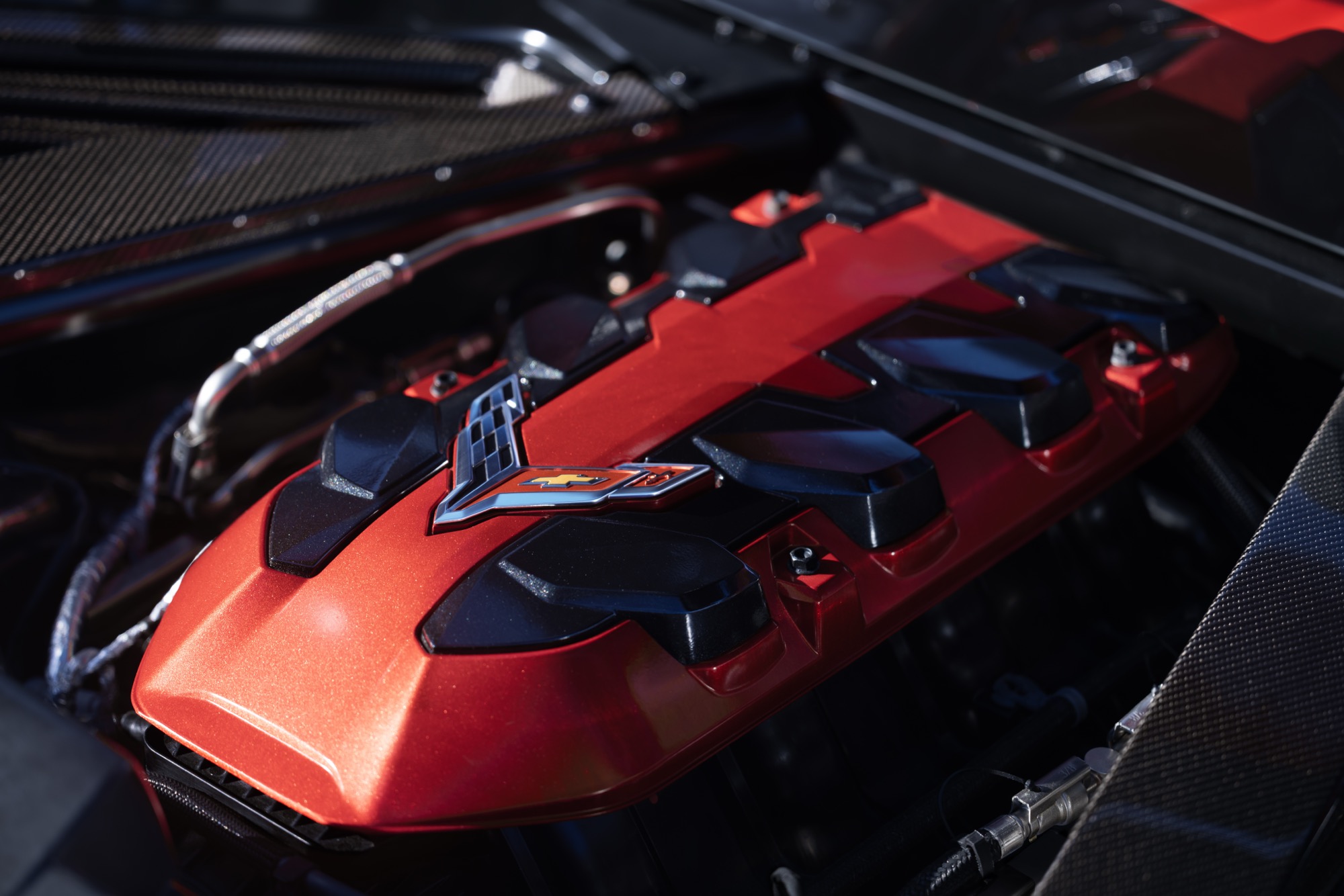
After transitioning to LT branding on Corvette engines since the launch of the C7 in 2014, the first sixth-gen V8 is reverting back to LS this year, starting with LS6 (for no discernible reason). The standard engine displacement for small-block Corvettes for more than 20 years has been 6.2 liters, but the LS6 bumps that up to 6.7 liters thanks to an 8 mm longer stroke than the outgoing LT2. The compression ratio is also bumped up to 13:1 from the previous 11.5:1, making it the highest ever in a series production small-block.
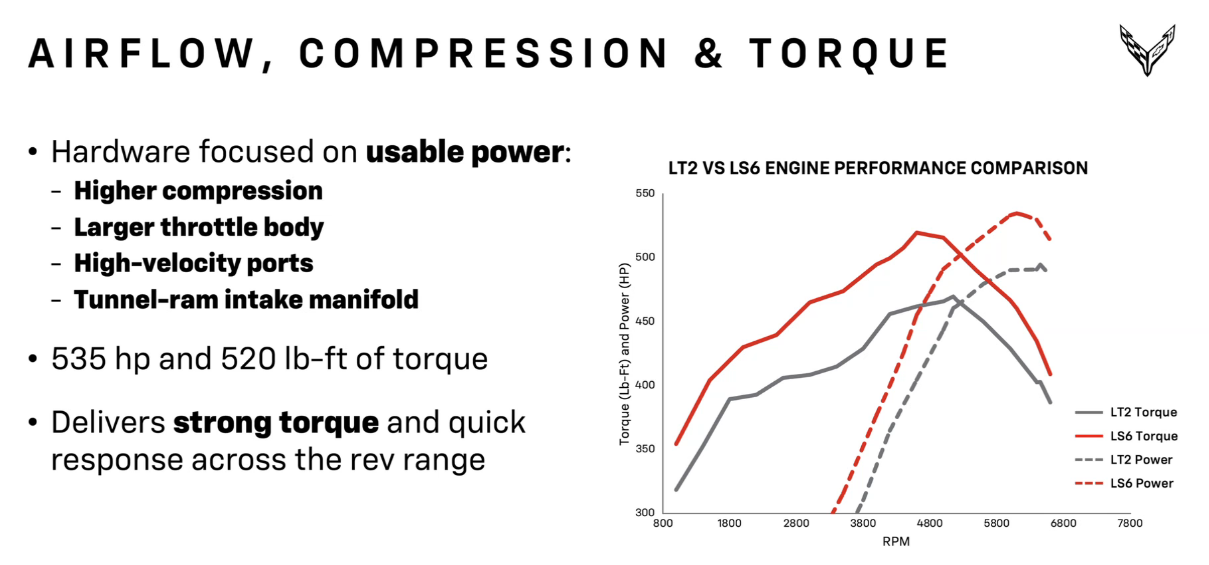
The engineers have also integrated a new tunnel ram air intake manifold with high-velocity ports for better breathing. Like many other newer engines, the LS6 has dual injectors for every cylinder, one in the intake port and one directly in the cylinder for cleaner emissions and better driveability under all conditions. The throttle body has been increased in diameter from 87 mm to 95 mm
Making more power over the long haul requires upgrading a lot of other components. Both the pistons and connecting rods are now forged rather than cast to better withstand the stresses of that compression ratio, and there is a two-barrel oil supply to the crankshaft. The coolant paths through the cylinder heads have also been redesigned to provide more targeted cooling around the combustion chambers for better durability.

Tri-Y exhaust manifolds that are claimed to improve the sound output of the LS6. While the standard exhaust setup for the LS6 will continue to be the corner-mounted dual outlets we’ve had on the C8 since it launched, an optional center exhaust will be available as an option for the first time with a small-block on this Corvette generation. Apart from the core dimensions of bore spacing and camshaft position, virtually no parts are carried over from the fifth-generation V8.
The LS6 in the 2027 Corvette will be rated at 535-horsepower and 520 lb-ft of torque, an increase of 45-hp and 55 lb-ft. The torque curve exceeds the LT2 across the board but really picks up steam from about 1,800 rpm and peaks at around 4,500 rpm. GM isn’t giving out any specific performance numbers yet, but since a C8 Stingray can hit 60 mph in the low three-second range, this should continue to be a true performance bargain.

The LS6 will live in the Stingray, Grand Sport, and Grand Sport X, with the latter model effectively being a replacement for the e-Ray with its all-wheel-drive hybrid system. The Grand Sport X will produce 721-hp, a slightly larger performance gap from the base V8 than in the e-Ray.
Taking lessons learned from the development of the twin-turbocharged, hybrid ZR1X, the Corvette engineers are now using more of the available storage from the 1.9-kWh lithium-ion battery, which gives them more voltage to work with and thus more power. They also made changes to the case and bearings for the front-axle-mounted motor to withstand the increased torque loading to get an extra 26-horsepower.
With its extra weight, the GS-X might not necessarily be the best Corvette for track days, but with an extra 186-hp and all-wheel-drive, it might just be the best all-around Vette. You can even sneak back into your neighborhood late at night or leave early in the morning without annoying the neighbors by using the stealth mode that allows the GS-X to go up to 50 mph silently on the motor.
Bringing back the Grand Sport

Apart from the LS6, the base Stingray largely carries over from model year 2026, when it already got an updated interior. The fifth edition of the Grand Sport is new to the C8 lineup for 2027, and according to Corvette chief engineer Josh Holder, it represents the sweet spot in the lineup with a combination of approachable performance for most people. In this case, the Grand Sport features the wide-body layout of the Z06 and ZR1 but retains the more affordable small-block. Chevrolet isn’t talking pricing yet, but the 2026 Stingray starts at $72,495, so we’d expect the Grand Sport to come in at under $100,000. Not cheap, but considering the bang for the buck, it’s very hard to beat.

Apart from the wide-body layout, the GS comes standard with magnetic ride control, a touring suspension, and Michelin Pilot Sport All Season 4 tires. Those that want something more can get the Z52 performance package that swaps in Pilot Sport 4S summer tires, the higher-performance J56 iron brake package that is standard on the Z06, and a stiffer suspension setup. Those who plan to take their GS to track days on a regular basis can get the track pack, which substitutes a carbon ceramic brake package and Pilot Sport Cup 2R tires. The Track pack also adds a carbon fiber splitter, dive planes, rocker extensions, and a wing for maximum downforce.
The GS-X gets the carbon brakes and distinct chassis tuning as standard, much like the e-Ray. There is a performance package with the Pilot Sport 4S tires, but there’s no track pack for the hybrid.

Since this is a Grand Sport, it has to also feature the traditional dual hash marks that have been on every GS since 1964. However, since it’s the first example with the engine out back, the hash marks also sit on the rear fenders. The GS models also get unique 10-spoke, forged alloy wheels that will be offered in four different finishes.
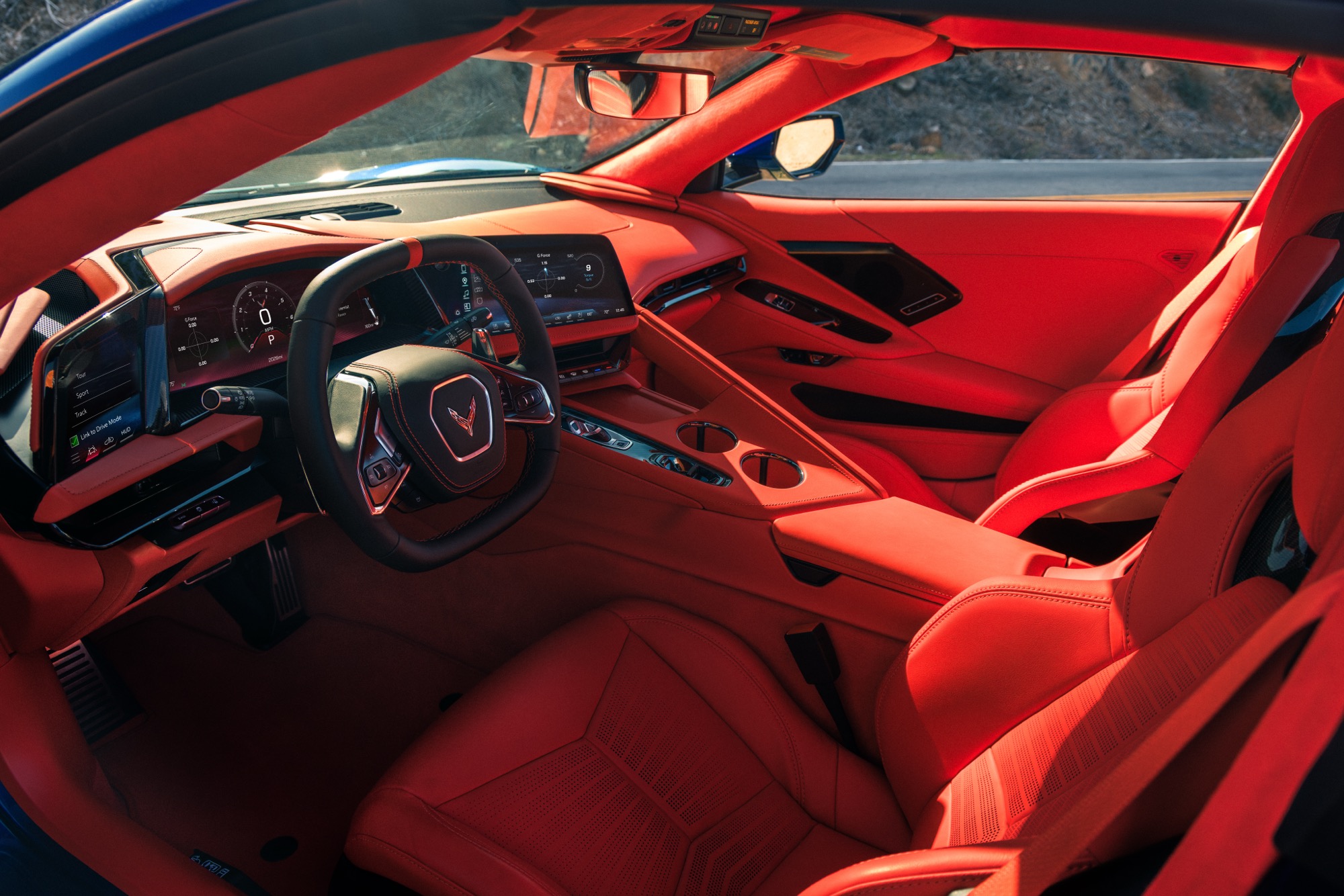
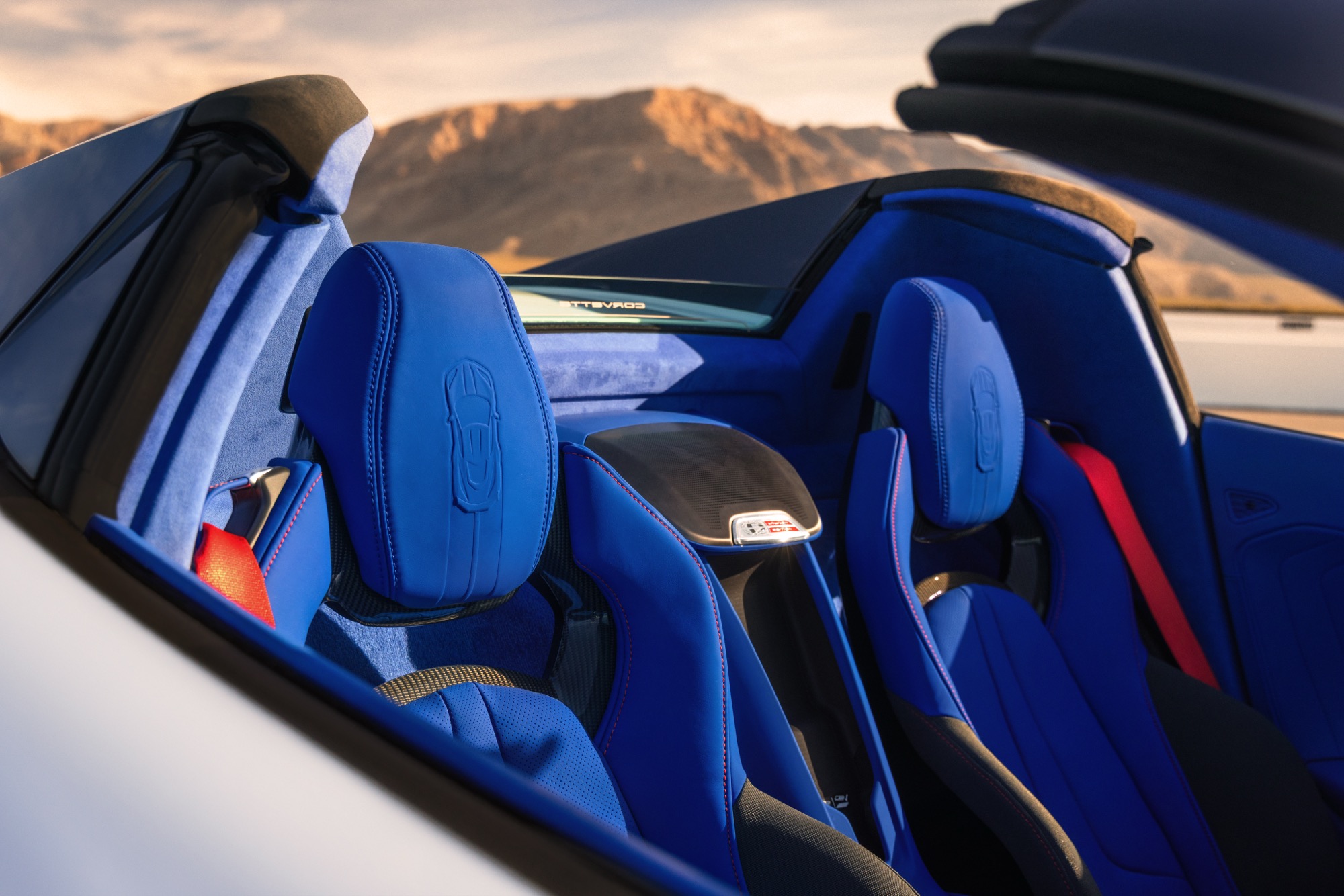
The new GS marks the return of the dark admiral blue paint that has marked previous generations, along with Pitch, a dark grey that can be combined with a black over-body stripe and blue hash marks, plus a range of other colors. It’s 2027, which means that Chevrolet needs to offer a special launch edition of the ZR1, which features a Santorini blue interior with red seat belts and other accents. That blue is an awesome color to look at, but if you keep your GS for the long term, it might just be a bit much.
The 2027 Stingray and Grand Sport will hit dealers later this summer, with the Grand Sport X following a few months later. Chevrolet isn’t talking pricing yet, but it would be reasonable to expect it to climb a bit from current prices. Chevrolet does expect that these three LS6-powered models will account for about 70% of Corvette sales, and given the expected performance they’ll offer, that sounds like it might even be low. Now let’s see what GM can do with this new generation V8 in its trucks and SUVs.
Top graphic images: GM





This is the best Corvette trim and as an added bonus it replaces the E-ray in its Grand Sport X trim. I loved the E-ray except for its stupid name so this is an absolute win.
The reason is nostalgia.
The original LS6 – i.e. the one that was available in the Chevelle in 1970 – was a monster (in a good way). It was the V-8 that most Chevy performance fans wanted but relatively few could get.
It was also a 454, while this new “LS6” is a 409*. Chevy did make a 409 in the 1960s (the Beach Boys did a song about it) but this bears no real resemblance to that.
* (6.7 liters x 61cid/liter = 408.7 cubic inches)
Are you telling me that song isn’t just about my favorite kitchen and bathroom cleaner?!?!?!
I thought the cleaner was about the song….
Hooray for dual injection. It’s about time.
It was only a matter of time once they figured it out on the ZR1.
Yes, truly. Also, thank god they didn’t just go for direct injection.
Because muh LS. Not that different to Dodge’s Hemi branding despite the name being almost meaningless as an actual differentiator. Also they’re not even true hemispheres for awhile now, just marketing to boomers.
Also, that red interior is RED. Not my taste per se but always happy to see a manufacturer go all-in like that.
GM seems to alternate between LS and LT designations for their small block v8s, the “LS” engine isn’t even the first LS engine from GM
The LS1 was the first gen3 small block, unless both my memory and wikipedia are wrong.
Don’t forget Cadillac sedans!
By my deeds I honor him, V8
But no MT?
*side eyes tremec*
Someone needs to ask Tremec what the hell they were showing since the GM guy said it was “fake”. I want answers dammit.
They should take a hint from Porsche and offer a manual version for $10k more and you get big graphics on the side that say “MT”.
But that doesn’t help me because I can’t afford that in a new car, and the manual ones would be the most sought after used vettes out there so they’d still be $110k in 5 years after GM kills it off after 2 model years.
They’ll never learn. Always compromising the halo car to sell volume, even though it never sells volume. If you give it a manual, the free airtime from journalists and youtubers doubles or triples, uninterrupted by “if only it had a manual” lamentations, and you get to be the “cool” company for as long as it’s in production. But the product planners absolutely can’t conceptualize a halo product.
All 17 buyers that won’t buy a 2 pedal Vette will be pissed, but from everything I can find there’s zero plans for a 3 pedal. GM has what, 3 vehicles total in USDM available with a stick?
After the two Blackwings, what’s the third car?
Those are it; the Camaro was the third until it went away.
*pours one out*
RIP Camaro
It’ll get brought back as a 4 door EV probably. Just to squeeze every nostalgia dollar out of the name possible.
You’re right, there’s only 2. My mistake. Just proves my point further: that it ain’t gonna happen.
The Tremec 6spd transaxle is out there if someone wanted a 3 pedal C8 bad enough. I still haven’t seen one actually get built.
From another article: