

Look at that, I went two whole days without doing a Citroën-focused Cold Start! Should I get a medal? I should probably get a medal. Who do I talk to about that? Should I, like, call my congressman or governor or town alderman or something? I guess I’ll slap my valet awake and demand he get this all sorted, stat. Anyway, my streak of plural numbers of days is over, because there’s another Citroën I want to talk about! And this one was never released!
So, we’re all familiar with Citroën’s famous corrugated shed on wheels, the H-Van, right? Sure we are. It’s one of the best examples of utilitarian design in the whole Automotive Expanded Universe, I think. Even though we never got these in America, there’s more than a few of them around, often converted into coffee or food trucks. Hell, there’s companies that specialize in just that!


Anyway, if you forgot what they look like, here’s a picture, in both pickup and van forms:
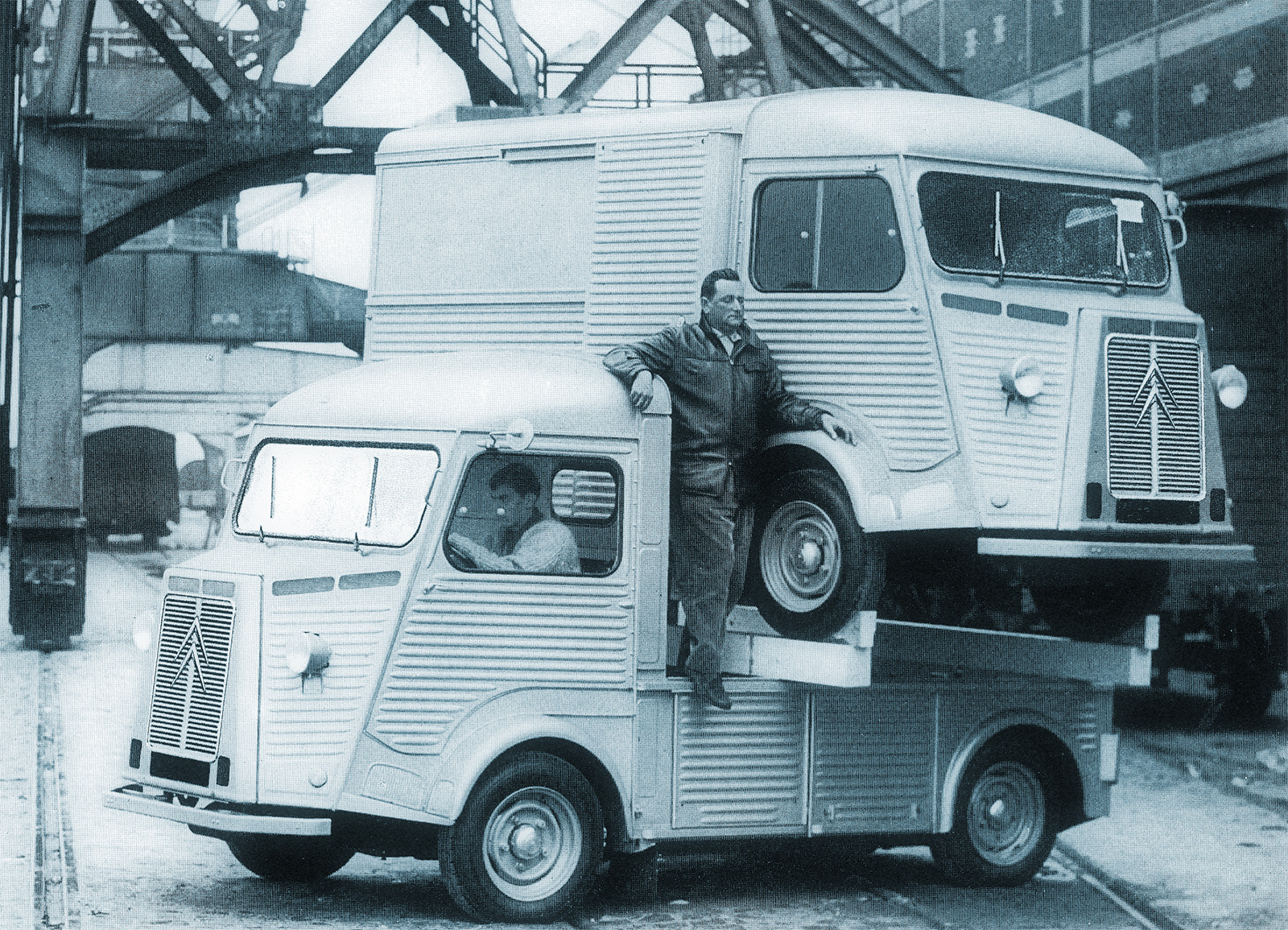
I think this picture also gives you a sense of the size of these vans, too; not particularly huge, but not tiny, either.
Now, what I never realized is that Citroën considered a smaller version of the H Van at one point, calling it the G Van. The H Van was released in 1947, right after the war, and development had started on it as early as 1942. Citroën seemed to understand, with some optimism, that the war would eventually end, and when that happens people would need commercial vehicles once again, so best be ready.
Citroën used the running gear from their popular Traction Avant car for the H Van, a 1911cc inline-four liquid-cooled FWD drivetrain, though where on the Traction Avant the transaxle was ahead of the engine, in the van application they flipped that around so the engine was ahead of the transmission, which fit the space better under that stumpy hood.
Right around the same time, Citroën was also finalizing development of the 2CV, their small peasants’/peoples’ car that had been in the works since the late 1930s, and would be officially released in 1948, with a tiny 375cc air-cooled flat-twin making all of 9 horsepower. All this we know! What I didn’t know what that Citroën was also considering a smaller sibling to the H Van, based on the drivetrain of their new 2CV! This was the G Van.
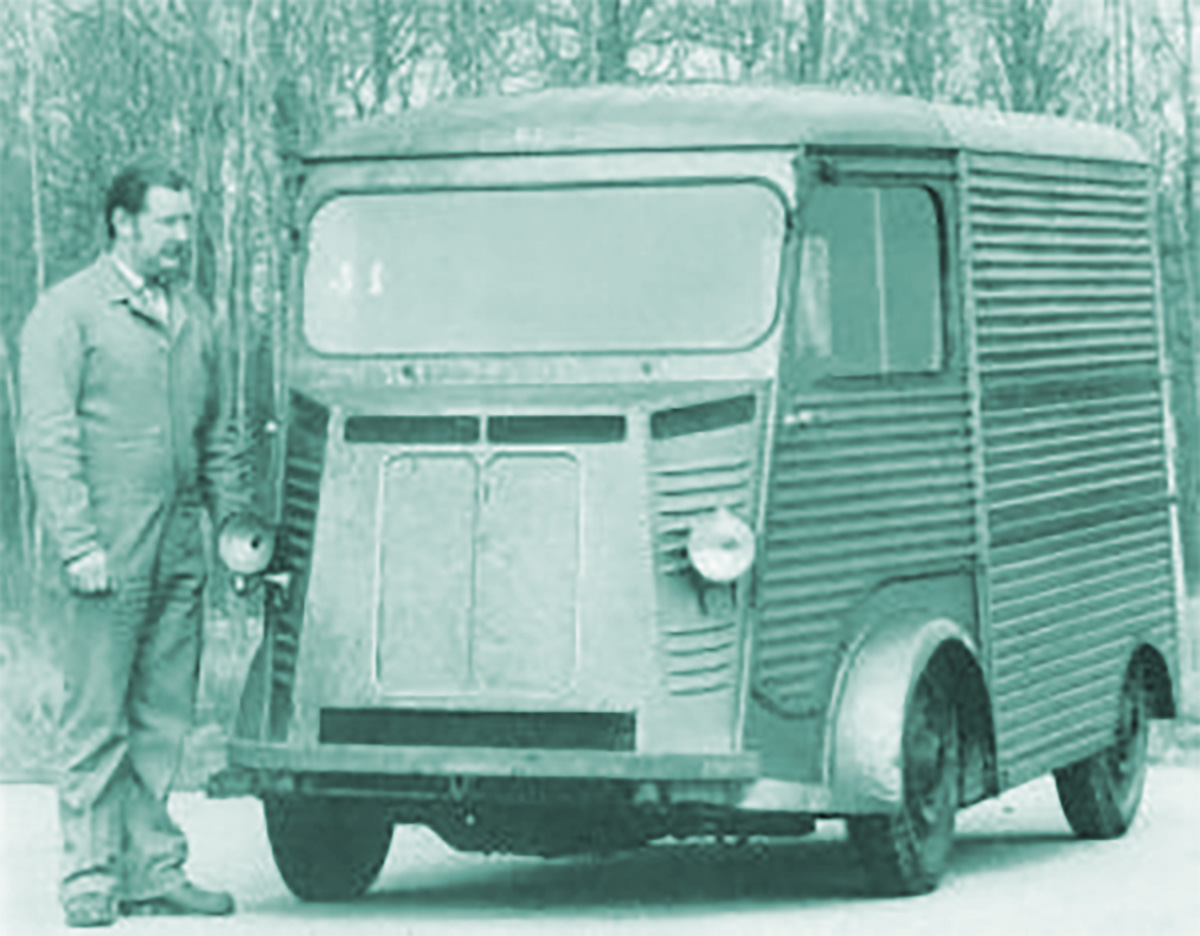
The G Van, as you can see by that guy standing next to it, was quite small, at least for a commercial van. It shared the same basic design philosophy as the larger H Van, which is to say none, save for a liberal use of corrugated metal and a ruler. One notable and interesting detail is how the grille area is actually just a pair of flat recessed stampings in the bodywork, and not really a grille at all. since there was no tall radiator needed, no huge grille area was needed, with the low-mounted air-cooled engine getting all its air from that slot above the bumper.

If you look at diagrams of the G Van, you can see the clever and highly space-efficient way it was laid out: the 2CV engine – in this case bored out to a ravenous 475cc – sat low and between the front seats, just ahead of the front axle, essentially how it is in the 2CV.
The chassis and suspension are very 2CV-derived, but beefed up a bit and using torsion arms for springing. If you compare these drawings to similar blueprints of the H Van, you can see just how much smaller it really was:

The length of the cargo area of an H Van was about 95 inches (2430mm); on the G Van, it was closer to 78 inches (1810mm). That’s a good bit smaller.

Even though it was smaller, it would have been a pretty effective little commercial van, being almost a box on wheels with lots of unimpeded cargo space. Really, the 2CV-derived commercial vehicle that Citroën eventually did build, the AK/AZU Fourgonette, proved to be longer and have significantly less cargo space than the unrealized G Van:

With the Fourgonette, Citroën kept the standard 2CV body up to the B-pillar, meaning that there was all that hood area that couldn’t be used for cargo. The G Van sat the driver atop the front wheels, freeing up so much more cargo space behind.

The lone complete prototype still exists, and is in the collection of the Conservatoire Citroën, The Private Museum Collection, in Paris. If it wasn’t for that solid false grille, it would be almost impossible to tell the difference from this and an H Van at a distance. I suspect when you got close enough, the size difference would either make it clear, or convince you that you just grew a bit.


it is really small, the wheelbase and length of the g-van is 400 mm less than the 2cv it is based upon.
Unfortunately the Conservatoire Citroën closed in 2024. The plan at the time was to envision a reopening at a different site around 2028.
I just assumed the smaller h vans some of the Chinese food truck people are making was just something weird they came up with. But the g van dimensions look similar to some of them. What a strange world.
On holiday in Amsterdam and saw an H van still doing commercial delivery service. It’ll probably still be running whenever the end comes
I learned about the original H-van from the wildest source….Persona 5 lol
Wheelbase: 2000mm
I know that is where they started at the chalkboard.
Yeah two whole days but it was a holiday weekend you didn’t post anything. Not that big of a feat of strength for Torchinalia. Which is Saturnalia on Torch Island
The G Van sure triggered Dalek memories for me.
Now I’m imagining a modern retro electric version of the small van and I really want one.
Huh, what a coincidence. I saw a red early Citroen Jumper today on my way to work and it got me thinking about the H van.
So, a van in black?
Have any of you ever driven/ridden in an H-Van? I knew a guy that had an H-van truck whatever it’s called and holy moly that thing was RAUCOUS inside, so much so that ear protection was needed for a trip of any length.
Yes, I have driven and ridden in an H-Van. It is really noisy inside and incredibly slow. We drove from the middle of France to the Netherlands with a DS break and an HY-van; 80 km/h in the Van and you had to shout to each other, while the person in the DS cruised in total comfort and whisper silence.
You just reminded me that I’ve actually helped drive a DS from CT to Kentucky a few years back…and even though it was an older car in need of work, it still was a great drive and much better than the H.
Had the demand for the 2CV and H-van not been so strong, Citroen may have built it. But the last thing they needed at the late 50s was another production line for a different platform when they were selling everything they could make.
Citroen did sell a smaller van from 1939 to 1942 called the “TUB” that was traction avant based but more in size of the G-van.
https://share.google/gzmGaCCQQ7SHYp5R3
I think the G-van would have been a better option than the 2CV derived AK series if they would have offered it.
– but decided to put a small(ish) engine in their big van…
It’s SOOO scary you can actually ruin the H engine, just by going highway speeds from this century in it. Something with the low gearing, because it was never an issue in the ID/DS.
Very cute, the small one! 🙂
You are completely right, the HY is not equipped for the highway. When we drove it we had to drive a little bit over the French highway; it was very scary to see the big lorries in the mirrors coming towards you at alarming rate. Much better suited on small country roads and Route National.
A lot of the HY vans have been upgraded with either a 4-speed gearbox from an early DS, with the newer 5-bearing engine and gearbox from a later DS or with completely different engines. I know of HY-vans that are equipped with a modern VW tdi engine.
The stacked H vans with the guy casually stepping off into the void is the most French thing we’ll see today. I can’t decide if the guy inside is striking that classic dynamic driving pose or checking his watch.
Well, it’s close, but they should have waited until he lit a cigarette to snap the picture.
It’s my fourgone conclusion that they should have made the G van!
Dammit I came here to say that
The stance of that guy in the topshot is priceless. It looks like even his nostrils are clenched and he’s saying “I am hesitantly introducing this concept vehicle which I assure you has not been approved for production!” Which is kinda odd because it is kinda cool.
Pívot to Peugeot, Dangel, or Hommel.
I’m OK with Citroen posts as long as we never live in a post Citroen world.
Sadly they are in Australia since the importer stopped bringing Citroens to us earlier this year. They held the record as the earliest car imported into Australia.
Does Torch need a “Days since last Accident” sign altered to show days since last Citroen post?
Caselani has you covered.
https://en.caselani.com/m/21-quadricycle.html
This is absurdly cool.
There can never be too much French vehicle content on The Autopian.
I wish they did more than consider it and put the damn thing into production!