


The Ford GT, released in 2005, is one of the coolest American supercars I can think of. Inspired by the company’s GT40 race cars of the late 1960s, it delivers a retro flair without being too gimmicky, and backs it up with a mid-mounted, 550-horsepower supercharged V8 engine and some of the coolest doors in the business.
Anyone who knows the story of the first-gen GT knows that it wasn’t particularly popular when it was new, with many cars sitting on dealer lots unsold for months. It was only several years later, when collectors began to realize the GT’s greatness, that they began to appreciate in value.


And appreciate they did. The GT originally started at $139,995, or at $151,695 if you checked every single option box. Now, though, you’d be hard-pressed to nab one off of Bring a Trailer for under $400,000. But depending on what options you chose (or didn’t choose), your GT could be far more valuable, all other things equal.
In This Case, Less Is More
I was inspired to write this by the always interesting Doug DeMuro, former car writer and founder of the online auction site Cars & Bids. While speaking on The Smoking Tire podcast back in December, DeMuro spoke about how he came across the original Ford GT order form that buyers had to fill out to get their order in.
The Ford GT’s list of customization options was famously small, with buyers able to pick between six colors and three different racing stripe setups (no stripes, stripes on the sides, or “full” stripes, including on the sides, the hood, the roof, and the rear decklid). Additionally, buyers could choose to add red- or grey-painted brake calipers, BBS lightweight aluminum wheels, and a McIntosh high-end sound system. That’s it. No fancy interior colors, no exclusive paint-to-sample programs, no weird aero kits. Just the color, the painted stripes ($5,350), the wheels ($3,500), and the stereo ($2,100).

As DeMuro points out on the podcast above, the current value of your GT could swing wildly based on which of the option boxes you checked off on the above hand-written order form. (DeMuro’s quotes have been edited for clarity):
It’s just a piece of paper that you fax to Ford. And it’s these check boxes. I’m looking at it, and I’m thinking, if you checked these in a certain way, you would have a $150,000 [gain].
At the time, the options didn’t have a cost, or they were minimal. But, just making certain decisions was a $150,000 value add or subtract. You had no way of knowing that 20 years ago.
[…]
If you had chosen red with a stripe, that car is worth $100,000, $200,000 less than if you had gotten a black, no-stripe car [or] a silver no-stripe car. Obviously impossible to know at the time, but kind of funny to look at this sheet of paper and think there was so much [potential value]. [The original owner] probably didn’t put that much thought into it.
DeMuro is, of course, totally correct. Or, should I say, mostly correct. Ford built just 3,660 GTs, so prices are only expected to go up as time goes on. His description of how color selection by the original orderer can certainly affect how much the car’s value has increased, sometimes by six figures. Looking at recent Bring a Trailer auction results, there’s a clear pattern.

Looking towards the top right of the graph embedded above, the highest sellers are Heritage Edition cars, which come with a Gulf livery reminiscent of the livery used by the GT40 at the 24 Hours of Le Mans. Ford made just 343 of these, representing 9% of production. Collectors will fight tooth and nail over low-mileage examples, leading to near-seven-figure hammer prices.
Below those cars is where DeMuro’s theory rings true. Stripless cars in rarer colors like blue and black, depending on mileage, regularly command sale prices over $500,000. This Midnight Blue example with 2,400 miles sold for $550,000 back in February. This similarly specced model with 2,100 miles on the clock sold in 2024 for $605,000. This black one with 5,700 miles on the odometer sold for $535,000 back in June.
Similarly, cars painted in yellow—stripeless or not—usually command more money than other colors, simply because this color was rarely chosen new (only 172 yellow Ford GTs exist, or around 4% of production). This one sold for $520,000 back in 2024, while this one sold for $630,000 back in October. Silver, another rare color, also demands a premium. Here’s one with side decals that went for $565,000 in December.
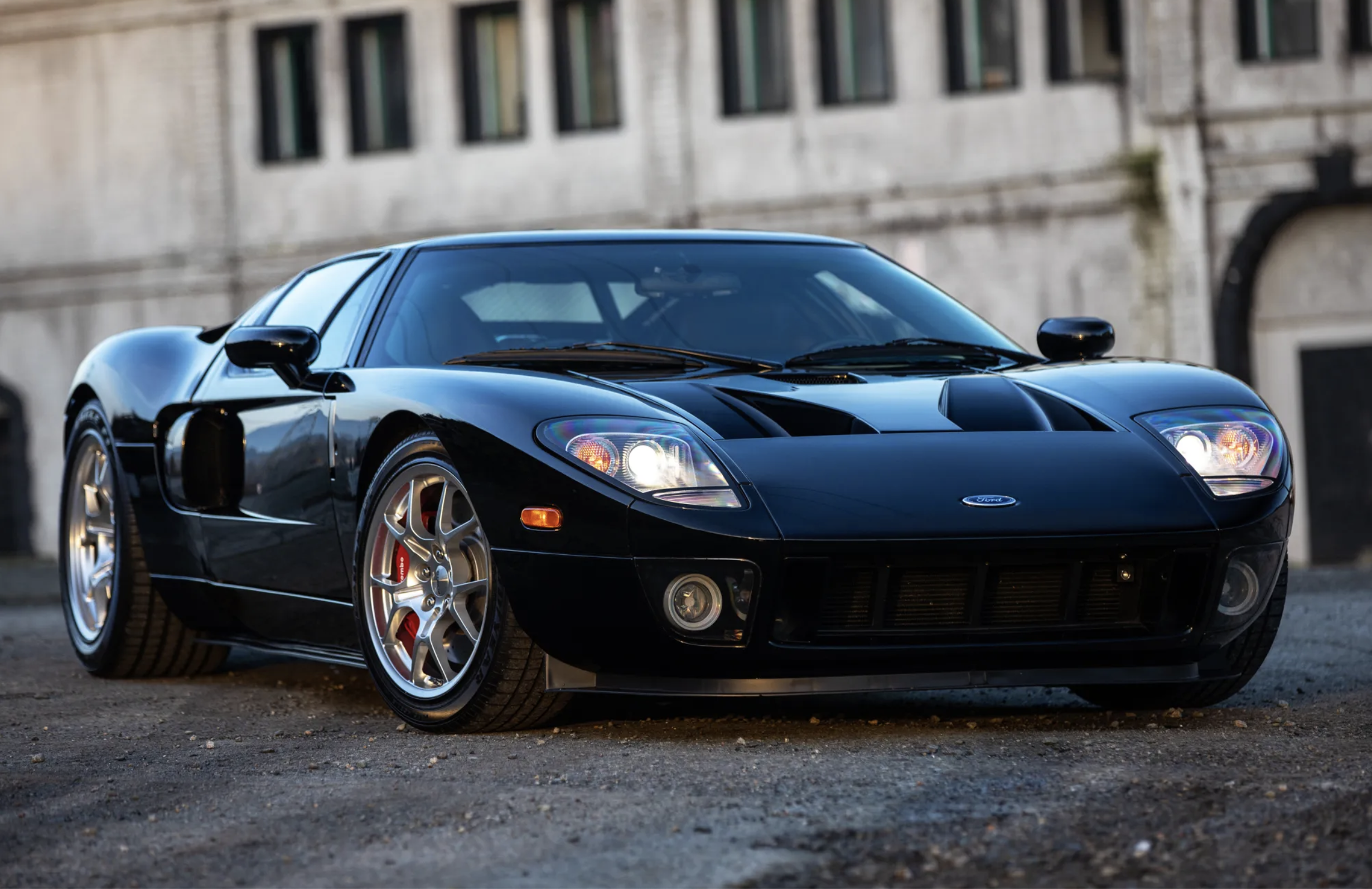
Meanwhile, if you peruse the lower portion of the sales results, you realize most of those cars are red, striped cars. Red cars make up nearly a quarter of all Ford GT production, making it by far the most common color. This one, with just 2,600 miles, sold for $455,000. This one with 4,700 miles went for $461,000 in October. Here’s one with 6,000 miles that sold for $410,000.
There are exceptions that pop up from time to time, of course. This red Ford GT sold for $627,000, despite the color and a handful of modifications, because it was owned by Paul Walker and didn’t have any stripes.
This phenomenon isn’t unique to the Ford GT. Plenty of collector cars have values that can swing wildly depending on option choices like color or transmission selection. As Hagerty points out, a Lamborghini Murcielago with a gated manual transmission is worth a staggering 300% more on average than the same car equipped with paddle shifters.
Speaking With Someone Who Bought a Ford GT New
Where DeMuro got it wrong is thinking that his car’s original owner “didn’t put that much thought into” choosing a color combo. In fact, the opposite happened.
I know this because I spoke with Karl Brauer, an executive analyst for iSeeCars.com, the host of the Karl Brauer Cars YouTube channel, and the original owner of DeMuro’s 2005 Ford GT, over the phone recently. He recounted how he was lucky to be able to spec his car out in the first place.
“Almost all Ford GTs were ordered by dealers,” he told me. “It was relatively rare that the customer got to order it. I was very fortunate because I did get to order mine.”
“I was part of a select group that Ford said, ‘You can have the car at MSRP, and you can order it the way you want ahead of time,'” Brauer continued. “I got really fortunate … from my understanding, from someone who was the main contact I had at Ford at the time, they got something like 750 requests from people saying, ‘I want a Ford GT,’ basically trying to call in favors through their Ford contacts.”
“And [of those people], 121 or 122, I think, was the number that Ford actually approved,” he said. “And it included people like, of course, Jay Leno, Sammy Hagar, Michael Anthony from Van Halen, and myself. I was very fortunate. That guaranteed that [I’d] pay MSRP, [I] could pick whichever dealer [I] wanted, and [I] could pick the car the way [I] wanted it to be equipped.”

Then came the hard part for Brauer: Actually picking his specification. Though the above order form seems extremely straightforward, Brauer told me he struggled for a long time to decide on the color he wanted. In the end, he was stuck between Midnight Blue or white.
“I agonized over color for almost the entire time I was waiting to put my order in, and I still wasn’t sure, because I like bright colors in general, and the blue looked so dark in all the photos,” he told me.
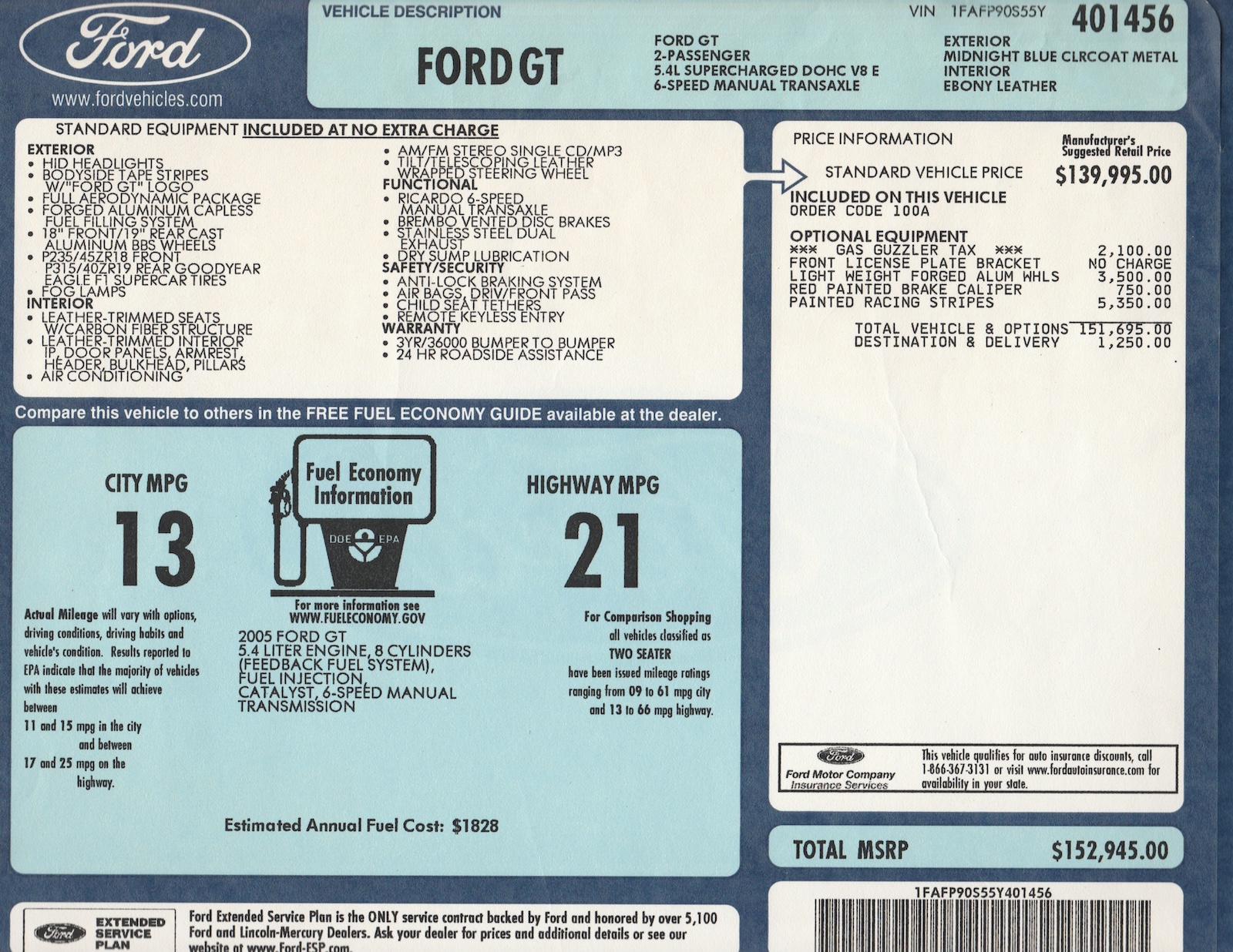
Before Brauer locked in his build, he managed to see a blue car in person—one that was getting delivered to a different customer at his local dealership—to make sure he wasn’t making a mistake.
“I sprinted over there because I was afraid it was going to get picked up before I could see it,” Brauer says. “And it was sitting there behind ropes, and as soon as I saw it for, like 10 seconds, I’m like, ‘It’s gonna be blue.’ The blue looked awesome in person and all.”

The blue turned out to be a financially smart call for Brauer, as it became one of the GT’s more desirable base colors for collectors. But as you’ve probably already figured out by now, Brauer’s car was optioned with the full stripe package, an option that, if left off, would’ve made the car even more valuable. But Brauer says he has absolutely no regrets about his spec, even if it meant not making as much when he sold the car.
“I’m glad with what I did,” Brauer says. ”I got the exact car that I, from an aesthetic point of view, [thought] looked the best. I put 31,000 miles on it and still sold it at a nice profit to Doug DeMuro. And now he’s got it. So I am extremely happy with my experience in that car.”

I think the lesson here depends on your priorities in life. If you’re the type who treasures the preservation of value and potential investment status when you buy a cool car, then make sure you get a version that very few people go for. Because eventually, it’ll end up being rarer and more desirable. Or, you can do what Brauer did, and simply pick the options that make you happiest. Personally, I’d go that route every time.
Top graphic images: Bring a Trailer


I would never spec a car based on what I thought would max out the resale price. If I buy what I want, then I’ll get that little flash of happiness every time I look at the thing. If I don’t, I’ll likely get that little flash of letdown every time I look at it. I’d be more than happy to trade some resale value to get that happiness and avoid that letdown every time I got in the car to drive it.
I like any color with the stripes, the stripes really work on the GTs.
I saw a heritage edition in the gulf colors on M46 outside of Saginaw, MI. I didn’t know what it was at the time but it looked like a space ship. I hope I never forget.
Years ago on the old site I remember reading an article saying to keep your resale value don’t spec your car with unusual colours. Keep it silver/white/black. At the time I disagreed with the theory as if I’ve got a choice between more or less the same car at the same price but one’s silver and the other is red/yellow/purple I’m buying the coloured one. Why would you want a car that looks like everyone else’s? The stripes on the GT are a cliché so no surprise flat colours and less obvious colours are worth more. Also 2500 miles over 20 years, what a waste. Drive your damn car.
Common colors will make your car sell faster, but interesting colors sell for more money, as a general rule.
Of course, if you try to trade to a dealer, they will try to play both sides. Common color – oh, that’s so common, it’s worth less. Interesting color “oh, nobody wants anything but black, silver or white”.
For a daily driver boring is the way to keep resale value, it will not be a collector’s item. For the future classics go wild, that is the whole point you want to be seen.
To think, in a high performance car, something like paint color or a stereo, not something more profound and tangible, like a sport suspension option, higher power, better brakes, etc takes precedence in desirability. Whats next? The sound of the horn?
That’s a shitty radio, even for 2005.
Did it cost $20 from Radio Shack?
Yes, yes, I know it’s a mid-engined supercar and high-end audio isn’t the first priority (and the engine wouldn’t be too quiet anyway), but it was 140-freaking-thousand-dollars in 2005 and was absolutely deserving of a much better stereo than that, even as the “standard” one
I thought it looked pretty terrible too, then it dawned on me that I don’t think Ford even HAD a single DIN radio available in any of their cars at this point anymore. The smallest ones they had were the 1.5 DIN Thunderbird radios, which probably would have been a better fit anyways. Maybe I’m a stickler for the OEM stuff but I’d prefer they were shoving the highest end Lincoln radios they had in them as the ‘Standard’ for my supercar.
It does look a little ridiculous, but I’m imagining how ridiculous this would look with the same am/fm/cd/aux that’s in our Ranger.
It didn’t have to be a Ford radio.
I’m sure this one isn’t.
But this was 2005 and there were plenty of single-DIN cars on the road and a healthy supply of third-party radios to be installed in them.
Alpine, Blaupunkt, Kenwood, Sony etc
Any of those would be better than this $20 piece of plastic crap
Considering that red is a terrible colour on cars, and stripes make everything look significantly worse, it makes perfect sense.
Both the Gods of Sports Cars and those of fine and good taste condemn your blasphemous words.
Blasphemous indeed. This is like saying a pint of Guinness on St Patrick’s Day is shit.
Wait you mean the ale brewed in Chicago by an English company called Diageo?
Neither Irish nor catholic, so I don’t care for either xD
Can’t think of a single car that looks better with stripes than without.
I dunno… I don’t think that the sample size is big enough to draw any conclusions about value. It is often up to the quirks of the wealthy who buy these.
That said, I love these in any color and any gen. Happy that Ford ever even made these. I’ll take the blue with the white stripe and the McIntosh sounds system.