

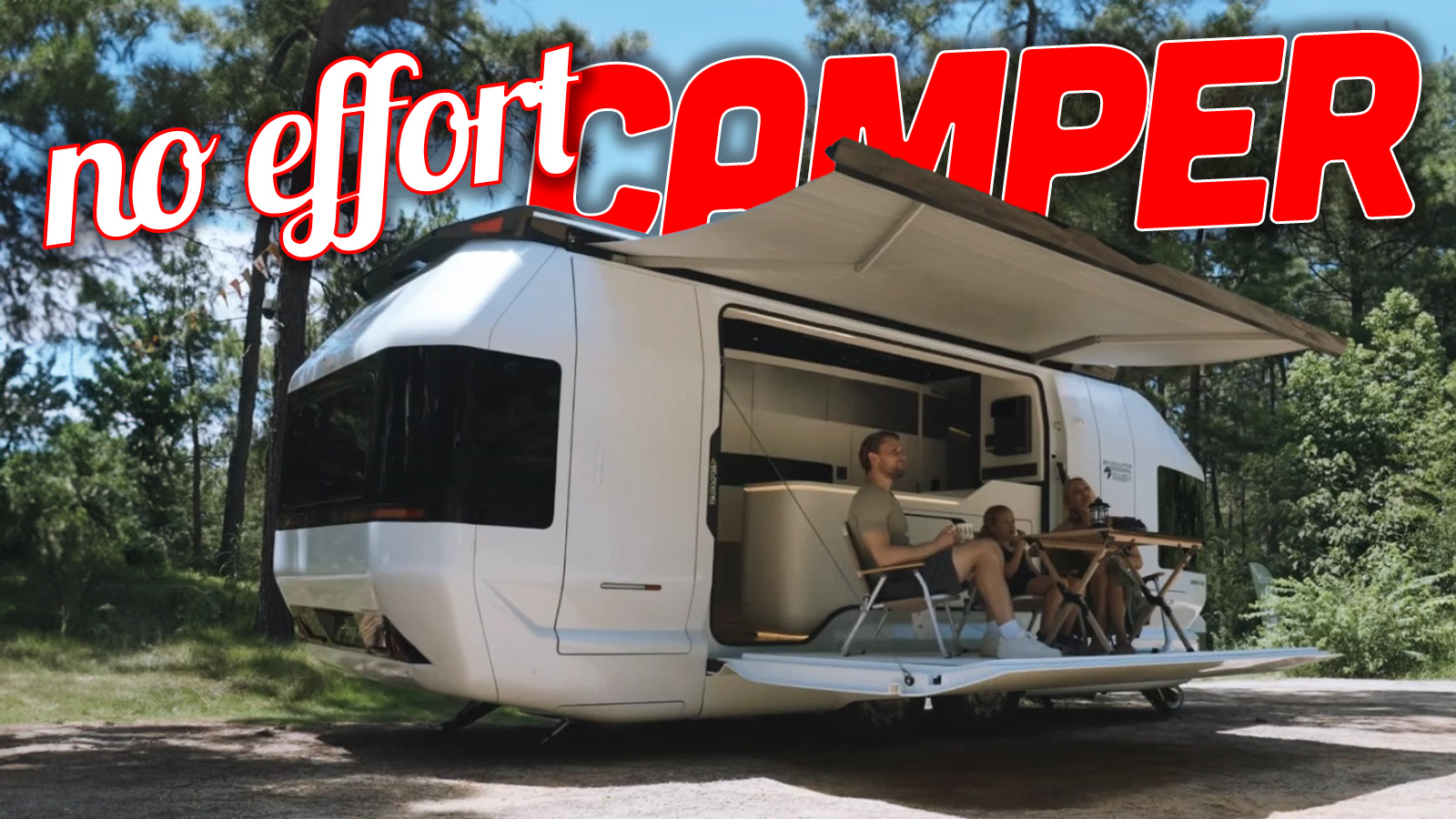
Enjoying a summer vacation out of an RV is great, memory-making fun. However, driving a motorhome or towing a travel trailer should be done by someone who knows what they’re doing. It takes just one mistake for a camping trip to turn tragic. One camper startup wants to take the skill floor out of RVing by having computers do all of the work. This is the Skydream Caravan, and it wants to make camping crazy easy by hitching itself, parking itself, towing itself, and even providing its own steering. It’s basically an RV with the same suite of driver assists as a new car.
The concept of a trailer that has some of these features isn’t really new. The Pebble Flow, the world’s first production travel trailer with a built-in drive system, is able to drive itself up your tow vehicle’s trailer hitch. It then uses its drive systems to assist the tow vehicle in hauling it, helping the tow vehicle preserve fuel economy or electric range. You can even use a remote control system to drive your Pebble Flow perfectly into a parking space. The Flow will even deploy its camping mode with the touch of a single button.


The other trailer that’s in production that does similar work is the Lightship AE.1. This trailer doesn’t have the nifty self-hitching mode, but it will also allow you to remote control it into a parking spot, and it also has an innovative drive system that assists the tow vehicle. Both of these trailers are marketed as helping tow vehicles keep their range, but also as making RVing as easy as possible.

Chinese engineers have also been trying to make waves in this high-tech end of the RV market. One recent example is AC Future, which sees itself solving California’s housing crisis with a weird AI-enabled electric motorhome designed by Pininfarina and engineered in China. Most recently, I wrote about the Evotrex-PG5, an American brand founded by former Anker and Geely execs. The PG5 will have a giant battery and a drive motor like the campers above, but also a gas engine that works as a generator. Basically, it wants to be the world’s first extended-range electric camper.
Now, a new player is entering the ring, and its ideas are perhaps the most ambitious yet. Skydream Caravans wants to launch a lineup of campers in America that won’t require their owners to know how to tow a trailer, how to hitch a trailer, how to set up a trailer, or how to park a trailer.
Skydream
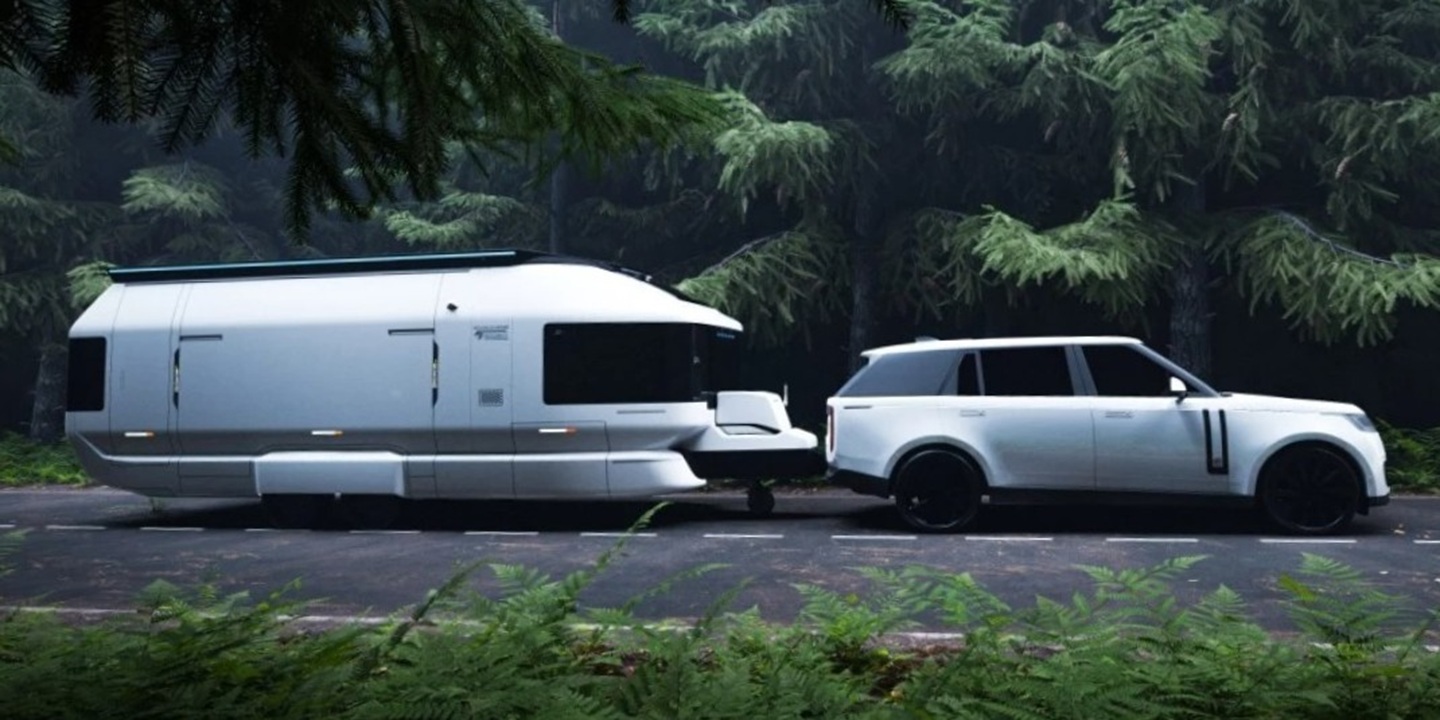
Skydream Caravans more or less just materialized into existence. The company — Skydream (Chongqing) Innovation Technology Co., Ltd. of Chongqing, China — was founded in 2024 by Felix Yang before making its debut in August 2025 at the Caravan Salon Düsseldorf. According to Skydream Caravans, it assembled an executive and R&D team in 2023 before officially forming the company. Its targets from the start were the world’s largest RV markets, including America, Europe, and Australia.
Despite my best efforts, I could not get the Skydream Caravans website to actually load on any device or platform. It can be accessed through the Internet Archive, but the ‘Company’ page is blank there. I’ve been trying to figure out who Felix Yang is and why he decided to make a techy camper. While the story remains elusive, the mission of Skydream Carvans is bold, to say the least:
If your impression of a “caravan” is still that of white box-shaped vehicles, with outdated interiors from the last century, along with a bunch of keys and remote controls, that’s normal. Over the past few decades, the industry has remained largely stagnant: outdated design language, slow progress in electrification and intelligence. A series of cumbersome operations still deter many people.
Skydream is set to revolutionize the industry — On August 29, the company made its global debut at the CARAVAN SALON DUSSELDORF, Germany, where two types of new energy smart caravan nearly ready for mass production were unveiled to public. It is reported that Skydream is committed to realizing user’s dream of future caravan trips through cutting-edge technology by deeply integrating the latest new energy and intelligent driving technologies already applied to the passenger vehicle, intelligent technologies in smart home controls, as well as mature research and manufacturing experience from Europe and the United States. The Company is collaborating with global users to create an entirely new breed of caravan — an intelligent, mobile and flexible living space that can be placed anywhere. This appears to be another generation-leading breakthrough in the history of the industry.
[…]
This sense of disruption stems from the design team’s bold breakthrough: they completely abandoned the decades-old tradition of “white box-shaped vehicle”, they created futuristic designs based on the concepts of “interstellar camping” and “land yacht”.
Since the company’s debut, Skydream Caravans says it has scooped up some dealer partnerships and, in December, earned the Platinum Award at the 2025 MUSE Design Awards. In February, Skydream Caravans also announced $11.6 million in funding from angel and Pre-A funding rounds. Apparently, a prototype trailer has been built, too.
Skydream’s Camper
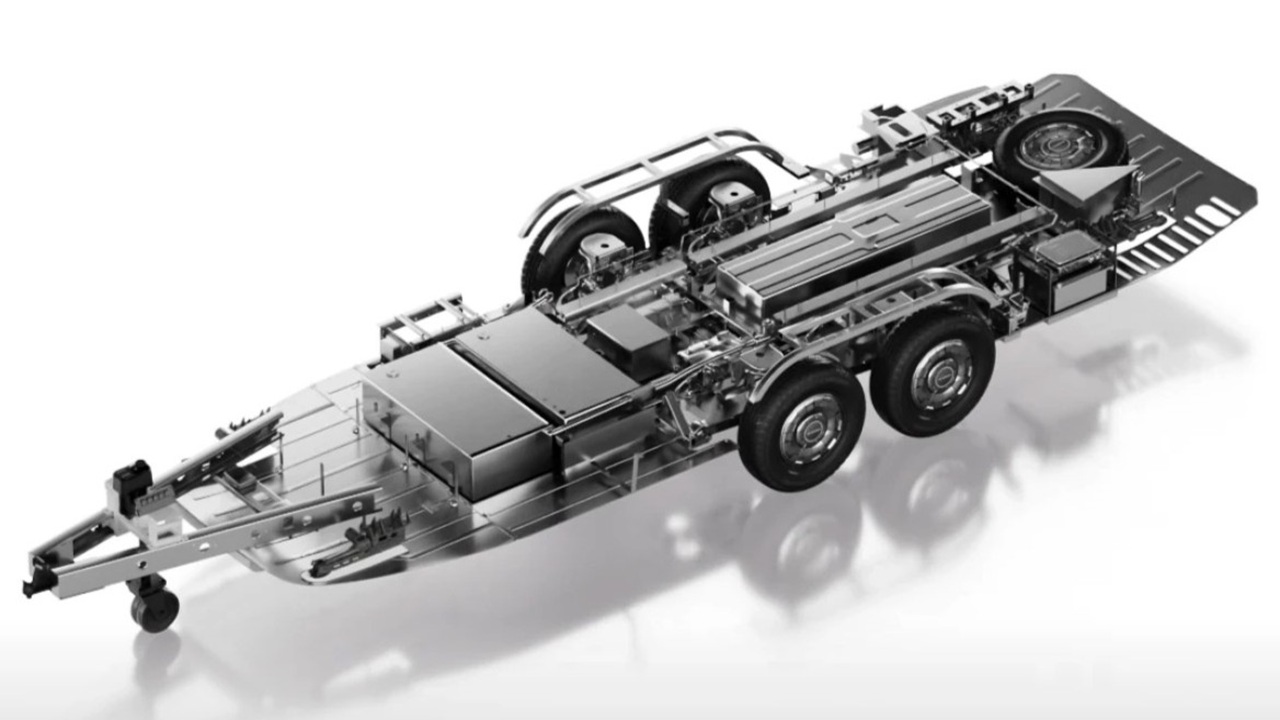
That trailer is a peek into what could be the most tech-heavy camper ever created. Skydream’s camper, which doesn’t have an official model name yet, starts off with what Skydream says is “the industry’s only self-developed passenger vehicle-grade electric towable skateboard chassis.” That’s a bold claim, and one that I’m sure both Lightship and Pebble would question the legitimacy of. But it’s still cool, nonetheless.
This chassis is the heart of the operation of the trailer and contains the holding tanks, the batteries, the circuits, the controllers, the electric drive system, and an AI “brain” to control it all. This dual-axle chassis sports an independent air suspension, two drive motors, and two battery packs for a total capacity of between 45 kWh and 85 kWh. Per Skydream’s website, these batteries use lithium iron phosphate (LFP), and one is a “power” battery while the other is a “storage” battery.
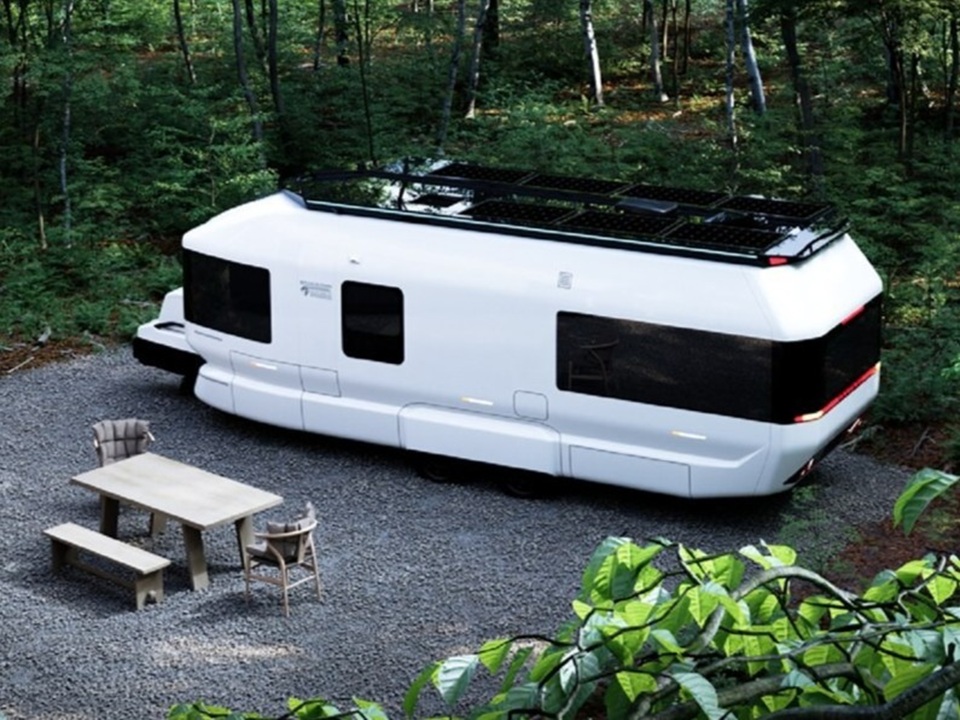
On top of the chassis is the living space, and Skydream Caravans doesn’t say what it’s made out of. However, it would look like it would be made out of some kind of composite material, similar to what Evotrex, Lightship, and Pebble are doing. The box is 26.5 feet long, 7.5 feet wide, 9.3 feet tall, and weighs 6,400 pounds. It’s unclear if that’s the empty weight or the loaded weight. Skydream Caravans seemingly chose just the right size for this rig, as companies like Airstream would be happy to tell you that trailers about this size are very popular.
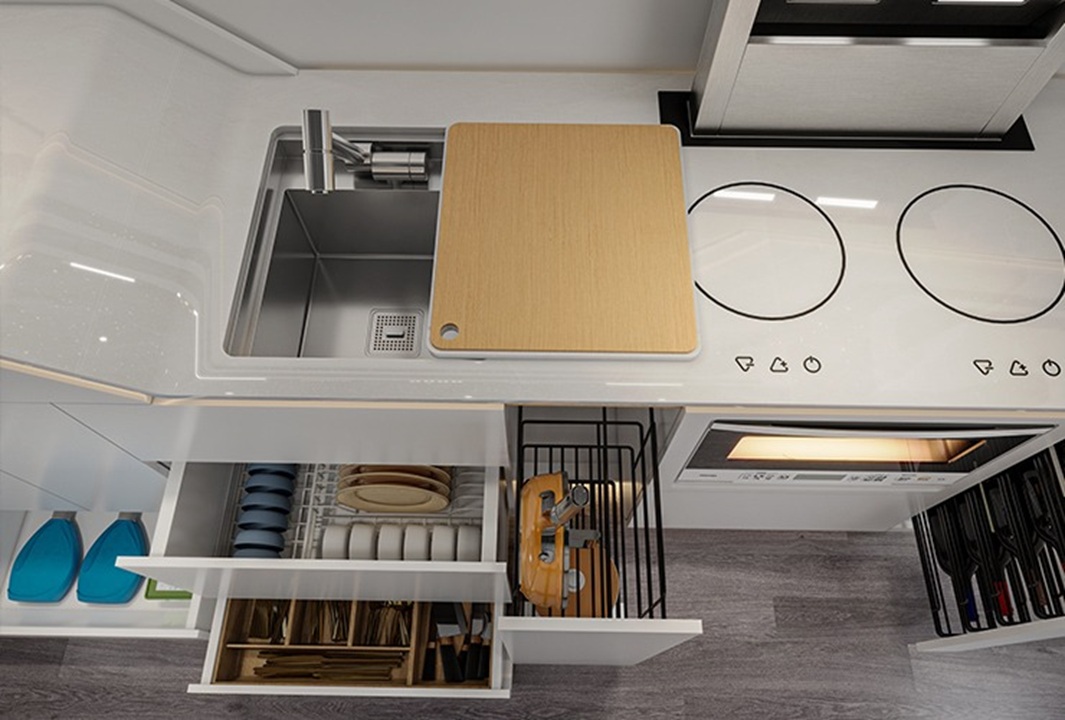
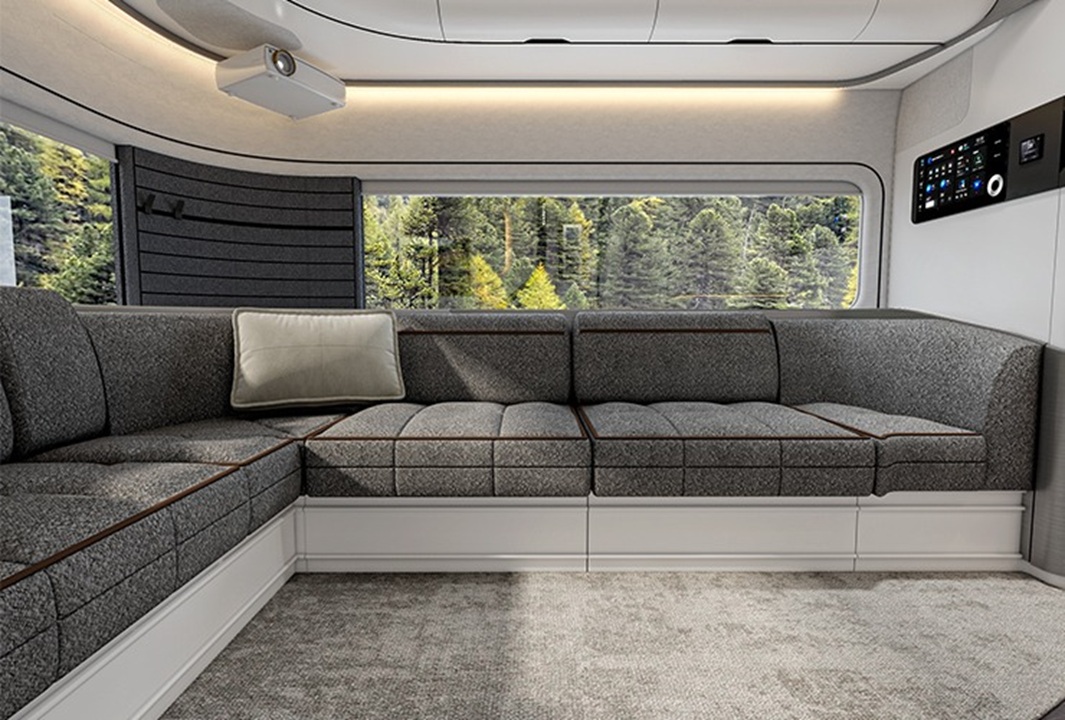
Much of the inside of the trailer takes technologies we’ve seen before, only dresses them up in a futuristic wrapper. At the front of the trailer is the private bedroom, which has an electric “zero gravity” bed. Behind there is a dry bath, which features a quiet toilet and a separate shower. The kitchen features a two-spot induction cooker, a dishwasher, a microwave, a dual-basin sink, a water purifier, and a refrigerator.
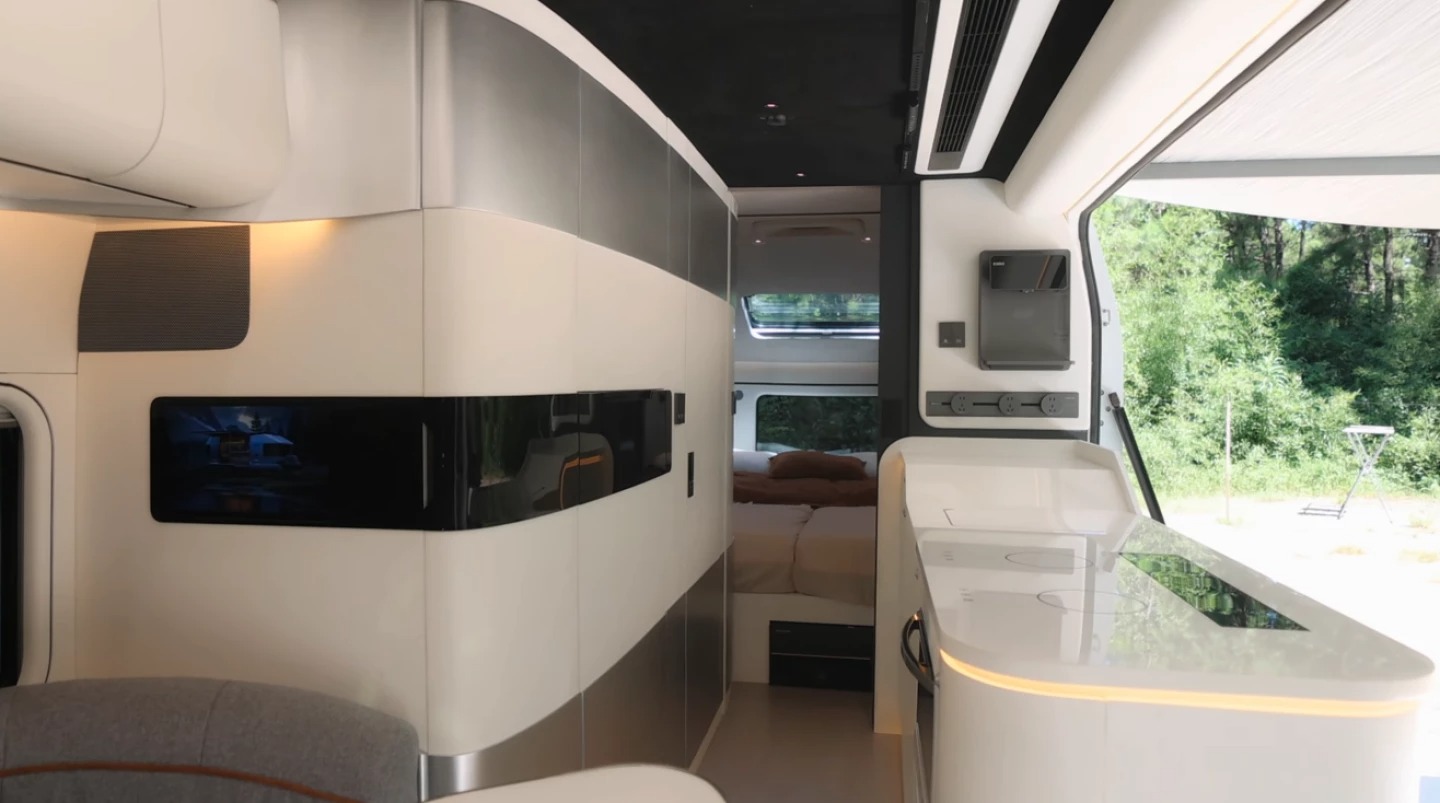
Finally, there’s a living room in the rear, which features an L-shaped couch that turns into another bed or into a dining room.
Skydream Caravans says that this trailer can sleep up to six, but it looks more like four people would sleep comfortably in here unless they’re really close. Many of the bits and pieces inside the trailer are motorized and are operated through the tablet on the wall or by talking with the trailer’s AI assistant. The blinds are motorized, as is the TV that flips down from the ceiling and the range hood for the stove. Even the kitchen sink flips down and disappears. The tech and AI features of the camper can be accessed through an app and through a pad as well.
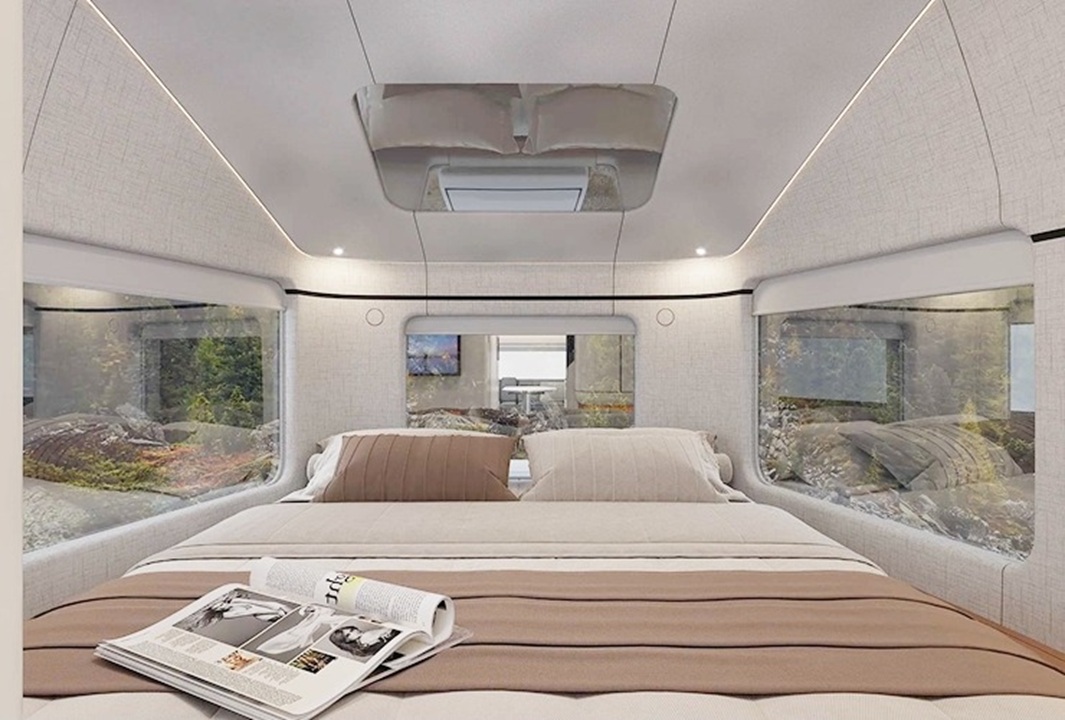
The final trick with the interior is a movie mode in the bedroom. With the touch of a button, the trailer’s lights dim, the blinds close, the electric bed adjusts into a recliner mode, and the projector turns on, displaying a movie on a 60-inch projection screen.
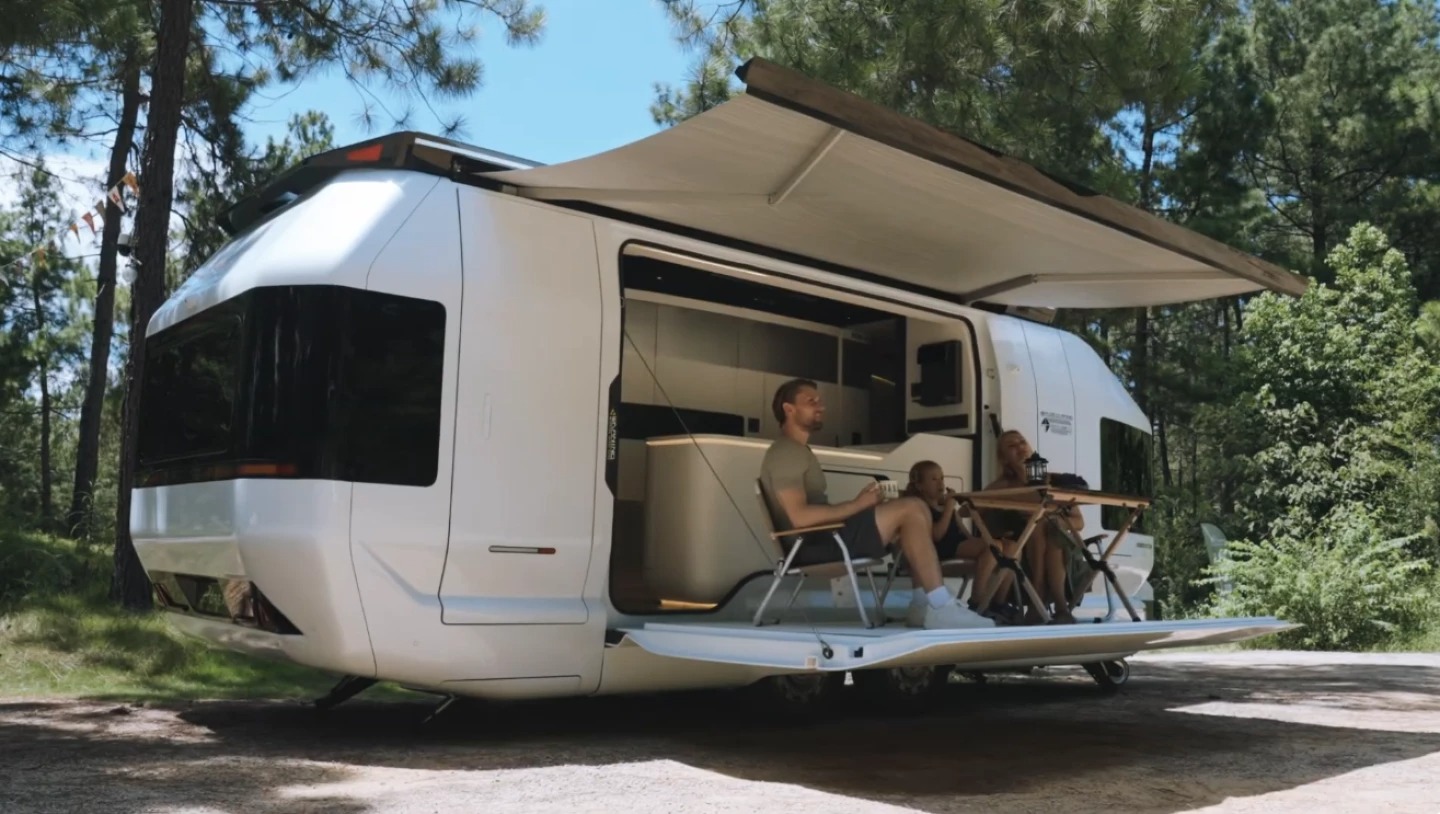
If being inside gets boring, with the touch of another button, most of the right wall of the trailer will open down, and the awning will extend forward, creating a giant balcony.
I haven’t even gotten to the craziest tech parts yet. The trailer has been designed from top to bottom to remove the parts of RVing that require real effort. From Skydream Caravans: “Some users may also encounter some challenges during driving and parking. For instance, driving the caravan requires high maneuverability and stability. Furthermore, operations such as parking, hitching are time-consuming and laborious.”
Skydream then proudly proclaims:
“Traveling No Longer Requires Expert Driving, Your Caravan Is Smarter Than You Think.”
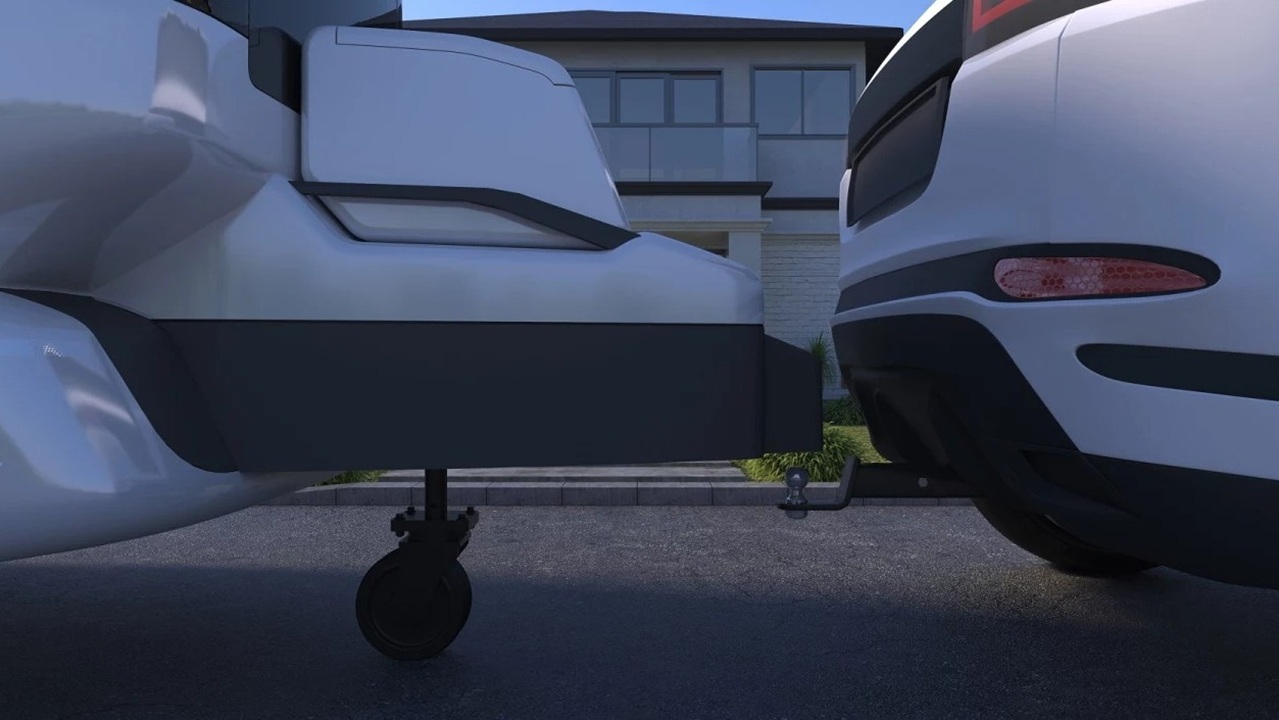
The trailer uses sensors, algorithms, and AI to take pretty much all of the legwork out of hitching, towing, and parking a trailer. Skydream says that its Caravan ADAS (Advanced Driver Assistance System) can drive the trailer up to your tow vehicle and automatically hitch up to it. Then, once you’re driving, it provides active stability control, a traction assist, a hill assist, an active steering assist, an off-road assist, a crosswind assist, and regenerative braking. Once you get to your campsite, the trailer will automatically decouple from your tow vehicle, and you can remotely drive it into your parking spot. Apparently, there’s also an automatic parking function where the trailer will find its own parking space at a campground if you cannot be bothered to park it with the remote control.
When the trailer is parked, hit one button to tell the camper to level itself, stabilize itself, open the awning, open the balcony, and turn the lights on.
When you’re away, a security system monitors the camper. In its parked state, the trailer can provide power to a house or to an EV, or just be a self-contained camper. The unit gets 1,100 watts to 2,200 watts of roof-mounted solar system, and the company says that it can last up to 14 days off-grid. The actual details as to how stores would last that long are not provided.

The drive system of this camper is fascinating in how it’s marketed. Lightship and Pebble market their drive systems as ways to help tow vehicles keep their fuel economy or electric range ratings.
Here, the drive system is pitched as a way to allow people to tow a trailer without being an “expert” in towing. In fact, as of publishing, Skydream Caravans makes no range claims whatsoever. It doesn’t even say how much horsepower comes out of the electric motors. Certainly, this is the first trailer that I’ve ever heard of that offers an “active steering assist.” Not even Pebble or Lightship advertise that. This camper is more or less a modern electric car with a trailer tongue on its front end.
Skydream Caravans isn’t saying much more for now. There will be a special American launch event on Monday, March 23, in San Jose, California. The event is for, among other things, getting American dealers on board with selling this trailer. Otherwise, Skydream Caravans hopes to get deliveries for U.S. customers started in December 2026.
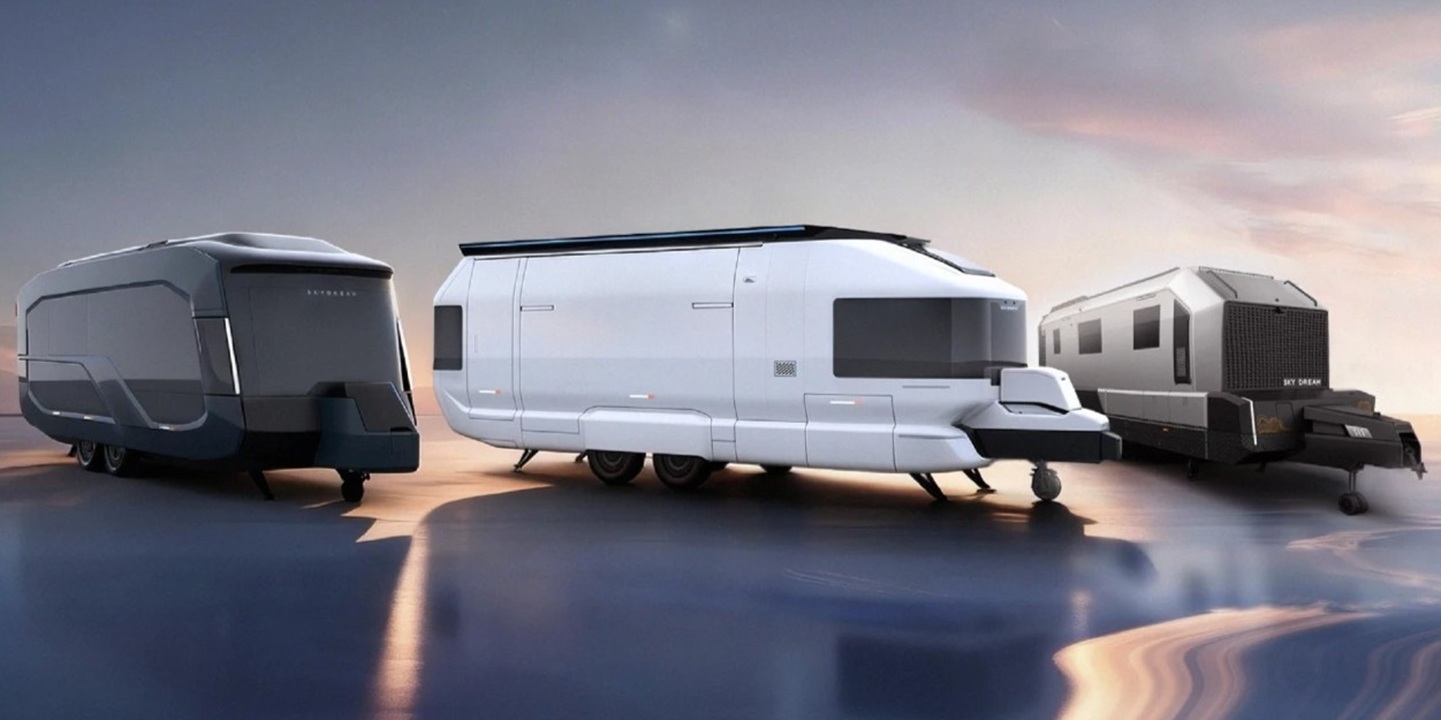
There is a whole planned lineup, which includes a larger “On-road Caravan” and an “Off-road Caravan.”
Do You Want An AI Camper?
Certainly, Skydream has a long way to go. It doesn’t even have a working website, hasn’t listed any pricing, hasn’t explained how all of its AI stuff is going to work, and hasn’t said much else, really.
I also wonder if people actually want such a tech-laden camper? Many of the people I talked to in my travels just want a unit that will make the drive home without falling apart. Do we really need AI all over our campers? I’m also not sure about marketing this trailer as something for people who might not be experienced in towing. AI or not, you should absolutely know how to tow a 6,400-pound trailer before you hitch it up. As pilots know, sometimes automation doesn’t work as you expect, but that’s why you learn how to work safely without it. Knowing how to tow a trailer is a great skill to have.
Marketing aside, I dig the look of this thing. I wish more campers had wraparound windows, party decks, and didn’t look like a boring white box. This, like the other self-propelled campers out there, looks like a space capsule, which is super cool. So, I hope something that looks like it reaches production, though maybe with fewer AI buzzwords.
Topshot graphic image: Skydream Caravans


“Do You Want An AI Camper?”
Hell no! Artificial Stupidity
What the hell is an “electric zero gravity bed”? Is that like an electric chair where you get zapped while sleeping? Yeah, no thanks
Also, I would be so embarrassed if I were any of these customers…”yeah, I bought this since I’m too much of a doofus to learn how to back a trailer”
Backing up a trailer is like learning stick…once you get it, it’s like second nature
You know, much like how prior to AI it’s always been possible to photoshop someone’s face onto a body in a compromising position (trying very hard to avoid tripping the moderation filters here 😉 ), but it was hard enough to do that it didn’t happen that often, it’s possible that the difficulty of hitching and parking a trailer was, in fact, a good thing. I expect every single one of these to end up with a new version of the Camry dent when some ignoramus who thinks their AI trailer drives itself pulls out of a gas station and swings the tail right into the pumps. I mean, that already happens, but now you’ve opened the field to a whole new level of idiot who shouldn’t be operating that much machinery.
Maybe some things shouldn’t be easy.
Wut? In most campgrounds you can’t just pull in and park your trailer wherever you want. Is it also going to call up the office and ask which site you’re in (and why am I giving them terrible ideas for free)?
I think I saw these (or something very similar) at the LA Auto Show a couple years ago. Some of the tech is neat, but it’s just way too overdesigned and luxurious for me. Being outdoors means getting away from some of the shit we deal with in cities everyday. Yeah, you want to be comfortable, but this is basically a Hilton on wheels. Not a fan at all.
Many years ago I met a Dutch fellow on a French campsite. He had electric motors in the wheel arches of his caravan. The turned a small rubber wheel, which sat against the inner tyrewall. They were operated using a model car RC device.
So this chap could ease his caravan into place by having one or both motors turning, forward or reverse or one of each. His party trick was turning the caravan through 180⁰ in its own length.
Jolly useful, extremely simple, and why don’t we see it more often?
Looks AI rendered as well.
I like the idea of an electric power-and-regen assist trailer, but I’m highly skeptical of self-parking claims.
Ugh, no I do not want anything “AI” anywhere near my camping. The fold out porch thing is kind of cool if it didn’t completely eliminate regular windows on that side. All the motorized stuff controlled with a tablet would drive me insane.
But the big thing to me is marketing this as “requiring zero skill.” This is a terrible mindset to have, and we’re already seeing it with 8000lb+ EV’s that do 0-60 in 2 seconds but can “drive themselves.” Idiots with no business being in control of that much power and weight buy them and bad shit happens.
This isn’t to say that I’m some “towing should be hard” purist. I appreciate all the driver aids and convenience tools. I think they’re useful and they make driving a bit less stressful or fatiguing. But when they screw up or don’t function properly, I know what I’m doing and can get out of those situations, or at least mitigate risk and damage.
I feel like there’s (rightly) a bit of backlash on the “these kids today don’t know how to do anything.” Is there really a reason anyone needs to know how to drive a manual? Not really, in the same way there’s no practical reasons everyone needs to know how to adjust a carb or use a timing light. The tech has moved on, and just because I do that stuff for fun doesn’t mean it’s somehow a “life skill”.
But when it comes to knowing how to control multiple tons of road-going missile? I don’t care how far the tech goes, I think we should emphasize knowing how to control cars/trucks/campers without all the gadgets and AI aids, just because it gives situational awareness and safety-consciousness that you don’t have if you don’t understand what the automation is doing or how to do it yourself.
I assume you’re still going to need at half ton pickup to pull this thing (I guess it’s unclear how much it assists the tow vehicle, but they’d probably recommend something that can tow this with a dead battery and 6600lbs is probably the dry weight) so you’re looking at 45+ feet and 12,000+ pounds you’re moving down the road. Not a great recipe for those without some basic skills towing.
I also like the porch – it reminds me of the RV episode of The Grand Tour where James May put a fold out porch on his pub RV. He was in the desert, which is just about the only place that would be a good idea. Where we camp the black flies and horse flies would be treated to a buffet.
I really like your 4th paragraph. I agree. We lament that kids today do not know how to shoe horses or braid buggy whips, no. I have grown tired of pissy boomers complaining about kids not knowing how to do x,y,z that was necessary 70 years ago, and not since, but the dang boomer posts AI slop videos 24/7 and cannot save a PDF.
Camper market is funny, you’ve got people clamouring all over each other for the existing market share of what’s “cheap and big” as they race for for the lowest-cost per sqft on a range of budgets.
And then there’s the niche: the small-trailer market, the premium (airstream and up), or unique (offroad trailers)
So where can you play as a new entrant except attempting to court, effectively, new buyers that would never consider a trailer in the first place?
Personally, I don’t think there’s a viable market for new entrants without a race to the bottom (like Thor Industries has done) or to go to premium where you can command a profit at low volumes
I don’t really care about the tech, but the design is really appealing. That pic of the pamper with the side folded down is extremely compelling. Cooking while looking at a mountain vista? Sign me up.
Any idea on pricing? I’m guessing $350k.
I like the concept, but in practice it seems to be either “cooking with no view because the bugs/weather dictate I close the hatch and there’s no window” or “Cooking outside on a picnic table gives me a better outdoor cooking experience without sacrificing the whole wall/windows to an expensive gimmick.”
I don’t really care about the self-driving bit.
I’m more attracted to the 21st century design and the openness to the outdoors.
Because it seems dumb the way most RV designers pretty much ignore the outside world and saddle their interiors with the cheapest of big-box residential design materials.
Who needs knowledge, practice, experience towing a trailer when overconfidence will make you an expert in all things. /s
As a person who hooks up trailers by myself often, getting a little help from the trailer would not be the end of the world.
Sorry, but in the land of Alpha Males a trailer that parks itself is not a selling point, but a drawback. And I’m assured by my wife (who’s taken many cross country trips with her bestie and a trailer) that there are plenty of men at any campground clamoring to help a couple of little ladies back their trailer in.
Joking aside (well, maybe not exactly jokes but rather sad observations) I think there’s about 3 people that would want a camper like this. Ok, let me rephrase that. There are 3 people who’d PAY for a camper like this. If you have the cash to splash on something that makes the whole camping experience as little like camping as possible, you’d just get a motorhome.
My friend’s wife teaches horse trailer backing up classes for women to avoid such issues.
Vaporware intended only to bilk investors. With the features they claim it has it would have to pass so many different categories of red tape that it would take years to be legal to sell anywhere.
Since all the images look like renderings I will declare this vaporware until Mercedes takes one to Oshkosh.
This is everything I don’t want in a camper. Lots of motorized pieces, electronics and an AI. I go camping to escape AI. Also I have a pickup and know how to tow. Finally I enjoy the tinkering with leveling jacks and hook ups
I just checked from Australia and the website https://www.skydreamcaravans.com/ does come up. I haven’t had much of a look, it doesn’t appear to be loaded with info. Way too much automation for me, far too many things to fail.
Looks like it’s working for me, too, now! It was down all of yesterday, which is not exactly confidence inspiring.
What do you mean? You don’t trust a company that can’t keep its own website working to develop a self-parking trailer? 😉
Not very ‘relaxing’ when the automation fails halfway and/or cant get ‘app’ to do what you want and you’re ready to push it off nearest cliff.
Unless it’s being used (nearly) full-time, I’d much rather rely on propane than electrons for something that will spend most of its life sitting in a fenced storage yard.
There’s plenty of low tech, lower cost propane powered trailers for folks who prefer off site storage yards. This one is for driveways.
No surprise an overtly techy trailer is being launched in my town.
I look forward to seeing the one prototype used in some Chinese filmmaker’s low budget scifi flick on Netflix in a few years, used to signify the before times or something.
Just get a conversion van LOL
Right?! I was thinking “An RV is for people who don’t know how to tow a trailer”.
There you go! 🙂
I have tried to tell too many people that but they do not want to maintain a second ICE or they want to excuse their daily driving a 1 ton truck.