


IIf you’re an environmentalist, the cancellation of all of its electric cars probably feels like a betrayal by Honda. It’s the “Earth Dreams” company. Honda was supposed to be the chosen one. I understand that feeling. You’re wrong, but I understand it.
I spent most of yesterday in a room with fellow journalists and auto industry analysts listening to an electric car company, Lucid, talk about its potential future. This was a company that’s gotten billions of dollars in investment, mostly from Saudi Arabia, and its hope was that it would be cash flow positive by the end of the decade. Lucid is, from a vehicle engineering standpoint, the most advanced electric carmaker in the world, and it’s going to need years to just start seeing a return on that investment.


What journalists were saying in the room, and online, was that what happened at Honda was terrible. An awful decision. Also, pretty much everyone agreed, the right decision. Honda wasn’t going to make any money on those cars, and so its $15 billion got added to the other write-downs, which now reaches above $70 billion in EV-related losses.
The Morning Dump today is going to focus on hybrids, EVs, and maybe where this is all going.
EV Registrations Fall In The US As Hybrids Rise
One way to make people healthier, from a diet perspective, would be to get rid of all the Burger Kings and replace them with Erewhons–the fancy and expensive organic grocery stores. That probably won’t work for most people. It doesn’t mean you get rid of organic grocery stores or stop building more, but perhaps there’s something to be gained by just making Burger King a little bit healthier.
This is how I feel about hybrids.
When I say that the 2020s are the “Decade of the Hybrid” I think there’s a tendency by irregular readers to assume I’m anti-EV and I have to first explain that I’m not. I think most people would find an electric vehicle a better commuter option than their current gas or even hybrid car, assuming they have access to home-charging. I also understand that the net-positive impact of more EVs far outweighs any environmental cost of their production over the lifespan of the vehicle.
My most controversial take is that the push for more electric cars is, itself, a kind of giving up on the real answer: higher density development. Simply replacing gas-powered cars with electric ones doesn’t do anything to reduce the number of miles driven. I always come back to this, but Los Angeles is basically twice as dense, population-wise, as Houston. This means that, in Houston, it takes twice as much energy to pick up the trash or deliver pizzas. Replacing pizza delivery vehicles and garbage trucks with EV equivalents is good, but in some ways it’s a half-measure. If we really cared about changing the environment, we as a society would put a lot more effort into fixing density and improving public transportation.
There’s a joke that people from the suburbs love cruises so much because it gives them a taste of what it’s like to live in a walkable city that doesn’t require cars, and that’s basically true. It’s nice! Dense places can be efficient, can promote community, and cities not oriented around cars are places with fewer car-related deaths.
It doesn’t mean that switching cars to electricity is bad. If you look at Europe, a fairly dense place already, as of 2019 about 25% of the continent’s total CO2 emission came from road transportation, and road cars made up 60.6% of emissions of that number. If you look at Norway, the only large country that sells almost entirely electric vehicles, even as of the end of 2024, 68% of the cars on the road were gas-powered. The next closes country is Iceland, at 18%, and then Denmark at 17%. Even in the most pro-EV countries, the transition is painfully slow.
The shortcoming of the pro-EV argument is that it assumes society isn’t going to be motivated enough to change the way it lives slowly and carefully over time, but will just be motivated enough to change its cars immediately.
What the Inflation Reduction Act and the Biden Administration proposed was basically a moon shot. A pull-out-the-stops attempt to get industry to switch to electrification. It didn’t work. Even before the new White House and US Congress killed the plan, it was falling apart because the demand wasn’t there.
If the assumption is that people won’t change their habits, then the better option is: Electric cars for some, hybrids for almost everyone else. The math gets complicated, so I’ll approach it from an extreme example. The Ford F-Series, broadly construed, is the most popular vehicle in America and Ford sold more than 800,000 of those last year. These are vehicles that presumably get driven a lot, as many of them are work trucks. The impact of improving the fuel economy average of an F-Series by 1 MPG is going to be way greater than, say, 15,000 Escape Hybrid buyers being pushed into Mach-Es.
Toyota has this ratio its engineers developed, which is that the raw battery material needed to make a single electric car is the equivalent of making six plug-in hybrids or 90 regular hybrids. That’s basically what Honda is doing.
Imagine if at least some of the $70 billion that is being written off to develop EVs had gone to more hybrid development. Would the net environmental impact have been faster and outpaced switching a small percentage of buyers to EVs? The problem with the switch to electric cars is that it requires all of society to move as one, in the same direction, for a long period of time. This is enormously expensive, and the politics of it aren’t great. [Ed Note: Two years ago I Wrote “America Focusing On Electric Cars And Not Plug-In Hybrids Was A Huge Mistake.” I stand by that. -DT]
Hybrids no longer seem to carry that same political charge. They require no change in behavior. They’re not that much more expensive and, in an environment where gas prices might rise a lot, the economics start to make a lot of sense.
That’s where most drivers seem to be. In the absence of tax credits, EV sales dropped off in the United States to just 5.1% share of the light vehicle market according to S&P Global Mobility, via Automotive News, down from 8.3% of the market last January.
Sales are now mostly Tesla Model Ys and everyone else, with Cadillac as the #2 brand:
Cadillac, at No. 2 among EV makers, grew its registrations by 8.1 percent in January to 3,189 with its expanded portfolio. The Vistiq three-row crossover had 737 registrations versus none a year earlier. The Lyriq midsize crossover fell 47 percent to 1,040 registrations.
Cadillac’s EV share rose 2.4 percentage points in January from a year earlier, to 5.3 percent, the data showed.
Remember when everyone was going to swap F-150s for Cybertrucks? The Tesla truck only managed to sell 1,458 units, compared to 47,981 F-Series trucks.
Ok, so that’s the United States. What about China, a place where the government has more ability to push the population in a single direction.
Even Chinese Consumers Are Embracing Hybrids

Would you believe that Volkswagen and Toyota, via joint ventures, were the two biggest automakers in China in February? That’s what happened, with Geely coming in third and BYD falling to fourth place.
What’s going on here? I’ll let Reuters explain:
The legacy automakers’ comeback in the market where they have been struggling to catch up with local rivals in EVs comes as purchase tax exemptions on electric cars expire and Beijing scales back subsidies for trading in EVs.
As subsidies fade, hybrid EVs that Toyota specialises in were shown to have steered some consumers away from PHEVs, said Cui Dongshu, secretary-general at CPCA.
Local automakers betting on budget electric and plug-in hybrid vehicles take the biggest hits from the curtailed incentives.
BYD, which unseated VW as the biggest carmaker in China by sales in 2024 and held onto the crown last year, fell to fourth place with 7.1% market share in the January-February period when its overall sales posted the biggest drop since the pandemic.
As CNEVPost points out, retail sales of what China calls NEVs (electric vehicles + hybrids + fuel cell cars) dropped 32% year-over-year. In China, where infrastructure is better and EVs are cheaper, consumers still need support to buy cars.
The Honda Prologue Is Probably Dead, Too

Honda had already let slip, via financial reporting, that it was going to be cutting back on Honda Prologue production. It sort of made sense, given that GM was building the Prologue for the company and Honda had already decided to kill its Acura ZDX sibling.
Now Automotive News thinks the Prologue is just dead, dead:
Honda is expected to pull the plug on its sole electric vehicle in the U.S., the Prologue, after the current production run ends in December.
The automaker isn’t planning a second generation of the midsize crossover, which General Motors builds for Honda on a shared EV platform, according to industry forecaster AutoForecast Solutions.
A Honda spokesperson declined to comment on future product plans but said the Prologue remains in the lineup.
The Prologue will only remain in the lineup because they’re selling so slowly and, therefore, Honda has a bunch of them.
Is This All Very Shortsighted?
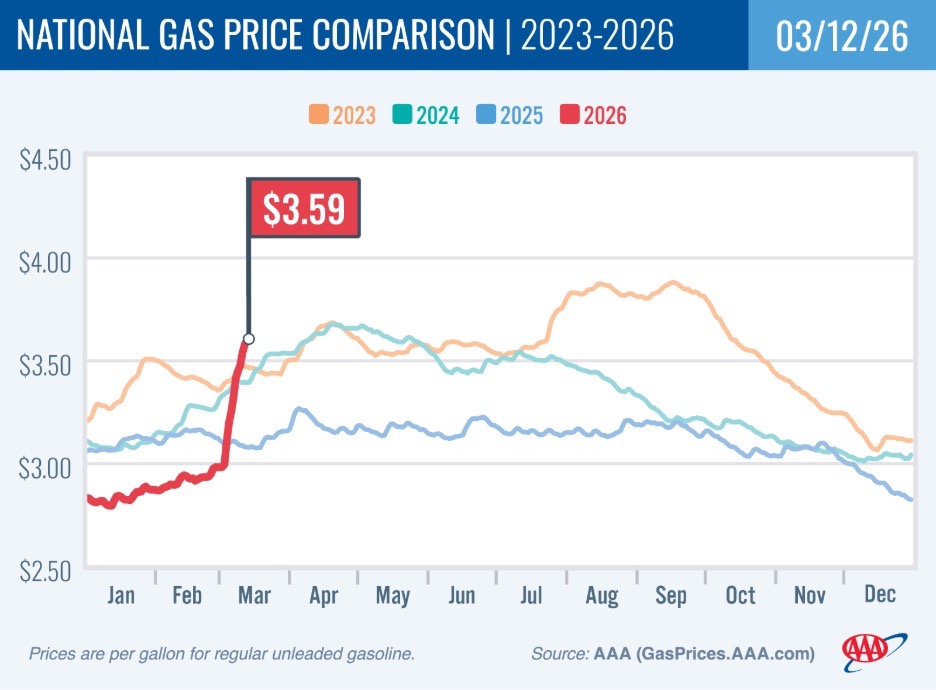
The country is at War with Iran in order to pursue unclear objectives. When this ends and where it’s all going is anyone’s guess, but what’s clear is that there’s at least going to be a temporary increase in gasoline prices. As you can see in the graph above from AAA, this is the time of year when gas prices usually go up, though not at this extreme rate.
It does feel like it would be a great time to have a lot of electric cars, right? Or at least more hybrids. The problem for automakers is, historically, a prolonged period of gas swings usually mean that people stop buying cars altogether.
In six past instances of oil crises, auto sales dropped by more than 10% of average sales. Three of those times, they plunged by 40% or more of average sales, according to Anderson Economic Group.
The group notes that it is impossible to predict what might ultimately happen as a result of the war in Iran, but past episodes that involved wars and oil embargoes had significant effects on U.S. auto sales.
“History shows that Americans cut back sharply on buying cars when wars, invasions, and oil embargoes occur,” Patrick Anderson, CEO of Anderson Economic Group, said in a statement. “While we don’t know how long this war will last or what the effects will be, at least six times since the 1970s, an event such as this has caused a sharp drop in auto sales.”
People now have the option to buy a car that’s way more efficient, which wasn’t necessarily true in the past. Maybe that’ll help.
What I’m Listening To While Writing TMD
If there’s an album that feels more like the pre-GFC malaise of the late 2000s than The Postal Service’s “Give Up” I don’t know it. Please fish your iPod out of the basement and put on “The District Sleeps Alone Tonight.”
The Big Question
Are you taking a spring holiday? Are you driving? Are you starting to be impacted by fuel prices?
Top graphic image: Acura



I am going on a cruise. Not because I miss walkable cities (I do) but because I need a brainless vacation. I am not good at relaxing when in a new place as there is too much to see and do. Haven’t decided on flying or driving to port but gas prices won’t affect the decision.
I worry that gas prices will affect the (hoped) cratering of used EV values as they start to come off lease.
My buddy is an airplane mechanic and always tells this story about how airplanes transitioned from piston engines to jet engines.
I tell all this to say that we’re definitely at the “turbocharger stage” (i.e. Hybrids) when it comes to EV adoption. Hybrids are the now and they can get the most acceptance and do the most positive change. It won’t be long though when batteries get dense enough and chargers become ubiquitous enough that the public finally asks the question “what’s the engine for?” and BEVs will become the norm.
I’ve heard this one too, and it’s a nice story but not at all true. The gas turbine is older than the airplane and from the Wright Brothers on it was always considered as an option. Metallurgy and aerodynamics just wasn’t good enough until the late 1930’s to allow it to happen. So no, there was no “quantum leap”, just gradual refinement that eventually made it possible
I mean, I love EVs, but this is a pipe dream. Commercial batteries have improved from roughly 100ish 3.6kJ/kg to 1 MJ/kg in the past 30 years of common use. Which is an impressive 300% gain! Unfortunately, it’s inching along compared to the 46 MJ/kg of gasoline, so I think your timeframe may be slightly optimistic.
how do solid state compare? I know we’re not quite there yet, just curious how much of a jump it will be in density.
See, I always took that as the moral of that story. We didn’t just jump from pistons and propellors to jet turbines, there were meaningful steps along the way that led to such gains. Turbochargers led to better metallurgy and heat management which allowed full jet turbines to finally make sense.
With hybrids needing batteries the money is now there to properly invest in newer and better battery chemistries. I mean hell, Donut has supposedly already cracked that egg.
What I hear you saying is we need turbine cars.
Seriously though, that’s a good point: 20 years ago the extreme/crunchy option was a Prius hybrid. Now it’s an EV, which resets hybrids to being the “moderate” choice for people. It’s no longer exotic or carries any kind of stigma (for ppl who care about that). So, in that sense, EVs on the market probably results in a lot more people willing to buy hybrids.
I thought the attraction of cruises was the 21 buffets over 7 days, and a giant vomit catcher called “The Ocean” right outside, just in case.
Alternately, the balcony directly below….determined primarily by wind direction.
As a long-time cruiser – the attraction to me has been being able to see a lot of places in a limited amount of time while only unpacking once.
When I don’t cruise – I tend to stay in one place for a week or two, being able to really experience a place in depth.
Most people falling off ships are said to be taking a whiz.
But barfing could easily be a factor.
Taking a road trip in the EV. But even with the recent increases in gas prices, I will probably still be paying more for fast charging than the average road tripper is for gas. Our gas is still stupid cheap, which I am thankful for because that eases the financial strain on EVERYONE. I am also thankful for the normalization of hybrids in the US, their continued increased availability and availability at more price points. This is the way.
Mismanaged government interference in citizen’s lives, especially transport design, already looks like economic genocide.
Are they the reason cars became too costly to buy?
The legislators throwing money at their pet car designs may as well have been throwing firebombs at them, as far as achieving acceptance.
1] Gasoline is actually dirt cheap, even at current prices. I started driving in 1980 and gas was a buck a gallon. That 1980 dollar is worth $4.20 today, which is what I paid for my last fill up.
2] I’ve seen several articles saying “Gas prices are up! You should get an EV!” which seem to completely ignore the recent rise in electricity prices due to AI data centers. Gasoline prices tend to fluctuate over time, but once the price of electricity goes up, it rarely comes back down.
Until a war kicks in, in the Middle East.
I can easily make my own electricity. I can’t easily make my own gasoline and diesel.
not with that attitude.
“Jason and JJ invade Saudi Arabia – An Autopian Adventure”
I’m free Tuesday. From all I’ve read it shouldn’t take more than a few days to get this sorted out.
Some of those guys are a bit cranky.
Canada is closer.
To be fair, electricity price has been historically surprisingly flat after year when you factor in inflation. Going back 50ish years electricity is actually marginally down. It’s only the very recent past few years that electric rates have really started to move, but not yet enough to outpace the slow decline it had for the prior 50ish years.
Electric cars are not for everyone and will never be (at least for our generations, I am hoping my kids will embrace them since they grew up with EVs). By now, the majority of vehicles should offer a Hybrid option, something similar what KIA does, every flavor/powertrain configuration and let the customer decide. The majority of my neighbors that drive a F150 already replaced theirs for their powerboost option (hybrid).
Stellantis had the good concept but horrible implementation with the new Charger, having an EV or ICE option, they could also have a PHEV if they wanted but their packaging is awful.
I love my Chevy Volt, I can decide to use gas on the highway and just switch to electric for city driving since thats where its more efficient. Running the engine at constant load at highway speed is a very simple task for the powertrain. When the HV stops working, I am replacing it. More environmental friendly than buying another car.
I think about my young daughters who have only experienced EVs. When they enter the car market, I imagine that will be what they want. They have 0 understanding of what an oil change is or why you need it, along with all the other maintenance required for an ICE vehicle. If you don’t grow up thinking all that stuff is normal, why on earth would you decide to put up with it later on? That said, the rate of adoption will be glacial.
In fairness to your daughters and others like them, a friend, who is highly qualified person in an elite, professional way, recently asked me “Are brakes a thing? Like, is that a thing you have to ‘do’ or change or something?” After 100,000 some miles in this car.
In her defense, they somehow are not squealing or worn down to the vents in the rotors or anything. I didn’t check the disc (not that I have specs at hand anyway) but the rear pads were still at 3mm. Methinks she must have had them done at some point and just not realized it.
(I realize this is a terrible example in the context of EV vs ICE, but my point is that people were woefully oblivious long before the drivetrain was at issue.)
Ha. You’re definitely not wrong. I still think trying to explain an ICE car to a teen who has zero personal experience would be tough. All the maintenance, the weirdness of shifting (if you’ve never experienced it) plus “oh never turn it on in the garage bc it will kill you.”
Honestly, that’s kind of a shaky thing to conclude as far as a prediction of what would happen if we had the fleet of EVs we should have available for sale right now, because the overwhelming majority of gas swings throughout history have happened when ICE cars were pretty much the only option for consumers to buy.
I think more instructive is to consider how behavior changed among people who were actually buying cars. A good example would be the 1970s oil embargo which led directly to Japanese imports becoming popular in the U.S. because they were the ones making small, fuel efficient cars while we were making large, gas guzzling barges. When gas is rationed, you want to get as many miles out of what you have as you can.
That indicates that consumer behavior will change when the calculus for what makes a car more or less desirable changes.
The problem with going all-in on hybrids is that it just extends the problem. Oil is still a finite resource. We can’t make more of it – at least, not on a timescale that matters. It’s great (semi-sarcastic there) that we keep finding new oil deposits, but that isn’t going to last forever. Eventually we will reach the point where extracting more oil is going to cost too much for most people to be able to afford to use it.
And that’s not even counting the costs we are already paying due to the environmental impact of oil use. My homeowners insurance has doubled over the last five years because billion-dollar storms have become much more common and the insurance companies are definitely not going to cut into their profits just to keep insurance affordable.
Stretching the end game out doesn’t change the end game, it just lets us kick the can down the road and hope we’re dead before the problem gets really bad. At best, that irresponsibly leaves future generations with a worse problem to solve than if we’d just solve it now.
https://dealer.porsche.com/ca/lauzon/en-CA/News-and-Events/Carburant-efuel
No need to ration. Just ramp this up.
I think it would take a return to genuine rationing to motivate people. It would impact people of all income levels and be an issue you can’t buy yourself out of. That said, I think our current government would start several more wars rather than allow that to happen.
…it’s times like these I’m glad I stick with small cars.
And, yes, planning on a road trip this weekend.
No spring break, but Rata the Junior graduates in June and is being sent to Ireland for a Euro-trip before university in the fall. We decided to do our own version, meeting him in Dublin before sending him off to go camping with his Aunt and Uncle, and we’ll carry on for another week.
As far as the ev/hybrid/phev debate goes, I can’t foresee a time where I buy a full gas car again. Of the four cars in the house, we have 2 PHEV, a Clarity, and Volvo S60, a hybrid Maverick, and a 2001 BMW. I’m not going to give up 40+mpg for the 90% of the time we drive. The Clarity, when it was my daily would do my commute almost entirely on battery, and it was common for that six gallon tank to do over 1000 miles between fills.
I drive a Tahoe, so the gas prices affect me a bit, but it’s not my daily. My hot take though, is wondering if gas price increases are a Big Deal because it’s an easy thing to see and compare, but are actually overblown? For example I might be spending $30-60 more a month, depending on how much we drive. But I don’t bother checking the daily price because I need gas, it is what it is. Meanwhile, groceries for our family of 6 average around $250-350 a WEEK, when it used to be $100-200. That’s a bigger expense than gas, and just another thing we budget for. Compared to that, spending a little more on gas sucks, but the actual cost doesn’t seem to match the coverage and outcry on it.
Amen.
Yep, have long argued this.
Gas prices being volatile, easy to see, and mostly non-optional make them have an outsized impact on our psyche compared to our actual wallets.
If the price of a dozen eggs was displayed on a massive lighted sign on top of the grocery store, it would probably get a lot more attention.
Maybe? The problem is gas is one thing whereas when people go to the grocery the usually buy many things. Maybe you know what a cucumber was going for a year ago vs today, but I don’t. You see it at the register, but aside from the outliers ($10 for a dozen eggs), it’s hard to tell what’s adding the most to your bill. Especially with shrinkflation. I don’t think there’s a person on the planet who could tell you how many grams of Cheerios were in a box a year ago vs today, making it basically impossible to see the increase in cost.
The thing about gas is it has compounding effects throughout the entire economy in a way very few other things do. Your budget gets eaten by more gas, but also almost every other thing in you budget does too. If you are worried about grocery prices, every single thing in your grocery store was brought there by something that uses an oil derivative to get it to that store, and the warehouse before that, and the processing plant before that, and the original site before that, and the machines that got it from that place before that.
Our personal budget margin gets eaten by our increased gas purchase, but transportation companies dont eat margin, they increase prices.
This is what I was going to point out, the rise in diesel prices is a bigger hit to the economy then the gas prices going up.
hey folks in the Sacramento area are (sometimes) getting their Frito-Lay products via Tesla Semi. Let the $avings begin!!
Bingo – this is the broader impact. Our entire economy is based on diesel. Literally everything is delivered using fuel.
It’s great that spending a “little” more on gas is something your budget can afford. A lot of people have nothing left at the end of the month after they pay their bills, and price increases can put them at risk of budget failure and even homelessness.
Assuming something isn’t a “Big Deal” because it doesn’t cause you, personally, pain is pretty short sighted.
I think the point people are making is if you look at all the non-discretionary costs of living, the increase in gas prices is far from the biggest problem. The folks on the bottom end would have a lot more in their pocket if grocery prices went down 10% vs gas being $1 less/gallon.
Sure, yes, other non-discretionary costs are up too. That does not mean we should be OK with illegally starting discretionary wars that are guaranteed to increase the cost of gas. “You already have a cut on your arm so it’s OK if I stab you through the heart” has never been a valid assumption.
Plus, there are ways to stretch food dollars. Food shelves, SNAP (which, yes, there is a reason Trump is trying to kill that off), buying cheaper foods like rice and beans, etc. Hell, if you’re really desperate you can dumpster dive in the back of a restaurant. People do it all the time. It sucks and it’s frankly shameful that a society as rich as ours has people who have to do such things, but it’s doable and you won’t starve.
There is no such thing as a gas shelf. You can’t go buy “plain” gas to save money. You will not find 5 gallons of gas in the trash can behind the gas station.If you want to obtain gas legally, you have to go to a gas station and buy it.
If you stop buying gas, you’re probably getting fired because many people live where there isn’t decent public transportation between home and work.
We’ve engineered our country so that the majority of people must be able to drive or they will not be able to stay afloat. At the same time we’ve engineered an automobile supply scenario in which the emphasis has been on bigger, faster, more wasteful rather than emphasizing fuel efficiency. Also at the same time we’ve engineered our economy so that the vast majority of the population, including those who have good jobs, are one bad medical diagnosis away from bankruptcy. The vast majority of those people are one flat tire away from having to choose between paying rent and paying the phone bill.
For 50 years we’ve been taking money away from most of the population and funneling it upward into the hands of the wealthy elite and then blaming the people who were robbed for being poor.
So yes, the biggest problem is that the robber barons are back in force and they have made everyone else suffer.
However, the more immediate, acute problem is that gas prices have soared because the guy who swore we’d never get into another war on his watch just got us into another war with a region that would obviously fuck with the petroleum market in retaliation.
I agree with everything you said. I also want to be clear I am not justifying or excusing this latest global mess. My point is that even in a magic world where gas is $0.10/gallon, most people would still be utterly screwed, for all the reasons you said. The robber barons would just find a new way to extract money from the masses.
I think is also depends on your commute for some one like me a 1 dollar swing is has prices if I was still dailying my FJ would be huge as that only get 15-16 mpg and I have a ~95mile commute per day. Luckily I currently have an EV I can charge for free at work for now (which is changing later this year though as they will put chargers in we have to pay to use)
Bingo
But, but, the local news interviewed some Uber drivers, who say this is REALLY impacting their life. So, it must be true for everyone!!
Alternatively, one choice is “don’t drive so much.” And, honestly, this is something all financially tight folks should do. Uber drivers and other independently contracted drivers are an exception, though this cost is likely to get passed to whatever freight (including people) is delivered.
I’m spending my spring holiday time refurbishing a 21 year old supercharged Seadoo. Just in time for gas to go way up, yay! Since it’s a toy, using it less is always an option. Or going easy on the throttle. The smaller lakes around me have 45 mph speed limits. I’ll abide since a 2 mile long and 3/4 mile wide lake gets awfully small at that speed. I’ll need to take it to a larger lake to make sure the jet pump works as it should. That’s not until mid-May around here to give the water time to get from “instant death cold” to merely “take your breath away cold”. Towed with an AWD EV since boat ramps are slick.
As much as I want to wail and gnash my teeth about batteries being diverted to hybrids instead of BEV’s, it’s probably the right call. Given how much FUD has been spread about BEV’s, people need to experience it for themselves how much nicer the drive is without the noise and vibration of an ICE. A toy ICE vehicle is one thing where that’s part of the charm. In a daily it gets old fast.
I have no idea what kind of efficiency those things get. How much gas do you end up using for a day on the water?
It depends. It will consume 22-24 gallons per hour at full chat. At a more reasonable speed about 8-10 gallons per hour. A naturally aspirated one would consume less.
Dang…
Pushing through water takes energy. Jet pumps are less efficient than propellers. The most efficient speed is sitting on the trailer. The next most efficient speed is once the hull is on plane and the engine at about 4000 RPM or so. Plus the supercharger for this one taking power to run. It’s physics. A 1500 cc 3 cylinder engine making 215 hp has to do it somehow.
Is Honda continuing any kind of EV development in other markets? I get it hybrids over everything but even Toyota now seems to have figured out how to make competitive EVs. It seems to take the Legacy OEMs a generation of vehicle to figure out how to make one that isn’t comically behind other manufacturers.
Yes, they are.
The second point in their press release mentions how Honda’s EVs aren’t competitive in China. Folks seems split if their U.S.-bound ones would have been. Maybe a good call to cut their losses now.
I agree with you on the generation needed but I wonder if they will be able catchup with the leading Chinese OEMs iterating so quickly.
We are taking the kids to meet their great grandmother for the first (and hopefully not last) time this spring. We will be flying then renting a car. We already bought the plane tickets and hopefully the EV we rented is actually available. Car rental agencies have a great reputation for taking reservations for specific types of cars but don’t always deliver.
Gas and diesel prices will only impact me indirectly* through inflation. It hasn’t hit yet, but when it does we will feel it. I remember what 2022 did for prices…
*My wife and I drive EVs and have a home solar system.
Jerry: I don’t understand, I made a reservation, do you have my reservation?
Agent: Yes, we do, unfortunately we ran out of cars.
Jerry: But the reservation keeps the car here. That’s why you have the
reservation.
Agent: I know why we have reservations.
Jerry: I don’t think you do. If you did, I’d have a car. See, you know how to
take the reservation, you just don’t know how to *hold* the reservation and
that’s really the most important part of the reservation, the holding. Anybody
can just take them.
Jerry: “You better give me the insurance because I’m gonna beat the crap out of that thing…”
OK, so lower the price, Honda. Maybe I’ll bite. Except for all that GM in it.
No vacation plans yet. Hosting Easter for (mainly) wife’s family.
All of this started because I decided to buy an Excursion to replace my Sorento. So, sorry everyone.
Now go to your room and think about what you’ve done.
I for one appreciate someone keeping a useful vehicle on the road. Especially an Excursion.
The real answer is to invest into efficient public transportation, and non-car transportation.
Sure, rural areas will still require a vehicle, but those high-density (read: high-polution) centers like LA, like Houston, like NYC will have the ability to take reliable transportation for their daily needs without the need to invest in the purchase of a dedicated car that spends most of its time parked somewhere.
For me to travel to work, it’s 15m by car, <30m by bicycle, ~2hour walking, or >2hours by bus. This makes no sense whatsoever.
But, then, it would require investment in public infrastructure by governments. And it seems, based on current headlines, public money is being spent elsewhere.
Relying on public transportation requires the user to limit (geographically) their housing area and sometimes to limit (geographically) their work area. People who choose to live in the suburbs (for personal reasons) have fewer options. I live in the suburbs because that is where my work was until COVID shut the buildings down near me.
I lived in the bay Area for a bit. I took The BART (the locals hate the “The”) from Walnut Creek to “The City (the locals like that “The”) for work. Walked a mile to the station, because I chose housing close to the station when we moved there.
A lot of it has to do with good city planning, but much of it has to do with efficient public transit and public acceptance.
A colleague explained to me the reason that Dayton (Ohio) busses don’t run outside of the city is that the suburbs don’t want people from Dayton in their area – so they continually vote against public transportation.
So, instead, let’s pave a few lanes more roadway and wonder why traffic didnt’ get better.
Most people do not want to take public transit unless it is better than driving. So your public transit has to either be very good, or driving very bad. In a place like New York where driving to work daily takes a long time and is expensive, and transit infrastructure is reasonable, it works. For most midsize cities like Dayton, driving is not bad, there’s no reason to take transit that will probably take longer and be less pleasant.
Public money must go to war, the only thing with near universal bipartisan approval.
“We may have destroyed the planet but for a brief moment, we made the investors very happy”
That could have been a Buck Turgidson quote.
it’s not public money as there’s very little of that. It’s public debt financing these adventures.
Until everyone has easy local access to charging, pure EVs will never work. I agree, Hybrid is the way to go for now.
I’ll probably do a spring staycation. If I were still in the SW, I’d love to go visit my old vacation spots in Mexico.
There’s a LOT of public charging. But unless specifically looking for it, it’s invisible. Download Plugshare and take a look. A good chunk of people can 120v charge at home.
Charging is shockingly common. Even rural areas have one or two fast charging stations
I’d agree that EVs won’t work for EVERYONE until everyone has access to charging but they would work for a whole lot more people than have them today.
Roughly 55% of the US population lives in single family homes with dedicated off-street parking.
Plus, why do people act like gas cars work for everyone? They are relatively unaffordable for some people, hard to store for others, and not able to be driven by even others.
Yes, those overlap with EV concerns, but people keep saying, “EVs don’t work for everyone!” But never stop to consider if ICE ones do either.
“…pure EVs will never work”
Except they do for a great many people.
I think of hybrids as the worst of both worlds. You still have to buy gas. And now you now have 2 different drivetrains to maintain and repair. You have oil changes and brakes and timing belts. You don’t get the pure EV smoothness. Hybrid tech always seemed like a stop-gap until a decent EV came along.
I bought a Tesla Model 3 Long Range AWD a few days before the war started.
It’s shockingly quiet and incredibly fast. 4.0 second 0 to 60 and a 12.5 second quarter mile. This thing is 8 years old and still faster than that gasoline 550hp Dodge Charger thing. Faster by a lot.
And they go forever. There are Model 3 taxis with 500,000 miles. These cars are the new 2000 Toyota Camry in terms of reliability.
I’m an old car guy. A DIY guy. This Tesla replaced a long series of 2000s era BMWs. But there is no denying a Model 3 is just the rational choice for these times.
That’s somewhat true, but I think the better way to think about it is that hybrids are a stopgap until changing becomes faster, more reliable, and more ubiquitous.
We are on our second BMW i4, upgrading from and eDrive35 to xDrive40 when the lease was up. Both have been excellent, with all the EV advantages you noted. Basically maintenance-free. We charge at home most of the time, and the public networks have definitely improved in the midwest since we bought the first car (especially since we can access the Tesla network with an adapter).
We love the i4, but it’s still not the do-everything car for our needs and for this region. I don’t know yet with the new car and its larger battery, but the impact winter (and snow tires) had on range was substantial. Still plenty for any needs within our metro area, but enough that driving a few hours to visit family felt a little iffy. We’ve dealt with chargers full or broken in that area a few times, while it’s usually fine there aren’t necessarily a ton of backup options there or along the route.
We are planning a trip from Central Ohio to California this summer, seeing everything along the way. Chargers appear to be fairly plentiful along our route, but we don’t plan to take the i4. Besides just using up all the miles on our lease, it would still cut down on flexibility, and charging 3-4 times a day would add a non-trivial amount of time to our big driving days. Instead, we’ll suck up the cost of premium and take the (hybrid) Land Cruiser (which also has the added advantage of a lot more space).
“And now you now have 2 different drivetrains to maintain and repair.”
If VW made one, then I’d worry about that but NYC is chock-full of Camry Hybrid taxis under hard prolonged use and has been for a decade. Rivians have had the lowest reliability rating on CR despite having only one drivetrain to maintain and repair. Things aren’t always so simple.
“You still have to buy gas”
But you buy less of it, particularly during the inefficient stop-and-go driving. And you have to mine far fewer minerals and rare earths. And avoid charging issues at home and on the road (not going any deeper into that particular quagmire we’ve all heard the arguments and you know if they apply to you or not).
I just can’t understand your point about density. i don’t think people who like the density of a cruise ship on vacation necessarily want to live like that full time. I also think that there are a lot of people who vacation in national parks to get less population density on their vacation.
In either case, I can’t see how we would go about creating a transformative better density in a way that is cost effective and appealing to the population. The focus should be on reducing miles driven in other ways, like getting back to working from home and reducing travel for shopping/food. Other than my commute, despite living in a fairly good sized metro area, my driving is all within a few minutes of my house.
The “who cares about EVs, let’s just smush people together” schtick today was really annoying. There is no one thing that is going to save us. But a lot of those one things can make a meaningful impact without negatively impacting our quality of life.
Consider that less dense areas also tend to be more red. My god, can you imagine the reaction if you tell a bunch of rural Republicans your great idea of “creating a transformative better density”?
I would honestly rather shift the conversation to decentralizing so much industry away from city centers to make us less dense and spread things out a lot.
When I was younger I wanted to live in a walkable city (and I did!) but then I wanted things to just be more quiet. So I moved out.
But large industry always seems to attract more large industry and congestion and density. It seems like all of the things (traffic, air quality, time-consumption) would improve if there were smaller pockets spread around for people to congregate with others that do similar work.
But my idea is as likely to happen as higher density everywhere so whatever. These are all just thought experiments.
If all of the environmental lobbying groups got together and pushed for more remote work, imagine the support they’d get from the crowds crying about going back in the office 5 days a week. It would probably do as much or more for the environment too.
“Consider that less dense areas also tend to be more red.”
People who don’t like living near people also generally don’t like other people and are unwilling to do things that make their lives better because it may benefit other people too.
Whereas people who live near other people generally like people and are generally willing to do things that make everyones lives better
Makes sense to me.
A local maker is making Trump “I did that” stickers. I kind of nagged them to do a second version that says “I dood it” in comic sans, and am getting a pack to sticker pumps today. So I’ll buy gas one gallon at a time for the immediate future, and I drive a freaking Mirage.
https://shop.sparklyship.com/products/i-did-that-creative-resistance-stickers in case anybody else wants to participate in some low risk vandalism.
Vandalism isn’t cool regardless of where you fall on the political spectrum.
A vinyl cling would be a better option if you HAD to do this quixotic endeavor, so then the gas station workers who have to remove it have an easier time of it.
Presidents don’t control gas prices. They can have influence on them, sure, but not control. Blame the oligarchs behind the oil companies if you want to assign blame to fuel costs.
Respectful let’s agree to disagree. I especially and legitimately like your concern for the worker who has to deal with it. But if it’s good for the goose, its good for the gander, and totally agree on hating the oligarchs. Thank you for a good-faith disagreement.
I think this case is an exception: Gas is up b/c supply is getting choked, which was the obvious consequence of messing with Iran. They’ve even done the same move before.
My Spring holiday is going to be installing the kitchen and bathrooms in my new house. My trip is roughly 75ft, as it’s right next door. But some gas will be used as the easiest way to move stuff between the sundry locations I have been storing it and the new place is the utility trailer hitched up to my convertible. 🙂 I could not care less about the price of gas, as I have said here many times, I wish it were $10-15/gal so people would be incentivized to not be so stupid about all things involving cars – and that includes choosing where to live.
RE: density. I think there is a happy medium between high-rise apartment living (Dear God NO), and suburban McMansion endless sprawl. I think my neighborhood here in FL hits it pretty good. The standard lot size is 1/5 acre (10k sq/ft), though double lots are not uncommon, and that is what my new place is on. This means a lot of houses in a pretty small area. It is walkable bikeable to “stuff” if you really want to, or a very short drive if you do not.
I have ZERO interest in ever again living “downtown”. BTDT for five years after college, it was fun and sucked in equal measure. I am too old for that nonsense at this point. Too many people in too small a space – and that was downtown in a very small city (Portland, ME) that is not exactly a crime mecca. Still had my car broken into a couple times, watched a guy get whacked with a machete out my living room window in some sort of turf war thing, had crackhead neighbors in the apartment above me flood my kitchen, and all the other fun of urban living, even if I could stumble home from a bar on foot if I really wanted to (but never did, not my jam). And this was in the most expensive, nicest neighborhood in the city, the West End.
The best thing the world could do to reduce car use is to incentivize working from home for everyone where that is a reasonable possibility, which at this point is a massive swath of the working population given we are a services economy today with huge numbers of people just staring at computer screens and talking on the phone all day.
This is an answer lots of people like in theory, but almost no one will vote for or put up with themselves. Even bright blue California will do almost anything to avoid building new dense housing.
Cruises are popular because you get the good parts of dense development without many of the bad parts, and after a week you return to your suburban home and enjoy wide open space and your F150 in the garage.
Ultimately, pushing lower energy consumption through lifestyle changes is IMO doomed to failure. Degrowth, austerity, etc have been the calling cards of the environmental movement for decades, and have failed at their stated goals (total emissions and per capita are both down from peaks, but that is in spite of extreme economic growth and much improved living standards).
I believe people should be able to live how they choose, so if that means we need more dense housing in high-demand cities, I support removing restrictions on building it. At the same time, urbanists and degrowthers should support those of us who appreciate space, quiet, and calm in our preferences as well. The way out of climate change is through technological progress and energy abundance, not forced austerity.
They did a great job of convincing my generation that saving water, recycling everything, and not using plastic bags was our way out of this mess, when in fact the major sources of pollution are all large scale industrial manufacturing of good, and the delivery of them.
I agree with your point, forcing austerity on the population to compensate will do nothing but foster additional animosity and mistrust of the government and environmentalists.
Want large scale global change? You have to deal with those that are contributing to it in the largest percentages. Not sure how we even do that give our current societal expectations.
My generation saw successive governments reach across the US-Canada border to enact environmental laws that brought about the end of severe acid rain.
It was an example of cross-country, cross-platform, and cross-political-spectrum win that improved the quality of life for everyone, and gave a cleaner environment for a large number of people to enjoy for decades to follow.
This is what we really need; not someone who wants to fight you every step of the way.
FFS, you don’t need a straw to drink your beverage, it’s not a national emergency.
The fight against acid rain, ozone depletion, lead paint, and such didn’t require material sacrifices from regular people.
You can laugh about the straw thing, but if you tell people they can’t have something anymore that they’re used to having, human nature is going to be to push back.
I think governments need to be much more cognizant of the cost-benefit of such initiatives before rolling them out, or they risk further and deeper backlash against the entire idea of environmentalism.
In other words, what exactly is being saved by banning straws?
All those things needed political will, and needed funding. Beyond that, they all had a corporate cost to adress the previously acceptable poor environmental practices (which is ultimately borne by the public).
In the end: the public paid to clean up the mess and politicians worked together on it.
But daily life didn’t change.
Taxes or corporate costs are opaque to the average Joe or Jane.
“I can’t get a straw at McDonalds anymore”, “I can only buy this crappy low-flow shower head” or potentially: “I can’t buy a gas truck anymore” are real annoyances that lead to backlash, even if you personally find that attitude puzzling or silly.
As someone who hopes to see a better, cleaner environment for my kids than for myself, I want to see a better focus on things that will actually make a difference, and less posturing on things that are very visible but don’t actually move the needle.
Walking past most fast-food, or coffee shops and seeing countless plastic lids, cups, wrappers, etc…
Yeah, I’ll take that plastic straw when “joe” decides to toss his trash out on the street like the entitled ahole he is so that it’ll decompose later.
It’s really hard to imagine that we’d accept doing meaningful changes fighting things like this (or for more solar/wind power – rather than continuously burning things).
So I have my doubts that we’re actually moving the needle meaningfully in the right direction when left on our own.
Not sure how straws factor into what I said above?
FWIW, I have a son with sensory issues that make drinking anything but water without a straw a harrowing adventure for him. We have re-usable straws in the house that are probably 8 or 9 years old now to both save money and reduce our waste.
Removing straws entirely would result in how much positive change in the world?
Shifting the blame to people just trying to exist without holding those doing the actual lions share of the polluting does nothing but garner anger and animosity. People don’t particularly enjoy being told their wrong or bad, if you haven’t noticed it tends to radicalize them.
It would represent a non-zero improvement.
We aren’t computers, and don’t work in binary.
This is the entire spirit of what I said, forcing everyday people to sacrifice, when they are not the ones responsible for the policies or doing the actual polluting does nothing but garner anger. Counter to your argument, some people, in fact; do need straws. Even had your jaw wired shut? Have sensitive teeth? I can sit here and poke holes in every piece of your argument like you are doing to mine, or we can accept that the industrial society we have created is the reason we are in this mess, and forcing that industrialization to reduce their environmental impact is the way out of this, not telling me I Can’t have a goddamn starw.
Plot twist, I don’t care I mostly drink coffee which you can’t even drink out of one. FFS I can’t believe I’m ranting about straws on the internet. Time to log off.
while it all adds up, straws don’t seem worth fighting over. the amount of plastic in product packaging alone adds up to exponentially more material use than straws ever well.
Yes, and the modern equivalent of this line of thinking is that buying an EV will save the world too.
I’ve done the math in prior comment sections, and switching every single car and light truck in the US to an EV tomorrow would save something like 1% of global emissions. Not something to scoff at perhaps, but not an earth-shattering improvement in exchange for the societal impact it would have.
A carbon tax does this imperfectly, but probably isn’t politically feasible. Considering how much electricity and electrification matter to reducing emissions, my preferred method would be massive increases in solar generation, grid expansion and modernization, and battery efficiency. Add in some carbon capture and nuclear plants, and we have a good shot at halting this.
This isn’t about “you” or “the US”. This about everyone. We can’t “blame China” when they’re leading.
And, yes, changes like this have meaningful air quality improvements in urban areas and transportation corridors.
Surprise! We don’t control the world, and I like probably most of our commentariat have experiences limited to their particular country or region. Stumping about “This doesn’t fix everything” just continues to stymie any progress, and being combative with people trying to have a genuine dialog about CAN be done is counterproductive.
Just the US switching, and getting a 1% global reduction is actually huge. 4-5% of the world population making a change in just one sector, translation to a 1% global reduction is massive.
There are no easy solutions. I think asking individuals to cut back on anything is pretty rich when large corporations are making the lion’s share of the pollution.
I also think it’s a bit unfair to ask China and India to reduce their emissions while the west has been polluting since the Industrial Revolution. We got to take advantage of all that cheap, easy energy and now are expecting them to cut back.
I agree, and China at least has said as much publicly. I also agree with V10onomous’s points. I enjoy living near an urban environment, but not really in one. Parking is terrible, noise is high, and there is no room for my kids or pets to have meaningful outdoor spaces. Telling people you are living wrongfully does not garner support for your cause.
China’s basic point is that Emissions per Capita is the correct measure.
Irony?
Recently I’ve started picturing giant container ships as unfathomable amounts of (oil-based) plastic crap on its way to be landfilled a few years down the road. They keep coming b/c we keep buying. I don’t really know the practical way out of this, as people do not voluntarily reduce their standard of living.
Overpopulation is the actual problem.
It will probably self correct.
Global population decline is pretty much a given with current demographics. I believe the current projection is 2084.
Bingo. Technological progress has always been and will be the way to fight climate change. Some of that progress can certainly be influenced by government policies but the market can also drive progress. Automakers are building hybrids because people are wanting more fuel efficient vehicles that don’t have the limitations of BEVs.
“Give Up” is a fabulous album.
Also, cruises give people from the suburbs a chance to experience norovirus and potentially other things resulting from tenement-like living conditions
I’m doing the Power Tour in June, not sure if that’s officially spring or summer, but that’s still happening. Probably going to do it in something with a flathead 6 instead of a V8 though, maybe save a little fuel there