


IIf you’re an environmentalist, the cancellation of all of its electric cars probably feels like a betrayal by Honda. It’s the “Earth Dreams” company. Honda was supposed to be the chosen one. I understand that feeling. You’re wrong, but I understand it.
I spent most of yesterday in a room with fellow journalists and auto industry analysts listening to an electric car company, Lucid, talk about its potential future. This was a company that’s gotten billions of dollars in investment, mostly from Saudi Arabia, and its hope was that it would be cash flow positive by the end of the decade. Lucid is, from a vehicle engineering standpoint, the most advanced electric carmaker in the world, and it’s going to need years to just start seeing a return on that investment.


What journalists were saying in the room, and online, was that what happened at Honda was terrible. An awful decision. Also, pretty much everyone agreed, the right decision. Honda wasn’t going to make any money on those cars, and so its $15 billion got added to the other write-downs, which now reaches above $70 billion in EV-related losses.
The Morning Dump today is going to focus on hybrids, EVs, and maybe where this is all going.
EV Registrations Fall In The US As Hybrids Rise
One way to make people healthier, from a diet perspective, would be to get rid of all the Burger Kings and replace them with Erewhons–the fancy and expensive organic grocery stores. That probably won’t work for most people. It doesn’t mean you get rid of organic grocery stores or stop building more, but perhaps there’s something to be gained by just making Burger King a little bit healthier.
This is how I feel about hybrids.
When I say that the 2020s are the “Decade of the Hybrid” I think there’s a tendency by irregular readers to assume I’m anti-EV and I have to first explain that I’m not. I think most people would find an electric vehicle a better commuter option than their current gas or even hybrid car, assuming they have access to home-charging. I also understand that the net-positive impact of more EVs far outweighs any environmental cost of their production over the lifespan of the vehicle.
My most controversial take is that the push for more electric cars is, itself, a kind of giving up on the real answer: higher density development. Simply replacing gas-powered cars with electric ones doesn’t do anything to reduce the number of miles driven. I always come back to this, but Los Angeles is basically twice as dense, population-wise, as Houston. This means that, in Houston, it takes twice as much energy to pick up the trash or deliver pizzas. Replacing pizza delivery vehicles and garbage trucks with EV equivalents is good, but in some ways it’s a half-measure. If we really cared about changing the environment, we as a society would put a lot more effort into fixing density and improving public transportation.
There’s a joke that people from the suburbs love cruises so much because it gives them a taste of what it’s like to live in a walkable city that doesn’t require cars, and that’s basically true. It’s nice! Dense places can be efficient, can promote community, and cities not oriented around cars are places with fewer car-related deaths.
It doesn’t mean that switching cars to electricity is bad. If you look at Europe, a fairly dense place already, as of 2019 about 25% of the continent’s total CO2 emission came from road transportation, and road cars made up 60.6% of emissions of that number. If you look at Norway, the only large country that sells almost entirely electric vehicles, even as of the end of 2024, 68% of the cars on the road were gas-powered. The next closes country is Iceland, at 18%, and then Denmark at 17%. Even in the most pro-EV countries, the transition is painfully slow.
The shortcoming of the pro-EV argument is that it assumes society isn’t going to be motivated enough to change the way it lives slowly and carefully over time, but will just be motivated enough to change its cars immediately.
What the Inflation Reduction Act and the Biden Administration proposed was basically a moon shot. A pull-out-the-stops attempt to get industry to switch to electrification. It didn’t work. Even before the new White House and US Congress killed the plan, it was falling apart because the demand wasn’t there.
If the assumption is that people won’t change their habits, then the better option is: Electric cars for some, hybrids for almost everyone else. The math gets complicated, so I’ll approach it from an extreme example. The Ford F-Series, broadly construed, is the most popular vehicle in America and Ford sold more than 800,000 of those last year. These are vehicles that presumably get driven a lot, as many of them are work trucks. The impact of improving the fuel economy average of an F-Series by 1 MPG is going to be way greater than, say, 15,000 Escape Hybrid buyers being pushed into Mach-Es.
Toyota has this ratio its engineers developed, which is that the raw battery material needed to make a single electric car is the equivalent of making six plug-in hybrids or 90 regular hybrids. That’s basically what Honda is doing.
Imagine if at least some of the $70 billion that is being written off to develop EVs had gone to more hybrid development. Would the net environmental impact have been faster and outpaced switching a small percentage of buyers to EVs? The problem with the switch to electric cars is that it requires all of society to move as one, in the same direction, for a long period of time. This is enormously expensive, and the politics of it aren’t great. [Ed Note: Two years ago I Wrote “America Focusing On Electric Cars And Not Plug-In Hybrids Was A Huge Mistake.” I stand by that. -DT]
Hybrids no longer seem to carry that same political charge. They require no change in behavior. They’re not that much more expensive and, in an environment where gas prices might rise a lot, the economics start to make a lot of sense.
That’s where most drivers seem to be. In the absence of tax credits, EV sales dropped off in the United States to just 5.1% share of the light vehicle market according to S&P Global Mobility, via Automotive News, down from 8.3% of the market last January.
Sales are now mostly Tesla Model Ys and everyone else, with Cadillac as the #2 brand:
Cadillac, at No. 2 among EV makers, grew its registrations by 8.1 percent in January to 3,189 with its expanded portfolio. The Vistiq three-row crossover had 737 registrations versus none a year earlier. The Lyriq midsize crossover fell 47 percent to 1,040 registrations.
Cadillac’s EV share rose 2.4 percentage points in January from a year earlier, to 5.3 percent, the data showed.
Remember when everyone was going to swap F-150s for Cybertrucks? The Tesla truck only managed to sell 1,458 units, compared to 47,981 F-Series trucks.
Ok, so that’s the United States. What about China, a place where the government has more ability to push the population in a single direction.
Even Chinese Consumers Are Embracing Hybrids

Would you believe that Volkswagen and Toyota, via joint ventures, were the two biggest automakers in China in February? That’s what happened, with Geely coming in third and BYD falling to fourth place.
What’s going on here? I’ll let Reuters explain:
The legacy automakers’ comeback in the market where they have been struggling to catch up with local rivals in EVs comes as purchase tax exemptions on electric cars expire and Beijing scales back subsidies for trading in EVs.
As subsidies fade, hybrid EVs that Toyota specialises in were shown to have steered some consumers away from PHEVs, said Cui Dongshu, secretary-general at CPCA.
Local automakers betting on budget electric and plug-in hybrid vehicles take the biggest hits from the curtailed incentives.
BYD, which unseated VW as the biggest carmaker in China by sales in 2024 and held onto the crown last year, fell to fourth place with 7.1% market share in the January-February period when its overall sales posted the biggest drop since the pandemic.
As CNEVPost points out, retail sales of what China calls NEVs (electric vehicles + hybrids + fuel cell cars) dropped 32% year-over-year. In China, where infrastructure is better and EVs are cheaper, consumers still need support to buy cars.
The Honda Prologue Is Probably Dead, Too

Honda had already let slip, via financial reporting, that it was going to be cutting back on Honda Prologue production. It sort of made sense, given that GM was building the Prologue for the company and Honda had already decided to kill its Acura ZDX sibling.
Now Automotive News thinks the Prologue is just dead, dead:
Honda is expected to pull the plug on its sole electric vehicle in the U.S., the Prologue, after the current production run ends in December.
The automaker isn’t planning a second generation of the midsize crossover, which General Motors builds for Honda on a shared EV platform, according to industry forecaster AutoForecast Solutions.
A Honda spokesperson declined to comment on future product plans but said the Prologue remains in the lineup.
The Prologue will only remain in the lineup because they’re selling so slowly and, therefore, Honda has a bunch of them.
Is This All Very Shortsighted?
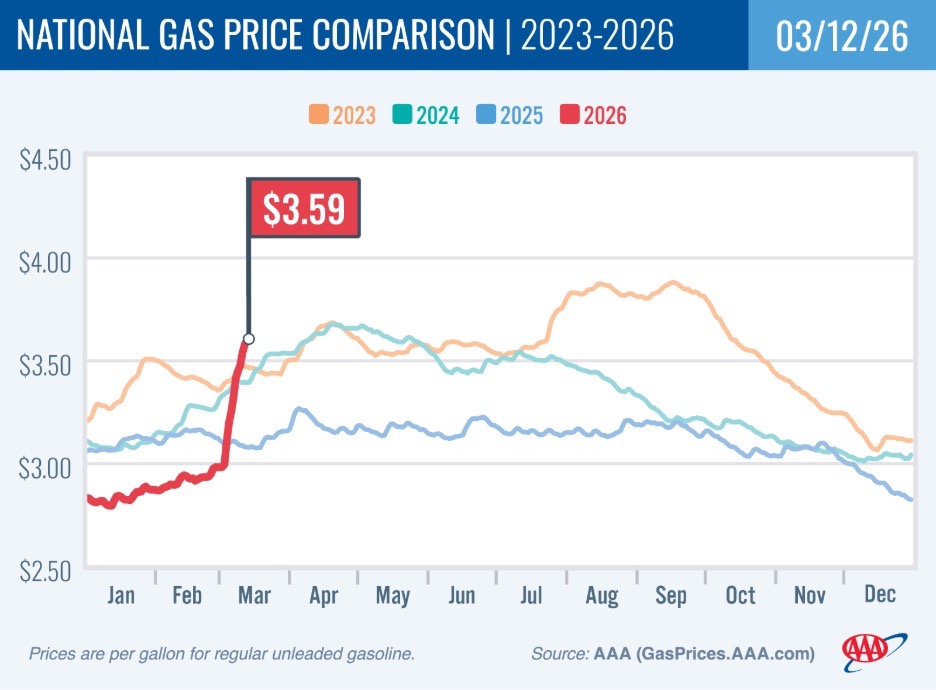
The country is at War with Iran in order to pursue unclear objectives. When this ends and where it’s all going is anyone’s guess, but what’s clear is that there’s at least going to be a temporary increase in gasoline prices. As you can see in the graph above from AAA, this is the time of year when gas prices usually go up, though not at this extreme rate.
It does feel like it would be a great time to have a lot of electric cars, right? Or at least more hybrids. The problem for automakers is, historically, a prolonged period of gas swings usually mean that people stop buying cars altogether.
In six past instances of oil crises, auto sales dropped by more than 10% of average sales. Three of those times, they plunged by 40% or more of average sales, according to Anderson Economic Group.
The group notes that it is impossible to predict what might ultimately happen as a result of the war in Iran, but past episodes that involved wars and oil embargoes had significant effects on U.S. auto sales.
“History shows that Americans cut back sharply on buying cars when wars, invasions, and oil embargoes occur,” Patrick Anderson, CEO of Anderson Economic Group, said in a statement. “While we don’t know how long this war will last or what the effects will be, at least six times since the 1970s, an event such as this has caused a sharp drop in auto sales.”
People now have the option to buy a car that’s way more efficient, which wasn’t necessarily true in the past. Maybe that’ll help.
What I’m Listening To While Writing TMD
If there’s an album that feels more like the pre-GFC malaise of the late 2000s than The Postal Service’s “Give Up” I don’t know it. Please fish your iPod out of the basement and put on “The District Sleeps Alone Tonight.”
The Big Question
Are you taking a spring holiday? Are you driving? Are you starting to be impacted by fuel prices?
Top graphic image: Acura



Spring holiday! Hanging out in the garage finally putting the Subaru Brat back together. Mild weather, lots of music & beer! As far as gas prices, I still got the Geo Metro that’ll be seeing more road.
Finally, an electric car never would make sense for me. My employer should be using them though. Start & stop hundreds of times a day with only 10 miles driven. The ignition module constantly needs worked on. It would probably be more reliable to use an oversized golf cart.
Oil goes up and down. We are talking about 20% of the worlds oil supply effected in the current conflict. None of which is heading to the us. Other then maybe to set a benchmark on price. It’s just finance bros causing havoc. It’s down again so prices will come down again.
I drive my truck less and hybrids and bev more. But I was doing that before. It’s just really don’t want to see a $4+ diesel fill up if I don’t have to. I’m taking my hybrid on a trip. Where I’m going gas is cheaper the whole way and I probably will only use 2 tanks. At about $28 to $32 a tank so not bad at all. If I took a bev and fast charged would be at least double if not 4x the total cost.
The bev question is much deeper. It’s one of those cases of the people that shout the loudest that we have been dealing with for a long time. Tolerance for that might be at an all time low. People who 20 years ago were scared of hybrids are now pro hybrid. That probably means we are 10 to 15 years away from them considering bev. Or maybe their kids will go bev. Either way these things can’t be forced in the free world. Hybrids weren’t and still had negative reactions.
China is now at the bleeding edge of tech in just about everything. The Japanese were at least perceived as bleeding edge in a lot of things from the 80s to 2000ish. But the us still held the keys. The us still does but it seems less and less with China. They will take an idea even an old cast off idea and run with it. Bev is tech defined by tech laws and it just moved too fast for most people. The idea your car is obsolete in 5 years like your phone is just too much for most. But for people that want the newest thing all the time it’s a godsend. Offering a even small rex for alot of these bev even as an option might be enough to get support from a wider audience. China is showing us that now. They have the flash chargers and fast chargers and battery swaps. Low prices and still hybrid is coming back. Because they are cheaper for range and value. $8k to $12k for hybrid or phev vs $15k to $20k at a minimum for similar class of bev. The little $5k to $10k city car as bev still works.
Assuming an annual three-day family reunion counts as a spring holiday? Yes.
We’ll put about 800 miles, most of it will be from the ICE in my Volt. Obviously that’s not going to impact our plans, given that the car delivers low-mid 40s on the dino fuel so maybe another 15-20 bucks if gasoline stays a buck or so above “normal.”
Enjoying this post and comments thread and getting lots of take-aways, which is why I’m here.
I like to go to the bottom: RE the tragedy of the commons [economics]. if we (humans/the world) had accounting that included the costs (and benefits) of externalities, we would have a much better everything.
Ask “why” more than ten times in a row in any given analysis and the commons comes up, again, again and again.
Hi-rise urban: hell YES. Depends on where you are and what you’re doing.
Suburban cookie-cutter: hell YES. Depends on where you are and what you’re doing.
Rural: hell YES. Depends on where you are and what you’re doing.
What you drive: ditto.
I usually pull out the 50 MPG Harley or the 45MPG Yamaha in the summer, gas prices are pretty low concern for me. I don’t like the thought of living on top of most of you in a dense city, but I do understand living 15 minutes from your place of work if at all possible. Again I can even ride an E-Bike pretty simply if need be. My daughter rarely uses hers anymore.
Yes, I’d prefer space as well. But if I have to choose between living on 0.2 acres and spending another hour each way getting to work, I’m living on the 0.2 acres. Those two hours represent about 50% of the entire available free/family time on a weekday.
Funny you should mention, we’re aiming toward doing that later this year. Trick is deciding which cities to visit.
Agree about retching and heaving at the very thought of being stuck on a big cruise ship.
The only cruise I’ve done was a 3 day one in Vietnam on a ship with about 50 – 60 cabins. That was the right size for me and it was great. (The rest of the 10 day trip wasn’t so great and we got COVID in 2019 as a bonus)
Taking the White Whale down to Sebring for the 74th 12-hour race next weekend, a roughly 3,000 mile round trip, and heading out tomorrow morning. I’m guessing I’ll have to spend an extra $100 to $200, but it’s still going to be plenty cheaper than three plane tickets and a rental car during spring break. Won’t have to deal with whatever’s going on with the TSA either.
I was really tempted by a Bolt Premier I saw for sale locally yesterday with low miles for $15K as I’m going to eventually want something to replace my 2012 Volt once its traction battery finally dies, but I still want to finish paying off my home equity loan before pulling the trigger on another vehicle. Granted, if gas is creeping toward $6/gallon by the time we’re back I may see if it’s still available. $0.125/Kwh is sounding nice for a commuting cost these days.
I also went ahead and purchased the plane tickets for my family’s trip to the 24 hour of Le Mans in June. We still hadn’t decided what else we’re doing besides the race, but something tells me airfare to France isn’t going to get any cheaper from this point forward.
If you look at Norway, the only large country that sells almost entirely electric vehicles, even as of the end of 2024, 68% of the cars on the road were gas-powered. The next closes country is Iceland, at 18%, and then Denmark at 17%.
Huh?
I am assuming it is Iceland at 88% and Denmark at 87%? Or that 32% were EV in Norway? That was my guess.
It a very messed up way of saying norway is still at 32% bev. Iceland is at 18% and Denmark is 17%.
Yeah, this was not clear. I am making assumptions because I’m still not sure. But I think that the 68% of cars on the road being gas for Norway translates to 32% being electric (of some variety or another) as a starting point. You have to make that leap because it’s not clear.
Then, the next closest in electrified is Iceland at 18% (again, not stated here so not sure) and in third electrified is Denmark with 17%.
Matt gives a lot of detail and generally breaks down the numbers for us really well. So I have to give a pass but this one had me re-reading several times over to make sense of it.
Today almost every new vehicle sold in Norway is electric. However, 68% of the total number of cars registered in Norway are still gas. This make complete sense as it takes decades to turn over and replace the entire fleet*.
(The USA replaces about 5% of our cars per year.)
Citation needed. AFAIK, EV sales and market share monotonically increased until last year when a concerted effort was made to stop that.
And why do you suppose that is? Could it be that the government pushed automakers to build them via increasing fuel economy regulations, and eventually even the most Luddite members of society realized that hybrids are good, actually? It certainly didn’t happen by accident.
Look, I’m a fan of hybrids, and I agree that hybrids were a better thing to push (and still might be), but I’m also pissed about the gutting of the EV industry because I think it’s also a good thing that we should still be working toward. And now just as charging infrastructure is getting to a place where road tripping an EV might just be viable for most people (due in large part to the massive investment in infra from the IRA), some of the biggest a-holes in the world have screwed it all up.
Strawman argument. Literally no one outside of Elon Musk thought that was going to happen.
Anyone who actually owns or operates a truck has been screaming for a PHEV at least as long as Rivian and the Lightning have existed.
Likely because gas price stability and economic stability tend to go hand-in-hand. When people are uncomfortable about their economic future, they push off large purchases like, say, the second most expensive item they’ll buy in their lives.
None of this is surprising, except, apparently, to the people at the top making decisions that affect hundreds of millions of people.
It’s not that it’s surprising to the decision makers.
It’s because they just flat out don’t care about the masses.
“Let them eat cake!”
Possibly, but the fact that he’s panic-releasing over 40% of the strategic oil reserve (which was already running at only 59% of capacity in the first place) in response to this makes me genuinely question whether he understood the implications of starting a war in the Middle East.
“Why not both?”
I mean not seeing the forest through the trees is pretty much on point for him and the rest of the unqualified appointees, isn’t it?
Hey, Luddites were the original labor organizers.
I bought a Volt in 2013 and commuted, plugging in every night. I saved about $250 a month in gas. Meanwhile, California got rid of solar power incentives and rubber stamped utility rate rises that whittled away the cost advantages. The rates will go up in the future as the utilities bury lines and replace aging infrastructure in response to recent fires and subsequent lawsuits. It should have been done incrementally but quarterly reports are the major cause of deferred maintenance.
Did I think that solar power was such an obvious solution that forward thinking California would jump on it? Yes, I did. Was I wrong? Yes, I was.
I live in a moderately walkable suburb, if you can walk.
As you age your perception of your environment shifts. “How high is that curb? How close is the door? Is the sidewalk even?” Solutions become hurdles. Wider sidewalks? Watch out for the jogger pushing the three seat baby carriage. Designated bike lanes? Just another obstacle, designed for 10 mph peddlers and now used by electric bikes going 25.
Adding density would increase the challenges. And more people would be parked on the street, limiting access. And everybody gets older if they are lucky.
One of the largest polluters in Southern California is cargo ships, burning the cheapest, nastiest diesel in their generators while they wait to unload. The goods that they carry make our modern lives possible but it comes at a price that is not paid by everyone. You can get almost everything delivered but it still comes from somewhere. The Inland Empire is full of giant distribution hubs and the trucks roll day and night, while the local government tries to add the infrastructure after the fact.
There are no easy solutions. You can only make the best decisions for yourself with what you know now and what you can guess about tomorrow.
93 octane is expensive no matter what, so whatever happens to gas prices, I’m just getting what I signed up for. I never bet on gas prices staying low, because they never do, and I tend to buy somewhat fuel-efficient vehicles as a side effect of buying small, nimble cars.
If I bought some big-engined GT car, gas prices wouldn’t get me to sell it, I’d just drive it less often, but I would never own a boring vehicle that delivers poor fuel efficiency. Any gas I burn has to either be necessary or exciting, I’m not about to waste fuel dragging around some insipid 2-ton carcass on my way to the office with a laptop bag and a lunchbox.
I heard Subaru was considering changing the Forester name to Insipid 2-Ton Carcass.
Funny enough I saw a few people in a parking lot last night looking at the new Forester parked next to a newer Ford edge. The basis was they couldn’t believe they aren’t the same car and they look the same. I asked if they were Subaru people they said they had Outbacks and currently Crosstrek were thinking about a Forester hybrid but didn’t understand why they did what they did to it.
I truly miss the days when it was common that the gas prices jumped 10¢ for each grade up the scale.
I get slightly tumescent when I see 4.099 on the readout at this point
I was planning to do a road trip from Florida to Maine to visit 7 of the 9 states I have never been to. I am rethinking that, but not because of fuel prices (mostly because I’m lazy – I still want to go but I might fly instead).
Realistically, the difference in fuel cost isn’t enormous. Assuming diesel is $6/gallon (which is probably higher than it will be on average), fuel for the trip will cost ~$400 more than it would have a few weeks ago. That isn’t trivial, but considering how much hotels, food, and other expenses cost for a 10 day road trip, it adds maybe 20% to the total cost.
This is a good example of why a quick transition to EVs was never realistic. It is still relatively cheap for me to drive my unnecessarily large diesel pickup an unnecessarily long distance, even with increased fuel prices. I could painlessly switch to a hybrid, but there aren’t any hybrids I like and the cost savings aren’t enough to give me motivation to drive a vehicle I find less interesting. For drivers of smaller vehicles or those who aren’t interested in transcontinental road trips, the incentive to change is even less.
I still think EVs have enough benefits (lower fuel costs, lower maintenance, etc.) that they will supplant most ICE vehicles as technology and infrastructure improves, but it will take time. I’m not sure why anyone expected this to be quick.
For better or worse, most people respond irrationally to gas prices, I think because it’s one of only commodities whose price (visibly) fluctuates from day-to-day. Every driver can tell when gas is up $0.20 vs last week, but few do the math. For example, $.20 increase over last year in a 30mpg car driven 12,000 miles = $80 annual increase. $1.00 per gallon increase = $400 a year more. Certainly not nothing, but utterly, completely, indefensibly bonkers for anyone to think “with these prices it’s time to get an EV.” $400 is maybe gonna cover your doc fee at the dealership. I don’t feel like doing adding it up but I think you’d probably need to get to $10/gallon+ for the math to math for most people.
The other irony is they will pay more to road trip the bev. DC fast charging is not cheap. Bev only makes sense if the majority of the time it’s on cheap level 2 charging now. I’m in the same boat with a diesel truck but taking a old hybrid because I can and it’s still the cheapest.
I was out in Colorado a few weeks ago to go skiing, and going to Ireland in early May for a vacation, also hopefully driving up to the the North Shore of Lake Superior for a cabin weekend with some friends soon. I don’t usually let fuel prices dictate my behaviour although yesterday I saw fuel for about $0.50 less than most gas stations so I bought 17 gallons, when I normally won’t stop until I need 20 (ie. Range = 0).
Here’s some extreme historical revisionism and ideological twisting in this article.
The world is so crazy, I don’t even know which way you are leaning with this comment.
Can you be more specific so we can understand the point you’re trying to make? I genuinely want to understand your perspective.
Nothing is revealed.
Question of the Day:
No, gas prices aren’t impacting me. More than 20 years ago we chose to purchase fuel efficient vehicles and since then have always had at least one vehicle that gets at least 45 mpg. Right now we have a Bolt (3.8 miles / kWh) paired with an Acura wagon (27.8 mpg). If gas prices got really high I could have my wife drive the Bolt and commute on my MP3 scooter.
Last year we spend a total of $2,283 to drive 22,702 miles.
It’s worth pointing out that , globally, the total transportation sector accounted for only about 15-20% of global greenhouse emissions (data varies depending on the source) -. Personal vehicles are only a subset of that (maritime diesel is f&#Iing horrible!)
I’m 100% for cleaner and more-efficient vehicles, and think we can all do our part, but over-all the problem goes way beyond our driveways.
Here’s some quick pie chart links I googled since I can’t embedded images…
https://www.google.com/imgres?q=pie%20chart%20global%20greenhouse%20gasses%20by%20sector%202024&imgurl=https%3A%2F%2Fimages.ctfassets.net%2Fcxgxgstp8r5d%2Fcm-892-graphic-global-emissions-by-sector-2019%2F14dd023034984794c951d04cbdac1d64%2F2022GHG_GlobalSources_en_title_lg.jpg%3Fw%3D3840%26q%3D85%26fm%3Dwebp&imgrefurl=https%3A%2F%2Fwww.climatecentral.org%2Fclimate-matters%2Fpeak-co2-heat-trapping-emissions&docid=sA9kplkTd6T7HM&tbnid=aDB8SjotJqgJ_M&vet=12ahUKEwjSgJPup52TAxUpmWoFHaNhBxAQnPAOegQIJxAB..i&w=1920&h=1080&hcb=2&ved=2ahUKEwjSgJPup52TAxUpmWoFHaNhBxAQnPAOegQIJxAB
https://www.google.com/imgres?q=pie%20chart%20global%20greenhouse%20gasses%20by%20sector%202024&imgurl=https%3A%2F%2Fwww.epa.gov%2Fsystem%2Ffiles%2Fstyles%2Fsmall%2Fprivate%2Fimages%2F2024-04%2Ftotal-ghg-2024.png%3Fitok%3D8vVAAFIR&imgrefurl=https%3A%2F%2Fwww.epa.gov%2Fghgemissions%2Fsources-greenhouse-gas-emissions&docid=JHoFmJ4hHOqiKM&tbnid=1RsOHMT4dFRqqM&vet=12ahUKEwjSgJPup52TAxUpmWoFHaNhBxAQnPAOegQIGhAB..i&w=320&h=284&hcb=2&itg=1&ved=2ahUKEwjSgJPup52TAxUpmWoFHaNhBxAQnPAOegQIGhAB
https://www.google.com/search?sca_esv=d087776caa853f74&rlz=1C1ONGR_enUS1166US1166&sxsrf=ANbL-n6e1ryyomQ0jNPBPp6MPZ1iMpfFgA:1773419873166&udm=2&fbs=ADc_l-aN0CWEZBOHjofHoaMMDiKpaEWjvZ2Py1XXV8d8KvlI3jljrY5CkLlk8Dq3IvwBz-R5R-93bnJN-gfJetFY0A5MQaA9mhTzYrXdh-kf2CQirmjoWZGMYa7yCnkJVasc4rk5gdJp9fYRWUISM6o39hx3aoSToYvSDM72k3WKkDDljFS9ZkrVrBjDyM-UtxSYMe-agzaPhrXnoRN4-owfKUG5En7N6A&q=pie+chart+global+greenhouse+gasses+by+sector+2024&sa=X&ved=2ahUKEwjbls_sp52TAxVPkGoFHbVAMbwQtKgLegQICxAB&biw=1600&bih=731&dpr=1#sv=CAMSVhoyKhBlLXZvTkYxQ0tTYVN1eDdNMg52b05GMUNLU2FTdXg3TToOaF9EcjJMeDlRYWVROE0gBCocCgZtb3NhaWMSEGUtdm9ORjFDS1NhU3V4N00YADABGAcg59e02QwwAkoIEAIYAiACKAI
I have a similar peeve around emissions related to agriculture. People assume that transportation is why food has such a large carbon footprint, but it’s actually the smallest part. The greenhouse gases from a steak aren’t due to transporting it, they’re from making ammonia to fertilize corn to get digested into methane that cows fart out.
Of course, transportation is more apparent to most people than the above process.
The amount of resources needed to “make” a pound of beef is insane. It’s not just the soy and corn but also the water. And, if I remember correctly, it’s something like 90% of what you feed the cow gets turned into methane farts and poop.
Even just the feed is crazy. Beef is 25:1 calories of feed for a calorie of meat. Pork is 15:1 and Chicken 9:1
Beef is tasty but the logical way to do it is to graze them on marginal land that can’t grow crops for humans.
The main benefit of EVs for me is the local air quality, not overall emissions. They may not make a huge dent in overall transportation emissions, but they are proven to drastically clean local air, where people actually live.
Agreed! Great to have clean air, but as is often the case, it really all depends. I think in most places, the EV’s aren’t emission-free, they’re displaced emissions. If they get their juice off the power grid, and the power grid isn’t solar/wind/hydro/etc then something is polluting somewhere
Modern large grid gas power plants + EVs are still very much cleaner than typical direct vehicle exhaust spewing from a tailpipe btu-for-btu of energy, but if there’s some dirty coal smokers somewhere on the grid, you wouldn’t want to be down-wind of that power plant.
A good case for the carrot/stick approach to modernize our power grid not only for capacity, but for environmental reasons too.
Two years ago I preferred to have bought a Prius or Maverick Hybrid. Bought a base Impreza instead as both Toyota and Ford limited production to not meet demand, so dealers were gouging and good luck on the wait for base level. Actually I would have preferred either a new manual Focus or Fiesta, but those models were taken behind the shed and shot. I wonder if Ford wishes they had a small, efficient, affordable, enjoyable car to sell right now? How about the dealers? A hybrid Focus sized car would be sweet. Remember the C-Max? Oh, how they keep snatching defeat from the jaws of victory.
I daily drive a hybrid for my longish commute, so the 45-50mpg I usually get softens the fuel price increases better than the 9mpg my built TJ gets. Luckily, I worked from home when the Jeep was my “daily”, so the 9mpg wasn’t a big deal when I barely used a gallon of gas a week.
But I love my hybrid, and since I am rural I will likely consider only hybrids and EREVs for future vehicles.
The best hybrid is an EV with an ICE car as a secondary vehicle.
Personally I prefer EV + and ICE hybrid.
We roll an EV and a PHEV and it’s been working out pretty slick.
You are pointing your finger in the wrong direction when you talk about EVs and EPA. EPA did not have an EV mandate. The CAFE numbers set by the Biden administration could be met with hybrids. Even if companies chose not to meet CAFE that was fine – the fines where small. The federal government was big on carrots (Inflation Reduction Act) and very light on the stick.
It was CARB that actually had a mandate for an increasing number of EVs and PHEVs. They minimal carrots but a very big stick ($20,000 a vehicle fine for missing the target percentage)
It is ironic that it is CARB’s flawed approach that is likely to actually continue as they have a strong case that their waiver was removed illegally.
I have 6 trips and about 30 days of camping planned for this year, and a lot of towing miles (probably close to 4,000 this year). That’s going to hurt at 11-12 mpg, but at least the RV is paid for so the vacation overall is still cheap. Campground rentals, making your own meals, and drinking by the fire can be done easily for under $100 a day.
On the EV thing. EV trucks were the wrong approach. E-REV truck will be great. EV’s are great as a commuter car, but there are very few that are marketed that way. Our Bolt is an excellent commuter car, and more than offsets all the gas that I use in the truck for our towing.
“Electric Cars Were Never Going To Save Us”
Electric Cars ARE saving us… saving us from Peak Oil (as it was described in the mid-2000s… peak production not keeping up with demand). Electric cars are also in the process of saving us from bad air quality. And electric cars save us from being as dependent on oil and oil related products. And electric cars shield us from being as greatly affected by swings in oil/fuel costs.
What electric cars DON’T save us from is:
-Traffic congestion/miles driven – Need better public transit, more accommodation for bicycles and walking and better urban planning to put a dent in that.
-Collisions
-high insurance rates
-Bad drivers
-Bad politicians/bad politics/MAGA
-Involuntary Celibacy
“EV Registrations Fall In The US As Hybrids Rise”
One effect electric vehicles have had is it has enabled battery and other related EV tech to get better and cheaper.
That has also benefited hybrids… especially plug-in hybrids.
Personally I think automakers should ditch all the CVT and 6+ speed transmissions (except for heavy duty applications) and just replace them ‘eCVT’ hybrids as the default automatic transmission.
And have plug-in capability with a bigger hybrid battery as an option.
But BEVs are still the future in the long term.
Oh and for hydrogen vehicles… ship them to Ukraine so they can use the hydrogen tanks as bombs against the Russians.
“The Honda Prologue Is Probably Dead, Too”
I’m guessing the management at Honda is pissed at the management at GM for NOT living up to their claims of providing a quality product.
In terms of reliability, GM’s Ultium-based vehicles have had a rough start according to Consumer Reports.
“Is This All Very Shortsighted?”
Yes.
“Are you taking a spring holiday?”
Nah… gonna take a summer holiday.
“Are you driving?”
It’s gonna be a camping trip, so most definitely
“Are you starting to be impacted by fuel prices?”
I drive a C-Max plug-in hybrid… so I’m not greatly impacted by fuel prices.
Before the price spike, I was averaging CAD$93/month. Even if fuel prices double, that’s still only CAD$186/month.. which I can easily afford.
When buying cars, I’ve always gone with the most (or nearly the most) fuel efficient option that met my needs and budget.
In the past, that meant getting small manual cars like the Honda Fit, Ford Focus, Civic, Escort and Festiva.
But used hybrids like the C-Max have gotten to be quite cheap. So in 2024, I got a great deal on a loaded low mileage 2017 Ford C-Max Energi Titanium.
And after owning it for 1.5 years, I’m glad I have the ‘Energi’ version. It’s the most fuel efficient vehicle I’ve ever owned. I’m averaging 3.41L/100km… or 69mpg (US gallons)
The problem with hybrids is that that do absolutely nothing to address the problem of our automotive obsessed culture – urban air pollution. A Civic Hybrid and 7.3L F-250 have to meet the same emission regulations. Local air pollution has nothing to do with fuel economy.
I honestly don’t care much at all about CO2 numbers. I care about the fact that on many days I can see the air. What I care most directly about is that there are days my wife can’t go outside because she can’t breath.
Are you for real? I’d move because I love my Wife and I want her to live as long as possible. Not sure what your plans are, but hopefully you are pro-active instead of waiting for people to stop driving trucks in America.
Yes, I’m for real. The USA should really improve our air quality.
We have moved 5 times. Air quality is bad in any large city – which is also where jobs tend to be located. My wife’s job it what took us to our current home with is outside of Portland, OR. She turned down a really nice job in Salt Lake because the air quality there is atrocious.
Personally we will be retiring this summer and moving. Good for us but does nothing for the hundred million or so people living in US cities that don’t meet minimum air quality standards.
Agreed.
I live in New England and for 40+ years the only time my airs been anything but “green” on the map is when Canada is on fire during the summer for a few weeks. I spent two weeks in Salt Lake City and didn’t notice any air issues, but I’m not that sensitive to it either, so that could be a big difference.
It sounds like you’ve tried to balance health and income and its been a struggle. Hopefully you guys can find peace in retirement. And I guess hopefully they start doing something out West about their air.
Poor air quality isn’t just a west coast problem. Look at a national air quality map in the summer and you will see cities all across the USA that don’t meet air quality standards. Mostly for ozone.
Today east of the Mississippi: St. Louis, Nashville, Cincinnati, Columbus, Cleveland, Toledo and Gainesville are failing for Ozone.
Salt Lake City, like many cities, depends on the weather. When there is an inversion the air gets really bad. They average 25 days a year for Ozone and 18 for PM 2.5.
No, they don’t. And that’s a large part of the problem.
Every vehicle under 14,000 GVWR has the same emission standard. That changed with EPA Tier 3. (Passed in 2014 and phased in from 2017 to 2025)
If you are interested in the history:
Tier3 limits still permit “trucks” to emit more emissions than cars.
The F250 in your example does not have the same limits as the Civic.
Maybe you are thinking about fuel economy standards but for local emission standards (CO, NOX, NMOG, PM, HC) everything under 14,000 lbs is averaged together.
We are in the final year of Tier 3 and All classes of vehicles are the same. When Tier 4 starts in 2027 MDV (both trucks and passenger cars) will have a slower phase in of the new requirements.
From Diesel Net which has a great summary of global emission standards:
F250, at it’s lightest with the 7.3L gasser, is 10k lb GVWR; as far as I can tell on 40CFR86 (and summary docs from congress.gov outlining the justifications for the future changes), at 10k GWVR, it actually falls in as a MDV (heavu duty vehicle), and despite being permitted to average the standards for fleet as rightly noted – but at that weight, it’s amongst other HDV vehiclles, it’s PM standards are separate and slightly higher. But maybe you can find a different loophope here than I did looking into testing limits.
Even if it fell under as a LDT2 (3750-6000lb), it appears to be averaged withing a different band.
However, regardless of its weight, as a truck (and even though it already has a higher threshhold for PM standards), I think it’s really interesting that all deductions for ‘technologies’ (such as, famously, stop-start, but also aero credits and alternate fuels) are increased as compared against a typical passenger car – so is permitted to emit more.
So, as far as I can tell, an F250 7.3 will be permitted to emit more emissions than a Honda Civic hybrid under the rules.
Separately, however, whether the Civic or F250 are anywhere near the limits of the rules: I can find no such records.
Again, Diesel Net is a great source: https://dieselnet.com/standards/
EPA Tier 3 Light Duty On-Highway standards have the same requirements for everything in Model Year 2025
As to actual certifications – I’ve found EPA ones online in the past but they seem to be gone now. CARB’s are still up. The are a bit different than EPA but you can do an apples to apples. CARB calls their certifications Executive Orders
(These are from 2025 because CARB changed the form in 2026 at it appears to only show the fleet average for each vehicle not the individual results)
F-250 w/ 7.3
0.070 g/mi NMOG + NOx
0.001 g/mi PM
F-150 Hybrid
0.029 g/mi NMOG + NOX
0.000 g/mi PM
Civic Hybrid
0.022 g/mi NMOG + NOx
0.000 g/mi PM
Pilot
0.014 g/mi NMOG + NOx
0.000 g/mi PM
0.300 g/mi CO
Honda XR150L (Just for fun)
0.640 g/mi HC
8.000 g/mi CO
So the Civic Hybrid is in fact cleaner than the F-250 even though they are held to the same standard. It just squeaks by a F-150 Hybrid. However, the Pilot is the cleanest of them all even though the Civic gets 49 mpg and the Pilot only 21 mpg.
Executive Orders are here:
https://ww2.arb.ca.gov/applications/new-vehicle-and-engine-certification-executive-orders-light-duty-vehicles
“Every vehicle under 14,000 GVWR has the same emission standard.”
Problem is, every vehicle OVER 14,000lbs GVWR doesn’t. And those vehicles are typically commercial diesels which are absolutely awful for air quality.
It’s for that reason I personally am excited about the Toronto Transit Commission buying more and more electric buses.
By the end of next year, 500-600 buses (out of a fleet of 2500-2600 buses) at the TTC will be BEVs.
And those buses will mostly be replacing the oldest conventional diesel buses.
Vehicle over 14,000 lbs GVWR do have different regulations. They also are certified as engines not as full vehicles.
There there have been massive reductions in emissions from HD vehicles – 98% over the last 40 years.
There is another big change happening for EPA 2027. Allowed NOx drops from 0.20 to 0.02 (90%) and PM from 0.01 to .005 (50%)
They perfected electric buses last century.
Ran them on the grid power.
“The problem with hybrids is that that do absolutely nothing to address the problem of our automotive obsessed culture – urban air pollution.”
I wouldn’t say hybrids do nothing. Hybrids at the very least eliminate a lot of unnecessary engine idling.
And when it comes to bad air quality, diesels, old cars and ICE motorcycles are the worst culprits.. with diesels being the worst of the worst due to particulate emissions… which is the worst for asthma sufferers. I know, I have asthma too.
If all the diesels were replaced with gasoline hybrids, that alone would result in a big improvement in air quality in cities.
Old vehicles are one thing – new ones are another.
For new light duty vehicles gasoline and diesel vehicles have the same requirements. (Which is a change from Tier 3 which is why gasoline DI turbo engines are starting to get particulate filters)
Are you actually being serious here?
Sorry for your wife though.
TBQ – we’re heading to CO next week for my nephew’s first birthday. We’ll be taking a plane because 14 hours in a car with a 4 and 2 year old doesn’t interest me. Maybe when they’re a bit older we’ll choose to drive instead of fly to save money but (in the spirit of this article) I’ve never included the environmental impact of the method of travel in my decision making for these types of trips.
My ‘daily’ (I WFH and don’t drive every day) is a diesel pickup but I haven’t had to fill up since this misguided middle eastern war started. I only put on about 10k miles a year, most of that during the summer when we’re going camping and such. Will I notice when it cost $200 to fill up my truck? Absolutely! Will it influence whether we go on a camping trip or not? Probably not. Will it make me consider getting a different, more fuel efficient vehicle? Absolutely not.
You might find your airport wait times longer than that car ride. Should keep an open mind heading into the week!
I’m off in a few weeks and was considering taking a day trip to finally run Tail of the Dragon. That’s not happening if gas prices continue to rise.
And I am trying to sell my old truck that gets 12-14mpg. I have no doubt gas prices rising is going to impact my ability to sell it.
That’s an interesting take I had not considered: while it doesn’t make much (economic) sense for someone to sell their car/truck based on gas being $1 more per gallon, if you’re in the market for a car, yeah all else being equal, you’re going to prefer something that costs less to fill up. And, inevitably, the demand and value of guzzlers will decrease.
I’m on the E-REV bandwagon, though unfortunately there’s not really any to choose from right now. The SCOUT looks interesting but only for those who (think) they need an off-road 4 wheel drive beast.
What I want, what I really, really want is
something likethe Mazda Vision coupe, especially the 4-door ‘coupe’ variant with all electric dive, a smallish-battery, plug in at home (120v is fine), and a spinning Dorito range extender/generator.Actually any small-ish E-REV like a maverick, CX-50, Rav-4. But a real e-rev, not a PHEV. Something that has 100% of the power all the time, regardless of battery or ICE power engaged. Give it 80+ miles all battery range and something near 4 miles/kWh and you’re golden. No range anxiety, no charger issues (simple 120v level-1 should get you 80 miles of charger overnight), no change in habits, and all that glorious instant torque! Most trips would be fully EV so you get the environmental impact of EV travel most of the time.
The problem with E-REVs is that there’s just nothing available in the US right now, but if Mazda did the Vision (or RX Vision, or Iconic) I’d be first in line with my checkbook yelling “shut up and take my money!”
Drool…
https://www.cnet.com/a/img/resize/656f19de4ce79cc192f331a133684af9aea527db/hub/2017/10/24/f50c67f3-e5fc-4291-8e49-0c6e9bd7e77d/mazda-vision-coupe-promo.jpg?auto=webp&width=1920
We -might- drive down to the beach this spring for a few days in May. 1200 miles round trip. We’ll be taking the Hybrid Maverick since taking the EV mostly sucks for road trips.