


IIf you’re an environmentalist, the cancellation of all of its electric cars probably feels like a betrayal by Honda. It’s the “Earth Dreams” company. Honda was supposed to be the chosen one. I understand that feeling. You’re wrong, but I understand it.
I spent most of yesterday in a room with fellow journalists and auto industry analysts listening to an electric car company, Lucid, talk about its potential future. This was a company that’s gotten billions of dollars in investment, mostly from Saudi Arabia, and its hope was that it would be cash flow positive by the end of the decade. Lucid is, from a vehicle engineering standpoint, the most advanced electric carmaker in the world, and it’s going to need years to just start seeing a return on that investment.


What journalists were saying in the room, and online, was that what happened at Honda was terrible. An awful decision. Also, pretty much everyone agreed, the right decision. Honda wasn’t going to make any money on those cars, and so its $15 billion got added to the other write-downs, which now reaches above $70 billion in EV-related losses.
The Morning Dump today is going to focus on hybrids, EVs, and maybe where this is all going.
EV Registrations Fall In The US As Hybrids Rise
One way to make people healthier, from a diet perspective, would be to get rid of all the Burger Kings and replace them with Erewhons–the fancy and expensive organic grocery stores. That probably won’t work for most people. It doesn’t mean you get rid of organic grocery stores or stop building more, but perhaps there’s something to be gained by just making Burger King a little bit healthier.
This is how I feel about hybrids.
When I say that the 2020s are the “Decade of the Hybrid” I think there’s a tendency by irregular readers to assume I’m anti-EV and I have to first explain that I’m not. I think most people would find an electric vehicle a better commuter option than their current gas or even hybrid car, assuming they have access to home-charging. I also understand that the net-positive impact of more EVs far outweighs any environmental cost of their production over the lifespan of the vehicle.
My most controversial take is that the push for more electric cars is, itself, a kind of giving up on the real answer: higher density development. Simply replacing gas-powered cars with electric ones doesn’t do anything to reduce the number of miles driven. I always come back to this, but Los Angeles is basically twice as dense, population-wise, as Houston. This means that, in Houston, it takes twice as much energy to pick up the trash or deliver pizzas. Replacing pizza delivery vehicles and garbage trucks with EV equivalents is good, but in some ways it’s a half-measure. If we really cared about changing the environment, we as a society would put a lot more effort into fixing density and improving public transportation.
There’s a joke that people from the suburbs love cruises so much because it gives them a taste of what it’s like to live in a walkable city that doesn’t require cars, and that’s basically true. It’s nice! Dense places can be efficient, can promote community, and cities not oriented around cars are places with fewer car-related deaths.
It doesn’t mean that switching cars to electricity is bad. If you look at Europe, a fairly dense place already, as of 2019 about 25% of the continent’s total CO2 emission came from road transportation, and road cars made up 60.6% of emissions of that number. If you look at Norway, the only large country that sells almost entirely electric vehicles, even as of the end of 2024, 68% of the cars on the road were gas-powered. The next closes country is Iceland, at 18%, and then Denmark at 17%. Even in the most pro-EV countries, the transition is painfully slow.
The shortcoming of the pro-EV argument is that it assumes society isn’t going to be motivated enough to change the way it lives slowly and carefully over time, but will just be motivated enough to change its cars immediately.
What the Inflation Reduction Act and the Biden Administration proposed was basically a moon shot. A pull-out-the-stops attempt to get industry to switch to electrification. It didn’t work. Even before the new White House and US Congress killed the plan, it was falling apart because the demand wasn’t there.
If the assumption is that people won’t change their habits, then the better option is: Electric cars for some, hybrids for almost everyone else. The math gets complicated, so I’ll approach it from an extreme example. The Ford F-Series, broadly construed, is the most popular vehicle in America and Ford sold more than 800,000 of those last year. These are vehicles that presumably get driven a lot, as many of them are work trucks. The impact of improving the fuel economy average of an F-Series by 1 MPG is going to be way greater than, say, 15,000 Escape Hybrid buyers being pushed into Mach-Es.
Toyota has this ratio its engineers developed, which is that the raw battery material needed to make a single electric car is the equivalent of making six plug-in hybrids or 90 regular hybrids. That’s basically what Honda is doing.
Imagine if at least some of the $70 billion that is being written off to develop EVs had gone to more hybrid development. Would the net environmental impact have been faster and outpaced switching a small percentage of buyers to EVs? The problem with the switch to electric cars is that it requires all of society to move as one, in the same direction, for a long period of time. This is enormously expensive, and the politics of it aren’t great. [Ed Note: Two years ago I Wrote “America Focusing On Electric Cars And Not Plug-In Hybrids Was A Huge Mistake.” I stand by that. -DT]
Hybrids no longer seem to carry that same political charge. They require no change in behavior. They’re not that much more expensive and, in an environment where gas prices might rise a lot, the economics start to make a lot of sense.
That’s where most drivers seem to be. In the absence of tax credits, EV sales dropped off in the United States to just 5.1% share of the light vehicle market according to S&P Global Mobility, via Automotive News, down from 8.3% of the market last January.
Sales are now mostly Tesla Model Ys and everyone else, with Cadillac as the #2 brand:
Cadillac, at No. 2 among EV makers, grew its registrations by 8.1 percent in January to 3,189 with its expanded portfolio. The Vistiq three-row crossover had 737 registrations versus none a year earlier. The Lyriq midsize crossover fell 47 percent to 1,040 registrations.
Cadillac’s EV share rose 2.4 percentage points in January from a year earlier, to 5.3 percent, the data showed.
Remember when everyone was going to swap F-150s for Cybertrucks? The Tesla truck only managed to sell 1,458 units, compared to 47,981 F-Series trucks.
Ok, so that’s the United States. What about China, a place where the government has more ability to push the population in a single direction.
Even Chinese Consumers Are Embracing Hybrids

Would you believe that Volkswagen and Toyota, via joint ventures, were the two biggest automakers in China in February? That’s what happened, with Geely coming in third and BYD falling to fourth place.
What’s going on here? I’ll let Reuters explain:
The legacy automakers’ comeback in the market where they have been struggling to catch up with local rivals in EVs comes as purchase tax exemptions on electric cars expire and Beijing scales back subsidies for trading in EVs.
As subsidies fade, hybrid EVs that Toyota specialises in were shown to have steered some consumers away from PHEVs, said Cui Dongshu, secretary-general at CPCA.
Local automakers betting on budget electric and plug-in hybrid vehicles take the biggest hits from the curtailed incentives.
BYD, which unseated VW as the biggest carmaker in China by sales in 2024 and held onto the crown last year, fell to fourth place with 7.1% market share in the January-February period when its overall sales posted the biggest drop since the pandemic.
As CNEVPost points out, retail sales of what China calls NEVs (electric vehicles + hybrids + fuel cell cars) dropped 32% year-over-year. In China, where infrastructure is better and EVs are cheaper, consumers still need support to buy cars.
The Honda Prologue Is Probably Dead, Too

Honda had already let slip, via financial reporting, that it was going to be cutting back on Honda Prologue production. It sort of made sense, given that GM was building the Prologue for the company and Honda had already decided to kill its Acura ZDX sibling.
Now Automotive News thinks the Prologue is just dead, dead:
Honda is expected to pull the plug on its sole electric vehicle in the U.S., the Prologue, after the current production run ends in December.
The automaker isn’t planning a second generation of the midsize crossover, which General Motors builds for Honda on a shared EV platform, according to industry forecaster AutoForecast Solutions.
A Honda spokesperson declined to comment on future product plans but said the Prologue remains in the lineup.
The Prologue will only remain in the lineup because they’re selling so slowly and, therefore, Honda has a bunch of them.
Is This All Very Shortsighted?
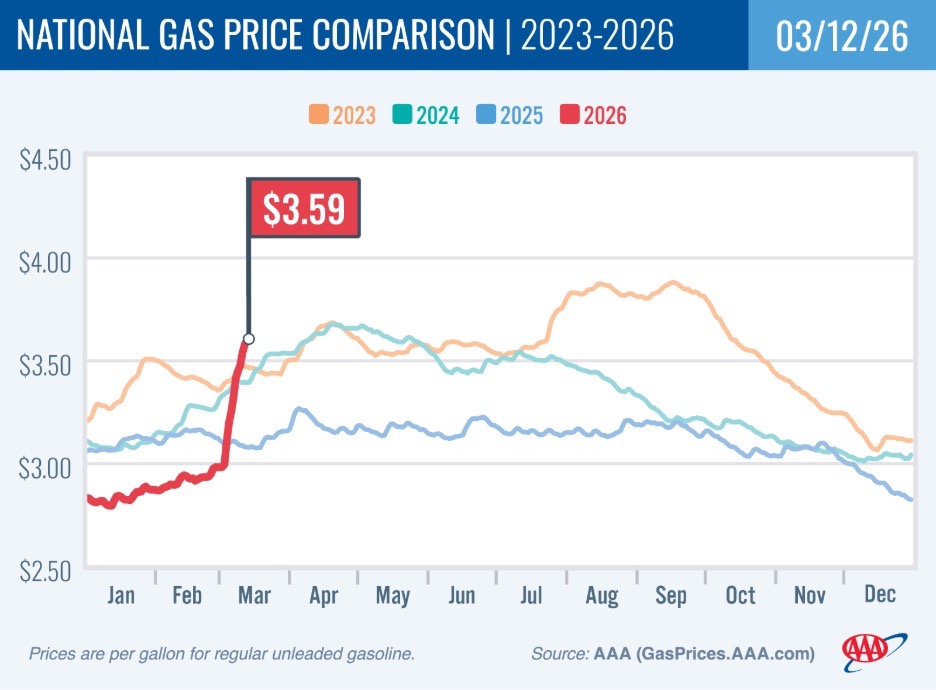
The country is at War with Iran in order to pursue unclear objectives. When this ends and where it’s all going is anyone’s guess, but what’s clear is that there’s at least going to be a temporary increase in gasoline prices. As you can see in the graph above from AAA, this is the time of year when gas prices usually go up, though not at this extreme rate.
It does feel like it would be a great time to have a lot of electric cars, right? Or at least more hybrids. The problem for automakers is, historically, a prolonged period of gas swings usually mean that people stop buying cars altogether.
In six past instances of oil crises, auto sales dropped by more than 10% of average sales. Three of those times, they plunged by 40% or more of average sales, according to Anderson Economic Group.
The group notes that it is impossible to predict what might ultimately happen as a result of the war in Iran, but past episodes that involved wars and oil embargoes had significant effects on U.S. auto sales.
“History shows that Americans cut back sharply on buying cars when wars, invasions, and oil embargoes occur,” Patrick Anderson, CEO of Anderson Economic Group, said in a statement. “While we don’t know how long this war will last or what the effects will be, at least six times since the 1970s, an event such as this has caused a sharp drop in auto sales.”
People now have the option to buy a car that’s way more efficient, which wasn’t necessarily true in the past. Maybe that’ll help.
What I’m Listening To While Writing TMD
If there’s an album that feels more like the pre-GFC malaise of the late 2000s than The Postal Service’s “Give Up” I don’t know it. Please fish your iPod out of the basement and put on “The District Sleeps Alone Tonight.”
The Big Question
Are you taking a spring holiday? Are you driving? Are you starting to be impacted by fuel prices?
Top graphic image: Acura



(Full disclosure I have 2 fulls EVs and 1 PHEV)
The government flubbed the EV push just like they did 30 years ago when CARB mandated EVs because GM was being innovative and actually built one that could get nearly 100 miles. This time around Tesla showed they could get over 200 miles and GM built the Volt so they did it again, settings mandates that by 2035 some states will ban gas cars, making it political. Just like hybrids 20 years ago when celebrities and the government were pushing them and getting ridiculed by South Park.
The sad thing is other incentives were working, emission credits(and Paypal/SpaceX money) basically built Tesla, high priced competitors to Tesla like Porsche/Jaguar/Rivian were coming along, but due to mandates and incentives everybody made crappy compliance EVs. The Nissan Leaf is a poster child for failing batteries, public garages actually posted signs saying you couldn’t park your Bolt EV there as they could catch fire, these did not help things.
Part of the issue, to the point about density, is America is constantly in a race with Europe of all places. The combined size of the European Union and UK, the Jones’s we keep trying to keep up with, is half the size of the US, with more people, so twice as dense, with much better public transit systems, and mandated charging infrastructure being built out, not just Tesla, they are so far ahead of us in charging. Germany alone has nearly 50,000 dc fast charging stations, all of the US only 65k, as of last year and 18k of those were added last year due to the IRA. Also Europe is at $8 a gallon gas prices. So for them, small commuter EVs as a last mile solution works so much better.
The politicians in the US go “oh, we should do that too!” But without adding any infrastructure, without a lot of mass transit, and where we do have mass transit there isn’t a lot of, if any, public or at home charging. Also electricity prices in places like California make EV charging rival gas prices, for the efficient ones at home! Never mind fast charging your F150 lightning, that will cost more than just filling up a regular F150!
So everybody stepping back in the US from EVs makes sense, the infrastructure is building out, and with individual incentives going away the truly good, profitable EVs should float to the top.
Although, the used market is gonna have a field day the next few years with the Prologues and 1st gen Solterras and ID.4s and what not, so that will probably open some people’s eyes as they get affordable and the less hardcore skeptics start considering them.
Also a note on the Iran conflict, with fracking/shale oil, once oil prices hit a certain point that becomes profitable and fires up, so that seems to cap the max we pay for gas, it may spike in the short term but don’t think we’ll see the $8 a gallon that Europe sees, and Europe will probably see a much bigger spike, increasing their EV adoption even more.
Honestly such a well written comment I hardly have words.
You brought in more context and answered more question than the article did and somehow did it in less words.
I never seem to hear anyone talk about just how fundamentally American the US approach to EVs has been. Like some kind of environmental absolution, through marketing, that allows us to make bigger, badger, faster, and crab-walkier machines than we really need and feel okay with it.
May I point out to all the people trying to say hey gas prices are going up to almost half to what they were under Biden but I don’t care I drive an EV, that electricity prices are going up quicker than gas prices?
Gas averaged $3.46 per gallon for the 4 years Biden was president. The absolute maximum was $5.11 after Russia invaded Ukraine.
My EV costs me 3 cents per mile to fuel.
My gas car costs me 15 cents per mile to fuel.
Needless to say we take the EV for most trips. Cheaper and a better driving experience.
I still haven’t understood why no car sites have recognized the fact that EVs aren’t any better for the environment than ICE, and depending on your electricity source worst. Just building them with the toxicity of metals etc destroying the environment more than driving one will cure. The end of life of an EV is only slightly better than the storing of spent nuclear fuel rods if that. Honda isn’t the only auto manufacturer moving away from EVs every car manufacturer is unless it’s production is only EVs. Remember building cars is hard.
The car sites haven’t recognized the “fact” because those aren’t facts. That’s all the same, tired Big Oil propaganda that have been disproven again and again. That doesn’t stop the president’s state-run media mouthpiece from echoing it ad nauseam, though.
The only problem with EV’s is also a big problem with all cars. They are so filled with tech junk that they have become less reliable. And all the sensors make a car more likely to be totaled in an small accident.
Oh my EV is saving me from having to directly worry about rising gas prices at the pump.
Short-sighted people everywhere.
Yes today’s gas prices are about 75 cents a gallon over last year and $1 less than two years ago.
Where do you live that electricity prices are not going up twice as fast?
I love The Postal Service. This is kinda weird, since I’m not a Death Cab For Cutie fan and I generally don’t enjoy electronic music. But there’s just something about the combination of those two elements that keeps me coming back. “This Place Is A Prison” is my favorite track.
Our only car at the moment is a Mach E, so we’re mostly insulated from all the shenanigans going on at the moment. However, my glasses aren’t rose-colored, and I just know this crap will trickle down to my charging expenses somehow. It’s the American Way.
Until it makes financial sense to make more or all EVs, it won’t happen. It’s not about what people want or think they want, but about what companies can do and want to make (profit margins and sales growth as the main focus). All the “muh gas” and “muh green” discussions are, in my opinion, irrelevant.
Never is a very long time. I guarantee that at some point in the future there will be no ICE vehicles. Don’t know if people will outlast them or not.
Anyway, the demand is there, but the supply wasn’t. People who are inclined to buy EVs aren’t looking for gigantic expensive vehicles. If Chinese EVs were on sale here they would sell like hotcakes, or at least like moo shu pancakes. The Fiat EV didn’t sell very well but neither did the gas Fiats.
I agree that a hybrid that has an EV only range of 60 or so miles would be the sweet spot. With $15 gas people would probably plug it in.
What I don’t understand is why EVs are so complicated and overloaded with features. The safety requirements are about the same as for ICE vehicles, but there is a huge swath of complexity that could just go away.
I realize that most of the unit cost of a lot of software features is close to zero, but the reliability and perceived cost of something you don’t actually want is high.
“What I don’t understand is why EVs are so complicated and overloaded with features. The safety requirements are about the same as for ICE vehicles, but there is a huge swath of complexity that could just go away.”
Tesla dood it.
Tesla cool. Everyone said so. Car press. Regular press. Govermint. Big stars. Little stars. Norway.
Tesla cool.
They make cool future kar with big screen, cool hide door handles like Star Trek shizzle and no buttonz.
Cool inside with no stuff but screen. No key fob. Cool. Ton o’ tech.
Govermint must love all Tesla cool cuz they never said nuthin about it being bad. Or dangerous.
Tesla Cool.
All cool kidz drive Tesla.
And all kar makerz want be cool kidz too. Make copycat Tesla type kar.
Coolness abounded.
Oh, people die cuz so much cool they can’t get door open in fire?
Small price to pay for mega cool.
Tesla sales have supposedly dropped (I personally seen any sales totals because I haven’t looked), but some consumers started to boycott Tesla after Elon Musk “sided” with President Trump in the whole DOGE situation. Many of the more Liberal people are quite ticked off about it. I heard today on the radio that none other than Sean Hannity told his listeners that HE bought a new Model S Plaid, in reaction to the Libs “abandoning” Tesla (another reason for the Left to stop buying Musk’s products?)
More liberal people? Don’t you mean the crazy people?
Tesla’s US sales:
2024: 634K
2025: 589K
The drop in Europe was bigger
2024: 326K
2025: 235K
Think first keeping a decent well maintained ICE car on the road is better for the environment than scrapping it and building a new EV.
It depends on how much you drive.
If I have the room to park it, a beater truck to do truck stuff, and a high efficiency car to do car stuff. Plus toys, but they are not about transportation. Last I had a truck I filled it about once a year. Of course that was a Cummins engine ram with a 30 gallon tank.
Buying a used EV or a used ICE is what I’d personally be doing when I need to replace the 16 year old Prius I have now.
The scraping a useable car argument isn’t really a thing. Most get sold over and over , eventually ending up somewhere in Africa or the Mideast.
Well I drive cars until they are underivable, or at least unsellable at which point I give them away to people less picky than I am.
The Fiat 500E also sold poorly because it was a 2 door. Look at all the Uber drivers with Bolts and Leafs.
Look at all the cars with only the driver. I see six lanes of traffic at about 20mph and the 2 or more HOV lanes almost empty at 80mph every day. I think most people don’t know what a Fiat is, and the people inclined to buy a Fiat didn’t want to go to a Dodge dealer.
I don’t think what taxi drivers buy has a lot of relevance.
This. We need more articles on the supply of EVs in the U.S. How many are compelling to consumers and competitive in the market?
I can understand the pivot to hybrids vs. EVs for owners accustomed to refueling ICE vehicles. An underrated aspect of the reluctance for laggards to consider EVs is the required change in refueling behavior. A hybrid requires only fewer trips to the gas station, but there’s the psychological pressure to treat EVs like cell phones and always think about and taking the actions to charge them which over time may become an exhausting ritual, even when primary done inside of one’s garage.
Also, over the course of a month, the difference in time between the typically 2-4 predictable trips to a gas station which is often on one’s route versus L1 or L2 charging an EV multiple times per week or even per day is negligible; or at least, any time savings from a single EV plug in/plug out action is eclipsed by an “inconvenience of repetition” for some folks.
Basically, the barrier to convenient and pleasant EV ownership is real estate, and that’s a high barrier. At apartment complexes with chargers, the chargers are often farther from the entrance, or there aren’t enough chargers to guarantee you’ll continue to have a spot. If there are 2 chargers, only 2 of your neighbors need to buy an EV before you have to start playing musical chairs with those spots.
I’m happy to recommend an EV to anyone who has a garage and isn’t addicted to shifting gears
It seems to me, incentives for roof solar would do the most good. The more access to cheap electricity, the more the demand will be to utilize it.
Roof solar and a battery so the power company doesn’t complain about having to buy your excess power when you aren’t home.
They don’t complain, they just pay you pennies on the dollar for the power you do generate.
I regret getting solar on my house. Even with the fat $4,500 rebate. It’s going to take at least 10 years for it to pay for itself, and here I am 2 years in, with two dead panels already.
Sorry to hear that. Any warranty?
I don’t believe there are any major panel manufacturers that don’t have 25-ish year warranties on them.
I’m guessing the warranty doesn’t cover installation of the new panels, only the panel itself.
Rooftop installation when quoted to me labor was half the cost.