

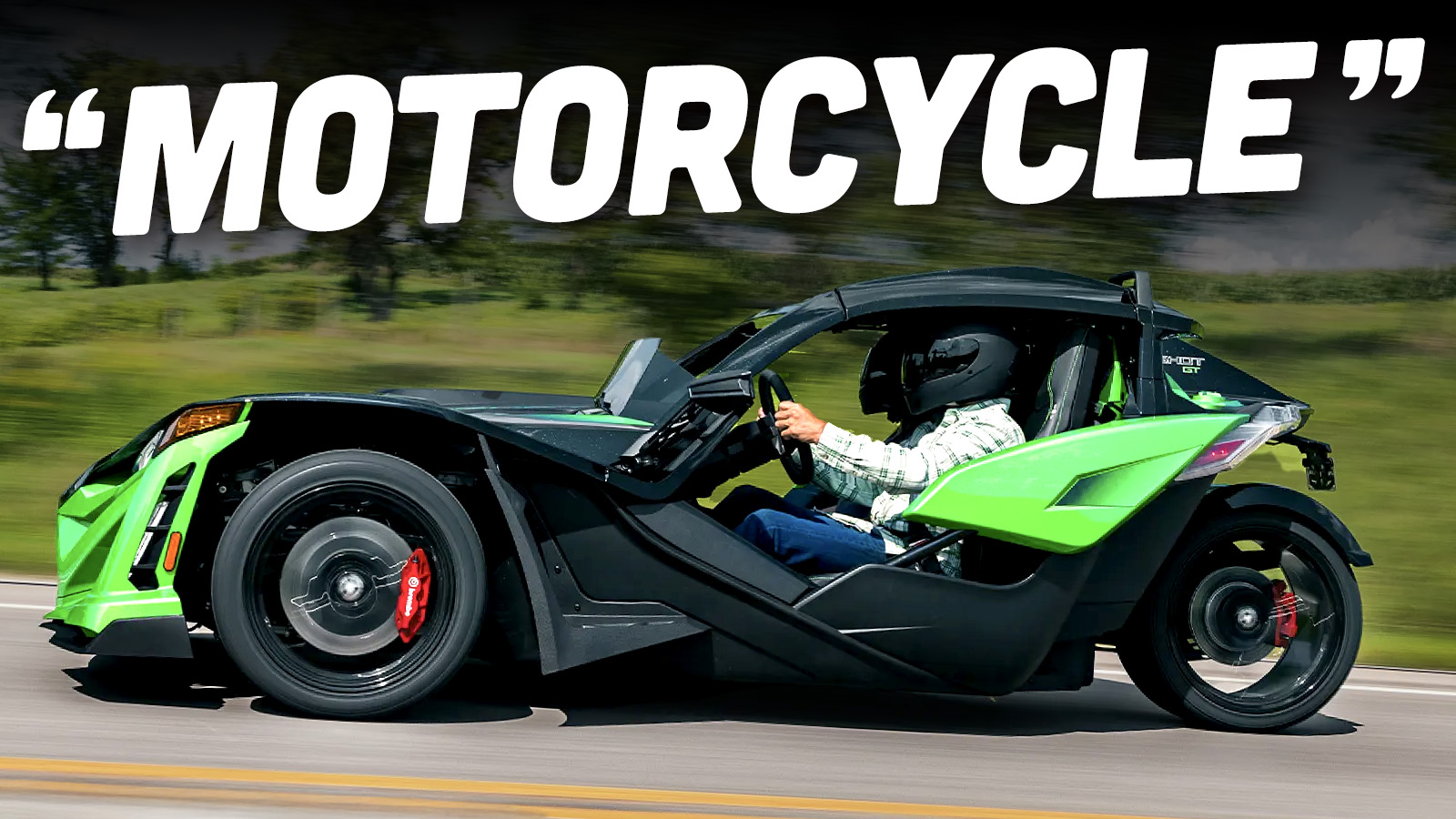
What is a motorcycle? If you’re most people, a motorcycle has two or three wheels, a saddle that has you sitting astride the vehicle, and directional control through handlebars. If you’re the federal government, it’s any vehicle that has fewer than four wheels with a few other qualifiers. A handful of lawmakers want to change that. Bill H.R. 3385 seeks to eliminate vehicles like the Polaris Slingshot from being called motorcycles.
This comes to us thanks to WTVC, and the bill has the motorcycle industry feeling uneasy. As it currently stands, the federal government is really flexible about the definition of a motorcycle. If you mosey on over to the Code of Federal Regulations, you’ll find this definition for “Motorcycle” under 49 CFR 571.3:


Motorcycle means a motor vehicle with motive power having a seat or saddle for the use of the rider and designed to travel on not more than three wheels in contact with the ground.
There are other federal standards that motorcycles must follow. You’ll find that motorcycles must have their headlight(s) on the vertical centerline and must follow certain labeling and measurement rules. But for the most part, if you build a vehicle that has fewer than four wheels, the federal government considers it to be a motorcycle.
Categories Of Motorcycle

This has led to a few very different vehicles existing in the landscape that, to the eyes of the federal government, are motorcycles. In the eyes of the feds, a Can-Am Spyder and a Polaris Slingshot are both motorcycles, even though they’re very different vehicles. A Can-Am Spyder has a motorcycle saddle, a motorcycle engine, a powersports transmission, and motorcycle controls mounted on handlebars. A Harley-Davidson Freewheeler, countless trike conversions, sidecar rigs, and other vehicles that are motorcycles but just with three wheels fit into this category.

Meanwhile, there’s another category of three-wheeler. A Polaris Slingshot has a steering wheel, car seats, a car powertrain, and even car wheels and tires. I single out the Polaris Slingshot here, but there are tons of models that fit this second category. If you own a Morgan 3 Wheeler, a Vanderhall, a Pulse Autocycle, a Reliant Robin, an HMV FreeWay, or any number of kit-built trikes, congratulations, the federal government sees you as owning a motorcycle.

Building a car with only three wheels comes with advantages. Your car doesn’t need to be crash tested, it doesn’t need to follow Federal Motor Vehicle Safety Standards for cars, and it doesn’t need to meet car emissions standards, either. This is how companies that don’t have the funding to make four-wheeled cars are able to get their products onto the market. This is also the case for the forgotten Elio and the possible future of the Aptera.
This has created a sort of weird situation, however, because these vehicles aren’t motorcycles in the traditional sense. You don’t drive a Polaris Slingshot and think you’re riding a motorcycle. It feels like a car. As such, states have picked up the slack, enacting their own flavors of “autocycle” regulations. The idea is that, if you own something like a Polaris Slingshot in a state that would normally require helmet use, that state might no longer require you to wear a helmet because the state is willing to consider carlike trikes, or autocycles, as something closer to cars.
The Bill

On May 14, 2025, Representative Derrick Van Orden (R) of Wisconsin sought to do something about this by filing Bill H.R. 3385. His bill gets straight to the point. If signed into law, the federal definition of a motorcycle will be defined as:
(a) In general.—Not later than 120 days after the date of enactment of this Act, the Secretary of Transportation shall issue such regulations as are necessary to amend the definition of the term “motorcycle” in section 571.3 of title 49, Code of Federal Regulations, to match the definition in this section.
(b) Motor cycle defined.—In this section, the term “motorcycle” means a motor vehicle, as was originally manufactured, with motive power, having a seat or saddle requiring the rider to sit astride, designed to travel on not more than three wheels in contact with the ground, steering controlled by handlebars, acceleration and braking controlled by handlebar and foot controls and capable of reaching speeds in excess of 30 mph.
That’s it. The bill ends there. While the bill was introduced last year, it has been slowly snaking its way through the House. Its last action was on February 10, when the bill moved to “Forwarded by Subcommittee to Full Committee by Voice Vote.”
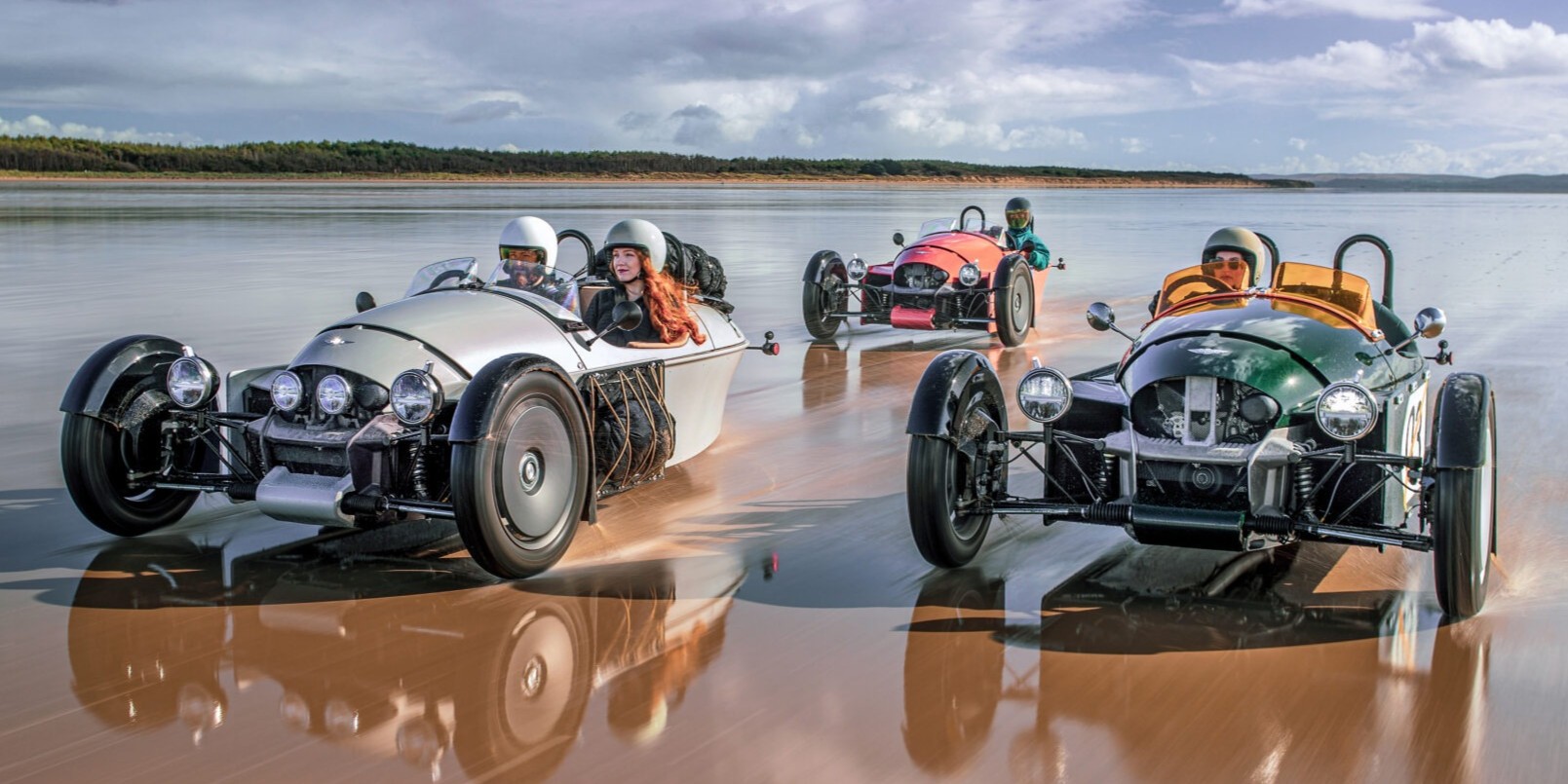
Rep. Van Orden was precise in his wording here. His version of the federal definition of motorcycle will still define trikes as motorcycles, but only if they have foot controls, handlebars, and saddle seats that have the rider sit astride the vehicle. That means that the aforementioned Harley-Davidson trikes and the Can-Am trikes would be safe and allowed to be sold.
However, since federal law doesn’t have definitions for trikes that have car seats and car controls, the entire second category of motorcycles will no longer be considered motorcycles. This would put them into a sort of legal purgatory. These vehicles are not crash tested and aren’t built to car standards whatsoever, so they wouldn’t be considered cars. However, they would also be kicked out of the motorcycle category, too.
The Defense

The Motorcycle Industry Council has taken note of this discrepancy and says that if H.R. 3385 were to become law, it would effectively ban all carlike trikes, destroying that entire industry. Further, since 15 states, including Alabama, Florida, Idaho, and Illinois, tie their laws to the federal definition of a motorcycle, this could mean that potentially tens of thousands of vehicles will no longer be legal to drive.
Here’s some of what the Motorcycle Industry Council said in a letter dated January 10:
RE: Oppose H.R. 3385, which directsthe Secretary of Transportation to issue certain regulations to update the definition of motorcycle.
Dear Chairman Bilirakis, Vice Chairman Fulcher, and Ranking Member Schakowsky:
The Motorcycle Industry Council (MIC), represents several hundred companies in the powersports industry. H.R. 3385 will be considered on January 13 at the House Energy and Commerce Subcommittee on Commerce, Manufacturing, and Trade. We write to express our strong opposition to H.R. 3385, as the legislation threatens to eliminate an entire category of innovative American-made products from commerce and jeopardize thousands of domestic jobs.H.R. 3385 seeks to narrow the federal definition of a “motorcycle” by excluding three-wheeled vehicles equipped with steering wheels, pedals, and bucket seats—commonly referred to as autocycles. This is not a mere administrative adjustment; it is a de facto ban on an established and successful motorcycle market segment. Federal law currently lacks a separate “autocycle” safety category. By removing these vehicles from the motorcycle definition, H.R. 3385 places them in “classification limbo,” making it illegal to sell or register them.
The Motorcycle Industry Council argues that, in addition to “Total Market Elimination” and the aforementioned conflicts with state laws, H.R. 3385 is “A Deviation From Free-Market Principles,” would negatively impact American dealers, manufacturers, and workers, and disrupt established motorcycle safety standards.
As of now, it appears that the bill is still steaming ahead. It has gained sponsorship from Representative Jay Obernolte (R) of California, Representative Scott Fitzgerald (R) of Wisconsin, and Representative Darin LaHood (R) of Illinois.
Maybe There’s A Middle Ground?

I do get the desire to do something about autocycles. It has always baffled me that, in the eyes of the federal government, a Polaris Slingshot is the same thing as a Honda Super Cub. They are vastly different vehicles. It has also often rubbed me the wrong way when some startup companies pushing potential three-wheel vaporware tout their vehicles as being extraordinarily safe, when they would never actually have to prove their claim. If you want to build a car, but don’t want to worry about car safety or car emissions, just subtract a wheel, and the feds will call it a motorcycle. So, I get why there’s concern about autocycles.
However, I think the proper course of action is to carve out proper autocycle regulation, not just eliminate them entirely. There is a middle ground here that is not being explored.
It’s also confusing because this move would directly impact American business. Polaris builds the Slingshot right here in America. It’s the same deal with Vanderhall and some other, smaller companies slinging three-wheelers. These are vehicles designed, engineered, built, and sold by Americans.
Thankfully, there’s still plenty of time for this bill to be stopped. If you own one of these vehicles or support them, call your state representatives. Tell them that these vehicles should be legal. Otherwise, I’ll be monitoring this situation to see how it plays out.
Top graphic image: Polaris




a) You don’t need a motorcycle endorsement to drive a sidecar rig, despite it being classified as a motorcycle (in CA at least)
b) how long until Polaris et al just switch to handlebar controls? I’ve never been in one but it doesn’t seem like it would be that hard, no?
I wouldn’t shed a single tear if these things were outlawed. I hate every single 3-wheeler in existence and, to products like the Slingshot in particular, there is not a single use case where I see them being a better option than a Miata. Furthermore, they’re almost as expensive, so where is all that omission of safety going, exactly, anyway? Regarding safety, I always think of the statement, “If motorcycles were invented today, they’d be outlawed tomorrow.” Personally, they exceed my risk-to-reward threshold for driving on the street, though I loved my California Superbike School experience and would love to do more track riding, but I digress…
I’m conflicted because Mercedes brings up 2 good points in my eyes. One is current owners of these products, who should not be penalized if the law were to change. There would have to be a grandfather clause. Second is that there are simply people who want these, wrong as I may personally believe they are. They’re not LESS safe than a motorcycle, and they’re used in similar ways, but they clearly exist to circumvent the safety laws. There needs to be some room for kit cars and the like, and I feel like they could fit in there somewhere, but I don’t have an answer for what that middle ground would be.
Is anyone one else worried that the “sit astride” requirement implies that step-through scooters will also not qualify as motorcycles?
Whenever the government sees people having fun and enjoying themselves they feel compelled to step in and put a stop to it.
These may look silly, but my wife and I had a blast when we rented one. Even though it has a steering wheel and car seats, it felt closer to a motorcycle than a car to me. I didn’t wear a helmet, but I was tempted to since you there isn’t much to protect you from anything. At a stop light I could reach over and touch the road (and I have short arms). It was definitely a different driving experience than a wrangler with the doors off. We found some twisty roads and it was a ton of fun. My 3.0 MKZ and even the wife’s 2.0 Escape would smoke it in a drag race, but that isn’t what this car is all about. I’m too old to learn to ride a motorcycle and this gave me a small part of the experience. We saw and heard new things on roads we’ve traveled forever.
My buddy is a huge Harley guy (He’s got a Harley tattoo), but he did buy one of these since he is getting older and still wants the open-air experience. It is also still one of the few vehicles that you can still get with a stick.
I’m all for safety standards in cars, but something like this wouldn’t be allowed to exist otherwise. Pretty crazy that people can ride bikes without helmets and we can hardly buy vehicles that don’t weigh 4000+ pounds and have a ton of nannies.
Autocycle “drivers” don’t require a motorcycle license or wear helmets. In my opinion they are not motorcycles.
I am no fan of the enormously wide and tacky slingshot, but agree this proposed regulation is overbearing. It would seem that creating a category of autocycle (which, maybe if americans are lucky, includes quadricycles??) that can avoid onerous safety regulations and open the market to unusual and small cars could be a good compromise.
Slingshot is the 3 wheel version of a fully tarted-up 2005 Hummer H2.
The government can call it whatever they want but my definition of a motorcycle is pilot to bombardier seating as opposed to pilot to copilot seating for a car!! I do think that autocycles are exploiting a loophole, but I don’t see a need to close that loophole
Ah yes, the party of small government coming to save the three dozen owners of the Polaris Slingshot. What a noble and totally not purchased by lobbyist cause.
Texas DMV was the first to judge on this back in 2014 and was simply a legal interpretation argument. It was then followed shortly thereafter by a bill in Connecticut from a Democratic representative and Democratic Governor. This is a bipartisan issue, stop trying to make it something even more divisive.
The bill in question is written by a Republican and co-sponsored by three other Republicans. No Democrats involved this time. This one comes 100% courtesy of the party of small government, personal responsibility, and a free market economy. Or at least that’s what they used to claim to be.
Doesn’t change anything I stated. Still a bipartisan issue and ignoring that fact is just trying to be more divisive.
See response from Rad.
See response to Rad.
Having owned one of these for a while —replaced for reasons that had nothing to do with how much fun it was— “halfway between car and motorcycle” is more true than it would seem.
I basically had to get a motorcycle outfit waist up to drive sensibly at speed, helmet and earplugs included. Felt similarly in traffic in that any distracted driver in a truck could just go and drive over me.
This feels a bit off to me. Surely there are otherwise perfectly normal motorcycles that have only one or the other. Perhaps some electric motorcycles (no transmission)? If it were me, I’d strike this line out and leave it at handlebars and saddle seats, and maybe the three-wheels-or-less part (quadbikes are also a thing though, so unless they become autocycles…).
Most scooters are hand control only, and some electric motorbikes are that way too.
And of course, some people with disabilities have hand controls fitted to their cars.
(Even drift cars)
I don’t usually agree with these particular politicians, but I often see this on the road (Slingshots) and my first thought is “deathtrap”. Perhaps their slogan could be, “The Motorcycle That Traps You Like a Car”.
Is it more of a deathtrap than… your average motorcycle?
That’s a good question… my thought was that, in a motorcycle crash, you get thrown. Cars protect you better with crumple zones, reinforced doors, etc. In say, a Slingshot, you’d get neither.
Getting thrown off the bike is hardle a good thing, more of a lottery.
You do get safety belts on the autocycles so depending on the type of crash you’re likely to stay in place shaken but not stirred. A frontal carsh with a F150 won’t end well, but neither it will with a motorcycle (is it too tall for the rider to actually vault over?)
the thing with a motorcycle is, they’re TINY. Even the biggest bike is tiny compared to the smallest car. And that’s where a lot of their safety comes from- they’re so small that when, say, that car next to you starts coming over into their lane, they’ve got several feet of room to maneuver and find a way out. Ask me how I know.
So yeah, if you get hit on a bike you’re going to be in trouble, but they’re surprisingly hard to hit.
So building a motorcycle but giving it the size of a Miata while also making it less manouverable and heavier… Yeah, that’s making it a deathtrap.
These vehicles are obviously not as safe as a crash tested car, but seriously? It is such a small market – is this really worth bothering with?
The fact that the insurance industry hasn’t said anything speaks volumes. My guess is that like motorcycles, the owner tends to get killed and the vehicle itself does very little damage to other vehicles so from an actuarial standpoint, they’re just fine- they won’t end up being a massive insurance liability.
Not exactly high praise for their safety, but…
Easy fix, alter the bill to state that any other 3-wheel vehicle is an autocycle, and then add another clause stating that absent other legislation, an autocycle is considered a motorcycle.
Then you can come in at a later date and add some legislation to specifically address whatever needs addressed regarding the autocycle.
I’m not in the market for one, and I’ve always thought that they looked pretty silly going down the highway, but I also lean libertarian. People buying these know what they’re doing (and Darwin will take care of that part of the equation), and no matter how well a law gets written, there will always be loopholes and exceptions that end up being exploited. I’m not sure if this is really a “problem” that Congress should be wasting its time on.
Yes, given the state of the country, this is definitely something the government should be focusing on right now.
Yeah, but, “choosey beggars”, or something.
“other, smaller companies slinging three-wheelers”
I see what you did there, Mercedes. Nice shot!
But that’s not what the proposed statute says. You say it bans three-wheelers. But it actually says “not MORE than three wheels” which means two wheels is okay and so is three. But that’s it. Not more than three.
So this statute actually does absolutely nothing to any of these trike configurations. I’m not entirely sure what the law DOES exactly because more than three wheels is already into automotive categories.
What is clear is that words matter and this proposed law doesn’t DO what the clickbait-y headline suggests.
“Federal Lawmakers Want To Close The Loophole That Says The Polaris Slingshot Is A Motorcycle”
The bill would accomplish exactly this headline’s claim. Did you read the proposed wording??
I take accusations against my integrity pretty seriously, so I’m sorry that this will not be in my normal bubbly tone. At no point in this story do I say that the bill “bans three-wheelers,” I say, quote:
And:
“Carlike” is the operative word there.
Here is the direct text from the bill:
The pertinent parts:
If you actually read the article, you would note that I do not say that the number of wheels is at issue here. I even list out the three-wheelers that would be perfectly safe under the provisions of the new bill.
It’s the seating and controls. A Polaris Slingshot has car seats and car controls. It’s basically just a car without a roof or a fourth wheel.
This bill would eliminate the Slingshot’s and other carlike trikes’ legal standing as motorcycles, but federal law has no other motor vehicle classification that these trikes could reasonably fall under. Hence, the alarm from the Motorcycle Industry Council about this being a ban.
The obvious loophole would be to set up an enclosed 3-wheeler with steering bars like those of a recumbent trike. For an example, see the 1957 Jurisch Motoplan:
https://www.youtube.com/watch?v=xagluELeM3M
You put the throttle and brakes on the steering bars. If you need to seat more than one person, make it a tandem 2-seater. Then you set up a seating system that is more motorcycle-like than the above.
This way, the enclosed 3-wheeled car is still a “motorcycle”.
That solution is not relevant to the cars being built that will be in legal limbo, effectively outlawed by this legislation. Plus, yuck.
Everytime you make it harder to make something new you help the big corporations. At least make a new category for 3 wheelers if your going to do this.
It’s congress, they’ll never get anything done. Unless they can make some insider trading bucks off of it or a kickback to their “business” it ain’t gonna pass.
I’m conflicted on this. One one hand, as an aging cyclist having an alternative easier to ride open air option as my arthritis starts hindering my ability to clutch is very appealing.
On the other hand, I got my motorcycle endorsement the hard way, accelerating towards the barrier and locking up 2 wheels without stalling/falling, and not putting my foot down through the cones too much. Also learning how to keep my head on a swivel when riding and that you’re invisible to every other driver, even if they look right at you.
So people who get their endorsement on a Can-Am, or ride around in a Polaris with insurance for pennies vs if they got a Miata(that’s the real benefit) I feel are cheating the system a little.
Ultimately it doesn’t impact me, I have my endorsement, but this isn’t the right way to regulate, especially when some states allow side by sides(or even Chang-Lis) to operate on low speed roads, but the autocycles won’t even have that level of definition? That ain’t right.
This is a good point that further illustrates why there should be a separate category for trikes. Nobody should be able to get a 2-wheel motorcycle license with a trike. The licensing requirements have been established for a reason and a trike cheats that as so much of it depends on balance. As a separate category, trikes couldn’t be used as a way to cheat the motorcycle license. In theory, that shouldn’t change anything for people with motorcycle trikes who have no intention to ride 2-wheels or can’t due to mobility issues.
Right and to be clear like a Can-Am I think some states you can get a motorcycle endorsement with, not a Polaris. I’m not sure how that even works with the between the cone test, perfect score, no touchdowns! lol.
This is just wrong headed. If they want to legislate something, make three-wheelers a new category.
Here in California, three-wheelers of any type can count as a motorcycle/autocycle in the toll lanes. No motorcycle license endorsement needed, no helmet if it’s enclosed (AFAIK).
Really, if you’re buying a three wheeled vehicle, you’d think you’d go into it realizing that it doesn’t have quite the same safety features as a car.
What’s interesting is that this also impacts the dubiously-legal “e-bikes” that are really more like Mopeds with a vestigial set of pedals. By setting the ceiling at 30mph, it dovetails with the 28mph speed limit for Class 3 E-Bikes. It means that the law will clearly designate the not-really-bicycles as they should be — motorcycles.
PS. Van Orden is a giant pile of excrement. And yes Im a Wisconsinite and know
Great job Rep. Van Orden- solving a problem that didn’t exist. I am sure we have run out of real existing problems that needs solving.