


I used to have a “bit” about how the worst day for a firefighter is when a warehouse full of those novelty birthday candles that reignite after you blow them out catches fire. But I’m sure the firefighters at the Fort Worth Fire Department’s (FWFD) Station 23 would have happily taken on that novelty-candle warehouse blaze over the far more dangerous fire they did find themselves fighting at Frank Kent Cadillac on October 9th. As the incredible photos show, the incident sent crews up against notoriously difficult-to-extinguish EV fires for just under 18 hours before the flames were finally under control.
What apparently began as a single-vehicle fire ultimately claimed six Cadillac SUVs (some of them Escalade IQs) and damaged two more, according to the FWFd’s Facebook post below. Initially, firefighters were unaware the burning vehicles were EVs. “As crews were battling the fire that was quickly spreading from one SUV to the next, they realized these were all electric vehicles,” the post states. As the fire department goes on to say, not only do EVs burn hotter, but because their battery packs are purposefully designed to be watertight, it’s much harder to get water to the source of the flames.


[Ed Note: It’s here that I point out that EVs have less of a propensity to catch fire than gas cars. They burn hotter and are harder to put out, but overall, they’re considered safer. This post is just highlighting a heroic act captured by an excellent photographer. -DT]
I don’t think I’ve ever seen photos that so dramatically capture the incredible energy of an EV fire and the bravery of the firefighters who get up close to contain them:
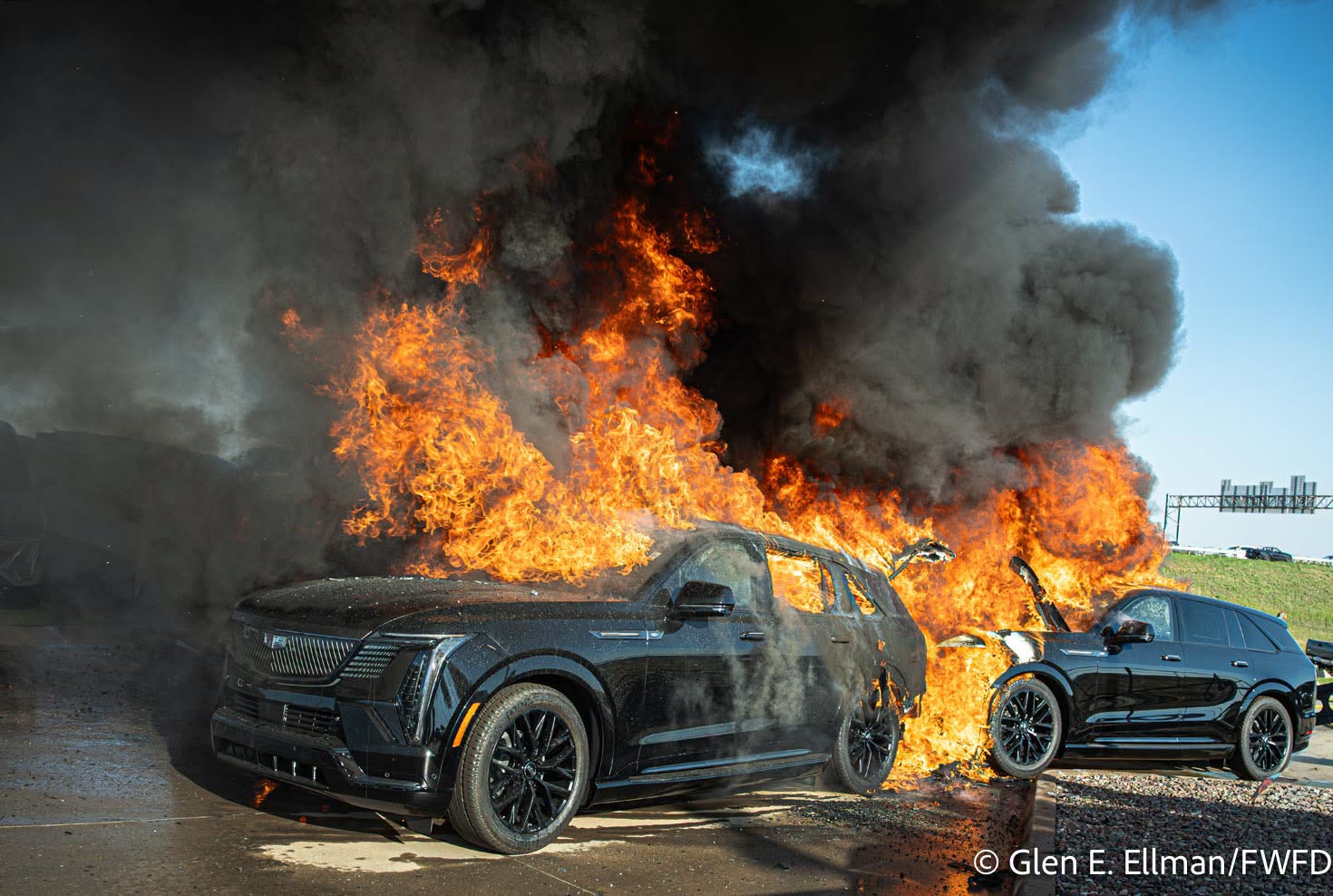
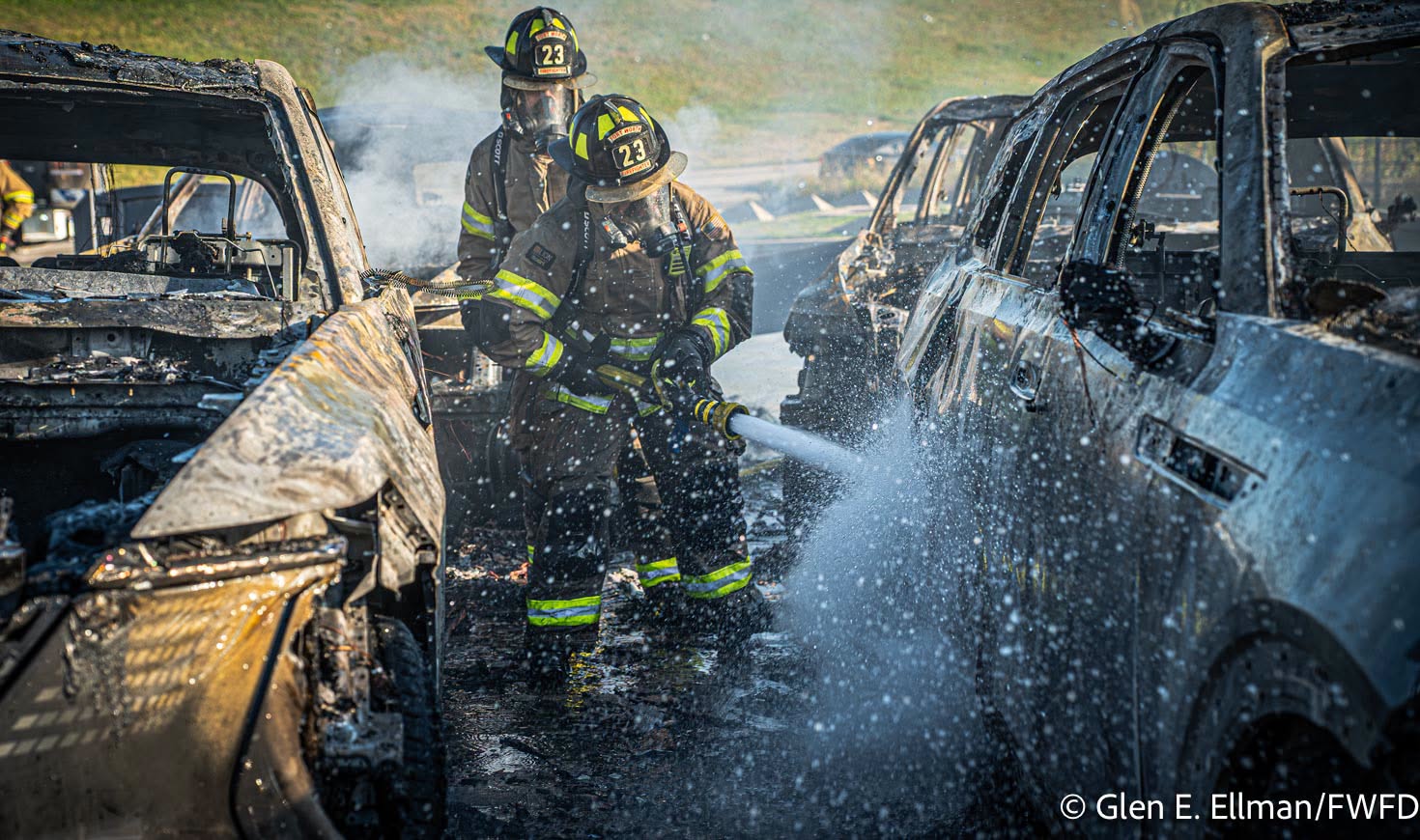
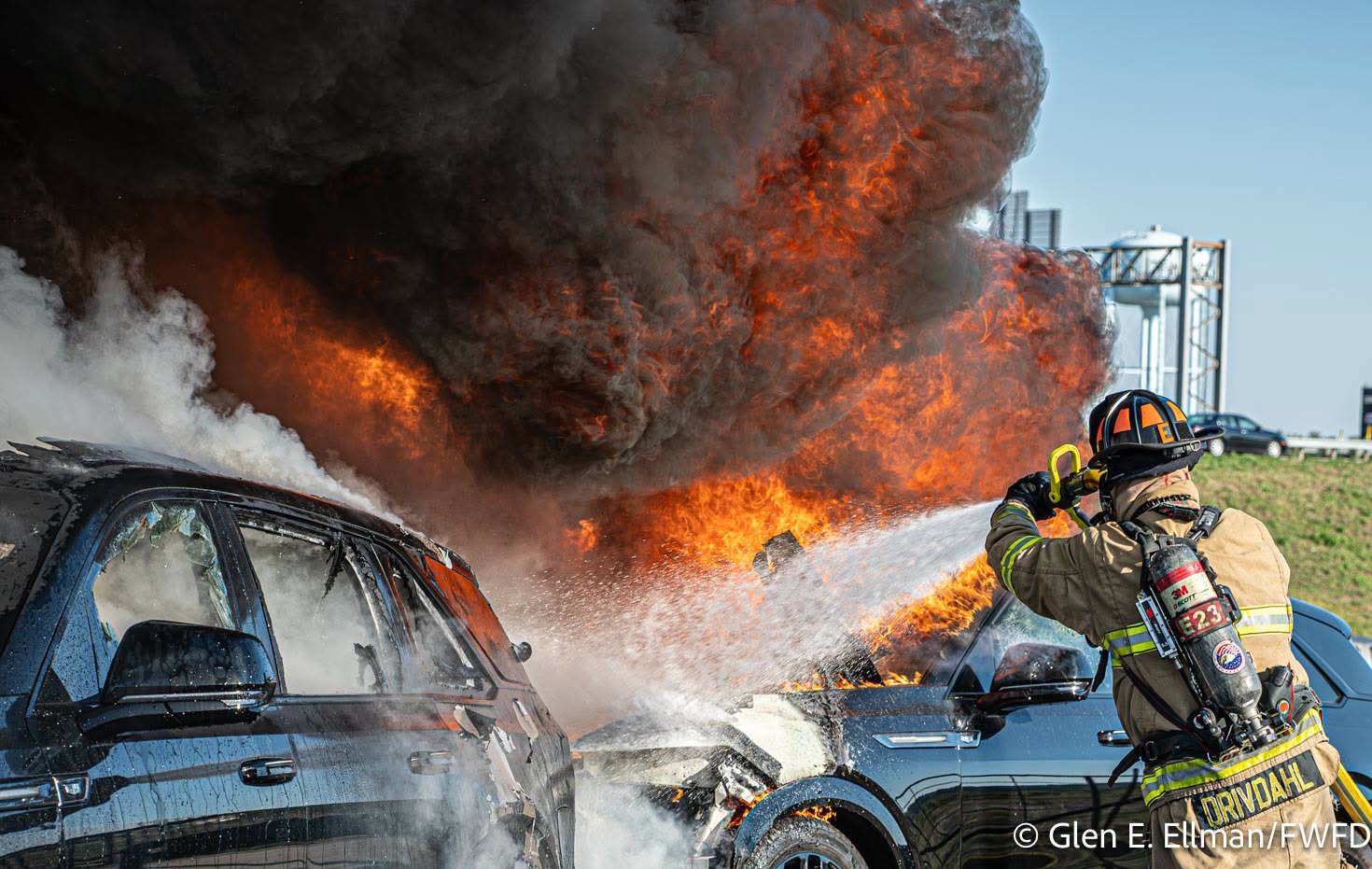
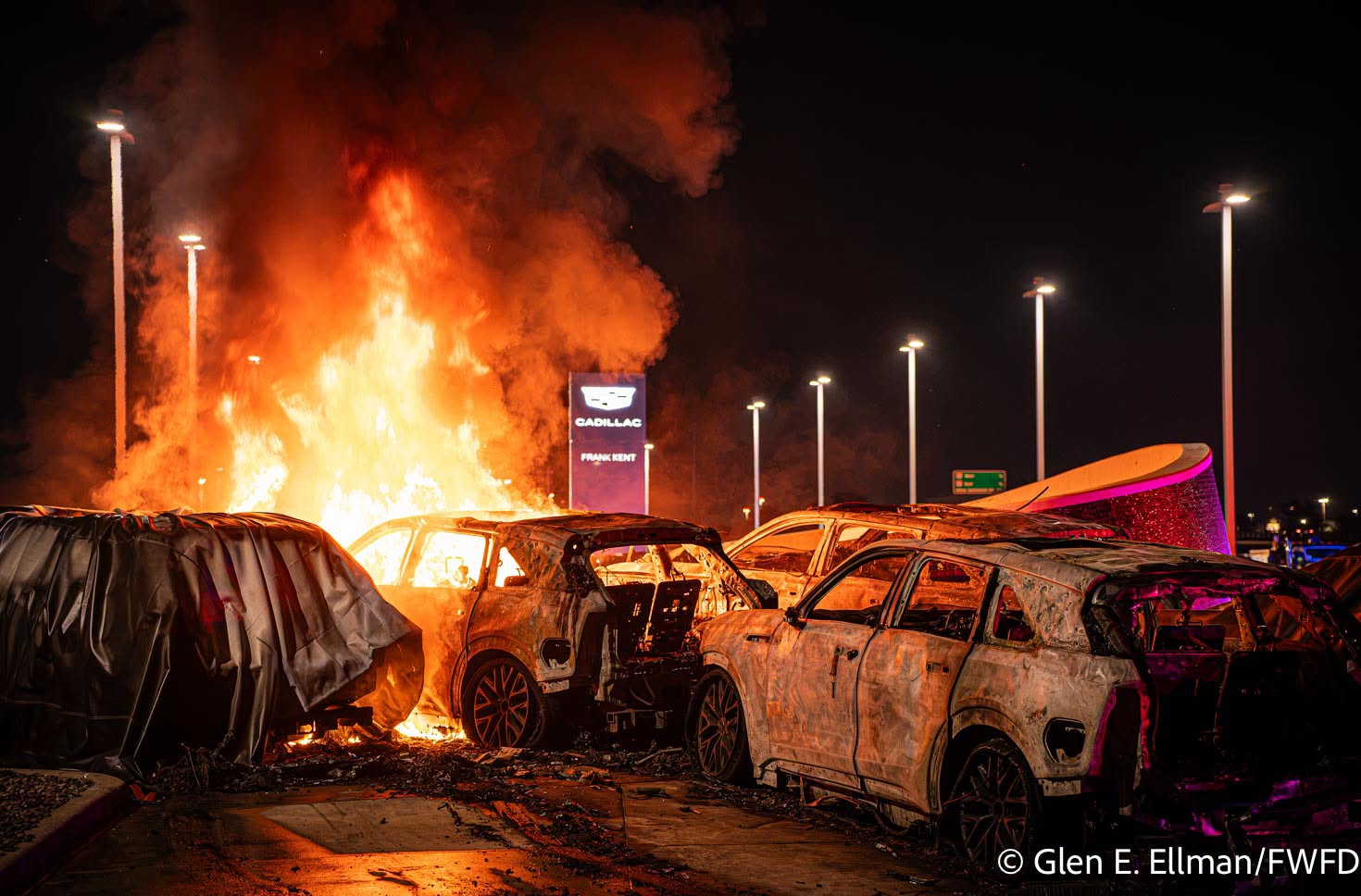
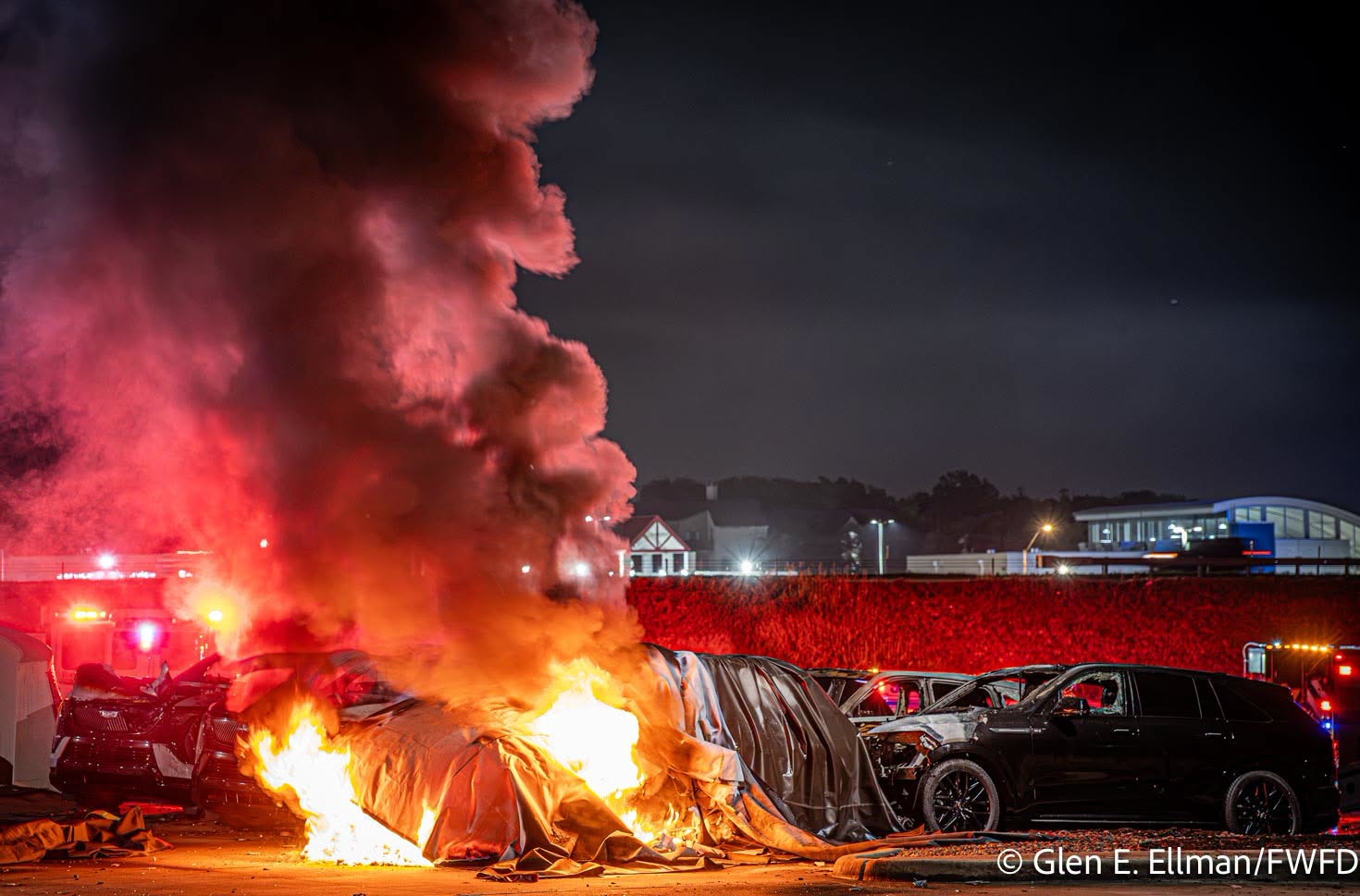
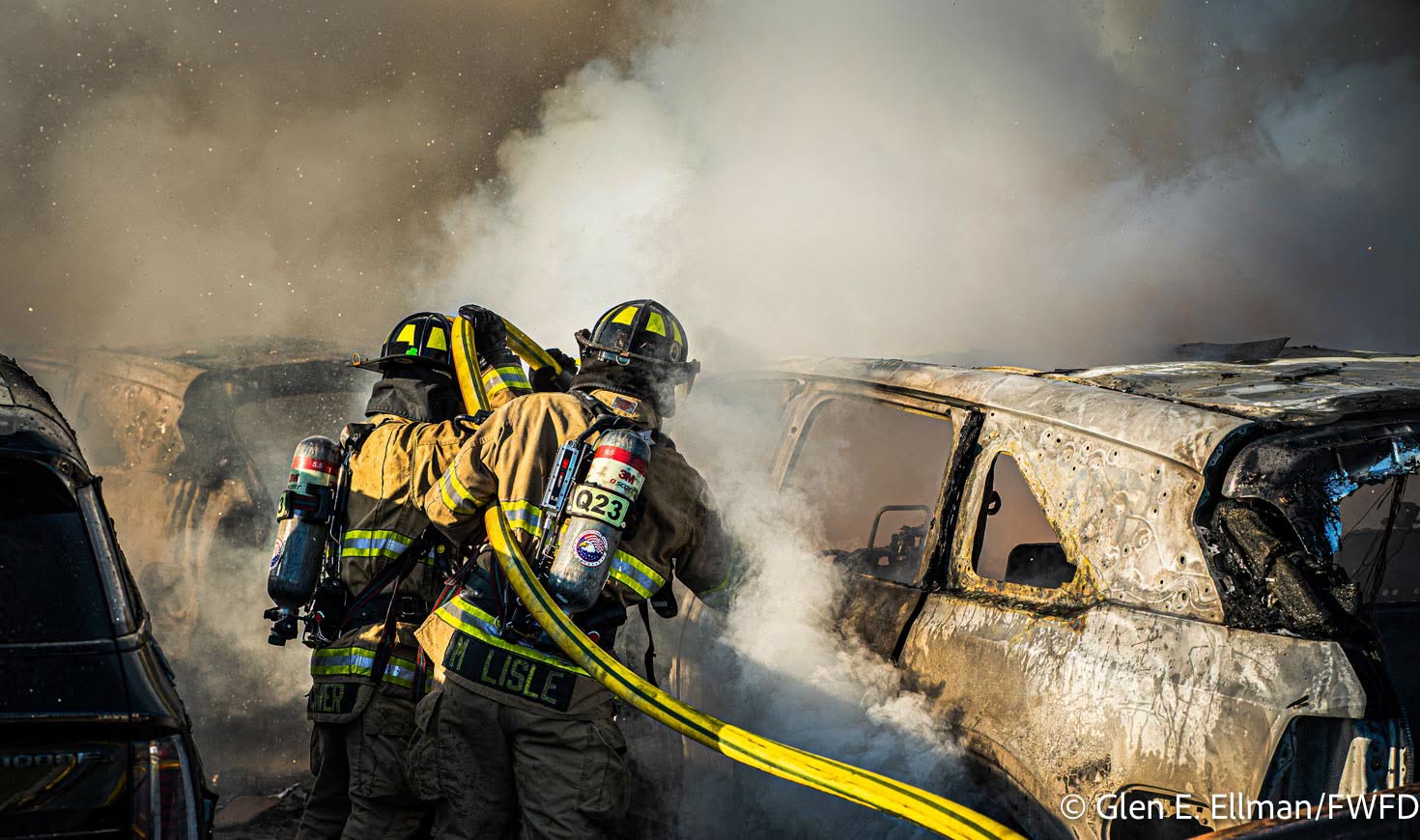
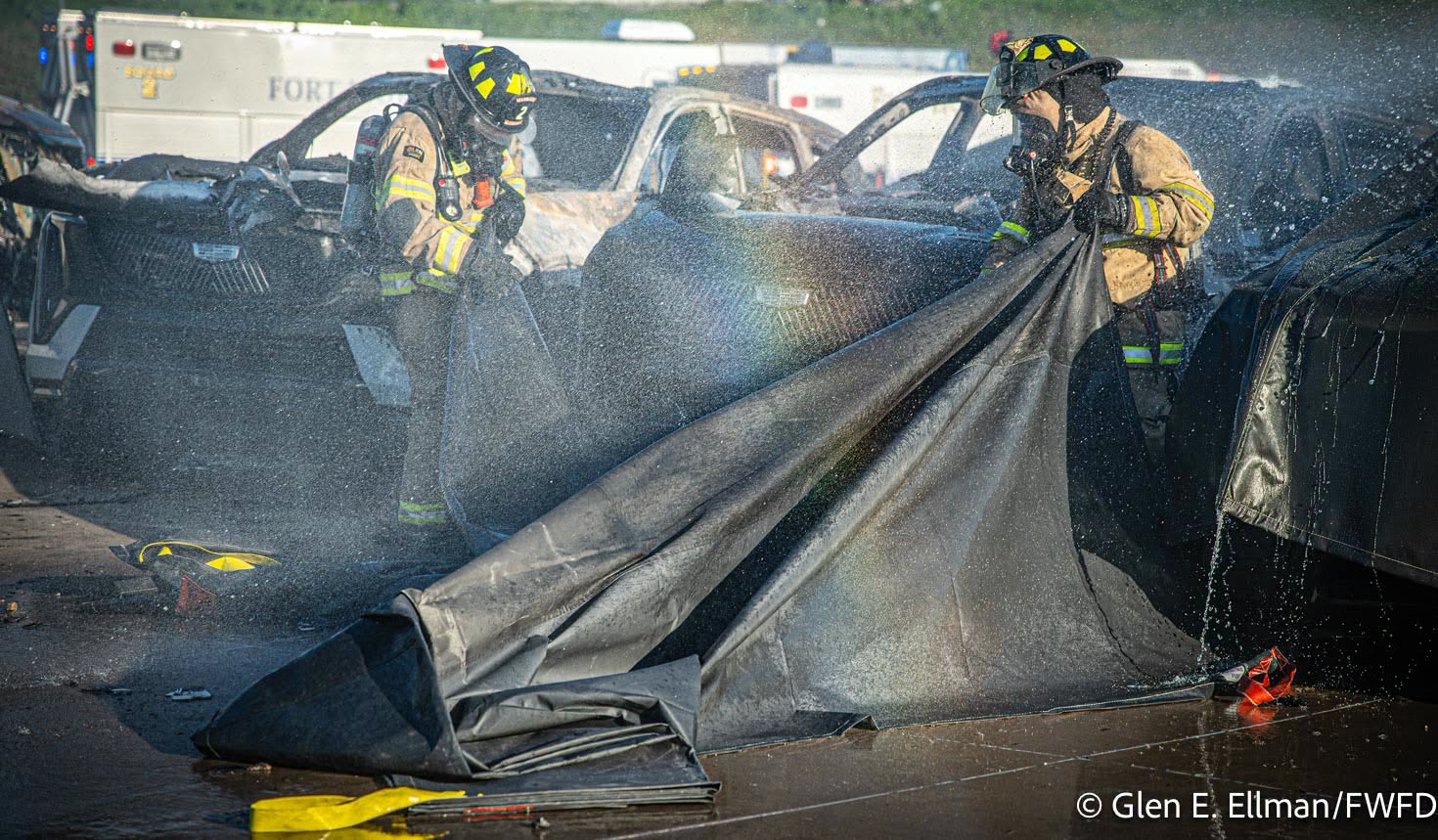
According to the FWFD, what looks like a tarp in the photo above is actually critical firefighting equipment credited with helping thwart the blaze:
In many of the photos, you will see vehicles covered in what looks like a blanket. These special vehicle blankets were placed on the cars to hold the fire at bay while other vehicles in the path of the fire were moved away. This would prevent the spread of fire to the exposure vehicles which would inevitably have created a bigger issue.
Frank Kent Cadillac was, of course, thankful for the heroic efforts of the FWFD that prevented what could have been a far more costly and potentially deadly fire, and conveyed their gratitude via Facebook:
We owe an enormous thank you to our first responders, whose quick response and decisive action brought the fire under control before it could spread to neighboring businesses or the surrounding grassland. Their professionalism, courage, and swift action made all the difference, and we cannot thank them enough. […] Please join us in leaving a kind word of thanks for the incredible men and women of Station 23,” the dealership wrote. “They showed up when we needed them most, and we plan to make sure that firehouse eats well for days to come!”
Here’s additional coverage of the fire via WFAA in Fort Worth:
For more insight on how firefighters deal with the unique nature of EV fires, I looked up the procedures recommended by the UL Research Institute’s Fire Safety Research Institute. According to its report, “Full-Scale Electric Vehicle Fire Experiments and Recommendations for Fire Incident Response” (you can view all 150 pages here), these are the essentials:
Immediately Suppress EV Fire With Water While Protecting Exposures
Suppression with a handline with water (no additives) is recommended as the first choice of suppression strategy, similar to a conventional vehicle fire attack. The use of tools designed to introduce water directly into the battery pack was not examined in this work. However, firefighters should not open or pierce the battery pack outer case.Fight the Vehicle Fire First, the Battery Fire Second
The fire in the passenger compartment represents a significant portion of the thermal and chemical exposure hazard and will readily respond to water. Rapid suppression of the cabin fire reduces the thermal and chemical exposure hazard to surrounding objects, civilians and first responders, especially if battery involvement is prevented.The battery fire is best controlled by supervising the battery fire until thermal runaway stops. Water should be applied intermittently to prevent reignition of the rest of the vehicle and redirect flames from exposures if necessary. Applying copious amounts of water to the battery enclosure is wasteful and will not stop thermal runaway. Likewise, introducing water into an uninvolved battery may increase (re-)ignition risk.
Use Caution if Deploying Fire Blankets
Fire blankets, while not recommended as the first choice in suppression strategy, may be effective under limited operational scenarios. They will not stop thermal runaway or the resulting production of flammable gases, and they limit firefighters’ ability to monitor the vehicle. Firefighters should not manipulate the blanket once it is deployed and remain cognizant of the latent reignition and deflagration hazard. It is inadvisable to use fire blankets in areas where flammable gases may accumulate and form an explosive atmosphere, such as indoors. Fire blankets should remain undisturbed for at least one hour after the last visible fire or smoke emanating from under the blanket.After the Fire
Following extinguishment, the vehicle should be observed for reignition risk to identify any ongoing hazards. Release of the vehicle should occur after inspection has identified the relative reignition risk. Even if the battery appears to have burnt out, it cannot be excluded that moving the vehicle may cause a short circuit and subsequent reignition of remaining intact cells. For this reason, firefighters should remain vigilant and continue to use an SCBA during overhaul and inspection. Fire departments should consider escorting the tow truck to the tow lot to ensure rapid identification and suppression should reignition occur. A quarantine distance of at least 5 m (16 ft) to any other combustible object should be left at the salvage yard.
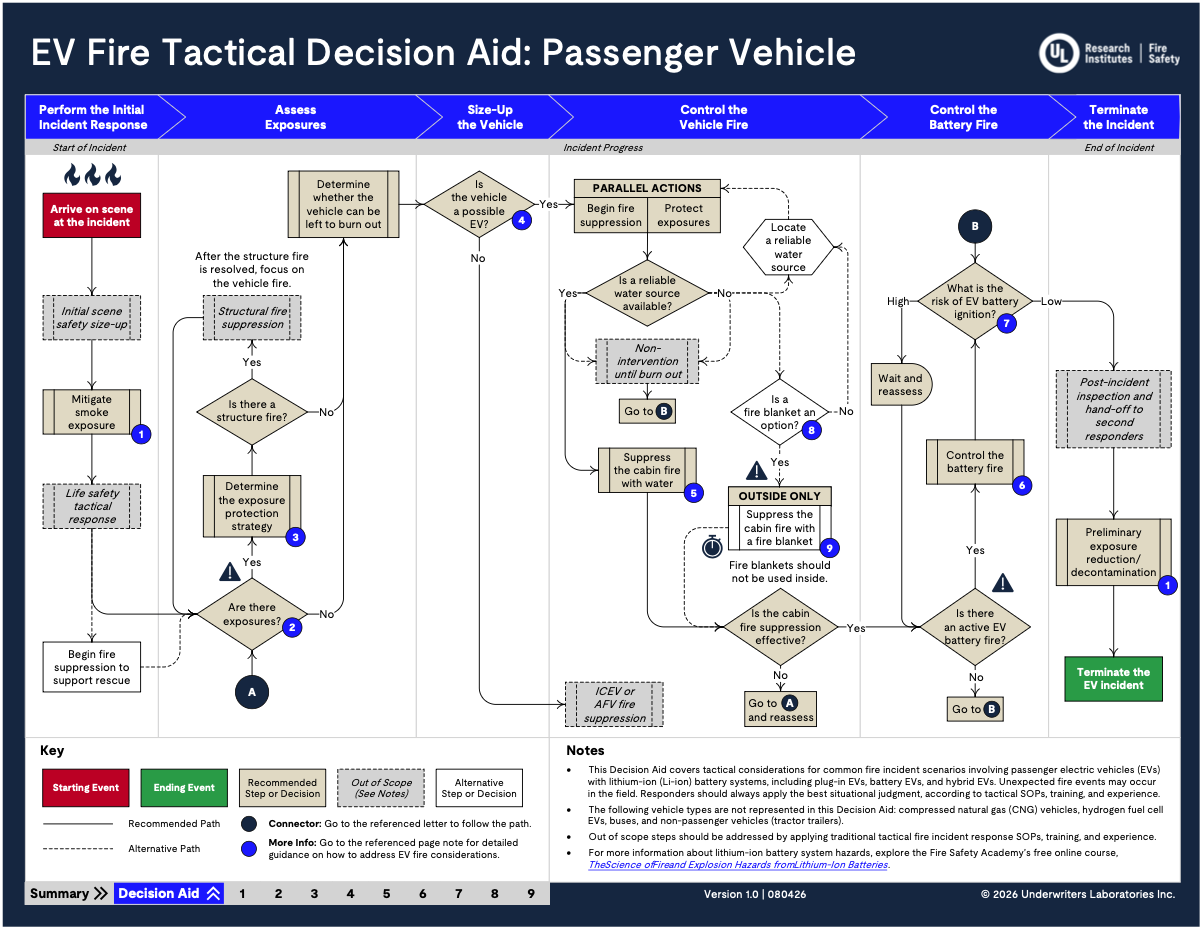
The report also includes response decision trees like this one. It’s a lot more involved than “aim hose at fire.”
[Ed Note: You have to check out this amazing website funded by the Australian government. It provides detailed info on EV fire suppression. -DT]
In the unlikely event anyone needs extra convincing that EV fires are no joke, the firefighting steps and photos above oughta do it. We join Frank Kent Cadillac in our appreciation for the hard work of the Fort Worth Fire Department and the firefighters everywhere doing their best to keep us all safe.
Top graphic images: Glen E. Ellman/FWFD


I wonder how many gallons of water they had to use to ultimately extinguish it. 18 hours is a long time to be pouring water on anything.
I attended a crash demonstration at a Traffic Safety conference in Reno yesterday. When I asked, a fire fighter responded that they expect to use 35,000 to 40,000 gallons of plain water to control a single EV fire.
How long before fire departments in the Southwest decide they can’t afford the water to put out an EV fire and just let them burn?
Just clear out as many vehicles as possible and let the remaining ones burn
That wasn’t firemist paint, was it?
Absolutely amazing pictures. I would love to know why these fires started in the first place.
Really appreciate the editors note. EVs are between 16 and 20 times less likely to catch fire than ICE vehicles. It should be noted that, although all EV fires are difficult to extinguish, those Cadillac Escalade IQs can come with the largest battery pack in any non-commercial vehicle on the road at over 200kW. That’s like 2.2 normal sized EV battery packs. That much capacity which would certainly exacerbate the fire.
When I was a small-town newspaper photographer in the late 70s, I heard about VW Beetles and vans catching fire almost every week.
In nuclear reactors they often do a hose coupling at the outside of the containment connected to some important to cool stuf at the inside of the containment.
I feel they could do the same for EV battery packs. Where there is just a hose coupling to the underside of the vehicle. Providing fresh flowing water here could cool the batteries from the outside, withoud destroying the good cells. This could potentially halt thermal runaway.
great idea
Most EVs already have a cooling loop, so you could probably tap into that?
The cooling loop is very small pipes purposely designed to not come in direct contact directly with the cells. You want a lot of water right on the cells and fast.
DT’s Editor’s Note misses the point. Conventional vehicle fires are often extinguished within 5–20 minutes and be brought under control, whereas EV battery fires can take hours to control, requiring prolonged cooling, substantial water consumption and management of contaminated runoff.
Jason Torchinsky’s frequently cited EV-versus-ICE fire statistics deserve serious scrutiny. Do the observation periods and denominators match? More importantly, what caused those ICE fires? Ageing wiring, neglected maintenance, faulty relays and electrical components? Collision damage rupturing fuel lines or puncturing fuel tanks? Or a distracted driver dropping a cigarette while his eyes wander towards an attractive woman on the pavement? Perhaps the Mafia-style sabotage?
Older vehicles can be more susceptible to fires due to deteriorating wiring, insulation, electrical connections and components, as well as deferred maintenance. Newer vehicles may also catch fire because of design, manufacturing or material defects. Then, there are inherent design flaws, such as the infamous Ford Pinto and Mercury Bobcat fuel-tank design.
If the ICE fleet contains substantially more older vehicles than the EV fleet, how can we fairly compare their fire rates without controlling for vehicle age? Were the vehicles compared within equivalent age groups, using comparable exposure data? Without that adjustment, the statistics could give a misleading impression of the relative fire risks.
Meanwhile, EV battery fires can release toxic hydrogen fluoride (HF), generate intense heat and escalate rapidly, leaving occupants precious little time to escape. In a confined passenger compartment, toxic gases entering the cabin can accumulate rapidly, potentially exposing occupants to dangerous concentrations before they can get out. HF inhalation can cause severe respiratory injury, and breathing difficulties may worsen even after exposure ends. Combined with extreme heat and potentially malfunctioning door releases, a rapidly developing battery fire can turn the passenger compartment into a life-threatening environment within minutes. Panic and disorientation can further delay escape, as occupants instinctively search for the familiar door handle rather than recognising or locating an unfamiliar mechanical emergency release, as found in some Tesla models and other vehicles. The September 2025 Schwerte Tesla crash in Germany, in which three occupants died after the vehicle caught fire, illustrates the potentially fatal consequences when occupants cannot escape in time.
If EVs are supposedly “safer overall,” where is the comprehensive comparison of fire suppression time, water consumption, toxic emissions, occupant escape risks and environmental consequences? Counting fires alone does not tell the whole story.
No! Then a few more no’s and some yesses.
I don’t think the edditor’s note misses te point when the point is to point out EVs catch less fire. Especially in an article highlighting the dangers of and problems with this EV fire.
This may change when the average EV on the road is maintained by some shady dude around the corner and has a replacement battery from amazon.
How many people were killed or severely injured because they were unable to exit a vehicle with a starting fire? And can we then subtract the ones with a stupid door opening mechanism. This is not discussed in the article. Probably because this info is hard to come by.
Unless there was a high energy collision, EV fires are relatively slow. As in ‘park your car and exit the vehicle in time to record, slow’.
There might still be danger to the surrounding buildings and the environment, but I will take that scenario over a Michael Bay type of explosion any day.
I agree with some of EricTheVikings questions.
Yes EV’s catch fire less often than ICE. But what is that actually telling us? We don’t know.
The average EV on the road is probably what 3-5 years old? The only meaningful comparison would be to 3-5 year old ICE vehicles.
At least fuel cell cars never took off! I bet a hydrogen tank would be fun in a fire!
Cadillac Exothermiq
Genius!
Qotd!
Awesome. Can’t wait for these to be more common on the road.
I guess you missed the part where they said that ICE cars catch fire more than EVs,
The problem is that people’s brains overfocus on spectacular and rare events. This leads people to fear rare events far out of proportion to the actual risks.
Thie didn’t use the /s, maybe they just like Cadillacs or they are a raging fire enthusiast?
I’m thinking fores from accidents more than spontaneously combustion.
Buuuuuuuut, if one does catch on fire in say an airport or apartment parking structure. That’s not just eating the cars, that’s possibly destroying the parking structure.
Did you miss the part where a brand new car caught fire while it was sitting there parked and burned for 18 hours?
A. I highly doubt that stat is only looking at new gas cars, and is highly inflated by old poorly maintained junkers from before real EVs existed.
B. Sure, in an accident a gas car is more likely to burn if a fuel line gets ruptured. But everyone expects an accident to be dangerous. It’s cars setting themselves on fire and burning your house down while your asleep that’s way more dangerous.
C. Did you miss the part where it took the firefighters 18 hours to put out just 6 cars?
Those photos look a lot like burning petrochemicals, with orange flames and lots of soot.I suppose the interiors would burn like that.
Kudos for the FD. But need more information on this harder to catch fire statement. AFAIK an ICE vehicle in maintained condition will not spontaneously combust with the heat of a hundred suns. Sure there are a lot less EV fires but a higher percentage of them catch fire vs the percentage of the market they make up. Plus I wonder how bad it gets as they age? You can’t compare new EVs rate of catching fire vs ICE and include any ICE vehicles before EVs were sold to the public
Then you don’t know very far. Autopian itself has covered recalls for spontaneous combustion of ICE cars
Picture the scene: it is the 80’s, you are a schoolboy. You ‘walk’ home from school daily, no bus for you because you are too close to the school. You are at the end of the street with your friends, walking and talking, as you all notice that far in the distance there seems to be commotion. Being middle-schoolers, you all have a fine time joking about it as you slowly get closer, until you start to realize there are fire trucks and cops. Then your buddy says, “Hey, isn’t that your house?” as you begin sprinting as fast as you can… because it turns out the family car had decided to explode in the garage and burn your house down. Oopsie daisy! Another fine GM product.
So, yes, it happens. I was that schoolboy, and I don’t drive any fine GM products as an adult.
Aw man that is horrible.
Yah… but not 100% bad. My dad was away for work, so Mom had to buy us a new car. A terrifying experience for her, made worse by the fact the sexist salesman did not take her seriously. BUT. But, my old man grew up in Mexico, he lived to bargain and barter. Nothing pleased him more than to negotiate. When Mom found this new car, we kids were with her at the dealership. Mom got the sales man to agree to talk with dad on the phone. He was 7000 miles away, and so natch, he never even saw this car. Yet within 20 minutes he ground the dealer down to a nub. Got 1000 bucks off the price, probably 20 or 25% off the starting point. I was fully impressed. Also they had one of those speaker-phones like on Charlie’s Angels; a weird box on the desk. Me in 2026 wonders, was my dad… Charlie? He was gone a lot.