


I used to have a “bit” about how the worst day for a firefighter is when a warehouse full of those novelty birthday candles that reignite after you blow them out catches fire. But I’m sure the firefighters at the Fort Worth Fire Department’s (FWFD) Station 23 would have happily taken on that novelty-candle warehouse blaze over the far more dangerous fire they did find themselves fighting at Frank Kent Cadillac on October 9th. As the incredible photos show, the incident sent crews up against notoriously difficult-to-extinguish EV fires for just under 18 hours before the flames were finally under control.
What apparently began as a single-vehicle fire ultimately claimed six Cadillac SUVs (some of them Escalade IQs) and damaged two more, according to the FWFd’s Facebook post below. Initially, firefighters were unaware the burning vehicles were EVs. “As crews were battling the fire that was quickly spreading from one SUV to the next, they realized these were all electric vehicles,” the post states. As the fire department goes on to say, not only do EVs burn hotter, but because their battery packs are purposefully designed to be watertight, it’s much harder to get water to the source of the flames.


[Ed Note: It’s here that I point out that EVs have less of a propensity to catch fire than gas cars. They burn hotter and are harder to put out, but overall, they’re considered safer. This post is just highlighting a heroic act captured by an excellent photographer. -DT]
I don’t think I’ve ever seen photos that so dramatically capture the incredible energy of an EV fire and the bravery of the firefighters who get up close to contain them:
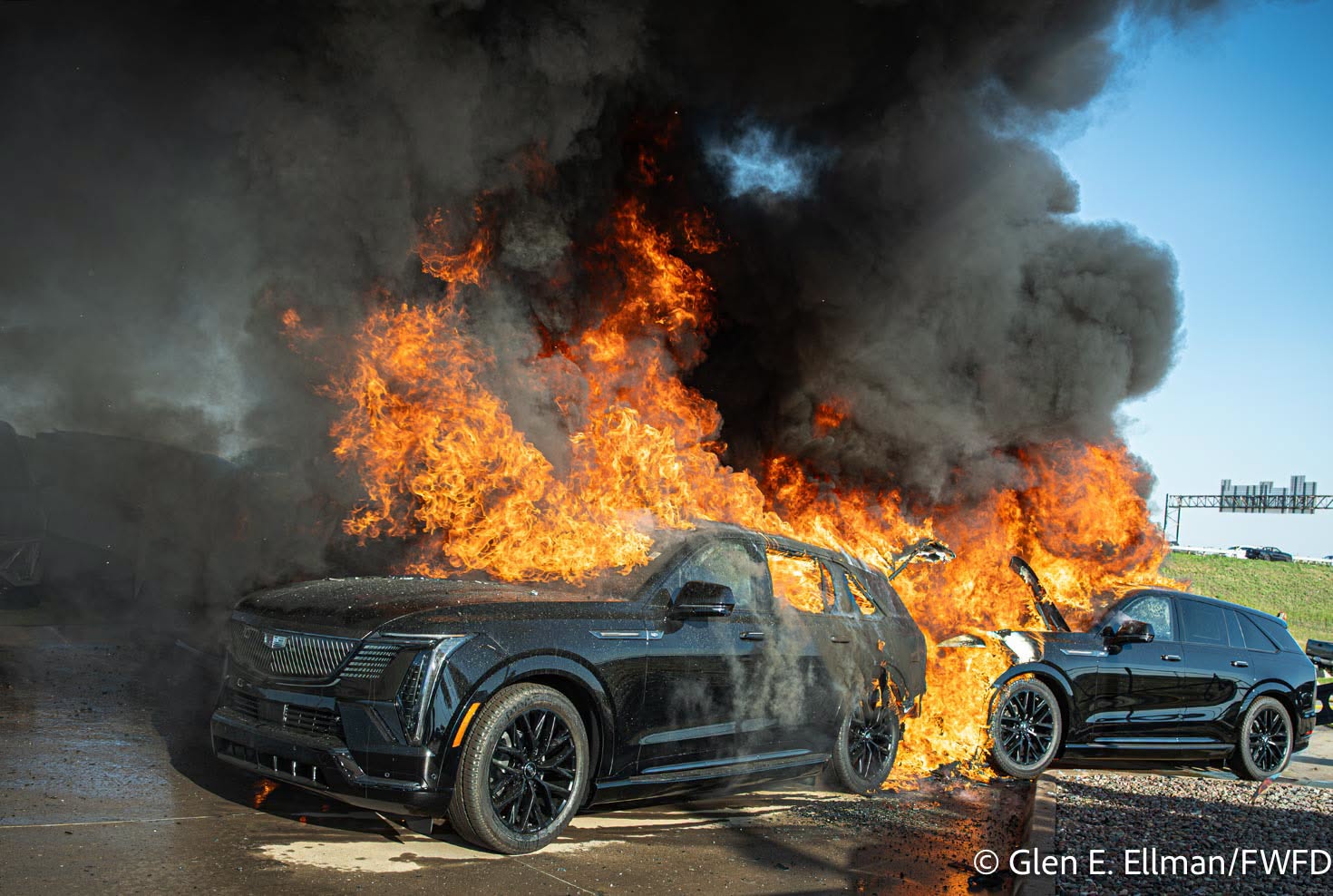
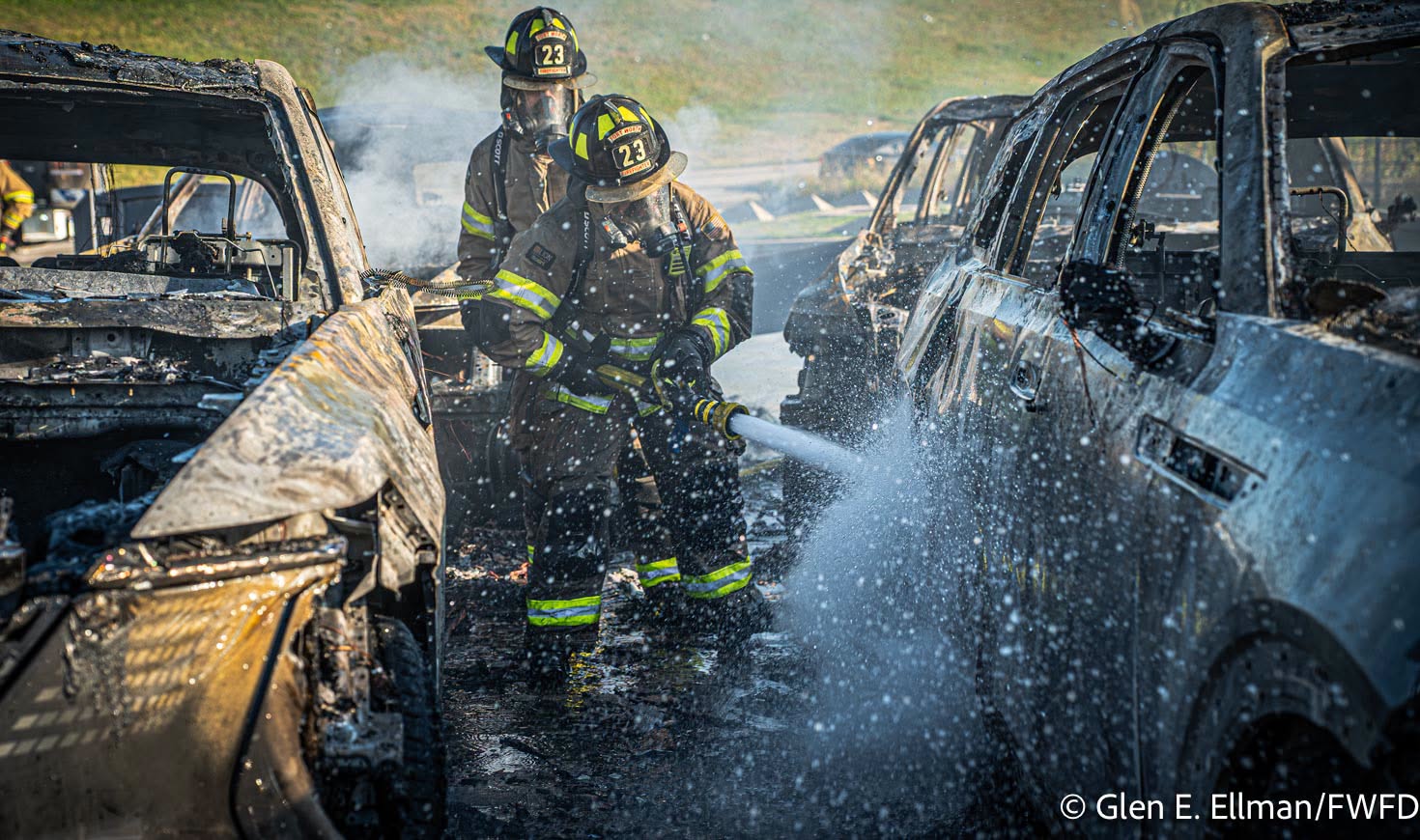
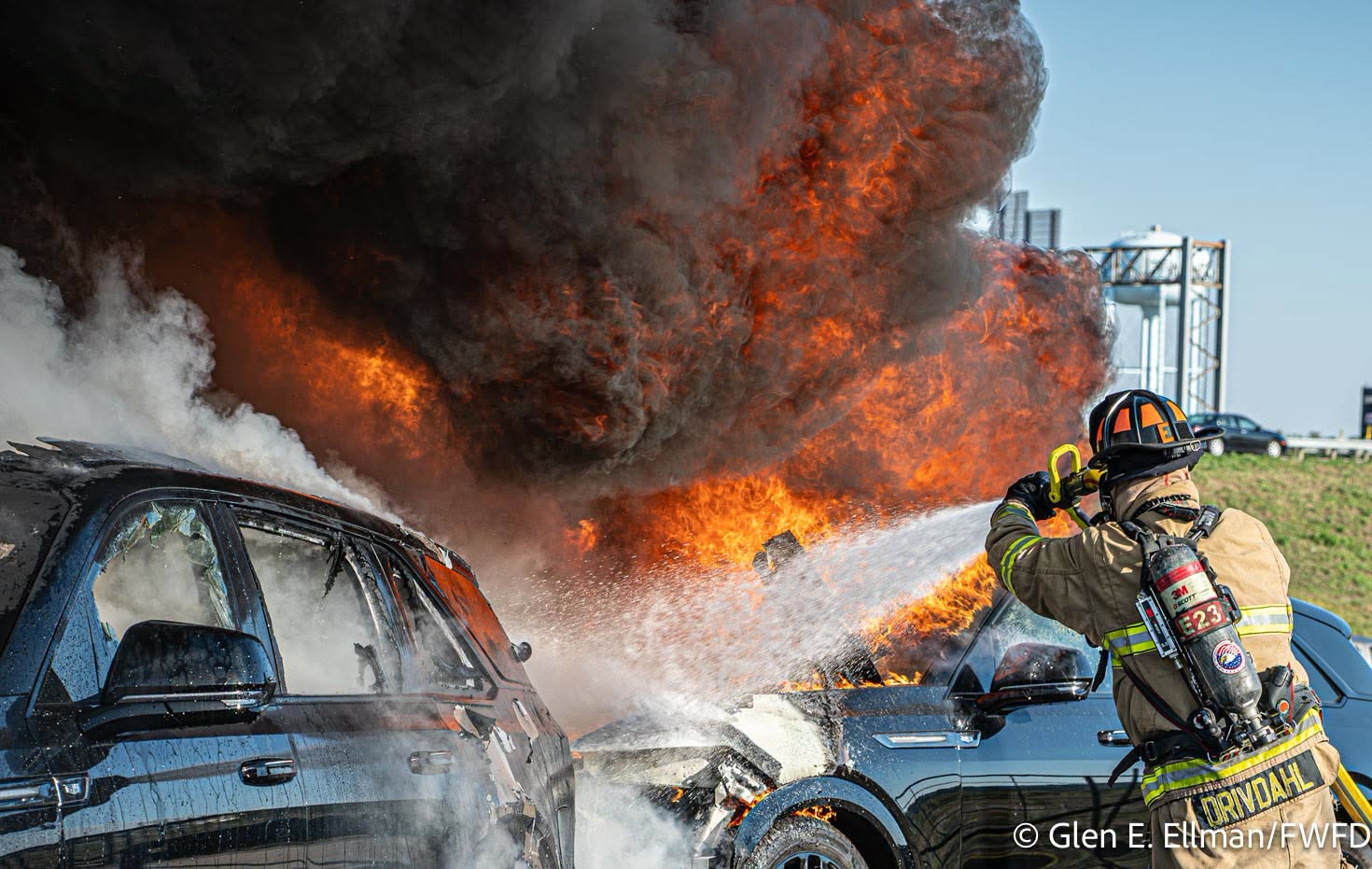
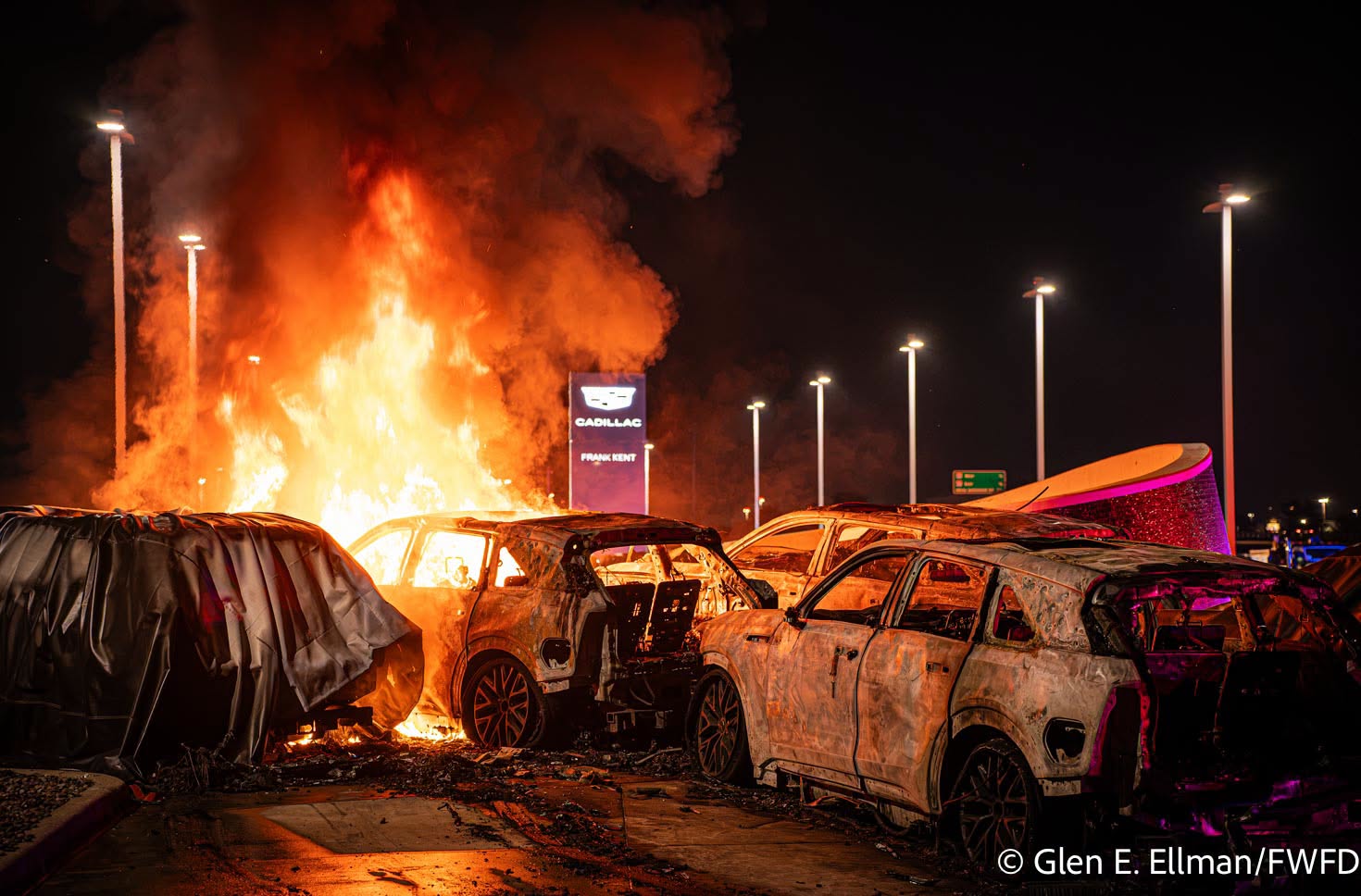
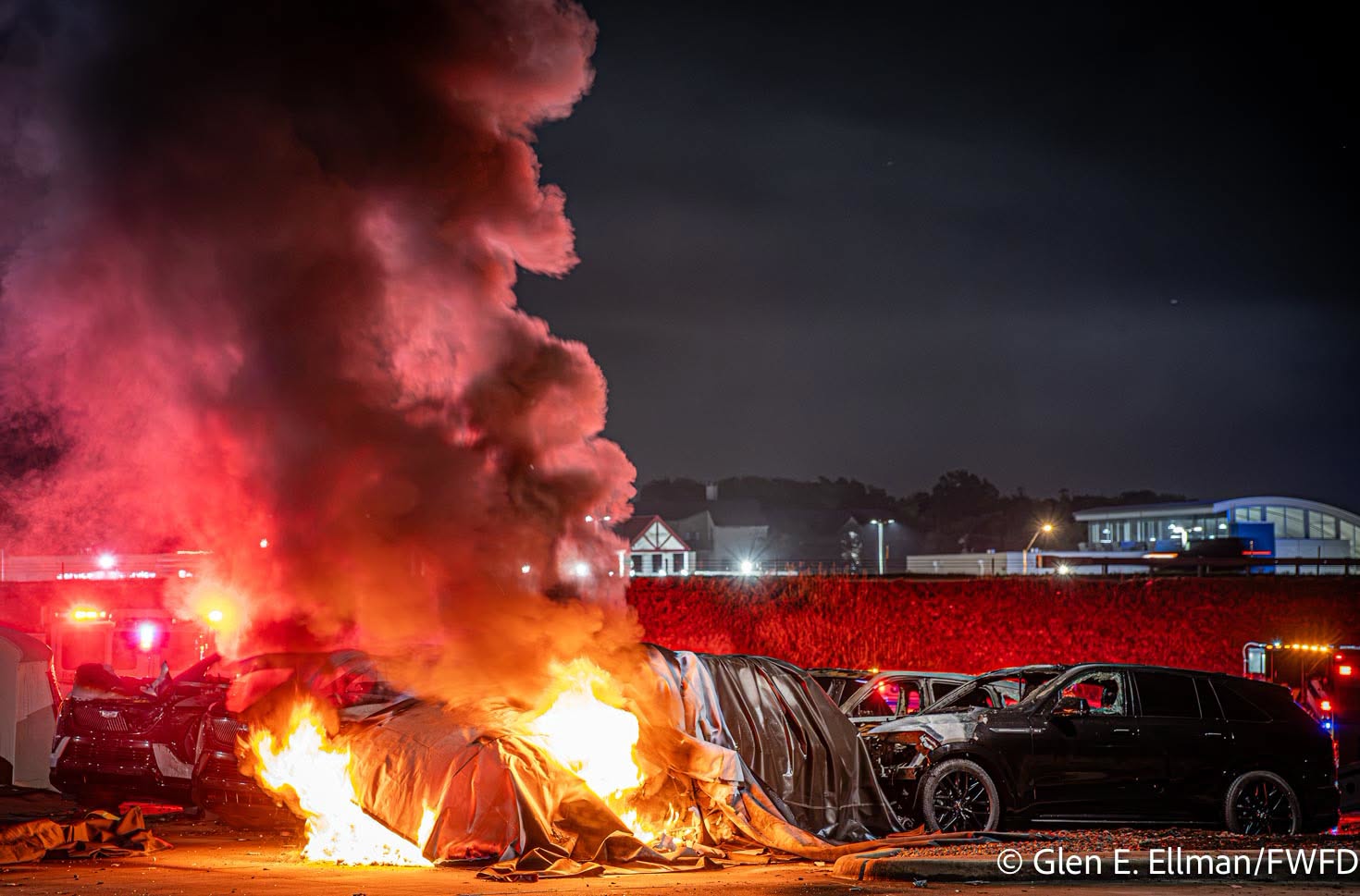
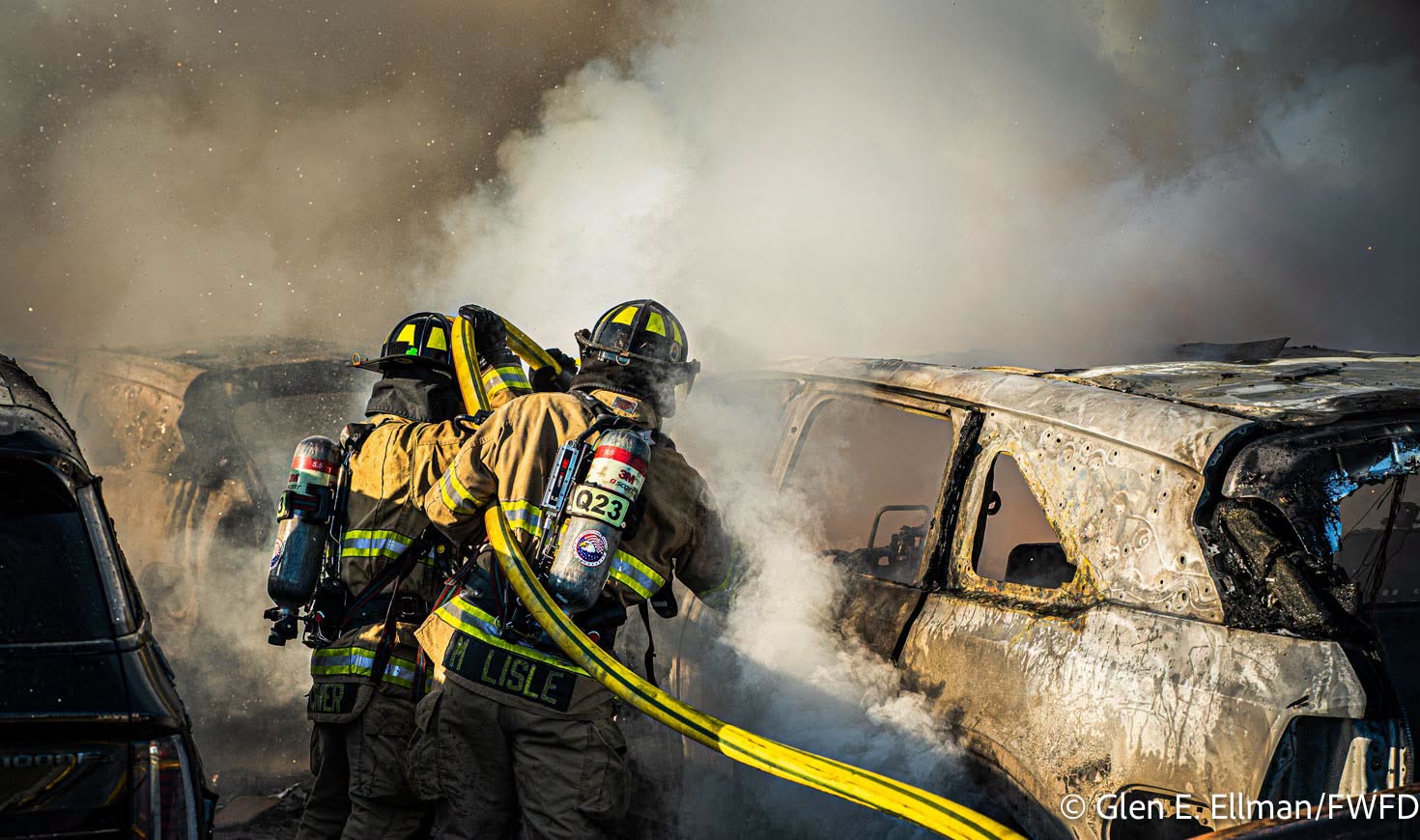
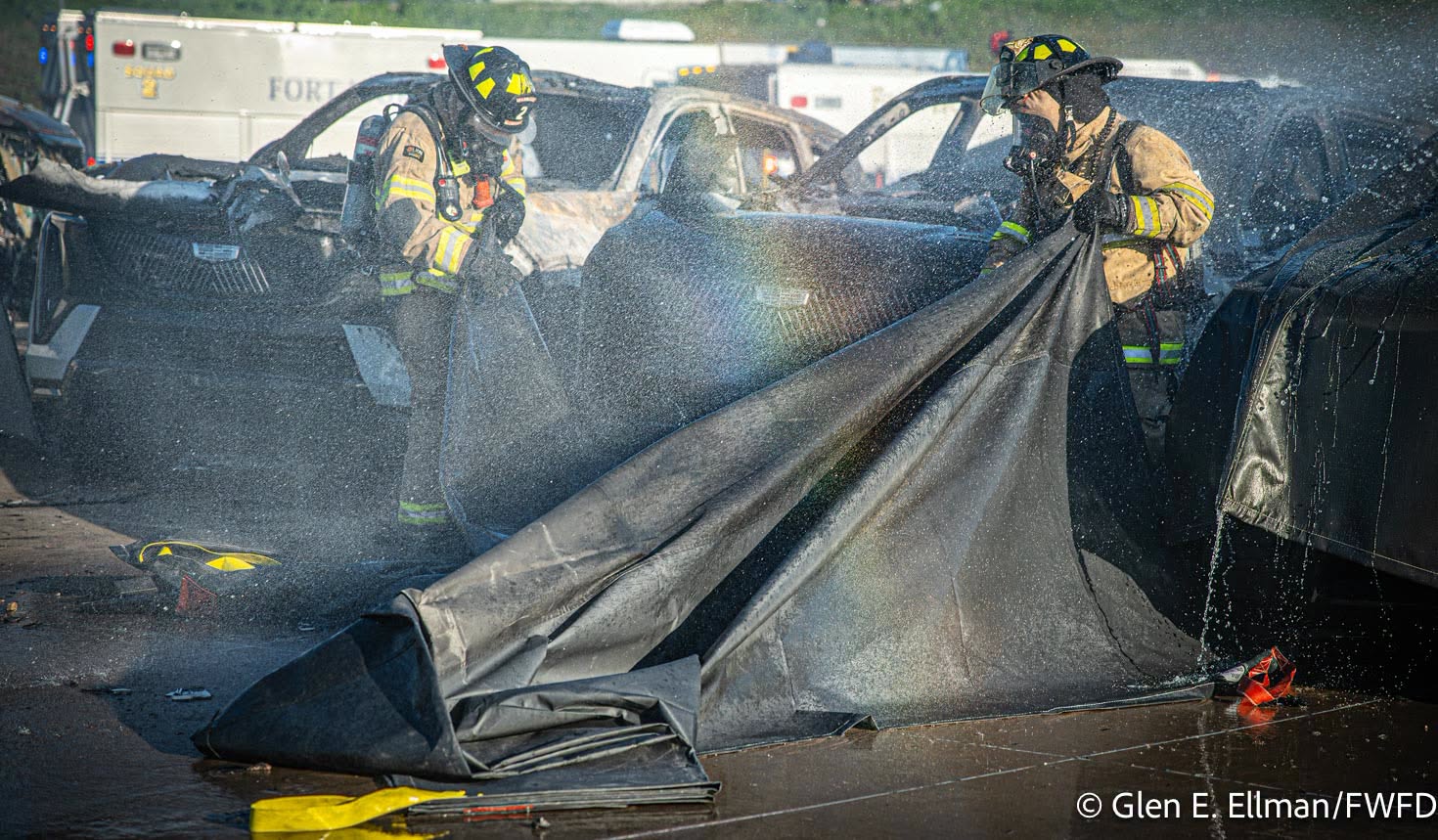
According to the FWFD, what looks like a tarp in the photo above is actually critical firefighting equipment credited with helping thwart the blaze:
In many of the photos, you will see vehicles covered in what looks like a blanket. These special vehicle blankets were placed on the cars to hold the fire at bay while other vehicles in the path of the fire were moved away. This would prevent the spread of fire to the exposure vehicles which would inevitably have created a bigger issue.
Frank Kent Cadillac was, of course, thankful for the heroic efforts of the FWFD that prevented what could have been a far more costly and potentially deadly fire, and conveyed their gratitude via Facebook:
We owe an enormous thank you to our first responders, whose quick response and decisive action brought the fire under control before it could spread to neighboring businesses or the surrounding grassland. Their professionalism, courage, and swift action made all the difference, and we cannot thank them enough. […] Please join us in leaving a kind word of thanks for the incredible men and women of Station 23,” the dealership wrote. “They showed up when we needed them most, and we plan to make sure that firehouse eats well for days to come!”
Here’s additional coverage of the fire via WFAA in Fort Worth:
For more insight on how firefighters deal with the unique nature of EV fires, I looked up the procedures recommended by the UL Research Institute’s Fire Safety Research Institute. According to its report, “Full-Scale Electric Vehicle Fire Experiments and Recommendations for Fire Incident Response” (you can view all 150 pages here), these are the essentials:
Immediately Suppress EV Fire With Water While Protecting Exposures
Suppression with a handline with water (no additives) is recommended as the first choice of suppression strategy, similar to a conventional vehicle fire attack. The use of tools designed to introduce water directly into the battery pack was not examined in this work. However, firefighters should not open or pierce the battery pack outer case.Fight the Vehicle Fire First, the Battery Fire Second
The fire in the passenger compartment represents a significant portion of the thermal and chemical exposure hazard and will readily respond to water. Rapid suppression of the cabin fire reduces the thermal and chemical exposure hazard to surrounding objects, civilians and first responders, especially if battery involvement is prevented.The battery fire is best controlled by supervising the battery fire until thermal runaway stops. Water should be applied intermittently to prevent reignition of the rest of the vehicle and redirect flames from exposures if necessary. Applying copious amounts of water to the battery enclosure is wasteful and will not stop thermal runaway. Likewise, introducing water into an uninvolved battery may increase (re-)ignition risk.
Use Caution if Deploying Fire Blankets
Fire blankets, while not recommended as the first choice in suppression strategy, may be effective under limited operational scenarios. They will not stop thermal runaway or the resulting production of flammable gases, and they limit firefighters’ ability to monitor the vehicle. Firefighters should not manipulate the blanket once it is deployed and remain cognizant of the latent reignition and deflagration hazard. It is inadvisable to use fire blankets in areas where flammable gases may accumulate and form an explosive atmosphere, such as indoors. Fire blankets should remain undisturbed for at least one hour after the last visible fire or smoke emanating from under the blanket.After the Fire
Following extinguishment, the vehicle should be observed for reignition risk to identify any ongoing hazards. Release of the vehicle should occur after inspection has identified the relative reignition risk. Even if the battery appears to have burnt out, it cannot be excluded that moving the vehicle may cause a short circuit and subsequent reignition of remaining intact cells. For this reason, firefighters should remain vigilant and continue to use an SCBA during overhaul and inspection. Fire departments should consider escorting the tow truck to the tow lot to ensure rapid identification and suppression should reignition occur. A quarantine distance of at least 5 m (16 ft) to any other combustible object should be left at the salvage yard.
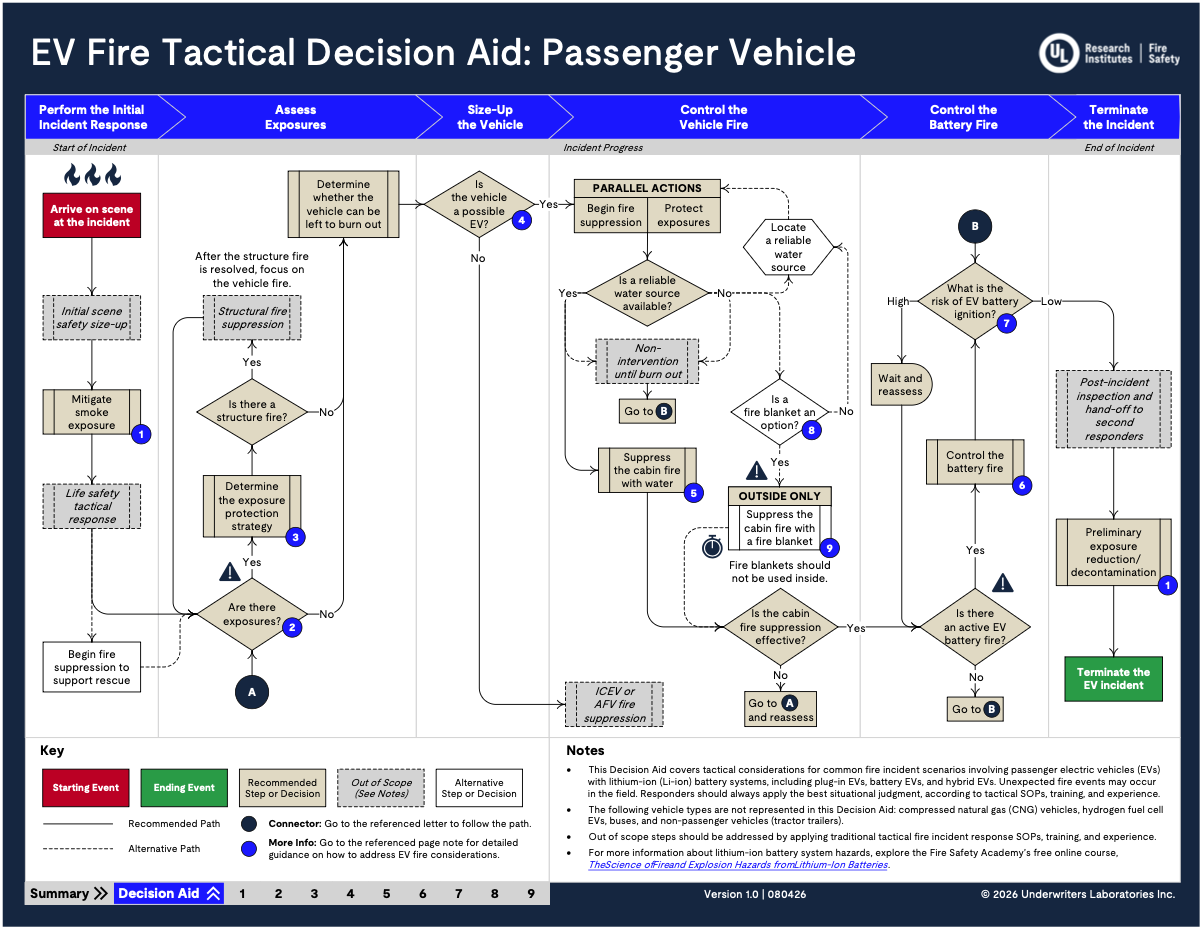
The report also includes response decision trees like this one. It’s a lot more involved than “aim hose at fire.”
[Ed Note: You have to check out this amazing website funded by the Australian government. It provides detailed info on EV fire suppression. -DT]
In the unlikely event anyone needs extra convincing that EV fires are no joke, the firefighting steps and photos above oughta do it. We join Frank Kent Cadillac in our appreciation for the hard work of the Fort Worth Fire Department and the firefighters everywhere doing their best to keep us all safe.
Top graphic images: Glen E. Ellman/FWFD


These appear to all be either Escalades or Vistiqs since I do not see any charging doors where they would be on the Lyriq or Optiq.
It seems like they need a way to get something like class d powder in to the pack. Its same sort of thing as the old magnesium block vws catching on fire. They always tried water it reacted and made it worse. Then they trained everyone to use a class d extinguisher on vw fires. It became a non issue. Every unit had at least 1 class d extinguisher. That might not be true anymore. B
Does not work in thermal runaway.
All they need is heat dissipation.
GM: We dont say fire or blaze, we call it thermal event.
Cocktails in a hot tub?
That’s been a thing since I started in the automotive industry nearly 20 years ago and at companies other than GM.
I’m sure it started well before my introduction and that most, if not all, corporations that produce products with risk of fire use it.
I agree it’s silly, but neither new nor isolated.
I always thought if you had a pair of new Jaguars sitting side by side, wouldn’t you
have a bodacious pair of Tatas??? Lol
Obligatory comment: Maybe this would’ve been a slightly smaller issue if GM didn’t make 5 different EVs that just look like interchangeable store-brand crossovers.
Rumour has it that a man was spotted running away from the burning Escaliq, laughing maniacally, whilst revving a chainsaw.
I fear GM has a problem with the platform shared by the Escalade IQ, GMC Sierra EV, Hummer EV and the Silverado EV. There was a similar fire over the weekend near Tulsa. The news stories are very light on details, but some social media reports mention the fire started with a truck. There was a recent recall on that platform regarding a component in the HV battery that may have been incorrectly installed. Hopefully this doesn’t turn into Bolt recall 2.0 again.
The Cadillac IQ has the largest battery out of any passenger EV on the market at 233.3 KWH gross. If six of them caught fire I am not surprised that it was pretty extreme, as that would be 1400 KWH of battery going up in flames. That would be about the same as 17 typical EV batteries. Did they determine how the fire was started?
Imagine the fun my work would have.
350 EV buses, ~550kWh per bus.
All parked inside.
We’ve done what we can with uprated fire suppression, 2 hour fire rated walls separating sections of parking, etc.
But hoo boy, if we ever have an incident, it’s gonna be a big one.
Cool story, but 233.3 kWh also has the same energy equivalent as 6.92 gallons of gasoline, which (checks notes) is less than every single ICE car on the road…
Huh. To go along with my “pile of fleet special Lightnings” comment yesterday, this reminds me to ask our emergency response department if they have a good plan for a similar situation.
I hope we never see you comment about your “burning pile of fleet special Lightnings”
My dealership has one FLASLD fire blanket, but I’m not sure how effective they are at countering a thermal runaway if at all.
We need an inventory to come up with a fire blanket that envelopes the car and then quickly sucks all the air out, but I’m not sure how or if that would even work.
Wasn’t the Atlantic Ocean also not enough to immediately put out some of the Lamborghinis, Bentleys and Audis that were claimed on that shipwreck?!
So who would deploy the blanket in case of a EV fire. I’m imagining the Animal House parade segment. Do not panic All is well…
Seems to me the risk and intensity of a battery fire should track with state of charge. How are these EVs stored, with batteries charged or depleted?
Lithium batteries have to be stored with at least some charge to prevent damage, so my guess is they were pretty much kept topped up.
The internet lists somewhere between a charge of 20-60% for optimal long term health. I assume that range may depend on environmental factors.
Yes, 40% is what we did at an EV Transit Bus company. Right in the middle of your numbers.
Edit: Since it’s a dealership aren’t really being “stored”. I wouldn’t be surprised if they were kept at ~80% so they are ready for customer test drive. Just speculation, however.
In my humble experience visiting EV sellers?
They are stored subjected to the whim of the salesperson. Often at 0% or 100% for weeks at a time.
Just think, if this fire had ignited at a JLR dealer you could have had a Disco inferno.
The Jaguar side of the dealer: “Whew, glad we don’t have any cars to sell right now!”
What are you talking about? They probably have more new 2025s and 2024s than a Lincoln dealer.
https://www.youtube.com/watch?v=JZ-6V-OZ4g8
Retro-futurism; is that like the present? 😉
The new Jaguar Type 01 is so hot right now.
Just how many “mysterious car fires” will be breaking out in a couple of years when those poor JLR dealers are stuck with acres of unsold Type 01 inventory?
Was there any cause determined? Gives me great confidence knowing new EV can spontaneously combust!
DT’s editorial note is interesting but concerning. Comparing ICE and EV fire risk is important, but is like comparing black powder to a magnesium incendiary device.
If/when I own an EV, it will have its own little parking spot far from my house and other structures. How are insurance rates of EVs compared to ICE/hybrid?
Was there any cause determined? Gives me great confidence knowing new EV can spontaneously combust!
Have you never heard of an ICE vehicle catching fire when parked? It happens, but we don’t call it “spontaneous combustion” when we don’t know the cause of the fire immediately. Presumably someone knows, or will know after investigation, what caused these vehicles to catch fire.
If/when I own an EV, it will have its own little parking spot far from my house and other structures.
If EVs catch fire less often, it seems odd to be more concerned about it catching your house on fire than an ICE vehicle.
I get that the EV fire is harder to extinguish, but from my perspective, the important thing is whether or not it catches fire in the first place. You don’t have to extinguish a fire that never happens.
DT’s editorial note is interesting but concerning.
How so? It added context to this dramatic, but rare, fire.
This is a simple insurance math thing: frequency versus severity.
The “hard to put out” is the major issue here.
Akin to a tornado: Not all that frequent for a specific spot, but the severity is extremely high.
And, the frequency inferred by people based on news articles (or this particular article) is much higher than reality.
“What is reality?”
25 per 100,000 for EV.
1530 per 100,000 for ICE.
3475 per 100,000 for HEV/PHEV.
Says Google AI.
To then answer the insurance question that MazdaLove asked:
I have an anecdote. I went from a 2014 Mazda 3 to a 2017 Chevy Volt. So from a 1520/100k fire risk to a 3475/100k fire risk.
[BTW, I feel like those numbers are way too high. That’s saying that a PHEV has a 3.5% chance of catching fire, which would be terribly high.]
The insurance was literally cut in half. I was shocked. Mostly it was due to the many additional safety features on the Volt. So things like lane assist, emergency stop, parking sensors, rear camera, blind spot monitoring, etc. are apparently much more of a factor to insurance than any minimal fire risk.
Are insurance companies required to pay for the cost of putting out the fires?
Yes but you are comparing 20 years of EVs vs ICE vehicles of decades age and poorly maintained. Comparison to same years of age and condition of vehicle and no outside factor I bet this switches
Spontaneously combusted…
https://insideevs.com/news/729196/mercedes-eqe-korea-fire-underground/
I’ll see that and raise you.
https://cleantechnica.com/2026/08/29/most-park-outside-warnings-involve-vehicles-with-internal-combustion-engines/
Also, a quote from the article you linked
We are taking this very seriously and will do our best to collaborate with fire authorities to determine the exact cause.
To quote a great man (i.e. me):
we don’t call it “spontaneous combustion” when we don’t know the cause of the fire immediately. Presumably someone knows, or will know after investigation, what caused these vehicles to catch fire.
Yeah my old Bimmer caught fire when a circuit breaker behind the glove compartment arched and ignited some hydraulic fluid or something. This problem only affected like a million BMWs so, you know…
Modern cars are never truly “off.” Their electrical systems are always active and present a fire risk.
So an old Bimmer, why isn’t it Beemer, vs brand new Cadillac lac lac and that is supposed to be a apples to apples comparison? The EV conspiracy push is still happening
Bimmer is for cars, Beemer is for motorcycles.
In an ICE vehicle fire it is usually a car older than any EV and usually poorly maintained. Let’s be honest new ICE Vehicles aren’t setting themselves on fire like new EVs. And hey EVs are safer than 30 years old poorly maintained ICE Vehicles is not apples to apples
Any new car can start on fire. Hell, Ferrari 458s were kind of known for it for a while – and that’s about as internal combustion as you can get.
Anxiety about EV fires is like anxiety about plane crashes. Yes, they happen, and they’re bad, but it’s probably not going to happen to you.
Also your house is going to burn the same way no matter what powers the car in the garage, and it’s more likely to go up for reasons other than the car in the garage.
So you’re saying that I’m more likely to burn down the house if I make fish ‘n chips when I’m drunk off my ass, than if I let the neighbor park his EV next to mt ICE in the garage? Sounds unlikely to me. /s
Yes same thing if you are storing oily rags next to old dynamite. Let’s just not take chances.
The ICE Cherokee I had before losing it in an accIdent had a recall notice saying it had a chance to catch fire due to something with the lift gate and I was to park it away from any structures. Same with my Carnival I believe.
Singling out EVs for shitty manufacturing and design practices seems slightly unfair.
Recalls aren’t posted based on possible random shit they are usually pretty specific.
That’s a great editor note about frequency of fire. The vast majority of EV fires happen with a damaged vehicle, so this was a really unusual fire. I’ve designed storage for EV’s after crash testing, and it’s basically a big concrete pad far away from anything flammable (vegetation, buildings, etc) after which they move them into a metal storage box with smoke detection/fire alarms in the box, also on a concrete pad away from anything else.
I seem to have missed where that fact was proven? Usually EV fires are from pretty new EVs ie 6 new Cadillacs it is the ICE fires jimmy Bob’s 74 Camaro that he used for racing on the weekend went boom.
Maybe it’s time we started worrying less about range and move to more stable LiFePo4 batteries.
I’m pretty sure those novelty candles are low-order pyrotechnics, since they spark. I wouldn’t want to be anywhere close to tens or even hundreds of tons of them in a confined space. We might not be talking about fireworks factory, here, but I don’t want to find out.
And, yes, these struggles to confine a blaze are familiar to me, having once been involved with RC vehicles and Lithium Polymer batteries. Handled carelessly they can be just as destructive as this, which is why I own a fire resistant charging box all my old batteries are kept in.
If you want to put out a battery fire you have to get water inside the battery housing where the fire is located. There are fire apparatus companies that sell piercing nozzles specially made for this. Another option is to submerge the car as others have mentioned and there are companies that make basically dumpers with a door on the end so the car can be pushed in, door closed, and the container filled with water. Either way the fire is contained quickly without huge amounts of water.
EVs and hybrids aren’t going anywhere- time to upgrade our tools.
The other option would be a universal port on the top of the battery that fire crews could connect too but that would take regulation and we hate regulation.
That would invite far too many shenanigans.
I would be wary of a piercing nozzle, that’s how batteries burn/explode in the first place. I wonder how safe and effective they are in practice?
Maybe they should just open the battery boxes with chainsaws?
But if the battery is already burning, it’s already got holes in it. They don’t burn unless they are physically compromised, another hole for the water won’t make things worse.
Fair enough, I didn’t think of that
High-pressure water jet. Let the water do the piercing…
Maybe they should put fire fighting apparatus in the battery design?
I’ve heard that wrecking yards mitigate any reignition by dropping wrecked EVs into pits or containers filled with water. Like the article said, the water does nothing to suppress the fire but at least cools the surrounding area.
Firefighters train for the EV-specific fire hazards, but once the adjacent risks are dealt with there’s not much they can do but watch the car burn.
One side note: when performing extractions from an EV the best route is through the roof, since the battery is below the seats. Rescue cutters FTW!
I knew I should not have eaten taco bell last night
Just yesterday I read an article about a 2013 Nissan Armada that caught on fire and burned to the ground when an empty passenger seat heater was left on and ignited the empty seat. The seat did have a pillow laying on it but I’m not sure that would be a contributing factor since the seat is intended to have a buttocks present.
I now feel less paranoid about turning off the seat heater on the passenger seat when it’s empty.
There wasn’t much left to investigate but the article noted that heated seats have thermal management to prevent the seats from becoming to hot so as to prevent injuring people. One of the theories is that due to age, that module failed allowing the seat to heat up to such an extent it ignited the seat.
The driver noted he smelt something burning but couldn’t readily identify the source. It seems things took a turn for the worse when he removed the pillow, allowing a fresh supply of oxygen.
Usually those are directly connected to the ignition so they can’t be left on.
Next up on The Autopian: “How a Terrible New Cadillac Can Actually Be A Great Used Car.”
I think DT already drove an unburnt example for a Trade-In Tuesday last month.
While I understand that EV fires happen less often than ICE fires, they sure seem to be more destructive, and much more resource intensive to extinguish. I’m not anti-ev, but I look forward to the day that they find a battery chemistry that is more stable.
Iron-air is stable but far too heavy for EVs. Very promising for grid storage, though, especially as they don’t require the large amounts of rare earths.
Lithium Iron Phosphate exists, but it’s not as energy dense and mostly manufactured in China. It’s mostly used in stationary applications, but there are many cars with LFP packs on US roads. They’re much better for cycle life and much more difficult to ignite, but the reduced range for the same weight keeps them limited to base models or shorter range variants.
Don’t worry, those Donut Lab guys are on the case!
I hear it’ll be in production and on sale by year end!
Remember when all we had to worry about were magnesium engine block and wheel fires? (I never could find out if those were real, but I did see an engine block ignited on purpose once.)
Magnesium fires definitely happened in race cars that used the material. (see LeMans 1955.)
How did the fire start? Did the Cadillac dealer have a bunch of Escalade IQ’s they couldn’t get rid of?
Can of gas and a match, maybe?
Fire fighters in the Netherlands nowadays bring a container to an EV fire. The burned EV is being hoisted into the container, filled to the brim with water, and kept submerged for at least two days.
For some reason, this reminds me of the “put your phone in a bag of rice” thing, but backwards
Kudos to the firefighters, this could have really turned tragIQ if they weren’t on hand.
Could have Escaladed
I wanted to write a heroic song about the firefighters, but the Lyriqs were just too hot to handle.
Fleetwood Mac cover?
This thread is General-ly as illuminating as backup lights that turn on when the unoccupied car’s unlocked on the fob.
The Optiqs would certainly have been bad if they did not have the appropriate equipment.
The DeVille is in the details.
After reading this, I wanted to Bolt.
It’s a shame because the iQ has a great Silhouette, and I’d Venture a guess that a few of these would have been registered in Montana.
You forgot the Volts. But none of these are current.
Nor are the Voltswagens.