


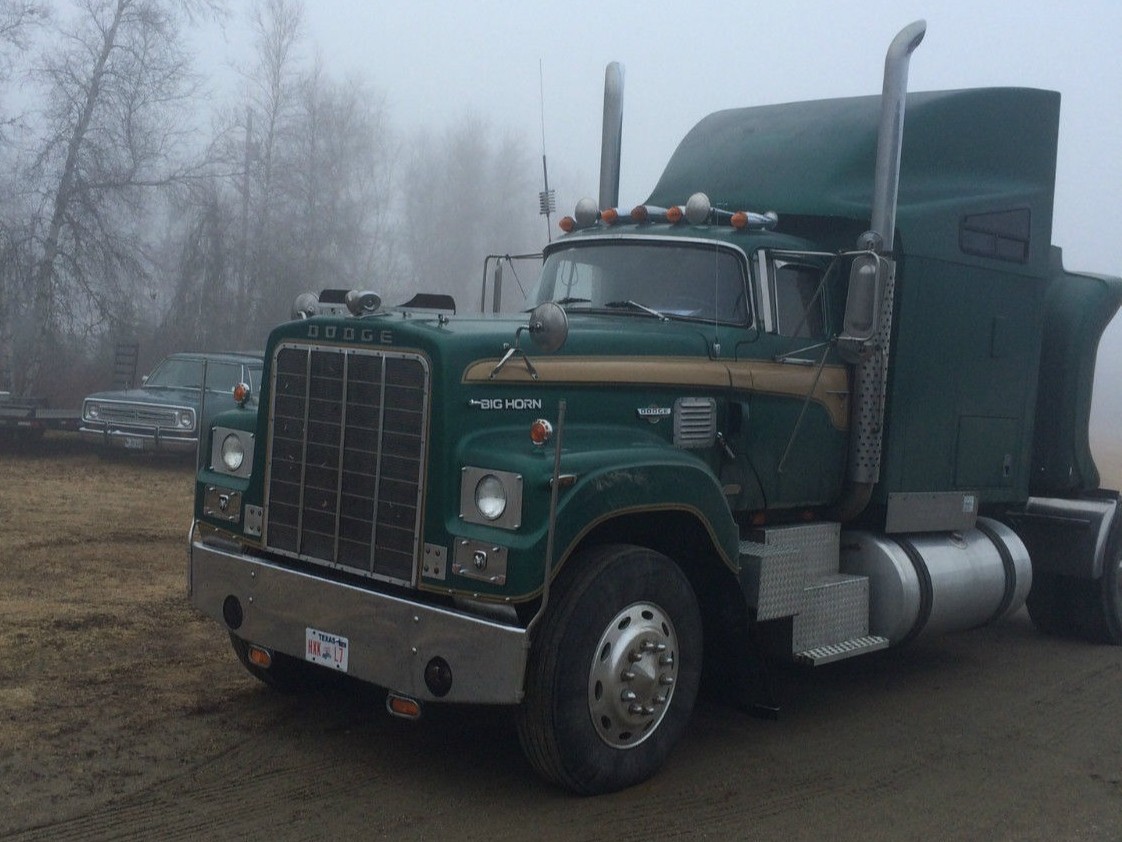
Automakers tend to stay out of the market for Class 8 trucks. If you’re a trucker today, you aren’t going to buy a new highway tractor with General Motors, Ford, or Chrysler badging. But this wasn’t always the case. Several decades ago. American carmakers also tried to compete in the big trucking industry, with varying levels of success. In the 1970s, Dodge tried to rule the trucking industry with the Bighorn, a semi that was huge on style with a ridiculously long hood and big on repairability. Yet, to many truckers, Dodge managed to create a truck that was outdated from the moment it rolled off the production line.
The world of trucking was a very different environment in the 1970s. Some people today look down on truckers and the trucking industry as a whole. But in the 1970s? Truckers were revered as counterculture heroes.


As I wrote in my story about the history of the CB radio, several events had thrust trucking to icon status. The United States had been hammered by multiple oil crises. If fuel shortages and high fuel prices weren’t enough to make you want to pull your hair out, consumers of the era also had to contend with changing vehicle emissions and safety regulations that arguably made cars worse while automakers tried to figure out the new era. On top of that, Americans had to trudge through a weakened economy, double-digit unemployment, the Vietnam War, and the Watergate scandal.

It was in this era of uncertainty and turmoil that an unexpected occupation became heroic. During the fuel crises, truckers used their CB radios to help each other find fuel stations that both had fuel and weren’t charging a fortune for it. Truckers also used their radios as a small form of rebellion, warning their fellow truckers and motorists about police speed traps.
In a time when people lacked trust in their authorities, truckers had become legends. CB radios flew off shelves, Hollywood churned out famous films involving truckers, and seemingly everyone wanted to drive a big rig.

Dodge saw this era as an opportunity to make its mark in the trucking industry. The Bighorn had the looks and had the marketing, but Dodge would end up selling only 261 units.
Detroit Takes On Trucking
There was once a time when automakers had concerned themselves with capturing as many industries as possible. General Motors used to be a powerhouse that dominated a shocking number of industries, including locomotives and buses. GM’s Electro-Motive Division and the GMC Truck & Coach Division were once so domineering in their markets that the manufacturers in second place were lucky if they even captured a quarter market share.
Historically, automakers loved pushing the envelope in the trucking industry. When Ford launched its iconic F-Series in 1948, the Blue Oval didn’t just build light-duty pickup trucks. The F-Series line rose to the meaty F-8 Big Job, with its 22,000-pound gross weight rating. Back in 1948, these trucks were considered heavy-duty rigs, and Ford’s F-7 and F-8 trucks were seen doing all kinds of heavy work from hauling trailer freight to moving hard and heavy rock.
Ford would later introduce the C-Series medium-duty, which would become an icon and enjoy an impressive 33-year production run from 1957 to 1990. Then came the Ford H-Series highway tractor in 1961, below.

Across Detroit, General Motors created a trucking legend with the 1959 GMC F-Model cabover trucks, which truckers nicknamed the ‘Crackerbox’ for its cab’s resemblance to a tilted box of crackers.
Dodge, like its rivals, had a long history of building trucks. Light trucks had been a part of Dodge’s history since 1914, the same time when the Dodge Brothers started slapping their badge on their own cars. However, as MotorTrend writes, Dodge really came into its own on the battlefield. In 1916, General John J. Pershing and then Lieutenant George S. Patton used a convoy of Dodge trucks and Dodge Model 30 touring cars in the Mexican Border War.
Dodge would later send nearly 13,000 trucks, including 2,500 commercial trucks, into the battlefield in France in World War I. It was in the field where Dodge trucks gained a reputation for hard work and dependability, but it was the events of World War II that really thrust Dodge’s popularity. Dodge armed the Allies with more than 400,000 trucks during the conflict, the most famous of which was the WC. Here’s what the Estrella Warbirds Museum says about the WC:

During World War II, the Dodge Company produced tens of thousands of light weight, versatile trucks including the WC “weapons carriers”. While most cargo was carried in “deuce and a half” or larger vehicles, the Dodge WCs worked long and hard, an essential part of Army mobility that led to victory in 1945. Thousands more were shipped to allies, including the Soviet Union, where they were also revered.
Following World War II, the same Dodge WC trucks continued to serve, then returned to duty in the Korean War. They were finally replaced in the 1950s by the Dodge M-37, another legendary tough truck. There was a time when the people who drove four-wheel-drive vehicles were mainly men on missions, be it for the military, the Forest Service or utility companies. The vehicle of choice for those manly men who got the job done was the Dodge Power Wagon.
In military use the M-37s were configured various ways, including as ambulances and fire trucks, with WC series trucks acting as weapons carriers (1/2 tons WCs were produced from 1940 up until 1942 and then the 3/4 ton series were produced from 1942 up until 1945). Civilian Power Wagons also came in several types, and many did see service as fire trucks, especially in forestry work, but the most common Power Wagon was fitted with a pickup box that measured eight feet long by four and a half feet wide with sides the sides of the pickup box about two feet above the bed.
When soldiers came home from all of these conflicts, says Dodge, they wanted to buy the trucks that helped them win the fight. The Power Wagon was the truck for these people. But the wars also weren’t just good for light-duty business, as Dodge’s big trucks had also proven themselves in battle.
Dodge’s workhorses would evolve in the years after WWII, with Dodge hitting the heavy-duty market with cabovers in the 1950s and the blocky Low Cab Forward (LCF) conventional truck in 1960.
But 1973 would bring something big. That’s when, as Heavy Duty Trucking Magazine writes, Dodge decided to cash in on the steadily rising popularity of trucking.
The Bighorn

The best resource for the Bighorn used to be OldDodges.com, which had a couple of archived stories on the Bighorn as well as an owner registry and preserved spec sheets. Sadly, the website is gone now, but it is still accessible through the Internet Archive.
As serial Dodge Bighorn owner and Bighorn expert Tony Youngblood wrote, Chrysler didn’t want to just leave the big truck market to players like Kenworth and Peterbilt. While Dodge did have an existing semi, the aforementioned LCF, the marque wanted to come swinging with a truck befitting the trucking-obsessed 1970s.
Dodge’s engineers wanted to cook up a truck that would sway buyers away from the truck establishment. Their truck would have an engine bay huge enough to accommodate the largest engines of the era. But more than that, Dodge wanted its truck to be easy to repair and long-lasting, all qualities that truckers were looking for.

Youngblood wrote an article titled The Endangered Bighorn, which was published in Wheels of Times in the 1990s and in Old Time Trucks in 2004. In it, Youngblood describes what made the Bighorn different:
Basically there were two styles of Bighorns built. The top of the line was the Custom Cab Bighorn consisting of the following options:
– 350 Cummins
– 13 Speed Fuller or 16 Speed Spicer. The 16 Speed Spicer had a chrome tower that covered the gear shaft lever and air lines.
– 12,000 front axle, some with front brakes, which my truck (Tony Youngblood) has. This is very rare. Most are 38,000 rears being Reyco 101 on the ’73 and ’74 models with inboard brake drums , and Reyco 102 on the ’75 models with outboard brake drums.Other options to keep the weight down were aluminum crossmembers, rear skid and intermediate, front bumper, hubs front and rear, differential carries, battery boxes, centerfuse drums, aluminum cab supports (which I found was only on the ’73 models,) fuel tanks, and a transmission case on Spicer transmissions. Also, the rear wheels were lightweight hi-tensile steel wheels, while the front wheels were lock rim style aluminum wheels. In these areas Dodge was trying to watch the weight of the truck.

Youngblood goes on to note that Dodge went through a lot of iterations of the ram affixed to the hood. The one on the prototype truck was made out of stainless steel and weighed 14 pounds, which must have been hilarious given the other ways Dodge worked to lower weight. However, Youngblood writes, Dodge would figure out how to shave the ram hood ornament down to two pounds using aluminum.
Youngblood continues:
The nice Bighorn also came with a 1500 Cubic inch radiator, which is one of the biggest if not the biggest radiator ever put in an over the road truck. In front of it were Kysor shutters. The shutters were built to remain open if the truck had air conditioning and it was on.
The 13 speed Fuller was usually a RTO 9513 with Rockwell SQHD rears and a 4.44 ratio. These options were offered by Dodge, but you could get a number of rear axle ratings. The ratings range from 34,000 to 44,000 with a 140,000 turnpike rating. Any ratio’s were offered with the ratings. The front axle was mostly FF921 on 12,000 and FG on the 16,000 pounds. Shocks were also offered on the custom cab with an air suspension Western Stabilizer on the rear.
Frames were offered at any wheel base and were of heat treated Hi-Tensile Steel- 110,000 PSI on the 10 1/8 X 3 1/4 X 1/4. A 5/16″ thick frame rail was optional. There were 1810 series propeller shafts on most of the trucks I have seen. Exhaust systems on most Bighorns consisted of a 5″ chrome elbow starting under the vertical muffler curving around and under the rear of the cab where they connected to a flex pipe and then a solid pipe joining the turbo. The muffler was held at the top rear corner of the cab by and aluminum bracket. The lucky Bighorn owners with dual exhaust systems had a better balanced looking truck, making the cab look bigger behind the massive hood. Otherwise without the mufflers and shields the cab looked like an after thought, which was small for the hood.

Youngblood’s article continues by talking about how each Bighorn was assembled by hand. This meant that each frame had only the exact number of holes it needed and that the trucks didn’t have mounting hardware or extras for parts that the specific example being built didn’t have.
As noted earlier, these trucks were also built to be easy for an owner-operator to work on. For example, the Bighorn’s stylish white steering wheel, which had a custom suede wrap around the column, could be adjusted all the way down. From that position, one could remove four screws and then open up the dashboard like a piano. Opening the dash gave complete access to the gauges, wiring, and air valves. Dodge even provided the driver with a wiring diagram that was visible right when you opened the dash.
Youngblood says that the truck’s gauges were bi-torque waterproof units from Stewart and Warner. These gauges, which included everything from air levels to the oil temperatures of most critical drivetrain components, were also mechanical in most Bighorns as electric gauges weren’t quite reliable just yet.

Youngblood then goes on to describe how the interior of the Bighorn was supposed to be luxurious:
The inside of the Custom Cab Dodge was clean and its systems were close at hand. The seats were any type offered by Bostrom with a Bostrom Viking companion seat. They were pleated and matched the color of the vinyl trim on the door, roof inserts (also pleated), back panel and the console between the two seats. The inside door grab handles were polished aluminum with a square shape. On the 1975 Bighorn the outside grab handle matched the inside grab handle. On the ’73 and ’74 they were round chrome handles on the outside which made the ’75 easier to spot. In the ceiling was a housing storing either AM or AM/FM stereo. The speakers were in the back corner of the cab, just about head level. The glass was tinted all around which along with the integral air conditioning system helped keep the cab cool. The air conditioning used the same housing in the cab as the heater. The evaporator fit in with the heater radiator. The condenser was in front of the shutters. The compressor was a York or Tec with a 3 speed switch.
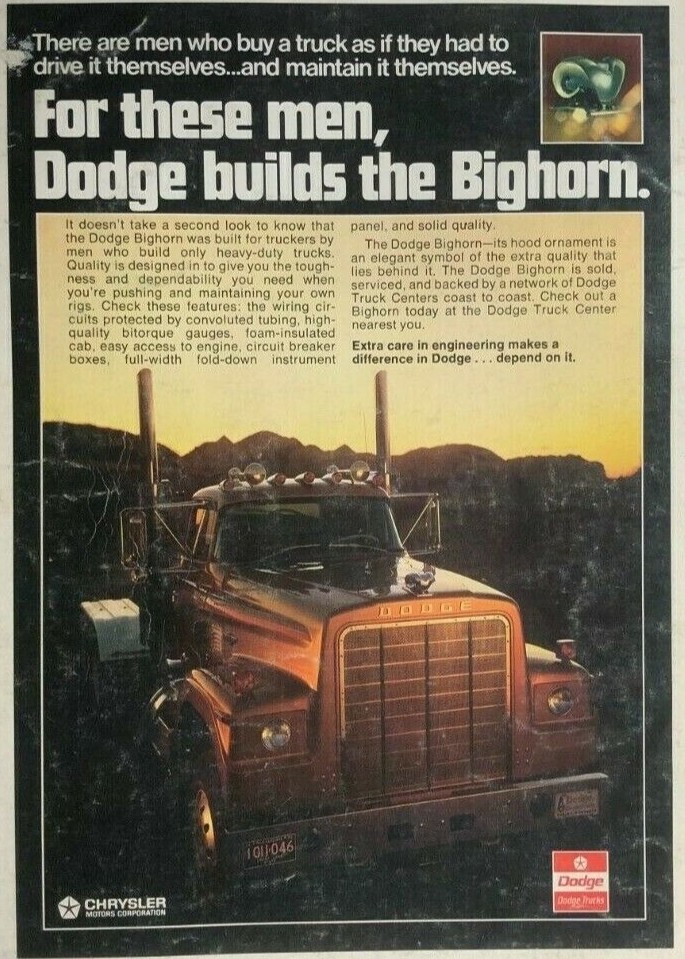
In advertising, Dodge said that the Bighorn was built for the “men who buy a truck as if they had to drive it themselves … and maintain it themselves.”
Alongside the aforementioned trick dashboard, Dodge touted the Bighorn as having wiring protected by tubing and circuit breakers, an easy-access engine bay, and “solid quality.” The ad urged drivers to visit one of 89 Dodge commercial truck dealers to pick up a dependable rig.
The standard Bighorn shipped with a 927 cubic inch Cummins Super 250 straight-six diesel. I could not find horsepower data for this mill, but the standard Cummins 250 made 250 HP. If that wasn’t meaty enough, the Bighorn was also available with Cummins powerplants as high as the NTC350 855 cubic inch straight six diesel, which was good for up to 350 HP. If you fancied yourself as a fan of Detroit Diesel, the hottest engine was a 9.3-liter Detroit Diesel 8V-71T turbodiesel V8 good for 350 HP. Torque figures got as high as 965 lb-ft.
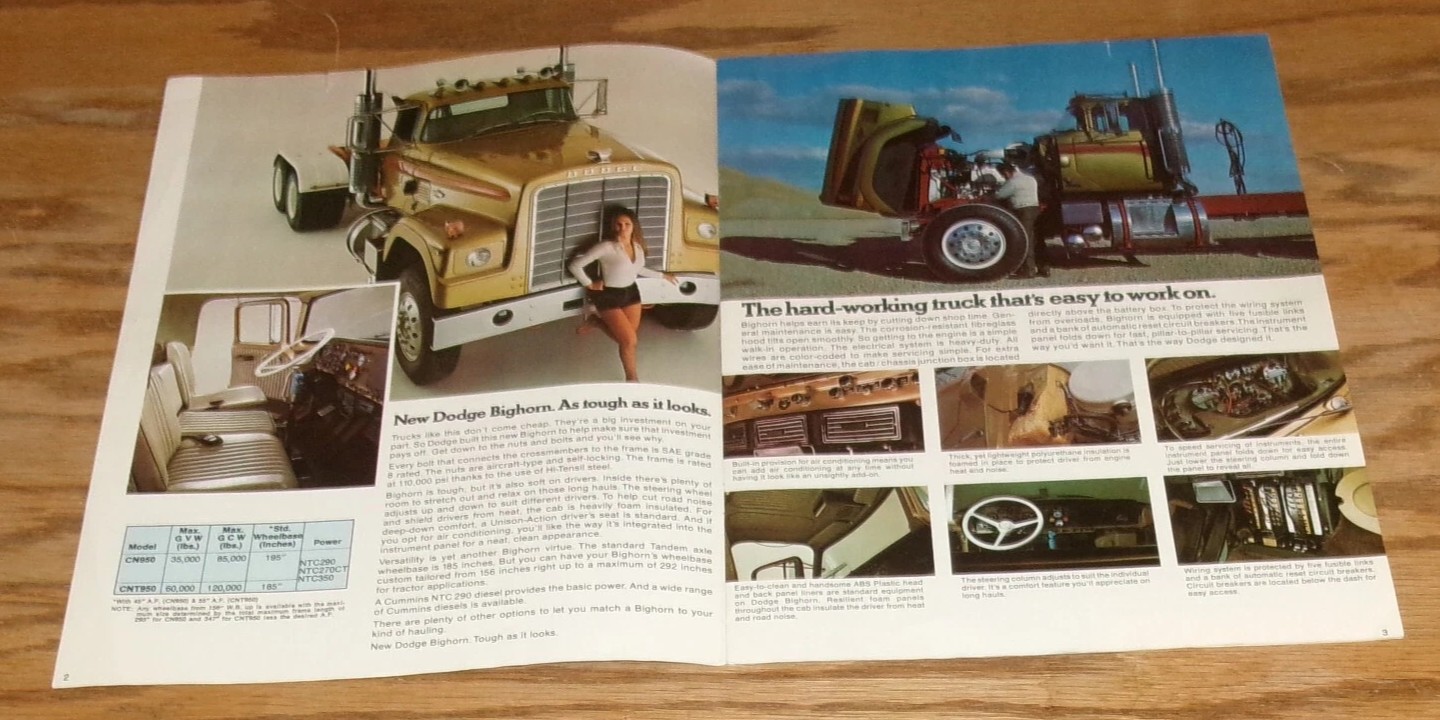
Bighorn buyers had a choice of Fuller or Spicer transmissions, Eaton or Rockwell axles, 75-gallon or 100-gallon fuel tanks, leaf springs or air suspension, upgraded brakes, aluminum and chrome dress-up parts, and so much more. Basically, there were so many different options that most Bighorns could have been ever so slightly different. Dodge had even planned on introducing an option to get your truck with an aluminum frame (the prototype Bighorn had an aluminum frame), but production would end before that would happen. Some options, like the air ride, were rare enough that, per the articles that Youngblood had written, not even he had seen any Bighorns with the option.
The Bighorn Makes A Small Splash
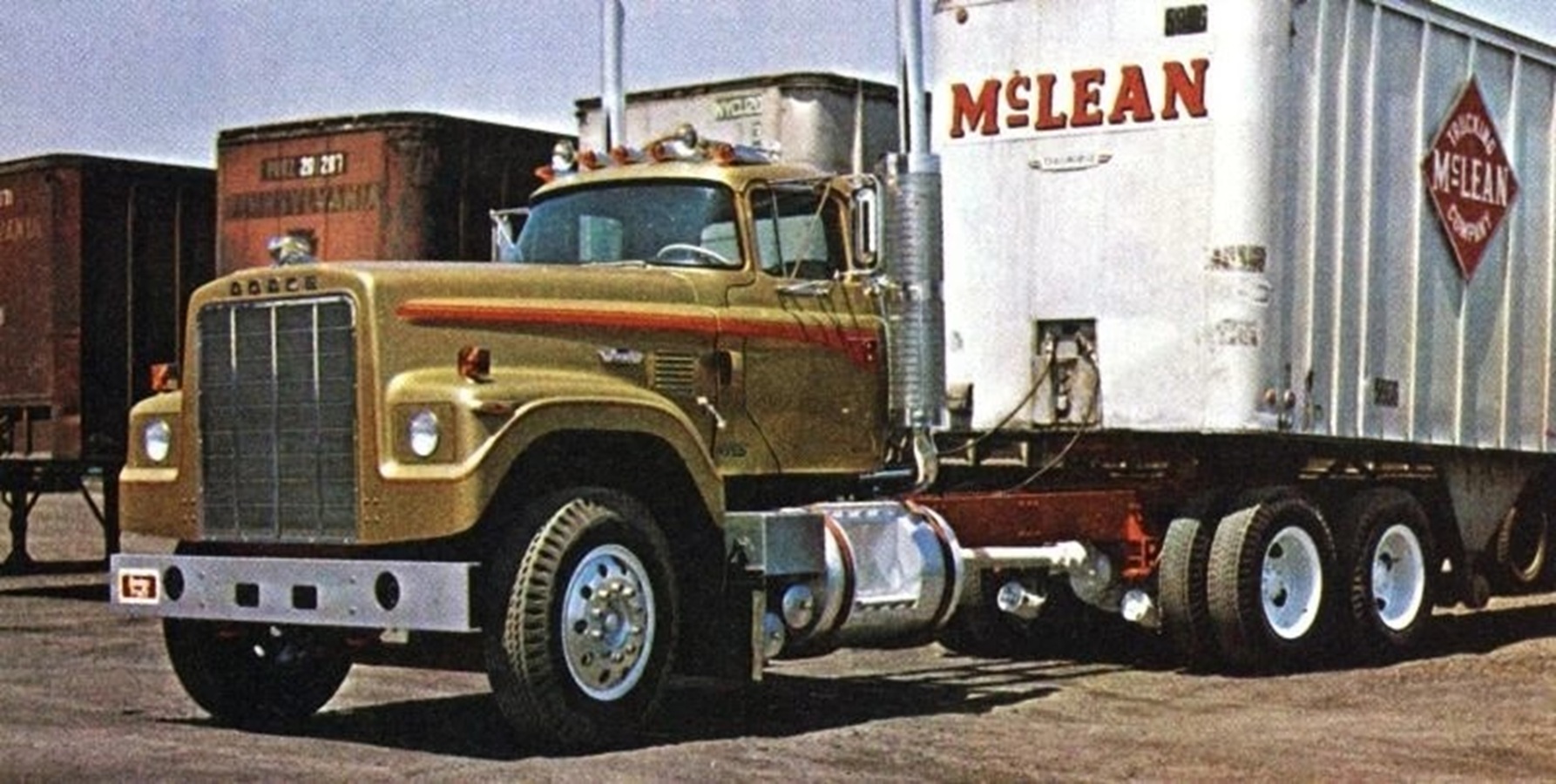
The Bighorn made its debut in 1973. Sadly, I could not find a period review of the truck. However, HDT Equipment Editor Jim Park drove one back in 1973, and gives his take in the retrospective at Heavy Duty Trucking Magazine:
“The enormous big horn hood was impressive looking, but it did little to improve the visibility from the driver’s seat,” Park notes. “The hood on the C-models, 600 thru 900, was slimmer and the headlight assemblies we integrated into the fenders. But really, the hood was the only impressive feature of ’70’s vintage Dodge trucks.
“The cab was small and noisy, and very dated, even for that era. It looked like a hold-over from a ’60’s vintage pickup truck”.
“Those first Dodge trucks were nearly my last,” he says. “That fleet spec usually had a naturally aspirated, in-line 6, two-stroke Detroit Diesel Series 71. It produced a whopping 238 hp. Barely enough power to get out of its own way.”
Later, HDT’s editor got to drive a hotter version, and he still wasn’t impressed:
“Drivers called that engine the ’shiny-290’ because it made a whopping 290 hp. I thought I had died and gone to heaven. But it was still a Dodge. On several occasions, when coupling to a heavy trailer, the tractor got pushed back out and the engine started running backwards, with exhaust billowing out of the air cleaner.
“The tiny cab, the huge hood, no firewall to speak of to keep the engine heat at bay, and no power steering rendered the Big Horn, in my mind, only slightly more fun to drive than an ox cart.”

Youngblood notes that while the cab on the Bighorn looks to be exactly the same as the cab used on Dodge C series pickups in the 1950s and on Dodge’s heavy-duty line in the 1960s, the Bighorn version does have some differences:
The cab on the Bighorn most people think is the same as the C-cab, but it it not. Of course the doors are the same, but the firewall is different and braces inside the cab are also different. Two outside panel extensions where the 950 emblem goes, fill the space between the door and hood. Full sprayed-on closed cell foam on firewall toe board and under cab floor help keep out heat and noise. Also closed cell foam sheet between metal and floor mat along toe board and dash. Floor mat had double closed backing insulation. The cab of the Bighorn was produced by Checker Cab Company. The part number is 3731-905 where as the C-cab part number is 3731-904.
What’s interesting is that there appear to be two camps here. Heavy Duty Trucking Magazine called the Bighorn dated, “disdained by many drivers,” and “very much a cobbled-together design,” calling out that, despite the changes, the cab still dated back to the ’50s. HDT’ Magazine’s article also points to a cramped cab and the lack of standard power steering as reasons why the Bighorn was a miss.

Yet, there’s an entirely different camp of people who think the Bighorn was the biggest thing in trucking. Here’s what Youngblood says:
All past and present Bighorn owners will tell you they think this is the best all around truck produced by anyone. When produced it was so far ahead of its time that is would blend right in with today’s trucks.
Regardless of what you thought, it didn’t really matter. Ultimately, the Bighorn would be short-lived. Dodge produced only 261 units between 1973 and 1975. That year, Dodge didn’t just cancel the Bighorn, but it left the Class 8 trucking industry entirely.

The reason why is unclear. On one hand, it’s unlikely that HDT Magazine‘s editor was the only person who thought the big rig was a huge miss. On the other hand, the Bighorn does have its own fan club. Youngblood places the blame at least partly on Chrysler, as Dodge dealers failed to stock the trucks under the belief that Chrysler’s pulling out of the Class 8 market was inevitable. Youngblood even says that even as Dodge was beginning to market the Bighorn, there were already rumors about Chrysler pulling out of the market.
Then, Youngblood notes, there was the fact that a new anti-skid safety law was enacted, and the Bighorn wasn’t designed to meet the specification. Regardless of what actually happened, the Bighorn was a flop, and Chrysler left the market and hasn’t looked back since. Not even the Dodge Rams of Mexico rose to the level of being Class 8 trucks.
A Second Life
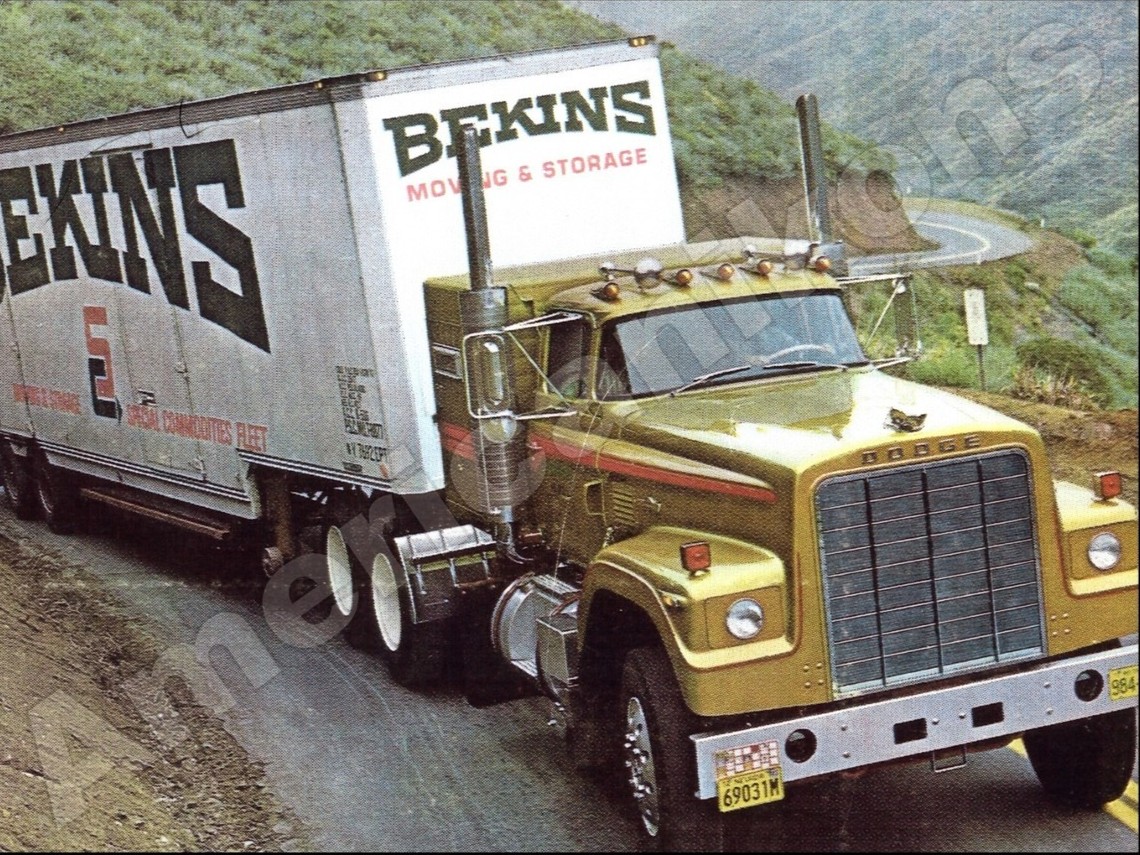
Despite this, the Bighorn is revered among classic big rig fans. While it might have failed to rule trucking, Bighorns are highly sought-after collector trucks today. In a weird way, the Bighorn is like one of those movies that become famous only decades after they flop at the box office.
If you’re looking for a Bighorn, be prepared to wait. Youngblood believes that there are around 105 Bighorns that have survived to the modern day, and their owners rarely let go of them. Thus, it’s hard to find comps for these rigs. One was listed for $95,000 in January 2025, and one of the even rarer shortnose prototype Bighorns, of which only nine were made, appeared on eBay in 2021 with bids exceeding $30,000, with the reserve still not met. So, treat a Bighorn like a 1970s muscle car and expect to pay a ton for it.
The Dodge Bighorn was a product of a different, wilder time. A time when America’s car manufacturers wanted to go up against the big names in the trucking industry. Sometimes they had innovative trucks, and sometimes you got moonshots that went nowhere, like the Bighorn. I wonder what a modern “Ram Bighorn” would look like if Stellantis tried to get into this market again?





I can’t believe you missed the real reason for the cultural moment of truckers and CB radio, the biggest revolt of the otherwise law-abiding against a stupid law since Prohibition, the hated 55 mph speed limit, the dreaded double-nickel.
That things looks what Quagmire would look like it he were a big rig. The proportion of the hood to the cab is comical.
My father got into trucking pulling bottom-dump trailers to construction sites with a mid-60s IH tractor with an 8V-71 Detroit Diesel and a 4×4 transmission. It was a punishing duty for the trucks and their operators.
Once he was making money, he sold that and got a ’71 Kenworth with a 350 Cummins and a 13-speed RoadRanger. Given the poor sales figures, I guess it’s not a surprise that I never saw a Dodge when I rode with him.
I got to drive it, bobtail, a couple of times in high school and it was the most intimidating thing I have ever been behind the wheel of.
To this day, I give truckers a ton of space, let them in, flash the lights like my father taught me and just give them a lot of grace and courtesy. Driving those is not an easy job.
Convoy – What a weird mess of a great movie. Peak Kris Kristofferson, Ali McGraw, Ernest Borgnine. My dad was an over the road trucker when I was young. He did drive a black Mack just like the Rubber Duck. Sam Peckinpaugh wanted an action movie, studio wanted a more character driven movie or vice versa. A movie based on a song…. CW McCall. My mom even recorded the movie off a late night cable showing. The 2nd best part–the commercials were left in. So, I got the Rubber Duck causing havoc all over the Southwest and Gilbert Godfrey selling me Micro Magic food for the miracle microwave device!!!! Nostalgia….
I wonder how hard parts will be to get for these Bighorn trucks?
I know it is an issue with regards to the competing GMC General/Chevrolet Bison (probably more so than the General), and nowadays the Ford Louiseville/Aeromax.
Never knew anything about the Dodge Bighorn and wouldn’t have thought it would be interesting, but it was. Great article!
Mercedes, you are incredible.
One of the fun quirks of 2 stroke engines, they’ll run in either direction. A handful of times on a 2-stroke quad a failed hillclimb resulted in a bit of rollback and then the engine starting in reverse to then really make for a wild ride.
Early outboard boat engines used this as a feature, not a bug. If you wanted reverse, you just wind the starter cord the other way around the flywheel. I remember seeing one (probably 40s or 50s vintage) that had recoil starter, but with a spring loaded lever that if held, would then pull the engine in the other direction. Cheaper than adding a gearcase with a proper reverse I suppose.
Modern 2 stroke snowmobiles run the engine backwards for reverse- press a button and the ECU will slow the idle down to almost a stall, and deliberately fire the injector/ spark as it’s about to stop to “kickback” the engine and restart it backwards. Saves weight not needing a reverse gear/transmission. Rotax had a patent on the tech for a while, but that expired in the 2010s and now all the brands do it.
But am I right in thinking, that the only difference is the direction of rotation? The intake and exhaust are still the same?
Because if the exhaust was now the intake, how would fuel get introduced to the engine? Unless the quote is talking about a single puff of exhaust as it switches direction perhaps.
Those big diesels have the injector right in the cylinder head. There is nothing in the intake at all. Diesels throttle by controlling fuel.
Ohhh! Of course! Thanks, I’d never have worked that out. 🙂
Really interesting and well written article.
Mercedes never misses.
I can’t imagine who would “look down” on truckers. Truckers are responsible for the lions share of everything that gets moved around this country. My hats off to the guys and gals that make that happen.
Awareness of our supply chain wasn’t quite as prevalent as it is now, and for a long time truckers were perceived through the lens of the usual “lower class lout” stereotypes. You’re absolutely right about how essential they are, though; our logistics system is a complex web and over the road trucking is essential.
Sadly, Zepplopod is right. I’ve come across far too many people who see truckers as being more or less on the same level as they see fast food workers. As a daughter of a former OTR trucker, I still see them as seriously cool!
I knew these were a big flop but never knew just how big of a flop they were to only build 261 of all versions and spreading that out over more than 2 years. Easy to understand why they were hand built and only had the holes drilled in the frame for that specific build when you are only assembling ~2 trucks per week.
I’ve always found that the Bighorn is interesting, and the marketing hype behind it sounds convincing. When you look at the truck and read the promotional materials, it sounds like a great idea. But the reality is that what Dodge executed is more along the lines of cobbling together a new truck from a combination of industry-standard parts and as much of the older Dodge LCF truck’s parts bin as they could raid.
The Bighorn wasn’t the first attempt at improving serviceability, either. The LCF didn’t have a “doghouse” tilt-forward hood like what became standard. In an era where butterfly hoods and “alligator” lift-up hoods atop fixed fenders still dominated, the LCF approached engine access by applying an automotive style rear-hinged lift-up hood on top, and making the entire fender assemblies swing out and forward, hinged from the sides of the radiator housing. It worked, but there was probably a lot of weight to the assembly, and by most accounts it was ugly as sin.
What the Bighorn did was take a modern, lightened frame and running gear (which were already established in the industry), dusted off the LCF’s cab with some trim updates and a much-needed improved dashboard, added some sound and heat insulation like GM and others were already doing, and then replaced the LCF’s hood and swing-out fenders with a simple, lightweight fiberglass doghouse hood. It was sort of a mash-up between what dedicated truck builders like Paccar (Kenworth/Peterbilt) and Mack were doing with conventional cab trucks, along with Dodge’s roots in the Detroit automakers’ approach to truck building. But it wasn’t as far along as GM was in designing a new generation of trucks, plus it was a long conventional at a time when cabovers were still more common due to length regulations.
Probably the two most significant improvements the Bighorn offered were the larger radiator and room for a large A/C condenser, and the more serviceable dashboard design. The ample room around the engine did help with serviceability and probably helps keep some of the noise and heat out of the cab, compared to stuffing the engine up against/partly under the firewall — those are things that made the modern conventional “long nose” trucks the standard today. But in the early 70s, the long nose meant giving up pulling the longest 53′ trailers in most states. No amount of marketing or design re-thinking could overcome that.
The prototype short-nose Bighorn in the pictures kind of demonstrates that Dodge was re-thinking the long hood’s impact a bit. Interestingly, it looks a lot like what you’d get by putting an updated fiberglass nose on an LCF. Stuffing the engine further back meant putting the cab up a little higher and making the grille taller — right back to the LCF’s proportions. Packaging has a huge impact on vehicle design; no matter how much designers try to break new ground, sometimes packaging makes it hard to deviate from what’s necessary to make a vehicle work within constraints.
“In an era where butterfly hoods and “alligator” lift-up hoods atop fixed fenders still dominated, the LCF approached engine access by applying an automotive style rear-hinged lift-up hood on top, and making the entire fender assemblies swing out and forward, hinged from the sides of the radiator housing. It worked, but there was probably a lot of weight to the assembly, and by most accounts it was ugly as sin.”
The first time I saw one of those I figured it was a home brew fix someone did to save some money. Then I saw more of them and realized it was Dodge that hit them with the ugly stick and it wasn’t just a field expedient repair to get a truck back on the road.
The dated Bighorn was a sharp contrast with the GMC Astro 95 and Chevy Titan cabover trucks, that were introduced in 1969. FWIW Kenworth and Peterbilt got away with building trucks with cabs dating back to the late 40s. If I was shopping for a class 8 truck in the early 70s I wouldn’t be in a Dodge dealer either. Mack, IH or Freightliner would be my first stops
Peterbilt was using a cab that was visually the same for 50 years. There was small changes in it, but let’s be honest, most truckers preferred it that way. Heck, a few years ago, Pete put a long hood on their new cab, and you should hear the fits.
But at least Kenny and Pete were cabs that were designed to be HD trucks.
I knowo why it failed. My dad was into interstate trucks and we had a cousin who was a long-haul driver.
A big thing that changed was trailer length. In 1960, a typical trailer was 40 feet long. Now it’s 53 feet, sometimes 57 feet.
During the 70s, the demand was to use these 53 foot trailers. Meanwhile, some states have rules on the maximum length of the truck and trailer (to this day). When the trailer length grew from 40 to 53 feet, the states were slow to respond to raise the maximum length of the truck and trailer. The result was that in many states, the only way to use a 53 foot trailer was to use a Cabover truck.
Now back to the Big Horn. The big selling point is that the hood is huge so its easier to work on the truck. Meanwhile, while this was being marketed as a selling point, truckers were buying cabovers that had sleepers instead of traditional semis that didn’t have sleepers. The truckers would rather have more room for themselves than for the engine.
I mean it makes sense. Assuming you didn’t get a complete lemon of a truck, you are under the hood maybe once a month. But you are in the cab (and sleeper) 20+ days a month. Giving up 3 feet of space under the hood to have 3 more feet to spread out makes sense.
Great take.
The proportions on the Bighorn are weird from every angle. Even with a sleeper, the cab looks tiny.
The cab was derived from the “LCF” truck which preceded it. The outer stampings all came from the older Dodge pickup line. It was definitely smaller than most contemporary truck cabs. It does tend to emphasize the big, long hood — almost like a cartoon or toy truck.
“A Truck That Was Already Old When It Was New“
Dodge: “This is the way.”
“There are dozens of us!” – All past and present Bighorn owners
*The Bishop, after jumping thru a wall like the Kool Aid Man* “Wonder no more”
I just wondered if you are building any vehicle with the intention it can be maintained or repaired by the owner wouldn’t you prefer the working parts to be dated because the owners probably are not ASE Certified or whatever truck school training is called? Otherwise with all the availability of options on everything, it blew my mind, can you blame Dodge for the truck being underpowered if the buyer selected an engine that was too small? Certainly it had its issues and this is a well researched article but with all the options and only 261 units sold I wonder if any two sold were alike?
To its credit, if you completely debaged the entire truck and asked what it was, everyone would assume Dodge. It’s easily the most Dodge Dodge that Dodge has ever built
Nice article, I’ve seen 1 maybe 2 around. When I first saw one I thought someone took an r model mack chopped it with some older truck. I talked to a guy that had one at a show he said they were aimed at farmers and ranchers. Kind of ironic in that farmers and ranchers love a r model mack to this day.
TIL that aside from making taxi cabs, Checker also made truck cabs.
And apparently was still stamping bodies for manufacturers until 2010.
Checker’s primary money making business was as an OEM subcontractor for sheet metal stamping, which became their only business after 1982. David Markin took over the company after his father’s death in 1970 and became increasingly disinterested in making their own cars and favored growing the OEM business. They also became a bit of a conglomerate at the time, owning taxi cab services in a couple of cities, and also Great Dane trailers, and some other businesses