


America, the land where pickup trucks and crossovers have largely replaced sedans, has long been obsessed with the concept of a pickup truck that can hang with sports cars. Ever since the 1960s, pickup truck manufacturers have been outfitting pickups with larger engines and the accoutrements more often found in a two-seat, low-slung roadster. Even Toyota was in on the game. From 2001 to 2004, the original Toyota Tacoma S-Runner was Toyota’s answer to the street truck, and it came with a V6 engine, a lowered suspension, an optional body kit, a manual transmission, and oh yeah, a dealer-installed supercharger to boost output to 262 horsepower.
The evolution of the American sport truck was initially a slow one. Back in 1964, Dodge sold a version of its D100 pickup as the Custom Sports Special (CSS), which featured bright red paint, bucket seats, racing stripes, and a 426 Wedge V8 engine. The CSS was a muscle car with a pickup truck bed, but America wasn’t quite ready for such a concept just yet.


The idea of a stupidly fast pickup truck really gained traction around 1978, when Dodge exploited a loophole in emissions regulations to sell a hot muscle car when other muscle cars were choked by early catalytic converters. The only caveat was that the muscle car in question had to have a gross weight rating of more than 6,000 pounds. The Dodge Li’l Red Express truck was born, and while its Chrysler 360 cubic-inch police interceptor V8 made 225 horsepower, which would seem small by today’s era of insane power numbers, that was more than ample enough to smoke many actual sporty cars in a straight line.

America would quickly become infatuated with the idea of overlapping sports cars and trucks. Soon enough, tuners and customizers started taking the many compact trucks that were sold in America at the time, and began outfitting them with go-fast parts, slick chrome, and artwork. In Southern California, Racer magazine notes, mini-trucks grew into a whole modding culture, just like custom Volkswagens.
Eventually, the car manufacturers themselves wanted to offer a slice of the hot new trend right from the factory. Each of the Big Three and even Jeep offered sporty appearance packages for their compact trucks. Shelby worked his magic touch on the Dodge Dakota. Even the import brands got in on the action. During the mid-1980s, Toyota gave Americans the 4×4 Turbo Truck, which went up against the V6-powered domestics with a hot, turbocharged four.

Then came the raucous 1990s and legends like the Chevrolet 454SS, the Dodge Dakota Sport Convertible, the Dodge Dakota Li’l Red Express, the GMC Syclone, the Ford SVT F-150 Lightning, and so on. Toyota didn’t want to be left out of the fun, and it, too, punched out some fun trucks during this era. For just a single year in 1997, you were able to buy a first-generation Toyota Tacoma with a regular cab, a V6, a manual transmission, and an optional dealer-installed supercharger.
But if you missed out on that truck, or wanted your Tacoma sport truck to look as hot as it was fast, Toyota offered just the thing from 2001 to 2004. The Toyota Tacoma S-Runner was Toyota’s answer to the compact sport truck craze, and it’s rarer than you’d think.

A Toyota Truck Designed By America, For America
The original Tacoma was born out of what was then Toyota’s growing success in the American pickup truck market.
Toyota spent the 1970s and the 1980s slinging the Hilux and, later, the Pickup and the Truck. These trucks helped cement the Toyota name into the American truck psyche. These trucks were affordable to buy, cheap to run, astonishingly reliable, and fun to modify. They became more than just trucks for work and play; to some, owning a kitted-out Toyota truck was something to aspire to. Toyota’s trendy trucks even showed up in film, with perhaps the best example being Marty’s black beauty in Back to the Future. Reportedly, Toyota led the compact truck segment for the 14 years leading up to the Tacoma.

When it came time to develop the sequel to these trucks in 1989, Toyota decided to switch up the game. Instead of sending America a Japanese truck with some American flair, the new truck, which would be called the Tacoma, would be designed and built right here in America. Responding to the demands of the American truck buyer, the Tacoma would be a little bigger, a little softer, and more comfortable than the rough-and-tumble trucks that came before. The look of what would become the Tacoma was carried out by Toyota’s Calty Design Research in Southern California. Designer Kevin Hunter’s sketches were reportedly picked in 1991, and then the Tacoma’s design was frozen in 1992. Design patents were filed in 1993.
As for the name, it isn’t just the name of a city in Washington. It comes from the indigenous Salish people’s term for Mount Rainier. In March 1995, MotorTrend reported that Toyota chose Tacoma as the truck’s name just because it sounded cool.

Production of the Tacoma kicked off in January 1995 at the New United Motor Manufacturing, Inc. plant in Fremont, California, and the truck made its public debut at that year’s Chicago Auto Show. Here’s what Toyota said then:
“Built exclusively in America, Tacoma exemplifies Toyota’s commitment to constant product improvement, as well as its commitment to the U.S. market,” said Dave Illingworth, TMS senior vice president and general manager, Toyota Division. “The all-new Tacoma features three powerful new engines, a redesigned chassis and suspension, enhanced safety features and aggressive new styling inside and out.”

The original design concept for the Tacoma was provided by Toyota’s Calty Design Research, Inc. in Newport Beach, California. The hood, fenders and grille of the Tacoma are deeply sculpted emphasizing the truck’s sportiness and bold character lines. To visually differentiate the 2WD and 4WD Tacomas, styling variations were made to the front fascia and fenders.
A roomier cabin is one of the many refinements made to the compact pickup’s interior. The cabin height and front hip point have been raised on both 2WD and 4WD models and the floor height has been lowered, improving ingress and egress. When stowed, the rear seat cushion of Tacoma’s Xtracab model lies flush with the back of the cab. A folding table behind the Xtracab’s passenger seat provides for the use of a child restraint system. The table may also be used as an additional cupholder.
Buyers were able to get a Tacoma for the rock-bottom price of $11,848 ($26,322 in 2026). For that dollar, you got a rear-drive regular cab truck with a 2.4-liter four-cylinder making 142 HP and 177 lb-ft of torque. Your base model truck also didn’t have an air conditioner, a clock, a tachometer, or a tilt steering wheel. All of those were options.

Trucks with a four-wheel-drive system got a 2.7-liter four with 150 HP and the same torque as the 2.4. This engine had a set of balance shafts to make it a bit more buttery than the typical inline-four. Finally, the top of the pile was a 3.4-liter V6 borrowed from the T100 with 190 HP and 220 lb-ft of torque ready to kick at 3,600 RPM. Here’s what MotorTrend said in its drive:
Our test truck was a V-6-powered, rear-drive Xtracab. There’s great motivation from idle right up to the 5500-rpm redline. Peak torque is 220 pound-feet and kicks in at 3600 rpm. The well-matched four-speed automatic wastes no time downshifting, so the engine is never caught napping. And unlike the old 3.0-liter V-6 that felt overmatched when the truck was loaded, this big V-6 squirts the Tacoma along with vigor. In measured performance testing, the Tacoma covered the quarter mile in 16.6 seconds with a terminal speed of 84.4 mph. The sprint to 60 mph took only 8.8 seconds, roughly a 2-second advantage over a similarly equipped, previous-generation Toyota. The Tacoma’s figure is right on top of the 8.7-second Ford Splash, but nearly a second behind the class-leading time of a Chevrolet S-10 SS.
There’s much more to the new Tacoma than just motor, however. Chassis changes are aimed at improving ride and handling. A whole new double-wishbone front suspension uses coil springs in place of torsion bars. The old recirculating-ball steering gear has been replaced with a new rack-and-pinion arrangement, rubber-mounted to the frame to improve road isolation. Steering feel and accuracy have improved noticeably. Four-wheel ABS is available as an option and was fitted to our LX model. Riding on pavement-oriented Firestone Wilderness H.T. tires, our Tacoma stopped from 60 mph in just 130 feet—a remarkable figure for a truck.
The ride is just as remarkable. Even though the Toyota has great load carrying capability for a compact pickup, it has the best unloaded ride in the class. On most surfaces, the Tacoma could pass for a compact sedan. It’s only on particularly rough pavement, or when putting down a lot of power in tight turns, that the live-axle rear suspension makes its presence known. Handling tests revealed benign understeer at the limit, with skidpad and slalom performances right in line with other compact pickups.
Here’s the obligatory MotorWeek review:
Hot Tacos
By 1998, Toyota offered a special treat to buyers of the 4Runner, T100, and the Tacoma with the 3.4-liter V6, and it was the Toyota Racing Development Supercharger. The supercharger, which was installed by dealers and given a warranty by Toyota, offered decent gains.

From Toyota:
HP & TORQUE GAIN
• Peak to peak gain: + 64 HP (34%)
• Best gain: 75 HP @ 5,200 RPM (43%)
• Peak to peak gain: + 50 lb-ft torque (22%)
• Best gain: 77 lb-ft torque (43%)
• The TRD supercharged 3.4L engine produces as much torque at 1,800 RPM as the normally aspirated engine does at its torque peak.
MotorTrend got to take a TRD supercharged 4Runner out for a spin and said this:
The 4Runner’s 3.4-liter/183-horsepower four-cam V-6 is a jewel to begin with, but what sport/ute couldn’t use more power? TRD’s Roots-type supercharger kit does the trick in that regard, as it claims to be good for an estimated 70-horsepower increase. Torque is also said to rise by about 50 pound-feet. Whatever the exact ratings, the proof is in the test numbers, with the 0-60-mph time dropping to a blazing 6.4 seconds.
The TRD-designed kit consists of five elements: a special intake manifold with the blower and bypass valve already installed, a boost-sensitive fuel-pressure regulator, the drive belt, drive belt tensioner assembly, and a hardware kit containing all required fasteners, brackets, and gaskets. The kit is essentially a bolt-on, requiring no internal engine modifications and no reprogramming of the computerized engine management system. Installation time is estimated at 2.5-3 hours and can be done at home with average hand tools, or by your Toyota dealer.
[…]
On the road, the enhanced acceleration does wonders for the 4Runner’s personality. While some will value the horsepower strictly for showing off with Mustang GTs, it will also be a boon to those who tow a trailer or really use their 4Runner in off-road situations where extra torque is always handy. The only downside is noise. While most enthusiasts enjoy the whining sound of a supercharger, this one is just too loud under load for longterm comfort. However, it was a prototype piece, and we’re told production units will be much more refined. The exhaust tone is just right, however, and the now-stout V-6 offered no stumbling, pinging, or other bad driveability habits.

Official power numbers were 254 HP and 270 lb-ft of torque with just the supercharger. Add the optional injector kit, and power jumped to 262 HP and 279 lb-ft of torque. With the right amount of kit, your Tacoma was a real sport truck. It was maybe even a bit of a sleeper, too, since you could have these performance upgrades without doing anything to your truck’s visuals.
The cost of the supercharger was $2,895, plus $500 for installation ($5,982 and $1,033 respectively, in today’s money). Later, the kit price went up to $3,137. If you wanted your truck to look as fast as it actually was, you had to wait until the 2001 model year.
Toyota’s Sporty Tacoma

The 2000s opened up with the sport compact truck world still having some sizzle.
In 1999, Chevrolet debuted the S-10 Xtreme, which replaced the S-10 SS as the Chevy factory’s nod to custom mini-truck culture. The S-10 Xtreme had sweet ground effects, larger wheels, and a dropped suspension. Over at Dodge, the Dakota R/T had been burning rubber with a 250 HP 5.9-liter Magnum V8 since 1998. Even Nissan was in on the action as it offered a supercharger for 210 HP in its new Frontier.
Toyota, not wanting to miss out, launched a factory custom truck of its own in late 2000 for the 2001 model year. The Tacoma S-Runner was less about work and a whole lot more about play. To create the S-Runner, Toyota started with a rear-drive Xtracab, and then dropped its suspension by an inch and damped it with Tokico shocks. That was complemented by increased-rate springs, sway bars in the front and rear, and tweaks to the power steering to increase road feel. The S-Runner was available solely with the 190 HP V6, a five-speed manual, and 4×2. Capping off the build was an optional body kit and a custom exhaust system.

One more special touch was not advertised specifically for the S-Runner: you could tap your dealer to bolt on the TRD Supercharger.
The S-Runner came in only two colors, Radiant Red and Black Sand Pearl, and to complement the upgraded suspension, the truck’s alloys came shod in P235/55R16 Bridgestone Potenza RE910 tires. MotorTrend would give the truck a full workout in February 2001 during its wild 10-truck 10-test shootout to determine the best pickup of 2001.
Reviewers complimented the S-Runner’s strong powertrain (their test truck didn’t have the supercharger) and reliable build, but cautioned that, unlike the other trucks in the showdown, it wasn’t really meant for work:
Toyota doesn’t try to convince anyone the S-Runner is a heavy work truck; its lowered stance and performance-oriented flavor say “sport truck” all the way. However, the S-Runner does have a decent payload capacity of 1373 lb, though we suggest you be conservative: Loaded with only 680 lb in the bed (roughly half of payload capacity), the rear of the truck sank deeply and handling became frighteningly light, which totally changed its handling characteristics.

The S-Runner would also be the fastest truck to 60 mph in the comparison, from MotorTrend:
The Sierra was the undisputed king of the unladen quarter mile, racing through the traps in 15.5 mph at 87.2 mph. But the 0-60-mph distinction wasn’t taken by a brawny 6.0L OHV V-8. Top honors went, on a pure power-to-weight ratio, to the Toyota S-Runner with its sporty-sounding 3.4L DOHC V-6. The S-Runner also served up the best unladen stopping distance, grinding the Toyota 60-0 in only 127 ft. Loaded, the S-Runner needed an additional 10 ft to stop, allowing it to post the best overall stopping distance with a bed full of gear.
While trucks aren’t known for sports-car-like handling, the S-Runner is an exception. It made quick work of the slalom course, cornering quite flat and true, for a truck at over 57 mph. “Not a real truck,” noted C. Van Tune, “but an excellent street cruiser.”
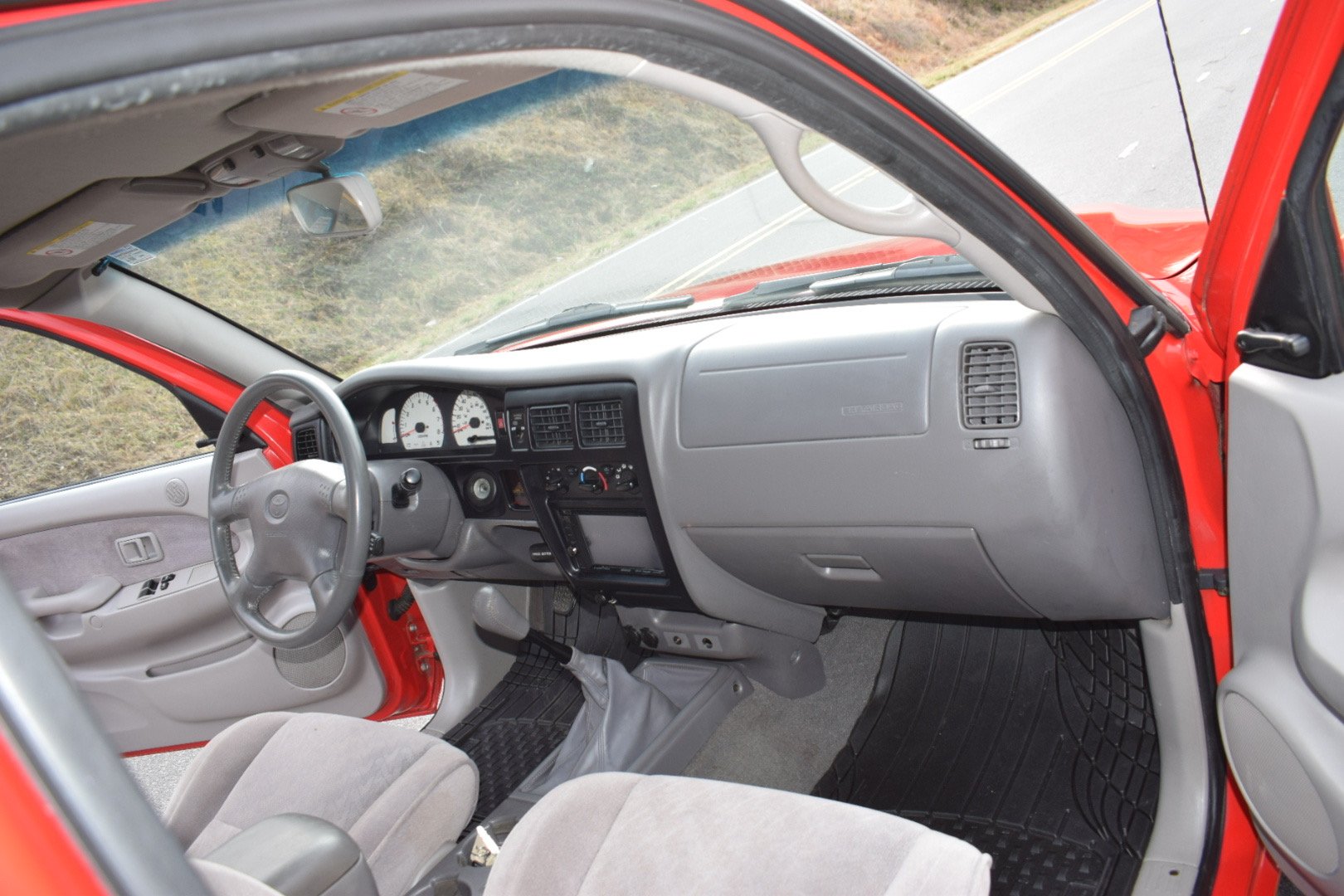
The magazine noted that, at the time of publication, a base Tacoma was $17,905 ($34,145 in 2026), with the S-Runner coming in at $19,400 ($36,996 in 2026). Reportedly, it was possible to option a 2001 Tacoma up to $29,395 ($56,056 in 2026). Ultimately, the testers concluded that the S-Runner looked awesome and had legitimately better handling, but it was easy to drive up the sticker price with the huge list of options, and the interior wasn’t anything to write home about.
Sadly, while I found no reviews of a Tacoma S-Runner with a supercharger, MotorTrend did pit the Nissan Frontier S/C and the Toyota Tacoma TRD Supercharged against each other in 2001:
In the 600-ft slalom, the Tacoma wallowed and understeered its way to a 58.9-mph speed, unloading its inside front tire nearly the length of its suspension travel as it transitioned. It’s a handful in such conditions. Yes, the Frontier handles the slalom course like a truck, but at least its 60.6-mph speed places it at the lower end of passenger-car performance territory. Its steering is better weighted, more responsive, and combines with the truck’s more taut suspension and tires for quicker, crisper turn-in. The Frontier is relatively smooth and comfortable at freeway speeds, with good directional stability, while the Tacoma’s suspension tackles bumps and potholes more harshly-and more in line with a 4×4 setup. At 70 mph or so, the Toyota feels a bit darty, especially in heavy winds. Lacking progressive-rate springs common in full-size pickups, the unloaded Tacoma simply rides harshly on most roads.
But it’s better in a straight line. The TRD blower kicks in with a nice high-pitched whistle, not unlike the sound of those buzzy World Rally Championship cars you see on Speedvision, and the truck launches with a hearty squeal of its rear tires. It keeps on going until it hits fuel cutoff just shy of 100 mph (both trucks are speed-governed because of tire and driveshaft limitations). Make no mistake: The Tacoma TRD is not SVT Lightning-quick, but it is impressive. The Frontier is more leisurely in getting to its governed limit. With a 10.3-sec 0-60-mph time, the supercharger brings the big four-door 4×4 Nissan up to speed the way the V-6 should on its own. Did we hamstring the Frontier by insisting on an automatic-versus-automatic comparison? No. A Frontier SE we tested in October 2000, with supercharged V-6, lighter rear drive, and five-speed, managed only a 9.3-sec 0-60, 1.3 sec slower than the Tacoma TRD.
While that TRD supercharger makes the Tacoma the hot rod of the two in a straight line, it surprisingly doesn’t transform the truck’s personality. Blower or no, the Tacoma is the more practical and utilitarian of the two. It has an upright stance and a toothy grille befitting a vintage ’50s pickup. Also, our test truck’s gray interior was so anonymous, it looked beige in certain lighting. On the plus side, all controls and switches are ergonomically arranged, and all the panels have Toyota-quality fit and finish. But the interior door handles are in an odd place: With the seat pushed back the right amount for a 5-ft-11 driver, the left elbow rests uncomfortably in the hole created where the armrest ends and the door handle begins. Both trucks suffer from awkward-to-operate pop-up sunroofs, mostly due to the sunshade panels you must remove before opening.

I do wonder if the Toyota would have fared better in this comparison if it were the S-Runner and not a 4×4 Double Cab. At any rate, it sounds like strapping a supercharger to a first-generation Tacoma was a great way to get it to convert tires into smoke. It was a sport truck in every sense of the term, and you didn’t even have to get a full-size build to enjoy it.
A Rare Piece Of Compact Truck History
Yet, Toyota’s entry into the compact sport truck segment largely fell on deaf ears. Maybe it was the fact that you could just slap the supercharger onto any V6 Tacoma and skip the S-Runner upcharge. Maybe other brands marketed their sport trucks better. Whatever the reason, by Toyota’s own estimates, it didn’t sell many S-Runners.
The truck sold from September 2000 to about August 2004, and in the time from 2000 to March 2003, Toyota estimated that it sold only 2,000 examples. It’s unclear how many total examples were sold, but I can’t imagine Toyota sold more than 3,000 of them. Granted, Toyota never really intended the S-Runner to be truly mass-market, as it said it planned to build only 200 examples per month. Yet, Toyota didn’t even sell that many.
This is also another case of rarity not correlating to value. S-Runners bring in less than $11,000 even at sites like Bring a Trailer. The nicest S-Runner on Bring a Trailer, which had only 14,000 miles, sold for $21,561. So, I’d expect to pay some of the so-called “Toyota Tax” for one of these, but not crazy money.

The S-Runner would end up overshadowed by Toyota’s later works, like the 2005 to 2015 Toyota Tacoma X-Runner, which embraced the street truck concept even better than the S-Runner did. Then, of course, Toyota was also willing to sell you a regular cab Tundra with a 504 HP supercharged V8. I could understand why the S-Runner might not be particularly popular, even today.
But if you’re the kind of person who enjoyed how small, simple, and dependable 1990s compact trucks were, the S-Runner was probably pretty cool, especially with a supercharger. Word on the street is that the supercharger doesn’t hurt the legendary reliability of the original Tacoma, either. It’s guilt-free fun!
I miss this era of pickup trucks. You were able to get a truck of all sizes from a huge swath of automakers, and they all had fun making them faster, more off-road capable, or more stylish than the competition. Now, most of the trucks out there are hulking beasts with bedrails above your shoulders. But if the Ford Maverick and its go-fast toys are any indication, the compact sport truck segment still has some life in it. Hopefully, other automakers join in on the fun as they did in the 2000s.
Top graphic image: Toyota


Mercedes, I gotta say that this article, like everything you write for us is obviously exhaustively researched and comprehensively presented and I have to say ‘THANK YOU’ yet again for such great 100% human content. 🙂
With so many old Toyota trucks fetching an extra-pretty penny these days (since the pandemic/supply chain crisis/inflation) I’m actually surprised that the S-Runner isn’t more expensive at BaT. Though I’ve never owned a mini-truck, I really dig the concept, and that used-to-be-everywhere Tacoma body with a bigger, forced induction engine is undeniably appealing.
I think it looks great too, especially compared to all the hulking full-size, jacked-up, chrome-laden sporty trucks I see all over SoCal.
Super tempted to put one of these superchargers on my 5vz swapped 89 4runner
Ah, that explains why I never see these up for sale. I prefer the size to the later X-Runner.
PS – If you want the blower, get a truck with the blower already installed. Toyota discontinued all of its TRD superchargers.
This truck was such a far cry from the ’90 SR5 V6 5M 4×4 Xtracab I bought in California on closeout in early 1991, for $13,500. It was the most disappointing vehicle I have ever owned. Maybe the only thing nice I can say about it was that I was able to sell it for $11,500 four years and 60K miles later in Washington after three winters in western NY and Ohio. The mechanical bits were rusty. I guess that engine would run forever, but it was gutless and thirsty.
Lesson learned, there’s no way I would have bought one of these.
It didn’t permanently make me anti-Toyota. The ’84 Tercel 4×4 wagon I bought to replace it and using the rest of the equity towards a home in Seattle, was a really fun car. I wish there was a modern-day equivalent now. There probably is, but not in the US.
Back in the late 70’s I bought a Toyota Regular Cab SR5 Long Bed truck (not sure of the year now). Worst seats I’ve ever driven but I’d love to still have it now seeing the prices and sizes of trucks out of Detroit now.
Too bad the S-runner wasn’t offered in just a regular-cab version. Extended-cab sport-trucks just don’t look right to me.
I prefer the looks of the Syclone, S-10 SS and even the the rare Ranger Splash regular-cab with the 4.0 and the 5-speed. Or the original 1997 Toyota regular-cab 5-speed.
Before I bought my X-Runner 12 years ago, I had looked for these first. They were rarer and more expensive even back then, and I couldn’t justify the cost and distance compared to the X.
You totally missed the opportunity to make the caption in the lead photo “Taco Supreme”
Taco Grande
i still want an X runner
People that have them are always very proud of them. They seem ok. I don’t understand why the used superchargers is so expensive on the secondary market other then relative rarity. Tons of others out there of similar quality for much less.
I always think about when the frame swap recall was happening it seemed like many Toyota techs liberated the super chargers thinking the owners wouldn’t notice then claim it didn’t have one. What a mess. I think some people still very angry about that as they should be.
It’s because they pass CARB. It’s the same reason the TRD/Lotus superchargers for the 2ZZ are so expensive even though there’s aftermarket ones that are far better.
As one of the three people who designed the original Lotus 2ZZ supercharger installation, I have to ask: better how?
Cheaper, actually in production, considerably more performant, less susceptible to heat soak, quieter, more efficient at producing the (higher) power they achieve.
If you already have a factory supercharged car the juice probably isn’t worth the squeeze to rip it all out and replace it with a Katana 3 or REV 300 when you can just sell it and buy one with an aftermarket supercharger on it; and if you’re in California you’re shit out of luck either way (though swapping in a factory supercharger to a non-supercharged car can be a hassle now that they’ve been off the market for several years so even then just selling and buying another car is likely the better bet than scrounging up all of the factory parts and hoping you can find a place that will do the ECU changeover). If neither of those two qualities apply and you have an NA Elise and you still don’t want to get an aftermarket superchager, you’re better off going with one of NA “torque” tunes (that will probably be faster on a track than the factory MP45 supercharger will anyway and has a similar effect on the area under the curve); or just putting a K24 in it.
Ah ha.
The stock intercooler is terribly fed with cooling air, and the whole system was originally only supposed to make 220bhp, so it’s efficiency up at 270bhp is poor. The cast intercooler tubes are just terrible.
As for the noise: the first time I drove the 270E I stopped half a mile later to call someone and ask if it was supposed to be that loud.
Lotus are desperately shit at keeping old parts in stock. Before I left I ordered one of everything they had for my Europa, and it was a very very small box.
I wonder if these have held up better than the equivalent Frontier even though it was “just” a dealer option. Nissan fabbing up that specific engine designation for the VG33 that you could order supercharged from the factory (instead of just dropping in the VQ35 variant that they had already put in the Pathfinder) has to my understanding made it so the supercharged Frontiers and XTerras (which already aren’t very impressive in performance) aren’t really worth trying to keep on the road.
The interior might not be anything to write home about, but it eschews a lot of trends that age poorly. As such, the interior is still nothing to write home about – but neither does it feel out of touch with current style.
Jeans and light flannel, two buttons open. It ain’t formal, it ain’t stylish, it ain’t wrong.
For about the same dough, you could buy a Silverado RCSB with a 5.3 LS motor and a stick shift. The GMT800 was one of the greatest trucks ever built, and I’d pick that over this Toyota. Not sorry.
No you couldn’t. You could get the manual with the 4.3 carried over from the GMT400 (that was more or less already carried over from the S-10) or you could get it with the 4800. I remember this distinctly because at the time my Grandfather was trying to order a 5.3/manual combination for use as a plow truck and was complaining for months that they wouldn’t sell him one before just buying a 5.3/4L60E stepside instead.
Regardless, skinflint full sized trucks built primarily for sale to utility companies and handymen probably weren’t cross-shopped that much with top spec compact street trucks that were at least nominally performance focused.
There was a Toyota TRD Supercharger kit for the 4.0 V6
Quick search on duckduckgo says it’s discontinued from Toyota, but there’re a few aftermarket superchargers.
I toyed with the idea of springing for a Magnusen for our 4.0-liter 4Runner, until I realized it was something like $6500. And it’s not as if I need this SUV to drink even more fuel.
I’ve got an ’01 Tundra with the 5vz that’s…not a powerhouse. I want to swap in an Atlas I5 (Vortec 3700) just for fun, but everyone on the Tundra boards says that the 5vz is “the best Toyota engine ever, just supercharge it”…for $4500 on an old engine.
Of course an engine swap to an entirely different motor from a different company would be even MORE expensive but also quite a bit more Autopian!
I submit that both these ideas are very Autopian. Pretty much everything you want to do with your ride that comes from a place of enthusiasm and interest is Autopic.
I love inline engines, I6 and I5 (currently owning both in hold crap-can Volvos, a 164 and a V50) so adding one more I5 to the mix just sounds like fun!
Plus, rotty old Colorado/Canyons are a dime a dozen and the R150 transmission in my Tundra actually bolts to the Atlas engines right out of the box…what else could go wrong?!
I have an irrational love for big fours. I can’t explain it. And also colossal singles from motorcycles.
So when the Colorado showed up with an available 2.9l straight four, I was pretty impressed.
This kind of reminds me that the 300 cubic inch Ford straight six…is only almost the same displacement as the famed Five-Oh (302)…
Om606 or OM612 could be an interesting swap.
But pricey. I think the Atlas engines are underrated and cheap (at least for now)…
You can pick up a OM612 for under $1k often including c class or e class. Sometimes in a rusty sprinter for around the same money.
OM606 are rising because people are starting to use them. Vortex 4200 might be starting to have a moment but there are so many of them out there I don’t think prices will rise anytime soon.
Interesting. A new engine choice has entered the chat.
Several years ago I picked up decent OM612 sprinter reefer van for around $2k. Helped my buddy turn into to his wife’s dog van. They have been getting cheaper and less decent.
And with dees-suhl skyrocketing, not sure it’s the right time to contemplate an oil-burner swap.
There is always Tesla and leaf swapping.
TRD discontinued supercharger availability for the gen 2 Tacoma in June 2015, right before the gen 3 model came out.
There are aftermarket superchargers for the 5zv…but they’re pricey.
I also like the Tacoma X-Runner.
I liked it, but it needed to get rid of the fake hood scoop, it make a massive amount of wind noise on the highway.
Super TACO ? Really ? SPICY TACO this joke was right there !!
Super Spicy Taco was also there!
Look, I don’t make the top shots. lol 🙂
I own a 1996 Tacoma, the small one with poverty specs and 4-banger. Even it by itself is surprisingly fast. Probably because it weighs nothing. I still love driving it as much as I did 30 years ago. Some of the best small trucks ever made but then again- I’m biased.
Trying to remember if I’ve ever seen one of these on the road. Would be a fun little road monster even now.
Driven this gen Tacoma in multiple forms but it’s been years. The 2.4/2.7 were strong for the time and very long lived. The 2.7 was used as the base Tacoma motor until just a few years ago.
The 3.4 was a sweet engine. In low-slung 2WD form with the stick, that Tacoma would move out with surprising vigor and smoothness.
I own a 1996 Tacoma with the 2Rz-Fe 4 banger. Bought it new off the lot so now having owned for 30 years, over 300,000 miles. Its seriously unaffected by miles and seemingly age. I would have no issues driving across country in it. I will never sell it. Nobody makes anything like it anymore and to me, its the perfect small truck
Nice! I love those little things. Corrosion killed a lot of them early, unfortunately.
Yep. I have seen horrors of what the frames look like in Michigan. Luckily I’m in California so its fine. But I imagine they mostly disappeared in the rust belt
Those Golden Era Tacos are my second favorites. There a beautiful one on my way home that has some custom mirror gradient graphics down it’s sides and I swoon each time I see it.
An old guy in my city has a super mint one, in the awesome electric blue color. I think he only takes it out on nice days, which seems so strange for a Toyota truck