


For decades, Toyota has been a purveyor of dependable, predictable transportation. With some great exceptions, the most thrilling part about an average Toyota from the 1990s was the heart-pounding action of twisting the key and the engine firing right up, every time, followed by the white-hot excitement of good fuel economy. The Toyota Paseo was one of those cars. It looked sporty, but was otherwise a perfectly cromulent ’90s Toyota. But Toyota sold one version that was a bit of a hoot, and for a single year, Americans got to enjoy an affordable compact that dropped its top on good days.
Living with The Autopian‘s Nissan Murano CrossCabriolet has reinforced my opinion that the convertible is the best kind of car. There’s nothing quite like heading out on a sunny day or clear night, dropping the top, and enjoying infinite skies with the wind at your back and a windshield at your face. Everything is better with a convertible, from chasing the aurora to beach days. I’ll even drive a convertible in the winter!


Sadly, there’s a dearth of “mundane” convertibles in today’s market. Car and Driver‘s list of convertible cars starts with the BMW M4 and meanders its way through the Chevrolet Corvette and the Mercedes-AMG CLE53 on the way to the Porsche 911 and the Aston Martin Vantage. If you want a more attainable car that drops its top, you’re largely limited to the Ford Mustang, Mini Cooper, Mazda MX-5 Miata, Ford Bronco, and Jeep Wrangler. Edmunds has a longer list of ‘verts, but the additional cars are entries like the BMW Z4, Lexus LC 500, Jeep Gladiator, and BMW 8 Series.
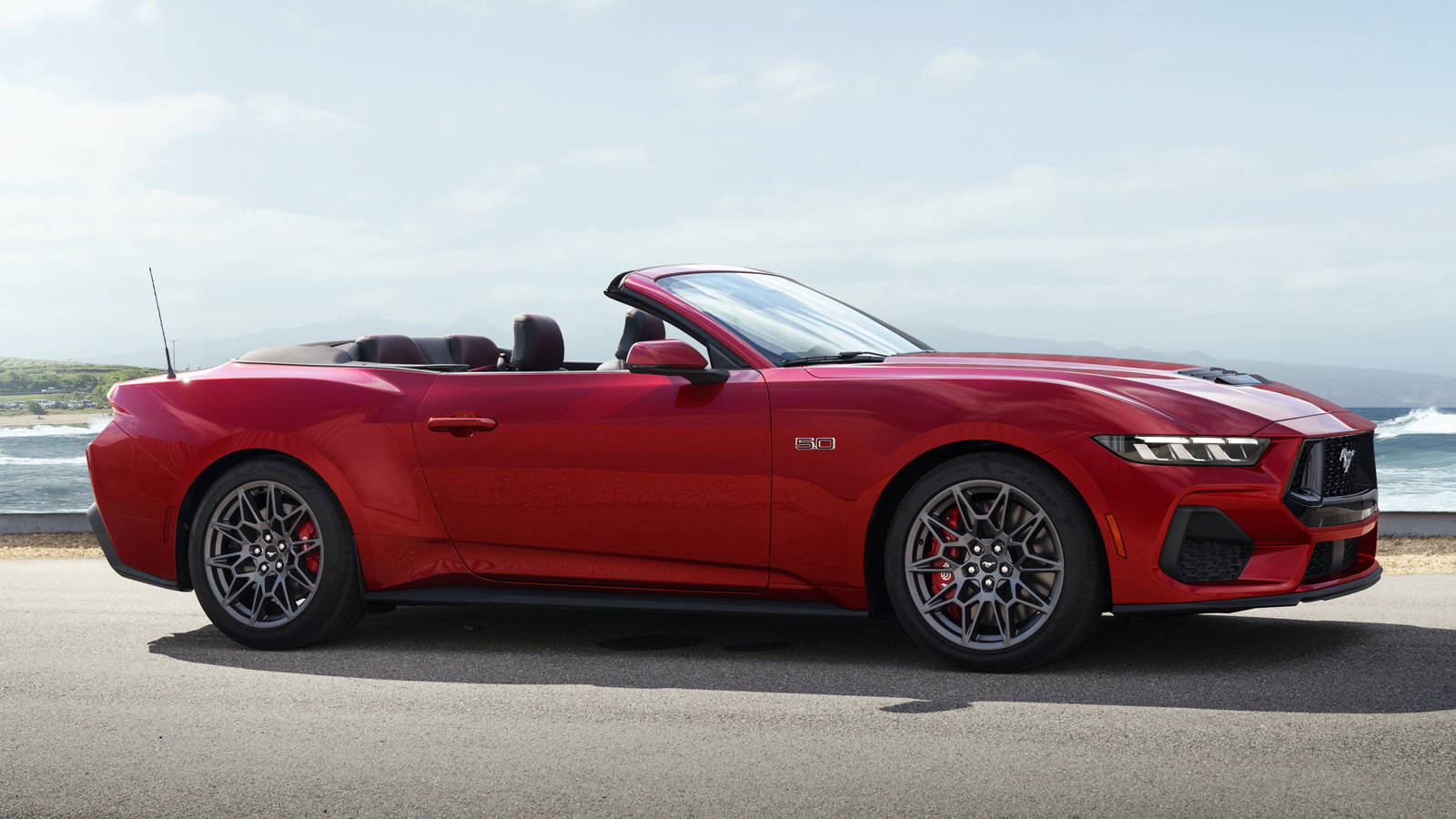
None of these cars are truly “regular,” however, as they all cater to some enthusiast niche or luxury segment. Seemingly gone are the days when automakers spiced up their mundane cars with a drop-top.
In the 2000s, you used to be able to roll down to your local Chrysler dealer and drive out in a Sebring, PT Cruiser, or Crossfire with the roof down. Meanwhile, Volkswagen was slinging cars like the New Beetle, Cabrio, and Eos in open-air configurations. Regular car convertibles were even hotter in the 1990s, with everyone from Buick to Mercury in on the action. Even the humble Chevy Cavalier and frugal Geo Metro were available as convertibles!

Toyota wasn’t afraid to take its tops off in this era, either. Fans of the Celica might remember the short-lived Toyota Celica GT Convertible of the early 1990s. There was also the Toyota RAV4, the Toyota MR2, the Toyota Supra, and the Toyota Camry Solara.
Then, there was this, the Toyota Paseo Convertible. Sold for just a single year in America, you may not even remember this totally regular convertible.

A Spicier Economy Car
The Toyota Paseo was the international variant of the Cynos. In old press releases, Toyota indicated that the Cynos was designed to appeal to younger buyers. But this wasn’t really a performance car.
To attract youthful buyers to its affordable coupe, Toyota says it developed a 2+2 coupe under the basic concept of “comfortable appearance and a satisfying driving experience.” According to Toyota, this meant an overall design concept of a “coupe gliding through the city.” Alright, so what does that mean? Toyota continues that the Cynos had a lightweight and compact body, sporty lines, and a handful of graceful curves. Adding to this vibe were six bold colors, including a new color, Turquoise Mica Metallic. The interior was supposed to be stylish, sporty, and gentle all at the same time.
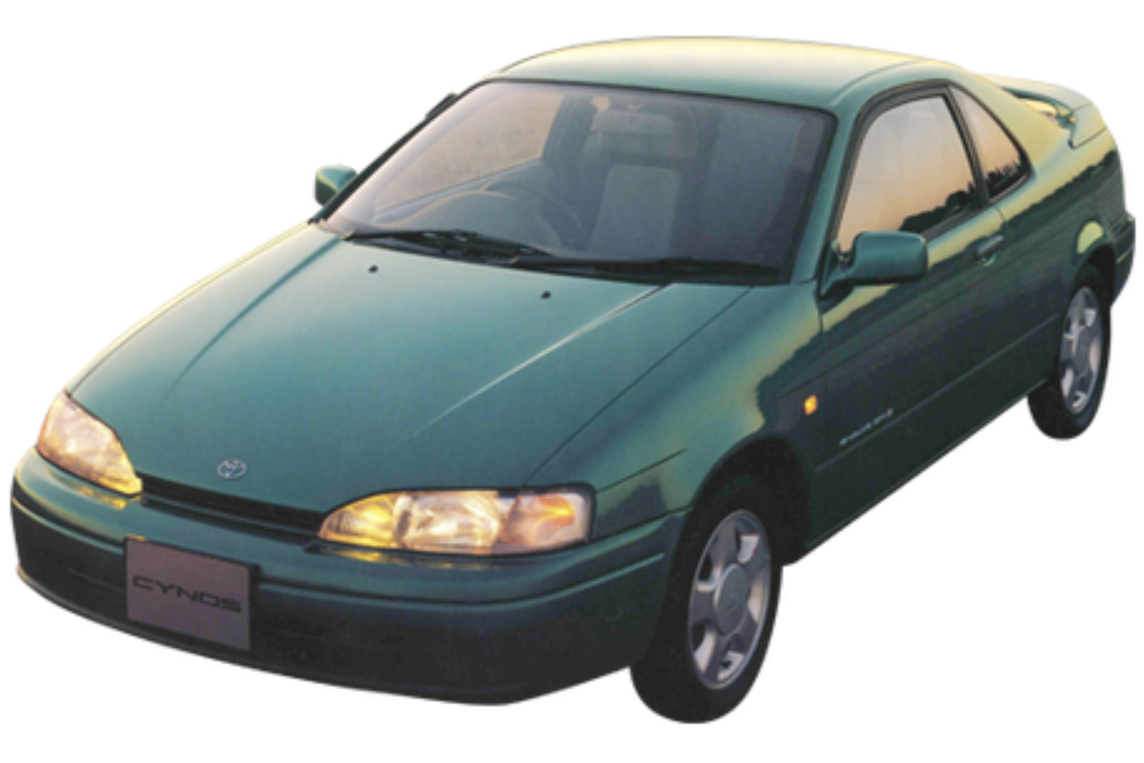
Additional highlights of the body were flush surfaces, a sweeping hood, a high deck, and a drag coefficient of 0.32. This aero was not just good for looks, Toyota said, but also for fuel economy and for lowering wind noise. Helping Toyota achieve this aero was a set of front fender liners designed to divert airflow over the front tires in a more efficient manner.
Toyota saved money on the Cynos by raiding its own parts bin. According to a 1991 report by Popular Mechanics, the vehicle was based loosely on the then-new Tercel platform. Other components were robbed from the Corsa and the Corolla II.

Two twin-cam four-cylinder engines were available in the original Cynos, a 1.5-liter 5E-FE four with 105 ponies on tap and a 1.5-liter 5E-FHE with 115 horses in the power barn. Both of these engines had been proven in other Toyota models for years already, and brought nothing new to the Cynos, but did make it a little spicier than a Tercel. The juice reached the front wheels through either a four-speed automatic or a five-speed manual.
Backing the powertrain up were MacPherson struts up front and twist-beam following in the rear. In Japan, the Cynos Beta-grade with the slightly hotter engine also got semi-active dampers that used sensors measuring braking, acceleration, steering angle, and G-forces to adjust damping. All of this, Toyota said, was meant to let you truly enjoy the fun of driving.

Then there was the name. Toyota said that Cynos was derived from the English word “cynosure,” which means “someone or something that is the center of attention.” In international markets, the Cynos was sold as the Paseo, which is Spanish for a “walk” or “stroll.” I suppose if you were an American, Toyota didn’t exactly set your expectations very high. Still, here in America, the Paseo also replaced the Corolla SR-5 and the GT-S.
But that was fine. Part of the appeal of the Cynos/Paseo was that it was cheap. When Toyota launched the car in 1991 for the 1992 model year, it said that the Paseo would cost around $10,000. In addition to being an affordable car, it was cheap to insure and, depending on where you lived, it was cheaper to keep on the road. In Japan, this was smaller than Toyota’s larger fare, which meant that buyers had some tax benefits.

Popular Mechanics commented that the front seats were pretty roomy for six-foot adults, but the back seats were best for children or maybe a pet. The rear seats were really great at keeping your insurance agent from calling the Paseo a sports car. Sadly, the Paseo wasn’t as hot as its Japanese sibling, as the 5E-FE was brought down to 100 HP, and in states that adhere to California’s emissions standards, output was even lower at 93 ponies.
So, how well did Toyota execute the Paseo? Here’s automotive legend John Davis behind the wheel of one at MotorWeek:
If you don’t have six minutes to watch the review, I’ll sum it up quickly. Davis found the Paseo pretty adequate. Not really fast, not really too slow, and “econobox” handling that did not really match the looks. Even John Davis had to take a swipe at the backseat, saying that it was really best for cassettes for the stereo, because you weren’t getting an adult back there. Davis concluded that the Paseo delivered on its mission. It wasn’t a real sports car, but a sporty economy car with an attractive $9,988 starting price ($24,152 in 2026), a dependable drivetrain, great fuel economy, and fun dynamics.
Toyota said that the Paseo ended up being a hit with one particular demographic, from Toyota:
It was considered a “secretary’s car” in the North American market, due to its popularity among urban working women.
The Paseo was far from the hottest car in the Toyota lineup. Its best sales year was 1992, when Toyota moved 36,513 copies. A total of 94,187 Paseos were sold between 1991 and 1994.
More Of The Same

Toyota decided to follow the Paseo up by doubling down on a sequel.
In 1995, Toyota announced a second generation of the Paseo. In its announcements, Toyota said that the original Cynos was acclaimed for its “eye-catching looks” and “just right” size. So, Toyota decided to stick to the same formula for the car’s second edition. The new Paseo even raided the parts bin again, taking its platform and associated components from the Tercel, Corsa, and Corolla II again.
According to Toyota, the latest in computer-aided design (CAD-CAM) was used to upgrade the Cynos for its second generation, which upped the car’s quality and improved the manufacturing process. The Tercel had recently been restyled before the new Paseo, and the Paseo would get that car’s upgrades as well. Once again, the new Paseo targeted young folks who might have been buying their first new car.

Toyota produced a list of what made the new Paseo different from the old one:
– In profile, the new generation Cynos has all the hallmarks of a classic coupe: from the sleek headlamps, across the elegant, sloping roofline, back to the slim, separate tail lights. The smooth bodyline sweeping from nose to tail also provides for a low drag factor, thus lowering wind noise and boosting fuel economy. With an overall length of 4155 mm, and overall width of 1660 mm, the Cynos retains the compact dimensions that have made it a convenient, easy-to-handle coupe, especially in town driving. A total of seven exterior colors are available with the new Cynos. These include new and refined shine quartz toning (silver-based two tone colors) and the unique and fashionable light turquoise mica metallic (greenish) colors.
– Safety was paramount in the design of the new Cynos. The Cynos’ rigid new monocoque shell protects passengers from offset frontal collisions and complies with all current safety requirements in Japan. The bodyshell can even meet side collision impact standards on line to be introduced in Europe in the future. Slim rear quarter pillars which reduce blind angles, thus improving rear visibility, are an important preventive safety feature of the new Cynos. A rear wiper features on all models, either as standard or optional equipment. The ABS (anti-lock brake system) that stabilizes the car during panic braking is offered on all models at a new, low price. An LSD (limited slip differential) is available on Beta-grade models with manual transmission. A driver’s side front SRS airbag is standard on most models in the new Cynos range or available as an option.

– The Cynos’ attractive cabin blends style with practicality. The simple and slim front seats are well attuned with the compact coupe theme. For easier operation, the seat slide handle has been replaced by a loop type on the new model. For a sharp, sporty touch, the instrument panel features white colored (Beta-grade) instruments, such as speedometer and tachometer. For the cabin as a whole, gray is the theme color. With an eye to growing environmental concerns, the Cynos also debuts innovative new glass technologies to reduce glare in the cabin and the risk of sunburn. New UV-cut glass and solar-cut glass block out not only ultra-violet rays, but also solar radiation sources, especially infrared rays.
Here in America, the Paseo launched in the 1996 model year with the 5E-FE engine making a return. Sadly, in order to meet emissions standards, the engine remained detuned to 93 HP. The Paseo also gained over 60 pounds going into its second-generation, with Toyota saying that the car weighed anywhere between 2,028 and 2,138 pounds, depending on options.

Still, the car was received well. Here’s what the Auto Channel said of the Paseo in 1996:
APPEARANCE: Toyota has started more than a few styling trends in its time, but also has shown that it is no slave to them. The new Paseo is a good case in point. Its cousin, the Lexus coupe, started trends towards rounded styling and separate projector-beam driving lights that were picked up by many other car companies. Even the Toyota Celica, the Paseo’s big brother, shows these influences. The 1996 Paseo does not. It is leaner, crisper, and more angular than its predecessor, with thinner roof pillars and more glass area for better visibility. It is decisively a Toyota in appearance.
COMFORT: The interior of the 1996 Paseo is very appropriate for a modern entry-level sports coupe. It is sportingly spartan with contemporary colors, accents, and materials. Fit and finish is traditional Toyota – excellent. Black on white background instruments lend a dash of tradition. The instrument panel has been lowered for improved forward visibility, and radio and ventilation controls repositioned for better access. The front seats are supportive and comfortable. Rear seat passengers have their own storage spaces and cupholder, but rear seat passengers had better be short, as headroom is limited. The Paseo is a sports coupe, which means the rear seat is best used for cargo, and it folds down for trunk access and extra capacity. Air conditioning, power windows and door locks, cruise control, and a sunroof are all optionally available.
[…]
PERFORMANCE: The 1.5-liter four-cylinder engine in the 1996 Paseo is shared with the Tercel sedan. In typical Toyota fashion, it is a modern dual overhead cam, 16-valve design. Also in typical Toyota fashion, it is tuned for torque and flexibility rather than absolute maximum power. This makes the Paseo work as well with the four-speed automatic transmission as with the five-speed manual. Years ago, a small engine matched with an automatic transmission was an invitation to performance disaster. No longer it that true. The latest Paseo is a practical, civilized sports coupe.
The Auto Channel concluded by saying that the new Paseo was a good choice for a sports car fan on a budget. By most accounts, the Paseo sequel was like the first, and repackaged Tercel bits in a slightly more thrilling package. Otherwise, it was still the frugal car it was back in 1991, only sharper.
Chasing The Sun

But Toyota did have an ace up its sleeve. A month after the Paseo launched in September 1995, Toyota appeared at the Tokyo Motor Show with two concept cars. One was the Fun Runner II, and the other was the Convertible Cynos. The Convertible Cynos was supposed to be an add-on to the driving experience of the Cynos while also being the smallest full convertible offered by Toyota at the time.
To facilitate the creation of the Convertible Cynos/Paseo Convertible, Toyota rang up everyone’s favorite convertible conversion company, the American Sunroof Corporation (ASC) of Michigan. Toyota already had an existing relationship with ASC, which also cranked out the Toyota Celica Convertible.

Creating these drop-tops was rather convoluted. According to Toyota, Cynos and Paseo coupes would be completed in Japan. These cars featured reinforced rockers, beefed-up rear strut towers, and strengthened rear quarters.
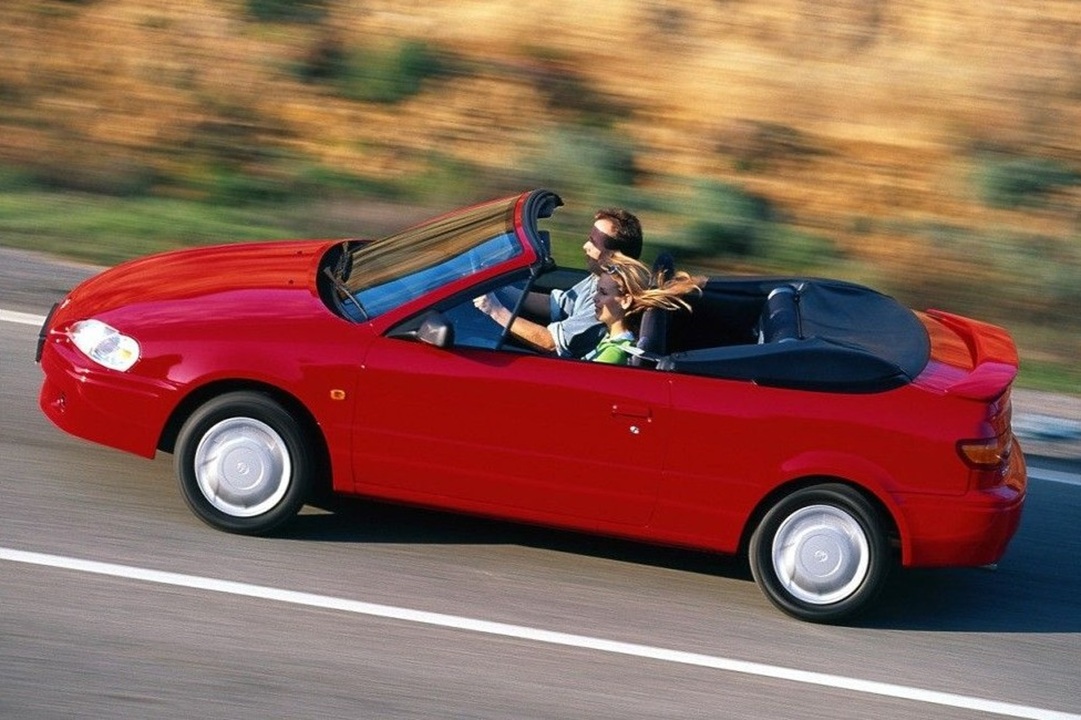
They would then be shipped off to Long Beach, California, where ASC would slice off their roofs. During the conversion process, ASC added a manual four-layer soft top that, when closed, mimicked the coupe’s roofline. The doors were also modified, with the biggest noticeable difference being the addition of large quarter windows. Another change was the trunk lid, which was specific to the convertible. Once finished, Toyota says, the Convertible Cynos cars were loaded back onto a boat and shipped back to Japan.

The process was a little different for American Paseos, where completed cars were shipped off to Toyota dealers for sale. The whole conversion added only 143 pounds, and the roof was designed to be opened and closed by one person. As was typical of ASC conversions, the roof was fully functional, too, featuring a rear window with an electric defroster that automatically folded itself away with the rest of the roof.
The Paseo Convertible went on sale in October 1996 for the 1997 model year. The Auto Channel reviewed one, and I’m not at all surprised that its review was largely a repeat of the Paseo coupe review, but now with a drop-top.

ROADABILITY: With its low-slung stance, the Paseo convertible gives all of the good sensory inputs of a small sports car of the past. With a rigid, reinforced unit-construction chassis, it has none of the shakes and rattles that gave old cars “character.” It has nimble handling and is great fun to drive, particularly with the top down. Its front-wheel drive and insulated top design help make it a year-round car in all but the worst climates.
PERFORMANCE: The Paseo convertible shares its 1.5-liter, 93-horsepower engine with the coupe version. Like small sports cars through the years, it has enough power for enjoyable, zippy performance, and gets great gas mileage as well. It should be equally at home used for commuting or weekend pleasure trips. The standard 5-speed manual gearbox makes the Paseo convertible more of a sports car, but the torqey engine is perfectly capable with the optional 4-speed electronically-controlled automatic.
CONCLUSIONS: The new Toyota Paseo convertible combines top-down fun, good handling, and great gas mileage.

The second-generation Paseo had a base price of $13,838 ($29,046 in 2026). Adding the soft top increased that price to $17,200 ($36,102 in 2026). Layer on some options and it was possible to get the Paseo convertible up to $19,600 ($41,140 in 2026). Toyota marketed both the Celica and Paseo convertibles as great, graceful ways to catch some rays.
Crickets At The Toyota Dealership
Unfortunately for Toyota, it found few buyers who wanted a Paseo, period, much less an expensive convertible version. Toyota sold just 9,025 Paseos between 1996 and 1998. Of that lot, only 1,463 examples were the single-year 1997 Paseo convertibles. Amazingly, the number of Paseo convertibles sold in 1997 made up for slightly more than half of the 2,762 Paseos sold that year. The Paseo would survive until 1999 in other markets before Toyota threw in the towel.
For most people, the Paseo was a totally forgettable car, and the convertible may as well not even have existed. The only reason I still remember the Paseo is because of the mad tuner who strapped a giant blower to a Paseo engine and bolted it into a Smart Fortwo. But I couldn’t blame anyone for forgetting, or even just not knowing the car existed, because with 1,463 units being built, it’s rarer than many legitimate sports cars.
The Paseo convertible doesn’t show up for sale often, but when it does, you should be able to find a minty example for under $10,000 and a well-loved one for closer to $5,000. The Paseo convertible, like the Nissan Murano CrossCabriolet, has a small but happy group of fans that keep these cars around, so it’s unlikely they’ll ever be totally forgotten.
What I love the most about the Paseo convertible is just how normal it is. This isn’t a Miata or some million-horsepower supercar. It’s just a car. One that can return over 30 mpg and get you everywhere reliably. It’s a regular car that lets you enjoy some sun. While the Paseo convertible might be mundane, the world needs more cars like this, because even non-enthusiasts want to feel the wind in their hair sometimes.
Top graphic image: Toyota


Fun fact when watching the original Fast and the Furious in the scene where Brian is spying on Johnny Tran one of the cars on the lift is a hardtop Paseo with five spoke wheels exhaust and vinyl graphics down the side.
I love weird Toyotas and I really would like a Paseo.
Someone I knew in high school had a hardtop Paseo, and I think it’s still the only one I’ve ever seen on the road. I guess they weren’t very popular around here.
My old boss ran one of these into the fucking ground. It refused to die even though he treated it like garbage. Anyway, the first photo makes it look like 2 feet stick out in front of the front wheels, making it look pretty awkward.
With an eye to growing environmental concerns, the Cynos also debuts innovative new glass technologies to reduce glare in the cabin and the risk of sunburn. New UV-cut glass and solar-cut glass block out not only ultra-violet rays, but also solar radiation sources, especially infrared rays.
Hold on, are they saying it was designed to protect against the effects of ozone depletion?
Anyways, I support sporty little economy cars.
Until you lowered the windows and the convertible top.
Funny, but the description was from the non-convertible version.
My sister got a gen 1 Paseo as her first car during college. It was an underpowered, flimsy rattletrap that was ready for the junkyard by 100k. All hat, no cattle. She’s not driven a Toyota since.
My sister got blackmailed into one from the a secondhand dealer in about 97, That little thing lasted 8 years and 320,000kms and TBH was a perfect first car before being she traded it in on a Mercedes and has had Mercs and Porsches since that have caused her non stop problems but then she is a bit of a brand snob.
I do miss the days of the mundane convertible. Kind of hard to do these days when the mundane coupe is dead, and even the mundane sedan is increasingly hard to find.
I will give Nissan credit for trying to make the mundane crossover convertible a thing. I think the problem was starting with the Murano as the base vehicle.
(For the record, I rather liked the Evoque convertible, but Land Rovers aren’t exactly “mundane”)
I’m kind of a fan of small 4 seat convertibles. Too bad there aren’t may any more. Preferably less than 4.5m (15ft) long
I guess the current ones would be a Mini, Fiat 500, 2 Series?
A while ago there was the Mk6 Golf/A3, and the 1 series was smaller.
Would be great if someone could make a reliable one.
Wouldn’t mind something like a Swift or Yaris. Maybe even a Prius C
The crazy thing is the 1st gen VW T-Roc convertible is this size. But really, who needs another convertible crossover.
Oh, to be young and poor again. Wait, poors have never been able to afford new cars.
I too am coming to have to admit how good convertibles are despite long saying I prefer coupes. Swapping a BRZ for a Miata has shown my true colors, haha. But we’ll see if I still feel the same after replacing the top as it’s got a hole. Mercedes you should dump the Murano and it’s dying trans and look for one of those Buicks that was basically the last “normie” convertible here in the US, what were those called? Casablanca? Calvacade? Cascade? Idk.
Cascada
That’s it!
i was in high school in the 90s. nobody liked the paseo.
I don’t know what “the Auto Channel” is, but their review doesn’t jive with what I remember reading about the Paseo at the time. My recollection was that it had the exact same mechanicals as the Tercel of the day, whose only claim to fame was being the absolute cheapest car Toyota sold in the US. Even back then, Tercels were fairly uncommon, because if you wanted an economical Toyota, you got a Corolla. Only if you couldn’t afford a Corolla would you even consider the Tercel, which was underpowered and no fun to drive, even by the standards of the early 90s.
They’ve been around for decades, but yeah, they’re sort of like some publications where they really never say something truly negative about a car.
I feel connected to this article in several ways. I dated a woman who drove a Paseo (hardtop), I worked for ASC for a few months assembling interior components for Volvo big rigs, and my Dad had that generation Celica pictured above. /cool story, bro.
That Celica is indeed cool
Paseo
I Did Not Forget.
Also not forgotten, MR2, Celica Convertible, Starlet…
That’s the first I read of the detuned engine. Makes a little more sense why my aunt’s Paseo coupe couldn’t pull away from my ’84 Subaru wagon on the highway, though the P/W ratio was still in her favor. I imagine the Subaru had a better torque curve, IDK, but she was so embarrassed that she sold it soon after. She bought it brand new and I don’t think she had it a year. She ended up buying a nearly new Audi 90, whose engine blew up with something like 50k miles on it because it was an Audi.
The issue with all those low end convertibles was that they were a lot more money than the coupes they were based on, so you ended up paying higher end car money for a low end car with structural, weight, packaging, and security compromises for a trick that can only be used occasionally. Because of that, those kinds of cars were likely more often considered as a secondary nice-weather driver, in which case, someone either has enough money to spend to get something a lot nicer or they could pick up an older used convertible. Especially in the ’90s before the Boomers blew up all over the market, you could get some nice cruisers or sports cars for cheap—probably one of each for less than a new one of these.
I mean, Geo made a convertible Metro so Toyota had to do something.
Pity we never got the really weird Tercel/Paseo cousin, the Sera, in the US.
Strollin’, oh yeah, strollin’ ah
Rock and ro-uh-oh-oh-oh-oh-llin’
Strollin’
Well rock my so-oul
How I love to stroll
Paseo means “to take a walk” in Spanish. What a horrible name for a car… from Toyota.
These didn’t sell very well in Mexico.
Neither did they in Spain. But I don’t think the problem was the name…
Something something “Chevy No-Va” something.
I’d like to interject that the Paseo (and Tercel) wasn’t “pretty roomy for six-foot adults” if you looked up. The “oh schijt” handle on the driver’s side was never far away from the side of your head; and gave you a beating when the road was bumpy.
I knew someone who had Paseo convertible new because she got a good deal on it. I think her dad talked her into it over the vw Cabrio that was very popular for that demo at that time. I also knew another guy who had one because he got deal on one used. I’m not sure the buyer was all that different then your average Solara buyer just maybe slightly younger or just the same exact people. They did look a little different then lost things. And I have to admit the design has aged well like most Toyota designs of that period.
GenZ should do something actually cool, like bring back convertibles OF EVERYTHING.
I’ve encountered some “Zillennials” hipsters that are firmly planted in the mid to late 90s. With the 90s convertibles along with “being a slut for cassette tapes”.