

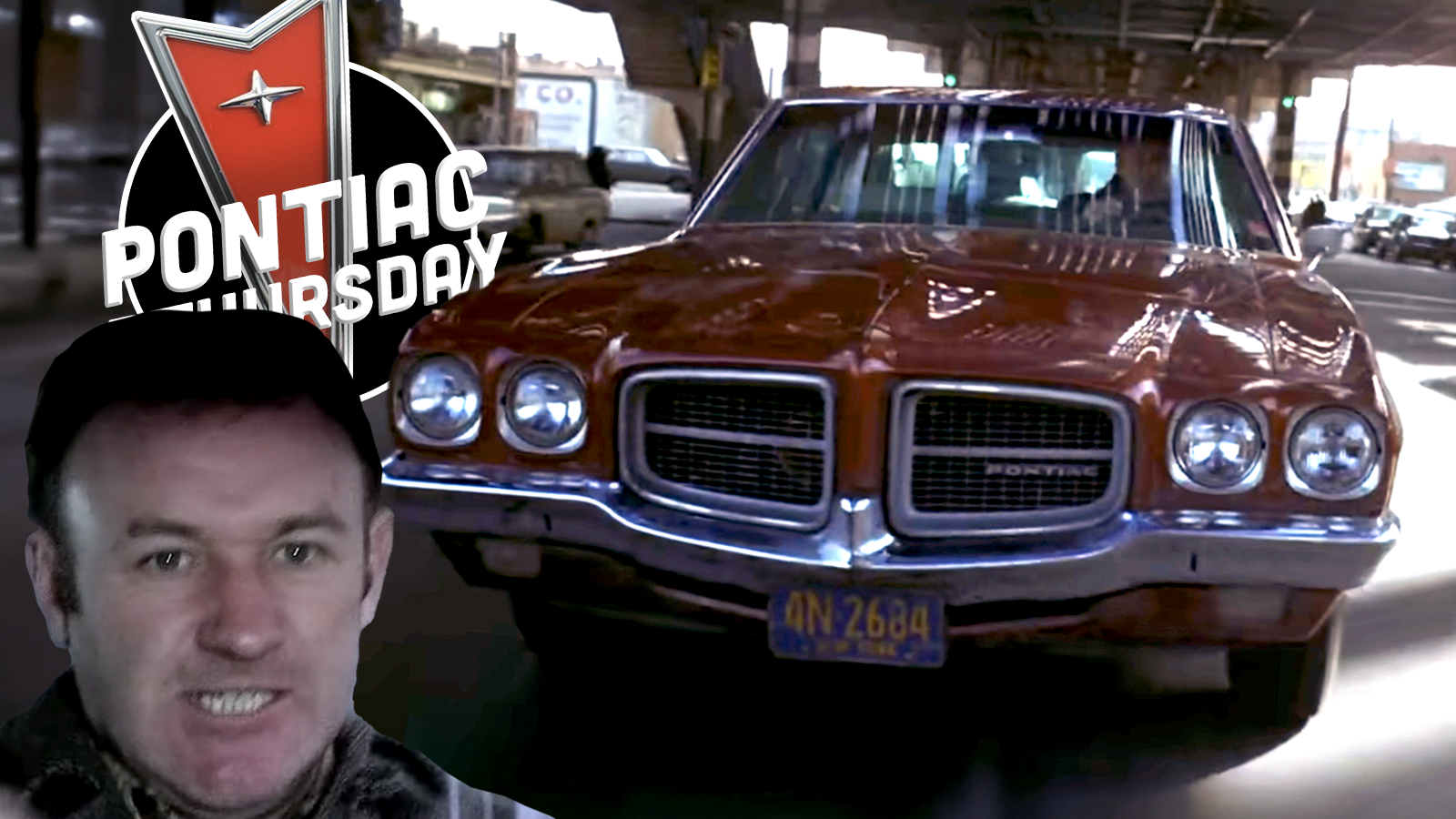
The most famous Pontiacs on television and in the movies are generally flashy things like the K.I.T.T. Firebird, Burt Reynolds’ Trans Am, and the GTO Judge in Two Lane Blacktop, among others. It would seem that a very basic 1971 LeMans sedan wouldn’t belong on this list, but that car has to rank as one of the greatest Pontiacs ever to grace the silver screen.
If you don’t think that’s possible, you need to check out eight minutes of a car chase scene that, in retrospect, even the director says never, ever should have happened.


Yes, There Was A Hackman And A Hickman
With decades of films like Fast and the Furious and Gone In Sixty Seconds under our belts, it’s very hard to be impressed by automobile stunts on film, particularly from over fifty years ago. The chase scene in William Friedkin’s 1971 film The French Connection, however, is a prominent exception. The nerve-wracking scenes still deliver edge-of-your-seat thrills as the action careens through gritty, dirty bankruptcy-era New York streets.
As with most chase scenes, you don’t need to know much to set the scene except for the fact that one of the factions involved is Bad while the other is Good. In the case of The French Connection, the racist, obnoxious, and single-mindedly-driven-regardless-of-collateral damage cop played by Gene Hackman is actually the “Good” guy: detective Jimmy “Popeye” Doyle.
The basic plot of the film involves an attempt by a nefarious Frenchman to sneak around $23 million in heroin into the port of New York, hidden within a car. The only reason I mention this part is because the vehicle with drugs stuffed in the rocker panels was a deep brown Lincoln Mark III with black French license plates, shown initially cruising through Marseille and dwarfing the Renaults and Peugeots around it.

I know, it was just a gussied-up T-Bird, but that thing’s dope as hell (excuse the pun) in that lovely not-quite-black hue. If it was really used in France in 1971, there had to be yellow headlights under those covers, making it even cooler.

Once the Bad Guys know that a tenacious cop is on to them, they make a move. One of the drug smuggler’s henchmen takes a shot at Popeye in Brooklyn but fails to hit his target. The would-be hitman attempts to escape on an elevated subway and manages to evade our anti-hero as the doors close. Popeye doesn’t give up; he commandeers a civilian car on the street below and proceeds to pursue the subject on city streets underneath the train tracks. The first car Popeye tries to get is a VW Beetle that doesn’t stop (thank God, too slow), and a second escapes him, but he’s able to pull the driver from a maroon/brown 1971 Pontiac LeMans and shift the action into gear. (Some sites that I’ve read claim that the car is a lower-level G-37, but it isn’t.)

Friedkin supposedly chose the car because of its “everyman” appearance, and purchased two examples for shooting. Some reports I’ve read state that the cars had Pontiac 400 cubic inch V8 motors under the hood, but I can’t find anything to substantiate that, other than the screen cars’ seeming ability to spin their tires at will.

The elevated Brooklyn train ran at speeds of around 50 miles an hour, and since it had a head start, the car would need to be driven at hair-raising speeds to keep up. The driver that Friedkin wanted to use was Bill Hickman, the man who did the stunt work in his two other car chases, which both rank as groundbreaking: 1968’s Bullitt and 1973’s The Seven Ups. Yes, it’s this guy below, who you will remember as the Charger pilot in Bullitt who looks far less like a skilled wheelman than he does the dude who sold your parents that State Farm homeowners’ policy.

To show how dangerous this drive was, Hickman actually refused the job several times before Friedkin goaded him into doing it. Hickman’s only stipulation was that Friedkin had to ride in the car with him for the driving scenes. Remarkably, Gene Hackman reportedly did around 50 to 60 percent of the driving in the movie. The filming car for in-car scenes had the front seat removed and replaced by a camera stand to capture Gene Hackman’s profile; another platform sat overlapping the rear seat. You can see Gene’s actual reactions since he was actually behind the wheel for much of the driving footage.

The most famous shots, though, were done with the camera mounted on the front bumper.

In the close city quarters, you really get the sense of speed with these low shots that were done with Hickman doing the insane wrangling of the rather large “mid-sized” sedan:

The “hero” car was the one that would take the abuse as its exterior was filmed. In the film, you see shots of three pedals, but Hackman is driving a car that is clearly an automatic. From what I can ascertain, the camera car had a column-shift slushbox while the “her0” car had a four-speed, but that’s such a rare car to specify that I have my doubts.

Friedkin had his cars and his driver; all he needed to do was get the proper permits to make it happen. Well, that’s another story.
Yeah, Sorry About Your Car, We’re Making A Movie
To film on the train, the movie’s producers did things the correct way; well, the correct way for early 1970s New York, that is. In order to get permission to film, they reportedly bribed an official with $40,000 and a one-way ticket to Jamaica (and I don’t think they meant Jamaica, Queens). The official’s assumption was that he’d be fired anyway, so why not get out of town? It looks like winter in the filmed scenes, may as well go someplace warm.
As for filming on the street below the track, that was a different story. The French Connection was based on true events that happened in the sixties, and the two real cops involved in the bust (upon whom Hackman’s and Roy Scheider’s characters were based) were consultants on the film. They were “consultants” in that they were sufficiently connected to assemble enough off-duty cops to close off the streets for the filming, or at least try to. You see, it’s a big area to secure; nearly impossible, really, even early on a Sunday morning.
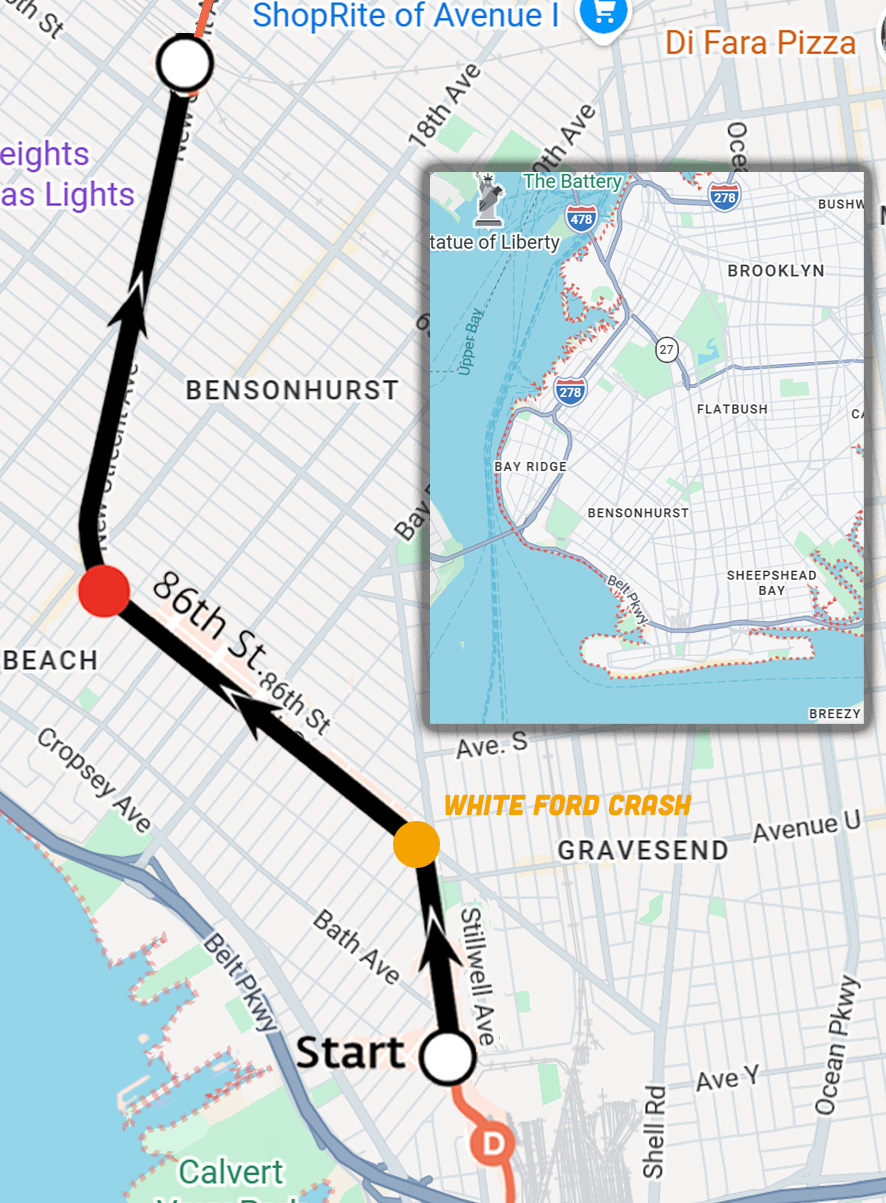
Here’s a rough map of the path the chase that follows what is now the “D” train, but at the time was the “B.”
The scenes with the hero car could naturally be broken up into shorter segments, but it’s that one-shot point-of-view work with the bumper-mounted camera and Hickman driving that were possibly the most insane. “We went 26 blocks at 90mph, and there was absolutely no control,” Friedkin admitted in an interview much, much later.
We had no police control, we didn’t stop cross traffic, we didn’t stop pedestrians from crossing the street. And the only thing that got us through the traffic was (that) we had a gumball (a flashing light) on top of the car and a police siren (obviously on the camera car shots only where it wasn’t visible and the siren could be sound edited out)… we had a few ‘bumps’ that weren’t supposed to happen…(but) it was irresponsible. Thank God no one was hurt.
Yes, some of the hair-raising scenes, like the Pontiac narrowly missing an (empty) baby carriage and driving through strategically placed prop garbage were totally planned out; as you can see below, there was miles of room for error.

However, one of the most serious and dramatic impacts in the chase is with a white Ford that collides with the Pontiac, sending it skidding off course and causing the other car to spin like a pinwheel. This seems like an incredibly difficult wreck to plan out and get right, and there’s a reason for that: it wasn’t supposed to happen.

As you’d expect with limited makeshift control on a sweeping 26-block area, not every intersection was properly secured; the driver of the white Ford entered the intersection of Stillwell and 86th entirely unaware that a chase scene for some movie was being filmed. He appears to have locked up his brakes when he noticed the speeding Pontiac, but it was too late not to hit it. Reportedly, there were no serious injuries, and the film production crew paid for the repairs to the hapless driver’s Ford; there were no Top Dog Law ads on the radio then to spur on as we have in today’s litigious society.

Oh, wait, you want to see the actual chase? Sorry for the delay; here you go:
Knowing what we know now, how the hell did nobody get fined, arrested, or worse?
“Detective Doyle Can Return Your Pontiac To You Now”
I sort of doubt that the speeds in the chase reached 90 miles an hour as Friedkin claimed happened, but it doesn’t matter; Bill was at least tripling the posted limits in these tight Brooklyn streets. In many ways, The French Connection was likely the high-water mark in insane no-nets car chases. With CGI and other tricks today, there’s very little likelihood that anyone will be injured in even the most dangerous-looking stunts on the silver screen.
That’s a very good thing, and even Friedkin claims that he was reckless and never, ever should have filmed the French Connection chase the way he did fifty-five years ago. He’s well aware that he put too many lives – including his own – at risk for a mere film. At the same time, when asked what he thought of the finished product today, he said he “wouldn’t change a single frame.” I think we can all agree with that.
Pontiac Points: 95/100
Verdict: Sure, it could have been any car in that scene, but it’s almost impossible to imagine it being anything other than Pontiac.
Top graphic image: 20th Century Fox (screenshot)


The website is so incredibly slow that I had to extract the YouTube link from the page source code to actually watch the video.
Friedkin’s 1977 film Sorcerer also has some pretty incredible vehicular stunts, but probably gets overlooked because they were done slowly by huge trucks. There’s one shot in particular where the camera is below a truck while the rear wheels almost go over the side – one tire is completely over the edge saved only by its dually partner wheel, literally 3 inches extra and that camera and cameraperson would be squished.
Sorcerer was a friggin’ wild movie. Only got to see it recently, and I’m glad I did.
That scene is batshit insane. Even by today’s standards and even more so because that was the real deal and not CGI
Timing – I just happened to have caught this scene on YouTube a week or so ago. Absolutely wild to find out it was filmed “gorilla-style”. That Poncho got the piss beat out of it.
I’ll grant you this is a better chase than Bullit, but it still pales in comparison to The Seven Ups.
Bill Hickman is simply otherworldly piloting that Grand Ville…I love it when you can see the rear-sway bar when the suspension is fully unloaded while transiting over intersections. I know it’s been sped up, but they were still travelling and impressive speeds.
BRING BACK PONTIAC!
“Knowing what we know now, how the hell did nobody get fined, arrested, or worse?”
Because in the early 1970s life was so much cheaper. DUIs were shrugged off, kids, even toddlers could flop around in the back of the station wagon without as much as a lap belt, everyone smoked everywhere, lead was in the air and on the walls, teenagers hitchhiked,..
It was a crazy time.
A few notes
1. Excellent car chase and filmed spectacularly. So much better than current night dark shots where you can see nothing
2. Still not as high profile as Jim Rockfords Firebird.
3. If you want to identify the actual car I suggest calling Marissa Tomei as you can see by the tire streaks there is only one skid mark so not a Posi Traction rear end. And in 1971 only 2 models came in that Hershey squirt brown and she is the lady who could identify that car.
Keep in mind that Gene Hackman participated in racing. He kind of sort of had a handle on what he was doing.
He did seem to have the car racer face front only no looking in the mirror or seeing if a car is about to cross in front of him.
But $30k and a trip to Jamaica for a dirty cop and the innocent guy who gets his car destroyed only gets it repaired probably with a salvage title. They couldn’t get him a new car from a car manufacturers sponsor?
Tell me he at least got a stunt Driver credit and union pay for his appearance
IMSA RS series, may both the series and Gene Hackman RIP
Why would I excuse the pun? It’s what I came here for! More please!!!
At :25 into the clip (after the failed attempt to borrow a Beetle), Doyle also tried to stop and commandeer a white Ford Fairlane, which looks like the same white Ford that got whacked in the chase sequence.
As that crash was not scripted I’d guess it wasn’t the same car.
The white Ford in the crash is a ’68 Galaxie – not a Fairlane.
Even early on a Sunday morning, I’m surprised they didn’t run into more traffic that would have ruined filming. It would have only taken one banana truck that had spilled its cargo to make the schedule slip.
I’m surprised that with the rest of today’s theme they didn’t turn Pontiac Pthursday into Plymouth Pthursday, just this once.
Great behind the scenes write up Bishop! So thorough I don’t need to scream “rocker panels! Come on!” at you.
Fun fact is that Hickman’s in the movie too, as the dour fed who Doyle mistakenly blows away in the climax.
Ain’t nothing cooler, don’t give me no flak, than a pork pie hat and a Pontiac.
In the old days Pontiac had an acronym for its name. Good taste prohibits writing it.
Pretty Outstanding Northern Turdis Is Awakening Creche?
It was completely racist, but that’s the only clue I’m gonna give you. That part of the old days doesn’t really need to be remembered.
He wound up hitting the white Ford that wouldn’t stop for him after the Beetle.
No as written in the article that crash was unscripted so not the same car
I know but funny coincidence.
Did you pick your feet in Poughkeepsie?
Something’s definitely wrong with that table.
In our house, whenever our dog starts licking its feet we tell it to quite picking its feet in Poughkeepsie.
Nope but I danced under the moon over Parma
“the GTO Judge in Two Lane Blacktop“.
I had to google that movie. How on earth did I never hear about a 1971 film that (per Wiki):
“stars musicians James Taylor and Dennis Wilson, Warren Oates, and Laurie Bird in the leading roles. The sparse, existentialist plot follows a group of street racers during a cross-country race through the American Southwest.”
Made as a follow-up to the success of Easy Rider, it has a 93% Rotten Tomatoes score! A must watch for me this Memorial Day.
I did think Two LaneBlacktop was a bit obscure of a reference. I heard about it years ago but I have asked many gearheads who were late teens/early twenties when the movie came out and they had not heard of it either. It’s a very unique movie and I personally really appreciated the Chevy as a real drag/street racing car.
Gene Hackman was a great actor. Terrible ending for him and his wife.
Indeed.
RIP Lex Luthor.
Growing up on stuff like this and the Seven Ups is why the Fast and Furious franchise does nothing for me.
In “The Seven Ups”, there was plenty more Pontiac-powered chase action through NYC, with Hickman again reprising the bad guy/wheelman in the *giant* Grand Ville, and Roy Scheider in the Ventura, which gets the Jayne Mansfield treatment.
Wasn’t that chase mapped out so it follows an actual route one could drive?
In high school, my step mom had the Grand Ville’s platform mate, a dark brown 73 Buick Electra with a 455. That car had some serious grunt!
She drove it like a grandma, but my brother and I did not!
The Seven Ups car chase scene is among the greatest ever filmed. You can appreciate its magnificence right here:
https://youtu.be/9vACWV5sRcY?si=6-VYbUNbxs4APFY0
I could not agree more. It’s on par, or better, than Ronin – simply for the technical abilities of the era.
I always laugh though, the bus driver is the spitting image of Joseph Gordon-Levitt.
Just growing up with The Rockford Files and Adam 12 puts the Fast and Furious in the shit-can. Car movies and tv have gone backwards faster than a Jim Rockford reverse 180.
I just saw this movie for the first time several months ago. The movie itself is just okay, but that chase is top notch!
Check out the Seven Ups as well. It’s a way lesser known but nearly as good sideways sequel, with Roy Scheider playing the same guy, just now by himself and with a different name.
It’s better than Bullitt. Both as a detective and car chase movie…
True.
Aside from the car chase, Bullitt is pretty dull.
I miss the days when actors in movies looked human. https://youtu.be/BzKXF0T75ps?si=h7Qq43e2tljbuDYn