

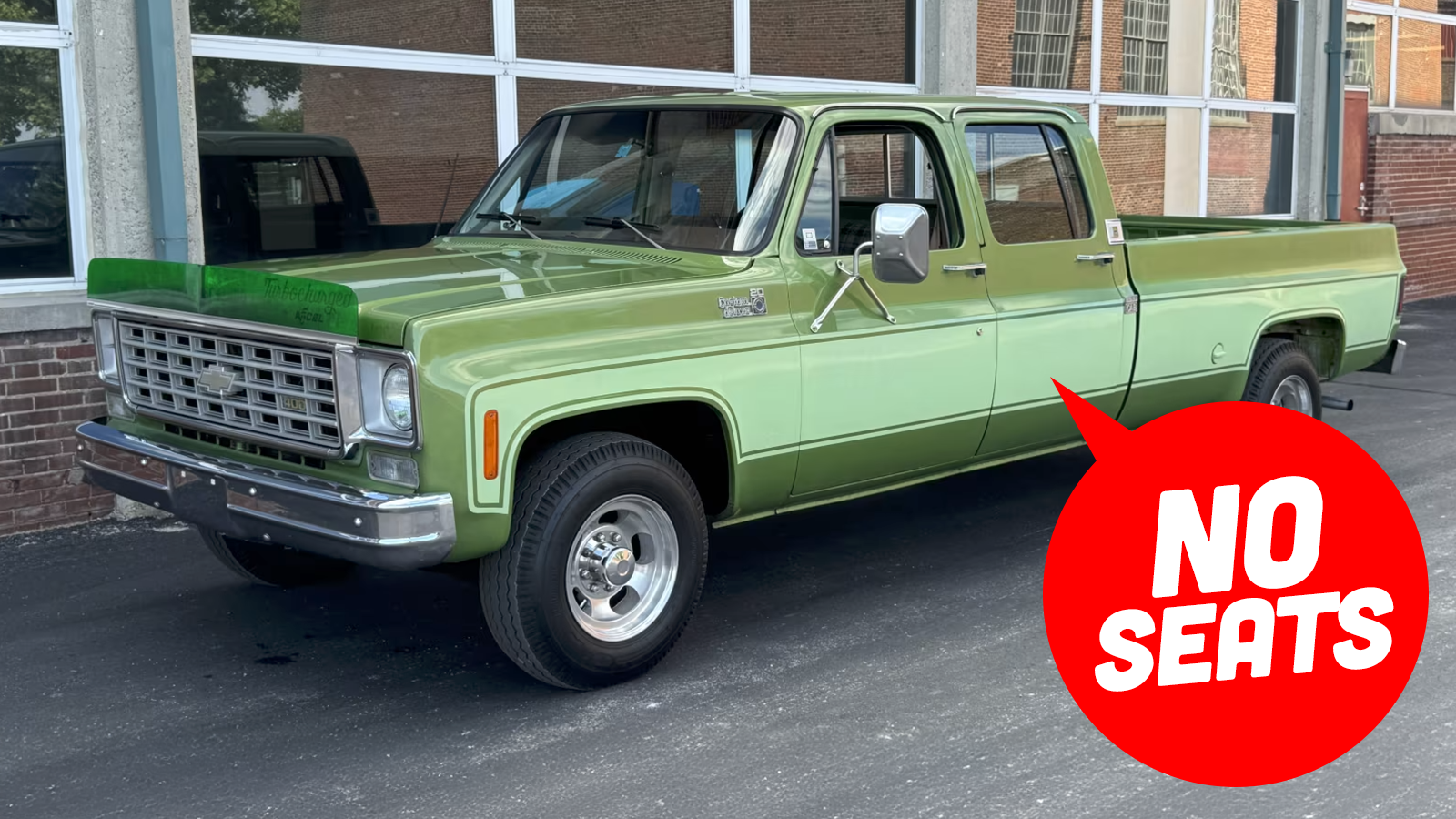
The American pickup truck is one of the most versatile consumer vehicles on the road today. Today’s truck can do hard work, haul the family, be your luxury vehicle, and even be your toy all in the span of a week if you wanted. These trucks also have lots of nooks and crannies to store stuff, but it wasn’t always that way. Decades ago, you got a cab to sit in and an open bed for hauling. In the 1970s, General Motors had a crafty idea. It would build crew cab trucks, but, unlike every other crew cab, the rear of these trucks didn’t seat a single additional butt.
Crew cab pickup trucks are pretty much the default flavor of truck in America. Sure, some brands will still sell you a regular cab if you ask nicely, but these trucks will usually be stripped down. Even Slate, which is launching with a two-door pickup, is intentionally making the most bare-bones vehicle to go on sale in a while. Most of those buying regular cabs today are tradespeople, fleets, farmers, and other workers.


For everyone else, the crew cab truck is nearly a universal truck. It serves as the family sedan, the work vehicle, the school bus, the going-to-town rig, and you can even get them with miles of leather and incredible stereos. It’s been a long road to get here, as the trucks of yesteryear had more in common with a tractor than a German luxury car.
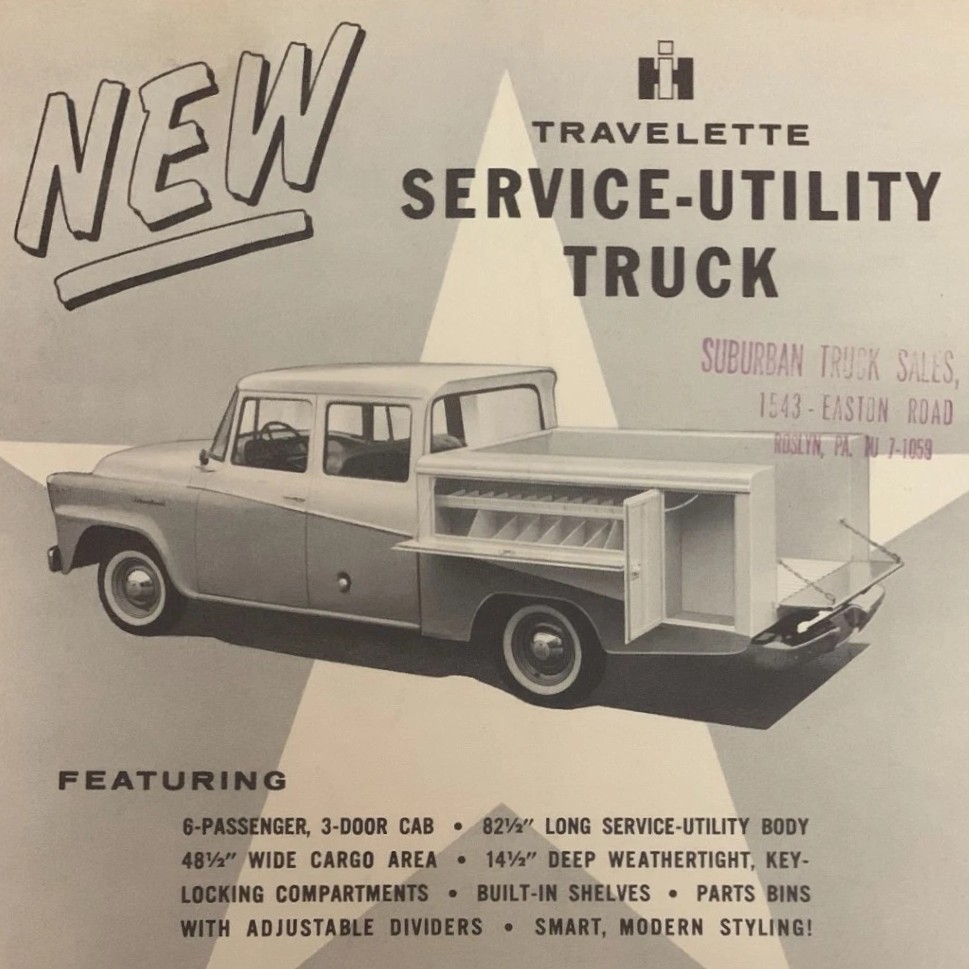
When International Harvester introduced the Travelette in 1957, America was greeted with a new kind of pickup truck. In the past, if you had a utility company crew, a group of farmers, or a squad of railroaders, only a few workers could sit in the cab while the rest had to ride in the bed with the cargo and tools. If you had a crew cab truck, it was almost certainly a custom or low production affair. But with the mass-produced Travelette, now company managers could go to the IH dealer and pick up a truck that six workers could ride in all at once.
Detroit took years to respond to IH’s innovation. Dodge came out with its first crew cab in 1963 in its D Series, while Ford hit the market with its own crew cab in 1965 in heavier F-Series trucks. General Motors didn’t come out with its first factory-built crew cab until the 1973 C/K. Allegedly, even Studebaker wanted to make a crew cab truck in the early 1960s, and managed to build two known prototypes.
Now, I must stress that these early crew cab trucks weren’t like today’s family trucks. At first, these trucks were more meant to haul larger work crews than their predecessors. However, they planted the seeds for today’s pickups. They also laid the groundwork for some weird cab experiments. More than one automaker toyed with the idea of making bigger cabs that carried more than just people. In GM’s case, if you bought a truck with Bonus Cab emblazoned on its side, you got a crew cab truck that didn’t actually seat more people.
Using The Cab As Extra Storage
Back in the 1970s, a new sort of arms race bloomed within the pickup truck manufacturers. In 1972 for the 1973 model year, Dodge announced what was then a major upgrade in truck cab space.
Dodge took a standard D series cab, cut out the back, removed the cab-based fuel tank, and added 18 inches in length. In doing so, Dodge created what it called the Club Cab, which offered 34 additional cubic feet of cab space. Dodge envisioned the Club Cab as supplanting the bed of the truck with covered storage. If there was something that you didn’t want exposed to the weather, you just tossed it into your Club Cab. Optional was a set of jump seats, which allowed your truck to carry two extra people in a pinch.
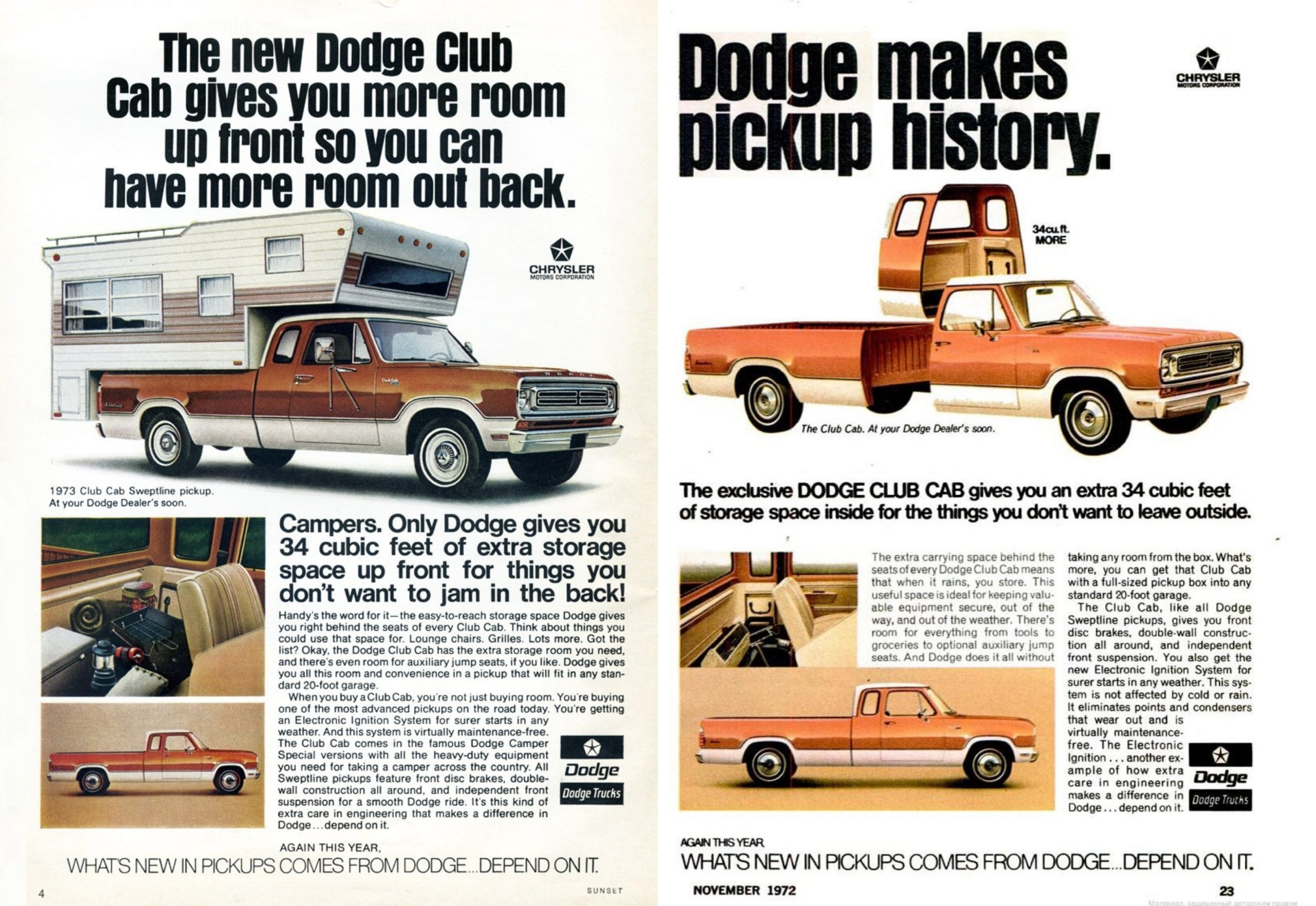
The Club Cab was launched on a D-100 with a special 133-inch wheelbase and came equipped with a 6.5-foot bed. Optional was a longer 149-inch wheelbase with an eight-foot bed. The Club Cab was also available with a D-200 sporting a 149-inch wheelbase and an eight-foot bed. To Dodge, the greatest beneficiaries of the Club Cab would be camper owners, because now they’d be able to have a camper in the bed of their truck and either storage or extra seating in the cab.
The rest of Detroit wasn’t willing to let Dodge have all of the fun. Ford already had a form of internal cargo storage for its pickup trucks in 1972. Optional on F-Series trucks with eight-foot Styleside beds was a locking beside toolbox.

This little compartment not only ensured that you didn’t have to carry a toolbox in your bed, but if you had a camper, you were still able to bring your tools with you without hauling them in the cab.
Ford also responded to the Dodge Club Cab with the SuperCab in 1974. Ford took a slightly different route than Dodge, tacking on two extra feet onto its two-door truck, adding up to 44 cubic feet of space. In the SuperCab’s standard configuration, you got an extra storage space behind the front seat, just like the Dodge. As an option, you were also able to add jump seats.
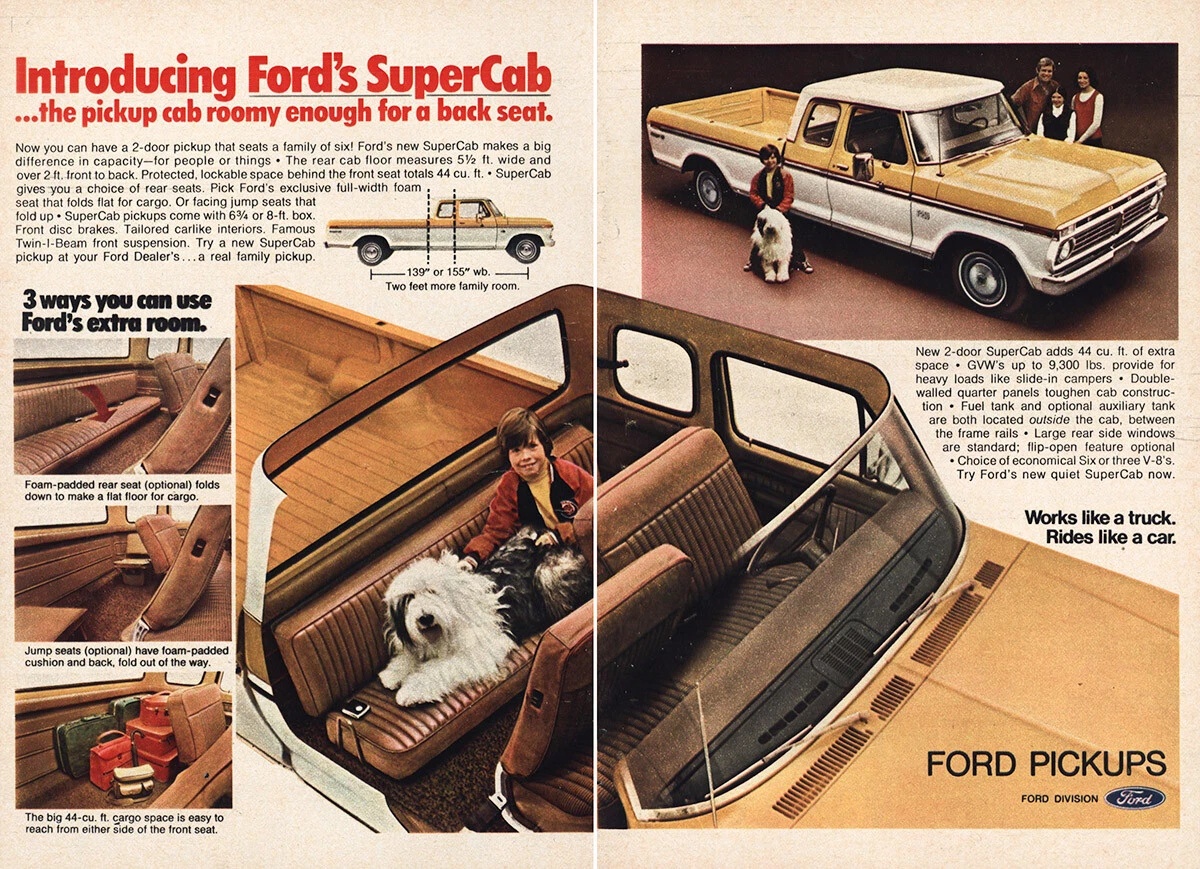
But then, unlike the Dodge, Ford also offered the option to add an entire second row back there. SuperCabs were sold with a 6-3/4-foot box or an eight-foot box on 139-inch or 155-inch wheelbases.
Ford marketed the SuperCab as giving you the seating capacity of a crew cab while retaining two doors. Or, more specifically, the tagline was “Works like a truck. Rides like a car.”
The Crew Cab That Added Zero Extra Seats
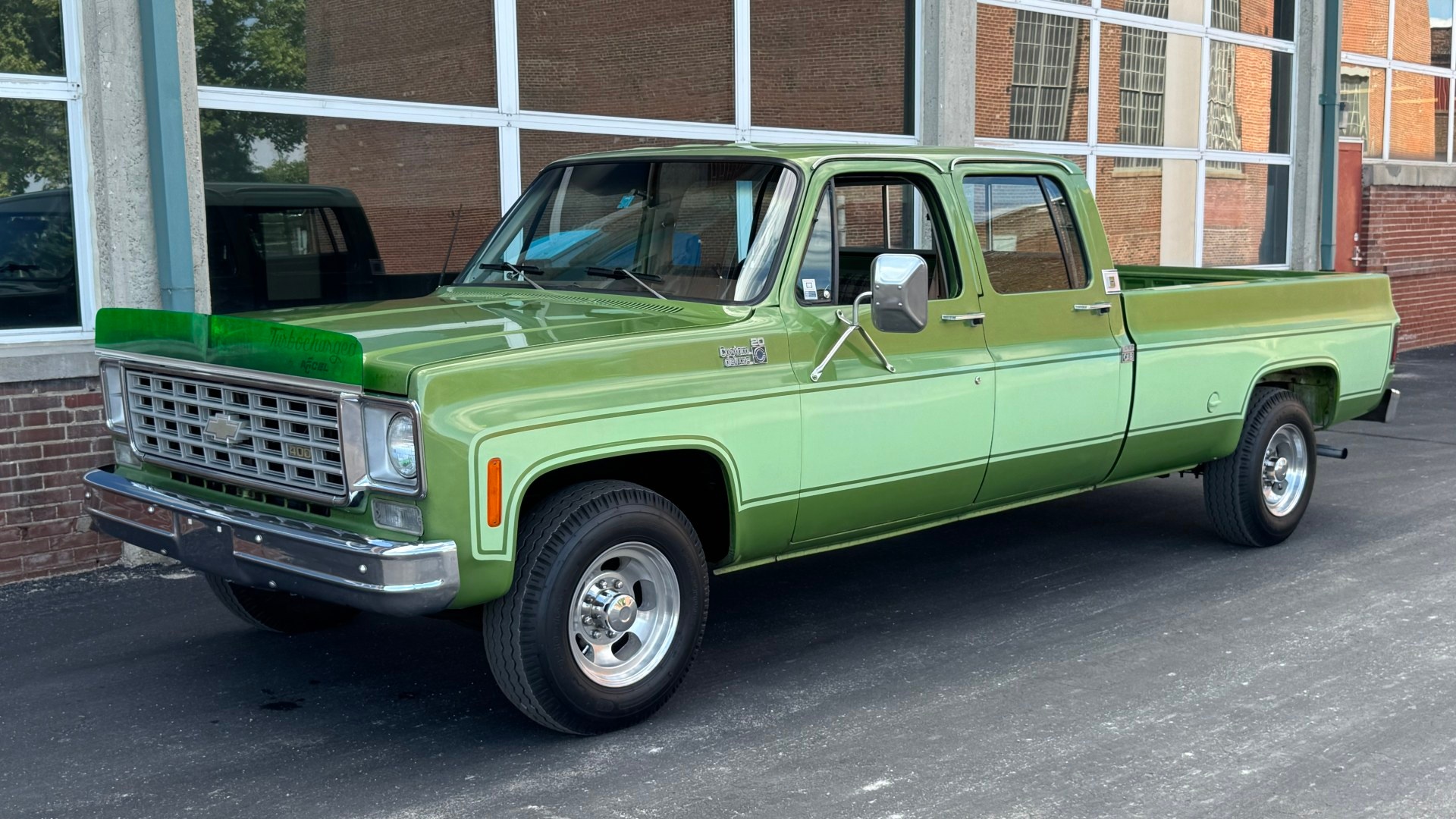
Finally, we arrive at General Motors, and honestly, GM might have had the most amusing solution to this. In 1972 for the 1973 model year, General Motors launched the third-generation C/K, known to most as the iconic Square Body. Built from 1973 to 1991, the third generation of the C/K holds the distinction of being the longest-running generation of Chevy truck. GM Authority continues:
The 1973 model year introduced an all-new third-generation for the C/K series Chevy pickup line, including a new look that became colloquially known as the “square body,” also sometimes referred to as “box body,” thanks to distinctive hard edges and panels that created a clean exterior style. “Larger glass areas with curved side windows contributed to visibility from the cab, while a large new grille and a wide stance gave the pickups a purposeful appearance befitting their capability,” Chevrolet writes.
In addition to new styling, the 1973 Square Body Chevy pickup also came with a larger, roomier cabin with more head, leg, shoulder, and hip room than the preceding model year. The cabin space featured redesigned trim and a one-piece instrument panel, as well as “flow-through” ventilation and improved insulation and weatherstripping. Entertainment options included an AM radio or an AM/FM radio. “It all contributed to making the trucks a more pleasant place to spend long days on the road, farm, or job site,” Chevrolet writes.
Buyers could choose from five different gas engine options, with the range-topping 454 V8 making 240 horsepower and 355 pound-feet of torque. Additional engine options included two six-cylinders, a 5.0L V8, and a 5.7L V8. Transmission options included three- and four-speed manuals, as well as an optional three-speed Turbo Hydra-Matic.
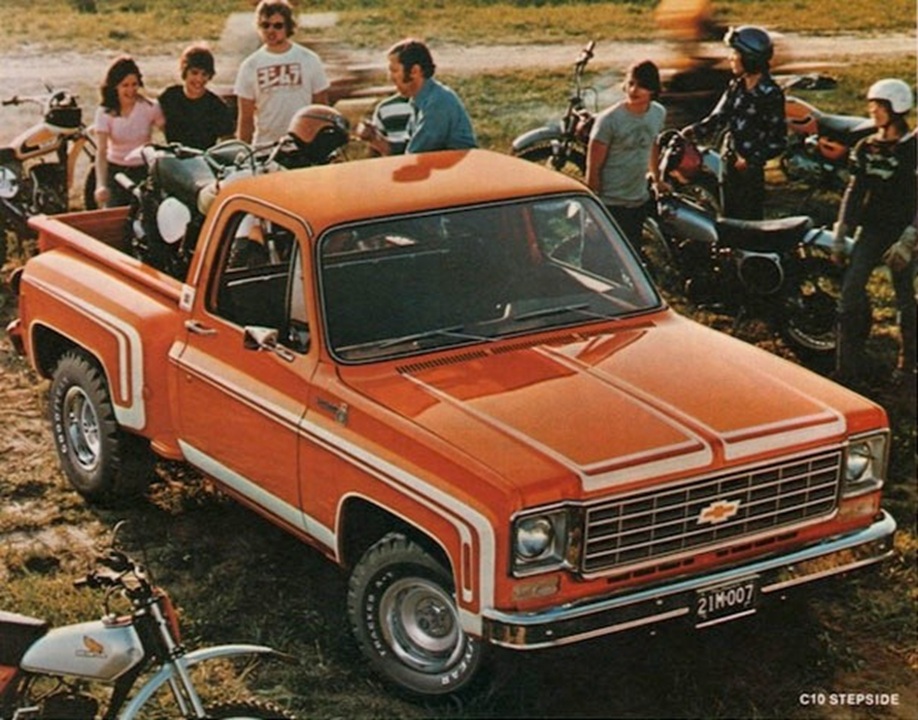
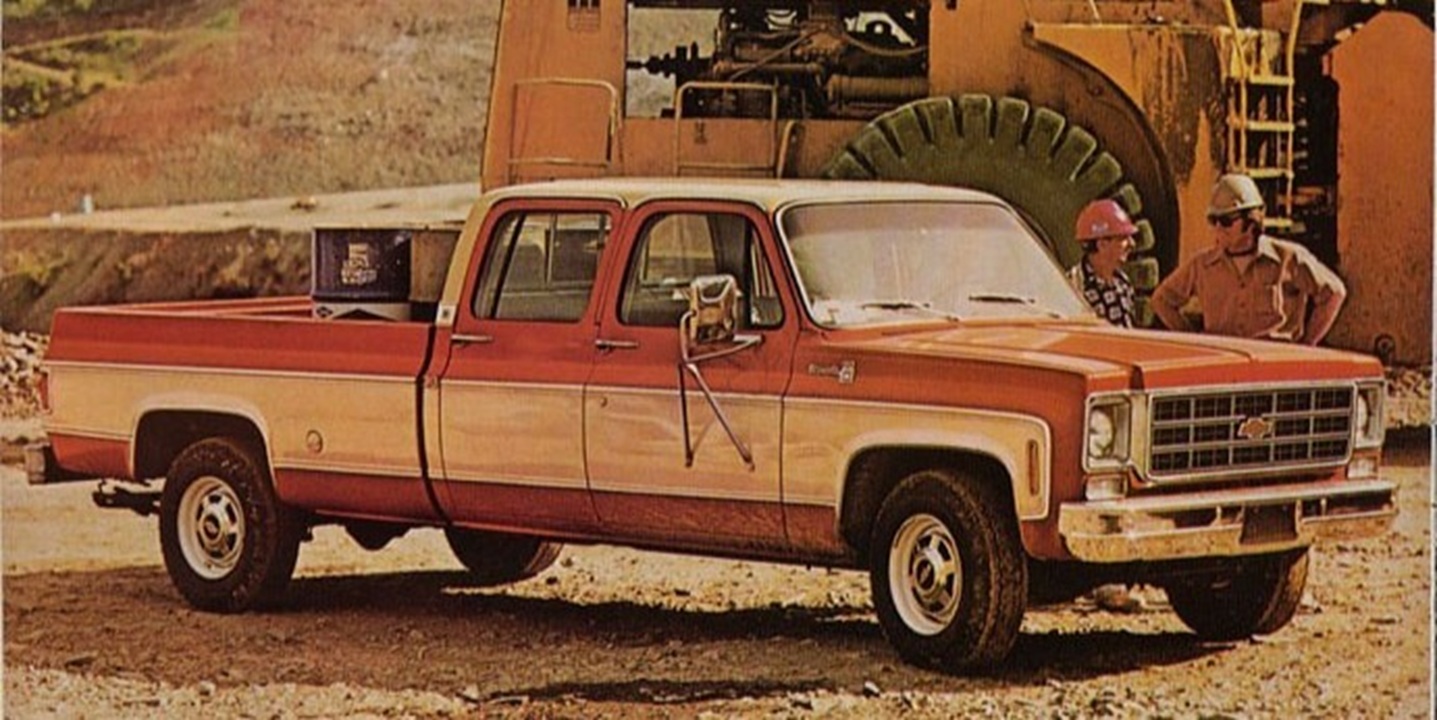
The Square Body also had the option of two rows of seats and four doors. If you opted for that one, the cab was called a “3+3” or a crew cab, depending on the advertisement you read or watched. But then came an interesting twist.
In summer 1975, GM decided to do something about the Dodge Club Cab and Ford SuperCab. But instead of building a specific cab that was meant to store stuff, GM had the clever idea to just take a crew cab and yank out the seatbelts and bench seat. Boom, the Bonus Cab was born.
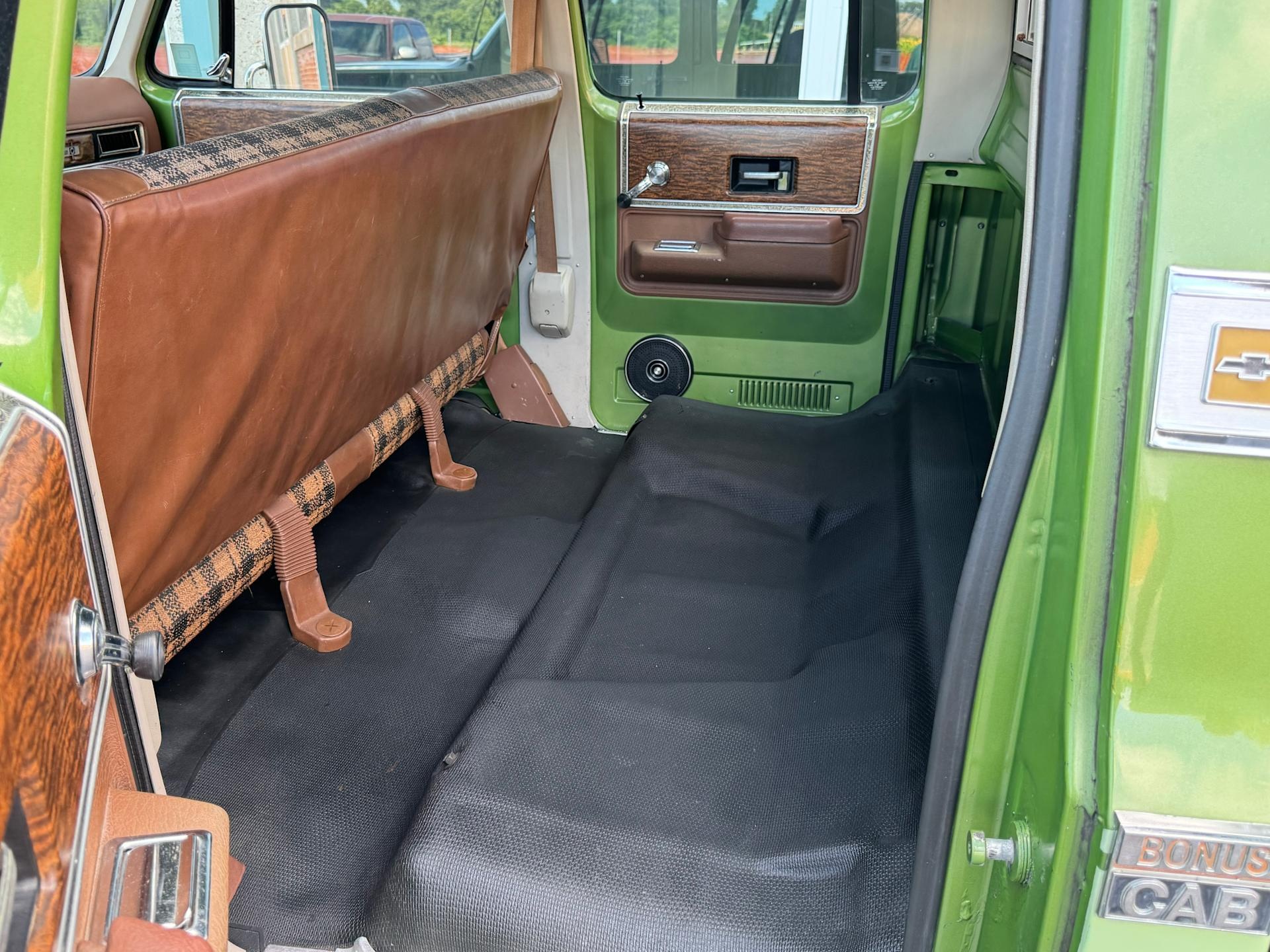
By simply converting a crew cab into a sort of extended cab, Chevrolet was able to brag that its weatherproof cargo area had an impressive 55.8 cubic feet of space. If that wasn’t cool enough, Chevy touted the fact that the cargo area had locking doors on both sides, so you didn’t have to reach behind the front seat to get your gear.
Of course, one of the ideas behind the Square Body was that it was as much of a daily driver as it was a hard worker. So, unlike Dodge and Ford, Chevy didn’t advertise the Bonus Cab with random car parts and such, but three golf bags sitting on the floor. Nearby, three well-dressed gentlemen are seen chatting about whatever dudes talked about in the mid-1970s.
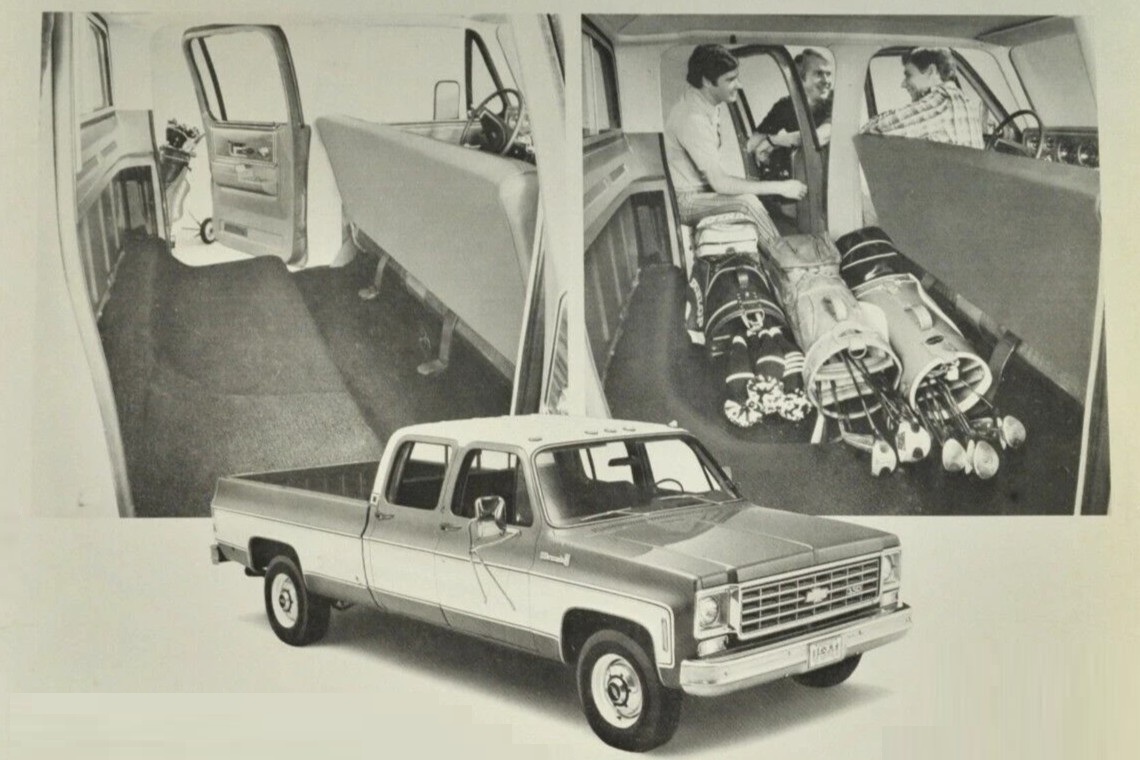
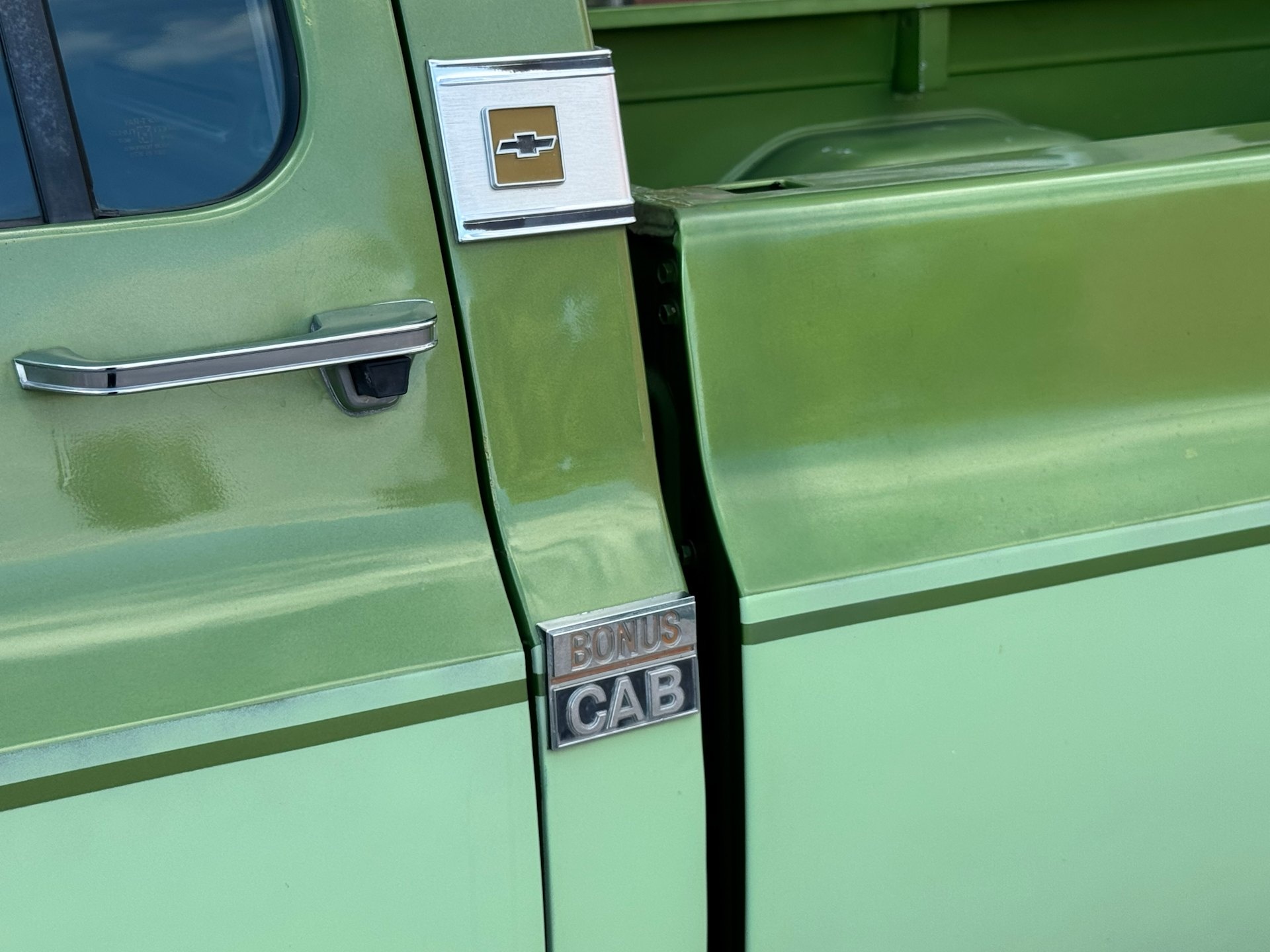
Chevrolet marketed the Bonus Cab as part of a chassis cab build, where the buyer would upfit the truck with a vocational body and use the Bonus Cab for storage. Otherwise, Chevy said that the Bonus Cab was available on eight-foot Fleetside trucks. Bonus Cabs were otherwise the same as crew cabs. If you were a passerby, you wouldn’t even know if a C/K were a crew cab or a Bonus Cab unless you checked out the small badge on the side of the cab.
Bonus Cab trucks would find their ways into fleets, as well as into the hands of private owners who wanted some covered storage. Some Bonus Cab trucks would also be used as donors for conversion truck builds. Of course, you don’t need to toss out an original seat if a seat isn’t there to start!
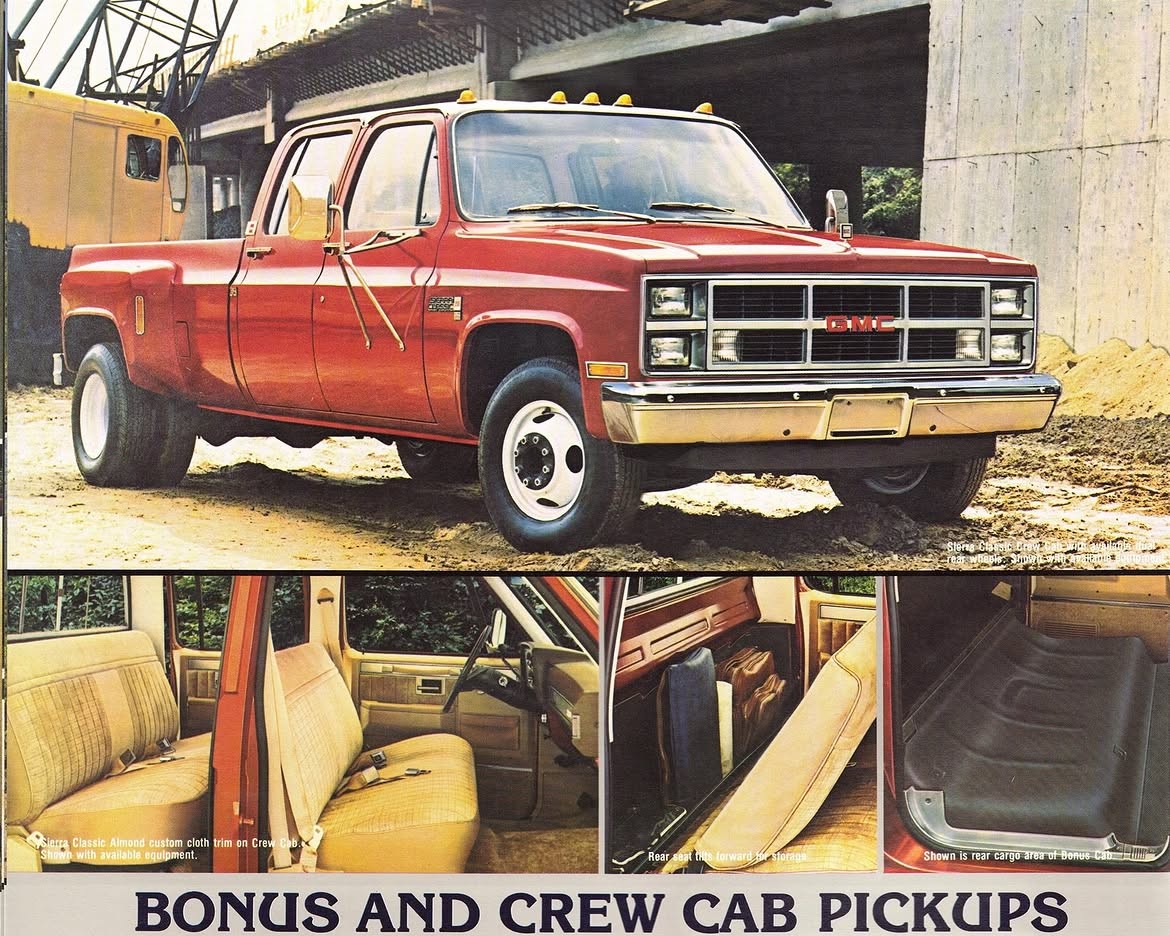
The Bonus Cab would be marketed alongside the crew cab until the Square Body’s discontinuation after 1991. The Bonus Cab would not return for future GM pickup trucks. By this time, GM had proper extended cab trucks in production and no longer needed to snatch seats out of crew cabs to create extra storage.
Today, the world’s pickup truck manufacturers have largely solved the whole storage thing. Modern trucks have all sorts of nooks and crannies in their cabs to store things, and if you don’t want your gear in the cab, there are all kinds of bed-based storage solutions. Of course, there’s also nothing stopping you from just slapping a tonneau cover on your truck bed to keep your gear out of the weather. Extended cabs are still around, too, only now you’ll usually find them with half doors and front-facing rear seats.
The Bonus Cab isn’t even close to the weirdest thing that GM has ever done. It’s probably not even in the top 10 of strange GM developments that I’ve written about. But I also love it. When Ford and Dodge tacked some length onto their cabs, GM simply took a cab it already had and chucked the seat out of it. In essence, GM was happy to sell you a crew cab truck that didn’t actually carry extra people. Of course, if you wanted a real extended cab, you were out of luck.
So, if you’re ever shopping for a Square Body and come across a truck that’s missing its rear bench, it might not be an oversight. You might be looking at a truck that was sold new without a seat. Now I want to see what kind of mini camper you could make in the back of a C/K.
Top graphic image: Mecum Auctions




Wow, yeah I didn’t know these existed w/o the seats…so interesting. I really love all the awesome classic Squarebody trucks
The rear of the truck has door handles, speakers, locks, window cranks located just where the passengers would have their hands, and ASH TRAYS for the non-existent passengers.
Leaving out the rear seats was clearly a last-minute decision.
It’s for the comfort and convenience of any livestock a farmer might carry around in there.
Square Cabs were GREAT… I miss my ’77 Silverado.
BowTie POWER y’all !!!
The days when GM wasn’t afraid of colors were glorious.
An old buddy used to do field service. He could lease any car he wanted for work, but company rules mandated four doors and a covered, locking cargo area. He followed the letter of the law. He had a crew cab F-250 with a tonneau cover on the bed, and he made the company pay for it.
The seats fold up in my 2026 Silverado. There’s a ton of useable space.
“Crew cab pickup trucks are pretty much the default flavor of truck in America.”
Yup, they are super handy.
And nope, I’ll never ever own one of the ugly and silly things. Single cabs forever for this elderly has-been.
So, to sum up:
If you need four doors get a car.
If you need to haul crap get a van or a single cab long bed. Or, shocking idea, rent one.
If you have more than one kid get a minivan or wagon, and no one needs an SUV.
These were solved problems, like door handles.
Hey now, SUVs are great for off-road-y things! But yes, I’m also a devotee of the single cab. 🙂
Yup, SUVs have a place.
At Auto Parts City!
This one goes into the crusher!
Nah, jk.
Or am I??
Talk to you guyyyss…. later!
That insert color on the 75′ is called “Willoway Green” and was the official color of the plumbing shop that I worked for in the 70s.
All their rigs were painted that color. Of course they were all Chebbys.
I love the concept, but it is a shame to not solve this by just having a removable seat. Or, have some sort of more robust cargo storage solution in the back (like a slide out tray…though that would need doors that opened further I imagine).
GM most likely just did this to save on the cost of an extra seat.
There should have been an option to add the seat, and the ability to bolt a seat in.
GM was great at figuring out how to delete as much as possible from a car.
The Chevette Scooter, for example, had no glove box door, no carpet, no back seat, no passenger sun visor, painted bumpers instead of chrome-plated, and painted emblems instead of metal or plastic. It was the Studebaker Scotsman of the 1970s, but somehow GM sold hundreds of thousands of miserable Chevettes year after year.
“Nearby, three well-dressed gentlemen are seen chatting about whatever dudes talked about in the mid-1970s.”
You really don’t want to know.
I can help!! I was there!!
No, on second thought….
Was there any vehicle driven by well-dressed gentlemen in the mid-70’s that wouldn’t easily fit three golf bags?
Most of those vehicles could have held the golf bats in covered safety without making three grown men sit on a single bench seat.
And absolutely slathered in soft Corinthian leather……
While wearing Hai Karate.
‘Have to fight the girls off ! ????
I don’t think you can carry 3 golf bags in a Mercedes R107 if you sprang for the “back seat” option.
Didn’t take much to be well-dressed.
A few robin’s egg polyester suits and the widest ties on the planet would do it.
Those green door cards with the brown plaid cloth seats are ’70s perfection!
I love contrast of the fully trimmed, woodgrain rear door cards with roll down windows in a bare vinyl floored cargo area. Also the rear bulkhead is bare painted metal.
It was probably cheaper for GM to do a four-door truck than it would have been for Ford or Dodge, because the box-body Suburban came out at the same time, so the rear doors were already a production item.
Rear seat delete is an option that manufacturers really ought to bring back.
75% of the time I have the bottom bench in my 2010 GMC extended cab folded up to get large equipment cases in the back seat.
My boss went one step further and completely removed the back seats in his ~ 2020 extended cab F150. Tons of cargo space for equipment and samples that we pick up on customer sites.
Toyota sells an Xtracab version of the Tacoma currently that doesn’t have a backseat factory and instead has storage. If that configuration with the manual and longer bed was available, I probably would have ordered one, alas the manual only comes in 4 door, short bed due to low volumes which is understandable.
I probably would have ordered one, alas the manual only comes in 4 door, short bed due to low volumes which is understandable.
This is absolutely insane.
If I want a Whopper Jr. with no mayo, I will order it that way and be angry if it’s incorrect. That’s a sub $5 purchase made with no planning or research.
Yet when it comes to getting a $50k vehicle configured entirely how we don’t want it, we’re all “I’m your piggy, gimme the slop!”
If Burger king had to extensively test per government regulations and make different tooling and assembly lines for different burger configurations, they would have a much more limited menu ha-ha.
Honestly, I’m just happy anyone sells a new manual truck of any configuration. I ended up buying a really nice CPO army green ’22 Tacoma for ~38K and it’s been good.
I agree that it would be nice to be able to spec out vehicles however we want, unfortunately not the world we live in anymore.
The speed and volume output of a fast burger chain makes Chevys seem coachbuilt by comparison.
Car manufacturers build this way because we never stopped bellying-up to the trough even when they stopped selling what we want.
I’ve never ordered a ‘Yota, mainly because I heard they were weird like that. No allocation unless it fit into whatever template they had.
Meanwhile GM let me order a ZR2 extended cab diesel w/ vinyl floors, a block heater, and no other option right before the books closed.
Good spec list!
I looked hard at the Colorados but I worked with 2 guys who had insane problems with their trucks, one guy owned his for a year before he got rid of it and it was at the dealer for 5 or 6 of those months. Suspension issues, transmission, electrical, all sorts of weird stuff. Didn’t want to take the risk in the end. Probably not statistically relevant, but man they had a hard time. This was peak pandemic 20-21 so maybe that’s the cause of the quality issues.
The third Gen Tacoma isn’t great (at really anything honestly) but they have a well-deserved reputation for quality and reliability, so it was a safe bet for me while I work on putting together another square body chevy for a driver. Never should have let my buddies talk me into “upgrading” from my ’84 K10 to a 2010 GMC Sierra. Sierra has been nothing but issues, another reason why I shied away from newer GM products.
Mine is a ’22, was still held up for a few months because of lingering supply chain issues.
I’m about to cross hit 87k miles, and the only issue I’ve had to bring it back to the dealer for was a NOx sensor at 16k that was replaced under warranty.
Any other issues have been self inflicted.. had to replace most of the accessory pulleys after the front end became a little submerged. Tcase shift motor was also a victim of that incident. Oh and I just had a CV boot tear, but I do have a front level. Surprised it didn’t happen sooner.
Otherwise it’s been a trooper, still on the original brakes and battery somehow. Put KO2’s on shortly after I bought the truck, still have a surprising amount of tread left with 84k miles on them. I’m really just waiting for the emissions system to shit the bed, but I think it helps that I do plenty of long road trips.
A good buddy of mine has a 2016 Tacoma, I think he’s well north of 150k by now. Been super reliable but that seating position.. I just can’t do it.
Glad to hear your truck is working out for you. They can’t all be bad.
Yeah, the seating position isn’t great. I’m actually the third owner of my Tacoma, first guy leased, second guy bought and put maybe 1000 miles on it before he couldn’t handle the seats anymore and went to a tundra.
Before I put seat jackers in I could drive the truck maybe 30 minutes before I lost feeling in my legs. After it’s about 5 hours which still isn’t great but a major improvement.
I don’t know who this truck was designed for ergonomically, but it isn’t me at 6’3” 275 lbs. It’s odd because I can drive a corolla or a Camry across country in comfort, but I have a hard time making it to PA in my Tacoma.
The fact that the Xtracab doesn’t even have suicide doors to get into the back makes it a no-go for me.
I ordered a 2022 Colorado extended cab when it was certain they were going to crew cab / short bed only for the 3rd gen. I removed the seat backs and installed the plastic inserts from the WT trim but still haven’t gotten around to building a platform back there. The back is storage for any gear I want to stay dry and locked up. It would suck to have to access that space through the front door.