


Roll call! What do you think was GM’s first hybrid? It’s not going to be the Chevy Volt, as that hit the market in 2010. Nor was it the Saturn Vue from 2007, as while the Vue was offered with a Green Line mild hybrid version, there were earlier hybrids from GM. In fact, GM’s first hybrid passenger vehicle sold to the buying public, outside fleet use or prototypes, was the Chevy Silverado/GMC Sierra Hybrid, which was launched in 2004 and sold to retail buyers between 2005 and 2007. It was a mild hybrid setup with an electric motor inside the transmission’s flywheel housing.
However, if we also take prototypes and studies into account, the first hybrid GM ever displayed was the Stir-Lec. The vehicle bearing that futuristic and mysterious name was an Opel Kadett coupe with a very weird experimental hybrid set-up, in 1968. In the mid-1960s, severe smog became a public health crisis, and since General Motors had put many polluting cars on the roads, it directed funds into researching alternative means of propulsion other than regular gas or diesel.


The Basic Car Was Good Looking

The Opel Kadett was one of those perfectly ordinary European family cars. The Kadett name was already used in the 1930s on a small and basic car that later spawned a Soviet copy, the Moskvich 400, that was produced until the mid-1950s. In the early 1960s, the Kadett was reborn. You might recognize the Kadett A as the “Oliver” car from Top Gear’s Botswana Special. These are small and friendly-looking cars, and while the Kadett B introduced just a couple of years later was somewhat larger, it was still compact enough to be sold as a small car at Buick dealers in the United States. That was also the Kadett, which Bob Lutz famously put on its roof.
The following generation, the Kadett C, was largely the same car as the Chevrolet Chevette, the Vauxhall Chevette and the Isuzu Gemini/I-Mark, as it was built on GM’s T-Body platform.
Stir-Lec For Stirling-Electric

In the late 1960s, General Motors let journalists behind the wheel of its experimental vehicle, built by GM’s Research Laboratories. Clothed in a production car body, the Stir-Lec was an early EREV prototype designed in the face of the growing smog situation in the United States. How about a commuter car that didn’t emit any meaningful exhaust gases?
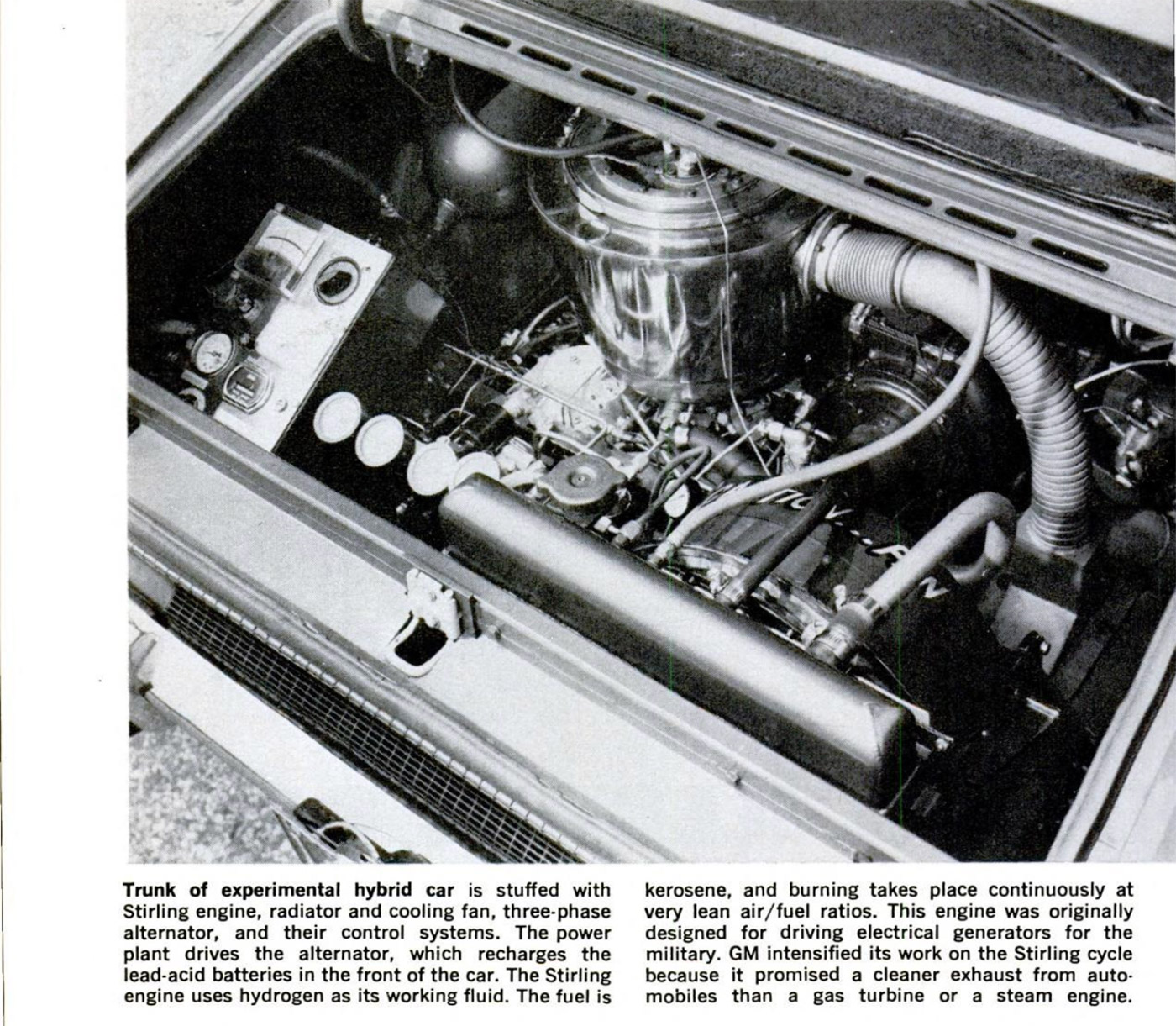
A bunch of small European cars of the time had the engine in the back, while the Kadetts were front-engined. The Stir-Lec changed that, as the car’s engine was located in the trunk, and attached to the differential was a three-phase, 20-horsepower electric induction motor, small and compact, powering the rear wheels via batteries mounted in the front.
The rear-mounted engine, running at a constant 2,800 rpm, had the sole job of keeping the car’s batteries charged, and had no connection to the driven wheels. And it didn’t run on gasoline, as it was a Stirling engine that could even run on kerosene. Mind-boggling stuff, especially for the late ’60s.
What’s a Stirling engine, you may ask? It mustn’t be confused with a Sterling engine, which is a 2.7-liter Honda V6 fitted in a Rover 800-series exported to the US.
The Stirling engine was invented by its namesake, the Scotsman Robert Stirling, and it’s a closed-cycle regenerative heat engine, also called a hot air engine, patented by Stirling already in 1816. As The College of Science and Mathematics at Fresno State explains the basic premise:
Stirling engines are more efficient forms of generating power from heat energy than standard combustion engines. The greater the temperature difference between the interior and exterior, the more efficient the generation. The two pistons of the engine are connected via a pressure chamber that allows air to flow between them. The ‘hot-side’ of the piston is exposed to the flame and heats up while the ‘cold-side’ is cooled by the ambient air temperature. Thermal expansion causes the heated air to push the hot-side inward, forcing the cool-side up. The air moves into the cool-sides chamber, where it cools and condenses. This condensation causes the cool-side’s piston to contract, the momentum of which draws the cooled air into the hot-side and forcibly compresses it further. The flame then again heats and expands the air, forcing the piston back inward, repeating the cycle.
The “cool side” in the Stir-Lec was water-cooled with a rear-mounted radiator and fan setup, with a separate blower for the combustion air. The working gas, hydrogen in this specific case, is permanently retained in the engine.
The downside is a low power-to-weight ratio. However, for keeping 6 kWh worth of batteries charged, it’s fine, and the Stir-Lec’s engine produced just eight horsepower. The engine was produced by the Dutch company Philips, which had been producing Stirling engines to be used as power generators, like the one in the above video. While that generator doesn’t run silently, I guess it would make a lot less noise clothed in a car body, even inside a 1968 Opel Kadett.
It Wasn’t Fast

Under the hood, the radiator’s place was taken up by the modulating inverter and 14 completely conventional, commercially available lead-acid batteries. Running on battery power only, the car would have a range of just 15 to 30 miles depending on how much the throttle pedal was pressed, but the Stirling engine setup (which did its own mashing of the gas) worked as a range extender, giving it a usable range of 150-200 miles out of 4.75 gallons of kerosene. As much as 42 mpg with barely any exhaust pollution isn’t bad at all, but it’s not like you would cover ground very fast.
The entire experimental vehicle weighed some 3,100 lbs with the front seats occupied, which is heavy for a Kadett.

Since the Stir-Lec was widely shown in 1969 magazine ads, it’s often noted to have been unveiled that year, but Popular Science test-drove the first version, the Stir-Lec I, already in 1968. The magazine said it wasn’t fast, as acceleration to 30 mph took “10 to 20 seconds”, which is an interestingly wide span, but the take-off was said to be very smooth.
During the test, the Stirling engine was fueled using kerosene. The article also says that 30mph is the “break-even” speed, where the car can travel without draining the batteries faster than it can recharge them. A second version, the Stir-Lec II, followed in 1969, which swapped the AC motor for a DC one, and the electronics were simplified further. Range wasn’t improved, but the car was slightly faster. The prototypes had both the trunk and the frunk full of stuff, and GM never developed the Stir-Lec cars to the production phase.
In 1973, Ford was developing a 170-hp Stirling engine together with Philips, reportedly to replace the 351 Cleveland in the Ford Torino, but it doesn’t seem to have been significantly more economical.

In 1971, GM also showed the XEP-1a experimental vehicle, which was based on a similar Opel Kadett as the Stir-Lec cars. It was a more conventional electric car prototype, just full of batteries without a range extender, and it worked as a test mule for Opel’s record-breaking Elektro GT.

The Opel GT-based prototype reached a top speed of 188 km/h (116.8 mph), with 1630 lbs of Varta nickel-cadmium batteries providing power. The entire car weighed as much as an Opel Blitz truck, or over 3700 lbs. When you know how small an Opel GT is, it puts that into proper context.
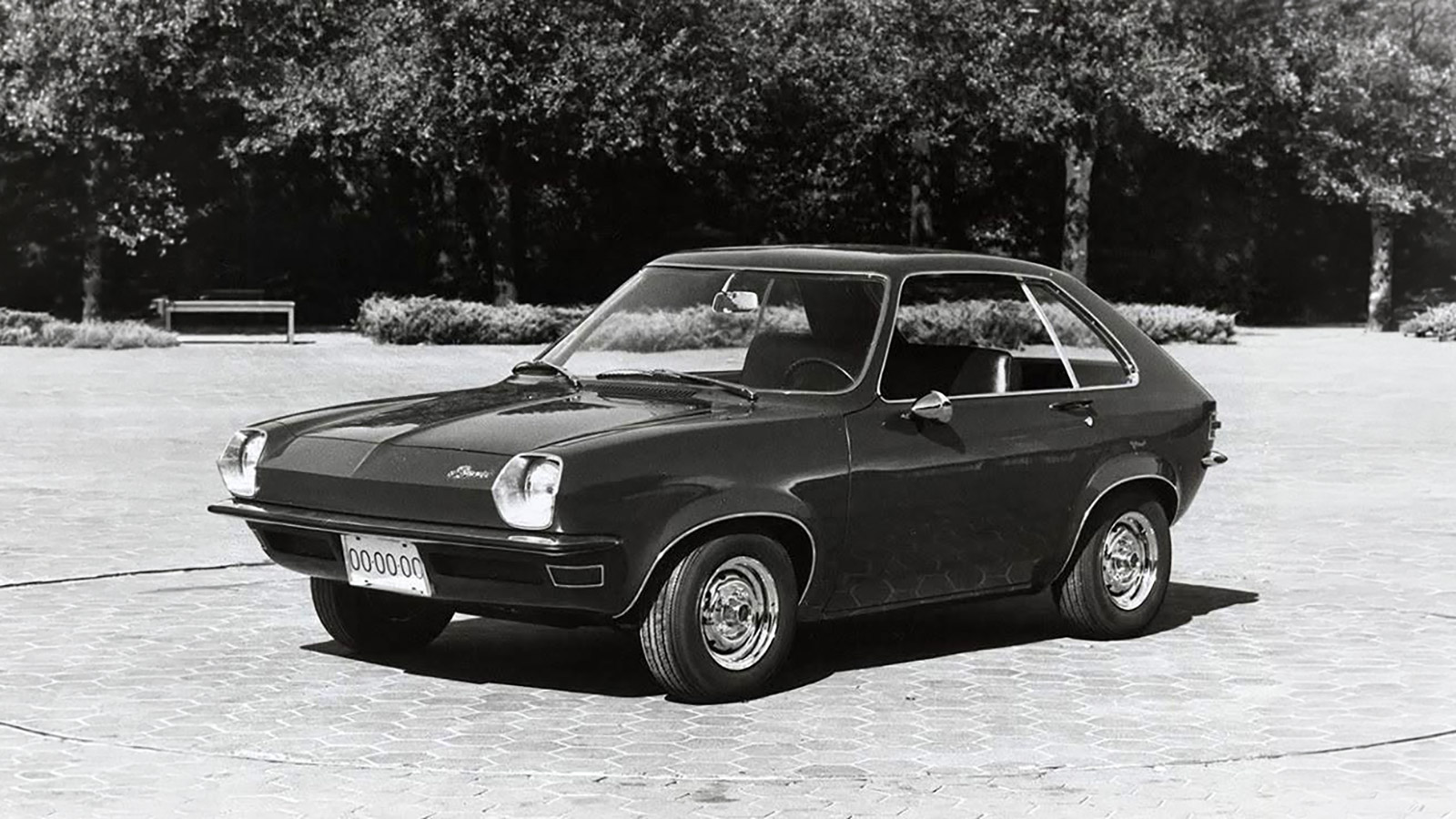
While the 1968 Stir-Lec was GM’s first hybrid prototype, GM also showed another hybrid prototype the next year. That was the XP-883, a tiny fiberglass nugget with a plug-in hybrid system. The engine was a 35-cubic-inch two-cylinder, coupled to a DC motor and six 12-volt batteries in the rear. Setting off, the car would run on electric power until it reached 10 mph, after which the engine turned on. The XP-883 would accelerate all the way to 60 mph, taking a whole 28 seconds to do that; 40mph was attainable in a more palatable 12 seconds.
Like the Stir-Lecs, the XP-883 remained an experimental prototype, and it took until the 1990s for GM to actually provide an electrified car for regular customers, with the EV-1 – which was strictly limited in the way it was distributed, too, as you could only lease them. The 2010 Chevrolet Volt, again championed by Bob Lutz, was a moonshot when you consider how long it took for GM to sell hybrids to people who wanted to save a bit of fuel and run on electricity when it suited them.
Correction: The original version of this story said that the Stirling engine runs on helium. The fuel is actually kerosene. We have corrected the error.
Top graphic images: Opel; Popular Science


Stirling engines are an interesting theory. They combine high theoretic efficiencies with a low minimum hot side temperature.
In a steam engine, you would need a hot temperature at least hot enough to boil water. Model Stirling engines exist that can work on the temperature difference between your hand and the ambient air.
However, even after decades of scolars making their thesis on this type of engine, I have yet to see a machine that combines affordability and favours in terms of efficiency compared to a simple gas burning engine. (Outside of some very specialized examples.)
Fresno state is wrong.
The air does not condense as it cools. Dry gas is meant to be used as a working fluid. Such as helium. If you are going to use a phase-changing medium, such as water, you have created a steam engine with al its inherent properties.
Dry gas expands when heated and contracts when cooled.
Great article, great comments!
My father had a Kadett that was so underpowered he had to use first gear to get up this one steep section of freeway. Years later, my Bug was able to take that same hill in third gear.
This made me think of the 1st ever? Hybrid auto the Lohner Porsche.
I didn’t realize 300 vehicles (almost exclusively commercial) vehicles were made using the system which also apparently inspired nasal engineers for the lunar rover…
https://en.wikipedia.org/wiki/Lohner%E2%80%93Porsche
So whacky! It looks like they were distilling moonshine in the trunk.
I loved the Opels Buick sold here years before I got my Driver’s License on my 16th birthday. Both the Kadetts and especially the GT! That thing was so cool-looking. They were both gone, but I was driving my parents’ wheels and there was no way they were going to buy either.
She’ll go 300 hectares on a single tank of kerosene!
An excellent article that inspired some great commentary from those who sit atop various upholstery materials. A good read from a good read. (-:
Of course they did.
This is great stuff. It sort of reminds me of how Xerox had some incredible early computer tech, but really dropped the ball on putting it all together and bringing it to market.
Part of it was that there were legitimate engineering issues they had to address and couldn’t work out. But it was also that they were making so much money off their regular copier business that the execs just didn’t see the experimental work as mattering.
…..Would…..
My Dad had that same model ’68 Kadett Sport Coupe – Ours was White over a Red vinyl interior with the 4 speed.
His was not a hybrid, nor was it fast.
And it wasn’t upside down like Lutz’s….
It was sold off in the summer of 1971 in preparation for our PCS move from Marysville, CA back to Upper Michigan…
Reliant also built a rather interesting series hybrid prototype in the early 1980s, in partnership with Lucas, seemed to work well enough, but appears to have been intended as a show car and not much else. They did partner with an American company later in the decade on a hybrid version of the Rialto to sell in the US, but I don’t know if that was directly related to the earlier concept or a new design. At any rate, ZOE appeared to be more of a scam than an actual business, so it went nowhere
I knew an old multi disciplinary engineer that finished his career at DOE he was brought in from NASA in 77. As he worked on their fuel cell program. He used to talk about things like this and looks at the cars around while shaking his head. Just like GM has the ev Corvair from mid to late 60s that was sort of a mule for moon rover but also a showcase of the tech of the time. It just all got thrown in a black hole of some warehouse.
The batteries in the Electrovair cost $160,000 in 1966 money, and it had a practical range of 40-50 miles, and no trunk space of any kind
Exactly space age tech that was a stepping stone. Silver based batteries weren’t ever going anywhere but space or the deep ocean though. They used them on icbms too.
The Stirling engine didn’t run on helium – helium isn’t a fuel gas. Its operating gas within the cylinder/s was helium due to its low viscosity and thermal conductivity – important traits for use in a Stirling cycle engine.
Its an interesting coincidence that the first hybrid car I hear of and read about in any depth was also an Opel, a homebrewed GT (gotta just sit back and marvel at choosing that cramped, low-slung engine bay for a project like this) with a lawnmower engine, a few lead-acid batteries and I think an aircraft starter motor repurposed for drive duties. Mother Earth News magazine talked to the guy that built that thing, then turned around and built their own, this time in an old Subaru with a small diesel engine. They reported something like mid-40s fuel economy; pretty great for the late 70s in a car that still seated four people.
I remember that article – when I was a kid I’d pour over those old Mother Earth News magazines just soaking up every car article.
At one time I had a very nearly complete collection – I had every issue except #2.
I remember that for a long time their lead experimental madman was Dennis Burkholder, and they hosted editorial cartoons from L Cobb. Ron Cobb? Hmm.
And the Down On The Farm comic strip serialized on the back page by “Cartoony L. Bruce Holman.” I eventually found the entire strip collected into a book, which I purchased and have on a shelf somewhere.
I’m a little sorry I didn’t keep them. It turns out that things that go onto the internet don’t necessarily stay there forever. Things get deleted, overwritten, moved to increasingly obscure servers or they lose their host and they’re just…gone. My paper magazines, I knew where they were. I’d rotate a few different ones into the bathroom every few weeks for restroom reading.
We found a run from #1 all through the mid 80s in a house my parents bought (that had been an attempted modern homestead). The first few years were bound, so I figure the old occupants had bought them as back issues.
Definitely remember Burkholder and that comic strip!
They sat in my parents shop for 20 years or so and then I had to move my parents and donated them all to the local public library for their book sale. Apparently someone snatched them up immediately. I’m kinda sad that I don’t have them anymore, but stoked someone who knew what they were and appreciated them got ’em and it gave a little money to that tiny library.
Yeah, we’re going to lose a ton of things because we assume that when something goes online it’ll be there forever, which just is not true. Especially because the one tool we have for that is increasingly blocked (Internet Archive/Wayback Machine).
XP-883’s most lasting contribution seems to have been its styling. It’s pretty clear how much influence it had on the first series Chevette.
How about a commuter car that didn’t emit any meaningful exhaust gases?
A bold claim for any car made in the era of leaded gasoline.
Kerosene.
Yeah. I should have said the era before catalytic converters instead.
Hate to be that guy, but a minor correction is needed:
The working fluid was helium, but as stated later in the article the engine was powered by kerosene.
Otherwise, what an interesting article! I knew GM had played with Stirling engine powered vehicles, but I never knew they did a series electric like this.
Thanks for the Noble correction. I was too inert and was confused on how something would run on Helium.
I think helium is used because its a non reactive monoatomic gas that remains a gas from about 4 Kelvin (just above absolute zero) to 12,000 Kelvin (hotter than the surface of the sun)
The nice thing about such a gas that is all its energy is stored as translational motion, e.g. bouncing around within the cylinder rather than storing energy as spinning, wiggling, stretching or phase changes as other gasses might.
Hydrogen OTOH is a diatomic molecule so it does rotate and stretch. It also embrittles most metals and escapes confinement quite easily although not as easily as helium.
Noble gasses would have worked better than hydrogen but are much more expensive and I expect for the prototype hydrogen was good enough.
Have you seen Helium prices these days?
No worries… we’re pivoting from Mars to the moon, where element number two is plentiful. Expect “One small step” orations in the pitch of Alvin and the Chipmunks any day now.
Nope. I’m still rocking a mostly empty tank I took home after a kids party in 2012.
It’s probably not as bad as it was, I think new plants in Dubai and Australia opened.
That’s why I cringe every time I see a car restorer dipping rusty parts in acid. Hydrogen embrittlement is very real.
I imagine whatever the acid does is nothing compared to the damage done by the rust.
When I was a kid I tried de-rusting a set of drafting tools with an acid rustproofing solution. They crumbled like stale candy.
I didn’t see the tools but if you were de-rusting them I imagine the rust was pretty bad.
I was thinking that “run on helium” meant that is was consumed in the process and that did not make sense. Using it in some not consumptive way is logical, yes.
Not the way I’d have worded it either.
Working fluid was hydrogen.
I do see the article states it used hydrogen and had missed that. The diagram of the car shows it had a helium reservoir which I can only assume would have been used to charge/maintain the stirling engine. It looks like Phillips used either gas in their engines so… maybe they played with both?
This. Some of the source material says hydrogen, others helium.