


Ever since the internet became A Thing, everybody in the world is everybody’s roommate and we all know all the tea and dirt and hot goss about everyone, everywhere, all the time. Is it a blessing or a curse or something in between? Probably. But it’s very much here, we’re stuck with it for the foreseeable future, so we may as well get used to it and appreciate it for what it is, if that’s possible. Or, at least we can try to cravenly profit from it, which is what I’m going to try and do right now, as I attempt to leap upon the runaway train that is the Kelly Clarkson Bird Automaton Kerfuffle.
Do you know what this is all about? I didn’t, until, shockingly, our own Editor-in-Cheap David Tracy asked me if I could “come up with a Kelly Clarkson mechanical bird angle?” and those were a collection of words I had never really expected to hear come out of David’s mouth. Maybe anyone’s mouth. David told me his wife has been “obsessed” with the whole thing, and it does seem to be all over the news right now.


Here, you can Alta Vista it and see for yourself, or just glance at this screenshot and trust me:

See, that’s a lot of stories about this, whatever the hell this is. What the hell this is seems to all stem from a tweet Clarkson twittled after she visited a Brooklyn store called Art of Play:
Just drove all the way to Brooklyn to check out this store I thought looked really rad and had a few things in mind to buy and literally was looked at as if I couldn’t afford it and was told he could find something comparable for me. Wow, dude. You’re an idiot and just lost a…
— Kelly Clarkson (@kellyclarkson) October 10, 2026
If that tweet gets deleted, here’s the full text of it:
Just drove all the way to Brooklyn to check out this store I thought looked really rad and had a few things in mind to buy and literally was looked at as if I couldn’t afford it and was told he could find something comparable for me. Wow, dude. You’re an idiot and just lost a huge sale. But y’all should go check out Art of Play in Brooklyn if you enjoy being treated like Julia Roberts character in Pretty Woman. For sure, check it out ????
Okay, so what seems to have happened is that Clarkson went to this store, which seems like it carries the kind of stuff in the whimsy section of a large art museum’s gift shop – think toys and games and puzzles designed by artists and architects, very cool and lovely looking things, all pretty expensive and maybe too nice to actually, you know, play with. There’s a lot of stuff there I’d find appealing – Eames playing cards? Sure, who doesn’t love the Eamses? And sure, I guess some of the stuff can be a little eye-rolly, but I’m not going to pretend that a modern digital video recorder made to look like a ’60 Super-8 camera isn’t at least a bit fun, and sure, $400 is a lot for a reconfigurable wooden marble run thing, but if you have the money? Go nuts. Life is for the living.
How This Mechanical Bird Works
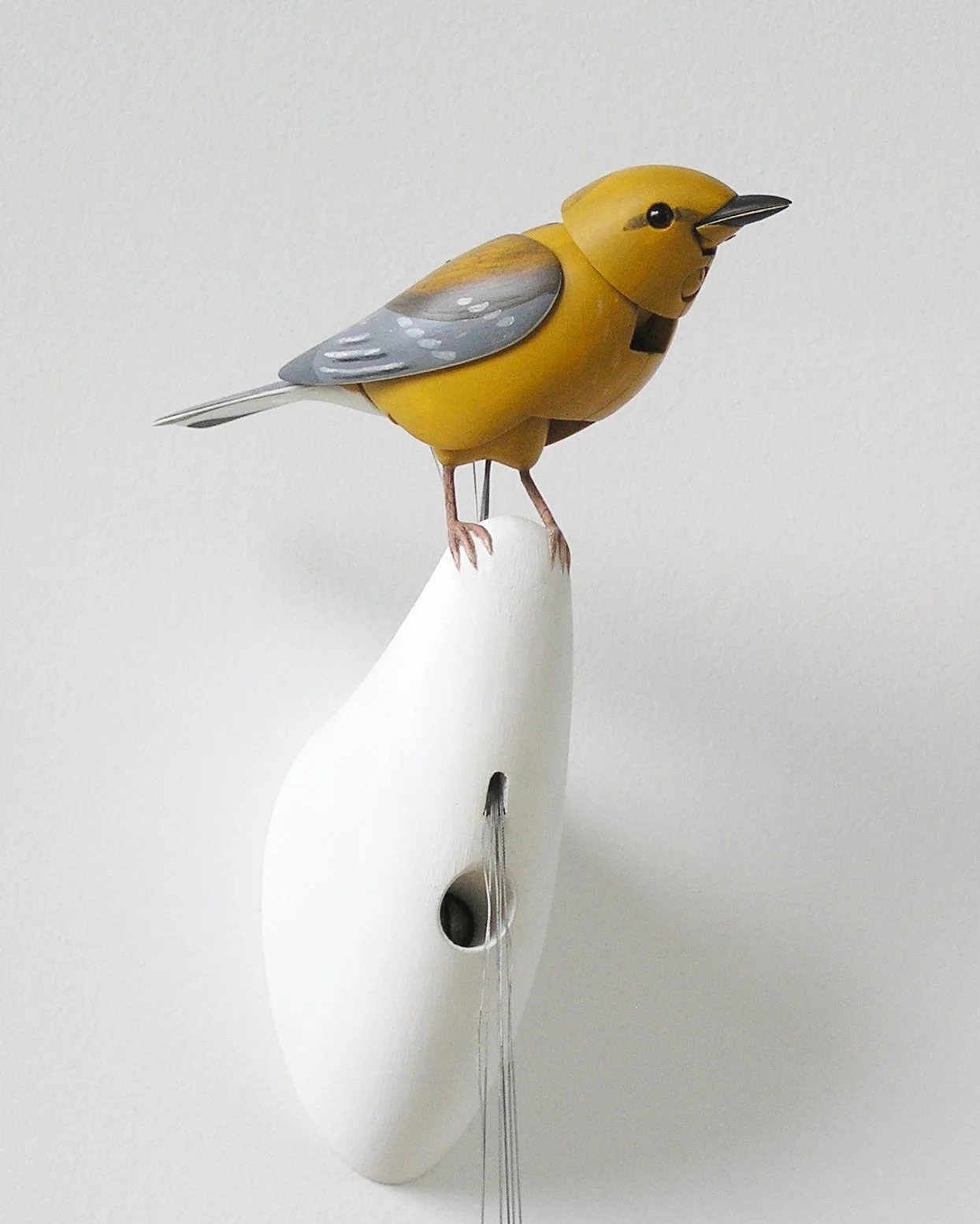
Anyway, also in this store, mounted to a wall, was this little bird automaton. It’s a beautifully-made hand-cranked machine that has a little wooden bird (I’m told it looks like a northern yellow warbler) that moves and sings in a charming mechanical manner. It was made by an artist named Bliss Kolb, who seems remarkably skilled at building such automata.
Let’s take a look at how this elegant contraption works. Our engineer-EIC David Tracy is going to take over writing the rest of this section.
The operator begins by rotating a crank handle:

That handle is attached to a worm shaft, which meshes with a worm gear, which is part of a camshaft that contains nine lobes.

Those camshaft lobes have very specific shapes in order to determine the exact timing of different bird-motions and sounds. The way this works is, there are what are known as a “cam followers” or “cam finger followers.” Each follower rides along a cam lobe such that, as the cam lobe’s shape changes, the follower drops into its valleys and rides up its peaks (it moves up and down).
Since the “finger follower” pivot about a shaft (see dotted line below), as each finger followers move up and down with the shape of each lobe, so does the other side of each “finger follower.” This is where cables and rods are attached.


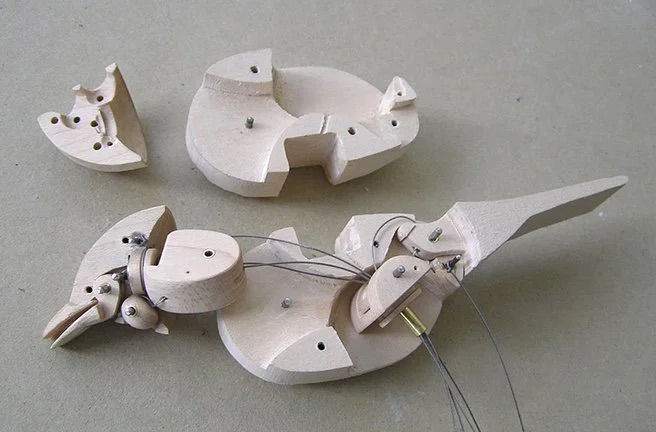
The cables are what allow the lifelike motion of the bird. As the crank rotates the worm, which spins the worm gear, which rotates the camshaft, which sends the lobes pushing up against “finger followers” that pivot to pull and slacken cables, those cables pull and release certain parts of the bird to make it move. You can see all the cables entering the bottom of the bird here:
This image shows how the cables are actually routed inside the bird to yield a lifelike motion, much like a puppet:
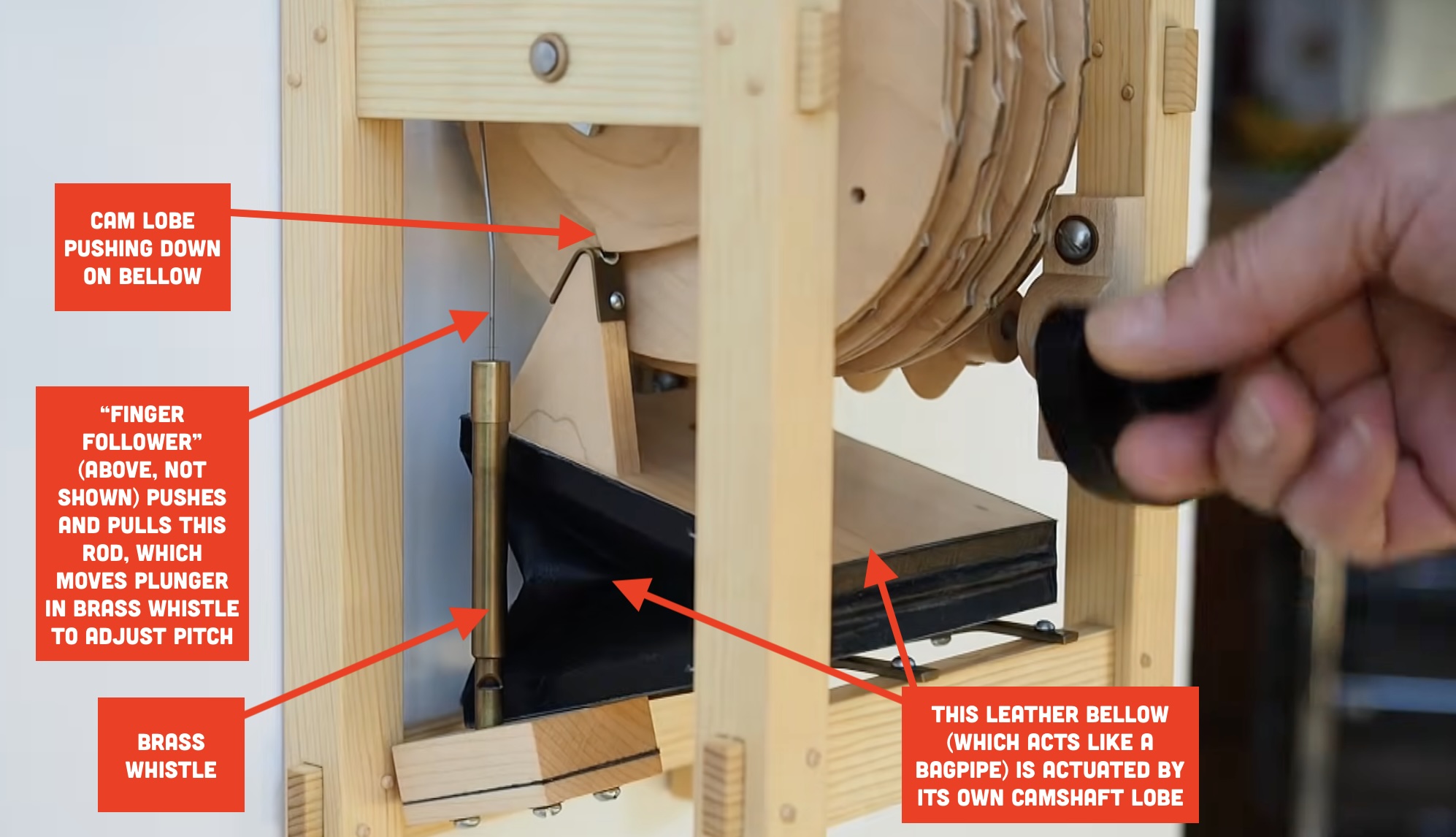
As for the bird’s sounds, those are also created via cam lobes. There’s one specific lobe whose “finger follower” is actually down below and part of the top of a leather bellow, which acts much like a bagpipe. As the cam lobe rotates, it pushes that “finger follower” down, which squeezes the bellow to create air pressure.
The pitch is changed by a rod attached to a “finger follower” up top, next to the other finger followers pulling the bird’s cables. You can see these mechanisms in the image below:
The manufacturer, Bliss Kolb Design, describes the mechanical bird’s operation simply:
A wooden worm gear operates a star gear and nine cams. Each cam operates a lever and cable that pull each of the bird’s movements. The song is produced by leather bellows that blow air through a brass whistle whose pitch is varied by a plunger operated by its own lever and cam.”

What a fascinating mechanism, and it uses camshaft technology, which is extremely popular in the car world. I’ll let Jason take over.
Automotive Tie-Ins (This Is A Car Website, After All)
A lovely thing! If I were wealthy enough that 15 large ones was the equivalent of, oh, $100 or so, I’d want to buy one, too! Why not? Can you have too many mechanical birds?
So, Clarkson came in to the shop, asked if she could buy the bird automaton, but was told it wasn’t for sale, and she felt slighted, sent that tweet, and then all hell broke loose. The bird was mounted to the wall, and while it did have a price tag – $15,000 – that seems to have been put up to dissuade people from asking if it’s for sale. Also, that seems to roughly be the price the artist charges for such automata. In fact, back around Labor Day, Art of Play actually posted on Instagram about things in the store not for sale, and the bird was right there as the first picture:
View this post on Instagram
Anyway, things seem to have escalated with response tweets from Clarkson:
Cool, cool. Sure, it wasn’t for sale. That’s the narrative Art of Play is gonna go with ???? so the whole conversation we had when I asked you if it was for sale whilst pointing to the price tag hanging on the wall with the title Singing Bird didn’t happen as you elevator eyed me… pic.twitter.com/9PEhUWnIOt
— Kelly Clarkson (@kellyclarkson) October 11, 2026
…and Clarkson has a massive army of fans who have been attacking the store online and, it seems, in person, leading to the store stating they have been “put in danger” and oh it’s all so stupid and I just do not care, not even a little, but here we are and, dammit, I want some of that sweet, sweet internet search traffic so I’m gonna try and grab some of it.
But in a positive way! Because whether you think Clarkson is being an entitled weirdo or the store is being judgmental or something, there arebetter lessons we can take away from all of this, and at least one is definitely car related, maybe even two. The first one has to do with bird automatons and cars, and the intersection of the two, and I’m happy to say there is at least one very famous example of that: the 1910 Brooke Swan Car.
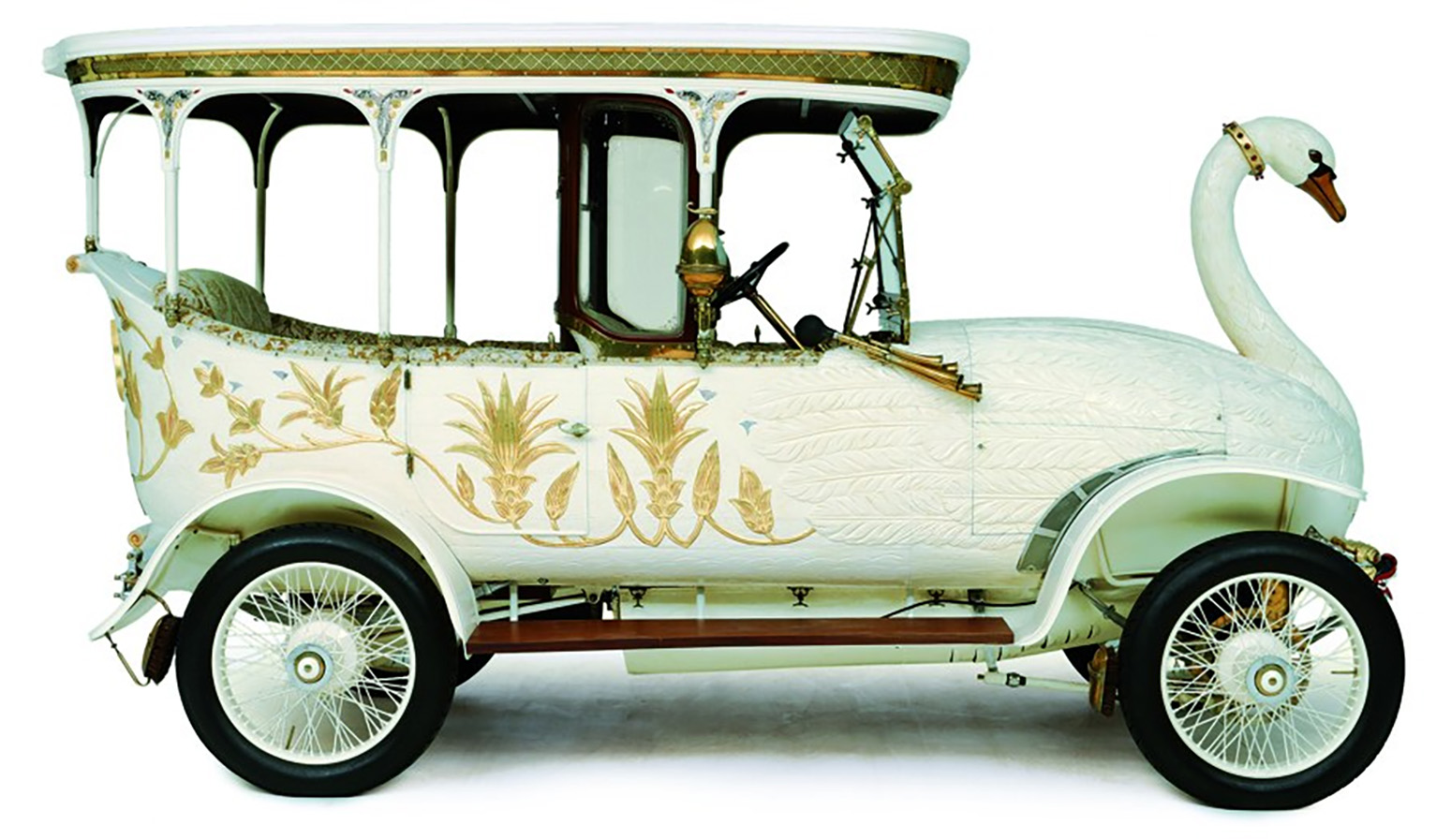
This is quite a famous car, and I suspect you’ve heard of it before. Based on an uncommon chassis, a Brooke 25/30, this car was the brainegg of a Scotsman names Nicholl Matthewson, who was living in India, and wanted something to impress the local bigshots. I think he managed that with this, a colossal swan-car that went beyond just having a swan head grafted onto a car. This was closer to automaton territory, because the swan’s head could, um, vomit scalding hot water and steam to get people to move out of the way, presumably because Matthewson felt a horn just wasn’t able to provide the boiling water burns on people that he demanded.
Later, the car was sold to the Maharaja of Nabha, whose family kept the car for 70 years before it was sold to the Louman Museum in The Hague.
Even better, the swan car can actually poop, keeping in a long tradition of avian automata starting with Vaucanson’s famous 1738 duck automaton, which could also shit.
Want to see the swan car shit? Of course you do, don’t pretend like you don’t. Here you go:
I cued it up to the pooping portion, but I suggest watching the whole video to really get a sense of how remarkable this thing was: it had a multi-tone horn controllable by a keyboard in the back seat, a ship-like telegraph to tell the chauffeur where to go without the indignity of speaking to them, and more.
You know what else is automotive-related about the Clarkson/Mechanical Bird fecalshow? Cams.
Yes, cams! Let’s take advantage of all this attention to remind the world of the glory of cams and what they can do! That whole little bird, for example, works pretty much entirely based on cams. And cams (and the rocker arms actuated by those cams) are what opens and closes the valves in your car’s engine!

Cams are beautiful things, because you can think of them as a way to record and play back repeating motions. If you want to get extra-poetic about it, you can think of them as physical objects capable of storing dance. See, if you track the motion of something over a period of time, and can describe that motion in terms of a moving line or a wave – imagine something hopping up and down, and the resulting wavy line you would get from that motion, when wrapped around an axis, forms the shape of the cam, what is known as its “profile.” It’s just a record of motion, and that motion can be re-created when the cam is spun, and its shape followed by a “follower” that actuates something, like bird wings or an exhaust valve.
Here’s a good video that explains it well, with some visuals:
Maybe that dude should have picked a different video thumbnail frame, though. Oh well.
You know what else famously used cams in cars? The first sequential turn signals ever! That’s right, the 1965 Ford Thunderbird’s sequential rear turn indicators were all controlled by tiny cams!
Yes, these taillights didn’t use integrated electronics to make those lights illuminate in sequence: it used a tiny camshaft, with three cam lobes, each one turning the light on and off at the appropriate times:

The cam profiles to make these lights work are quite simple; off for a two beats, on for one. The arrangement of the three cam lobes, staggered at the right position, turns into a series of on-off sequences over time, as delightfully shown in this Ford brochure page:
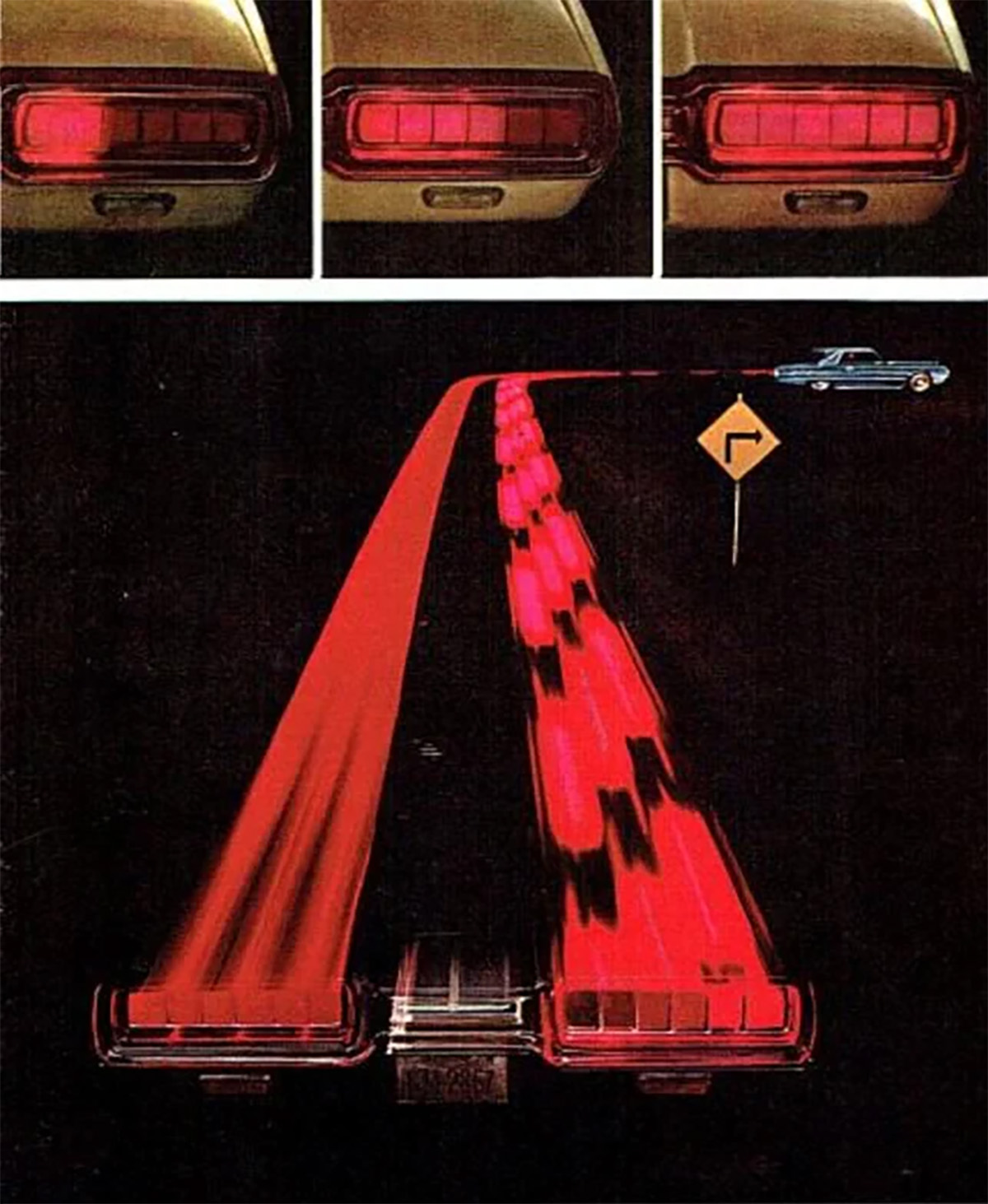
It’s just cams making electrical contacts at the right times, and the resulting combination of the three cams rotating is what appears to be lights moving in sequence. Just like how rotating the crank on that bird automaton moves cams that pull wires to open beaks, turn heads, flap wings, and pump a bellows to blow through a whistle. Very different outcome, but similar mechanisms.
Look at that, this whole Kelly Clarkson inanity has given us two fantastic automotive tie-ins! And I’m going to add one more thing to consider that’s related to all of this mess sort of that’s actually positive. And it’s also about a bird automaton, just one that doesn’t cost $15,000 or $15,000,000; it’s closer to just $15.
I’m talking about that iconic French flying bird ornithopter toy, the rubber-band powered thing we all had as kids before getting them lost on someone’s roof. You remember these, right?

I had one of these as a kid, and I got one for my kid that we still have around here somewhere, and I have to tell you, I never really get tired of these. You wind that little crank to twist the rubber band, hold it just right, and let it go, where it soars off with a cacophony of flapping plastic wing sounds, faster and more frenetic than you expect, as you hope it doesn’t get caught in a tree again.
These things are great. If you’re having a lousy day, I say find a local toy store, pick up one of these, go to a park and just fly your silly bird, leave your phone in your pocket and revel in not having to give a shit about what famous person is mad at what expensive Brooklyn toy store, hopefully ever again.


I like the bird. Kelly Clarkson, not so much.
not that I care, but why put a price tag on something that isn’t for sale. that sounds inane.
Honestly, at this point the shop should just, umm, give her the bird. Maybe even two.
Kelly was rich people upset because she wasn’t immediately accommodated as the entitled expect to be and because she identified with the bird automaton as she is often described as singing in a ‘charmingly mechanical manner. ‘
There is really nothing more satisfying than to watch the reaction of a person who is never told to piss off, to piss off.
Thanks for explaining this kerfuffle to me. I did not have the energy to care when it came across my newsfeed. Now I know that was the correct choice. Birb is cool though.
I want to know more about the Eames playing cars. Did they push each other around on aluminum group office chairs while making Buick V8 noises??
oops.
I see what the problem is. Kelly Clarkson immediately identified and bonded with the bird automaton because she, too, is often described as singing in a ‘charmingly mechanical manner.’ So, when the clerk refused to sell the bird to her, not because she looked like she couldn’t afford it, but because it wasn’t actually for sale, it must’ve felt like a she was losing out on a chance to buy soulmate. Which is what rich people do all the time and expect to be accommodated. And boy do they get nasty when they aren’t.
And apparently, British. Most Americans, esp. from Texas, don’t usually say “whilst.”
How ironic! I’m watching a news story on the news as I read this article. A lot of craftsmanship and engineering skills were involved in the making of this bird. Very impressive.
I got four words for you:
Jaquet Droz Bird Automata
https://www.youtube.com/watch?v=Ca1KF-mYjKg
It’s alla that in a wristwatch. And an order of magnitude more expensive.
(The video has a nice flying camera tour of the movement in action, so that ought to keep D.T. busy while you catch a nap.)
Excellent clickbait article to take advantage of…whatever this is. And I had always wondered how Ford had done those sequential taillights back in the day. I assumed there were some analog electronics with finely tuned capacitors and the like, now I know it was even more awesome. Cams!
Certainly you could make a solid state delay using a circuit of discrete MOSFETs… but since the very first commercial MOSFET was available in 1964 the number of them to create an analog times switch was probably approaching the value of the car. Certainly any IC for timing would cost more than the car. The venerable 555 timing IC is still 5 years away.