


As an import car advocate, my social media feeds are full of people enjoying cars that were never originally sold in America. Seeing a happy face next to a freshly imported Honda Acty Kei truck never gets old. But I also keep seeing images circulating around the Internet that make the bold claim that Kei trucks are better than an American pickup truck in every way. As much as we Kei enthusiasts want the image to be true, the reality is far more nuanced, and I’ll show you why.
Normally, I don’t say anything when I see these memes and images. I try not to yuck anyone’s yum, and I don’t want to add any negativity to America’s Kei vehicle conversation. States already want to ban these things, and I don’t even want to give those states a single piece of ammunition they can use to support their positions. I suppose there’s also just the aspect that I just don’t like using social media. Maybe it’s just me, but I see a lot of extreme positions being taken in situations where the reality is far harder to explain than in a single picture with a few words in Impact font.


Weirdly, Japanese Kei trucks have become one of those subjects. Being in the import world means I don’t go very long between seeing memes and assorted images that “prove” that Kei trucks are superior to the American pickup truck in every way. A popular one that gets circulated on the net appears to have originated from a post on Reddit:
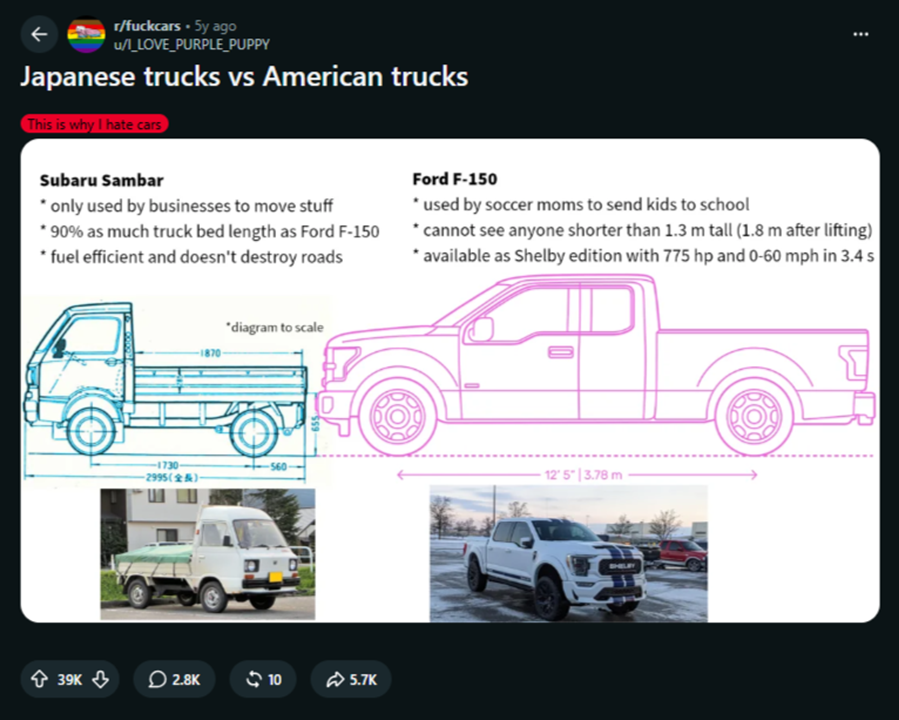
The premise seems simple. A Subaru Sambar has 90 percent of the bed length of a Ford F-150, and can haul loads without damaging roads.
Indeed, there are countless images and videos out there that show that a Kei truck’s bed is nearly the same size as common Ford F-150s, Chevrolet Silverados, or Ram 1500s. Likewise, it is true that the pickup trucks of today are absolute monsters that tower over short people, have insane horsepower figures, and are often used as daily drivers, rather than work vehicles.
That image went so viral that all sorts of people from TikTok to YouTube have compared how much can fit in the beds of Kei trucks versus popular American pickup trucks. The topic was recently revisited by The Grand Tour. Here’s another image I’ve seen circulating around the Internet frequently:
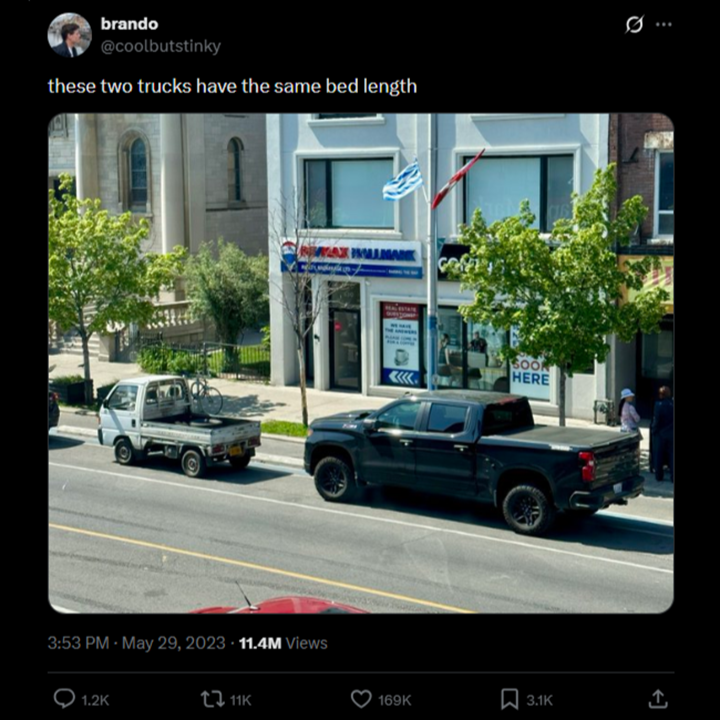
These images seem to throw all sides into a bit of a frenzy. Kei truck fans talk about how they’d never drive an American pickup, that towing capacity is irrelevant, and that, despite having official payloads well under 1,000 pounds, they’ll happily toss as much weight as they want in the bed. Meanwhile, the American pickup owners liken the Keis to toys, claim Keis are unsafe, and complain about the lack of big horsepower. I’ve even seen some people agree with the states that ban Keis.
Who is right? As someone who has imported multiple Keis and also tests all sorts of pickup trucks, they’re both right, and they’re both wrong.
Kei Trucks Are Small, But Do Big Work

Let’s first start with what, exactly, a Japanese Kei truck even is.
The kei-jidōsha is Japan’s smallest class of highway-legal vehicles. Kei vehicles are highly limited in size and engine displacement, while a gentlemen’s agreement dictated that Keis officially make no more than 63 horsepower. Kei cars were invented as a way to get the Japanese working class on wheels, and as time went on, the Kei was a tool to lower your tax burden. If you were living to drive a car tiny enough to fall between the cushions of the average American couch, you got tax benefits.

The brilliance of the Kei car is that car manufacturers managed to pack a fully functional car into under 12 feet. Kei hatchbacks can carry four people in relative comfort, while Kei vans seem like they’re bigger on the inside than they are outside. Then there are the trucks, which used to sacrifice all comfort in the name of work.
Old Kei trucks weren’t lifestyle vehicles in Japan. Instead, they were used as farm vehicles, delivery trucks, mail trucks, government fleet vehicles, and business vehicles. Japanese fire departments have used Keis, as have police departments. In Japan, Kei trucks are generally treated like how Americans use base model pickup trucks.

However, due to both the infamous 25 percent Chicken Tax and the restrictive 25-year import rule, America is late to the Kei truck game. The Chicken Tax keeps some automakers from even trying to enter our market. Meanwhile, the 25-year rule dictates that a vehicle must comply with U.S. emissions and safety regulations, or be 25 years old.
Thus, the newest Kei trucks that Americans can import right now for road use were built in October 2001.
In contrast, the American pickup truck is a bit of a lifestyle vehicle, and has been for decades. Lots of people buy pickup trucks that serve as the family car, the work truck, and more. There are luxury pickup trucks, fast pickup trucks, pickup trucks made to go 100 mph off-road, and pickup trucks that can tow up to 40,000 pounds. General Motors just launched a titanic 8.3-liter Duramax V8 diesel that makes more power than an entire armada of Kei trucks. America still makes trucks for work. Only, many of them end up in fleet service, rather than in suburban driveways.
Why Kei Trucks Are Great

I can see where the Kei truck advocates come from. Their trucks have beds about as big as you’ll get in a typical crew cab pickup truck, but in a substantially smaller footprint and a far lower height. If they need to carry items that can’t fit in their beds, they can just drop their bedsides. Here in America, Kei trucks are used for everything from farming and advertising to deliveries and toy hauling. Kei owners drive their trucks daily, carrying motorcycles, kayaks, tents, and other gear.
Kei trucks are real trucks, and they do real work. You’ll find Keis with robust four-wheel-drive systems, crawler gears, and sometimes even tracked systems. Some Keis have cranes, while others have dump beds. These trucks might be tiny, but they will happily get the job done and return over 30 mpg doing it. Our friends at the Fast Lane Off-Road pit a humble Honda Acty against a jacked-up Ford F-350 (click here if you don’t see the video):
Honestly, as someone who adores her Kei van, I get not wanting to drive anything else. My 1989 Suzuki Every van, which is basically just the van version of the Suzuki Carry truck, has great outward visibility, can fit into any parking space, is crazy easy to parallel park, and makes city driving actually fun. The memes are not lying about the practicality of the Kei. These trucks are simply brilliant.
But these trucks do have their limitations, at least when driven here in America.
What Kei Trucks Don’t Do Well

The typical Kei truck has a top speed of just over 70 mph. By top speed, I mean banging on the rev limiter or otherwise wringing the little engine out. A more realistic cruising speed is closer to 65 mph. My Suzuki Every bounces off its rev limiter at 75 mph, for example. This makes Kei trucks suitable only for short jaunts down Interstates. Trying to drive near top speed in a Kei for hours on a road trip is fatiguing and annoying. I know, I tried it once. These vehicles are not exactly quiet inside, mind you. Sometimes, their seats are not much better than what you’ll find as a passenger in a city bus. Some states don’t even allow Keis on Interstates.
Keis also don’t tend to have a lot of power in reserve. Give my Every a long enough hill, and it will slow to about 55 mph. That’s with it carrying only me and nothing else.

Then there are other caveats, like the fact that your towing capacity is essentially non-existent. Official payload figures are also pretty low. A common Honda Acty, for example, has a 770-pound payload rating. That’s the weight of you, your passenger, and anything you put in the bed. Yes, Kei owners regularly exceed their payload ratings and get away with it, but that doesn’t change the fact that the payload is low to begin with. Besides, pickup owners overload their trucks, too.
Safety is also another hot-button subject. Thankfully, Americans are now able to import Keis that have some real safety features. However, the bulk of the Kei trucks in this country don’t have airbags, don’t have ABS, and have only limited crumple zones. Keis are certainly safer than motorcycles and trikes, but modern vehicles have a lot more safety features and engineering than these trucks have. In fairness, old American cars didn’t have many safety features, either. But safety is something that vehicle buyers consider, and I don’t think it should be cast aside.
Why Pickup Trucks Are Useful

I also understand the defenders of the pickup truck. Your garden-variety Ford F-150 has comfortable seating for four, anchors for child seats, all sorts of airbags, an abundance of horsepower, and a bed that’s still large enough to do real work. Even a Ford F-150 Raptor, with its squishy off-road suspension, still has a payload up to 1,410 pounds. Pickup trucks can also tow tens of thousands of pounds, and do so while climbing mountains without losing speed.
These capabilities should not be ignored. Yes, lots of Americans buy pickup trucks and never use them for “truck stuff,” but there are also lots of Americans who do. Chances are, your local landscaping firm hauls in their tools, zero-turn mowers, and other equipment with a pickup truck towing a trailer. A lot of those with RVs use pickup trucks to tow them. There is not a single Kei truck on this planet that can tow even my family’s lightest camper to EAA AirVenture Oshkosh.
Some Americans try to buy one vehicle that can do everything they want to do, even if they only do some things a few times a year. The American pickup truck has sort of been turned into an everything vehicle. That’s what makes the pickup truck great, too. A pickup truck can be the school bus in the morning, the work truck by the afternoon, and the date car at night. You can get pickup trucks with nearly as much luxury as a German sedan, too. Trucks are also relatively safe for their occupants. As the IIHS has pointed out, large SUVs and pickup trucks have low driver deaths in crashes.
What Pickups Don’t Do Well

At the same time, pickup trucks can have their downsides. As the Insurance Institute for Highway Safety reported earlier this year, the Ram 3500 is the most dangerous vehicle for other drivers, with an other-driver death rate of 204 per million registered vehicle years between 2021 and 2024. Today’s cars are amazingly safe, but even they sometimes struggle to keep their occupants safe against the sheer size and weight of huge trucks in a crash.
According to the IIHS, trucks are also bad for pedestrians, as vehicles with hood heights greater than 40 inches are about 45 percent more likely to cause fatalities in crashes involving pedestrians.
As for how much pickup trucks damage roads, that one is interesting. While pickup trucks have seen only limited attention, there has been some research into the effect of heavy EVs on road damage. The general consensus seems to be that heavy private vehicles don’t wear the road as much as semi-trucks do. The trucking industry then says that its 80,000-pound trucks aren’t the problem, but poor road design.

Pickup trucks can also be pricey, and some trucks may never get higher fuel economy than the teens. These trucks are also harder to park, heavy, and have bed heights so tall that loading is far harder than it should be.
As you see above, the Silverado doesn’t even fit into the parking space, and I had the rear bumper only inches from the wall. For context, I usually take the last appointment of the day at my doctor’s office. Only the receptionist, the security guard, and my doctor were there. His Audi was a few spaces behind me when I took the picture. Since I was the only person entering and leaving the garage that evening, I decided to test how well a full-size pickup truck could fit. I had to do a three-point turn just to get around this curve without knocking down the bollards:

There’s more. If you, like me, aren’t tall, you might even have trouble reaching into a pickup truck’s engine bay without a step stool. I even struggle to close pickup hoods sometimes.
Then there’s the fact that today’s trucks have hoods so high that kids, Mazda MX-5 Miatas, and animals can completely disappear in front of the truck. The size of some of today’s trucks may make parallel parking in cities difficult, and some trucks can’t even fit in standard garages. Heavy-duty pickup trucks are so girthy that they often spill over into neighboring parking spaces.
Modern diesel trucks add another layer of complexity, given their expensive emissions systems.
Both Kinds Of Truck Are Awesome

So, what am I getting at here? Look, I am a fan of both kinds of truck. I have gone through the work to import multiple Kei vehicles. Then I drove out to the port to pick them up myself. I will always fight for Keis and spread the Kei love.
But I also want to be realistic about it. Keis are not for everyone. If you are someone who needs to tow a trailer, wants to sit in leather thrones, or wants to go down the highway at 80 mph, a Kei truck is probably not for you. If you want to get over 30 mpg basically no matter what you do, want to easily fit into any parking space, want to get attention everywhere you go, and want to haul large loads without worrying about bed height, a Kei truck is probably for you. We shouldn’t ignore the needs or desires of other vehicle buyers to champion our own favorite vehicles.

To me, Kei trucks and pickup trucks are just tools. One is not inherently better than the other. They’re both awesome. What matters is what you want your truck to do and the experience that you want to have. I wouldn’t use a Kei to tow a 6,000-pound trailer, but I also wouldn’t want to live in a large city with a Chevrolet Silverado as my daily driver. My Suzuki is about as luxurious as a phone booth, while I have driven trucks that were cushier than an Audi. I wouldn’t want to get into a crash against a Ram, but I wouldn’t want to crash my Suzuki. It all depends on your perspective.
Some folks may want to talk about what car you should own, but I don’t want to go there. One of the great parts about car culture is that we can buy whatever we want, not just what we need. Personally, I think pickup truck owners and Kei owners should be friends. Their vehicles are two different takes on the same idea, and both are fantastic.

I’m sure the Kei truck versus pickup truck battles will continue, and as I noted above, there are valid concerns on both sides. But shooting each other down is not how we improve vehicle safety or design. The real concern is not the pickup truck, the Kei truck, or the owners of either, but organizations like the American Association of Motor Vehicle Administrators.
As I have written so many times in the past, the AAMVA is the one that wants to ban imported cars, surplus Jeeps, and other vehicles we love. Let’s fight them, not each other!
Top graphic images: Subaru; Ford; iOS


The ideal smallish compact pickup is the 70s 80s and 90s compact pickups, the kei truck too small, IMO.
I don’t think I’d want to drive a kei truck with 775hp lol
The ideal pickup truck that would get you close to Kei in spirit but still be as useful as a modern pickup is the 1st generation Ford Ranger. Bed size is basically the same as a modern F150 crew cab, has some towing ability and is human sized.
I feel like Telo is going to hit the sweet spot here for people who don’t use their truck as a security blanket instead of a workhorse.
To some people, this is a selling point.
The main issue isn’t the bed length. It’s also the width. Can a Kei truck fit a 4′ wide sheet of something like plywood? The length isn’t as much of an issue, because you put the tailgate down and hang over.
Also, we have freeways. In a large city area, most people live an hour commute away. You want something that can cruse on the freeway.
Old American Trucks > Kei Trucks > Modern American Trucks
I really hope that The Autopian ask truck manufactures why the hoods are so high? why the trucks are so large? i can guess some answers but want to hear it from them.
Meanwhile, Telo is going to show up the other American manufacturers with something barely bigger than a kei truck that can tow 8,000 lbs.
I’m too lazy to read all the comments, but most people forget that there is a middle ground between these tow. That is, the Japanese cabover trucks that are too big for the kei class. Something like a Toyota Lite Ace. bigger (and bigger engine) but it’s a shorter wheelbase than an F-series. That’s what I want to buy.
Also from the other direction, there is a Ford Maverick, which is smaller but does almost as much as a F150.
I like the Maverick but the bed is almost square. I wish they would offer a 2-door or extended cab, with a longer bed.
I loaded up Carsized the other day to do important investigatory work, and as always, it randomly preloads a couple of cars to show. This time it had a Volvo EX30 vs a GMC Sierra 2500 and the size difference was shocking.
OMG I did not know that site existed! There goes hours of productive time!
Choosing the aluminum bodied F150 to talk about “damaging roads” is such an odd framing. My crew cab, 6.5′ bed 4×4 F150 only weighs 5150 lbs and has nice wide 275mm tires. Any 3-row SUV is basically the same weight with a few people in it.
My F150 payload is ~1800 lbs. If you put anything close to that same payload in the kei truck, it would put more pressure on the road with it’s tiny tires.
For anyone who regularly carries over 1000lb, yeah, a kei truck makes no sense. My kei car weighs 1499lbs, so using the word “only” for something that is over 5,000 lbs sounds very strange in my ears. If a modern American truck was intended to carry things and to work, it could easily weigh less than 4,000 lbs.
I agree. A 21′ long, 4WD, 450HP (I tuned it) truck that can pull 11,000lbs towing only weighing 5100 lbs is “only” in my book, because many far-less-capable vehicles are out there weighing just as much. You would not and should not drive a 1500lb kei car on American highways, one collision and you will die.
Not necessarily, you aren’t adjusting for the weight savings of the kei truck itself. it isn’t just the payload weight that is being distributed on the tires. So yours would be 5150+1800lbs divided by whatever the total contact patch is. The kei truck would be a number far below 5150, then plus the 1800 and that total divided by its total contact patch which you haven’t enumerated for everyone. Your premise may well still be correct but the way it’s argued doesn’t reach a definite conclusion.
You’re right, I did not feel like looking up tire sizes and pressures for kei trucks. My point was that the ground contact pressure is likely fairly similar.
I’d buy a Kei right now, but my state is being weird about registering them. It’s very frustrating.
I don’t have a pickup right now, but my parents have a full-size Chevy, a mid-size Frontier, and a Suzuki Carry. Every week, I borrow the Suzuki Carry for the work at the football concession stand because: a) it’s more fun driving a manual, the only one left in our stable; and b) the low bed height and droppable sides are more convenient than a normal-sized pickup. We’re never getting rid of this truck.
I own both a 2014 F150 and a 2001 Sambar truck. I also work as an automotive engineer designing trucks. The Kei truck is better at being a truck than the F150 is.
Modern trucks have gotten too large to use. Municipalities are seeing increased rates of musculoskeletal injuries caused in large part by how tall the bed and sidewalls on trucks that their landscaping and other service crews use. For example, the bed floor to ground height on a 1950 Ford pickup was 24 inches, and the top of the bed to ground was 44 1/3″. A modern F150 can be as high as a 36″ bed floor to ground and a 57″ from top of bed to ground. The 50th percentile height for a US male for top of shoulder to ground is ~57 inches. Depending on how large of an item you are trying to lift over the side of the truck to drop in the bed, at least 50% of men are having to lift above their shoulder level just to accomplish this, which is outside of ergonomic best practices for lifting. I am not tall, but the bed of my Kei truck is only waist high on me, I can comfortably lift bags of concrete onto the bed of that truck.
The only thing modern pickups are better at than the Kei truck is towing, which is not a dedicated truck activity (Vans and SUVs can tow as well as trucks for anything less than 5th wheels, and I consider Hotshots specialized vehicles not applicable to this argument)
If you want to actually utilize the bed of the truck for truck like activities, modern full size truck (anything larger than a Maverick really) are horrible to use, and the Kei truck is far superior in this regard. If you are a farmer or you need to tow heavy trailers, sure, the modern full size pickup is the right tool for you, but the vast majority of people driving F150s don’t utilize them for this.
Have you seen the Telo?
Yes, I am aware of it, I have not pre ordered one as I can’t bring myself to spend 40k+ on a pickup truck.
Fair enough. I don’t want a pickup, but given how few smaller (and inexpensive) cars we have in the US, I might save my pennies. Curious how Slate and Fathom will work out. Seems they’re both less capable, but priced accordingly.
I’m really interested in the van Telo has shown renders of though. Might lease something for a few years and see how it shakes out.
Oh no, I just realized a kei truck would be the perfect way to run around the ATV trails on the property behind my house…
Sadly, I suspect I wouldn’t fit in the cabs of most of them, so buying sight-unseen from overseas is probably a bad idea.
I am assuming you are referring to yourself being quite tall. Many of the Kei cabs would be cramped for you, but the Subaru Sambar is noted for having a cab that is capable of fitting people well into the 6″ tall range. There are a number of youtube videos available showing this capability off.
Yeah, I’m 6’5″ and don’t fit well in a lot of full-size American vehicles. I’m dubious I’d be able to make anything in the kei class work, which is a shame.
Daihatsu Hijet Jumbo is your answer. I have actually seen one at HVNY in upstate NY, I would definitely recommend strapping one on before purchasing.
I think most people are well past the six-inch-tall range, even at birth.
Maybe he’s a grower not a shower.
I’ve had kei trucks along side my American trucks for decades at this point. The kei truck is a tool the old American trucks used to be a tool. It started to go wrong in the mid to late 00s. When the 4 door pickups gained marketshare. I think part of it why the 4 doors did well was they were different. Kei has to be generally the same it’s a proven formula with space constraints. Bed sides that drop used to be a thing but hasn’t been in American pickups for decades. Now you have to get a custom work bed if you want that. Just like cab overs were a thing and then don’t have to be. Now with EVs we might be back to it like the telo. Sort of the old saying how Japan has lived in the year 2000 since the 70s. But it’s also not broken so why fix it.
I think the biggest everyday problem with the kei trucks we can currently import for on road is the seating it’s just some small cushions attached to the cab. Newer kei trucks have actual seats some have pretty comfortable seats or can be optioned. The newer ones I’ve been in also feel like they have more leg room. The older ones also don’t love highway speeds. I typically only drive off road and maybe 10 miles away. Sometimes I’ll push it to 15 or 20 miles. It can do 55 good enough. They are work horses and do what you ask. It’s a shame American trucks have become what they have.
The kids are getting back to truck meet ups in parking lots. The few times I’ve had my kei around their 1/2 ton and 3/4 ton trucks. Some are jacked up with the the stupid wheels and tires hanging out and all the dumb lighting. They get excited about the kei truck and come over to ask me things and want to sit it in it and take pictures with it. There is novelty there but also utility. They seem to appreciate it. Older guys I see places sometimes ask what I’m doing with that piece of junk and how do I even fit. So maybe some generational issues.
Meanwhile, the American pickup owners liken the Keis to toys, claim Keis are unsafe, and complain about the lack of big horsepower. I’ve even seen some people agree with the states that ban Keis
Probably in states with large american motorcycles and no helmet law
This is a test of the admin approval system. Is the word bro-dozer shadow banned?
Hey, cool. Bro-dozer is not a bad word, it’s a factual description of a particular type of oversized and overbuilt mall crawler.
The spam filter is tuned to automatically block certain words. Most of them are political insults, but I don’t know what the whole list is. So I’m not sure what word made the spam filter mad. Either way, I set you free!
Right on, thanks! Sorry I clogged up the comments here. 🙂 I’ll be sure to hyphenate bro-dozer in the future.
If I had to guess I bet it was microd*** that set off the approval system.
This is a test of the admin approval system. Is the word brodozer shadow-banned?
I’ve been thinking about having printed a postcard sized note that’s short and sweet. I don’t want to say “I’m sorry” but I want that to be the sentiment. Something like “Bummer about your microdick” but I also think “microdick” might be a word that’s slightly above the intelligence level of the average brodozer driver. Anyway, I could leave them on the windshield for the driver to find much like an advertising flyer and the like. If I can even get one of these monstrosities off the road, it would be worth it.
The real comparison is a kei truck vs a basic work side by side. Those Kawasaki mules, John Deere gators etc are grossly overpriced for what they are, new or used.
I dont know the market all that well for work side by sides but some of the blinged up off road models are 20k for a used one. Even basic work models are 10k and dont get you an enclosed cab like a kei
Also kei trucks are road legal for the most part so there’s that.
Thanks Mercedes, for a nuanced look at the great truck debate. It drives me nuts when I see posts or shorts saying kei trucks are equal or better than full sizers because of one cherry picked metric(bed length) and that we should all just use kei trucks. I remember one short calling Americans dumb for driving F-150s when kei trucks had the same bed length. I think the worst part of this debate is most of the rhetoric seems to be based on the assumption that all truck drivers are wannabe compensating douche bros or soccer moms, every truck is a fully loaded dually, and people only use trucks to go to the grocery store or school-none of which is broadly true.
I know lots of farmers and landowners who have one truck as their only vehicle. They’re not compensating or insecure, a truck is just the best vehicle for their use case and don’t want to deal with 3 older vehicles when one newer vehicle does everything for them. Lots of these trucks are also low or mid-trim levels. And yes, while they sometimes do get used to go the store or pickup the kids from school, I see them just as often pulling trailers or hauling things in the bed, not to mention how much nicer it is to cross a pasture in a 4×4 truck than a car. Do I use every bit of capability of my Ram 2500 4×4 all the time? No, but when I need to, I’m really glad it’s there. I think modified trucks, off-road performance, and street performance trucks embody the things the internet hates about trucks (big power, big size, little actual use, douchebag owners) more than farmer Bob in his F-250 XLT or Steve the hunter and landowner with his Silverado 1500.
PS-I do really like kei trucks as well, and I always like seeing them out on the road, I truly believe both groups of trucks have legitimate uses and drawbacks
That depends on where you live. I am in NYC/Long Island, and the new, big boy trucks here are all in the Trader Joe’s parking lot, or, at the most, parked at the job site with a clipboard on the front seat. On occasion I will see a new big truck pull some jet skis or a motorcycle or two. People that work with their vehicles have old minivans, box trucks, or beat up old ones. No one wants to force farmer Bob out of his truck, but judging by the local orchards, two thirds of the work is actually best done with keis. Heck, the nearest kei truck importer sells most of their trucks to farmers and the like.
I’m in a small town in Michigan that’s next to a village and a medium town, so there’s probably more farmers and landowners around than Long Island. A few of the orchards I’ve been to for work use keis, but I’d be surprised if any of them ever leave the property. Orchards typically use smaller equipment than other farms since the trees or bushes are typically spaced pretty close, so a kei or a John Deere gator is the ideal vehicle for their use case. Full size trucks barely fit down the rows between trees. Even orchard tractors are smaller and narrower than a standard tractor. I’d imagine other perennial and flower farmers could also get good use out of a kei. On the other hand, the corn/soybean/wheat/cattle/hay operations tend to use the hell out of their full size trucks for a wide variety of tasks, many of which would be too much for a kei. I do know of a few guys who bought a new truck and didn’t use it to “keep it nice” but they seem to the exception (at least as far as the farmer, hunter, and landowner crowd goes)
While a Kei truck can’t replace our 2500 Silverado for towing it can replace it for most of the local trips into town/Lowes and the stupid Polaris Ranger that we just had to have to use on the property
I’m waiting for what could be an American answer to Kei trucks, the Telo truck. Still too soon to know if it’s going to happen, but their working prototypes are impressive and they still project end of ‘26, early ‘27 for delivery start.
At 152” long, the Telo is an inch shorter than a Mini and less than a foot longer than Kei truck maximums. It’s 73” wide and stands 67” tall with 10” of ground clearance.
It’s got a 5-foot bed that expands to 8 feet with a neat midgate feature and can haul 4×8 sheets of plywood with the tailgate closed. Also has an under bed storage like the Rivian that’ll hold three carryon bags. It seats 4-5 adults in a dual cab configuration with expansion to 6-7 possible.
In single motor form it can haul 2000 lbs. and 1600 lbs. in dual motor form. It can tow 8000 lbs. and weighs 4400 lbs. Zero to 60 comes up in 4 seconds for the AWD dual motor and 6 seconds in the RWD single motor set up. It’s got a tight turning radius with a 111” wheelbase.
It can recharge to 80% in 20 minutes using NACS DC fast chargers (400kw) gets 260 miles per charge with single motor, RWD (300hp) and small battery (76kWh) and 350 miles with the AWD dual motor set up (500 hp) and 106 kWh battery.
It’s projected price starts at $41,000 and rises to $45000 (probably closer to $50k) depending on configuration and optional equipment.
This is more expensive than the Slate, but is more capable. And a true small truck.
And no, I don’t work for Telo, I just want one.
It is pretty ironic that I can’t get a dump bed for my 2026 Ram 1500 Crew Cab Long bed but I can get a Kei Truck with one.
In North America, any features like that are often added at a Body Builder. It’s very rare to ever see it from the factory.
Any dealer carrying something other than a normal bed or a cab & chassis had it done at a local body builder.
So it’s entirely likely someone makes a dump kit for your truck.
Although, depending on your use, one of those “Moving floor” adapters are super cheap and convenient as well, like this: https://www.princessauto.com/en/product/2-000-lb-truck-cargo-unloader/PA0009287053/9287053
I understand not a factory option, but even the aftermarket is lacking for basically all 1500 trucks