

The Inflation Reduction Act was a cornerstone policy of the Biden White House, and one that was quickly removed under the current administration. Because of a quirk in the interpretation of the law, the vast majority of electric car transactions for most brands were leases. Those leases are starting to expire and will temporarily remake the used car market.
Grab your red fedora and trench coat, because The Morning Dump is a global affair today. From the hallowed halls of Congress, I’ll whisk you off to the hippy hills of California, where the state is hoping to keep its EV dreams alive.


I’ll then take you south of the border, down Mexico way, where Volkswagen is claiming the United States isn’t holding up its end of the USMCA. And, finally, it’s off to Europe, where China and the EU seem to have come to terms on what to do about the sudden influx of cheap cars to the continent.
Rockapella voice: Where in the world is… The Morning Dump?
It’ll Get Interesting For Used EV Buyers In 3-4 Months

Back in 2022, then-President Biden and then-WV Senator Joe Manchin managed to sneak the Inflation Reduction Act through a Congressional backdoor. Did it meaningfully reduce inflation as the name promised? Not in any obvious way. Did it dramatically increase inflation as some warned? No, not that either. It’s just a political name to describe something that had way more to do with creating green jobs and incentivizing EV production and purchases than with inflation.
Most, though not all, of the Inflation Reduction Act was Uno-Reverso’d by the One Big Beautiful Bill, including the provision that provided $7,500 off for the purchase of specific electric cars. Because America’s European and Asian allies freaked out a little bit about this (this was back when the White House cared about having European and Asian allies), the Biden White House carved out an exemption big enough to drive a Kia EV9 through.
Specifically, the law said the $7,500 could apply to any commercial vehicle, whatever the country of origin. The IRS interpreted a lease as a commercial vehicle. Senator Manchin freaked out about this, but ultimately, the lease exemption stayed.
As you can see in the chart above, anything that’s orange is a leased vehicle. I wrote about this before, but for most automakers, leasing was how they moved electric cars. Most leases are 24 or 36 months, which means that there’s going to be a point where all of these leased electric cars are going to get returned. Courtesy of the Q4 Manheim Used Vehicle Value Index Call presentation, you can see exactly when that’s going to start:
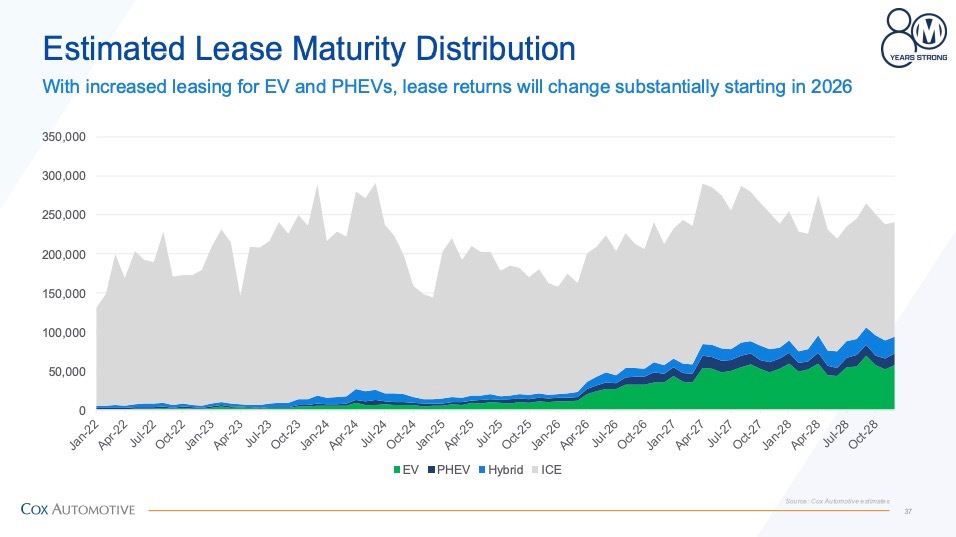
Those green vehicles are leases being returned, and the dark blue ones are PHEVs. As you can see, starting in approximately April of this year, the market is going to start getting flooded with potentially up to 40-50k used EVs every month.
Granted, many people could buy out their leases, but I think this is probably not a great idea for most lesees. As outlined before, our advice has always been to lease a new EV or buy a used one. The argument to lease has mostly gone away, but the idea of buying a used one still makes a lot of sense.
It’ll be a case-by-case basis, but for it to make sense for someone to buy out their electric car lease, a consumer will have to love the car and have either previously negotiated a buy-out price that reflects the significant depreciation that’s occurred, or be able to negotiate that again. I suspect that as more, say, used e-trons and Polestars get dumped on the market, used car values will drop further.
There are potential counterweights here. The lack of affordability in the market and the likely increase in electric car costs might balance it out a bit. Overall, this represents a great opportunity for someone to get a potentially good used EV at a great price. I suspect a lot of these vehicles will be CPO as well, which brings some peace of mind.
As an example, here’s a Hyundai Ioniq 6 with just 16,000 miles for just over $25,000 with tons of warranty left and even more on the battery/motor. I’d keep an eye on vehicles like the Ioniq 6, the MachE, et cetera. Also, this isn’t going anywhere. It may start in April, but it’ll continue on for the next 24-36 months.
The one caveat here is that I would check to see if the vehicle was used as rideshare car, as these tend to get charged up to 100% more frequently in my experience and may have a lower battery life. (Though modern batteries seem to be holding up well).
Will California Give You A Discount On A Used EV?

California has pledged to continue its own statewide EV tax rebate plan, setting aside $200 million for on-the-hood discounts. It’s not clear how long it’ll last, and it’s not clear if that’ll also work for used EVs purchased at a dealership.
California Air Resources Board Chairwoman Lauren Sanchez said in an exclusive interview with USA Today that her state is stepping up to offer EV tax credits because “the rest of the global market is moving toward” Zero Emission Vehicles, despite the backsliding in the level of federal support under Trump.
Sanchez said embracing EVs is “point of pride in California” because “a third of EV sales are in California.”
Under California’s previous EV tax credit program, which ran from 2013-2024, the state spent $1.49 billion to cover credits for 586,000 vehicles, according to CARB.
Asked specifically about used EVs, Sanchez told USA Today that “The team is taking a hard look at how we can [sic] a used incentive work.”
Fingers crossed for folks in the EV market.
Volkswagen: This Isn’t Fair

This is hard to quantify, but the sense that I get from most automaker execs–whatever their own personal politics–is that they don’t want to upset the President while also avoiding seeming political in a way that might upset people who disagree with the administration. It’s not worth it. Tesla’s CEO being so obviously political is likely to cost Tesla hundreds of millions, if not billions of dollars.
One of the big sticking points between automakers who sell cars in the United States and the White House is the United States-Mexico-Canada Agreement (USMCA). This was a modification to NAFTA, and it continued the idea of a trade zone between the three countries. It was also a major policy of President Trump in his first term. President Trump doesn’t like the deal anymore and has clearly tried to discourage continued production in these countries, and most automakers have adjusted by trying to announce big projects in the United States while trying to take advantage of some transitional offsets.
Volkswagen is not one of those automakers. It has a huge footprint in Mexico and is saying the quiet part out loud as the Associated Press reports:
Though some in the auto industry have privately suggested that Trump’s tariffs amount to violations, companies have been hesitant to issue public positions saying so. Instead, they have mostly stuck to questioning the merits of Trump’s actions while also offering constructive recommendations on how U.S. trade policy should proceed.
That trend largely continued in a series of letters filed this week by automakers, suppliers and trade groups regarding the USMCA’s automotive rules of origin provisions. The Trump administration previously solicited broader comments on the trade deal in November, but the latest request for comments was for autos only.
Volkswagen, amid falling U.S. sales, was more critical of the Trump administration than industry competitors in its public filing. Europe’s largest automaker pleaded for tariff relief and requested that existing USMCA rules not be made stricter after the review.
I don’t know that this means that VW is exactly joining the Resistance alongside the Fed Chair and, uh, Wine Moms, but it’s a notable difference from most carmakers.
China And The EU Are Friends Again, Sort Of

As anyone who reads TMD regularly knows, Chinese automakers created a huge production capacity for EVs. There aren’t enough consumers in China to absorb all that demand, so it’s been trying to export cars. This is good for markets where no one makes cars, as those folks get cheap EVs. Everyone else? Not so much, so the EU slapped high tariffs on Chinese importers.
The Chinese government got mad and threatened to make French wine and other random things expensive. Now, according to the European Union, there’s a plan that should make everyone happy enough.
In its “Guidance document on submission of price undertaking offers” document, the EU offers up a plan whereby automakers will set a reasonable “Minimum Import Price” (MIP) that will counter the impact of subsidization. How will this be determined?
- Based on the CIF prices of the exporter in question in the investigation period of the proceeding leading to the imposition of the measures, increased by the relevant margin of the countervailing duties imposed.
- Basing the MIP on the non-subsidised EU-produced BEV’s sales price in the Union of the same product type (or closely resembling, appropriately adjusted for physical differences), which includes Selling, General and Administrative expenses (SG&A) and a reasonable margin of profit.
It’s complicated. For the moment, the China Chamber of Commerce to the EU seems cool with it:
The China Chamber of Commerce to the European Union (CCCEU) warmly welcomes and highly commends the positive outcome achieved through dialogue and consultations between China and the European Union, which has enabled a soft landing in the electric vehicle case. This important result responds directly to strong concerns from the business community, including the automotive sector. It not only supports the healthy and stable development of China–EU trade, investment, and bilateral relations, but also sends a clear and strong signal to global markets that both sides remain firmly committed to managing differences through dialogue and consultation, and to jointly upholding a rules-based multilateral trading system and an open global economy.
Given all of the above involving the United States and its trade position, expect China to continue to fill the EV demand left by the United States in various places around the world.
What I’m Listening To While Writing TMD
It’s impossible to pick one Grateful Dead song to honor the passing of Bob Weir, but “Truckin'” seems appropriate for the site.
The Big Question
Is there a used EV you’d consider? How cheap would it have to be?
Top photo: Hyundai



I’d love to get a Lucid Air, but I really can’t afford anything more than $35k
So, I’ll take a 10-13k Bolt.
20 to 25 K. I mean I signed up for a Slate but would be overjoyed to snag an Ionic 5 for those dollars
They’re out there right now. Check out autotempest…. It’s a dangerous website as it helps you find the car you want but don’t need :).
Oh no. Another Rabbithole. See you in a week or so
Daughter just picked up a 24 Kia EV6 WIND AWD with less than 5K on it for under $25K, and I am trying to pull the lever on a 24 Ioniq 6 with less than 7K on it right now.
Autotempest does a great job but be sure to click on the CarGuru’s button and go there too. Autotempest doesn’t include those cars unless you open an extra link. No idea why but it works fine.
TBQ: Yes, for sure. Something big enough to fit everyone, i.e., a 3-row. Interested to see if there are a bunch in that category that come off lease at reasonable prices!
I don’t need a new car, but I’d consider three or four EVs if I did.
Money no object? Parsh Taycan wagon
Nice? Lucid Air.
Less fancy? A Hyundai/Kia. Their designs are killer.
Ford and GM don’t figure into the equation because I will not buy domestics after dismal experiences with them.
Stellantis? Lolno
Tesla? Gtfo
Rivian? Too big.
We are all waiting for the R3; hopefully they make it over the various humps in their future.
I’m watching Rivian R1S prices come down. Finally getting a service center near me so I’m willing to take a chance on one. I chickened out last year on one when service was 2 hours away. Wasn’t going to gamble on that. But maybe the R2 will tickle my fancy more at the same price as a used R1.
I’m waiting for the R3. I desperately want one.
Yeah the R3 is very cool. I am really hoping they move enough R2’s to make the R3 and beyond a reality. I grew up watching WRC rally videos and the resemblance to a Lancia Delta Integrale really does it for me.
I saw an R2 at the LA Auto show, and it’s pretty sweet.
I’m really hoping the launch goes well for them this year. I haven’t seen one in person yet but I look forward to the day.
Ha, this came on in the Optiq as I pulled in my driveway this evening:
https://www.youtube.com/watch?v=sJ_2vDsIOro
As for the question, big lol assuming I can afford to fart right now, much less buy another car. I’ve got broken hoopties at home, man. I’ll be waiting forever, it seems. Maybe you can buy a 30-year-old totalled Cayenne when I die.
I’d love a Taycan Turbo GT or a Taycan Turbo S Cross Turismo, though. Put a bow on it and call it a Mardi Gras present or something.
We bought a Bolt EUV in December, so I guess I already did. 2022 with every option for $17250. 44,000 miles but had the battery replaced at 34,000 miles. So we have 90,000 miles and 5.5 years of battery warranty and about 4 years of powertrain. It’s a great car. Used EV’s and PHEV’s can be a great value. You get high depreciation with a good warranty. I got my Gen 1 Volt used, then a used 330e and now the used Bolt. All were bargains and all were trouble free.
2017 Volt for $14500 in 2021, still driving it
2019 Bolt for $14700 minus $4k tax credit (so $10700) in 2024
The value is just off the charts ridiculous.
I’ve been recommending Bolts to people forever as a great bargain and finally got to take my own advice. It’s really for one of my kids to drive, but I’ve been stealing it often and really enjoy it.
Aside from “too much power” a Bolt seems like an absolutely ideal first car.
It’s his third car. He started on an old STS that we have since handed down to two other kids. Then he had a 3 year lease on an Acadia because he went to school at Michigan Tech and it was an 8 hour drive home and they get about 140 inches of snow a year there, and we wanted him to have something AWD and serviceable up there. He’s graduated now, and when he lands a engineering job he can start making the car payments, but they are a pretty reasonable $300ish a month. For now, it’s in my name and I’m paying for it, so it’s my car.
RIP Bobby!
As for not getting the appeal of the Grateful Dead, much of it is definitely “you had to be there” and see them live in person a time or two to see if it’s something you’d get into or not. I think taste-wise it’s best described by this Jerry Garcia quote: “We’re like licorice. Not everybody likes licorice, but the people who like licorice really like licorice.”
Live music is one of my favorite things, ever!
(black licorice is a nope tho)
Probably not splashing out for a used EV anytime soon. Maybe in a few years. And it would have to be on the cheap side. Like well under $20K, closer to $10-15K.
I’m curious how old your source material is for coming up with this belief/conclusion. Perhaps some black and white TV programming from the 1960s?
IDK, and I’m guessing you’re local or wouldn’t drop the comment, but from the modest amount of time I’ve spend in the Bay Area even the conservatives are pretty ok with some things folks from other parts of the Country would call “hippy.” To each their own!
That’s because the President of the United States unilaterally and completely disregarded an international treaty that he personally boasted that he negotiated – and claimed as a success. Something that has led directly to increased costs across the board (which have been held back from being fully passed to customers in hopes that it’ll pass)
And it’s not just cars.
So what does that say for trust?
What trust?