

It’s hard to say exactly when or how the most recent war in the Middle East will end. While huge in scope, time-wise, WWII was a TikTok video compared to the longer conflicts in Iraq and Afghanistan. Even the battles in Ukraine continue to rage with no sign of stopping. Unless you can get around on a bicycle and live in a house that is powered mostly by renewables, the cost of today’s conflicts will eventually impact your life. For car buyers, this is most easily understood as the cost of gasoline or electricity.
There’s data that shows that buyers are suddenly more interested in “electrified” models, which includes different types of hybrids and EVs. Does that math? For hybrid buyers, recouping the difference between the price premium and gas prices might take a little longer than you might guess. The other way to look at this is from a viewpoint of a country. How much money is a place like China saving by having all these EVs?


I’ve talked a lot in The Morning Dump about how a lot of good used EVs are going to come into the market soon. Is this a good deal for dealers that need nice used cars? Or is this just going to be a replay of the price wars of the past?
That’s a lot of questions, so let’s see if I can pull together some answers.
Nearly A Quarter Of Car Buyers Are Looking At ‘Electrified’ Vehicles
Would you like to see a chart? Here’s a chart:
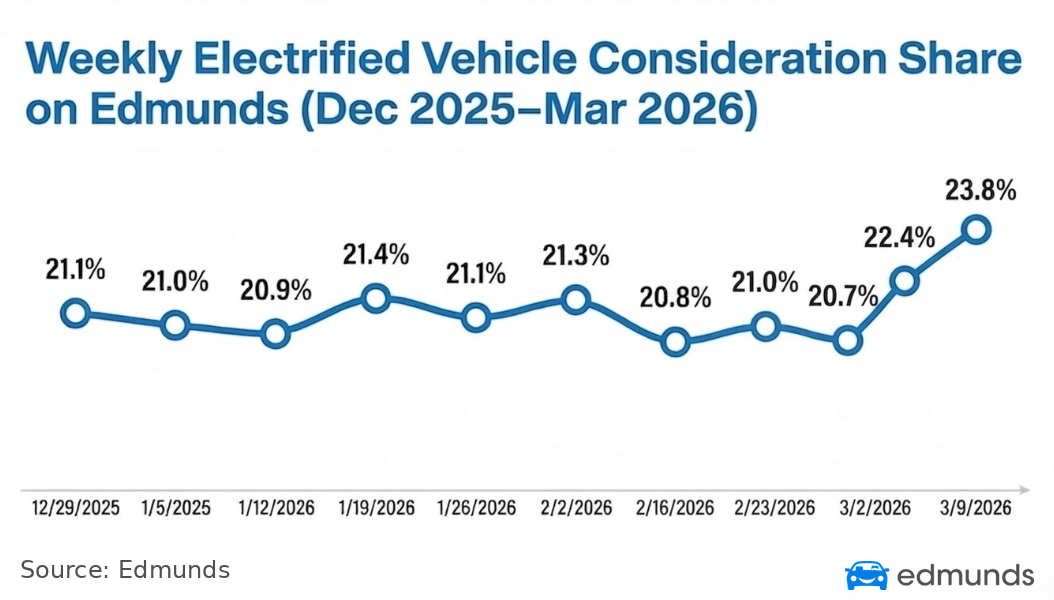
This is from Edmunds, which measures how often people are looking at photos, reading reviews, or browsing inventory of various vehicles. As recently as early March, the number of people interested in any form of electrified vehicle (hybrid, PHEV, EV) was hovering around 20.7%. It’s understandably jumped up to 23.8% as gas prices and crude prices have increased the most since Hurricane Katrina.
“High gas prices combined with elevated interest rates are a tough one-two punch for car shoppers,” said Head of Insights and verified cool person Jessica Caldwell. “If oil prices remain volatile, it could keep inflation and auto loan rates higher for longer, putting continued pressure on monthly payments for consumers who are already feeling stretched. While it’s too early to gauge the full impact, a prolonged conflict involving Iran could also drive up supply chain and logistics costs, placing further pressure on vehicle prices.”
Are oil prices going to stay volatile? It sure seems like it. President Trump just waived The Jones Act, which is something I wasn’t sure I’d ever see in my lifetime. That’s a seemingly obscure but very important maritime law that means any good shipped between ports in the United States have to be shipped on a vessel built here and owned by an American company. Getting rid of it, even temporarily, is a big deal.
The recession fears are real, too, as inflation is still too high and only likely to get higher as the impacts of the war ripple through the supply chain. That could mean a delay in interest rate cuts, as Caldwell points out above. Moody’s just put the chance of a recession in the next 12 months at 49%. Obviously, 49% is sort of like saying “I don’t know,” but the lack of uncertainty is the safe bet.
Does all this mean people are making a safe bet by buying hybrids? That depends.
Hybrid Buyers Still Need To Own A Car For Years To Make Up The Difference
There is a point that gas prices could hit where almost anything that doesn’t need gas is likely to be a good deal. We’re not quite at that point yet and, of course, it varies a lot depending on which car you want to buy. A Toyota Corolla LE is $22,925, whereas a Corolla Hybrid LE is $24,775, for a difference of $1,850. Using the combined EPA estimates, the ICE-powered car gets a good 35 MPG and the hybrid gets an impressive 50 MPG.
A person who drives 12,000 miles a year and has to pay the current $3.84 average per gallon (AAA), will save roughly $395 a year, meaning it’ll take 4 years and 8 months to make up the difference. If you assume that hybrid cars will carry a higher resale value and not compromise reliability, that’s not a bad deal. If average gas prices drop to $3.00, that’ll take six years, which still seems reasonable. If gas rises to $5.00 a gallon, that’s less than four years to make up the difference.
That’s at the lower end, however, and S&P Global Mobility puts the advertised range in prices between $1,614 and $13,121 for full hybrids. Assuming a 15 MPG improved efficiency at the high end, that would take more than 30 years to make up the difference. The average is a little better at $4,300, but that’s still ten years.
As more automakers sell hybrids, this delta should shrink, but high demand in the interim is causing an observed drop in incentives:
In many instances, because hybrid demand has gone up, there are fewer incentives applicable to hybrid versions or dealers were asking over MSRP for the hybrid model making them even more expensive compared to the gas only version. The result is a hybrid vehicle that typically costs more than the gas only counterpart with potentially fewer applicable discounts. However, even when there are higher discounts, it doesn’t offset the higher initial price.
Again, this is going to depend a lot based on where you live, what you’re currently driving, and how long gas prices are going to last. For something like a Corolla, CR-V, or Maverick, the small difference will likely be to your benefit over the long term. If you’re buying a Lexus LS500h? The third owner will reap those savings.
EVs Probably Saved 2.3 Million Barrels Of Oil A Day Last Year

The hybrid calculation is the easier one to make because you’re just comparing the usage of one fuel source to another. The cost of electricity is not only regional, it’s also related to delivery mechanism. Fast charging is, typically, a lot more expensive than home charging. It gets even more complex. While gas prices are likely to go up due to the war, so will prices associated with creating electricity.
Environmental group Transport & Environment looked at the EU market, took into consideration the potential impacts, and found that the price of gas is likely to rise about five times more than the cost of shoving some electrons into a battery:
Petrol car drivers can expect to be hit far harder by price rises related to the Iran conflict than electric vehicle drivers, new analysis finds. With oil prices surpassing $100 a barrel, the additional cost of fueling a petrol car is expected to be five times the extra cost of charging an electric car, according to T&E. Electric vehicles will be top of the agenda for EU Environment Ministers meeting in Brussels today when they will discuss a proposal to weaken climate targets for carmakers in the EU Automotive Package.
T&E analysed the likely impact on petrol prices and found that fuelling the average petrol car would cost €14.20 per 100km, a rise of €3.80 due to the conflict. The average cost of charging an EV would be €6.50 per 100km – an increase of €0.70 because of higher electricity prices due to more expensive gas. [1] For company cars, which drive high mileage, the impact will be even greater: an extra €89 per month for every petrol car in a company’s fleet. EV company cars would cost just €16 extra per month to charge.
As a producer of natural gas, and not an importer, American consumers might see that the price increase for gasoline might be ever greater than for electricity. But what about at the macro level? How much are countries saving by the EV switch? New research from BloombergNEF shows that last year the savings were meaningful:
Growing global adoption of electric vehicles helped avoid the consumption of 2.3 million barrels of oil per day last year, according to a modeled scenario from BloombergNEF.
Those fossil fuel savings are expected to increase every year for the rest of the decade as more drivers turn to battery-powered vehicles, said Claudio Lubis, BNEF’s oil analyst. The research group projects that by 2030, avoided daily consumption could more than double to 5.25 million barrels under the economic transition scenario, where governments deploy technologies that are economical rather than implement policies primarily driven by climate goals.
Put another way, globally, enough fuel was saved to account for about 15% of daily consumption in the United States. That’s not nothing. Another report cited by Bloomberg showed that, at current levels of consumption, China would save about $28 billion annually in lower oil imports, and that was when the price was $80 a barrel. As of this morning, Brent Crude prices jumped to nearly $110.
Are Cheap Used EVs A Trap For Dealers?

Numbers are fun. Let’s do some more numbers, shall we? In 2025, about 2% of cars coming off lease were EVs and 93% were ICE-powered. This year, Edmunds projects 8% will be EVs, or about four times as many. As I’ve discussed before, this is a quirk of the way the Inflation Reduction Act was enforced, meaning that way more EVs were leased than purchased. We’re not even at the peak, which should come in 2028 (roughly 2.5 years after the revocation of the IRA).
If you’re in the used market and are in a position to buy an electric car, this is potentially a great deal. The War in Iran, counterintuitively, is probably bad for buyers if the potential supply glut is suddenly met with more demand, but that’s far in the future.
Could this be good for dealers? Potentially, but there’s a risk. When EV mania took over during the early part of this decade, dealers took on a lot of used EV inventory. This was suddenly a curse for some dealers as Tesla lowered its prices and other brands followed. The relationship between new and used cars usually means that when new car prices drop, the comparable used car prices have to go down as well. Dealers might have spent $30k for a used Tesla Model Y at auction, only to see values crash.
As Automotive News points out, the operative question is how automakers are going to price these off-lease vehicles:
Bowman Chevrolet expects used-EV lease returns to balloon starting in May, though they already are trickling into the market, Jackson said. The dealership bought two off-lease EVs in December from GM to see how customers reacted to pricing. The first of those two cars sold the first week of February at a profit and the dealership has since sold the second vehicle, he said.
The dealership is waiting to see how GM prices off-lease EVs once “the floodgates open,” Jackson said.
“Are we going to see normal demand in spring or fall?” Jackson said. “That puts us in a position where all we can do is buy some to try and and see who calls.”
I will be keeping my eye on it this year.
What I’m Listening To While Writing TMD
For no reason at all, here’s “I Ran” by Flock of Seagulls. I wonder how hard it is to play the drums while spinning in a circle? Probably easier than wearing a garbage bag in a hot studio.
The Big Question
What’s the biggest jump (or dip) you’ve made in fuel economy from one car to another? The Forester got about 24 MPG combined and the CR-V Hybrid I have now makes about 35 MPG in my driving experience, so that’s +11 MPG.
Top photo: Ford



I’m still keeping the ~15 mpg V8, but for local trips, we’re getting a used EV.
Way too many gallons are being wasted for <30 mile trips.
I tried a Kona and a Bolt, but probably a Bolt EUV will be the top candidate, we’ll see how the local market behaves.
NH is kind of an EV desert though, the huge local Chevy dealer doesn’t have any EVs at all, neither used nor new.
I’m doing something very similar right now. I have the 500e (on a $33/mo. lease) for running around town, and it gets charged at home 99% of the time. I also bought a fully-depreciated V6 Panamera for road trips. When the Fiat lease is up, I plan to trade the Panamera in on something like an Ioniq 6 or E-Tron GT to combine the around-town and road trip cars.
The best time to switch to an EV or more fuel-efficient vehicle is when fuel prices are low, because the American Consumer has the memory of a flea and will instinctively react to high fuel prices by paying through the nose for a more efficient vehicle, even if that doesn’t save any money, and buying a gas guzzler the second fuel prices crash.
Something I don’t see mentioned much is that EVs are energy agnostic. I realize that not everyone can take advantage of this feature, but you can “fill” an EV with electricity produced by burning natural gas, or from sunlight, wind turbines, hydroelectric power, etc. People who are lucky enough can even install solar panels on their house and charge their cars effectively for free.
Petrol cars can take precisely one type of fuel, and one type only. That is the only way they will ever be able to be fueled. No one can drill for oil and open a refinery in their backyard, so they will be forever tied to the fossil fuel industry and all of the fluctuations that come with it.
I know it’s a very simplified generalization, but this statement amused me since your first paragraph was critical of consumers who ignore upfront costs in favor of reduced recurring energy costs and your second paragraph makes that very mistake.
I want solar and could probably afford it, but the payoff period is far too long for me to make the upfront investment.
Solar and affordability are really a US issue. Europe, Australia, other parts, can have the same installations at 1/3 the cost of US installations. I’ll let you read up on why that is.
My wife went from 25mpg in the Forester to an EV, but we don’t really drive enough to worry about fuel costs (within reason).
We’ve had a series of cars that has gone up and down between ~15mpg and EV with no real trend towards either. The only fuel-related issue I have is premium. Every time I look at a GV70, I have a hard time justifying premium fuel for a turbo 4 that doesn’t really wow with performance. If it had a V6 that took 87 octane I’d probably have one.
The Miata drinks Super, so I am always aware of the price of premium. On a nice weather car with a ~10 gallon tank the difference doesn’t kill me but I still find it annoying.
Went from an 18 mpg WJ Grand Cherokee to a Model 3 six years ago – and put solar panels on the roof. Since we’re a net producer of power, charging the EV comes at no incremental cost. Daily driving costs have almost completely flatlined, and even on road trips the cost of electricity used to be about the equivalent of a 40 mpg car. On my trip over the Rockies last weekend, it was considerably less expensive to be rolling on electrons.
We didn’t buy the car for gas savings, although it’s a nice bonus. My wife does not miss gas stations even one tiny little bit.
18mpg in the WJ, that’s impressive in its own right!
“High Gas Prices Are Pushing Buyers Towards Hybrids And EVs, But Does It Really Make Sense?”
Nothing this government and the plurality of its voting citizens have done lately makes any sense whatsoever. I heard all this sh*t was supposed to be fixed on Day One through 5D chess moves, but here we are 400+ days in and I’m looking around and it sure seems like there’s more sh*t than when we started. Definitely smells like it.
So sure, panic sell that gas guzzler at a loss and scramble for an EV or hybrid, ignoring the all the depreciation, financing, and transaction costs that entails. And when it goes back down, do it again to buy another guzzler.
This is what we do here.
With the off-lease EVs coming around, the switch may be a little less painful since the first and largest depreciation hit will already be out of the price.
Absolutely, if you do that you can save a lot on the EV purchase price. But if they are so sensitive to fuel prices this is something people should have been doing before, rather than knee-jerk reacting to a gas price spike.
When I got an EV I didn’t even really consider the fuel savings. There were lease deals, I was curious about EVs so it made sense.
That lease is going to cost Hyundai in the end because this thing is probably going to be worth $10000 under the residual when I bring it back – and they already took the $10k in state and federal incentives off the initial value.
I haven’t really done the math on energy savings. Our electric bill is a little higher, but its up by less than two tanks of gas in the Forester so I guess we’re ahead.
At 7¢ Canadian a kWh here in Quebec vs. $1.85/liter for gas.
Not difficult math for EV’s to win.
For those south of the border, that’s 5¢/kWh and $5.15 US/gal
Definitely helps to live in hydroelectric supplies. Here in SoCal, it’s $0.30/kWh, for the first 385kWh each month. Then it goes to $0.40.
If I can get solar cheaply (DIY and no permits, uh, yeah, no), that might make sense for refueling a PHEV. That shit’s free after the extreme up-front costs (or long-term amortized investment)
Where do you live? SCE TOU-Prime is 24 cents. That’s after an increase. I made the decision years ago to go solar. I’ve got a PPA on my system, fixed at 13 cents a kWh.
We need the AC from 4PM-9PM, so TOU-Prime would be 79 cents in the summer.
House doesn’t seem to fit the TOU optimal sizes. Large, gas heat, HVAC.
Still, the point I made was that if one is near hydroelectric dams making $0.05/kWh energy, EV/PHEV and charging at home makes a ton of sense versus here in SoCal.
Here in SoCal, Solar might be the way to go.
Home Depot estimates total cost at $3.00-$4.15/W. I could put probably twenty 400W panels on my southeast-facing roof. 8000W, so $24,000-$33,000. I also have Spanish tiles which require a special bracket.
What I would plan to do, (a plan of a plan): buy the solar panels and batteries, contract with a roofer who specializes in solar.
Ventura County.
Not sure if this was mentioned in comments, but my bankngives a .5% reduction in apr if you buy any hybrid/phev/ev. Not a lot, but it reduces the savings time as well!
We went from a ~15MPG Grand Cherokee to a 125 MPGe Model Y. My wife doesn’t miss gas stations and I don’t miss wrenching on the Jeep. Outside of new tires for the Model Y, we have 28K trouble free Tesla miles vs thousands spent on the Jeep for maintenance and repairs over the same distance.
Very cool! I effectively went from an E46 that averaged 26 MPG (with premium fuel) to an Ioniq 5, but the real cost savings was in maintenance costs. Once I factored in the parts cost of keeping a needy BMW on the road in with fuel savings, the EV clearly came out on top.
Most people are not crazy like us keeping 15+ year old vehicles on the road though!
I went from a 2009 GMC Sierra that got 13mpg regardless of what you did(in my area at least, I got 19mpg down south where it was flatter one time) to a 2022 Ram 1500 that gets 18mpg around town and 22mpg out on the highway.
Edit:
As for the cost of Hybrid/EV, I don’t really care about that. I hope my next vehicle is hybrid/EV, my truck is the eTorque so getting there. Whatever lessens our dependence on oil and gas will ultimately be a win for society in a whole myriad of different ways.
My wife and I were a one car family when we both worked from home. 2014 Corolla, averaged 31mpg. When she got a hybrid job we needed a second vehicle for the occasional times I need to go somewhere while she was at work. I bought a 1995 Dodge Ram and averaged about 12mpg in it.
Traded an Avalon getting about 19mpg for a Lexus 200h that gets about 40 (when I drive, which are generally long distance, versus when my wife drives it 2 miles to work and the gas engine does most of the driving).
What year Avalon? I average 30 in my 08.
Short trips recently, mainly. 1997. Traded in in 2016. 180K miles or so.
Family had a 98. Short tripping combined with the 4spd, 20 sounds about right. Great highway cruiser though. Several times I was mid 30s driving across state.
Seconded – what kind of Avalon gets 19 MPG? Was it being exclusively used for sub 2-mile trips? Sounds like something was wrong with the engine!
He mentioned it was a 97, and short trips. My parents owned my 08 before me and averaged 23ish. Short trips, lead foot, and no concept of coasting up to a stop sign/light.
Yeah, I think we traded it in because of an engine issue.
A few years ago, I went from commuting in a Saturn SC1 (28 mpg) to a Chevy K1500 (13 mpg), then a year later a Corolla (30 mpg.) The Corolla only cost $500, and the multi-car insurance discount was great enough that it was actually cheaper to own it than not. That dumb little beige thing might have been the best used car deal I ever got.
Those old Corolla’s and Camry’s with a stick were awesome econo cars. Really hard to kill as well. Shame they rotted out so easily here in the midwest.
I went from a 1995 Toyota Land Cruiser at ~14 mpg, to a 2012 Lexus RX 450h at ~27 mpg, to now a 2022 Volvo V60 Recharge PE at a current reading of 67 mpg.
Our biggest change was replacing my wife’s 2000 Frontier 4×4 with a 2003 VW Jetta Wagon. We went from about 16-17 mpg to 50 mpg.
That change also completely recalibrated our expectations for fuel economy.
I’ve given hybrids a lot of thought lately, so maybe I’m living in that bubble, but I’m surprised that interest in hybrids is only around 1/4. Thanks for doing the math. 4–6 years is an acceptable time to start getting a return, as most people owning an appliance vehicle should own them closer to 8–10 years.
The big thing for me is that not only do hybrids save you money, they’re also just nicer to own and drive. Engine start stop in an ICE vehicle is not exactly a pleasant experience. Whereas in a hybrid it’s a non-issue. Regen braking is great. I really like Toyota’s (and other’s) eAWD system which instantly applies when you need it, but doesn’t require a driveshaft running the length of the vehicle. Better car camping is also a major upside. Add in the fact that many OEMs hide the hybrids in the upper trims (for better or for worse), you also usually get better interior gadgets too.
Gas rationing. Australia and Great Britain are saying it loud. Other first world economies will follow suit. Imagine the shock here in the US if that happens. Gas rationing hasn’t happened in over a generation.
Don’t we produce a lot more of our own than they do? I’ve read Australia imports up to 90% of their needs. We refine most of our own, and a lot our crude imports come from Canada.
True but we also allow oil, NG, gasoline, and diesel to be exported and sold to the highest bidder.
FWIU we have the wrong refinery capacity for the oil we have. Unlike the Canadian stuff which would take some serious fence mending and crow-eating on the part of Little Marco and others of his ilk to rebuild the US-Canada relationship to what it was for 200 years, and hopefully his boss doesn’t undo that with a single late night tweet.
I don’t think that’s true. My understanding is that most of the US refinery capacity is for types of oil that we don’t produce. We export most of our oil to places that are set up to use it, and import from places that match our refinery capacity.
I have no idea how we ended up in such a situation, but here we are.
This is exactly correct. It’s a bit of a simplification, but we produce a lot of light, sweet crude and our refineries are set up for heavy, sour crude.
I think the reason is how old the refineries are compared to our oil production and how much more capital investment is tied up in refineries than oil wells. Basically we built all the refineries decades ago before fracking shale oil was feasible and the US didn’t produce much oil, but now that we do produce a ton of oil the economics of a global market plus the costs of changing refineries means it just makes better sense to sell everything we produce and import a ton of oil to refine and use.
That’d be quite interesting. With 90+% of our driving in an EV, and usually only 50-70 gallons a year of gas used for the old Jeep and occasional rental cars, I wonder what we could sell our leftover rations for? Could be a silly new black market of selling fuel rations to all the people around us who seem to think that a giant 4×4 truck is the only vehicle that can navigate a snowy or dirt road.
When I bought my Maverick, the hybrid was the less expensive option, so I’ve been benefitting since day 1. As I understand it, that’s flipped now. I average about 40 mpg, but I drive so little that the price of gas at the pump doesn’t matter to me. What does matter to me is that goods will become more expensive because transportation costs have increased. Food gets the double whammy of increasing fertilizer costs as well as transportation. I buy as much locally produced food as possible, but the farm stores and the butcher base their prices on the grocery store, usually charging just little less.
Interesting. Where I live the butchers charge about 50 to 100% more than the grocery store.
The butcher I go to is usually about $1/lb less on beef and maybe 50 cents/lb less on chicken than the grocery store. Specific items can be a lot less than the grocery store, for instance ribeye steaks were $22.99/lb at the grocery store and $18.99/ld at the butcher last time I looked.
All of my cars have gotten reasonably good mileage (high 20s) as they’ve all been 4 cyls and mostly small and aerodynamic sportscars. I recently switched to an EV which makes it hard to compare mileage to mileage but the amount I’m spending on electricity is 1/3 what I spent on gasoline (at last year’s gas prices).
Funny how perspectives can be different. You say high 20’s is reasonably good gas mileage. Our 2011 TSX Wagon has average 28 mpg and I consider that very poor fuel economy. A perspective that came from daily driving vehicles that got 45 mpg or better for 20 years.
I like to use $ / mile for my vehicles because at the end of the day that is what matters to me. My Bolt is at $0.03 per mile while the Acura is $0.15 for fuel.
I live in the land of giant trucks and SUVs that barely get out of the teens so relatively high 20s is good. My BRZ typically got 28-30 while still remaining fun to drive. The only vehicles I’ve had that gets 40s is my motorcycle.
I went from a truck that never got out of the teens to a 50 mpg Jetta TDI Wagon back in 2003. That move recalibrated my idea of good MPG.
My motorcycles actually got worse fuel mileage than that TDI and then there is the tire and maintenance bill. My BMW RT is the most expensive vehicle I have to operate.
I experienced the full swing and went from a 100+ MPGe Nissan Leaf to a 16-18 MPG lifted Tacoma to a 100+ MPGe VW ID4.
How does it make any sense, that the Trump administration completely destroys the EV industry in the US, including infrastructure improvements directed by the IRA Act, and then decides to start another oil war in the Middle East with Iran? Anyone?
The simple answer is that he isn’t terribly bright, but the completely 100% unfounded absolutely definitely untrue conspiracy answer is that Israel is blackmailing him with some heinous stuff from the Epstein files into doing a war for them.
I’d guess both.
I mean, Joe Kent, the top counterterrorism official who just resigned over the Iran war, straight up said the shots are being called by Israel. I don’t think it’s even conspiracy theory territory anymore.
Edit: I do realize this was sarcasm, but I think it’s important to note that it’s also an acknowledged fact.
I know it’s actually happening, but I was doing the thing where you give yourself some plausible deniability so they don’t send the KGB after you.
I was betting on Netanyahu just figuring out the right technique for Jedi-mind-tricking him into doing Israel’s bidding.
I am sort of hoping that directly due to his policies and war with Iran it ends up being the cause of a major national switch to EVs. After trying to destroy all the efforts to move us in that direction it would be a fun outcome.
I pass no judgements on which type of car people want to buy really, I just enjoy seeing irony in action.
My biggest jump was from a jeep commander to a jeep wrangler and my milage went up by 50%
Also since cars are on the road for a dozen or more years anymore they fuel savings is recovered long before many people get rid of the car.
I take the bicycle more often.
It offsets my beer consumption.
Which should offset my personal health costs.
In effect would reduce everyone’s health insurance, and reduce wear&tear on the roads.
And, long term, that should help pay for more beer for everyone.
You’re welcome.
I’m going to brew some beer this weekend, weather permitting.
You know, you could probably ride your bicycle AND drink beer at the same time!
Party bikes!
https://en.wikipedia.org/wiki/Party_bike
BP is locking out union workers at a refinery too. That’ll help gas prices.
“…cutting more than 200 union jobs in operations, maintenance and environmental safety as well as stripping away some workplace protections…”
BP locks out union workers at its Midwest oil refinery | Reuters
Never has the closing ceremony of the circus been more desired.
A few months ago I took a new job and I transitioned from WFH and daily driving my built Jeep TJ to commuting 55 miles each way. I picked up a used Kia Niro that gets between 45 and 52mpg, which is huge step up from the 9 to 11mpg my Jeep gets. Given what I paid for the Kia, I projected the car would pay for itself (purchase price and insurance, not maintenance) from fuel savings alone in 12.5 months. With gas prices what they are now, it will be closer to 10 months. In my case, the hybrid absolutely made sense.