

It’s hard to say exactly when or how the most recent war in the Middle East will end. While huge in scope, time-wise, WWII was a TikTok video compared to the longer conflicts in Iraq and Afghanistan. Even the battles in Ukraine continue to rage with no sign of stopping. Unless you can get around on a bicycle and live in a house that is powered mostly by renewables, the cost of today’s conflicts will eventually impact your life. For car buyers, this is most easily understood as the cost of gasoline or electricity.
There’s data that shows that buyers are suddenly more interested in “electrified” models, which includes different types of hybrids and EVs. Does that math? For hybrid buyers, recouping the difference between the price premium and gas prices might take a little longer than you might guess. The other way to look at this is from a viewpoint of a country. How much money is a place like China saving by having all these EVs?


I’ve talked a lot in The Morning Dump about how a lot of good used EVs are going to come into the market soon. Is this a good deal for dealers that need nice used cars? Or is this just going to be a replay of the price wars of the past?
That’s a lot of questions, so let’s see if I can pull together some answers.
Nearly A Quarter Of Car Buyers Are Looking At ‘Electrified’ Vehicles
Would you like to see a chart? Here’s a chart:
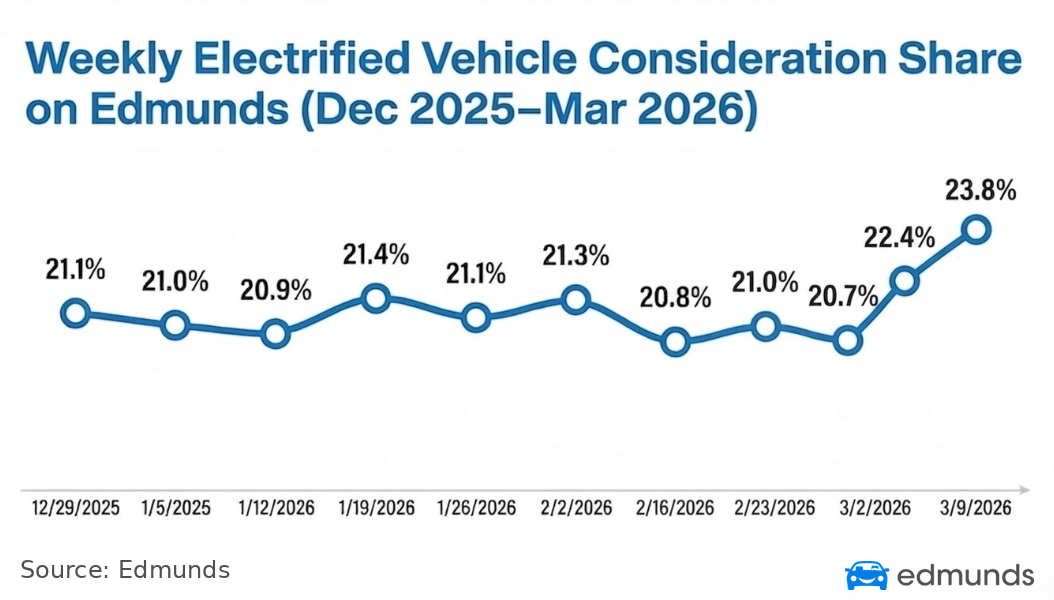
This is from Edmunds, which measures how often people are looking at photos, reading reviews, or browsing inventory of various vehicles. As recently as early March, the number of people interested in any form of electrified vehicle (hybrid, PHEV, EV) was hovering around 20.7%. It’s understandably jumped up to 23.8% as gas prices and crude prices have increased the most since Hurricane Katrina.
“High gas prices combined with elevated interest rates are a tough one-two punch for car shoppers,” said Head of Insights and verified cool person Jessica Caldwell. “If oil prices remain volatile, it could keep inflation and auto loan rates higher for longer, putting continued pressure on monthly payments for consumers who are already feeling stretched. While it’s too early to gauge the full impact, a prolonged conflict involving Iran could also drive up supply chain and logistics costs, placing further pressure on vehicle prices.”
Are oil prices going to stay volatile? It sure seems like it. President Trump just waived The Jones Act, which is something I wasn’t sure I’d ever see in my lifetime. That’s a seemingly obscure but very important maritime law that means any good shipped between ports in the United States have to be shipped on a vessel built here and owned by an American company. Getting rid of it, even temporarily, is a big deal.
The recession fears are real, too, as inflation is still too high and only likely to get higher as the impacts of the war ripple through the supply chain. That could mean a delay in interest rate cuts, as Caldwell points out above. Moody’s just put the chance of a recession in the next 12 months at 49%. Obviously, 49% is sort of like saying “I don’t know,” but the lack of uncertainty is the safe bet.
Does all this mean people are making a safe bet by buying hybrids? That depends.
Hybrid Buyers Still Need To Own A Car For Years To Make Up The Difference
There is a point that gas prices could hit where almost anything that doesn’t need gas is likely to be a good deal. We’re not quite at that point yet and, of course, it varies a lot depending on which car you want to buy. A Toyota Corolla LE is $22,925, whereas a Corolla Hybrid LE is $24,775, for a difference of $1,850. Using the combined EPA estimates, the ICE-powered car gets a good 35 MPG and the hybrid gets an impressive 50 MPG.
A person who drives 12,000 miles a year and has to pay the current $3.84 average per gallon (AAA), will save roughly $395 a year, meaning it’ll take 4 years and 8 months to make up the difference. If you assume that hybrid cars will carry a higher resale value and not compromise reliability, that’s not a bad deal. If average gas prices drop to $3.00, that’ll take six years, which still seems reasonable. If gas rises to $5.00 a gallon, that’s less than four years to make up the difference.
That’s at the lower end, however, and S&P Global Mobility puts the advertised range in prices between $1,614 and $13,121 for full hybrids. Assuming a 15 MPG improved efficiency at the high end, that would take more than 30 years to make up the difference. The average is a little better at $4,300, but that’s still ten years.
As more automakers sell hybrids, this delta should shrink, but high demand in the interim is causing an observed drop in incentives:
In many instances, because hybrid demand has gone up, there are fewer incentives applicable to hybrid versions or dealers were asking over MSRP for the hybrid model making them even more expensive compared to the gas only version. The result is a hybrid vehicle that typically costs more than the gas only counterpart with potentially fewer applicable discounts. However, even when there are higher discounts, it doesn’t offset the higher initial price.
Again, this is going to depend a lot based on where you live, what you’re currently driving, and how long gas prices are going to last. For something like a Corolla, CR-V, or Maverick, the small difference will likely be to your benefit over the long term. If you’re buying a Lexus LS500h? The third owner will reap those savings.
EVs Probably Saved 2.3 Million Barrels Of Oil A Day Last Year

The hybrid calculation is the easier one to make because you’re just comparing the usage of one fuel source to another. The cost of electricity is not only regional, it’s also related to delivery mechanism. Fast charging is, typically, a lot more expensive than home charging. It gets even more complex. While gas prices are likely to go up due to the war, so will prices associated with creating electricity.
Environmental group Transport & Environment looked at the EU market, took into consideration the potential impacts, and found that the price of gas is likely to rise about five times more than the cost of shoving some electrons into a battery:
Petrol car drivers can expect to be hit far harder by price rises related to the Iran conflict than electric vehicle drivers, new analysis finds. With oil prices surpassing $100 a barrel, the additional cost of fueling a petrol car is expected to be five times the extra cost of charging an electric car, according to T&E. Electric vehicles will be top of the agenda for EU Environment Ministers meeting in Brussels today when they will discuss a proposal to weaken climate targets for carmakers in the EU Automotive Package.
T&E analysed the likely impact on petrol prices and found that fuelling the average petrol car would cost €14.20 per 100km, a rise of €3.80 due to the conflict. The average cost of charging an EV would be €6.50 per 100km – an increase of €0.70 because of higher electricity prices due to more expensive gas. [1] For company cars, which drive high mileage, the impact will be even greater: an extra €89 per month for every petrol car in a company’s fleet. EV company cars would cost just €16 extra per month to charge.
As a producer of natural gas, and not an importer, American consumers might see that the price increase for gasoline might be ever greater than for electricity. But what about at the macro level? How much are countries saving by the EV switch? New research from BloombergNEF shows that last year the savings were meaningful:
Growing global adoption of electric vehicles helped avoid the consumption of 2.3 million barrels of oil per day last year, according to a modeled scenario from BloombergNEF.
Those fossil fuel savings are expected to increase every year for the rest of the decade as more drivers turn to battery-powered vehicles, said Claudio Lubis, BNEF’s oil analyst. The research group projects that by 2030, avoided daily consumption could more than double to 5.25 million barrels under the economic transition scenario, where governments deploy technologies that are economical rather than implement policies primarily driven by climate goals.
Put another way, globally, enough fuel was saved to account for about 15% of daily consumption in the United States. That’s not nothing. Another report cited by Bloomberg showed that, at current levels of consumption, China would save about $28 billion annually in lower oil imports, and that was when the price was $80 a barrel. As of this morning, Brent Crude prices jumped to nearly $110.
Are Cheap Used EVs A Trap For Dealers?

Numbers are fun. Let’s do some more numbers, shall we? In 2025, about 2% of cars coming off lease were EVs and 93% were ICE-powered. This year, Edmunds projects 8% will be EVs, or about four times as many. As I’ve discussed before, this is a quirk of the way the Inflation Reduction Act was enforced, meaning that way more EVs were leased than purchased. We’re not even at the peak, which should come in 2028 (roughly 2.5 years after the revocation of the IRA).
If you’re in the used market and are in a position to buy an electric car, this is potentially a great deal. The War in Iran, counterintuitively, is probably bad for buyers if the potential supply glut is suddenly met with more demand, but that’s far in the future.
Could this be good for dealers? Potentially, but there’s a risk. When EV mania took over during the early part of this decade, dealers took on a lot of used EV inventory. This was suddenly a curse for some dealers as Tesla lowered its prices and other brands followed. The relationship between new and used cars usually means that when new car prices drop, the comparable used car prices have to go down as well. Dealers might have spent $30k for a used Tesla Model Y at auction, only to see values crash.
As Automotive News points out, the operative question is how automakers are going to price these off-lease vehicles:
Bowman Chevrolet expects used-EV lease returns to balloon starting in May, though they already are trickling into the market, Jackson said. The dealership bought two off-lease EVs in December from GM to see how customers reacted to pricing. The first of those two cars sold the first week of February at a profit and the dealership has since sold the second vehicle, he said.
The dealership is waiting to see how GM prices off-lease EVs once “the floodgates open,” Jackson said.
“Are we going to see normal demand in spring or fall?” Jackson said. “That puts us in a position where all we can do is buy some to try and and see who calls.”
I will be keeping my eye on it this year.
What I’m Listening To While Writing TMD
For no reason at all, here’s “I Ran” by Flock of Seagulls. I wonder how hard it is to play the drums while spinning in a circle? Probably easier than wearing a garbage bag in a hot studio.
The Big Question
What’s the biggest jump (or dip) you’ve made in fuel economy from one car to another? The Forester got about 24 MPG combined and the CR-V Hybrid I have now makes about 35 MPG in my driving experience, so that’s +11 MPG.
Top photo: Ford





The only hugely efficient car I have owned was my first new car, an ’02 Golf GLS TDI. 50mpg driving it like I stole it. What came before and since was always circa 25-35mpg. Lowest for me are my current Land Rover Disco I and the Range Rover that preceded it – 16-18mpg at best.
Spending tens of thousands to save a little of fuel is stupid. The Golf TDI had the advantage of being a better drive and much more efficient than the 2.sl0 golf for only a small price premium. And much more efficient and cheaper than the 1.8T Golf.
I feel like the only viable option to panic buy a hybrid/electric car is if my current car’s trade in value completely paid for the new-to-me hybrid (doubt my car could get me a used BEV). That way I’m getting the fuel savings immediately without having to cover the price premium, I think.
Definitely tempted though. Filling up $60 for 250-300 miles a week on 91 octane. I love my WRX but man I wish the mpg was a bit better for my commute. Issue is that I love driving it and my son absolutely loves having a “vroom-vroom” car. Wife talks me off the “just get a Camry” cliff about once a month.
2017 Fiesta ST (30ish mpg) to 1999 Suburban (12-14mpg). Luckily I don’t drive much, more like 8,000miles/year split between two cars and two motorcycles, I have done the math a few times and at the end of the day I drive what I want, although right now I miss my Fiesta.
“What’s the biggest jump (or dip) you’ve made in fuel economy from one car to another? The Forester got about 24 MPG combined and the CR-V Hybrid I have now makes about 35 MPG in my driving experience, so that’s +11 MPG.”
I traded in my 1984 4WD 2-door S-10 Blazer for a 1991 Geo Metro 2-door 5-speed hatchback.
So I went from about 15 mpg to 51 mpg. A huge jump of +36 mpg.
Gasoline is still ridiculously inexpensive in most of the USA.
Driving an older, reliable car that uses more gasoline is almost always the winner if you aren’t considering anything aside from dollars in your pocket. Especially if you get reimbursed for any of the miles you drive, since a fully depreciated car costs much, much less per mile.
But if you want to think more broadly then burning less gasoline is attractive unrelated to price.
Few things to consider:
The base hybrid version of cars seem to come with a little more equipment for the increased price. From what I’ve seen anyway. Modern hybrid powertrains seem to be more reliable than comparable basic powertrains, and they now often perform better.
Considering that people often are willing to plunk down 4k for option packages that are mostly software, a few thousand for a powertrain that’s more efficient, quicker, has greater range and is more reliable seems like an absolute fucking steal to me. And that’s before you even get to the externalities of burning less fuel in general.
The attitude of “this hybrid will only save you 350$/year in gas!” is sort of missing half point.
Maybe missing more than half the point – those externalities are much more important to me. When we did our solar, my goal was for the system to be able to break even over its lifespan, for example.
Good point – some companies have a hybrid trim that’s close to the base trim and some don’t have anything even close. I wonder is that explains the price differences up to $13k noted above.
Exactly. When we compared our hybrid to the equivalent non-hybrid vehicle, we ended up with something faster, quieter, smoother, and with additional standard features like memory driver’s seat, a better audio system, and wireless CarPlay. Also, the hybrid has a low-stress Atkinson engine and minimal transmission vs. a smaller turbocharged engine with CVT in the non-hybrid version. In-town driving at almost double the MPG is just icing on the cake, as is going through the In-N-Out drive-through with the engine off from start to finish.
“Space Age Love Song” video, for the hair alone!
Nope, at least not for me. If my car died today due to a severe mechanical malady or an accident, then yes. But otherwise? No. It has to stick around because replacing it isn’t financially feasible or smart.
The car is a 2016 Mazda6 that I bought new in October 2015 and paid off in September 2019. It returns 27 MPG average with all city driving (which I normally do) and 35-36 (sometimes up to 40) MPG on the highway when I take it on trips. It holds myself, my wife, the two kids, and our small poodle just fine when we need it to. Which isn’t often, since my wife also has a van.
I’d like a hybrid CX-50, really. But until the 6 has reached the frequent/costly repair age, it must stay.
TBQ: hard to say in terms of car to car, but the day the vacuum line fell off the Bug’s carb comes to mind. Off throttle it was making WRC car noises.
I like Volvo’s approach. On my S60, you could buy the guzzoline one for about $10K less than the hybrid. Sure, the hybrid gave you a big average MPG bump with the 40 miles of electric range but the party trick was an extra 210 hp.
Regular B5 was good for 247, but the T8 Hybrid rocked 455, plus about 180 more torques. Now that’s an incentive.
The best argument for hybrids may not be strictly economic. Virtually every review I’ve read reports that the hybrid and PHEV models are better to drive than the ICE versions, with more power and quicker response. You usually get an E-CVT transmission rather than the dreaded CVT, and you lose the auto-stop-start that some drivers dislike. Your AC will keep running at stoplights because it’s electrically powered from the hybrid battery. Your hybrid probably won’t have or need a turbo, either.
In my experience, hybrids hold value better than ICE cars. Our Ford C-Max was purchased used for $15k. Six years and 50K miles later, it was sold for $10K.
This. Our Pacifica PHEV is soooo smooth (& way more powerful) than the gasser, even with the extra battery weight. So sad they DC’d it.
I went from a 2010 Charger(V6) to a 2013 Volt, also my wife went from a 2014 Forester to a 2024 Prologue, either way about the same jump.
I had a lifted 04 Wrangler LJ that got 11 mpg, then a Prius for 12 years that got 50 mpg until she imploded after 250k miles, now an 05 Tundra DC that gets 15 mpg. I live on the pendulum. The truck cost $12.5k and should last about a bajillion more miles but I’d love it to be more efficient, so much so that if Deboss Garage (or Edison Motors) somehow deigns my model truck worthy of inclusion of their new diesel battery erev system, and its $40k or less to do it, I’d probably go for it.
I hate it when people say or imply that truck owners don’t care about gas mileage, I don’t find that to be true at all.
My Sorento averages about 18mpg.
The Excursion I picked up is getting a hilariously bad 8.7mpg.
I’m getting it tuned, because the last owner put in a set of Comp cams that I’m 100% sure he never tuned it for. Cause a 5.4 V8 shouldn’t get worse MPGs unladen than a 6.8 V10 towing.
The joys of buying, and sorting, older cars.
Something something someone else’s project something something.
It was an old retired guy that owned it since 2008. He had a case of the “might as wells” when he put a new crate motor in at 300k miles. It’s otherwise pretty much bone stock. Seeing as he drove the speed limit and never towed, I don’t think he actually cared about fuel economy.
I have 2 guzzlers and 4 cars that are pretty efficient. Now that we don’t have a family hauler, we’ve generally increased our family CAFE in recent years, and the addition of a full electric to replace an Acadia has certainly decreased our gas spending. But we have 5 drivers for all these cars.
My worst cars are:
– 2008 STS V8 that was a hand me down for my kids to drive. Combined is 18mpg,
but it’s mostly city driving at this point which is more like 15. It acts as a spare most of the time and probably only accumulates about 3000 miles a year.
– RAM 1500 for towing that sits around 16 mpg lifetime average because of all the towing
My best are
– 2016 Miata – Lifetime 33.5mpg, but on premium
– Bolt EUV – Lifetime 3.5 miles per kwh
– 2006 Miata – Generally 27-28 mpg, but on premium
– 330e – 2-2.5 miles per kwh, but gets around 42mpg on interstate trips, but on premium fuel. Really hard to calculate the aggregate, but we mostly use electric and fill up with about 8 gallons of premium every 6-8 weeks.
Seeing as how the Edmunds data is measuring clicks and views rather than registrations or purchases, I’m going to go against the grain here and say that this data is less about people buying hybrids as a reactionary impulse to higher gas prices, and more people who are already buying cars anyway looking into the possibility of buying a more fuel-efficient car than they were originally considering. And it’s honestly not a very big jump anyway; a 3% increase in searches for electrified cars is a trend, but hardly going to set the world on fire.
That being said, as usual, higher gas prices have a disproportionate effect on people with low incomes, which means that people who might suddenly try to irrationally panic-buy a more efficient car are also in a worse place to take on board a new financial commitment like that. Perhaps at the end of the quarter we’ll start to see sales and registration data that will start to illustrate this.
I am fortunate to own a 2022 Camry Hybrid that gets 36-42 MPG (I drive it hard) on average, live in a state with relatively low gas prices, and currently drive very little day to day, so a 20% jump in gas prices has less effect on my wallet than an increase in air temperature does (home A/C usage).
I don’t think that’s what you meant to say. Double negatives are hard. 😛
I’m one of the people pushing that number up, although I already own a hybrid, so I’m not exactly new to the electrified market. But it’s not because of the cost of gas, it’s the reminder that the Middle East ultimately has a stranglehold on us because of our reliance on fossil fuels. Buying a new car because of a short-term (and probably temporary) rise in gas prices is rarely a smart thing to do, but buying a new car to stop sending money to a repressive, murderous regime is always sensible. Of course, paying my taxes is sending money to a repressive, murderous regime these days, so it’s an imperfect solution to be sure.
In reality I’ll probably keep driving my ~50 MPG Prius because at this point it’s practically free and sips gas, but what’s going on definitely pushes me further down the electrification path for whenever the time comes to replace it.
I feel so vindicated in my purchase of a used Prius C last year, right before the Tangerine Palpatine took office. I bought it when I did because I was sure he’d impose tariffs which would cause a rise in car prices, both new and used, and I figured he’d probably do something to make gas prices rise too. For the first year of the administration, I was pleasantly surprised to see that gas prices were actually fairly low. Of course, I now see that I was correct and that he’d do something to make gas more expensive. It’s good to have a car that will do 50 mpg all day.
I bought my leaf in 2019, and boy does it absolutely rule not buying gas for a daily driver. Powered by hydro here in Seattle too.
I was thinking of going all-electric, but I live in a condo building that has no provisions for charging in the garage. And I would need that if an EV was going to be my daily driver. I also drive long distances not infrequently, and my budget would not allow an EV that got 300 miles or better on a single charge, so that was out. So I did the next best thing.
yup, makes perfect sense.
” But Does It Really Make Sense?”
Let’s get one thing out of the way… most car buying choices have little to do with “what makes sense”. If logic and sense drove most car buying decisions, then far more people would be buying Toyota Corollas and far fewer people would be buying full size gasoline V8 powered trucks from Ford, Stellantis and GM. We would also see far fewer people buying BMWs, Mercedes-Benzes and Audis.
Most buyers buy based on image, style and emotion.
“Hybrid Buyers Still Need To Own A Car For Years To Make Up The Difference”
That depends on the person buying, how they use the vehicle and how much they drive.
In my case, I live in the city, I drive quite a bit (25,000km – 30,000km per year) and I only change cars after they wear out.
So in my case, my C-max plug in hybrid has cut my consumption of gasoline by 42% compared to my previous vehicle (a 2008 Honda Fit with a manual transmission).
And for the amount of driving I do, it means it’s saving me around CAD$1000/year.
And in terms of payback, when I was in the market, to get another low mileage Honda Fit of similar age/mileage, there was little to no price difference between that and the C-Max I bought.
And there is another benefit… often hybrids like the C-Max and Prius are cheaper to insure than average. Also my C-Max needs less service. I only need to change the oil half as often compared to my old Honda Fit. And that’s mainly due to doing a lot of driving in EV mode.
So for me, the C-Max purchase has made a lot of sense and the ‘payback’ was more or less from day 1 compared to what my costs would have been if I bought another Honda Fit of similar age and mileage.
But I’m not the typical buyer
“Are Cheap Used EVs A Trap For Dealers?”
Dealers exist to sell vehicles. I don’t see why the fuel/energy source of a given vehicle matters. A sale is a sale.
“What’s the biggest jump (or dip) you’ve made in fuel economy from one car to another?”
The biggest drop was when I switched from my worn out 2008 Honda Fit to my current 2017 Ford C-Max Energi… I went from averaging 5.88L/100km (40mpg using US gallons) to averaging 3.41L/100km (69mpg) so far…. which is a 42% drop in fuel consumption… or a difference of 29mpg.
Almost ten years in, I’m still delighted with my C-Max Energi. With no significant repairs in 90,000 miles and a lifetime average around 65 mpg, it’s been the best investment I’ve ever made in a vehicle. And it’s fun to drive, because it’s basically just a fat Focus!
I don’t know what mileage my 540i gets because there are so many dead pixels in the display that I can’t read the odometer. But it’s probably not good. I’d also have to factor in oil, as it leaks a couple quarts per tank of fuel.
Biggest MPG jump for me was when I went from a moderately janky ’84 Cadillac (~13) to a new ’01 Civic (~33). This probably didn’t save me money since the Caddy was $1500 and the Civic was $18000. Even at $4/gallon it would take over 85k miles to break even. Gas was a LOT cheaper then so I probably never broke even despite driving the Civic for a decade. The Civic was more reliable, though.
Realistically, buying a more efficient car isn’t the best way to save money on transportation costs. If you want to save money, drive a cheaper/crappier car. Buying a new EV or hybrid doesn’t make economic sense. Buy a well-used hybrid or EV can be a great choice, though.
“Realistically, buying a more efficient car isn’t the best way to save money on transportation costs. If you want to save money, drive a cheaper/crappier car”
That’s not true. The BEST way to save money on transportation costs is to sell your car and rely on walking, riding a bicycle and/or using public transit.
Fair point.
Although, if you live in a place where cars are a necessity, a cheap car will save more money than an efficient car.
“Cheap” still needs to be reliable. My now cheap car costs me about $1000/year on old-car maintenance. And I still put off replacing the heater core ($2000+) and replacing a front air dam (ran over semi’s tire), cuz looking to replace whole car and die a little by not driving a manual as my semi-weekly for the first time in my 64-year-old life.
Going to a corner to cry a little…
Over a period of two years we went from a Focus ST and Outback with the V6, to a Blazer EV and Maverick hybrid. Our gas bill is about 20% of what it used to be, although our electric bill has certainly gone up. Even then, we’re saving about $150/mo on fuel costs (Washington State, high gas prices but cheap electric)
When I graduated from college, my only vehicle was my ’70 GTO that got in the very low teens for mileage. When I could afford it, I bought a Nissan Sentra SE-R Spec V that got about 30 MPG. That was a big boost.
Focus SE to ST, I went from 36 to 30 mpg, but that was also 87 to 93 octane.
Went from a 16MPG City/Highway/Always TJ that is the avatar to a 2009 VW CC that would easily get 37mpg highway. With all the miles I did I think the gas savings were >>> the car payment.