

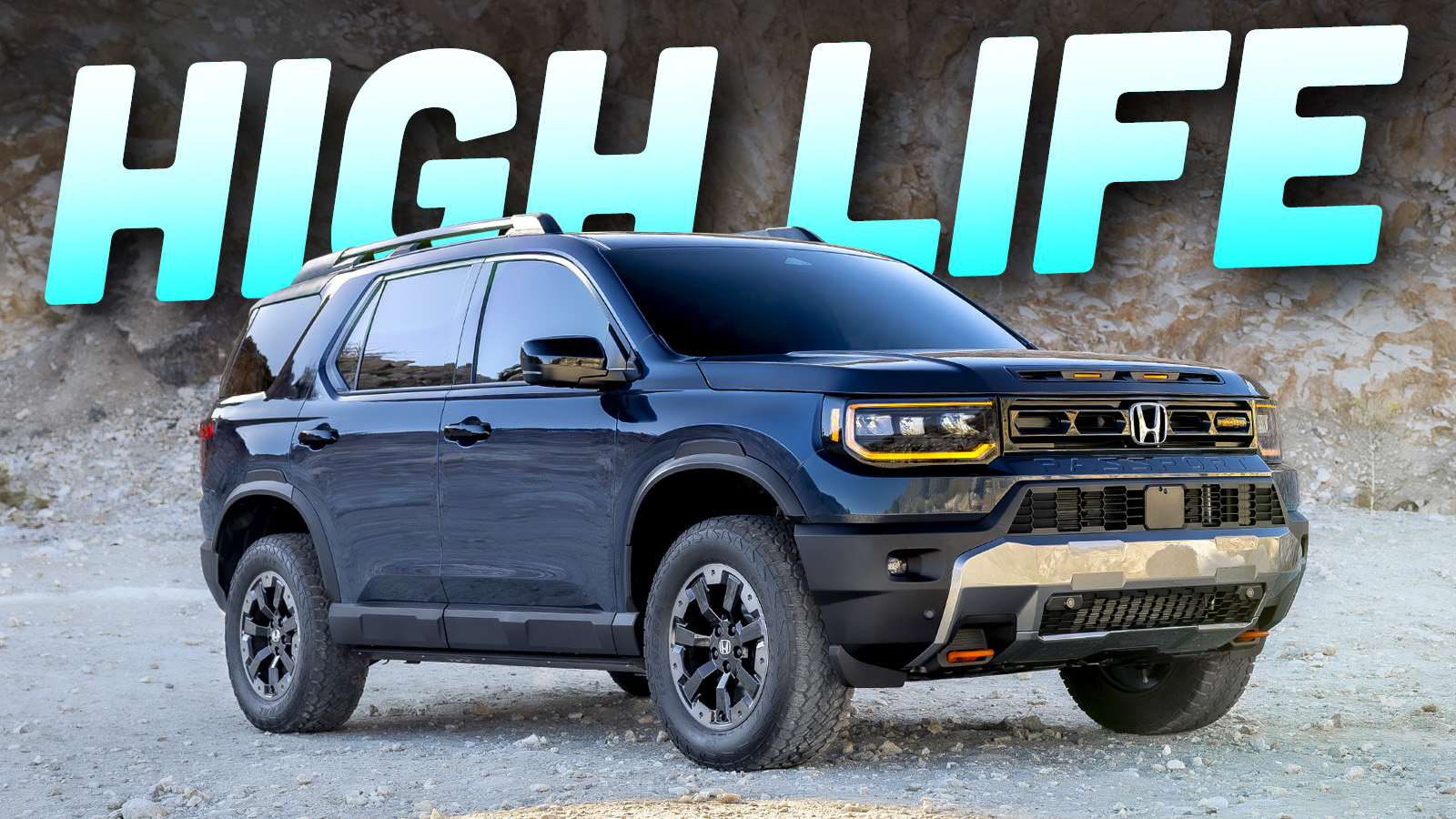
It’s 2026 and seriously rugged SUVs are so hot right now. Models with two-speed transfer cases to crawl over rocks, big clearance, and huge tires are making a comeback in a big way. That’s great if you need that capability, but old-school off-roaders often trade refinement and efficiency for go-anywhere capability. But what if you don’t need to go anywhere, just go some places off the beaten path on weekends and commute to the office on weekdays? The Honda Passport TrailSport might be just the ticket, and it’s growing even more macho for 2027.
In case you’re wondering where the Passport fits in the Honda lineup, it’s essentially the seven-seat Pilot’s shorter five-seat cousin that—in TrailSport trim—gains skid plates and knobbly tires to do a decent SUV impression. Sure, it certainly won’t go everywhere a properly equipped Land Rover Defender or Toyota 4Runner TRD Pro will go, but for drivers who want a tough-looking crossover and do light off-roading, it’s just the ticket.


For 2027, that Otterbox’d TrailSport trim goes even further, because Honda’s raised the ground clearance by 1.38 inches, boosting it from 8.27 to 9.65 inches. That’s more than a Ford Bronco minus the Sasquatch package and slightly less than a Jeep Wrangler. Impressive stuff from a unibody, coil-sprung vehicle with four-wheel independent suspension, but how does that translate to capability?

Well, it’s a bit apples-to-oranges. On vehicles with solid rear axles like the Bronco and Wrangler, the low point underneath is usually the rear differential. The thing is, that whole axle assembly moves with the suspension, which means that minimum ground clearance isn’t the best signifier of key angles. Off-road, you’re often limited by how steep of a hill your front bumper can clear, how sharp of a crest the underbody can clear, and whether the rear end will get hung up on rocks and stumps. In short, approach, breakover, and departure angles. With the updated Passport TrailSport, approach and departure angles improve by two degrees to 25 degrees, while breakover angle improves by three degrees to 23 degrees. That’s rather competitive with a Toyota 4Runner’s 24-degree breakover and departure angles, and you’ll have to pull the air dam on the Toyota to exceed the Passport’s approach angle.

Equally impressive is how Honda’s done this properly. While some automakers simply fit taller springs and dampers, correct the camber and call it a day, the new Passport TrailSport goes much further. New springs and dampers, yes, but also new front control arms, rear wheel carriers, anti-roll bars, steering knuckles, front CV axles, and a new front subframe to ensure geometry’s good and minimize typical side effects of a lift like bump steer and adverse axle angles. Honda even claims to have improved the steering feel, which means the updated Passport TrailSport shouldn’t lose the road manners that make it a standout choice. Oh, and Honda’s also now fitting all Passport TrailSports with a 360-degree camera system that should have benefits both on dirt and for squeezing into tight parking spots.

Beyond the substantially revised suspension, the easiest way to spot the updated Passport TrailSport is by looking for amber lights in the hood insert and a wider set of fender flares. The front valence has also been subtly resculpted clearance, there’s a new shade of blue on offer, and you can have Honda black out the wheels, trims and badges if that’s your sort of thing. Inside, there’s now a standard heated steering wheel but that’s about it. Honda doesn’t seem to have messed with what already works well, and that includes the naturally aspirated 285-horsepower V6, 10-speed automatic transmission, and all-wheel-drive system with a torque vectoring rear differential.

The Honda Passport might not be all the off-roader you want, but the TrailSport trim might now be all the off-roader you need. If low-range rock crawling and mud bogging isn’t your thing, the addition of extra clearance and more standard equipment to this compelling and surprisingly capable midsize crossover should make it a fine companion for gravel trails and everyday commuting. While Honda hasn’t released pricing yet, don’t be surprised if it sticks reasonably close to the 2026 Passport TrailSport’s starting price of $50,245.
Top graphic image: Honda


As some have mentioned I think the hybrid factor of the 4Runner would sway me that way for now. Honda can’t get that V6 hybrid going soon enough!
I for one accept our unibody overlords.
But it looks so silly, tho
This would have to be EXCELLENT on-road to make me choose it over the more capable and (somehow) more efficient 4Runner TRD Off-Road for nearly the same money.
An extra $3,000 in the 4Runner upgrades it to the hybrid with another 50HP and 150 lb-ft of torque and even better fuel economy.
Maybe making a RWD body-on-frame SUV more livable is easier than making a crossover into an overachieving off-roader.
honda take on rav4 woodland?
Honda’s take on the rav4 woodland is the cr-v trailsport. The Passport’s a bigger vehicle all around.
yea but it’s like a slightly tarted up model that is more “offroady”
My lovely 4’11” wife has a hard enough time getting into our non-Sasquatch Bronco with no running boards. And the Passport is even taller?
I tend to believe that most folks who want to seriously offroad their truck will probably not consider the Passport anyway, so I have my doubts as to the point of these enhancements. The remaining folks who do plan to lightly offroad their Passport probably won’t care about an extra 1.38 inches (ahem).
It looks pretty good, though.
I think it’s safe to assume that any “lifted” version was designed by men with men in mind. The patriarchy strikes again.
There was a recent review somewhere – maybe Edmubds, where they couldn’t get out of a lightly snowed-in parking spot with all the AWD bells and whistles because the i-VTM4 was too smart for its own good and disabling traction control was buried deep in the menus.
Will this thing have a (fake) central lock diff button, and/or a TC disable easily accessible?
New!
Less usable for your 99% use case – and worse mileage too!
Yay Honda America!
7.6 inches
That’s it.
Every 2026 Ridgeline has 7.6 inches.
Passport 9.65 inches makes Ridgeline feel very small, very inadequate.
For 2027 Ridgeline is cancelled. Honda is so mean.
The side profile looks silly. It needs smaller wheels and or larger tires to look right with the lift.
This is an attractive vehicle for an attractive price. I do wish the stylists hadn’t given up around the quarter-panel area; the rear fascia looks pretty apathetic and underdesigned compared to the front. And it definitely has interior volume and storage to rival (and exceed) those of both the Bronco and 4Runner, whose solid rear axles and longitude powertrains take up a lot of space.
This is a segment I used to hate that I begrudgingly sort of maybe like now. I like my van, but with some of the hiking I’ve been doing with my daughter, the van just can’t make it to a number of trailheads. I’ve wanted to force the issue a few times, but for a few of the rougher ones I’ve muttered to myself “really freaking glad I didn’t take the van”. My wife’s reasonably worn down Forester is perfect for the job.
I’ll give Honda this, the Passport is very good looking. Not Hansel by any means, but handsome compared to a lot of the dreck out there. The previous gen for instance was a snoozefest that managed to simultaneously look like ass at the same time. What an improvement!
I was honestly shocked to hear that Honda bothered to put out a “Trailsport” trim of this thing with less than 9″ of ground clearance? A regular-ass Subaru has 8.7″. I get that there’s more to the capability game, but like, seems like this should have been the original number to begin with.
Honda’s current lineup, Acura included, is good-looking in a fairly conservative way across the board. There really isn’t a dog in the bunch.
They’ve made some real strides with this current gen. They’re yet another brand though where adding some color would go a long way to adding some excitement. Painting a couple of Civics and Preludes bright blue isn’t enough.
Odyssey certainly could use a fresh take, but otherwise they’re all nice looking cars.
The Odyssey’s one of the victims of Honda’s decision to concentrate on EV development above all else, and will need to soldier on for another couple of years. But even it is a fine mode of conveyance, and the J35 V6 is certainly nothing about which to complain. They’ve also done a good job of keeping it reasonably up-to-date with the rest of the Honda lineup.
What it badly needs, I think, is a hybrid and/or AWD offering.
Yeah I get it. And it’s a totally fine van, I still think I like it more than all the other vans for a lot of reasons.
They just need to put sliding doors on it!
I’ve said it on here 100 times, if Subaru ditched the Ascent and made a minivan instead, I would buy it immediately.
Yeh agreed these are now one of the better looking vehicles in their segment. And also hear ya on the hiking thing, it’s not that you can’t take a fwd/low clearance awd on many forest service roads but it’s stressful.
Yeah one of the trailheads was an absolute “you’re getting stuck” with low clearance.
Plenty of them it was more of a comfort thing. Because as much as a basic vehicle can technically make it, you know what really sucks? Beating the crap out of your car or worse, getting yourself stuck in the middle of nowhere with your kid, lol.
I have a Bronco; the fear of getting stuck in the middle of nowhere with your kid never goes away. You just have to go a little further to encounter it.
Totally!
My sense is vans and passenger cars have lost a little too much ground clearance. Our van will scrape on any kind of steep ramp. If you look at pictures of body on frame passenger cars, those had a lot more clearance, and would bound down dirt roads with no trouble.
Oddly enough, the closest competitor to the Passport in terms of capability, pricing, platform, cargo space, and so on is probably an Outback Wilderness. But even then the Subaru is narrower, lighter, cheaper, more efficient, and gets away with a very high baseline ground clearance thanks to the flat-four up front.
I still can’t love the segment, though. It takes a perfectly acceptable crossover and lops off at least 5 mpg highway for some very temporary capability off pavement. And 99.99% of usage for these vehicles will be on pavement. I could defend it more if a hybrid option showed up to offset the drop in fuel economy.
That’s the tough thing. I think there’s a genuine use-case for a modified unibody vehicle to be somewhat more capable. But there’s are a lot of people who buy these things that didn’t even need the ground clearance or accessories of the standard model. Example, my in-laws Pathfinder Rock Creek, with the efficiency sucking all terrain tires and a massively heavy roof rack that they’ve literally never used. They couldn’t get things onto the roof if they tried. That car hasn’t seen anything worse than a well-graded gravel parking lot and never will. They basically just made their car worse for no reason. And they’re not fooling anyone with the cosplay lol.
But as dumb as it is, if the Pathfinder Rock Creek keeps them out of something like a Bronco or a full-size truck, cool I guess.
Hybrid powertrains for these sorts of vehicles can’t come soon enough.
Yay, another Raptor wannabe with amber lights in the hood. Is the Passport over 80 inches wide? Does it require marker lights? This trend needs to die along with blacked out rims.
So this is all Trailsports? The Trailsport Elite as well?
I. haven’t seen reporting that answers this yet, but it seems to me that they wouldn’t raise it up for the TS and then lower it back down for the TSE.
The fact that the ‘27 TS now gets the 360 cam and heated wheel of the ‘26 TSE is great. I was looking at the PP TSE, and now the TS is back on the table. If they’s strip out the sunroof on the TS (to keep up the general level of differentiation), that would be even better to me.
Honda is creeping up on actually making an off-road capable crossover. Sure, everyone makes a offroad package for their crossovers these days, but they all go short of providing the actual hardware necessary. The Honda 10-speed and ivtm4 actually deliver on the important bits of gearing and AWD duty-cycle. Until someone pairs an aggressive transmission, aggressive final drive ratios and an actual locking AWD unit, (to say nothing of low range), then this is it. Honestly, its very capable for what most people need most of the time for off-road travel that isn’t a rated trail.
Yes, it looks like a genuine effort and I appreciate how they managed to give it real clearances without equipping it with failure-prone adjustable height air suspension.
Agreed, although I’ve had any number of air-suspended vehicles, including currently a 2005 VW Phaeton V8 and a 2024 Volvo XC90 T8 Ultimate. I’ve rarely ever had air suspension issues, either.
Nonetheless, I think it would be a non-starter at this price point, not to mention offensive when even the much-pricier Acura MDX lacks it outside of the Type S. (Weirdly, the all-electric, General-Motors-based ZDX also has it on the Type S trim, even though its Cadillac Lyriq 600E4 sibling does not).
Interestingly, the KL Jeep Cherokee (2014-2023) was one of the few vehicles to ever pair a transverse-FWD powertrain with an actual mechanical two-speed 4WD/AWD system. More interestingly still, it’s actually got separate reduction at each axle, rather than a single transfer case that reduces both axles, as is traditional.
But the KL was/is a piece of shit.
If anybody could put that kind of arrangement on something reasonably robust and that you’d actually want to purchase, it’d be Honda.
I was wondering with the 10 speed if you get a reasonable crawl gear for going down slippery hills in first (obvs still not low range). I’d also be curious to see if they put in time on tuning the AWD and Torque Vectoring diff especially given Honda’s lack of background in this space (AFAIK.) I’ve seen plenty of off road tests of other AWD suvs where once they get into mud, a tire in the air, snow and ice, etc they wind up just spinning one wheel and the stability control isn’t programmed to be strong enough to force other wheels to drive, and as much as I roll my eyes at how many cars have torque vectoring diffs now I would think it could be programmed to effectively be functionally the same as a locking rear diff (or at least a limited slip.)
But I agree this is more than enough for some rough roading for hiking, camping, fishing.
The ’26 model crawl ratio is 21.8:1. That’s not as good as a low range, but its really not that far off. My Land Cruiser stock crawl ratio is 28.7:1. More to the point the ivtm4 system is fundamentally different to most other AWD units in that it can bias more torque to the rear axle the same way the GR corolla does (over speeding the output relative to the input) and because of the unique way it does it, its much easier on the clutches and can hang in the fight a LOT longer. Its genuinely a very good AWD system.
Thanks for the explainer that’s pretty rad actually. Glad to see Honda is adding some serious hardware and not just a badge and wheels package.
“Sure, it certainly won’t go everywhere a….Toyota 4Runner TRD Pro will go”
Correction: it won’t go everywhere a base Toyota 4Runner SR5 will go. Those are very capable out of the box for way, way less than the TRD Pro that people spend too much money on.
That said, the clearances are now looking good enough to take the Passport seriously. The high-range gearing is a limitation, but this could probably get most of the places I use my 10-yo 4Runner.
Shame about the Honda’s torqueless engine and cargo area, then. The Pilot lovefest is really strong, so I’m going to be a contrarian and throw a bit of a wet blanket on it for some balance. If you like having to push way into the gas pedal to get your heavy SUV to actually move out of its own way and avoid the rapid shift-shift-shift! run for the highest gear by that ridiculous 10 speed automatic and don’t mind getting poor fuel economy then you’ll like the Passport. I didn’t. I tried a Hybrid Max 4Runner the same day and am now an evangelical convert to the way that delivers effortless power in routine driving.
The Passport also still has a donut spare. The well won’t fit a full size. That has to go vertical in the cargo area like an XJ Cherokee, killing 1/4-1/3 of the cargo space. And you will need a full size if you really want to use this thing in places that require 9+” of ground clearance.
I just spent Labor Day getting down some redrock country trails where the 4Runner could 4Runner and there was one wash crossing where I don’t think this would have quite made it but it would have been impressively close. But I never would have been able to fit the gear for the 4 of us in the back of the Passport without a roof rack to mount the spare, and that’s stupid.
Long story short, the Pilot has a nice interior and good road manners but I’m keeping the old 4Runner because despite what on-paper specs show it doesn’t quite deliver for us in our use case.
True. I have a 2018 4Runner SR5, my brother had a 2016 TRD Pro (until his engine got the dreaded timing chain cover gasket failure). We would go out in the desert a couple times a year and mine could do anything his could. In both our cases, we met our personal limits before the trucks reached theirs.
Yeh a buddy of mine had a 1996 4Runner that was bone stock besides some off road tires that were the biggest he could fit and we did some hairy stuff in Moab and other parts of Utah and Arizona on a few different off road camping trips. I think we did eventually break a sway bar end on the last trip, but still a good basic platform and good tires go further than most of us will ever want or need.
This is great and all, but let’s get down to the important questions: how does it look with a rooftop tent, ladder, traction boards, and jerry can mounted on the top and sides (all pristine and never used)?
Like every other poseur rig with the same gear. It’s like asking what the guy under all the drag makeup looks like. Doesn’t matter. All you see is the drag.
I have and use that stuff but when I am not using it on a trail it is ALL off my jeep and safely in my garage. (not the RTT, I dislike those)
I’m very tempted to strap a shovel and water jug to the outside of my Bronco. I might need them on the tenth of never.
Do it, but use a plastic play shovel, rake, and all the other childhood sand-castle-making accoutrement.
But can it Rubicon?
It now has 0.15″ more ground clearance than the Subaru Outback Wilderness or about 5/32″
I still wish these lifted crossover came with real rocker protection. Plastic will not survive rocks and ruts.
Yes. And I expect to see one of these high centered on the rock in the mall parking lot as well.
https://www.collegehillshonda.com/product/08L33-3BM-100A.html Factory sliders. Though I would still go aftermarket, but still.
Wow!
Seeing how you can take a Prius offroad in the Gambler 500 and not utterly embarrass yourself – and perhaps even clown a bit on the “real off roader” alpha bros who think your car will immolate itself two feet inside the trailhead – I question the point of this thing. Did it need any of these improvements? Functionally speaking, are they improvements, or are they just changes?
Yeah… I spend more time on forest service roads and and trails than most, and inevitably if you don’t need 4lo and lockers you can get there in a Prius. My wife and I have actually started keeping count at climbing crags if we *don’t* see at least one prius parked between all the trucks and subarus.
What I really wanted on my subaru when I had it was for them to put a true low range (just make it another gear, like reverse, in front of the CVT) and the LSD from the WRX. Then I really could have gotten it more places. Instead I just got a truck like everyone else…
I fantasized about throwing a lift – maybe even portal axles so I could get a little silly with the lift, if you’re going to fantasize then go big – and a Torsen under the Prius when I had it. The portals were going to be hard to find; and I couldn’t find anywhere that makes a Torsen or even a locker for the Prius. Probably because it’s all mixed in with the hybrid system and there’s a so-called traction assist from the brakes, which I don’t like but what can you do.
I mean you’re not wrong there is always at least one Prius at the trailhead. That being said if you actually care about your car it gets old gingerly picking your way over miles of crappy forest service road and I have been in at least one near predicament with my old Mazda 3 where I didn’t think I was going to be able to get over a wet rock, after multiple tries rocking it over gently finally went full send and made it over but banged something underneath it hard, though fortunately it didn’t seem to actually break anything that mattered but it was unnerving and I scraped it in more minor ways a number of other times. Just saying yes you can get surprisingly far in little fwd cars but it’s more pleasant when you have a little ground clearance and awd.
I rememeber once taking a big-ass Ram Rebel down a very rutted, off-camber desert road to a crag in Cochise Stronghold, thinking we wouldn’t have made it with anything less. When arrived at the crag, what was parked there but a beige first-gen FWD Sienna driven by some 22 year olds from Oklahoma.
We asked them how they made it. The driver exhaled a massive blueberry vape plume and said “the road was no problem, but we thought there’d be a top-rop situation here.”
Top rope in Cochise! Lmao. Reminds me it’s been a long time since I’ve slung some chicken heads.
Functionally speaking, are they improvements, or are they just changes?
They are improvements. 9.6″ is real ground clearance and the profile shot shows very usable approach and departure angles.
I would be very surprised if this doesn’t harm the already poor fuel economy, though.
It’s an improvement if you are ever going to take the car off road where you need more than the original level of ground clearance to pass safely. Of the Honda Passport’s constituency, that’s a small enough segment to be a rounding error. This is a solution that fixes what wasn’t a problem. It creates Wrangler-like numbers that buyers can point to and say look, see, I did too buy a real off-roader.
I have taken my long, 4×2 Toyota pickup down some downright slick back roads; ground clearance was never the limiting factor. I have taken my Prius through 6″ snow with no worries whatsoever; ground clearance was never the limiting factor.
I had a Subaru Forester with eight inches of ground clearance, I never once took it off road.
I want people to be sold more efficiency and longevity, not more toughness and capability that will go forever unused.
I’m not quite following your argument. It’s not a BOF low-ranger so it’s pointless? Or Honda’s WAY behind on hybridization? I’ll agree with the former–the non-trailsport Passport is still an oinker on fuel.
But your first sentence makes the use case for this vehicle; it finally gets it close enough to stock 4R and base Bronco territory that I consider worth a cross shop, which means Honda just expanded the constituency.
Everyone has different off pavement needs. I’ve taken a 4×2 Toyota pickup down dirt roads as well. Clearance and traction became problems quickly. Just this weekend our 4R went down roads the pickup, a Prius, and a Forester would have no hope of navigating, but this Passport just might have. This wasn’t a yahoo offroad park, this was just BLM routes across public lands.
“I want people to be sold more efficiency and longevity, not more toughness and capability that will go forever unused.”
I guess that is Honda’s real problem; Toyota long ago decided to keep the 4×4 line separate from crossover so they’ve had both 4Runners and 35 mpg Highlander hybrids for awhile now.
You’re spot on. I had a prior-gen Trailsport rental a few years ago that we flogged the heck out of in the Arizona desert. For our use case of needing to cover big miles on pavement, then moderate offroad trails, it was perfect and we never once needed a low-range.
The reality is that soft-roaders are outrageously capable vehicles. I think what many of the off-road set don’t realize is that most of us aren’t driving off-road for the sake of driving off-road, we’re just trying to get a little closer to our destination.
“most of us aren’t driving off-road for the sake of driving off-road, we’re just trying to get a little closer to our destination”
Yes! And for that, this Passport looks quite good.
One of the most common cars in Mongolia is a 1st gen Prius with a lift kit. They are surprisingly capable.
Cool, this is exactly what people have been asking for other than an hybrid. Apparently the ground clearance (or lack thereof) was the real thing limiting these when off-roading. 99% of them will never actually do that, but people like to know they can and a couple of YouTube videos of Passports going places they’re not supposed to be capable of going will sell more of them.
We’re going to look at one for my wife’s next car. We keep seeing them and she’s decided she likes them. I don’t really see what’s not to like other than the lousy gas mileage.
100% these are cool! This has what comment people say they want, a proper NA V-6!
As a former 4Runner owner, I really like this. I think the capability is fine for what the majority of people will do with it; in fact, I probably pushed my 4Runner beyond what this could do just a handful of times. I took a look at one of these, and I like what they did with the interior, and the cargo space looks better and more useable than the new 4runner.
The mileage is kind of a bummer, but I guess they can only do so much with that old V6.
Wonder if they’ll offer a Ridgeline TrailSport?
At over $50K, people in my neck of the woods might consider it as an option to their 18 mpg F150s.
They… Do?
Unless you’re asking if they’ll give the same treatment to the Ridgeline? Which is a good question because the ground clearance and overhangs on the Ridgeline TrailSport are terrible. 7.6″. The Prologue has more clearance than that.
Yes, that’s what I meant. Most people in my area dismiss the Ridgeline as ‘not a real truck’, and 90+% of the trucks in my area are either Chevrolet, F*rd, RAM, or GMC BOF models. The other 10% are Toyotas, Hondas, or the Maverick.
If there were a lifted Ridgeline with at least the pretentions of being an ‘off-roader’ maybe people who were getting fed up with all the F*rd recalls and GM V8 woes might be swayed to buy a Honda.
I am glad the ground clearance details were explained. The lack of low range is an issue for control not just rock crawling but also getting unstuck. This is cool and I am glad Honda is making this but I think if I was out on my own on some trails, I would spend the same money on a Wrangler/Bronco/4Runner and I hope to add the Xterra to that list.
The details really weren’t. It explains how it stays pretty constant with a solid axle, but doesn’t mention that it changes with independent suspensions and depending on the amount of flex in the springs can change quite drastically when at full compression.