

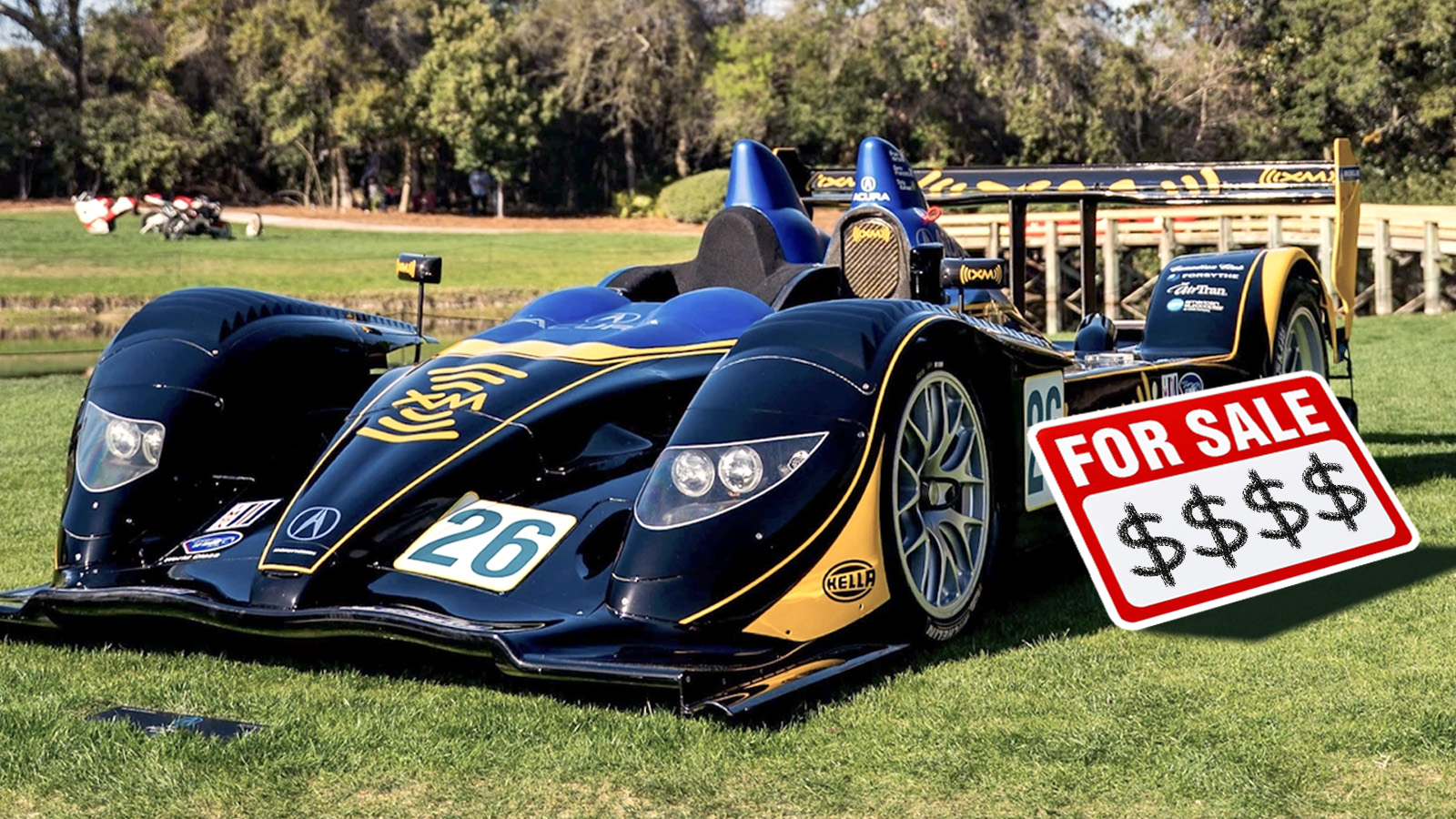
For those of you who have more commas in your bank account than most of us and have lain awake at night wondering what it’s like to throw a championship-winning endurance race car around a racetrack, Honda has some good news for you.
As part of its event activities at Monterey Car Week, Honda has announced the HRC Heritage Racing Program, based at the Honda Racing Corporation USA headquarters in Santa Clarita, California, and designed to bring old Honda and Acura racing cars back to the circuit.


The idea itself is a pretty simple one, but does require eye-watering amounts of cash. HRC will restore, modernize, and sell its old racing cars – even some of its most successful machinery – for private buyers to take to the track. The tagline, “Built to Win… Again,” clearly marks this as a project to keep these cars on tracks, and not to create pristine garage queens. Watch:
HRC presented two cars from its collection to launch the program, in the shape of an LMP2-class Acura and a more recent NSX GT3, both restored by HRC and offered for sale. As no prices have been floated, expect buyers to be very deep-pocketed individuals, of which there’s no shortage at Monterey Car Week.
In both cases, the cars aren’t just any example of the breed, but the most successful ones of each. That starts with the XM Satellite Radio AGR Acura ARX-01a #26, which, in the hands of Dario Franchitti, Bryan Herta, and Tony Kanaan, took class victory in its very first race: the 2007 12 Hours of Sebring.

Franchitti later drove the same chassis, which was the first car (and engine) developed by HRC back in its Honda Performance Development (HPD) days and the first dedicated Acura race car, to more victories, cementing its reputation as “a special car” in his own words.
Alongside the ARX-01a, there’s “the winningest NSX GT3 of all time,” by way of chassis 5 of the Acura model. Decked out in the “Lady Liberty” livery – one of the MSR team’s Fourth of July-themed liveries for the Six Hours of the Glen – the #93 picked up more of the NSX’s 38 class wins than any other.

Like these two models, every car offered through the heritage racing program undergoes a complete tear-down at HRC before being rebuilt from original factory homologation documents, technical drawings, and period engineering notes. That includes a complete engine rebuild, as well as some updates to materials, safety equipment, and electronics to bring the car into a more modern state for usability and reliability.
The program doesn’t just end at the factor doors either. Once the restoration is complete and the car is track-tested, HRC provides trackside engineering support too. Its factory race engineers will come out to historic motorsport events to help owners set up and run the cars properly.

Alongside restoring its own cars, HRC also supported McLaren Racing’s Zak Brown in the restoration of a Reynard 01i raced by Gil de Ferran in the CART championship and purchased from Roger Penske earlier in 2026. The car will be putting in demonstration laps at Laguna Seca this weekend, as part of an exhibition that includes other HRC-restored Acura endurance racers, some of which will be part of the Japanese Motorsports class at Sunday’s Concours d’Elegance.
HRC has further plans for the heritage program that include endurance racers and IndyCar machinery, returning racing cars that could become static museum pieces to their natural home. It’s already working on a 2010 Dallara IR-05.
For the rest of us wanting a bit of Honda racing history but operating on more meager funds, HRC has announced 1:8 and 1:18 scale RA272 models based on the car Richie Ginther drove to Honda’s first-ever F1 victory.

Recreated from scans of the original in Honda’s museum, it comes with all the detail you’d expect from an Amalgam model, with each hand-built car featuring CNC-machined parts. There’s a special presentation case, a display box, and an accompanying information booklet, with each example bearing a numbered plaque and certificate of authenticity.
Even in desktop 1:18 size, though, this vintage Honda will still set you back a not-insignificant sum at $1,735, provided you’re quick enough to score one of the 300-model limited edition before they’re snatched up. If that scale and price tag sound small to you, consider the 1:8 scale, $28,995 version.
Top graphic image: Honda Racing


So are they for sale or drive a lap. Not sure if it was written as my phone is slapped with more ads than a pornado
For sale proper, with engineer support for whatever era/class-appropriate racing you want to do with it.
My state already has legal assisted suicide, so I’ll have to pass up this opportunity. I’ll save the Dario Franchitti cosplay for the XBox.
Holding out for the RC166.
A HRC prepped NC35 would be a nice plaything.
“Honda Will Now Sell You Its Historic Race Cars And Send Engineers To Help You Race Them”
Selling the engineers directly would have been illegal.
Oh good. I found 73 suitcases stuffed full of 100s under my coffee cup this morning. I was getting anxious about how to spend it.
A reminder of when Honda used to be cool
While I am 100% on board with Honda’s prestige in the world of motorsport, I’m not seeing this being as successful as they intend it to be.
‘Honda’ is attached to ‘economy car’, and no matter the pedigree of the race car, it still bears the name more commonly associated with Civics and Odysseys instead of Daytona or LeMans.
So while the Acura (!!) NSX GT3 car may be the winningest one of all time, it’s not as exclusive or as prestigious as the rest of the GT3 field it raced with.
As such, I think that the well for extremely wealthy Honda motorsport enthusiasts is not deep and will dry up quickly.
TL;DR: Honda ain’t Ferrari.
Honda is a motorcycle company that, also, makes cars.
Its image in the USA is tilted to cars, and blurred with Acura. I think Honda did America dirty by not using the Honda brand for the original NSX as they did elsewhere.
Sounds like the beginning of we need money let’s try to sell things sitting around. It starts with the old race cars and ends with the industrial robots. Or gold chains to copper wiring.
I sold my rallycross WRX in 2020 when my roof repair bill was $10k and insurance gave me $1100. Plus we weren’t doing much RX (or anything) in 2020.
Relevant?
…or the newer, less valuable Acuras first.
Race cars and test mules are not known for being plug and play after years of neglect…
Up until now I didn’t know that I wanted my own ASIMO driving my own Kunimitsu NSX GT2, and now I know that’s the first thing I’ll buy when I’m a billionaire.