

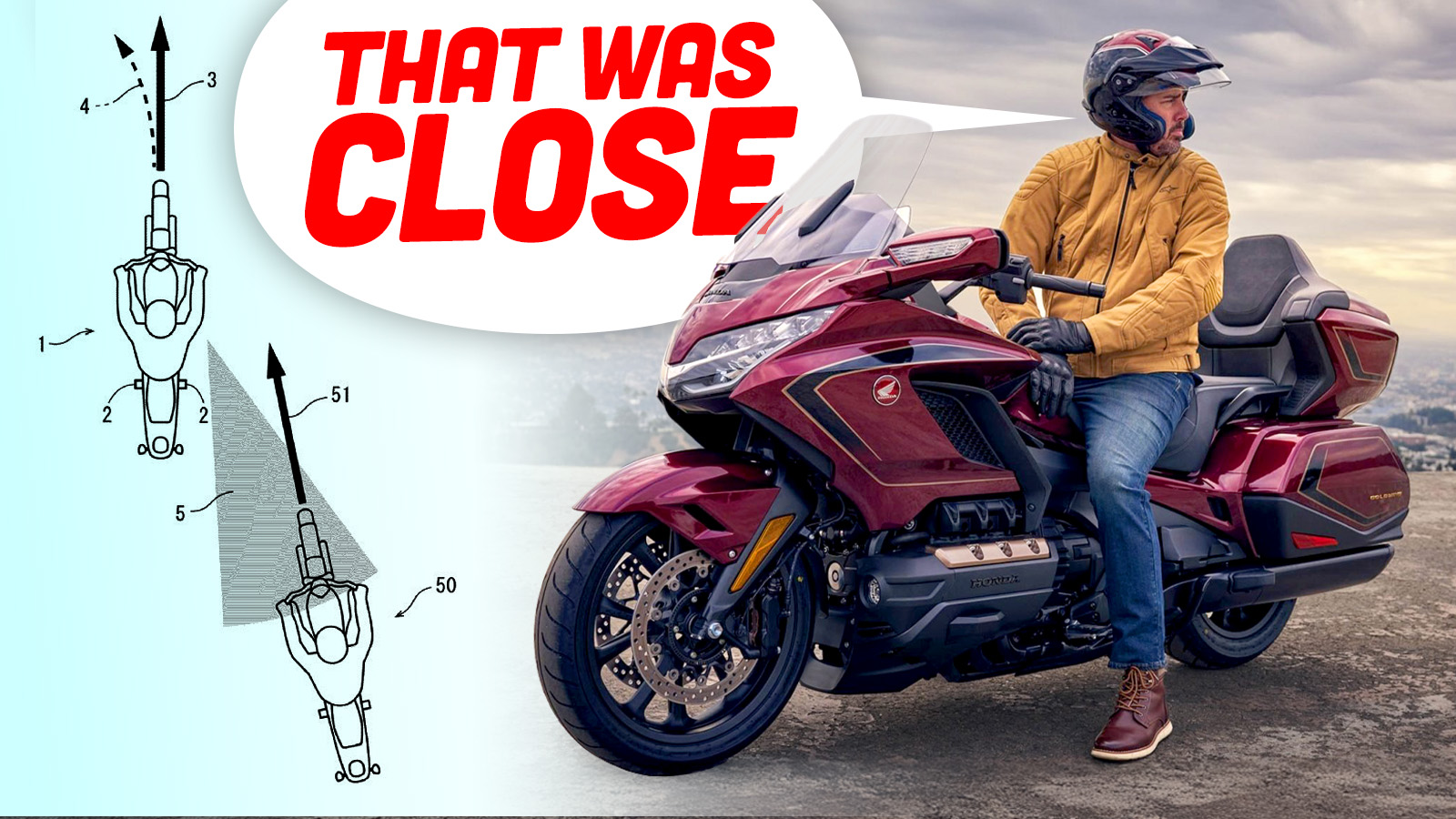
If you’ve driven a modern car, you’re almost certainly experienced the tech that gently nudges you back into a lane, automatically tries to avoid a crash, or performs some base-level self-steering. Motorcycles don’t have that tech, but Honda wants to change that. One of Honda’s newest motorcycle patents calls for a system that would make a motorcycle automatically dodge a danger, just like a car. It’s fascinating – and maybe a little bit scary.
This news comes to us from our friends at RideApart, and it’s another interesting example of how motorcycle safety technology sometimes lags behind cars. In 2020, BMW announced radar-based active cruise control on its R 1250 RT touring bike. A year later, I tested the same system on the R 18 Transcontinental, and it was mind-blowing as the system works just like the radar cruise that’s been in cars for more than two decades, but tailored to bikes.


Over here in America, it was big news when Indian Motorcycle introduced blind spot monitoring, tailgate warning, and a rear collision warning. That hit the market only this year! Even my lowly Smart Fortwo had a collision warning in 2016, and much fancier cars have had the tech for more than two decades. Until most recently, some of the more advanced motorcycle tech has involved cornering ABS, cornering traction control, wheelie control, riding modes, and the aforementioned safety tech.
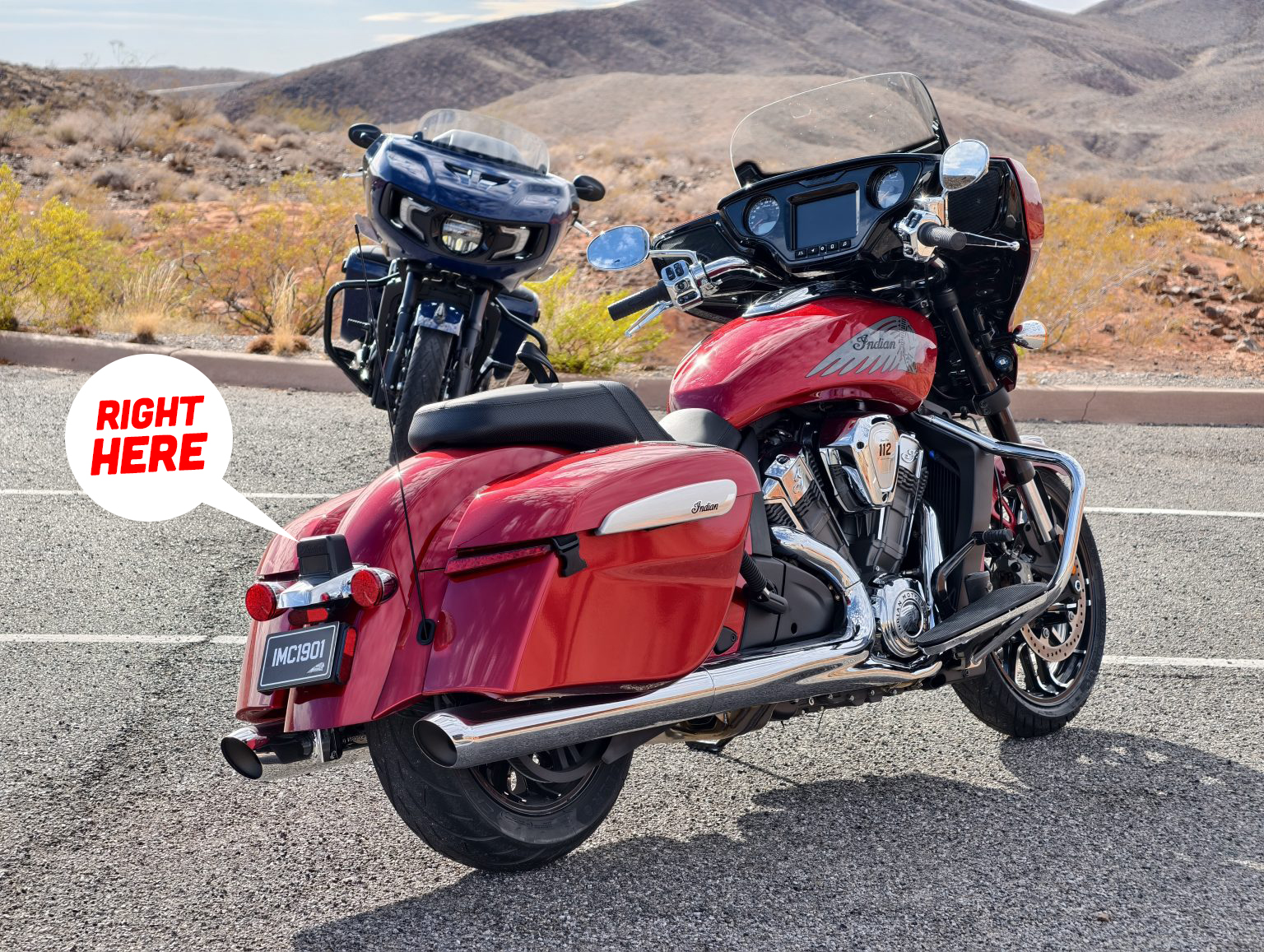
You’ve probably noticed that none of the above technologies actively intervene with your motorcycle’s steering. All of the above tech won’t do much to stop you from wiping out into the back of a car, or stop you from accidentally changing lanes into a car. Motorcycle companies have been toying with the idea of self-balancing and self-riding motorcycles for some time, but usually, these ideas never go further than wild concepts. That’s why Honda’s new patent caught my attention. While the idea of a self-riding motorcycle is something teased at seemingly every futuristic motorcycle show, Honda’s invention seems somewhat realistic.
Saving Your Bacon
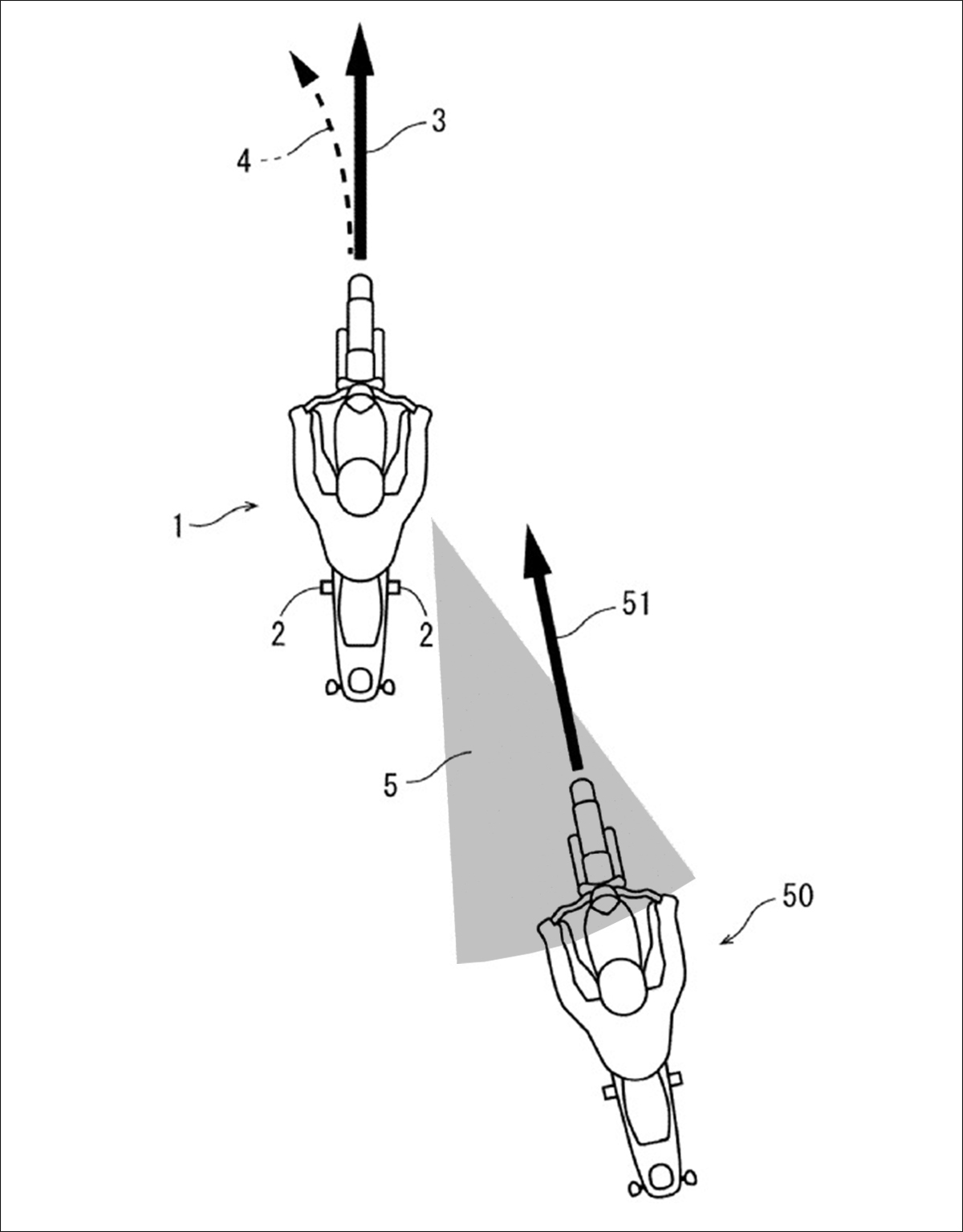
To oversimplify, Honda has developed a camera-based monitoring system that detects what’s going on in the motorcycle’s blind spot. If the system detects a vehicle is on a collision course with the motorcycle, the system will use an actuator to automatically steer the motorcycle out of the path of danger.
The abstract of the patent goes deeper:
Provided is a steering control device for motorcycle, capable of executing steering control appropriate for a characteristic of a motorcycle. The steering control device for motorcycle comprises: an imaging unit (2) which captures the outside of an own vehicle (1); a blind spot recognition unit (8) which recognizes that another vehicle (50) is approaching from a blind spot (5) of the own vehicle (1) on the basis of information from the imaging unit (2); and a steering-device control unit (10) which carries out steering control on the basis of information from the blind spot recognition unit (8), wherein the steering-device control unit (10) carries out the steering control to avoid the other vehicle (50) according to a riding state of the own vehicle (1). The riding state of the own vehicle (1) includes a path change operation, an acceleration operation, and a deceleration operation of a rider and the steering-device control unit (10) changes an intervention amount of the steering control according to the path change operation, the acceleration operation, and the deceleration operation of the rider.

Honda says the device works through a multi-step process. First, the blind spot monitoring system detects that there’s a vehicle closing in on the motorcycle. Then, it issues either a visual or an audible warning to the rider. This part is no different than the system that Indian has for its motorcycles.
Where Honda goes further is what happens after this. A system that only warns you of hazards has no way of intervening if you either do not see the warnings or do not act on them. Honda’s proposed system monitors steering, acceleration, and braking. The system apparently can determine if you’re reacting to the closing vehicle. If you start avoiding the vehicle yourself, the system can add steering assist to amplify your reaction.

Should you do nothing at all, the system would automatically ease you into a turn to avoid the obstacle. Apparently, the goal is to do this gradually in the hopes of not upsetting the rider or destabilizing the bike and thus causing a crash.
From the patent:
FIG. 3 is a flowchart illustrating a procedure of approach avoidance controls according to a preferred embodiment of the present disclosure. In step S 1, the host vehicle 1 is traveling as normal. In step S 2, the other vehicle 50 having entered the blind spot 5 is detected. In step S 3, the blind spot recognizer 8 determines whether or not the other vehicle 50 that has entered the blind spot 5 is approaching, and when an affirmative determination is made, the procedure proceeds to step S 4. In step S 4, an approach alert is issued by a display on a meter, a buzzer sound, or the like. When a negative determination is made in step S 3, the procedure returns to step S 1.
In step S 5, whether or not the rider has performed an avoidance operation is determined, and when an affirmative determination is made, the procedure returns to step S 1. As described above, the presence or absence of the avoidance operation is determined based on output signals from the piloting torque sensor 15, the throttle opening degree sensor 6, and the brake pressure sensor 7. In contrast, when a negative determination is made in step S 5, that is, in a case in which the rider has failed to perform the avoidance operation when the other vehicle 50 that has entered the blind spot 5 approaches the host vehicle 1, the procedure proceeds to step S 6, and whether or not piloting (turn) control intervention is possible is determined. In a case in which an affirmative determination is made in step S 5, turning control can be immediately executed with a maximum target torque.
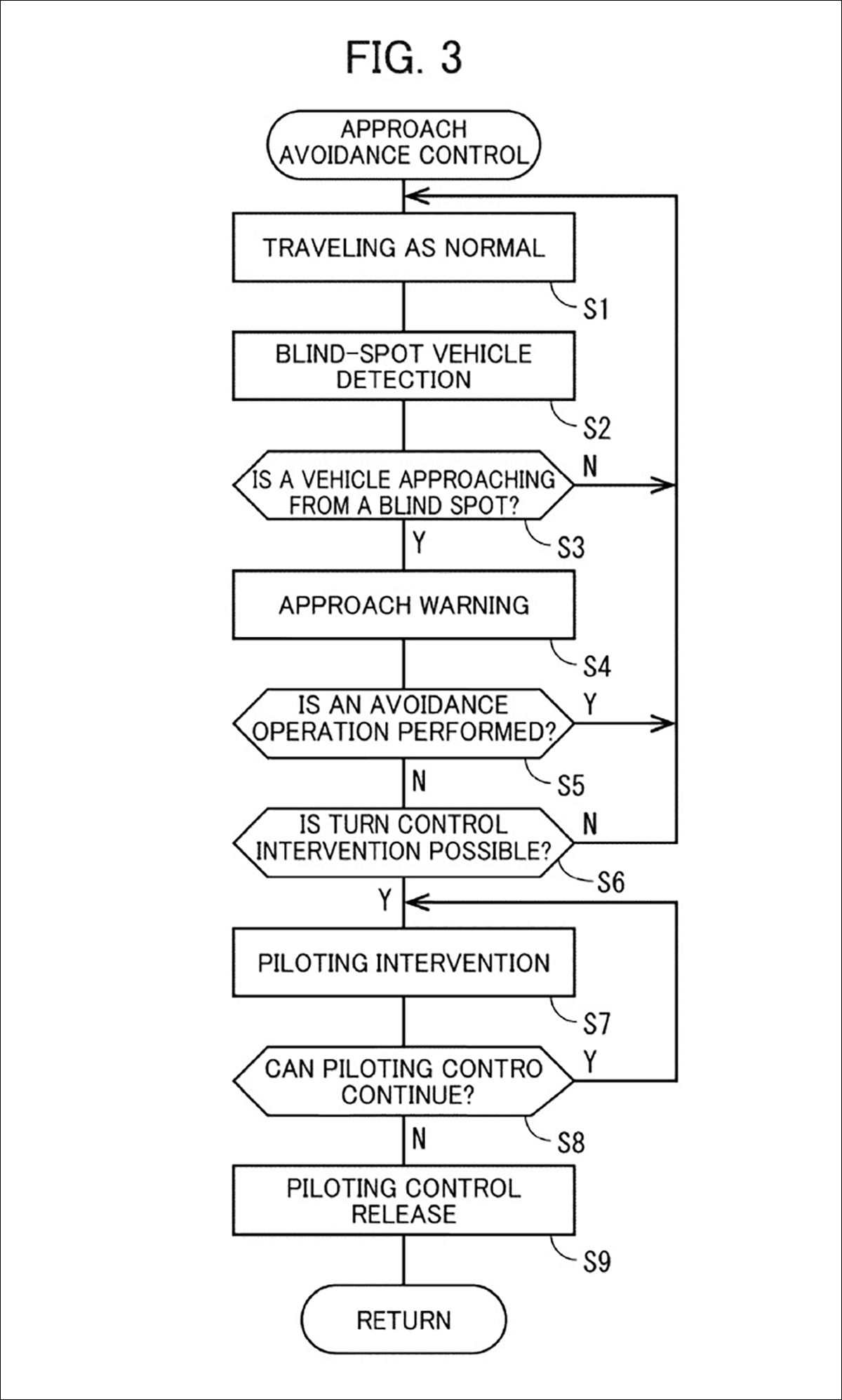
When an affirmative determination is made in step S 6, the process proceeds to step S 7, and a piloting intervention is executed by the turn device controller 10. In the preferred embodiment of the present disclosure, in this piloting intervention, control that reduces the initial intervention amount of turning control and gradually increases the piloting torque is executed. In contrast, when a negative determination is made in step S 6, that is, when it is determined that piloting control intervention is not possible, the process returns to step S 1. In step S 8, whether or not the piloting control can be continued is determined, and when an affirmative determination is made, the procedure returns to step S 7. In contrast, when a negative determination is made in step S 8, that is, when it is determined that the piloting control cannot be continued due to a change to the target course for avoiding the other vehicle 50 being completed or the like, the process proceeds to step S 9 to release the piloting control and end the procedure of approach avoidance controls.
I like that this isn’t just a car system. Honda seems to know that it can’t have a system that just jerks the handlebars, because that would scare the rider and might make the situation worse.
You might be wondering how exactly this system works with countersteering, and what happens if the rider isn’t paying attention. Honda doesn’t mention countersteering at all, but does say maximum torque is not applied to the handlebars until the system detects that the rider is paying attention and is ready to execute an evasive maneuver. Otherwise, the system is supposed to gently attempt to initiate a turn with the hope that you’ll notice, not freak out, and be prepared for the turn.
Would You Buy A Bike With This Tech?
The part of me that loves fresh technology is impressed. Making an active collision avoidance system for a motorcycle brings its own challenges. It has to be aggressive enough to be effective, but not so hard that it throws the rider from the bike. It has to do its job while keeping only two contact patches still on the road. Assuming this technology could be used in the real world, a motorcycle that can avoid crashes by itself might have the potential to save some lives.

It also makes some sense that Honda has even explored this technology. The Insurance Institute for Highway Safety says that, per an examination of fatal crashes involving 65 motorcycle models with ABS from 2013 to 2019, motorcycles with ABS were involved in about 22 percent fewer fatal crashes. Advancements in motorcycle safety technology have made our passion a bit safer.
IIHS also says that technologies like automatic emergency braking can reduce rear-end car crashes by 50 percent, while lane departure warnings can reduce single-vehicle, head-on, and sideswipe crashes by 11 percent. Maybe implementing similar technologies into motorcycles could have a positive effect?
I suppose one day we might find out, but it’s one idea that I’m not sure motorcyclists will be rushing to sign up for. A lot of motorcyclists don’t like the fact that some new bikes are full of buttons, screens, and technology. Plenty of motorcyclists, myself included, love the simpler kind of motorcycling where it’s just you and your machine, not a million computers. Your brain is your traction control, and your eyes are your collision avoidance. I’ve even heard some bikers say that if you’re going to surround yourself in car-like tech, you might as well just drive a car. How many of these motorcyclists will accept a bike with built-in steering intervention?
Some folks might also wonder if technologies like this could lead to complacency. Motorcycle training classes give you the tools to stay alive and to be a better rider. You learn how to always be scanning for an emergency exit and to always watch your surroundings. Riding a bike and flying a small plane have something in common in that having good situational awareness can very much save your life. Will there be riders who rely too heavily on tech to save them rather than their training?

I think that is a fair question. Sadly, we’ve seen how people are misusing driver assistance technology in their cars. Some folks watch videos, eat meals, scroll social media, and even read books while completely trusting their car’s tech to keep them out of trouble.
All of this is impossible to say for now. Also, it’s entirely possible, likely even, that this patent goes nowhere. The patent does suggest that Honda has been working on this technology since at least 2021, so it’s probably not a patent that was submitted just for the sake of patent work. But there’s also no indication that Honda is going to have a self-steering motorcycle anytime soon.
Still, I find it so fascinating. Here we are in an age where there are pickup trucks with hands-free cruise control systems that can change lanes and tow trailers. Yet, motorcycles are beginning to flirt with tech that cars have had for years. Will you eventually be able to buy a Honda that can avoid a crash by itself? I’m not sure, and I don’t know how many people would even want to buy it, but it’s still awesome that some inventor somewhere actively thought this out.
Top graphic images: Honda: USPTO





“Honda submits a patent to have a motorcycle to whatever the hell it wants when you’re riding it, like a horse.”
This is not a patent, it is a published patent application. It is still undergoing active prosecution, in fact they just received their first office action/rejection from the USPTO it seems.
Thank you for this.
Patents like this are intentionally ambiguous about the precise methods used, so they can’t easily be circumvented by using yet to be invented technology. In this case, I’d imagine a “realistic” implementation would use multiple imaging LIDAR and/or radar devices in conjunction with an IMU to determine which way to nudge the steering. The determinants of collision potential would be a lot more complex than simple speed/direction. More like a calculations involving the current steering angle/torque, the rate of change of the two vehicle velocity vectors, and a resulting probability that the vehicles paths will come within some limit in the next few seconds. And, there will are sensors on the far side detecting whether there are obstacles and/or an unobstructed escape route. Nothing is perfect, but I suspect it will work better than most think, once the bugs are worked out.
I see this having the same issues as current systems in cars. What if I’m in the right side of a double left turn lane setup, and turning and there’s a car on my left, also turning. Is it gonna fight me? Or left side of a double right turn. Or just riding 2 up or staggered.
I feel like if you’re going this far with motorcycle safety, just get a Jeep or something, motorcycles, especially when used for recreation have an inherent, “if I want to shoot myself in the face I should be able to shoot myself in the face”…ness to them, especially in a world of SUVs and Semis and such.
Also they have such a small footprint, they don’t have much of a blindspot, much less than a cars.
Now, if this was for a self balancing futuristic bike, maybe I’d think differently, put it in some Tron lightcycle Akira looking bike and I’d be like yeah it better have the collision avoidance abs traction control dual drive turbo encabulator hookup.
No one asked, but I want a Goldwing, even though a bike half that size feels too heavy for me.
I have flown little Cessnas and had a previous generation GL1800 and between preipheral vision and keeping my head almost constantly on a swivel, especially on the GoldWing when in traffic, I didn’t really feel like I had a blind spot. Now, on nice days, I ride an ADV 160 and the mirror situation is not as good as it was on the GW. But it’s a bit better than it was on my VStrom 1000, which was my last big bike.
48 years ago, when I bought my first bike, a Suzuki GS550, it was interesting how quickly you spot something in the body language of a motorist that tips you off to them about to do something harmful and immediately start looking for a place to go if they fail to notice you and start moving into your space.
I typically wear an armored high-viz yellow jacket instead of probably the more fashionable jacket the guy in the top shot and fourth image is wearing. But his does look like it has at least shoulder protection.
I’ve always been a fan of good riding gear and it has let me walk away from some crashes both on the road and track. Recently I upped it a bit more and purchased an airbag vest. No personal crash testing of that kit yet.
Hopefully, there never will be.
Until we do something about all the idiot drivers out there, I have no interest in bikes period. Which sucks, because they certainly have a lot to recommend them on a nice day. But the way things are, I have no interest in my body being the crumple zone of a vehicle.
I’d love to ride a motorcycle again. I had a lot of fun carpool lane commuting on my little 250cc JDM back in the day. @ 80 mpg I saved a lot of gas too.
But alas no longer. Now I have *responsibilities*, *commitments* and *mortality*.
Ugh!
Never grow up kids.
I live a fairly Peter Pan life. But I am allergic to pain as a rule. And well aware of my own mortality. No need to rush into that, and given how often motorcyclists around here make the news by dying, nope, not going down that road.
Curious – do you live in one of the many states that allows motorcyclist to ride without helmets? Riding is without doubt more dangerous than driving a car but riders also massively increase their risks by choosing to ride without a helmet.
Modern helmets and armor are pretty amazing and in the last decade airbag vests / jackets have become affordable.
Technically, no. Is that law enforced? Also generally no.
And decreasing risks still only makes riding a motorcycle massively less safe than driving a car, rather than nearly infinitely less safe. A helmet only helps so much when a 3-ton Canyonero runs over you.
As I said, I prefer to NOT be my vehicles crumple zone. My Spitfire is a deathtrap compared to even the worst modern car – but it’s still MASSIVELY safer than a bike.
My brother in law is in the — has grandchildren and no parents stage of life — and started riding again.
I myself am in the no parents to take care of, and children in late twenties – thirties stage, but too much fun in my youth have left my neck swiveling days behind. I’m more concerned about the rest of my life in pain scenario that the abrupt splattering on the scenery scenario. The last time I fell off a skateboard was demonstrating something really simple to a friend’s kid when I was in my late fifties. It wasn’t as bad as the time I split my tibia end to end ( words you never want to hear from an orthopedic surgeon “you mind if I get the department head? He’s never going to believe this otherwise.”) but it tore up my rotator cuff so I couldn’t hold a big Canon 1DS camera for a year and a half.
Actually the neck swiveling is really painful already. I got rear ended by a truck while stopped at a traffic light in a 1962 Galaxy about 40 years ago, and it was hard enough to bend the driver’s seat back about a foot.
Also my grandfather fell of a motorcycle at about 80 years old, and was never the same. Apparently when you get to be a certain age, breaking bones gets the calcium levels really high in your bloodstream, and that elevates the risk of dementia. Don’t want that.
Rationally, riding a bicycle in traffic is probably more dangerous, and I do that, so I don’t know.
Anyway, at this point in my life (no ladders or skateboards!) I keep telling people that a 160 mph sport bike seems eminently practical, in a general sort of way, but I think maybe just a Haysbusa swapped mg midget might be more my speed.
“My grandfather fell of a motorcycle at about 80 years old, and was never the same. Apparently when you get to be a certain age, breaking bones gets the calcium levels really high in your bloodstream, and that elevates the risk of dementia. Don’t want that.”
No you do not want hypercalcemia. A few years ago my 80 something FIL suffered from it. He had recently broken his back and was recovering from multiple surgeries. He started exhibiting dementia (his mom had suffered from it badly) and we all thought, oh boy, here it comes. Eventually his bloodwork showed elevated levels of calcium; hypercalcemia. I had never heard of hypercalcemia but I had a strong suspicion where it had come from. I reviewed his medications and bingo, every single one of the many horse pills he had been prescribed for whatever used calcium as a nonactive filler! My MIL confronted his doctor with this info and the reaction from the care team was “oh, yeah, that might be it”. They dialed back the nonessential meds and he soon fully recovered his mental acuity and some of his mobility.
So kids if you know someone who has symptoms of dementia check their meds (and diet) for excess calcium.
Oh
Thanks, that never occurred to me.
Looking at the vast amount of dairy in my diet…
Well don’t feel too bad. It didn’t occur to the crack medical care team at Kaiser either.
*shakes head*
It’s also not listed as a possibility of any of the sites I’ve visited discussing causes. The closest they get is antacids and calcium pills but no mention of medications with CaCO3 as filler.
Keep up the dairy though as long as you can tolerate the lactose.
Having ridden regularly for decades, I cannot imagine this system not throwing the rider.
At speed, cornering is more lean than moving the handlebars.
A system might work better if it had steering ability, plus a weight mounted on a side to side horizontal actuator up around tank level that it could use to shift balance at the same time. But even that still leaves the possibility of the rider instincrtually fighting the system.
plus some interesting failure modes…
False positives in the lane keeping of my wife’s Subaru where it takes over the steering to follow random lines on the road are exciting enough, I can only imagine on a bike it would lead to sudden bowel evacuation mode and stink up your leathers something awful.
I’ve gotten false positive in automatic braking, and very very nearly been rear-ended going over the metal stud plate on a bridge. Scary as hell as I had to floor the pedal to fight it, once I reallized what was happening. It probably took twenty minutes to for my heart to come down from 150 bpm.
The — turn handle bars left to initiate a right turn then turn them left to not fall down — technique is simple enough that that autonomous motorcycles are a thing. No need for a shifting weight.
The problem with the self driving motorcycles in the DARPA grand challenge autonomous vehicle race was not staying upright, they had the same problems all the four wheel vehicles had.
I think self driving motorcycles would face some severe marketing problems, but technically they as feasible as self driving cars.
Ok then, they do the initial countersteer to shift balance, followed by the steer once balance matches the desired trajectory. Same as a rider does, if I understand correctly, so no need for the shifting weight that I suggested.
I think problem of the human rider fighting the surprise steering would remain.
For a while, my daughter was sending all the neighborhood kids to me to teach them to ride a bicycle. Apparently the counter steer to initiate a turn is not only not intuitive, but none of the other parents thought to mention it to their kids.
It was pretty much “oh that’s how you do it? It’s so easy!”
I think lots of experienced riders don’t actually know what they’re doing.
When I learned that that’s what you’re doing when you ride a bicycle I thought “no way,” and then the next time I rode there was a bit of wow it’s true moment.
Yep. A little counter steer and a lean. I can’t imagine what would go through my mind if the bike tried to do it on its own. I’ve been riding for 48 years. I think I know what I’m doing. That said, I do appreciate things like ABS. I’ve ridden bikes without it and locked up a front wheel, but only briefly and while going straight when someone was turning left in front of me. And I managed to scrub off enough speed to steer around them. Those are terrifying moments, but I’ve only had two. And now I just ride a scooter around town. The observational skills still matter, but the kinetic energy involved is quite a bit lower.
I have a couple of bikes separated by 23 years and evenin middle of the tech pack the button game is stunning. I think newer bikes make less skilled, electronics dependent, shittier riders. It seems logical to me, but so does yelling at clouds at this point.
Bikes with nine lives like a cat, that is appealing. “Sorry Officer I wasn’t speeding, but the bike got scared and took off.”
Pretty sure my great, great, great, grand pappy tried something like that with his horse.
Flip side of that argument – rider aids like traction control and ABS help riders practice and find the limits of their bike’s capability without the risk of exceeding it by a bit and ending up sliding down the road or launched into the air.
The trouble with that hypothesis it that you never get to the edge so you can’t work in increments to the point that you think you know where 10/10ths is.
There are exceptions, bikes where you can turn stuff off or adjust a profile to the OMG point, but generally not beginner’s bikes.
Riders shielded by rider aids may never know (or feel) why.
The edge is when ABS kicks in. No reason to turn ABS off.
A rider can go parking lot or service road, do a series of every quicker and more aggressive stops until the ABS starts coming on. Then practice varying the way the braking is done and the mix of front / rear brakes until there is no more improvement.
The above isn’t new but the availability of ABS lets a rider push closer and closer to that limit with the knowledge that if they screw up they aren’t going to end up on the ground
Then there is the fact that ABS will outperform even skilled riders in wet and variable conditions. This is with relatively privative ABS systems from 16 years ago
CYearly Hunter 2M for Digital
Yeah, practice is always good.
https://www.youtube.com/watch?v=sDbWZiaUeDY
And rolling gravel roads let’s hope the algorithm can play or the back ABS can be turned off.
The vast majority of ADV bikes have ABS that can be switched off in the back and many the front as well.
FortNine’s video shows that a human can beat ABS braking – IF you have an experience rider, on dry pavement, with a consistent surface, riding a bike with privative ABS, and you practice that same stop over and over again on the same surface. As he mentioned in the video – in the real world you only get one chance and humans fail badly vs ABS
That was the example in the video I linked. Wet conditions and only one chance with and without ABS. None of the riders managed to beat ABS.
ABS is wonderful until it isn’t.
Yesterday morning I woke up to a freezing rain glaze on everything
As I drove to the grocery store in the car I reached down and turned the all magic off.
Traction Control and ABS is in a world of confusion on wet ice, I like my chances better without. For reference AWD, Bridgestone winter tires, no studs.
I haven’t ridden a bike in such conditions for decades and then it was a 125 enduro and I was younger, the oopsies were accompanied by laughter.
I’m trying to have an open mind. I remember being skeptical of radar cruise and blind spot monitoring. While I still don’t trust these systems, I can’t think of a time they’ve messed up so who knows, maybe this could work.
What I WOULD pay money for today is a system that can detect when I initiate a panic stop, calculate the stopping force needed, and control the brake pressure.
(For those unfamiliar, you cant/shouldn’t just grab the brake handle. You need to first use moderate braking to shift the weight over the front wheel so it can handle the full force. Otherwise you’ll either lock it up or ABS will come in too soon and extend your stopping distance. Sure you can (and should) practice, but it’s impossible to know how you’ll respond when your response matters most. An instructor told me a lot of fatal accidents involve the rider applying only rear brakes. I guess ppl reflexively only use their foot in panic situations. Point being, this is the sort of thing a
reliable system could do better and more consistently than a human.)
There are still a lot of people that simple do not use the front brake on a motorcycle because they think it is dangerous. Part of that is the risk of locking it up. Lock of the rear brake and the rear will skid but rear skids are pretty easy to control. Lock up the front and most rider will go down.
My father road motorcycles in the 60’s and was a firm believer that the front brake should never be used. So much so that he took the front brake off my first BMX bike to keep me from “Flipping over the handlebars”.
Of course anyone that has taken a motorcycle training course knows that the front brake does the majority of stopping and as you said they have to be carefully blended.
I didn’t realize there were people out there intentionally avoiding the front brake. You’ve got me curious and now I want to go to a parking lot and compare front vs rear stopping distances.
In defense of your father, I’m sure brakes were crap back then and it probably took a lot more skill to use the front safely.
The difference between only using the front vs only using the rear is huge. It take more than double the distance to stop a bike with only the rear brake.
ABS will also shorten stopping distance for the vast majority of riders even on dry pavement. In the wet or variable conditions it is not contest even for very experienced riders.
How do they even stop with a short notice? I remember when i started riding i’d tend to use the rear brake up to too high speeds and it scared me much more than the idea of the front wheel locking, but also I’ve only ridden on ABS bikes.
People that only use the rear brake don’t stop in a short distance – it simply is not possible. You will hear people say they “had to lay it down” which is to say lock the rear and when the bike go down just let go and pray.
That’s proper insane
1 – Tesla’s aside, being run down from a cager in my blindspot is much less of a risk than a cager turning left in front of me.
2 – slowing/stopping at intersections is where bikes are at greatest risk of being rear-ended. this system would have done nothing the 3 times i’ve been rear- ended on motorcycles in these circumstances.
3 – this addresses an infrequent corner case in a way that a rider will naturally react against (much as i would if a wind gust blows the bike from where i intend it to be positioned in the lane).
Genuine question – what is the primary purpose of using the term “cager” instead of the shorter, simpler, more common-sense term “car”?
Is it just habit after interacting with those who ride motorcycles and use the term? Is it a way to convey superiority over those who drive cars? Is it a way to convey that you are someone who rides motorcycles without having to explicitly say you are someone who rides motorcycles?
This is the first time I’ve seen the term. Maybe it refers to being caged in (squeezed) by a car?
Yes, I assume that’s the origin of the term itself. I’m just curious why it’s used at all. “A cager almost hit me today!” vs “A car almost hit me today!” serves what purpose exactly? Web searches give a lot of possible reasons as I asked above, so I was just curious to hear from someone who just used the term themselves.
sorry, no offense intended.
i hadn’t thought about the rhetoric, it is a term commonly used in the motorcycle community to refer to auto operators.
it’s not the car, it’s the operator.
fwiw, i took my last ride of the year last week, so i too will be a cager for many weeks until winter passes.
i believe the etymology is inspired by the idea that an auto’s structure (cage) insulates the occupants in both the kinematic/safety and sensory dimensions.
i hope you enjoy a happy christmas!
I definitely had not imagined that aspect.
I’ve been riding for a while and I’ve done a number of group defensive riding courses where the topic of cars came up constantly. Never heard anyone use the term, but I do see it online a lot. I’ve always assumed it was meant as a pseudo-slur stemming from folks with a motorcycle-based tribal identity.
Another thought: As someone who also drives a car, I have no use for the term. But maybe for ppl who only ride bikes it makes more sense.
The “cager” term is also used by bicyclists where I first encountered it used in the 1980’s. The car is the cage and the driver is a cager.
I think it originally reflected the drivers isolation and protection and the lack of two wheel “freedom”.
The thing is, the fault does not lie with the “car.” I prefer terms like “sum’bitch” or “jackass.”
Maybe it is because my two wheel travel is now all self propelled.
It is a rare commute that I don’t see a red light blown. I also see that kind of driving when I’m driving Moby, the great white F-350. Which is one hell of a protective cage.
They’ll need to add a bidet.
These are the ppl who added heating ducts and airbags to motorcycles. DO NOT underestimate them.
Not being a motorcycle man myself perhaps someone can answer a question. I know on a bicycle turns above a slow speed are done by leaning not the steering. I can’t imagine going 60mph and having the motorcycle just turn the wheel without flying over said handlebars. In fact I did it knowing full well what I was doing and it ended badly. Also once on a moped I hit a pothole and did an immaculate double flip over the handlebars and slid face first on the landing and miraculously didn’t hurt myself at all. No thanks for the motorcycle or the surprise steering technology
Turning is leaning and leaning is turning. To lean/turn the bike left, you steer the wheels out from underneath you to the right so you have a reaction point to push the bike to the left, but the bars eventually are turned to the left while you’re going left. It’s the same for all 2-wheeled vehicles (and oddly, sort-of snowboarding, skateboarding, etc) but most aren’t aware that they’re doing it.
This is a pretty good explainer of the physics: https://youtu.be/vSZiKrtJ7Y0
No. I don’t even trust this stuff in a cage with inherent balance. If it can only gently nudge the bars in the hope that the rider will notice and then react appropriately (that’s a huge assumption even with training, but untrained or trained long ago? Good luck), then it probably isn’t going to be enough to avoid an actual collision event, as those are likely to happen too quickly. It’s similar to what I argued to a state inspection tech about the horn—if I have time to hit the horn, which might not do shit to prevent anything and might even cause someone to panic in alarm, then it wasn’t that much of an emergency. In a real emergency, I need to react to avoid the situation through operating the vehicle controls. Expressing anger or frustration afterwards through a loud blast is not a safety issue. So after going home and wiring in a working horn button, I was able to pass inspection. Anyway, dumb anecdote and my complete distrust in the efficacy of these systems backed up by the litany of failures and false positives experienced in cars aside, I don’t see how this could engage a meaningful and proper emergency response without the motorcycle being self-stabilizing. Even worse, if that’s what’s required to make it work properly and it does come to market, I wonder how long it will be until that system is either outright or effectively made mandatory for all motorcycles. If I was a motorcyclist, the simplicity and connection through balancing myself would be big parts of the appeal. If I cared so much about safety, I wouldn’t be riding.
Agreed however the importance of the horn is to get the other drivers attention so he looks at you and can see you flipping him the bird.
Yeah, but I feel that’s not really a safety issue and the horn is a safety requirement. They didn’t buy that, though. It was the aftermarket steering wheel I put on that had a horn button that barely worked before eventually shorting out, so I disconnected it. Ended up just wiring a momentary switch onto the column. Wasn’t terribly ergonomic, but it just had to work.
It’s reminiscent of accidents involving automated systems on airliners that took precedence and surprised pilots who, instinctively, tried to counterbalance them.
On a two-wheeled vehicle, Honda seems frankly ambitious to prejudge the driver’s behavior.
Is ABS saving motorcyclists, or is there a bit of selection bias for motorcycles which have ABS (if stats fall back to 2013) would have been ridden by more experienced & mature riders.
All I know is that police forces that use motorcycles prefer ABS.
One panicked squeeze of the front brake means you’re going down unless you’re going perfectly straight. ABS saves a lot of crashes but probably doesn’t do much for the cause of most really dangerous crashes: squids being squids, and cars turning left 50ft in front of a bike doing 60mph.
Which makes sense that alcohol remains a major contributor to motorcycle deaths.
I’m all for innovation, but I don’t see this going anywhere. I don’t want my bike steering into a hazard it doesn’t detect just because a fellow rider is coming in hot. The liability in those scenarios seems huge. I like the 6-axis IMU on my MT-10, but I don’t want to give a computer control over my steering.
Yeah, that was my other concern. Will the system know not to, you know, steer you into more danger while trying to avoid another?