

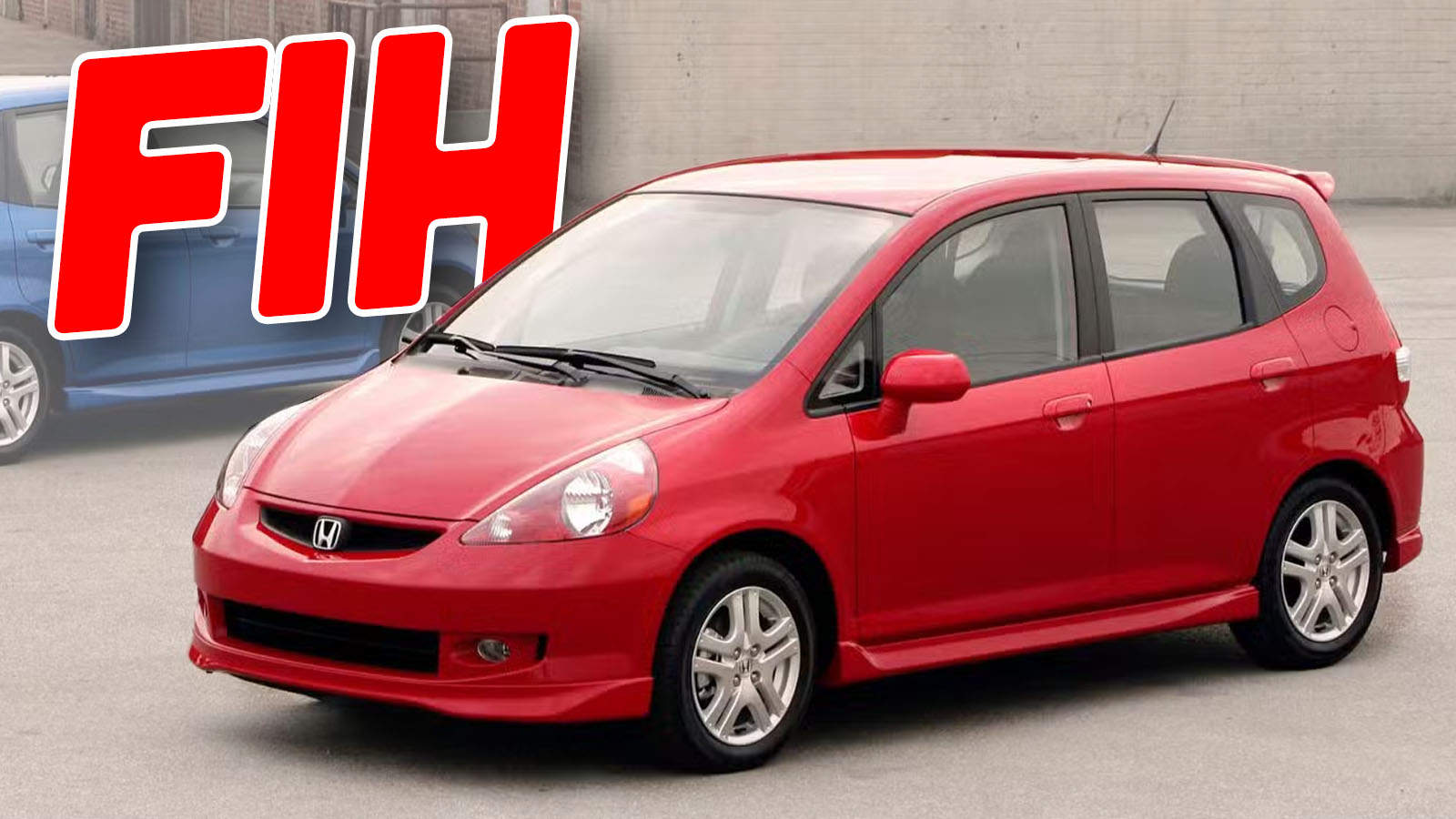
For as long as our species has had access to the internet, the online diaspora has clung to and idolized cars that, to an outsider, seemingly have no business being so well liked. Between today’s endless streams of depressing news stories and people trying to sell you things, a new champion has been crowned as the internet’s favorite oddly good, shockingly cheap car: the Honda Fit.
The Honda Fit (also called the Honda Jazz in European and some Asian markets), graced our planet’s roads for the first time in 2001, and finally touched American soil for the first time in the 2007 model year. Journalists were pretty universally shocked by how spirited and agile the Fit was considering its category, size, and affordability. Virtually any gripe about build quality, static shock from the cheap seat fabric, or otherwise was counteracted by raves over simply how much fun people had driving them.


Die-hard econobox enthusiasts loved them, sure, but Fits largely flew under the radar for years. Eventually the niche enthusiasm for the Fit became loud enough to take over entire quadrants of the internet. BringATrailer sold its first Honda Fit ever on its platform in 2026, and Google Search Trends for the Fit are up 40% from 2025. I personally can’t scroll through Instagram or TikTok without stumbling upon a Honda Fit fan account or appreciation post at least once – and trust me when I say these posts do absolutely insane numbers. Instagram fan account @hondafitsocialclub has amassed 14.2k followers, dubbing their audience “Fit Freaks.” Individual posts by general car meme/culture accounts can often amass hundreds of thousands of likes and millions of views. Looking closely, it might just seem like an underground community temporarily being pushed into the limelight. However, the Fit’s rise in popularity, in my opinion, is here to stay.
So why the heck is the internet suddenly so obsessed with the Honda Fit?

Shockingly enough, the Honda Fit is not the first economy hatchback to win over the hearts of car enthusiasts en masse. The Toyota Corolla, EG and EK Civic, and Mazda 3, to name a few, have all had significant amounts of fanfare around them in the past. However, only the Corolla rivals the Fit in terms of broad prevalence – it was responsible for sending a whole generation of anime and car enthusiasts into the Fujiwara Zone, after all.
This odd group of cars all have a handful of traits in common. They were all relatively popular and affordable when new, flooding the used market with cheap, half-decent examples. They are all generally considered to be easy to modify and mechanically simple, making them feel approachable to people who may be new to cars as a hobby. They all had shockingly good driving dynamics considering their class, and most importantly, they were commonly optioned with manual transmissions.
During times of economic uncertainty and high fuel costs, people cling to affordable and accessible ways to still engage with traditionally more expensive hobbies like motorsport, and the Honda Fit, along with its aforementioned classmates, slides into this niche perfectly. They’re cheap to buy, cheap to maintain, cheap to fuel, and cheap to modify into something that would make anyone at a track day say “Wait – my time got beat by that?”
View this post on Instagram
The Honda Fit was so successful as a platform that could be modified for track performance, in fact, that GridLife gave it its own event in 2017: SpecFit. Its popularity grew to the point where it was expanded into the Sundae Cup, which is open to any car with the same power-to-weight ratio as the first-generation Fit (2007-2008). The 25:1 power ratio target opens up the series to cars like the Mazda 2 and non-ST Ford Fiestas, but the Fit still remains the poster child.
In addition to a GridLife series, Fits are also frequent fliers in the SCCA-sanctioned racing class, B-Spec, which is a Subcompact class with strict modification limits. After a few years, the enthusiasm for the Fit started to leak out into the mainstream as clips from Sundae Cup events started circulating. In fact, an old roommate of mine purchased a Fit a couple of years ago with the intention of competing in Sundae Cup events after stumbling upon the community online. I thought he’d gone insane when he said he was buying a tall, boxy, 15-year-old econobox with the intention of turning it into a racecar, but after being forcibly made aware of their potential, I was a believer.
One of the most common mantras you hear in car communities is, “It’s more fun to drive a slow car fast than drive a fast car slow,” and the Honda Fit is the embodiment of that spirit. Sundae Cup races are not won by the car with the most horsepower, the fanciest parts, or the stickiest tires. They are won by the best driver. In a way, I feel like SundaeCup and series like it are some of the purest forms of motorsport, relying entirely on the skill of the pilot rather than the capabilities of the vessel. That being said, there is still a significant amount of irony to be found in a car marketed by its manufacturer almost entirely for its cargo capacity (something that is historically a disadvantage on the track) also becoming a performance-driving icon.
Know Your Meme
All of my previous points can contribute to a car being an icon for people in the know, but the Honda Fit has transcended to being “God’s Chariot” in the eyes of even the most casual car enthusiast by a force that no one would have predicted when it first arrived in new car lots almost 20 years ago: memes.

The Fit at its very core is an automotive oxymoron; a tall car that corners well, an economy car with fantastic driver inputs, a car designed for moving people and things but moves pavement even better. What started as people making jokes about how successful the Fit is at racing rapidly expanded into memes shared by kids not even old enough to drive. The appeal of Fit-based meme content online is so successful because of people who, like myself, very much remember when the Fit was first released in the US, and find the contradictory nature of our past perception with the current to be deeply amusing. This blend of irony rooted in both nostalgia and niche internet culture is the perfect recipe to propel the Honda Fit into the status of a cultural icon. The love of this friendly-looking hatchback has even expanded into entire fan accounts being dedicated to the model, with some of the larger accounts having over 15,000 followers in social media platforms like Instagram and TikTok. The subreddit /r/HondaFit has over 50,000 members and gets almost 2,000 contributions a week.
The Honda Fit was discontinued in the American Market in 2020 as a result of poor sales numbers. Thanks to the enthusiasm of a bunch of random people with an internet connection and a concerning amount of time on their hands, however, it shall live on in the hearts of a generation of car enthusiasts for many years (and memes) to come.
Top graphic image: Honda




Best car ever.
http://flic.kr/p/2dDU9V3
“but people don’t want small cars”
I would love to find a low milage fit but they are all crazy expensive.
Every. Single. Fit I see on the road today has the most faded and sun destroyed headlight lenses, and thus dimmest headlights on the planet. It’s amazing how they’re all like that.
That’s so true and such a shame, because restoring headlights is so easy and so satisfying. It updates the look of the car so readily.
You haven’t seen mine. 107k miles, 12 years old, clear as diamonds. Wish we could post photos.