

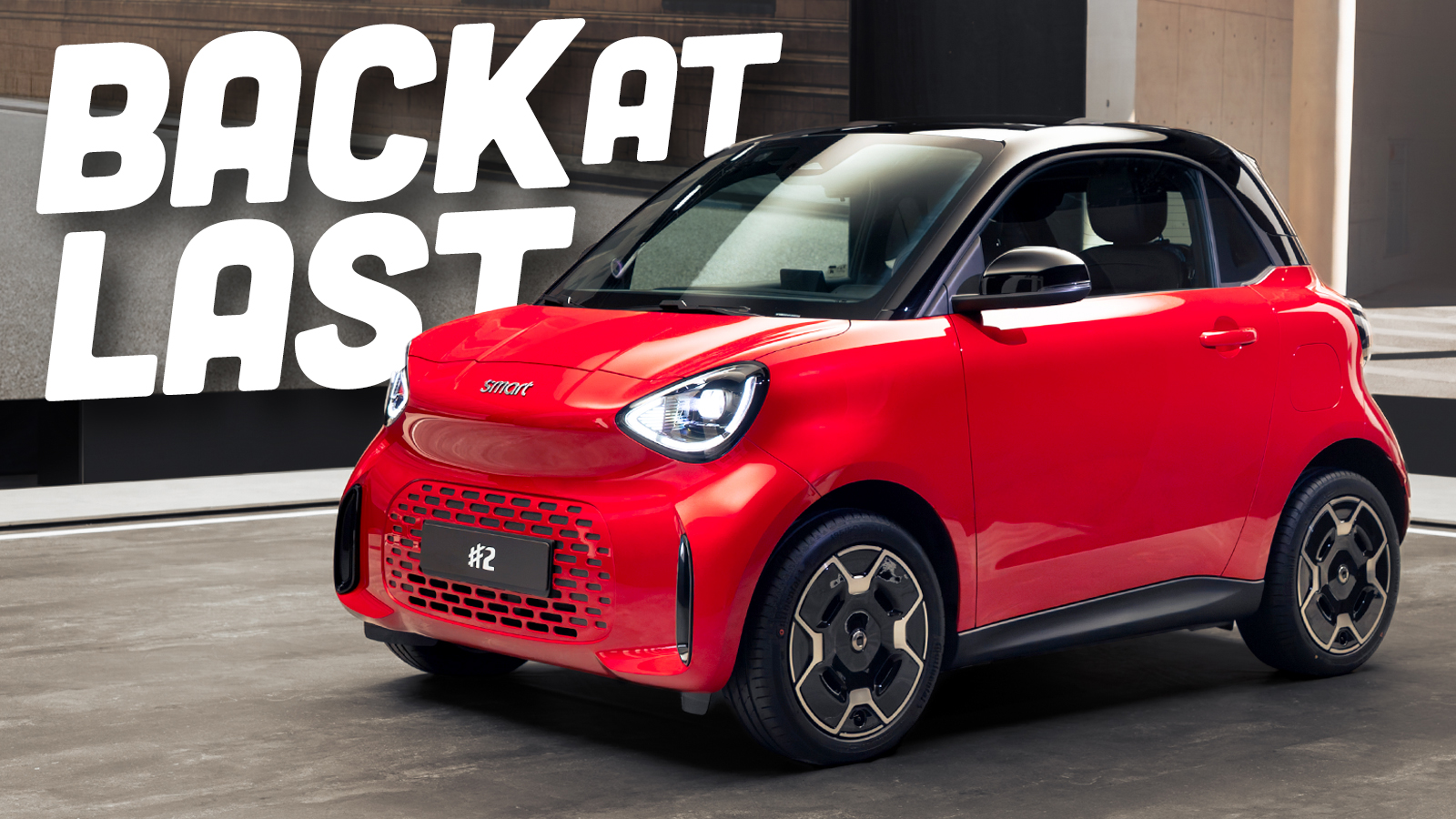
The car world is full of exhausting gimmicks, be it passenger screens, monster tablets that control every part of the car, faked engine sounds, or electric door handles. Yet, one car company just debuted a car that shows a surprising lack of bloat. The new Smart #2 doesn’t just take Smart back to its roots, but does so with a bench seat, a split-folding tailgate, and decently good range for such a tiny electric vehicle. I’m irrationally excited for this car, even though it’s unlikely I’ll be able to buy one. Let’s take a look.
This day has been a long time coming. Smart has been going through a period of reinvention for the past seven years. Back in 2019, Geely bought out half of Smart from Mercedes-Benz. Engineering and production moved to China, where the brand had an entire relaunch. The new Smart, which put out its first new vehicle in 2022, the #1 crossover, was essentially a completely different company. Smart traded its playful attitude and bright colors for a more grown-up and more “premium” approach to making cars. Even Smart’s entire naming scheme went out the window, trading names that told you how many seats the cars had to naming cars after social media hashtags.


Some of it has been sad to watch. The crossovers are undoubtedly neat, with versions making well over 600 horsepower and acceleration never seen before in any Smart. But Smart also seemed to lose itself. There’s nothing that really makes these crossovers stand out in the crowd. Remove their badges, and they could be crossovers from any brand. Smart’s character was essentially erased in the rebirth. In the past, you could never mistake a Smart for anything but a Smart. Then, Smart let the car that started it all, the Fortwo, wither away without significant updates until completely canceling it in 2024. Here’s what the third-generation Fortwo looked like:

Now, I generally call myself Smart’s biggest fan, so maybe my standards are higher than most. But it seems the public also isn’t buying into the new Smart, either. According to Automotive News, Smart sold only 13,100 cars across three models in Europe in 2025, a sharp decline of 47 percent. To be fair, a lot of that can be attributed to European tariffs on Chinese-built cars, but it’s not like Smart was selling many cars when it wasn’t getting slammed by tariffs. In fact, Smart’s sales were exponentially better, sometimes hitting more than 100,000 copies a year, when it had only the Fortwo and Forfour to sell.
The reception of Smart in China has also been waning. As CarNewsChina reports, sales are so slow out there that some dealers are dumping their glut of unsold inventory. So, Smart needs to do something to get people in love with it again.

Luckily, Smart’s market research shows that people are into buying city cars again. This is backed up by real sales data. According to Automotive News, the Leapmotor T03 is Europe’s best-selling city car with 37,224 units sold this year as of August. Yep, in just eight months, one tiny city car has outsold all three of Smart’s crossovers pretty almost by a factor of three.
Smart’s entire brand was born on selling city cars to Europeans, so it made the hopefully wise decision to go back to its roots to create an all-new generation of Smart city car. That car, the #2, is finally here. So far as I can tell, it’s at least twice as good as the old Smart Fortwo that came before it.

Smart’s Going Back To The Start
Smart says the new #2 embraces 30 years of Smart. The original Fortwo launched as the City Coupe in 1998, but that came after Smart unveiled itself to the world at the 1996 Mondial de l’Automobile de Paris in the Louvre. Back then, Smart had only a tiny budget, and Professor Johann Tomforde — the designer and engineer behind Mercedes-Benz’s city car research since the 1970s — and his team managed to cobble together a concept car that looked like an unfinished sculpture.
That little car was a sensation, and it kicked off three generations of tiny city cars that remain beloved all around the world. In making the #2, Smart didn’t want to mess with tradition, and looked to the past for the future. The biggest detail about the #2, I think, is how small it is. The final spec calls for a length of only 108.1 inches. This is big, or small, rather. Why? This figure makes the #2 only two inches longer than the old third-generation Fortwo, which was the same length as the second-generation Fortwo.

This means that the Fortwo has grown only two inches longer in 19 years. How many other cars can say they’ve only barely grown over two decades? Width is also still very narrow at 65.7 inches. This is only 0.2 inches wider than the outgoing Fortwo. This falls in line with what I reported back in December 2025 when I said that the new car would be about the same size as the outgoing car.
While a little surprising from the perspective of modern car model bloat, it’s logical when you think about it. Pretty much the whole point of the Fortwo is to make city driving and parking a cinch. You make that worse by making the car bigger.

Smart also didn’t stray too far from the third-generation Fortwo’s design. That means it has a little “hood” and then the egg-like passenger cell. Smart has been rocking this basic design since 2014, and Smart has said that it comes with several benefits. Having the hood is better for pedestrian safety compared to Smart’s older one-box designs. Likewise, the sort of one-and-a-half-box aesthetic is supposed to make the car look bigger and more serious than it really is.
Back in August, the Chinese Ministry of Industry and Information Technology (MIIT) revealed the look of the new #2 in type approval documents. I stated I was a little disappointed in the design then. One of the biggest draws of the old Fortwo’s design was the pairing of a bold color with the vehicle’s visible Tridion Safety Cell in a contrasting color. It led to great color combinations like yellow and black, red and silver, white and orange, and others.

Here, Smart has minimized the contrast, keeping it largely to the roof, mirror caps, and optional side skirts colors. I admit, the new design has grown on me. I called this design a scaled-down generic crossover, but now I think I was being too mean. Seeing the car outside of the harsh lighting of MIIT’s offices has changed my mind. Even without the fully visible Tridion Cell, this car is unmistakably Smart.
There are other good details, too. I predicted that this car would have a split-folding tailgate like every Fortwo that came before it, and I was right. Smart didn’t mess with tradition there. This new tailgate is even slightly cooler than the others with its integrated cupholders. It’s silly to say, but previous Smarts didn’t even have that. The open tailgate even supports more weight than previous generations at 265 pounds.

Another first for a Smart two-seater is the addition of turn indicators in the vehicle’s mirrors. Yes, that’s another small detail that most people don’t care about, but Smart Fortwo owners have been asking for this feature for decades. Shoot, back when I was a teenager, I even drew up what a Fortwo could look like with turn signals on its mirrors.
I also have to go back to the Tridion Cell, because there’s good news there. Smart has upgraded its characteristic safety shell for 2026, and the system is now called the Tridion Cell Evo, from Smart:

Safety is a core attribute of the smart #2, irrespective of its compact dimensions. Refinements to chassis rigidity and structural stress points ensure driver safety and confidence in the city and on the highway. The next generation of the renowned Tridion safety cell complements this structural resilience, combining compact exterior dimensions with a robust structure that meets modern safety requirements.
With the Tridion Cell Evo, the smart R&D and engineering team further developed one of the most recognisable elements of smart’s safety philosophy for a new electric era. More than 78% of the body structure is constructed from high-strength steel, complemented by a three-layer steel configuration and materials with tensile strength of up to 1,800 MPa (Megapascal). With torsional stiffness of 39,000 Nm/deg (Newton Meter per degree), the structure has been engineered for exceptional rigidity and can withstand a roof load of more than four tonnes.
Occupant protection is further supported by seven airbags and an advanced seatbelt system combining Pyrotechnic Lap Pretension (PLP) and Crash Locking Tongue (CLT) technology. These systems help to enhance restraint of the pelvis and lower limbs and reduce forward occupant movement in the event of a collision. The battery system is protected by a layered structural design, further supporting the smart #2’s safety concept. Additionally, the smart #2 has also undergone extensive vehicle-dynamics and stability validation.

Smart’s roofs have always been tough. The old Fortwo also had a roof that could take a load of more than four tons, and Smart proudly advertised it by parking a Ford Excursion on the roof of the old safety cell. So it’s great to hear that, in going to a native BEV platform, Smart hasn’t lost its safety touch.
Speaking of that platform, it’s pretty revolutionary for a Smart Fortwo. In the past, electric Fortwos had to deal with the drawbacks of having to share a platform with ICE cars. This time, Smart’s all-new Electric Compact Architecture was designed to be battery electric from the start. The #2 has a 35.8-kWh lithium iron phosphate battery, which offers up a WLTP range of up to 180 miles with energy efficiency of 3.0 mi/kWh. The car can DC fast charge at 65 kW, and go from 10 percent charge to 80 percent in 20 minutes. Charging to 80 percent takes three hours under AC 11 kW power, and the base model Pure maxes out at 7.4 kW, taking five hours to charge. The battery system also has V2L capability.

This power system fuels a single rear motor good for 80 horsepower and 96 pound-feet of torque. That scoots the car to 62 mph in 11.6 seconds and to a top speed of 87 mph. That makes the new #2 roughly comparable in straight-line performance to a gas-powered Smart from the early 2010s, or to the electric Fortwo that was discontinued in 2024.
The ECA platform also permits a turning circle of just 22.8 feet, which is the same circle that the old Fortwo could do. It also adds a five-link rear suspension, a dramatic change from the De Dion tubes that Smart Fortwos have had since 1998. The new car weighs 2,513 pounds, which is under 100 pounds heavier than a 2024 Smart Fortwo.

Most of these specs are massive upgrades over the old electric Fortwos. Those cars had less than half the range and half the battery. Even after you factor in the fact that WLTP is optimistic, the #2 should easily have twice the range that the old electric Smarts did.
The interior is another highlight. The #2 features an S-curved dash, which is a nod back to Smart’s original city cars from 1998. There are just two displays in there, and they aren’t even that big. There’s a 10.1-inch infotainment screen and an 8.8-inch instrument cluster. Sadly, while Smart does give you a handful of buttons for basic functions, even the #2 is shameless in putting HVAC and other controls behind the screens. At the very least, there are lots of buttons on the steering wheel and real door handles.

Something that is new is the Fortwo is the bench seat. Amazingly, this is a feature that actually carried over from the #2’s wacky concept car. Now, this not a true bench seat in the old car sense.
The two seats are still independent, but there’s no real barrier between them. Smart says that it did this to break down the traditional barriers between driver and passenger while making the interior feel more open. Honestly, I just see the bench as a great way to put an arm around my wife while we enjoy a flick at the outdoor theater.

If you aren’t snuggling your passenger, you can use the bench seat’s center console as a cupholder and storage. As with any modern electric car, the #2 is techy, featuring adaptive cruise control with stop-and-go function, blind spot detection, a highway driving assist, traffic-sign recognition, parking assistance, rear collision mitigation, cross traffic alert, and a rear camera.

Comfort features are pretty nice. Optional is synthetic leather heated seats, a glass roof, and a seven-speaker Sennheiser sound system. The glass roof is an important note. The second-generation and third-generation Smart Fortwos had polycarbonate roofs, and they had a nasty knack for delaminating and crazing over time.
Smart doesn’t say it, but you can clearly see in videos and some pictures that the hood and the doors are made of metal, not plastic like previous generations. This is a disappointing change from a repair and corrosion standpoint. One of the best parts about the old Fortwos was that the body never rusted, and damage could be rectified easily with a panel swap. However, the paint on those old plastic panels often aged horribly, leading to really shabby-looking Smarts rolling down the road.

The new #2 will be sold as the Smart #2 Pure, Smart #2 Pure+, and Smart #2 Premium in Europe. The Pure will have all of the tech features, but slower charging and a basic interior. The Pure+ adds 11 kW charging and a heated driver seat. Going for the Premium model nets you the faux leather, Sennheiser sound, more colors, the glass roof, and more. Additionally, just 999 examples will be sold as the Couture Edition, which is a Premium, but painted in gold with a special numbered plaque.
I Want It So Much
Pricing starts at just under €19,990 (roughly $22,309) in Austria, Belgium, France, Germany, Portugal, and other select regions in Europe. The flagship Couture Edition is about €25,500 ($28,600) before options. The #2 will be built in China, and deliveries will begin in Europe in the first half of 2027. Unfortunately, due to America’s policies against Chinese vehicles, I would not expect to see any of Smart’s cars in America anytime soon. Smart left our shores in 2019 and never looked back. Yes, that makes me really sad. Maybe things might change in 2029 if the government changes over, but that’s anyone’s guess.

Honestly? I think Smart nailed it here. The #2 is not perfect. I would have loved to see a visible Tridion Cell again and a lot more fun with color. But those are minor nitpicks, I think. The car doesn’t seem to be overcooked, and Smart doesn’t seem to be trying to shove gimmicks down our throats. It’s just a city car, and one that’s twice as good as the one it replaced.
Will that translate to sales? It’s hard to say right now. Smart will have to convince buyers not to buy a Renault Twingo E-Tech, which has the same price, a somewhat similar range, and four seats, to get the smaller car. Having the same sticker price as some larger cars was one of the problems that made the old Fortwo a tough sell for some.
But I do think that, in going back to its roots, Smart should get some more people back into its showrooms. Maybe I’m biased as a fan of Smart, but I’d love to see this company still kicking decades from now, so I’m rooting for it. So, is the world ready to fall back in love with Smart again? I guess we’re going to find out. Now to figure out how I can drive one of these things.
Top graphic image: Smart


I’ve said it before and I’ll say it again, I think a sensible US government like we don’t have would set zero tariffs, from China or anywhere else, on these sort of small cars that “Americans Don’t Want(tm)”. Also make ones that meet Euro or Japanese safety standards (emissions too if applicable) fully street legal. Some of us DO want small cars and this would drop the number needed to make a business case for bringing them in.
I agree, it’s not likely we’ll find any smarts in America any time soon.
Q: They named a car Number 2? What kind of dumb company would do something like that?
A: Smart.
Seriously tho, gotta agree with the assessment. It follows the design that made the last car great and I hope it has the appeal to succeed. Would love to see them mixing it up on the road.
Smart needs to get Robert Wagner as their celebrity spokesperson.
As long as they don’t film any commercials around boats
We already get the Fiat 500e and that’s a total flop, so of course the Smart isn’t coming to the US.
Are they really calling this the Number 2??? What a shitty name.
(Seriously, though, does no one think about this? How hard can it be to screen potential names for scatological or other potentially amusing meanings??)
The naming is the worst part, and it blows my mind that a brand that’s based on two different continents somehow didn’t realize how bad the whole “hashtag” stuff is.
It seems indefensible given we live in an age where AI can scan nearly all human knowledge and return an answer in plain language within minutes.
In 2026 it should be easy to understand a name’s literal and slang connotations in every major language. I can understand if a company uses a name that has an amusing meaning in a non-local language, but given how widely spoken English is and how common the scatological meaning of “number 2” is, I can’t understand why they thought “#2” was a reasonable choice.
It is unfortunate because it is hard to take this car seriously at all, even if it is probably a great product for the right use case.
Especially since actually pronouncing hashtag two in the real world in 2026 sounds so “Hey, Fellow Kids!”
Phrasing!
This will always be a ‘Number 2’ to me.
Hopefully it comes in various shades of brown.
A red number 2 is never a good thing for sure
Green and Yellow raise some questions as well.
Or a sticky tar like appearance, could indicate interior corrosion.
“Who does Number 2 work for?”
That’s right, buddy. You show that turd who’s boss.