

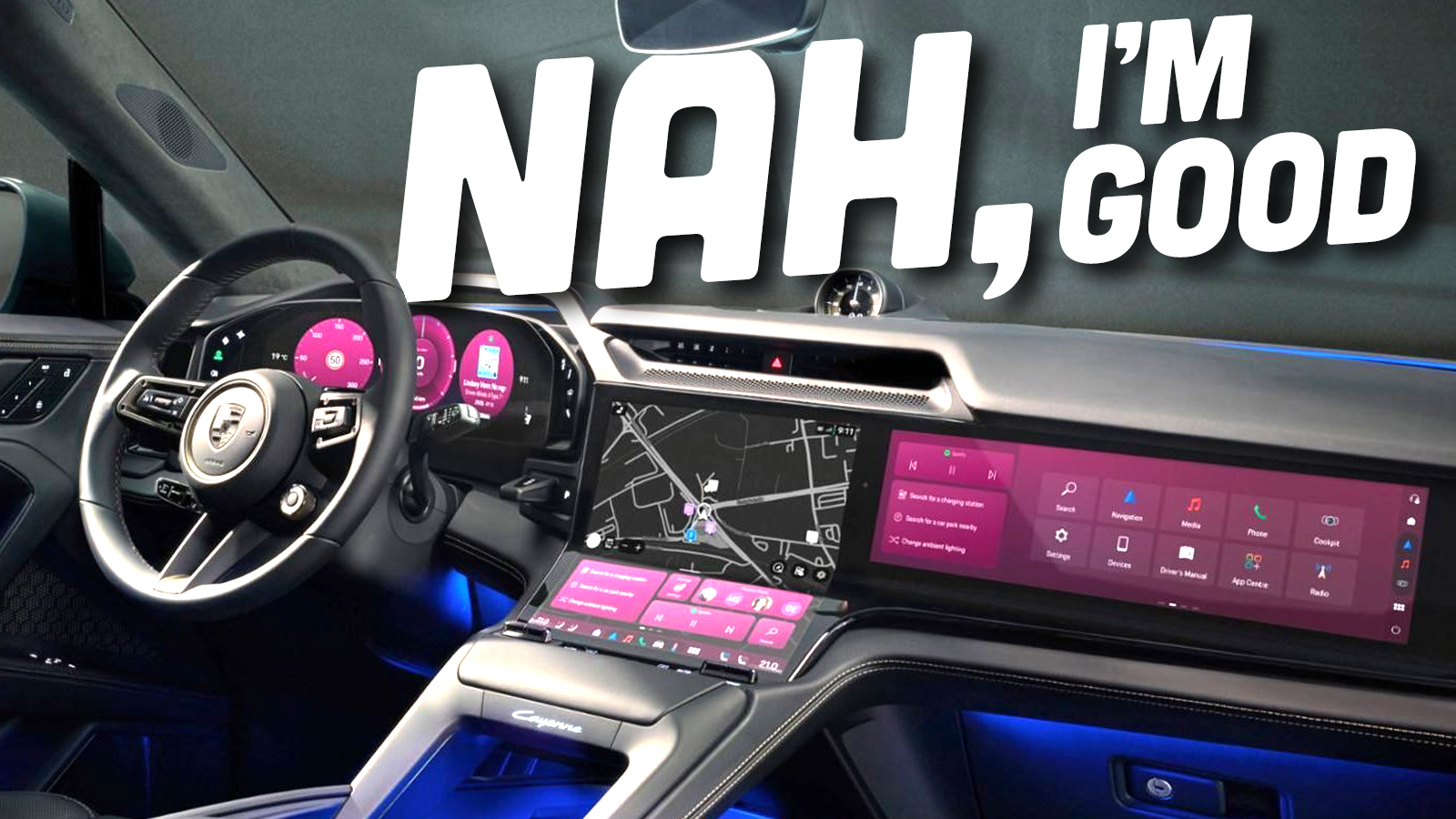
Today’s cars come loaded down with more gimmicks than a circus. Some of them, like ambient lighting and headrest speakers, range from harmless fun to pretty awesome. Others, like having an entire giant screen just for the passenger, seem to be added technology for no apparent reason. A new study from JD Power seems to suggest what you’ve already known all along. Seemingly few drivers care about having a screen for a front passenger, and even if your car has a passenger screen, your passenger probably isn’t using it.
There was once a time when having any screen at all in your car was weird and novel. The Buick Reatta and its phosphor monochrome cathode-ray tube seemed ripped from the pages of science fiction. Then there was a whole rash of cars in the 1980s and 1990s that had futuristic digital instrument clusters or proto-infotainment systems. Even everyday Chrysler products like its minivans had the option for a radical green instrument cluster that continues to capture the awe of drivers today.


Screens aren’t new anymore. Since at least 2018, when the federal government’s mandate on backup cameras went live, even the cheapest, most base model cars have at least one screen. Nowadays, it’s common to see regular cars with a screen for both infotainment and instruments, even if the instrument cluster screen doesn’t actually add much to the experience.
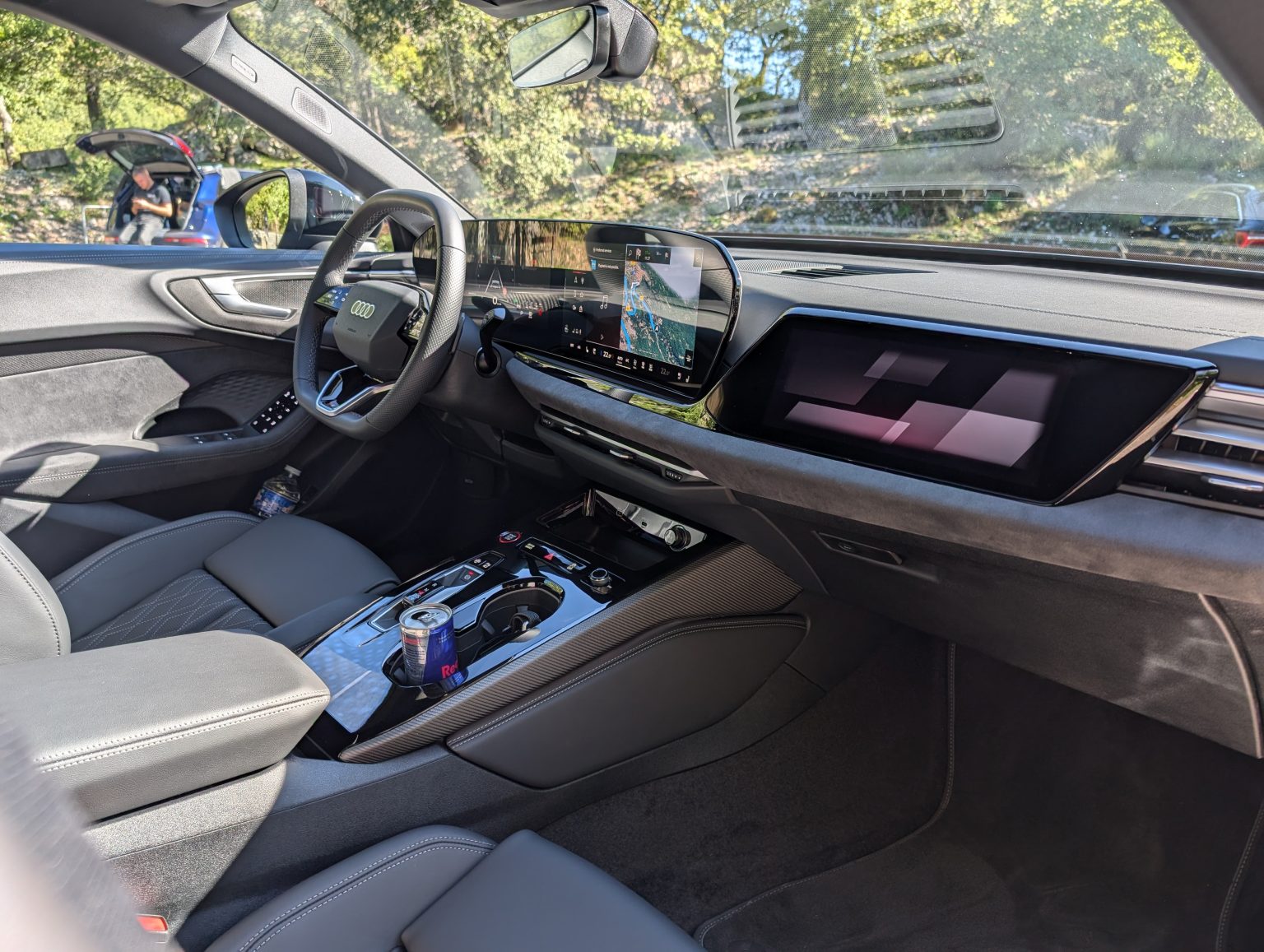
Automakers have become rather obsessed with screens. On one end, you have the likes of Tesla, which chooses to route most of its cars’ functions through a single, monolithic touchscreen. On the other end, you have legacy luxury marques whose visions of opulence mean screens that take up nearly 100 percent of dashboard real estate. An increasing number of automakers even give screens to front-seat passengers, which seems rather redundant as it’s almost certain that the person sitting in that seat is going to have a personal computer in their pocket or purse already.
The screens are just one techy feature that’s out there today. You can buy cars filled to the brim with tech like SAE Level 2 driver assistance, cars with biometrics, cars with electric door handles, cars with a million automated safety features, cars that claim to be able to drive themselves, and even cars with AI-driven climate control. Of course, the big question is whether people actually use this stuff.
According to the JD Power 2026 U.S. Tech Experience Index (TXI) Study, which was recently released, there’s one standout piece of tech that car buyers and their passengers don’t actually care about, and it’s one that isn’t surprising at all.
Car Owners Like When Tech Works In The Background

According to JD Power, it surveyed the owners of 2026 model-year vehicles about their experience after 90 days of ownership. This survey period ran from June 2025 through May 2026, based on vehicles registered from March 2025 through February 2026, capturing responses from 68,084 vehicle owners. JD Power says this about the study:
The U.S. Tech Experience Index (TXI) complements the annual JD Power U.S. Initial Quality Study (IQS) and the JD Power U.S. Automotive Performance, Execution and Layout (APEAL) Study by measuring how effectively each automotive brand brings new technologies to market. TXI combines the level of adoption of new technologies in each brand with excellence in execution. The execution measurement examines how much owners like the new technologies and how many problems they experience while using them. The TXI dataset allows automakers to immediately identify the specific technologies their customers consider to be must-have, nice to have or not necessary at all.
While this methodology potentially has some imperfections, it is a window into how people feel about their vehicle purchases. Three months is long enough for many people to figure out what features they like and what features they don’t care about.
One of the study’s key points was pretty obvious in that car buyers like when their car’s tech works in the background rather than being in their face. An example of this, per JD Power, is a smart ignition system. Buyers generally enjoy how frictionless today’s car ignition technology is – just don’t leave the fob on your hood – and also like cars that allow them to use their phone as a key. Buyers further like automatic climate control systems and cars that can easily remember and recall driver personalization settings like seat position, mirror position, and infotainment settings.
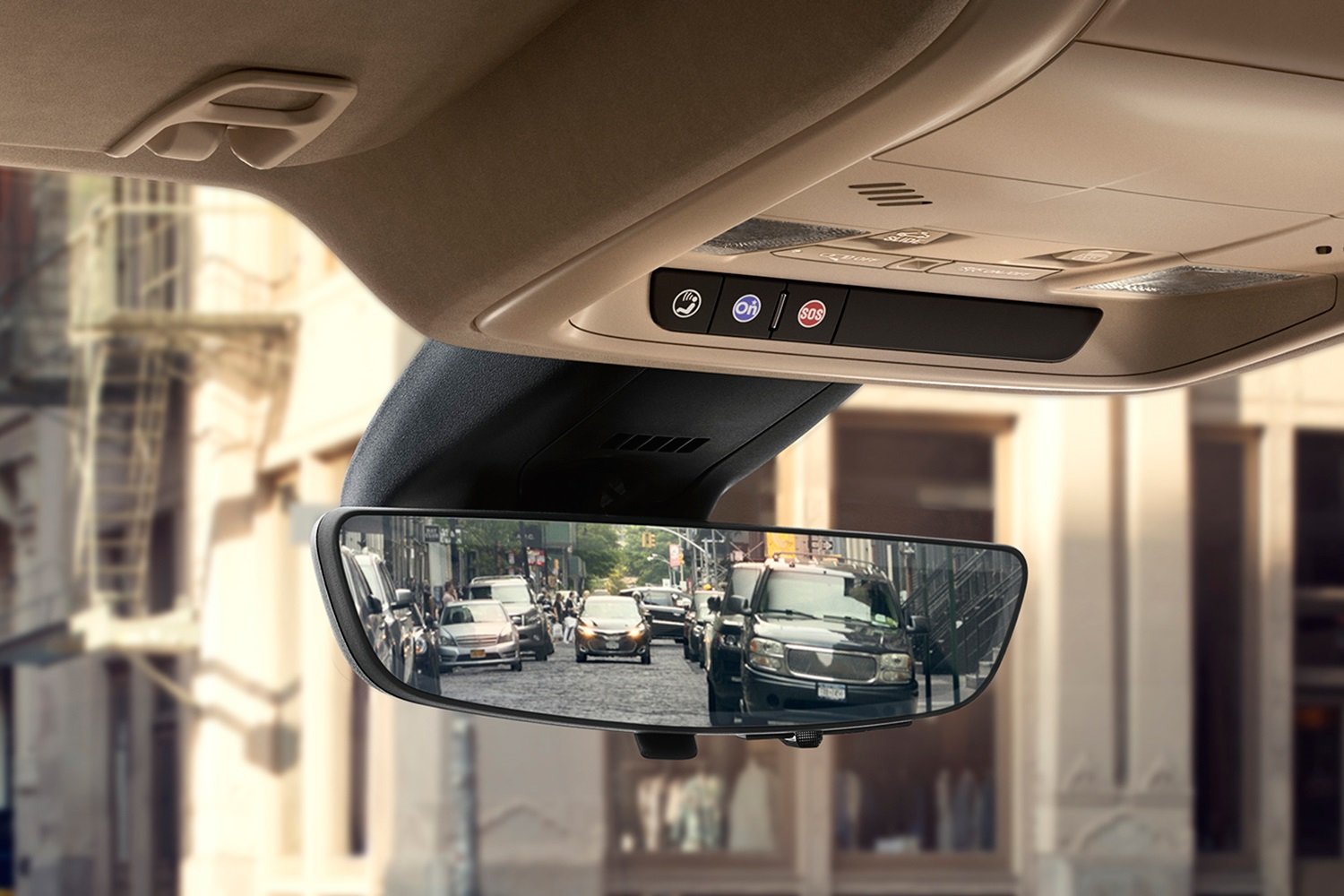
Cars receiving high marks in the study include the Cadillac Escalade and Toyota Tundra for their camera rearview mirrors, the BMW X6 and Hyundai Palisade for smartphone-based keys, the BMW iX for one-pedal driving, and the Hyundai Ioniq 9 for its EV charging scheduler. Cadillac and Genesis earned top marks in tech innovation with 641 points and 559 points, respectively, based on a 1,000-point scale. Hyundai led the pack of mass-market brands with 524 points.
Technically, responses would have ranked Tesla with 924 points and Rivian with 781 points, but JD Power says that those two brands, along with a few others, did not meet study criteria.
Drivers Aren’t Yet Fully Into Hands-Free Driving

One surprise came from how drivers are currently accepting SAE Level 2 driver assistance systems. According to JD Power, more driving automation doesn’t automatically translate to a more pleasurable experience. From JD Power, which quotes Doron Hikry, director of customer success at JD Power:
In the United States, SAE Level 2 (L2) driver assistance systems, which require drivers to keep their hands on the wheel and eyes on the road, outperform more technologically advanced SAE Level 2+ (L2+) hands-free systems on execution and overall experience scores, despite L2+ systems offering more functionality. While L2+ systems have a slightly lower problem count than L2 systems (13.8 vs. 14.3 PP100, respectively), they do not deliver a better overall experience, suggesting that simply adding hands-free capability does not necessarily translate into greater customer satisfaction. “The results indicate that owners may currently be more comfortable with systems that clearly assist the driver rather than those that introduce a greater degree of automation,” said Hikry.
I get this one to a degree. To date, GM’s Super Cruise is my favorite driver assist system. I’m still wowed by how a truck with Super Cruise can effectively and safely tow a huge travel trailer. However, it still requires a pretty decent degree of babysitting, and it’s frustrating when it does make errors. It seems that, at least for the drivers that JD Power surveyed, they’d rather have a system that helps them drive than a system that drives for them, but still needs as much supervision as a car that’s under full manual control.
Passenger Screens Are Being Ignored

Now, we get to the meat and potatoes, and it’s that, like you, other car owners don’t really care about passenger screens:
Passenger screens offer little appeal to owners: Passenger screens are more common and actively used in premium vehicles, yet they rank among the most problematic technologies in the index (21.3 PP100). More than one-third (35%) of owners industrywide who have a passenger screen say they have never tried to use it, while just 6% say they use it every time they drive. Some vehicles equipped with passenger screens also had higher rates of infotainment system problems in the JD Power 2026 U.S. Initial Quality Study (IQS).
This isn’t surprising at all to me. Back in early 2025, I tested Ram’s updated heavy-duty pickup truck line. At a casual dinner during that press trip, Doug Killian, Chief Vehicle Synthesis Engineer, admitted that Ram found out that its customers don’t actually use the front passenger screen that comes in higher trim models. Ram thought that, like rear seat passengers, the front seat passenger would appreciate having a screen with all sorts of media on it. In reality, most of the front passengers just use the phone they already have and would rather have more dashboard storage than yet another screen. The difference? Rear seat passengers are often children who don’t walk around with a smartphone. As Killian put it, Ram might have accidentally done “technology for the sake of technology.”

As a few other journalists at that event further noted, there are a lot of people who get carsick when trying to focus on a screen while they’re a passenger in a moving car. I’m one of those people. I have to be very careful looking at any screen while I’m a passenger in a car because there’s a good risk I’ll get violently ill.
Then there’s the fact that, as I have personally witnessed when testing new cars, these screens don’t do anything that your phone doesn’t. Sure, the dash screen might be larger, doesn’t need to be hooked up to a charger, and doesn’t need to be held, but your phone already has all of your favorite apps, movies, and music right there. Chances are, like me, you’ll be holding your phone in your hand as you use the dashboard screen.
So, between the people who get sick and the people who will just whip out the smartphone that’s already on them, there might not be a large population of people who actually care about having extra screens.
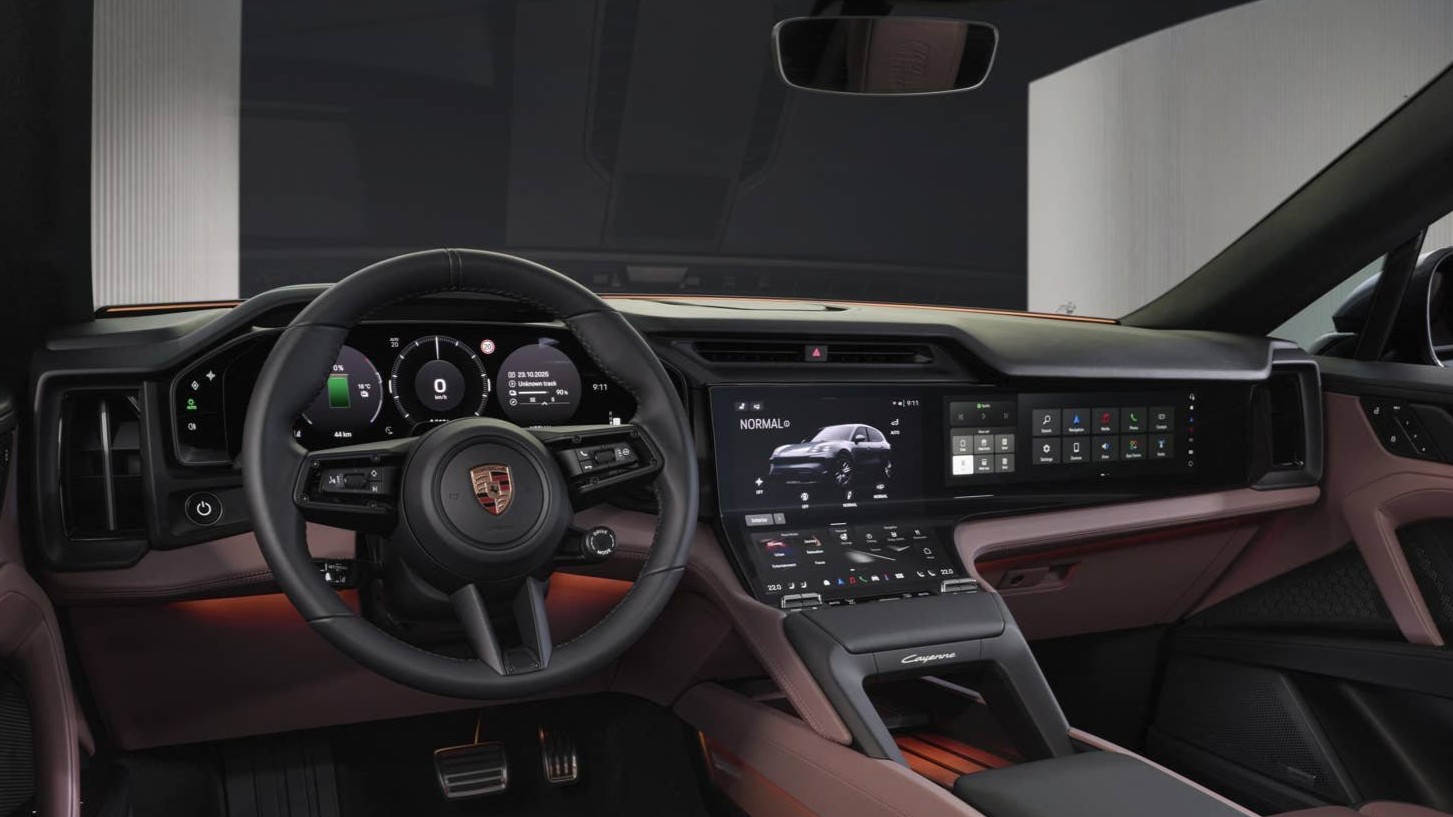
It doesn’t help that, as JD Power points out, passenger screens have given their owners problems. The screens apparently proved problematic in JD Power’s 2026 Initial Quality Study, which tracks owner-reported problems in the first 90 days. In that study, passenger screens were responsible for 21.3 problems per 100 vehicles. That doesn’t give a whole lot of confidence in how well these screens are going to work after warranties have expired.
JD Power’s study isn’t exactly a huge revelation, either. The reliance on screens has been controversial in the automotive world. Last year, researchers at the University of Washington and Toyota Research Institute put 16 people into a driving simulator, making them use a built-in touchscreen while on the move. Unsurprisingly, the results showed that, when forced to use a screen and drive at the same time, drivers became sloppier at the wheel while also being worse at hitting the screen. Earlier this year, Forbes reported on how even designers think that automakers went too far with screens. Of course, there’s far less at stake with a passenger using a screen than a driver, but it’s still a part of this trend of slathering dashboards in screens.
Hikry says that, given the JD Power study, automakers have an opportunity “to prioritize technology that makes driving simpler, not more complicated. The features that solve real problems without adding effort or stress for the driver are the ones resonating most with customers.” Does this mean that this is the end of the road for the passenger screen? Who knows. But if you’re the person who has been yelling at clouds about how many screens that new cars have, it seems you aren’t alone.
But maybe this is the beginning of something different. We’ve already seen some automakers commit to bringing buttons back. If automakers know that buyers aren’t interested in passenger screens and other gimmicks, maybe we’re headed to a future with fewer screens and perhaps fewer distractions. I can get behind that.
Top graphic image: Porsche



well sure, they want you to interface with their software, that way they are making your passenger a commodity. the driver is already a commodity in new cars.
you take something like GM, they aren’t walking back their integration of AndroidAuto and Car Play because they can’t get it to connect right without distracting the driver, they can’t scrape data, and they want that.
Yeah why lean awkwardly forward to poke at a huge screen when you already have a better one that you’re more accustomed too in your hand?
In the days before screens in cars there were buttons, knobs and levers. Once one became accustomed to where these were one could work all the controls without taking eyes off the road. With a screen one has to look away from the road, guide a finger to a particular spot on the screen and hope a bump doesn’t move the finger or the screen causing something weird to happen instead of what was intended causing a whole lot of problems that require even more time of eyes off the road causing an unintended wreck and resulting injury!! I firmly believe that screens should be banned from use by the driver when the vehicle is in motion
I too cannot look at screens, read, or whatever when a passenger in the car. Instant nausea for me. So you can imagine that all of this additional screen real estate is just a nightmare for me.
When my FF had a little LED display on the passenger side to show engine stats, that was cool. But now full size passenger displays truly serve only 1 purpose and 1 purpose only (and it’s how we use it in our Escalade V) turning the chromecast and putting on sesame street for the kiddo in the back. My wife does it and then turns the thing off again, but for that purpose it is ELITE. Before that you had to bend over and look back and it was a mild nuisance.
Passenger screens offer little appeal to owners:
I always figured the ultimate plan for those front and back passenger screens was to continuously blast ads at a captive audience ala gas station TV unless someone paid a subscription to shut the damn things off.
I’m sure that’s coming soon from our friends at BMW.
I’d rather it come from BMW than Lexus. With BMW there is a good chance it will break before too long :P.
Cheddar TV for cars
Only if by “Cheddar TV” you really mean nonstop ads for Chuck E Cheese, Velveeta, Kraft,…
I’m glad you mentioned motion sickness…this is always a concern when I travel with Mom and we’re on a plane with seatback screens. It’s usually no big deal to either turn those off, or put them in a mode that doesn’t induce nausea. I haven’t ended up with a rental car that has a passenger screen yet.
With all these screens, for the love of god, could they just tell us why the check engine light is on?
But that would put the power to repair things in the hands of owners, and we can’t have that!
Unfortunately automakers will read this and conclude that we want more voice commands, rather than put the fucking buttons back on the car.
You actually nailed the #1 voice command – put buttons back in the car.
My #1 voice command that has yet to be implemented is “Shut up!” when something is talking over my podcast and I want it to stop.
Yeah, there’s MY #1-least-used-feature in my newish car – the OEM voice controls.
I can handle working with Google (even if the new Gemini system is wholly awful compared to the older Google Assistant), but “Okay, Ford” just isn’t going to happen.
…although, now that I glance at the command set, I’m intrigued by “AM <freq>” and “FM <freq>”. Might be easier than dumping out of Android Auto to fiddle with figuring out the radio tuner.
“Climate – Set temperature <degrees>” though? Heck no.
Just using them in general is far less comfortable than a phone due to the reach. I can’t imagine playing a game on one; you’d have to move the seat til your knees are in the dash.
Also, Apple has Motion Vehicle Cues that is apparently helpful for a lot of people. It has dots on the screen that move based on the phone’s gyroscope and I’ve heard that they are a godsend for many folks. Android is getting it soon as well.
This was a problem at my last job. The marine industry wants to follow automotive, and it felt like the entire upper management was all about screens. Man, when I’m on a boat the last thing I want to look at it is another fucking screen.
I love my GPS screen in my boat.
If you’re going offshore, sure. But for lakes? Nah.
This is a big part of why the Slate appeals to me. No screen, minimum tech, simple machine. Fewer things to break means a longer lasting cheap to maintain vehicle. I just hope they are still in business when I’m in the market again.
I’m guessing the manufacturers “screens galore” kick is largely due to the “software defined vehicle” concept that they’re taking to its (il)logical extreme.
I want that crap in my transportation device about as much as I want it in my riding lawnmower. Which is to say, I don’t.
Can we start calling them ‘software defiled vehicles’?
That fits, especially given what I just read about GM’s troubles with their OTA update on their large truck & SUVs resulting in a stop sale and/or a trip to the dealer for a manual software update.
I can now rephrase: Get Off my Lawn. To get off my screen. Oh joy
I don’t even want a passenger in the vehicle with me, let alone a dedicated screen for said unwanted guest. I’ll keep my screenless, non-connected 5-speed 2005 Stratus R/T coupe until the wheels fall off or it is wrecked beyond repair.
I have never driven a vehicle with more than a 2-DIN navigation screen and regular meters, so I wonder how the ambient light from giant driver and passenger screens, plus camera rear-view mirrors, affects night vision on unlit roads?
It’s not great. When you’re in places with street lights it’s mildly annoying. On dark rural roads I end up turning all the screens off.
“…I end up turning all the screens off.”
Proof that they are a daft idea.
It always bugged me in movies, with the protagonists in a car at night, their faces unrealistically lit up for dramatic effect. Now you really see that with all the screens and phones and rear-view cameras, hence the question.
Saab had it right with its “night panel” or whatever they called it where all the dash lights except the speedo could be turned off completely
SAAB’s night panel is great, I never understood why more cars didn’t adopt something like it.
Mine automatically goes into night mode when the headlights are on so it’s not really been an issue. On the other hand, the screen can be tough to see in direct sunlight and there’s occasionally a glare in that case also.
Even modern instrument clusters are bad, since they’re all whites and blues and every other hue that is BAD FOR NIGHT DRIVING. It’s like they forgot why clusters used to be orange, and it wasn’t because orange lights were somehow cheaper.
It’s because whites and blues are all ‘futuristic’, and automotive stylists have been completely separated from the why behind the how anything is done for decades. All that matters is selling cars on lots, and futuristic sells cars according to the studies the execs read.
Well, here’s to the Buick Reatta: undersung legend of a bygone era and uncredited third lead in 1994’s ‘China Moon’
I’m not a fan of passenger screens, they seem useless to me and are almost always ugly. The integration, particularly on those new Audis, is horrific.
I do wonder about the study’s methodology, though. You’re asking owners, presumably drivers, how often they use the passenger screen.
I’m guessing these people don’t drive with a passenger most of the time (most drivers don’t). A more interesting question is how often the screen gets used by a passenger, when you have one in the car. I don’t think this is being accurately captured at all.
At first I thought you were mistaken. But then I reread the citation. And yeah, I’m not sure the question asked actually asks a meaningful question. I came here to disagree. Then was converted to your point.
It’s a shame that one of the applications of user data is supposed to be finding the features people “appreciate” most and guiding users who haven’t tried them so they’ll use those features. McKinsey and Co. suggested this. Now you can be spoonfed yellow paint by your Navi system when you don’t use your AI assistant button enough. For the positive brand experience.
Mirrors implemented as screens are the worst idea. It’s terrible for anyone who uses reading glasses.
Two things auto manufacturers should keep in mind when considering tech in a car.
1. The only reason to have a big screen in a car is if you’re watching porn or sports like tv.
2. As far as driver assistance what is most needed is helping people who never drove a tow vehicle backing up with a trailer, RV, or a boat.