

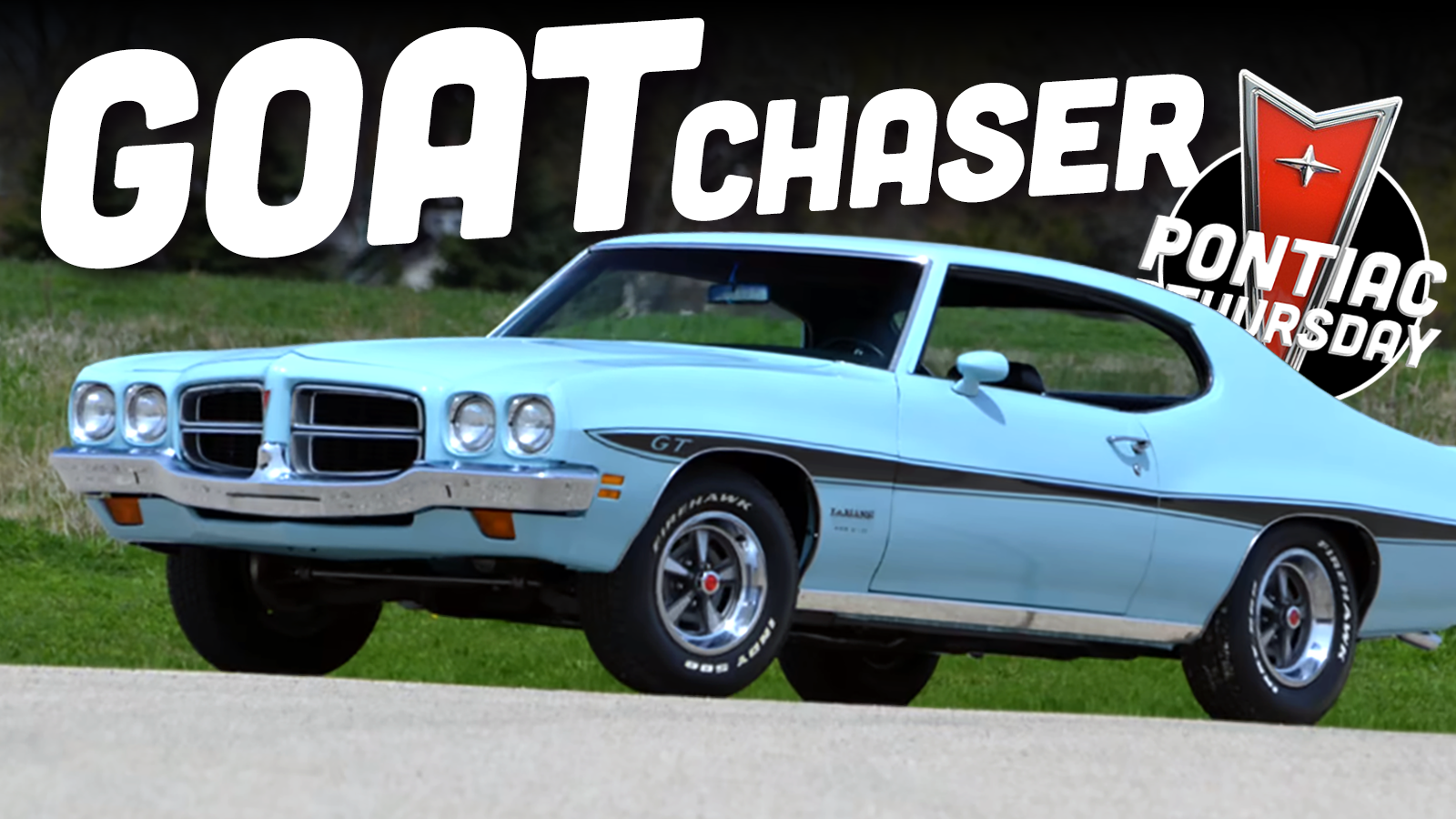
Pontiac Pthursday is frequently about hidden performance bargains. A number of Pontiac’s well-known performance products have had their values driven up to the stratosphere by “speculators” who will never drive their purchases, values that mere mortals like you and me could never afford and, honestly, wouldn’t want to buy anyway.
Many of us don’t care about “numbers matching” or “1 of 3” kinds of rarity, but that doesn’t mean we wouldn’t find a rumbling late-era muscle car to be an amusing investment.


I think I’ve found a few more of these lost gems out there. If nothing else, they’ll get you just as much attention at the Dairy Queen as a full-on GTO, but can be picked up for less pizza and beer money than you might think.
A Goat In All But Name
From the launch of the GTO in 1964 to the bitter end around 1972, the heyday of the muscle car was, in retrospect, extremely brief. Even in that short period of time, players like the Pontiac “Goat” went from being cheap speed for the young and cash-strapped to being cars with purchase prices and insurance costs that put them out of the reach of the next generation of greasy kids. For 1970, Pontiac offered something called the GT-37, a lower-cost muscle machine sleeper that gave would-be GTO buyers with thinner wallets something to enjoy.

Mercedes Streeter wrote a great piece on this hidden bargain a little while back. As a recap, the T-37 was a bare-bones version of the A-body Pontiac designed to give customers what would essentially be the lowest-priced mid-sizer GM offered. The GT-37 was the sporting version of this entry-level car that was, inexplicably, still available with all of the engine options you could get on the higher-priced LeMans and, yes, the GTO. As a stripped-down bench-seats-and-floor-mats car, you could theoretically spec’ out a car that was faster than the better-equipped (and heavier) GTO. And, because there was no “GTO” badge, most insurance companies assumed the GT-37 was just an unassuming drive-to-work car.

The GT-37 was discontinued in 1972, and rumors abounded that the GTO marketing team didn’t like the high-performance loophole it represented and had lobbied for its mothballing. However, Pontiac kept the party going with a new car that was arguably a better GTO than the actual GTO. They also continued to make this bargain special for longer than the actual GTO itself survived.
Plus One Less Letter On The Logo For Lower Weight
Many see 1972 as the bitter end of the true muscle car era, and the final one for the classic fastback GM A-body cars like Pontiac’s LeMans. The GTO was merely an option package for the LeMans in 1972 instead of a standalone model as in previous years. You got the body-colored Endura nose, which you would think gave your “Goat” a little distinctiveness. Well, maybe not.

You see, in 1972 Pontiac decided to offer the GTO’s special nose as a $41 option for any LeMans, further diluting the magic of the former Great One.
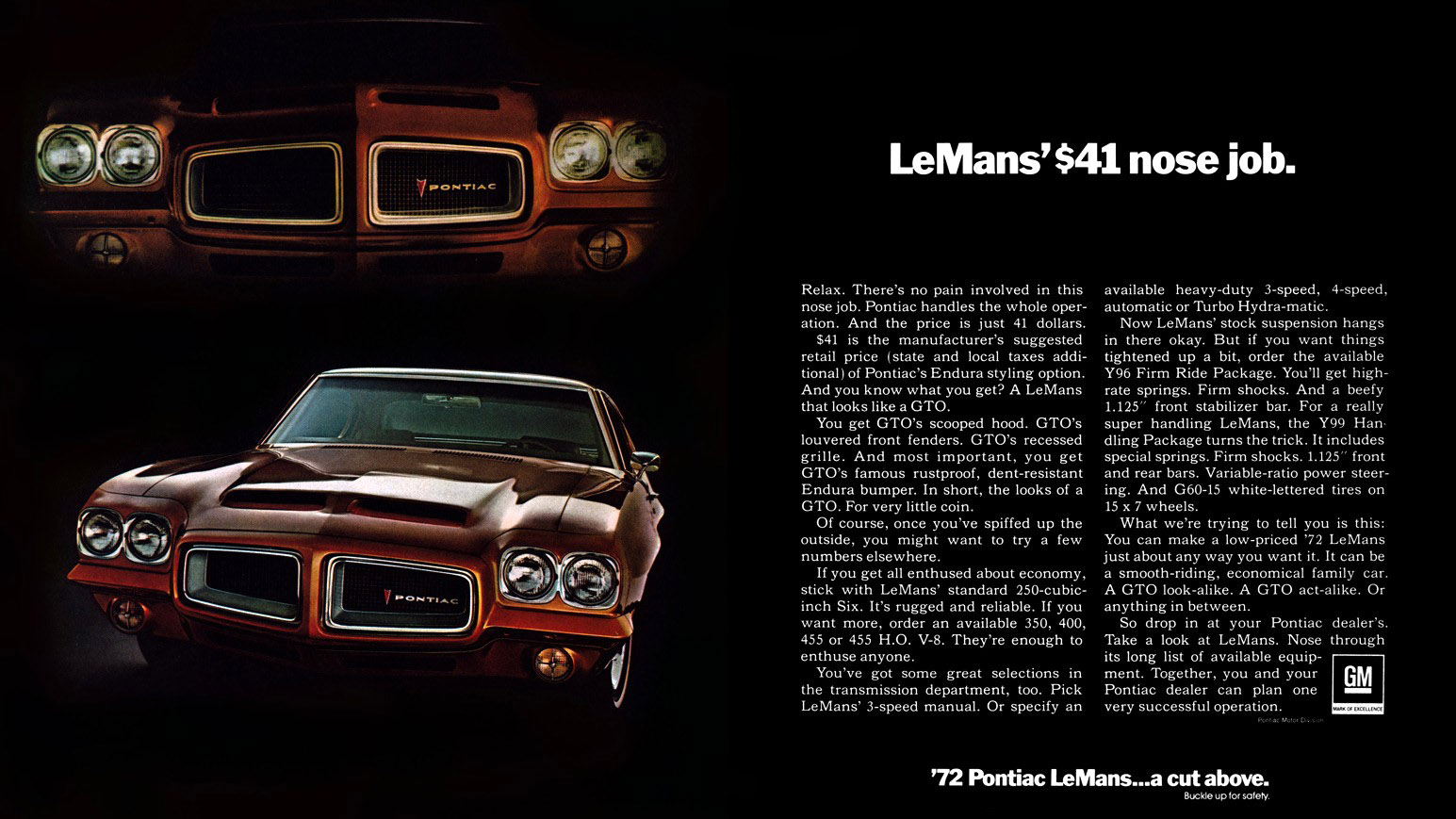
The T-37 series was dropped, and all mid-sized Pontiacs took on the LeMans name. You could still get a LeMans with a taxi-cab-basic interior and few options, but just like the T-37, every engine on the LeMans option list was available in the stripped-out trim, including the hottest motors offered with the GTO. If you weren’t content with a two-barrel 350, you could choose a two- or four-barrel 400 cubic inch V8s, or one of two 455 cubic inch options including the 300 horsepower (net, finally) High Output version and four-speed manual.
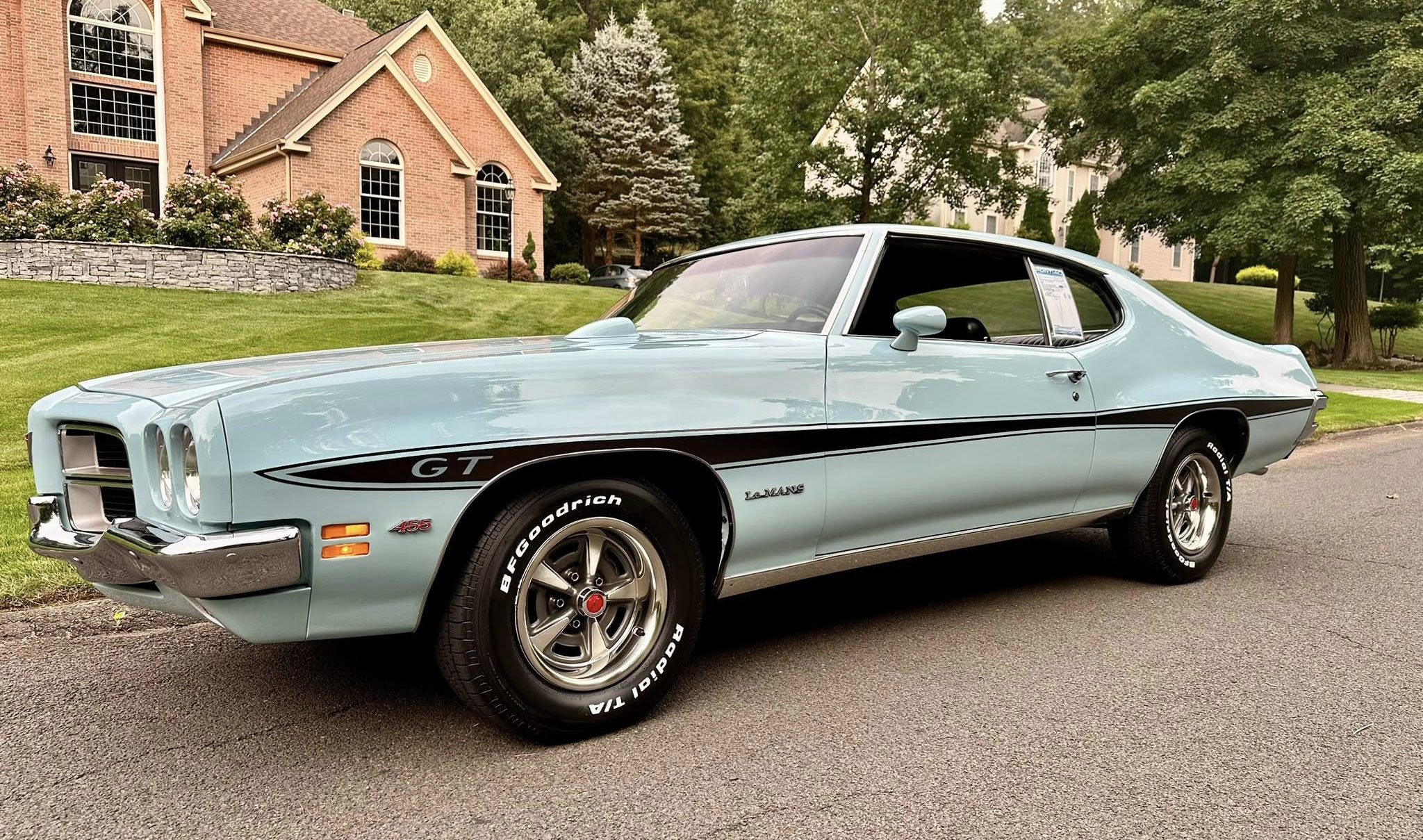
Also, just like the earlier GT-37, you could outfit your cheapskate mid-sizer with some of the visual and mechanical goodies of the Goat. The GT Package gave you a Hurst floor shifter for the standard 3-speed manual and dual exhaust with side splitters. White-letter tires on mag wheels (without trim rings), body-colored sport mirrors (remember, most cars didn’t come with a passenger’s side mirror then), and rather subtle striping gave you an understated sporty look. The silly hood pins from the GT-37 were gone. That lack of ornamentation was actually rather welcome at a time when the GTO was offered with things like a big whale-tail rear spoiler or the “Judge” package with funky colors and lurid graphics. Great fun in retrospect, but somehow it just visually cluttered what was easily one of the nicest Pontiac designs ever. Also, with a GTO there was no way that you were going to convince an insurance adjuster not to put you “on the charts” with a super-high rate. Unquestionably, the GT was the hot ticket for low-key muscle car fun.
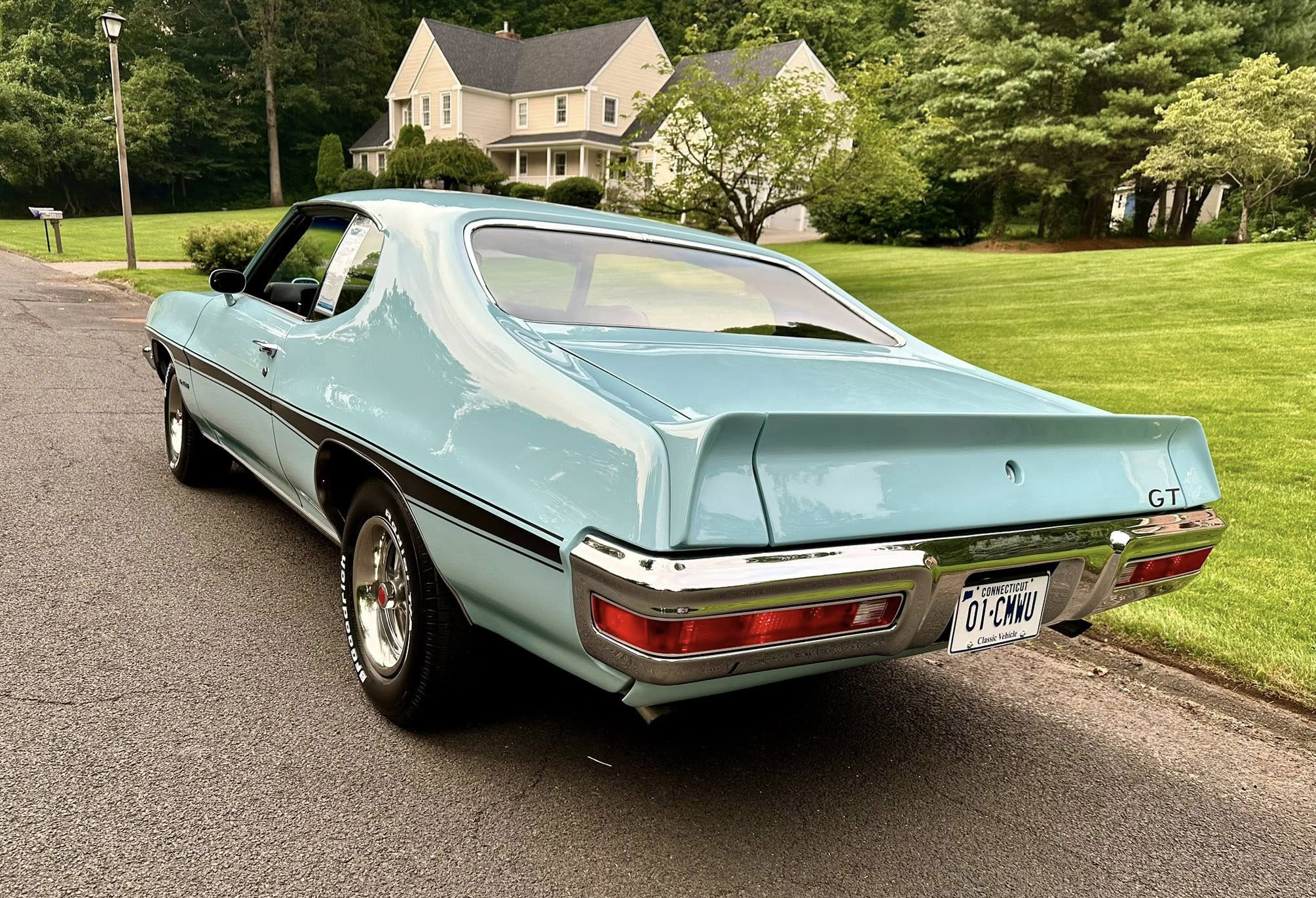
The GT had far less of the icing on the cake, but certain upgrades were still available. One very rare feature was dubbed the “ducktail” spoiler. This very subtle airfoil mounted to the back of the trunk lid and was an option for the GTO, but it’s commonly associated with the GT as well. The original three-piece unit is a very rare thing indeed, since apparently the mold for the spoiler broke after very few had been built, meaning that a lot of the ones you might see today are actually reproduction pieces. It’s a great-looking addition to this body style and looks like it was part of the design all along.
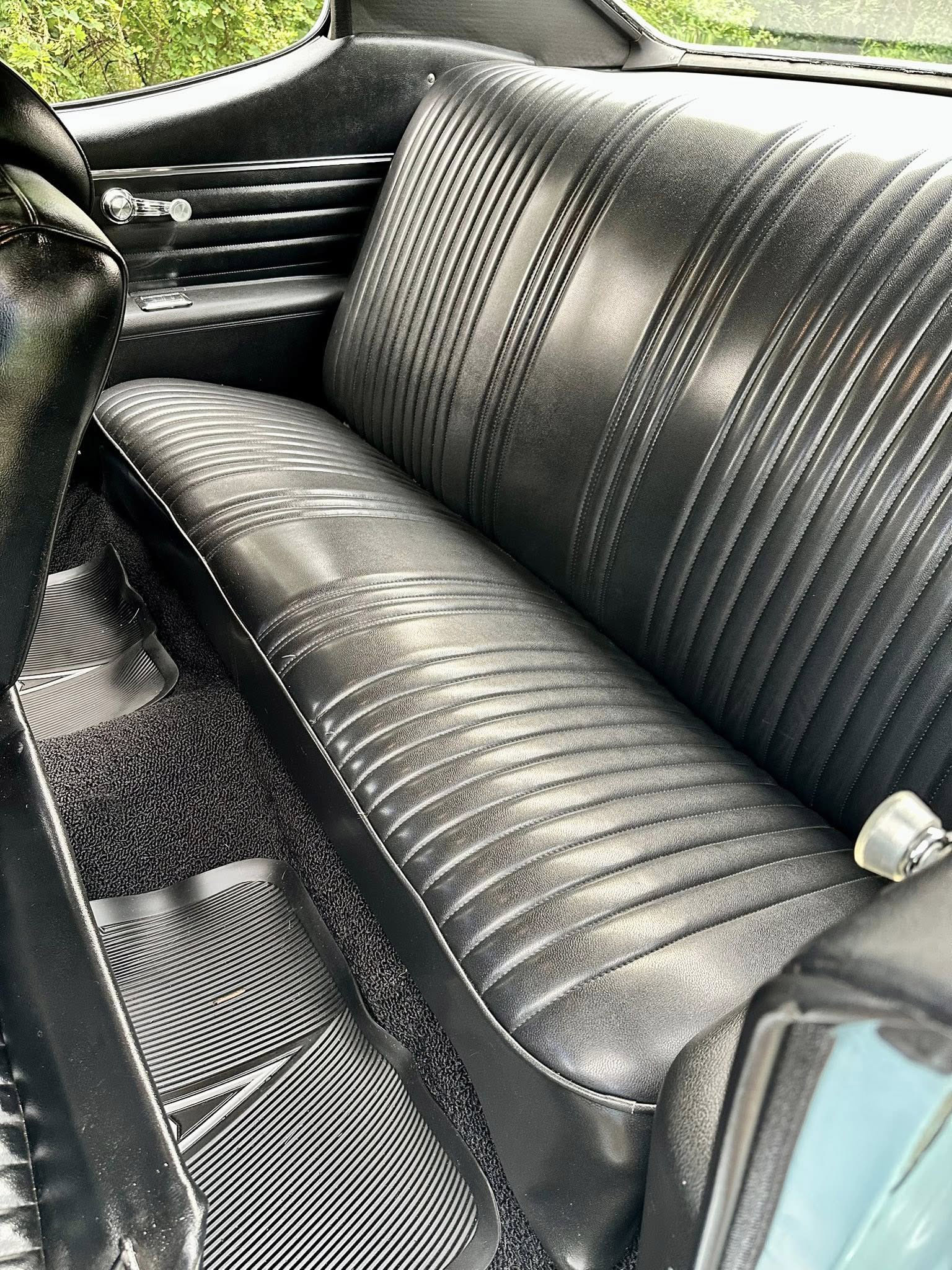
As with the GT-37, the interior was not for those with champagne wishes and caviar dreams. Even with the floor shifter, you still got a vinyl-clad park bench.
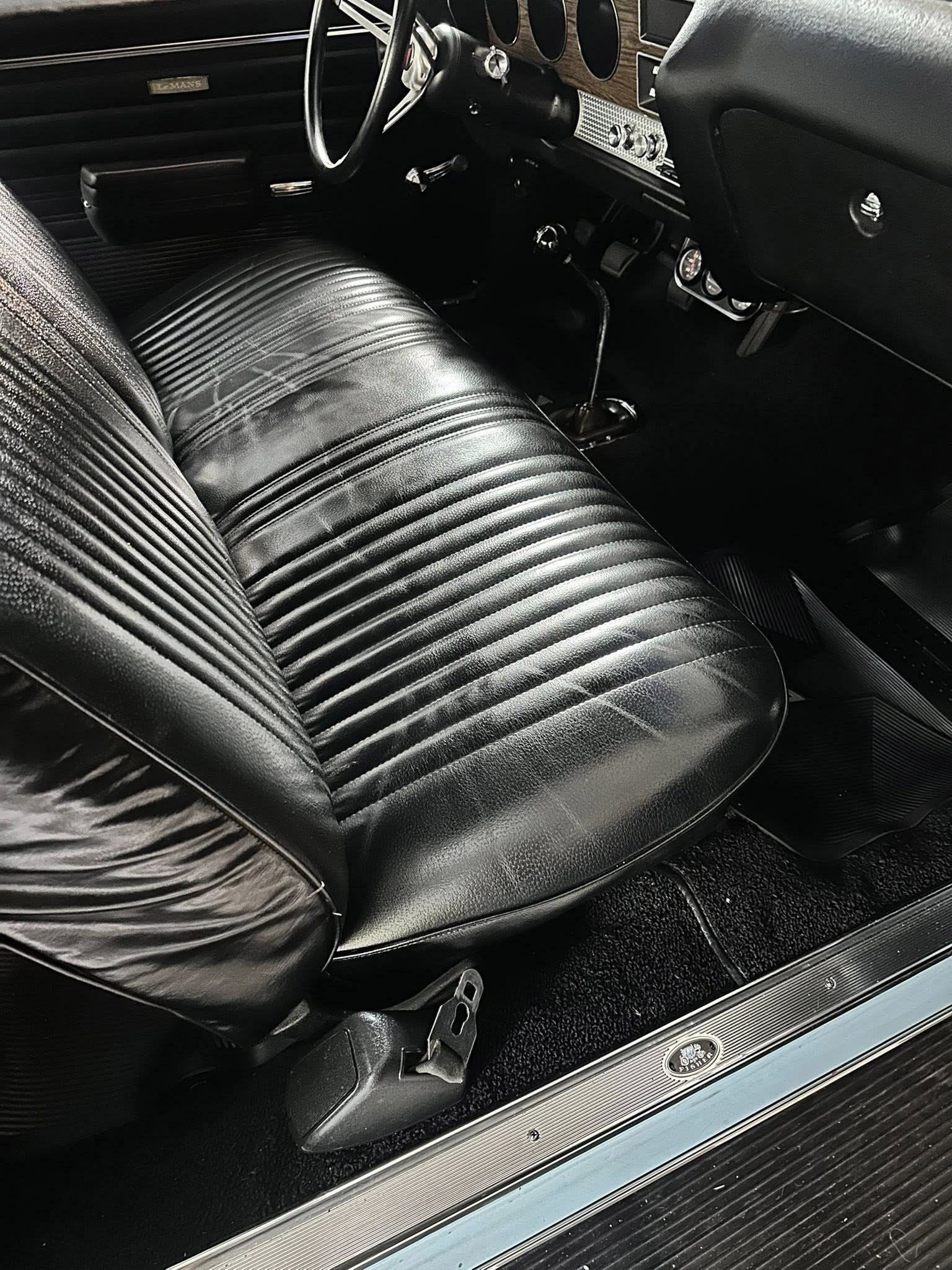
It’s almost a hose-out level of finish inside.
The GT was about one thing, and that’s what was under the hood. Of course, to pop the bonnet of any non-GTO and see this top-of-the-heap motor was a rare sight.
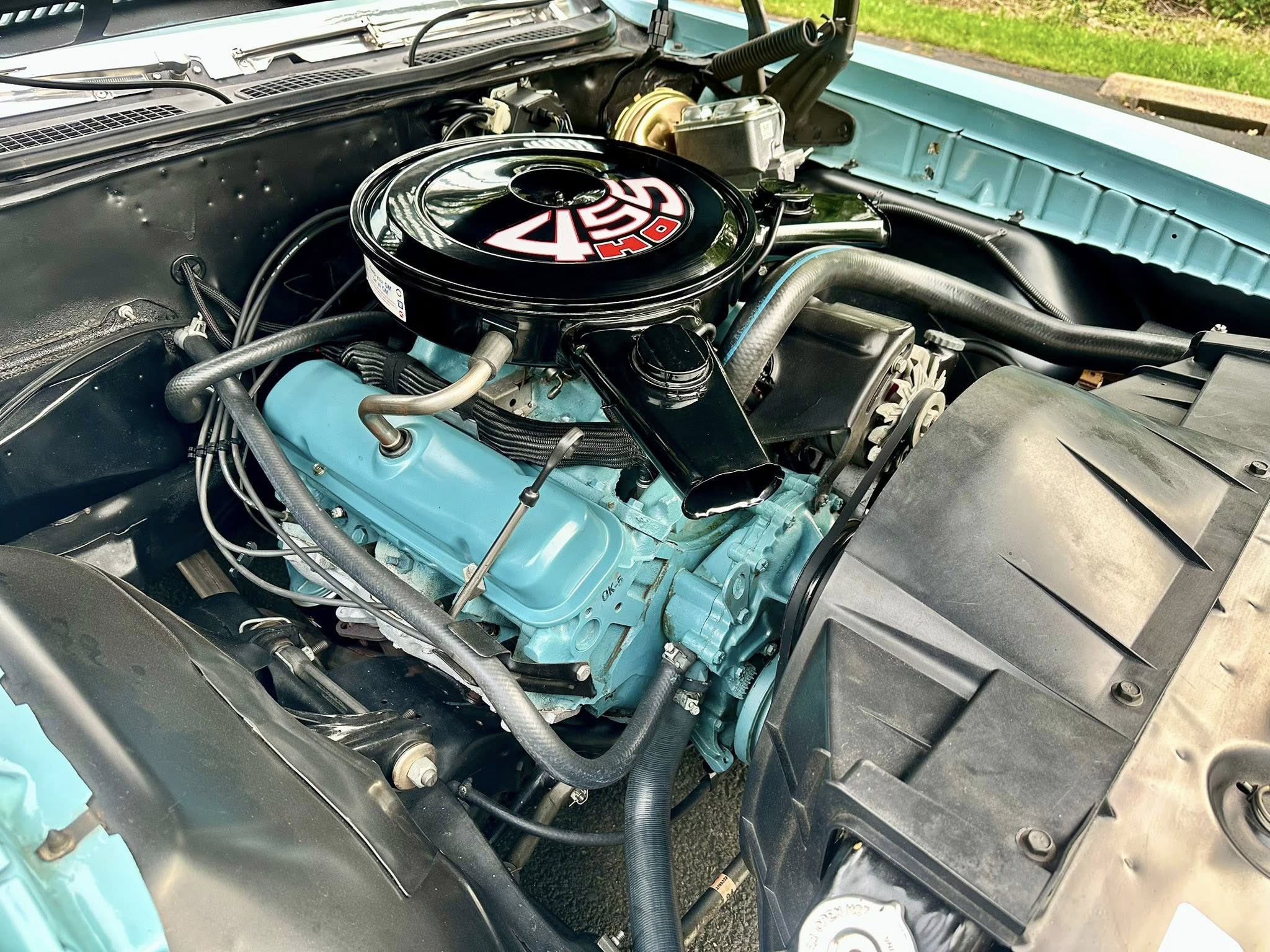
How rare? Well, a mere 5,807 GTOs were built for 1972, while nearly 8,800 LeMans with the GT option found homes. However, reportedly less than 1000 of them had the larger 400 and 455 V8s, including 24 with a standard 455 and a scant 14 with the H.O. version. Even more rare was the LeMans GT convertible; out of a total of 115 examples, only two had standard 455s, and seven had the H.O. No wonder few people remember this sleeper. Those who do tend to charge a premium for GTs if they have one of the rare higher-powered motors; that blue example shown above was listed for nearly $45,000. The good news is that’s likely a good $10k or more less than if it had a GTO badge on it, but sure, that’s a lot of cash.
Still, don’t lose hope. The muscle car era was truly coming to a close, but the LeMans GT wasn’t done yet.
They Used The Body Style To Make The SUX6000, Too
The much-loved new-for-1968 LeMans body style was replaced in 1973 by the controversial “Colonnade” series that seems to get lambasted in the comments section every time I mention it. I don’t know if it’s the lack of a pillarless body, the prominent snout, or the quasi-notchback styling, but you guys seem to hate this thing! It’s not my favorite either, but in today’s world of lookalike crossovers, I’m willing to cut it a break.
For 1973, Pontiac offered a GTO version of this particular LeMans with a base 400 cubic inch (6.6L) V8, producing 230 net horsepower, or an optional 455 cubic inch (7.5L) V8 offering 250 horsepower. The “Colonnade” Goat lasted only one model year and sold a mere 4,806 copies in the throes of the energy crisis.

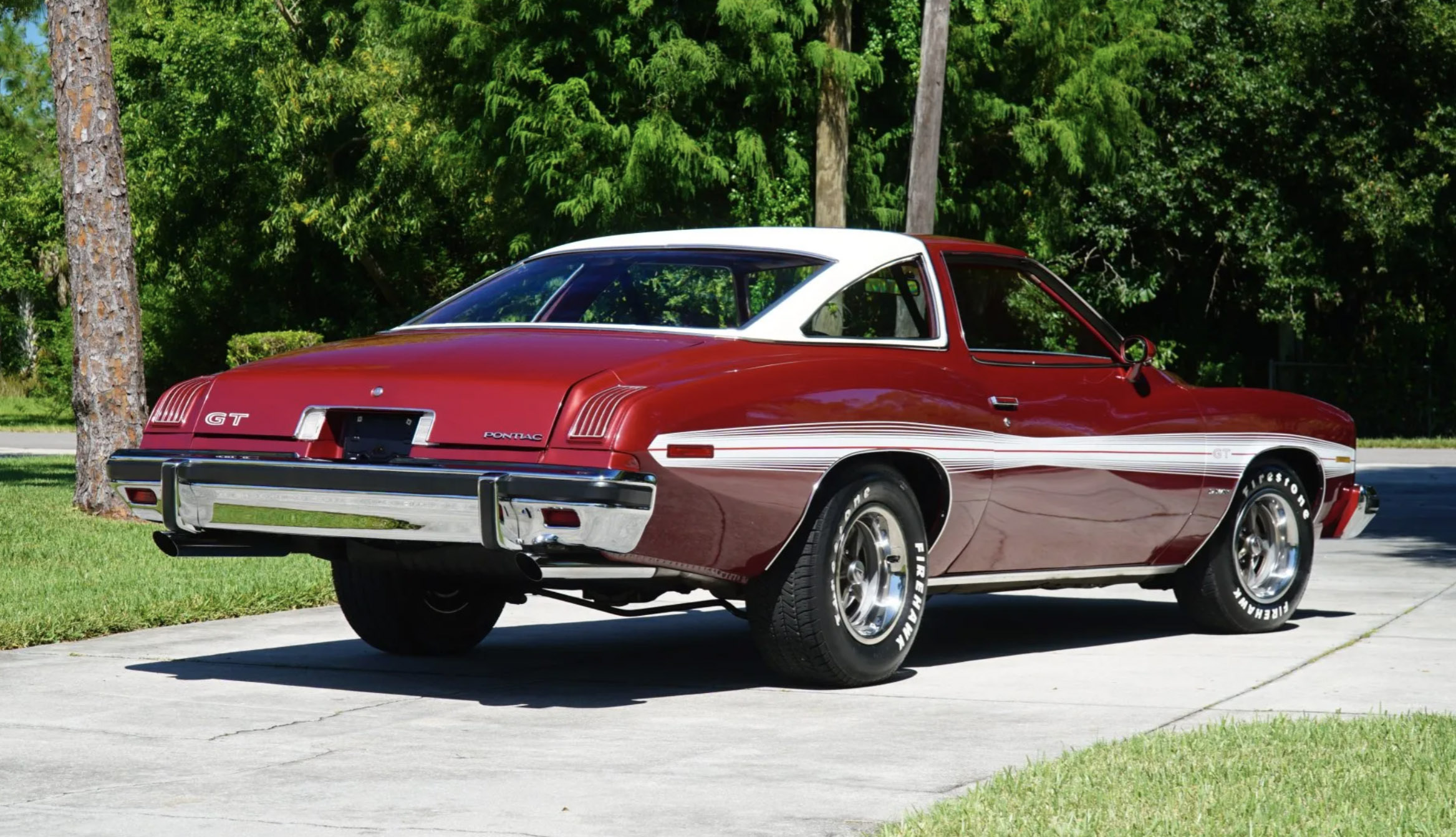
At the same time, Pontiac continued to market the GT package, again available with all of the largest motors you could get in any LeMans but with fewer of the “Goat” trappings and a lower sticker price. As with the previous year’s GT, you got some rather subtle customization with simple tape stripes and Rally II wheels.
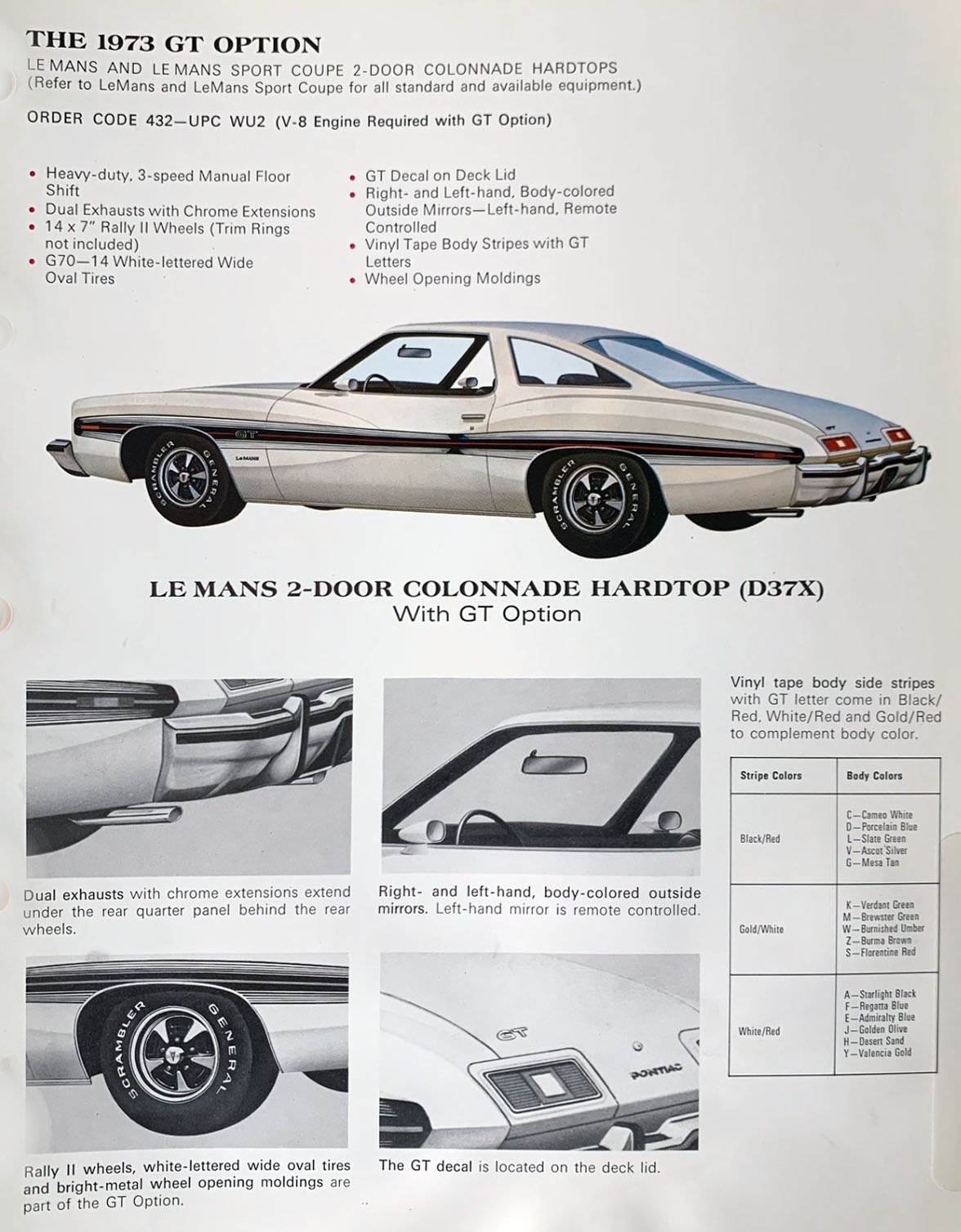
I can’t find sales figures, but, oddly enough, even though the LeMans-based GTO was dropped after 1973, Pontiac continued to offer the GT for the following year or so.

This ’74 shows the hood with what Pontiac erroneously calls “NASA” ducts. I’m confident they meant “NACA,” but the misspelling couldn’t be checked on Google back then, and using a space program name sounds infinitely cooler, doesn’t it?
Not as stark as the 1972 GT, the interior still sported a very non-sporting bench seat, which always looks odd with a stick shift.
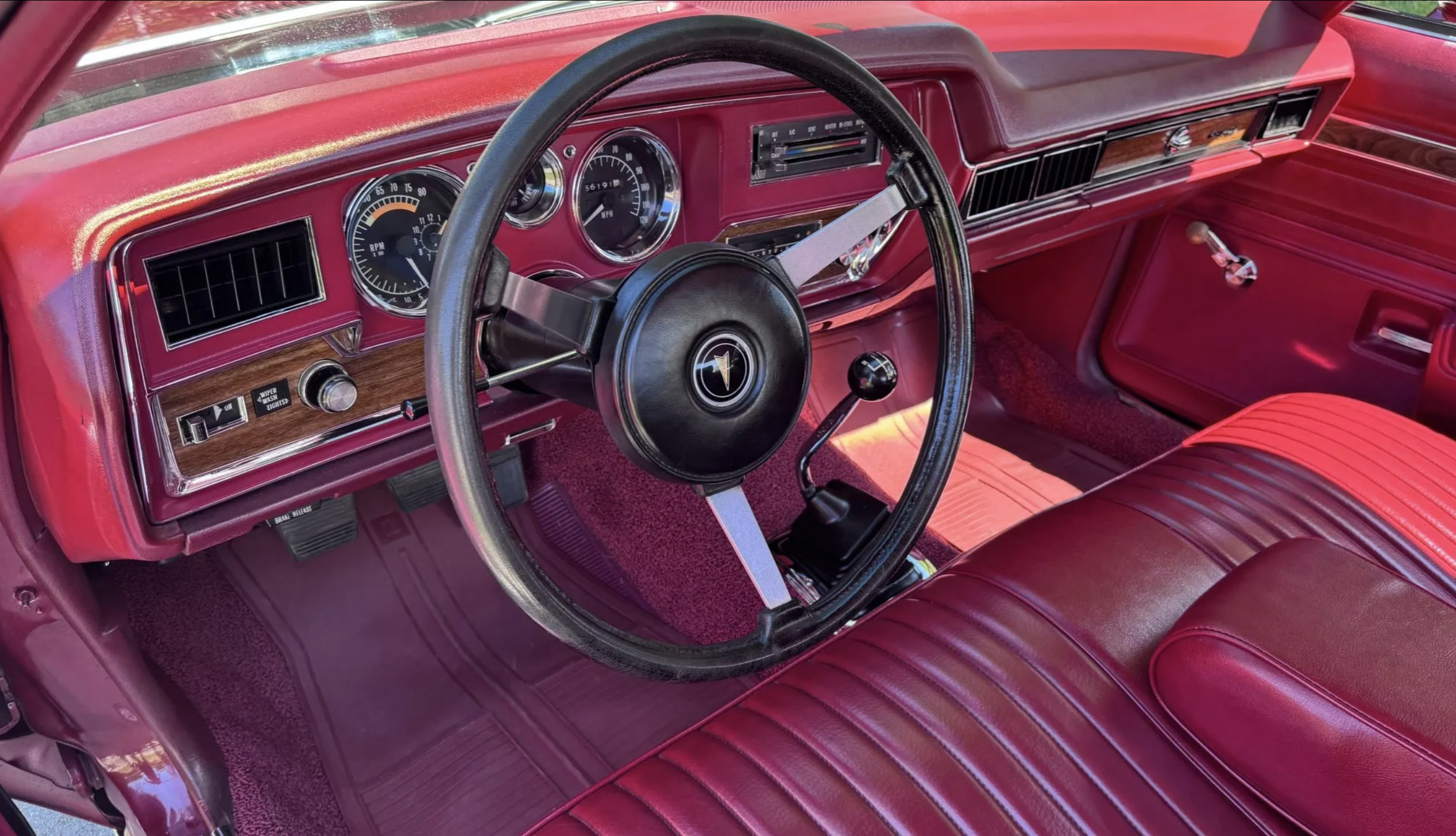
You even got a very Trans Am-looking steering wheel and a full set of gauges if you chose the option.

The GT might have outlived the LeMans GTO, but based on some sellers’ listings, it didn’t have that many more takers. Out of around 38,000 LeMans Sport Coupes, claims of anywhere from 6222 cars all the way down to 285 are out there for the number ordered with the GT package. Regardless, one could imagine the number with the biggest engines and manual transmission must be a small handful.
The GTO name was moved to the Nova-based Ventura for 1974, but when this outing of the name was dropped, the LeMans GT was left to soldier on into 1975 alone, and without the 455 cubic inch motor option.
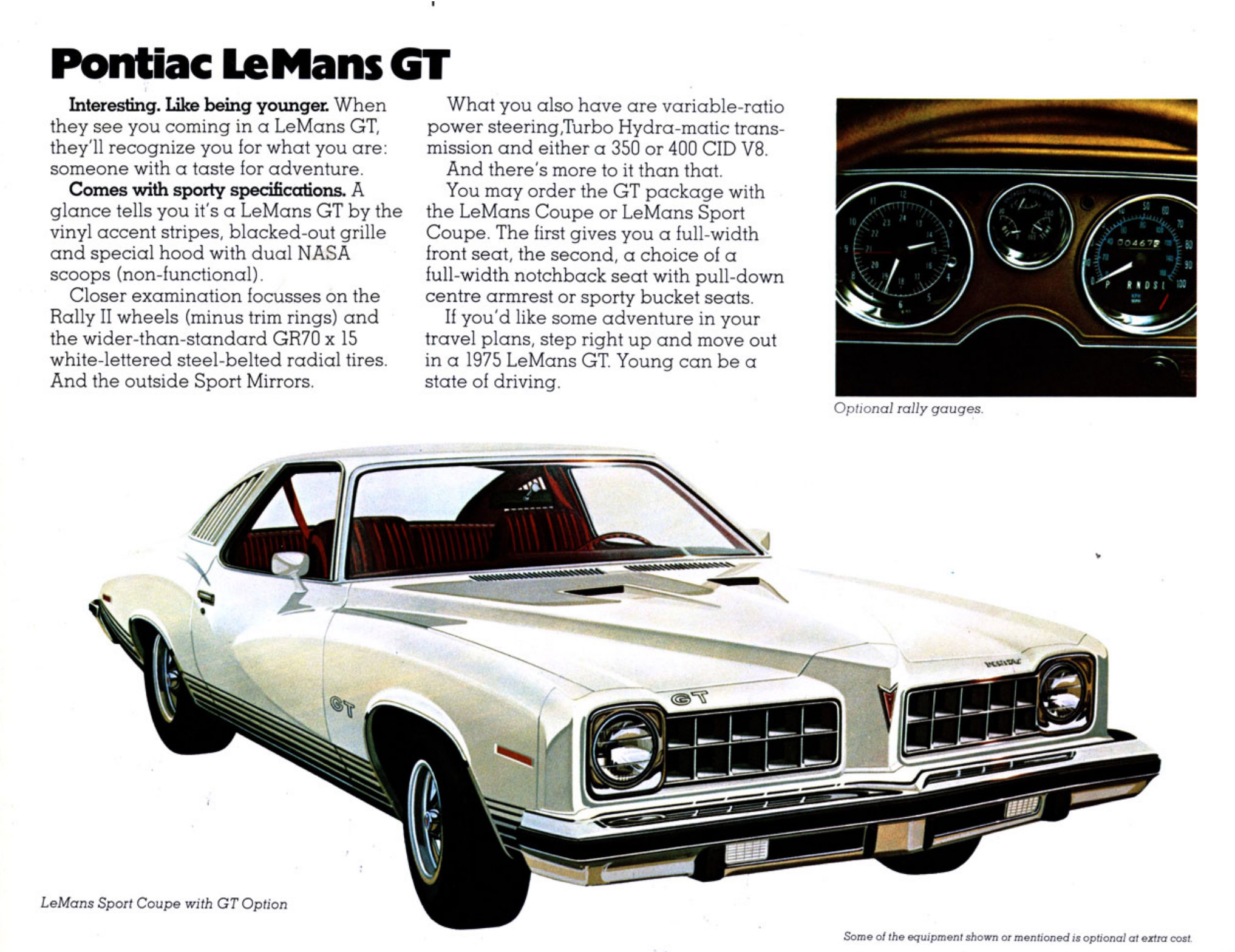
This means the GT actually outlived any iteration of the GTO, effectively coming full circle with an affordable musclecar package similar to the original 1964 car. However, this was a far different time than 1964. Unlike the runaway success of the first GTO, this last GT struggled to find an audience. Again, exact figures are hard to substantiate, but some sellers claim that fewer than 200 examples of the 1975 GT were produced – a sad end to a decade of exciting mid-sized Pontiac performance coupes, that likes of which we wouldn’t see again for decades.
An Affordable GTO? GTFO!
With cash-flush collectors running up muscle car prices at auctions, there aren’t many cheat codes left for those of us who want to affordably experience a little bit of the automotive fun that our parents had. These last LeMans GTs might be among the few out there.
No, the post-1972 cars don’t offer nearly the performance options of the earlier cars. These were true heart-of-the-malaise, tragically smog-choked rides. The advantage is that this reputation has kept prices low, making it not only easier to buy one, but also meaning that no “numbers matching” weenies will weep if you breathe on the weakling mills under the hood to make a 400 cubic inch V8 sound and run like a 400 V8 should.

This gleaming red one-of-200 1975 GTs was listed for $22,900; it’s since sold, but even at full asking price, that’s not much for a great- condition slice of landau-roof, disco-era glitz. Seriously, cars of this era have been pretty much wiped off the face of the planet, and I no longer think that’s a good thing.

In some ways, I’m glad that Mercedes Streeter’s very popular piece on the GT-37 didn’t mention these later Pontiac bargains. Like finding those last few potato chips in the bottom of the bag, it’s a nice surprise to learn that there was a forgotten encore to the cheap-Goat saga that was just as tasty.
Pontiac Points: 95 / 100 (1972 GT) and 80/100 (1973-75 GT)
Verdict: If well-to-do seniors have got your Goat, here’s a bargain equivalent that might be just as good and, in some ways, even better.
Top graphic image: Mecum Auctions


Those mid 70’s bumpers…. Just oof. I can’t unsee them!
Yes, I like the Colonnade cars and I’m not shy about it. Even the ones I used to not like have grown on me, like the ‘76 Malibu wagon my mom drove from ‘76 to ‘78.
I was kind of hoping a list of cars currently available for sale at decent prices. But on the bright side we were given many words.
The 1968 -1972 body was so well proportioned. It deserved to live a lot longer. I’ve never seen the duckbill spoiler before. I like it! The worst part of the Colonnade series was the pinched rear end. It just looked cheap.
I’m not ashamed to say it: I lusted after the Judge my last years, 69-70, in high school. Maybe because of Laugh-In? Now, not so much. Real life was different: a rusty ’67 bug in graduate school in the late seventies was my first car.
A guy in high school had a ratted out ‘71 T37.Gold with a vinyl top,lots of rust and dents but man would that car go.
Perhaps the best-known T-37 in cinematic history.
The vid is eight minutes long, but worth the time. RIP Gene Hackman.
https://youtu.be/XeT-GPcxkXs?si=ROqi-qVqEiqw5Jm_
“This ’74 shows the hood with what Pontiac erroneously calls “NASA” ducts. I’m confident they meant “NACA,” but the misspelling couldn’t be checked on Google back then, and using a space program name sounds infinitely cooler, doesn’t it?”
IIRC, NACA (National Advisory Committee for Aeronautics) was the (or one of the predecessors) of NASA. Enthusiasts for automobiles and such often like to argue about how many angels can dance on the head of a pin. Doubtless there are some who would argue that NACA and NASA are the same.
I still use “NACA,” probably because I am three years older than dirt.
NACA duct is correct. Nothing to argue about, I think.
https://en.wikipedia.org/wiki/NACA_duct
It was called NACA when the duct research was first done, but when it was renamed NASA the same researchers continued to do aerodynamic research in the new organisation.
So ‘NASA duct’ is incorrect, but not that incorrect.
Right, the organization was renamed, but I’d say not the duct. The term had already escaped into more common usage. I can tell you that when I was reading car mags in the 70s, they were NACA ducts.
No. They have all come to represent insufferable fat cats. They were cool when you could find a decent one cheap but you need to put money into suspension, brakes, engine, and exhaust to get halfway to the performance of more contemporary undervalued options that probably get double the gas mileage, and sell for half. I liked and owned late 60’s and early 70’s muscle cars in the 80’s and 90’s. The key to finding gems IMO is out of favor 7-15 yo that even most used lots don’t want.
My feeling on why “Colonnade” cars get so little love is that they tend to be remembered as intrinsic to peak Malaise. There were so many of them on the road in the 70s and 80s. They’re like over-played songs on the radio.
And they got a lot of flak for reliability problems and constant service issues due to a confluence of overall lackadaisical build quality, serious teething problems with early emissions technology, and GM bean counters’ penny-pinching on almost every aspect of them. Add to that styling which ran from tepid and anonymous to over-exuberant brougham and/or lurid graphics (sometimes all at the same time on some models…), plus the designers wrestling with form and packaging to meet new safety regulations… They’re just products of their time that left a lasting eye-rolling impression.
Not to mention the Colonnades were bigger (on the outside only), heavier and uglier than the previous gen Coke-bottle mid-sizers – but built on the same old chassis and wheelbases (coupes were on 112″, sedans and wagons on 116″). The worst were the sedans and wagons with their ungainly vertical B and C posts – Hence the “colonnade” nomenclature.
I clearly remember my moms 70’s red Pontiac with the white interior. It did not make much sense for a single mom with 4 kids and dogs but she loved it.
Come on, bench seats are great.. I mean remember this was before seatbelt laws, so your significant other could snuggle up, and maybe even shift for you. Peak 70s.
And sometimes the shifter hand slipped off of the shifter and just went places it wasn’t really meant to…
If you never experienced bench seats and a drive-in movie, I feel sad for you.
I’m old. Trust me, I have! And there’s still an active drive in near me.
Yes, my Mother liked to slide into the middle seat against my Father on those late-evening drives home.
She was a bit sad when she had to stay on her side of the car after the first Volvo 240 was purchased.
1974 was the end of the Muscle car era for me with Pontiac. the SD 455 should have hit more models, but it was the real deal baddest motor they made. even with the cam retarding and poorly jetted carb the thing was potent, and exceedingly rare in the Trans Am. HO 455 by comparison was a boat anchor.
I heard tales of a Grand Am from 73 with this motor, but I feel like it is either a company execs car that slipped out or it was just a test mule.
I believe they built one of them. I did a Grand Am piece a while back that mentions it!
Nice work, Bishop! I saw several T37s back in the day but they were all the first generation, I never realized they were built into the mid 70s, and I especially never saw a colonnade GT at all.
We did have a lot of fun with the 1973 Le Mans Safari wagon though:
https://www.automobile-catalog.com/photo/1973/2821055/260743.html
It looked exactly like the picture and had a 400 with 4 barrel Q-jet, with factory tow package (HD radiator), turbo 400 and dual exhaust. In good tune it was a tire roasting beast, with a thirst to match. probably a worthy long roof companion to the GT 37 coupe.
Man, I miss Pontiac. That is all.
same!
“An Affordable GTO? GTFO!”
Nice!
I really liked
GM should start putting high-output 454’s in mid-size passenger cars again. With a modern block and internals, they could easily go up against Stellantis’ Hemis. Of course, with the oil crisis of 2026, there would likely be very few takers. But hey, another halo car wouldn’t be a bad idea? Right? Right?
The current LS motors have no issue going up against the Stellantis Hemi’s, no need for a 455. Always thought it was weird that Pontiac moved the GTO to the Ventura body for 74.
I wholeheartedly agree that no one needs a 454 in a passenger car. They didn’t need it in the 70s and certainly not in the 2020’s. However, for a certain subset of humans, such an offering would be irresistible. Those folks are still banging the drum of “no replacement for displacement” too.
Never underestimate the American consumers ability to shoot themselves in the foot. With a good chunk of spending coming from the top earners, any takers can likely afford the gas.