

I had the chance to share a few negroni with fellow car scribes at last night’s Infiniti QX65 launch, and many of us realized we’d all be reunited next week on a Hyundai trip. What is Hyundai planning to show us? No one had any idea. The Korean automaker is launching so many vehicles it’s a little hard to keep track of it all.
In fact, the automaker just announced it plans 36 launches by 2030, with a lot of those cars being built in the United States with parts from the United States. That compares to, say, Jaguar Land Rover, which can’t seem to build cars in the United Kingdom. Over in Japan, Toyota seems to be slowly realizing that regular people don’t want hydrogen cars, but maybe there’s a place for commercial vehicles?


There’s been a bit of a whiplash in The Morning Dump when it comes to electric automakers given the war of it all, which has been good for BYD, but doesn’t seem to be helping Tesla much.
36 By 30 Is The New Mantra At Hyundai

I’ve said it at least once before, but it bears repeating now: Hyundai has one of the best powertrain mixes in the game. There are hybrids where you want hybrids, ICE options for most things, and EVs for everyone else. It’s not even that there’s a single powerplant or drive unit that’s exemplary. It’s all about choice.
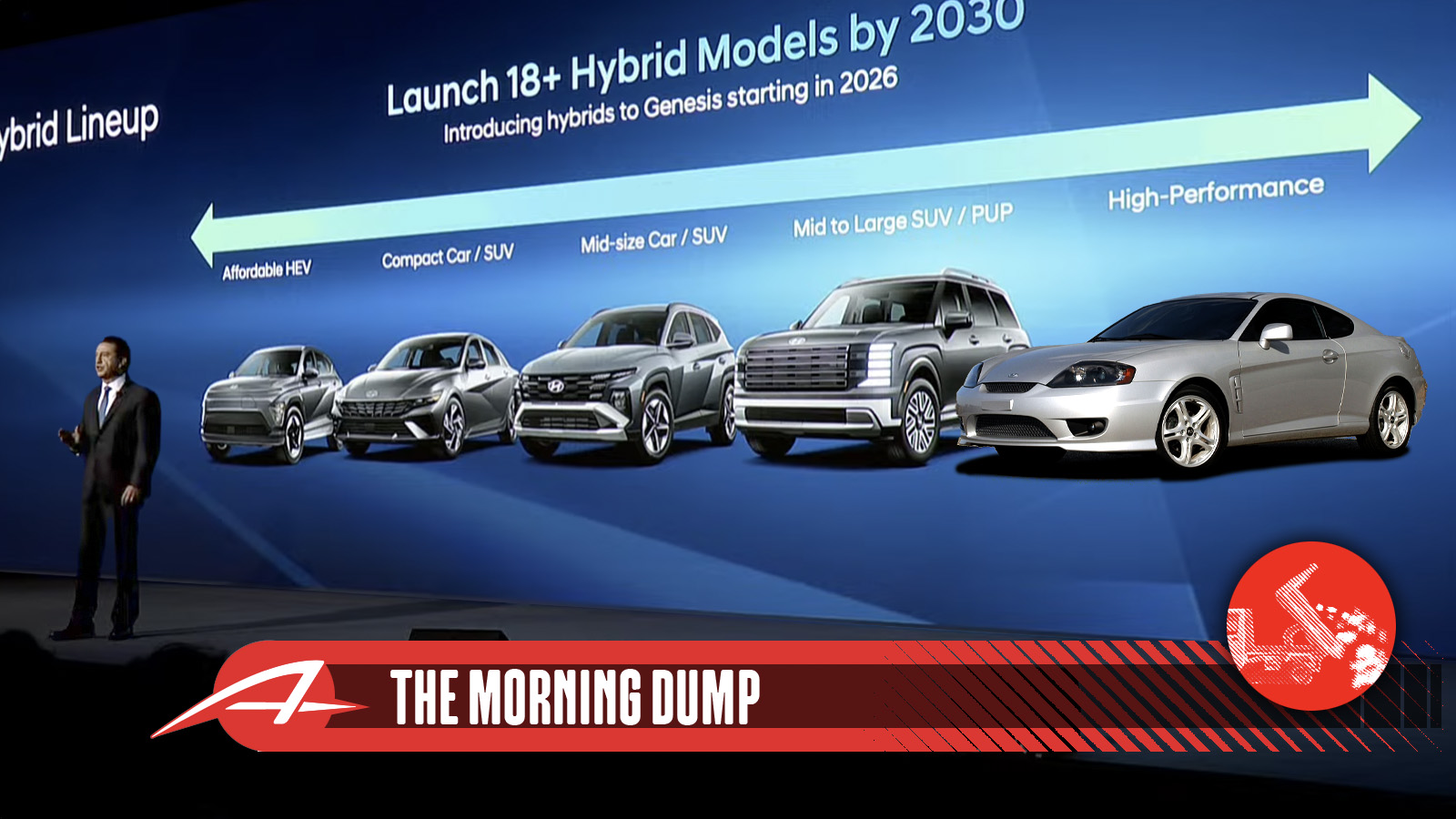
There’s a lot more choice coming according to Hyundai, which announced 36 new models by 2030, with 80% U.S. production and 80% U.S. parts sourcing. Is this a reaction to The White House or the inevitable outcome of Hyundai’s huge sales growth here that’s mostly been planned for a while? The answer is: Yes. Either way, Hyundai is betting big on America.
“Hyundai is accelerating across North America,” said José Muñoz, President and Chief Executive Officer, Hyundai Motor Company. “By expanding our product portfolio and offering a wider range of powertrains in North America, we’re giving customers more choice while continuing to strengthen our long‑term investment in U.S. manufacturing, jobs, and the broader automotive ecosystem.”
Here’s a little more detail from the announcement:
From 2026 through 2030, Hyundai plans to introduce 36 all‑new or significantly enhanced models including passenger cars, SUVs, trucks, and commercial vehicles. These new vehicles include core models and expanded trims, including XRT and N performance derivatives.
These models will be supported by a broad mix of ICE, HEV, EV, and extended‑range electric (EREV) powertrains to meet evolving customer demands across the region.
Ohhhh EREVs. Exciting. All joking aside, I don’t think the Tiburon is likely on the menu, but there are a bunch of potentially interesting models for enthusiasts. Up at the top of the list is the Hyundai Crater, which could be a Wrangler/Bronco fighter and would make sense as an EREV. The Hyundai-GM van is a lock, although the details are not yet clear. What about something that looks like the Insteroid concept?
The one that can’t come soon enough if you’re a Hyundai fan or a dealer is the Tacoma-fighting midsize truck that’s replacing the Santa Cruz. For longstanding Chicken Tax reasons, that truck is almost certainly going to be made in the United States.
I’m excited to find out next week what there is to learn what’s coming, because it can’t all be trim levels of the Tucson and Palisade.
Jaguar Land Rover Idles A Plant Again

Remember when Jaguar Land Rover couldn’t build cars for weeks due to a damaging cyberattack? Pepperidge Farm remembers. Or, at least, whatever the British version of Pepperidge Farm remembers. Now, JRL is again having to slow down production for a couple of weeks because of a “part supply challenge.”
What’s going on here? The Financial Times has some details:
The British carmaker, owned by India’s Tata Motors, told suppliers on Thursday that it would pause production for its Range Rover and Range Rover Sport models at the Solihull plant in the West Midlands until April 8, including an already scheduled five-day shutdown for the Easter long weekend.
In a statement to the Financial Times, JLR confirmed “a part supply challenge with a supplier” and added: “We are working closely with that supplier to resolve the issue as quickly as possible and minimise an impact on our clients or our operations.”
I guess it’s Spring Break for those workers, although at this point I’m guessing most of them would be happier to have the work.
Toyota Bends A Little On Its Hydrogen Plans

Toyota is one of those automakers that still believes that hydrogen cars will happen, even though every single hydrogen passenger car it’s built has been an extravagant exercise in blowing money. It’s starting to sound like the automaker is realizing that consumers aren’t going to embrace hydrogen cars any time soon, so maybe it makes more sense as a commercial option?
Per Nikkei Asia, the pivot is on in Japan:
The plan is to deploy sizeable hydrogen stations along highways between eastern and western Japan, not only to make them accessible to fuel cell trucks but also to ensure that hydrogen prices remain stable over the long term. The current price of hydrogen was almost the same as that of diesel fuel, Yamagata said.
The European Union is planning hydrogen refueling stations at least every 200 kilometers on main highways by 2031 while China has a similar plan. With Toyota having local partners in each region, it has been developing high-performance fuel cell trucks and carrying out test runs.
In Japan, the Tokyo Metropolitan government and Toyota have launched a fuel cell taxi project, aiming to deploy 600 fuel cell-powered Crown sedans by its fiscal year ending March 2031.
For commercial vehicles and maybe aviation there’s a possible use for hydrogen, especially in large trucks. Taxis aren’t a bad start, either.
The Iran War Is Good For BYD, Not Exactly Helping Tesla
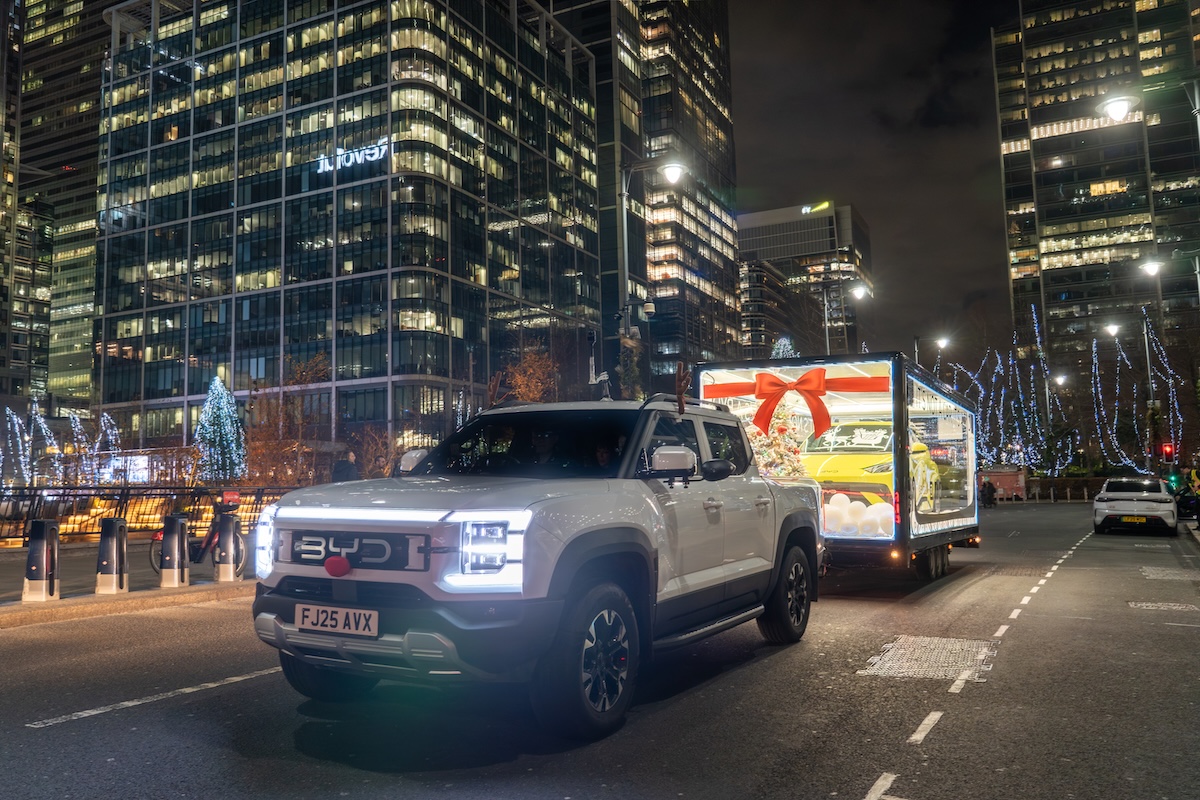
The price of oil continues to go up as the War in Iran shows no signs of actually stopping, and that’s bad for people who rely on Middle Eastern oil to power their cars and houses. Who has it been good for? Russia has been able to get a waiver to sell oil again, and Chinese electric carmakers seem to have found a way to stoke demand again. Was strengthening China and Russia the goal of this sudden intervention? Probably not, but that does seem to be one outcome.
For BYD, the boost to its car export business is a big deal given how mediocre its sales have been at home. As Bloomberg reports, cheap Chinese EVs are suddenly very popular in places that are likely to get squeezed in a prolonged energy crisis:
BYD’s guidance for the current year along with its results due Friday will provide clues for investors on the chances for an export-led recovery. Its overseas sales for the first two months surged 50% from a year ago, and customer traffic has been brisk at its dealerships across Asia in March as gas prices climb.
“We’ve seen stories out of the Philippines and Indonesia where locals are queuing up to buy an electric vehicle,” said Leonid Mironov, a portfolio manager at Gavekal Capital Ltd. “Longer term, this will help re-establish the EV narrative and consumer mindshare, especially in developed markets.”
Overseas sales accounted for about half of January-February sales volume for the Shenzhen-based automaker, which is also seeing a flood of orders from Central and South America. Likely rollouts featuring BYD’s new proprietary charging technology may help speed EV adoption in foreign markets where charging speed and infrastructure remain key bottlenecks.
Could this be a boost to Tesla, too? According to an analysis put together by the company, not so much. The consensus is 1.69 million sales, which is lower than the company’s last consensus guess, which was closer to 1.75 million vehicles. For the entire year, the non-Model 3/Model Y vehicle sales total 60,685, meaning that even Tesla knows it’s not going to sell a ton more Cybertrucks.
What I’m Listening To While Writing TMD
Do you need 10 minutes of dreamy Icelandic electronic music about the process of birth? Of course you do! Here’s Siguar Rós with “Svefn-g-englar.”
The Big Question
What would be the best thing Hyundai could add to its lineup?
Top photo: Hyundai/YouTube


In my opinion, having a diverse powertrain mix means diddly-squat if you can’t make them reliable.
People keep saying “well, the last generation of engines was garbage, but maybe the current ones are better!” And then the current generation of engines ends up being garbage too. This has been happening for more than a decade now, and I’m no longer inclined to believe it.
Hyundai is supposedly killing it right now for reasons, but their consistent inability to make a reliable powertrain makes them an absolute non-starter for me.
Hyundai sCoupe as a sub $20k commuter BEV with 150 mile range would be pretty radical, expecially if they made it look close to the old one.
I want to see Hyundai do something really radical to test how far it could go in the U.S. Market, like build a PHEV pickup truck with a 2.4L Theta II engine sending power through a 7spd dry clutch DCT and an ICCU for lighting fast 800v charging. I recommend they name it the San Bernardino
In an homage to ’60s Pontiac performance cars, Hyundai’s newest performance truck will be the “Judge” Crater. Reports claim acceleration is so strong that, under full throttle, the Judge Crater just “disappears.”
I got the reference.
“Up at the top of the list is the Hyundai Crater, ”
I heard this new model is gonna be Da Bomb..
“It’s starting to sound like the automaker is realizing that consumers aren’t going to embrace hydrogen cars any time soon, so maybe it makes more sense as a commercial option?”
It won’t. One of the reasons hydrogen cars have no future with consumers is because they actually cost more to run than regular gasoline cars because the hydrogen is so expensive. Plus the hydrogen cars are much less efficient compared to a BEV.
Anyone who knows anything about the commercial vehicle space is that it is much more TCO-sensitive than the consumer segment.
But TCO is one of the key reasons why hydrogen vehicles flopped in the consumer segment.
And thus, for TCO reasons alone, I expect hydrogen trucks (whether big or small) to flop even harder in the commercial space than they did with consumers.
Same deal for aviation and Taxis.
“Russia has been able to get a waiver to sell oil again, “
And that’s a mistake.
“What would be the best thing Hyundai could add to its lineup?”
Electric delivery van, electric passenger van, a small electric pickup (the size of the Maverick) and a big electric pickup (the size of an F150 4 door that is the most common config sold). And base all of these on their existing BEV architectures.
And while they are at it, do what is necessary to fix the ICCU issue so that has a zero or near-zero failure rate. And make those improved/redesigned ICCU parts widely available so that existing vehicles that have the issue can be fixed once and never have the issue again.
It’s called economies of scale. Toyota realized that the way to get Hydrogen adoption is to build up the fueling network in their home country. Price stabilization was even mentioned in the article. They might succeed in Japan, whereas in the USA, Toyota was dependent on energy companies setting up the fueling infrastructure, which never really happened.
If Toyota can get hydrogen to see near cost parity with ICE and EV in Japan, this would prove out the business case. Will Hydrogen work in every country? No. USA might be one of those countries where it will take decades to catch or maybe never at all.
“It’s called economies of scale.”
So they’ll lose money on a larger scale? LOL
“They might succeed in Japan”
They won’t.
“If Toyota can get hydrogen to see near cost parity with ICE and EV in Japan”
They won’t. The number of energy conversions needed to make hydrogen (let alone the energy needed to compress it) guarantees it never will.
It’s far more efficient to use existing power plants to generate electricity and use that electricity in BEVs.
In hindsight, it was a strange move for Toyota to release hydrogen cars to the public market for hipsters and college professors to buy, instead of starting with the commercial segment. Limited infrastructure isn’t a problem for short-haul trucks and taxis, but it’s a huge deal for average consumers. Also, making fleet sales means that you can build a bunch of basic, identical vehicles instead of more complicated and individualistic ones for consumers.
“Now, JRL is again having to slow down production for a couple of weeks because of a ‘part supply challenge.’”
Imagine directing this sort of managerial language in the other direction: “I’ll be unable to come in for a couple of days because I was selected for a ‘norovirus challenge.’”
Meanwhile, legacy US automakers: “How many more models of trucks can we build?” and when gas is $5/gal or more, “Where’s our bailout?!”.
The facelifted first gen Tiburon still looks nice today. It nailed boy racer without going over the top. Too bad it was a slow turd.
Good looking cars that rusted out badly here in PA.
Hyundai could use a new gen Santa Cruz that actually looks like a truck and is priced competitively with the Maverick. Also small/midsize cars would be pretty cash money.
If they would have given it the plug in hybrid AWD powertrain they would have had a hit. It was a small truck with MPGs in F150 territory.
The best thing Hyundai could add to its line up is reliability and not overlooking little details like seats that kill people. So naw I’m not super excited by them rapidly producing a bunch more models when they can’t seem to get the ones they make already right…
Told my wife about the Palisade seat stuff, she said, “we’re never buying a Hyundai.” I have a feeling many other families are having similar conversations.
TBQ. Maybe a small truck like a Brat/Baja.
I think in places like the Philippines etc. where they import hydrocarbons, using a BEV and solar charging sounds attractive and sensible.
Have the day you voted for!
16 seems like…an oddly specific number.
Did they think through that “crater” name? Sounds like it’s the pits!
My mind went to a joke about it completely vanishing without a trace
“Did they think through that “crater” name? Sounds like it’s the pits”
Sounds like Da Bomb to me…
There seemed to be a neat “if-then” naming convention going on between the Insteroid and the Crater… one results in the other for the kind of hit that could change the world forever. Sort of like:
https://pbfcomics.com/comics/dinosaur-meteors/
Perry Bible Fellowship! An Autopian of especially refined culture, I see.
Cars what don’t explode, crush people, or can be stolen with a paperclip.
They should bring back the Kia Rhondo. A small, urban friendly MPV with hybrid or EV options would be an interesting alternative to what everybody else is doing. Fight the bloat!
A Rondo EV would be something I would seriously consider as the eventual replacement for my Golf. My kiddo is on track to be in a sport of some kind or other, which means a large bag of equipment/gear, and the Rondo or something of similar size would be perfect for my family for a long, long time!
Please no – my parents, who currently have a Rondo would replace their current Rondo with a new Rondo that I would then be forced to drive every time i go visit. Don’t put that evil on me.
I second this… especially in BEV form. A smaller van is a great idea. And I like the idea of putting this evil on Christopher Gmiterek.
Hyundai should introduce a car called Svefng-englar. That’s a can’t miss.
TBQ: What would be the best thing Hyundai could add to its lineup?
ummm…ICE less prone to early-onset-kaboom-syndrome??
I fear that the 80% domestic content will result in Dorman being a major vendor.
I’m hoping the Tiburon is a placeholder for another 2+2 liftback in the same style…which means that their “performance” model will either be an N version of the Tuscon or a mid-engine 2-seater that the “n+1 is the proper number of vehicles to own” crowd will love, and I, wanting one vehicle that is stylish and engaging to drive but can also carry my gear to gigs, will hate.
Sigur Ros: Now that’s a name i’ve not heard in a long time.
Wagon. A car built on a sedan (or coupe) platform, but with a vertical hatch in the back.