

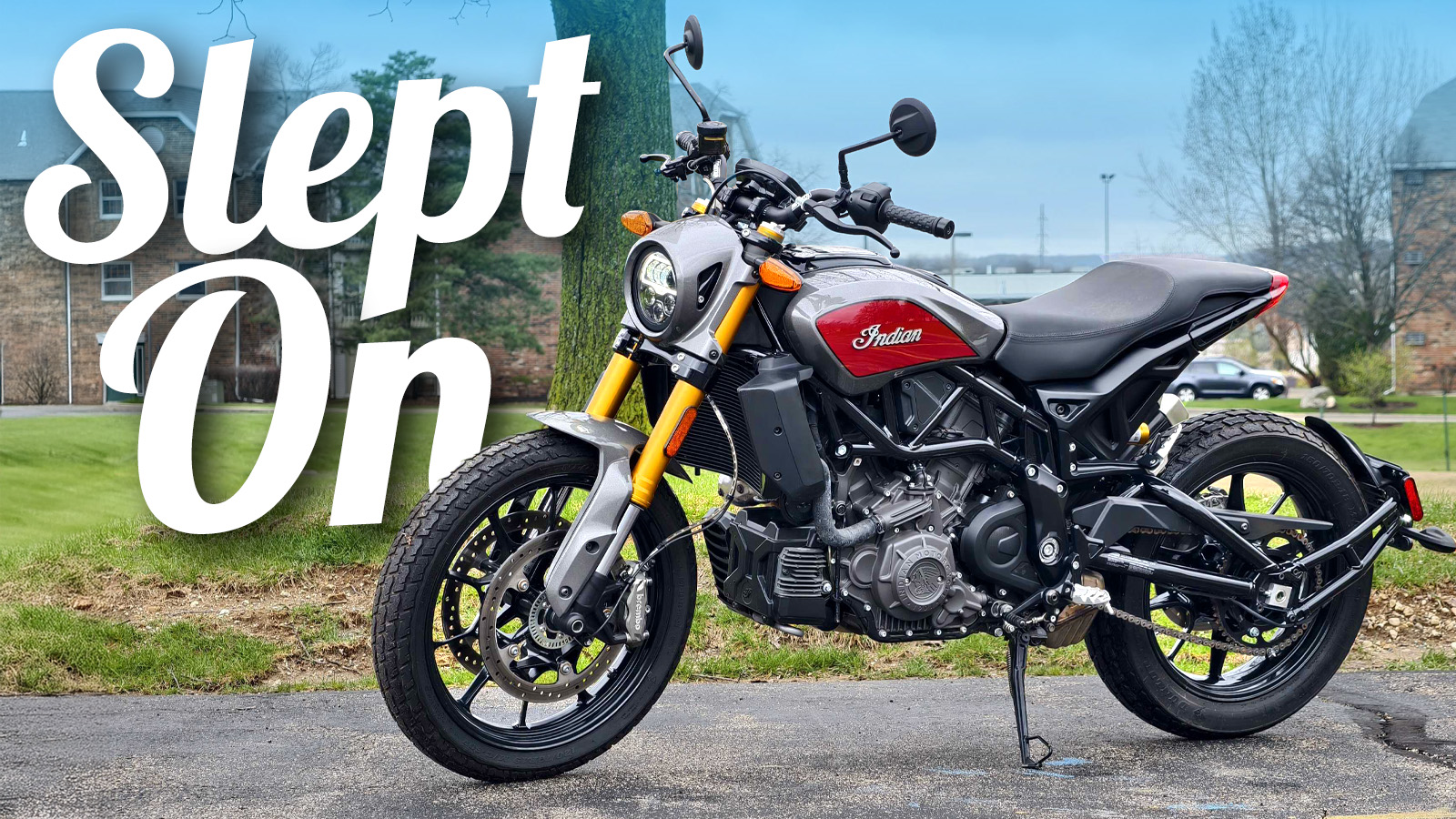
If you pay a visit to a dealership of an American motorcycle brand, you’ll see a lot of the same thing. You’ll usually find a sea of several large recliners with V-twin engines and pairs of wheels attached to them. That’s what made the Indian FTR 1200 a breath of fresh air. Not only was this street tracker not a heavyweight cruiser, but it was arguably the coolest motorcycle America’s built in years. But nobody bought the FTR, and Indian canceled them. I just picked one up for a song, and it’s a great example that, yeah, maybe you should meet your heroes.
At the beginning of 2025, Polaris Industries hid a nugget of terrible news within its Q4 2024 and full-year 2024 financial report. That report had suggested that Polaris, much like the rest of the powersports industry, had taken a battering from low sales. Sales were down 23 percent by dollar amount in 2024, and overall sales that year were down 20 percent compared to 2023. Polaris didn’t single out any single brand as performing badly, but the message was clear: people weren’t buying powersports products as much as they did in the past.


The saddest part was that, while Indian Motorcycle didn’t get a specific mention, one of its products caught a stray in the report. Polaris said, “The Company realized certain costs associated with the wind down of the FTR product line beginning in the fourth quarter of 2024.”

Boom, that was it. Polaris killed the Indian FTR in a single sentence. There was no public press release. There was no funeral, no celebration, or even a misty-eyed designer talking about how it was a great bike. Polaris didn’t even put a message on its website for existing owners. The FTR was kicked out and sent up to a farm upstate. Nobody would have even known if it weren’t for the motorcycle press digging into the report. Later, Polaris let go of Indian Motorcycle entirely, and now it’s under the control of Carolwood LP, a private equity firm.
Indian Motorcycle never released sales data or production figures for the FTR, but when I reached out for an explanation, I got back a lengthy response that could be distilled down to three words: Sales were weak. In fact, sales were so slow that dealers still have new 2024 stock, and the Indian Motorcycle website still has the FTR page up.

In my conversations with dealers and some riders, the reason why was simple. The FTR might have been the coolest, most beautiful motorcycle the entire American motorcycle industry has built in a long time, but it was also expensive. In 2024, the FTR’s final year, the cheapest model was $13,499 while the fanciest one was $18,499. This is before your local Indian dealer slaps you in the face with a freight fee, a setup fee, and a fee-fee.
The FTR was the kind of motorcycle that young riders love, but at a price that few young riders were interested in paying. The people dropping the better part of 20-large on a motorcycle aren’t going for an FTR, but something like a BMW GS, a cruiser, or a hopped-up sportbike. Even I was one of those people. I tried to buy a new base model Indian FTR back in 2022, but I just couldn’t make the math work with my finances.
Something sort of weird has happened with the FTR. Values for these machines are plummeting. I’m not even sure why, but it’s bad enough that you can find a handful of dealers selling brand-new, high-spec FTRs for around $10,000. That’s $8,000 off in some cases! This is before you negotiate even further. Basically, dealers just want these things gone. Again, the newest ones are from 2024, so these bikes have been waiting for buyers for around two years now. Some dealers have new old stock from as far back as 2019, when the FTR first hit the market.

That’s exactly how I scored a killer deal on one of my dream motorcycles.
Reigniting An Old Rivalry
Alright, so why am I gushing about a motorcycle that nobody bothered to buy when it was around, and still aren’t buying now? Put simply, I think the FTR 1200 is the coolest motorcycle to roll out of an American factory in the modern era. If you’re looking for a complete history of Indian Motorcycle, check out my previous work; otherwise, I want to jump to the good part.

Polaris Industries dusted off the Indian Motorcycles name in 2011 and put its first new motorcycles into production in 2014. Reviving Indian for the umpteenth time made sense. Indian was a name that technically went back further than Harley-Davidson, and Indian spent much of its existence being the Motor Company’s largest rival. Certainly, Indian had more name recognition than Victory, which sold great, innovative motorcycles, but didn’t quite have the cachet.
There was only one problem. Indian Motorcycle went through several revivals and failures that saw it get passed through several caretakers. Indian could not claim the same over a century-long heritage that Harley-Davidson could, as there were times when Indian simply wasn’t around at all. The new Polaris Indian bikes also had no tangible link to the bikes of the past.

In 2016, Indian Motorcycle employee Gary Gray sparked an idea. To him, the Indian Motorcycle that people remember the most was the one that was dominating flat track over half a century ago. What if Indian reignited the old rivalry by bringing a bike to the dirt track to challenge the supremacy of the Harley-Davidson XR-750?
Indian Motorcycle had nothing but cruisers at that time, but the engineers only took that as a challenge to create an entirely new motorcycle with its own racing engine. The resulting Indian FTR750 flat tracker laid waste to the circuit, winning its first Grand National Championship at the end of 2017. It would then take seven more championship wins in a row. Indian was back.
Why The FTR Is So Cool

Naturally, companies that stomp the competition on the track want to give a little something to the fans. In 2017, Indian pulled the covers off the FTR 1200 Custom concept (above) at the motorcycle show in Milan. The moto-loving public was instantly in love. The FTR wasn’t just a radical departure from what American motorcycle manufacturers usually do, but it looked like Indian put real effort into making it good. From my retrospective:
Indian greenlit a production version, and in 2019, the Indian FTR 1200 was born. At the heart of the new FTR 1200 was a new 120 HP 1203cc V-twin, and some minor traits trickled down from the racebikes. Like the racer, the FTR 1200 featured a trellis frame, and its airbox was tucked neatly on top of the engine.
The awesome part about the FTR 1200 (later just called the FTR) is that Indian didn’t just lazily make a boring bike that looked like the racer. It went through the work to make a motorcycle that rode just as good as it looked. We’re talking meaty Brembo brakes, a fuel tank under the seat, a low center of gravity, and some terrific fun handling. Sure, it wasn’t nearly as snappy as even anything with the name “Buell” emblazoned on the side (to give an example of another American bike), but it wasn’t afraid of curves.
The motorcycle then went on to score generally positive reviews by the motorcycle press and it deserved it. While I never had an FTR long enough to write a full review of it, I saw what the moto press loved in it. The FTR was never the fastest, the best handling, or the best value for money. It also wasn’t particularly light at 512 pounds, either. Personally, I thought the FTR was a bit more expensive than it should have been. The FTR also had a few quirks, like a flimsy side stand and an unrefined throttle response when the engine wasn’t fully warmed up.

The FTR was full of quirks, but much of the press and those who coughed up the cash thought the good was better than the bad. They fell head over heels. The Indian FTR somehow nails that perfect concoction of fun, beauty, and crudeness. It’s like if the Rock were a motorcycle, or maybe Jason Statham. You get the point. This motorcycle just oozes cool, and it doesn’t even need to tell you about it. This motorcycle is confident in how awesome it is.
As I said before, the FTR is so hot that Ryan F9 of Fortnine spent a whole video practically flirting with an FTR.
America Slept On The FTR, Now It’s Cheap

But then we come right back to the price. You can make the greatest motorcycle in the world, and nobody will buy it if the price is too high. That seems to be the hard lesson that Indian Motorcycle learned. So, I guess Indian going back to doing what American motorcycle brands do best, and is selling big cruisers and merch. To be clear, I love a big motorcycle. I’ve written more than one positive review on both Harley-Davidson and Indian fare. But I do love it when these brands take risks and do something different.
That brings us to about a month ago. In March, I attempted to purchase an imported 1998 Mercedes-Benz A160, but backed out after the seller misrepresented the vehicle’s condition after taking a bunch of my money. That entire headache, which still isn’t resolved, turned out to be a blessing in disguise.

One day, I was sort of sadly scrolling online classifieds, trying to get my mind off that Mercedes-Benz, when I stumbled upon an Indian FTR for sale on Facebook Marketplace. It was $9,000, which was out of my budget, but was also surprisingly cheap for a bike that had only a few hundred miles on the odometer.
I decided to occupy some time by going onto Cycle Trader and daydreaming about FTRs. That daydream didn’t last long, because the second I sorted by price, I had to do a double-take. At Elkhart Indian Motorcycle, the same dealer I bought my Royal Enfield Classic 350 from, there was a new 2019 Indian FTR 1200 S for the princely sum of $5,800.
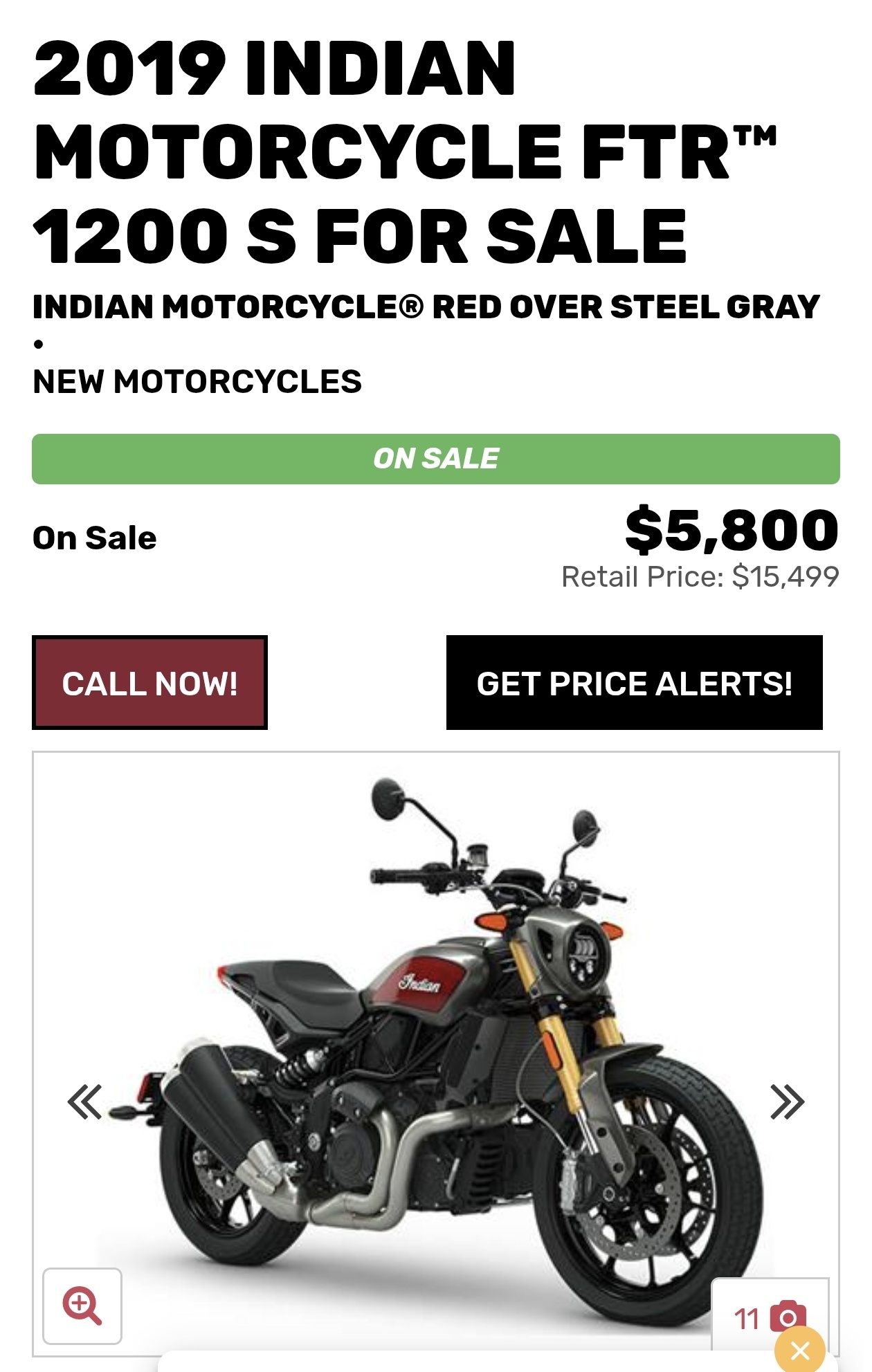
I thought it had to be too good to be true. What was the catch? I called the dealer, and they gave me a story. Apparently, the motorcycle was a demo bike at a different dealer in Indiana. It was ridden several times for demos, parked, and then never got sold. It wouldn’t get sold for a whole six years. Then, the dealership shuttered, with its stock going to an auction. Elkhart Indian Motorcycle scooped it up at the auction and then listed it for sale.
The bike did accumulate 2,200 miles, but since it was a demo, it was never registered and never titled. The dealer said that the buyer of this motorcycle would get a Certificate of Origin, just like you’d get with a brand-spanking new bike. The catch was that, of course, since it was put “in service” as a demo, the warranty triggered and then had long expired.
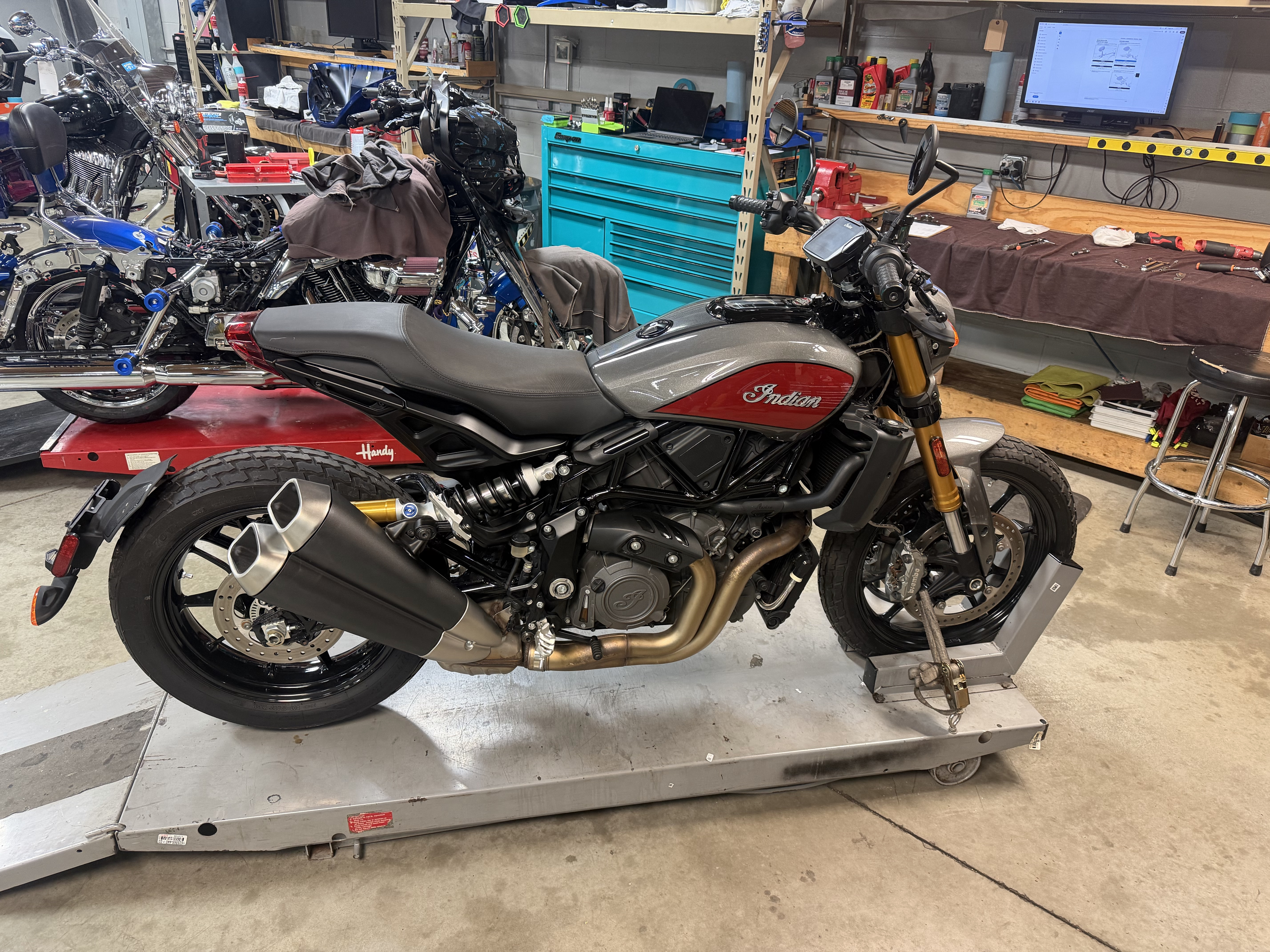
I was hooked and told the dealership to hold it for me. Within a few days, they got me an invoice, which illustrated the other catch. The dealership tacked on $1,800 in freight, setup, and document fees. I thought that was a high markup, but the dealer held firm. Sure enough, when I checked Facebook Marketplace, Cycle Trader, and other dealerships, even $7,600 was the best price in town for the mileage and condition. Other dealers were asking $9,000 for used FTRs with more miles. They also weren’t budging on price. People on Facebook were asking about the same. So, screw it, I locked in the deal.
Technically, my motorcycle garage was full, so something had to go in order for me to add the FTR. The choice was easy, unfortunately. My trade would be my 2024 CFMoto Papio SS. Why? When I bought the Papio two years ago, I learned pretty quickly that the Papio SS was a bike that I liked to look at more than ride. The Papio’s seat was so small and firm that my cheeks felt the burn after only 30 minutes of riding. I wanted off the bike by an hour in, and taking a break didn’t help.

Really, I liked the idea of the Papio far more than I ever enjoyed riding it. My 2005 Genuine Stella has the same top speed, is infinitely more comfortable, and is actually a whole lot more fun. Plus, it’s a two-stroke, which just makes me smile. So, I saw no reason to keep the Papio SS just sitting around and gathering dust.
Elkhart gave me $1,900 for the Papio SS, which is about right. Some local CFMoto dealers are trying to offload remaining new 2024 Papio SS stock for only $2,000, so it sounds like I got pretty close to retail for it. Besides, even if I could have done better on the private market, not having to deal with the denizens of Facebook makes it worth it.
My FTR 1200

The FTR 1200 I got out of the other side is better than I had dreamed of. The dealership wasn’t lying about this being a new motorcycle that just didn’t sell. I couldn’t find a scratch in the paint or any discernible wear anywhere. The only sign that this bike was ridden is the tarnishing on the exhaust pipes. That’s it. Even the screen is perfect.
Once I confirmed that my example is as clean as advertised, I swung a leg over the bike and fired that V-twin up. Back in 2020, our friends at RideApart had several gripes with their FTR tester. Apparently, their bike would sometimes stall out just trying to idle during a cold start. Sometimes, it would stall or buck if the tester tried to ride the motorcycle before the engine was fully warmed up.
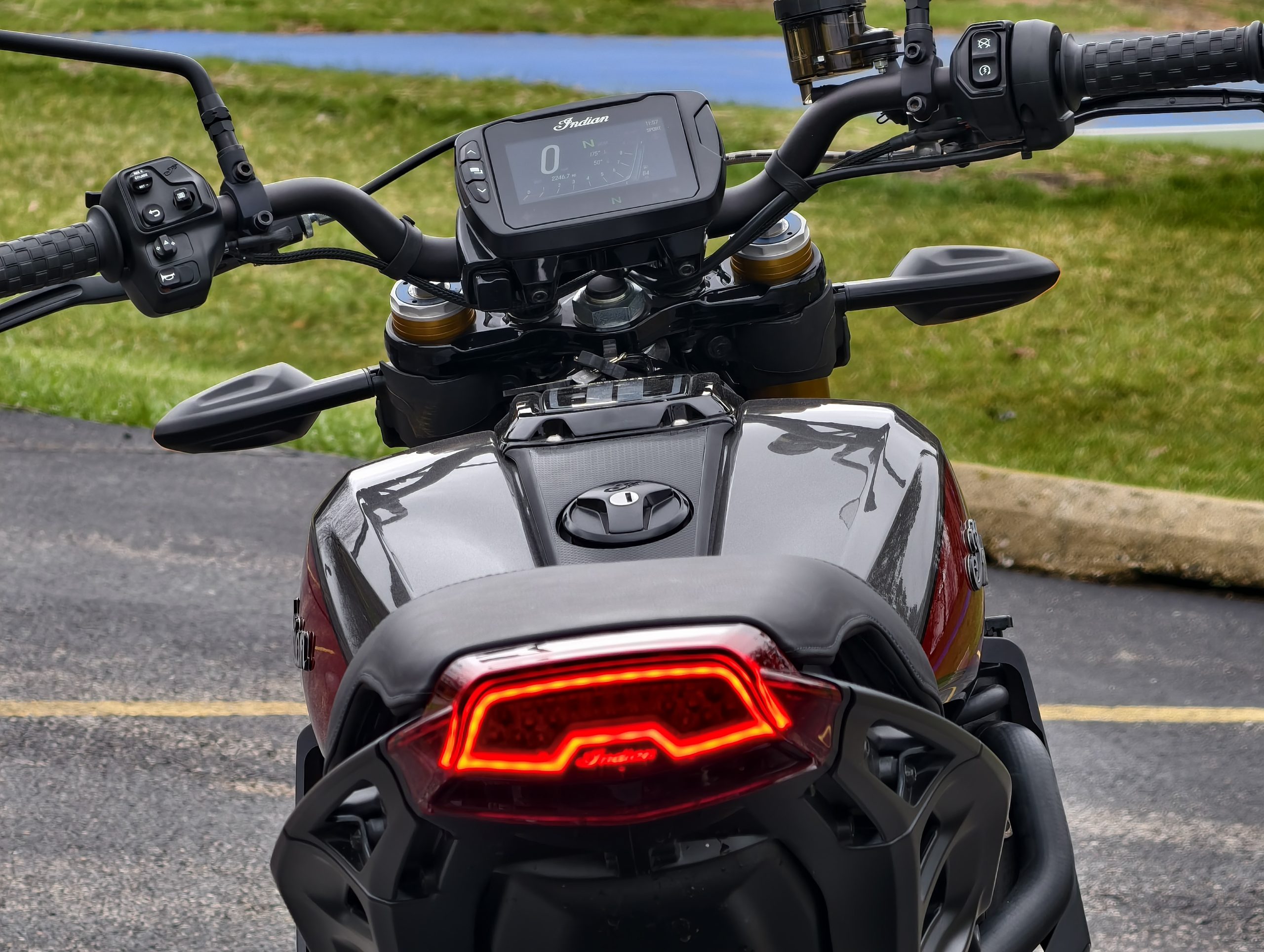
Mine has no problem idling when cold, but it absolutely bucks and tries to stall when I try taking off with the engine too cold. It’s amazing, really, because it feels like a carbureted engine that desperately wants choke, or isn’t getting the right amount of fuel. But once the engine gets close to running temp, that all goes away. I’m told this is normal and is just a quirk with the early FTRs. I can dig it; the weirdness only adds character to me. Apparently, this silly behavior is how Indian tuned the cold start procedure so the bike could meet emissions standards.
Once the 1203cc V-twin wakes up, oh my, is it ready to play. There’s 120 HP and 87 lb-ft on tap, which isn’t amazing by any measure, but what is wild is Indian’s ride-by-wire tuning. In Sport mode, just a tiny blip of throttle sends the tachometer to the sky. If I’m not prepared for it, the bike will even try to wheelie. It’s raucous, but in a way that makes me giggle. I have since learned to be easy on the grips when I’m starting out, or just use a gentler mode than Sport. But when I want to be a hooligan, the bike is ready for it.

The FTR can be just as calm and composed as I want it to be. It’s easy to point the bars forward and enjoy a scenic ride. Unlike my Buell Lightning, it doesn’t turn the instant I have the mere thought of a corner. But if I do want to have fun, the bike is ready and willing to lean over.
I can’t say the same about the Dunlop DT3-R tires. See, Indian gave the FTR chunky dirt-style tires. They look absolutely perfect on the FTR, but they suck at being, you know, tires. They’re very hard, not very sticky, and get squirrely in any situation involving imperfect pavement. Whew, it’s a good thing the Midwest is known for its perfect roads!
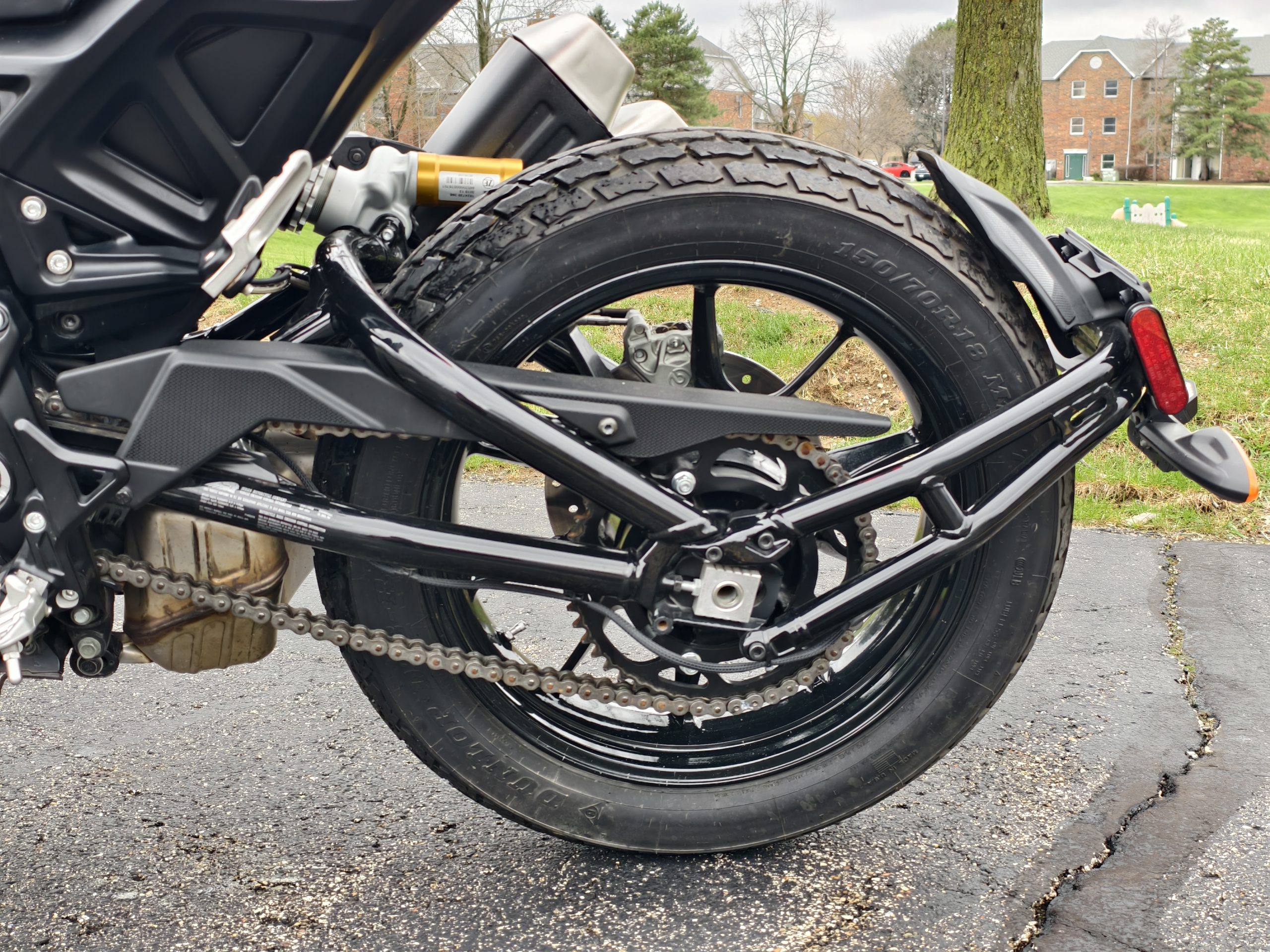
If I take a corner hot, and that corner is not a perfectly manicured road? The rear end gets a little jiggly, and the front end seems to get lighter. Even weirder is just trying to ride on a straight line on one of those roads with a grooved concrete surface. The tires can’t make up their minds about what grain to follow. The front and the rear seem to want to follow a different line, even though I’m going straight, and I end up feeling like the bike wants to slide out from under me. I know it won’t. But the tires suck so much at instilling confidence that the bike feels it wants to be anywhere else but on the highway.
Oh yeah, the highway is also a pretty bad place for an FTR. I’m not talking about comfort or anything, because I think the FTR 1200 feels absolutely great for my body type. Instead, I’m talking about fuel consumption. I have not burned through a whole tank yet, but the fuel gauge nosedives like a stock ticker during a market crash.

The part of the FTR that looks like a fuel tank is not a tank at all. Instead, your fuel goes into a cleverly hidden 3.4-gallon tank under the seat. This is great for weight distribution and for getting the center of gravity lower. But it’s bad for everything else. I’m a member of an FTR group, and people report getting anywhere from 60 miles to 120 miles per tank. As the group joked with me when I joined, I’ll pass everything but a gas station.
I’m also not the biggest fan of the quality of some of the parts. I never noticed this when I rode FTRs in short bursts in the past, but the matte plastics, from the case of the instrument cluster to the turn signals, feel cheap. I’m talking about cheap like a motorcycle from China circa 2012.

It looks and feels as cheap as the plastics that side-by-side bodies are made out of. There are countless reports out there of people breaking their turn signals, so I guess the plastic is just as cheap as it looks.
Thankfully, most of these complaints have either been solved in later model years or through the aftermarket. A tune will get rid of the weird cold start, fresh tires will make it more confident, and the aftermarket is full of turn signals. However, maybe all of these quirks are also part of why the FTR didn’t sell in the first place. Who wants to spend $18,000 on a motorcycle that runs like crap when the engine is cold? Also, what’s with the voltage regulator just sitting behind the front tire?
Dream Fulfilled

So, like all of my dream cars and motorcycles, the Indian FTR is far from perfect. But what is perfect is the smile it gives me every time I crank the throttle, every time I look at it, and heck, every time I think about it. I’m smiling about it as I write about it.
In that way, I think the Indian FTR is the motorcycle that all of America slept on. Yeah, it has some quirks, and yes, it was expensive. But there are solutions for all of that today. If you happen to find one for cheap enough, I think you should get it. The moment you ride it, you might be shocked that, wow, this was built by an American motorcycle company.
I will enjoy riding my FTR throughout the summer. Otherwise, it’ll be going into my garage of favorite motorcycles, where it’ll join my Buell Lightning XB9SX CityX, my Suzuki RE-5, and my teal BMW R60/7. Sometimes, meeting a hero is good.
Top graphic image: Mercedes Streeter


Pretty cool looking bike. Hope you enjoy it. And as always, please be safe. I rode for years but had too many close calls and a head-on collision. That was the last one for me. So be careful out there
On the tyres, if those are original, replace them as soon as you can as they are at least seven years old.
Second, don’t let the tyre shop throw them away, you will never get a new, made in Buffalo tyre again as the factory was closed a couple of years ago.
Funny to think that there is a chance that I touched the tyres that are on your bike.
I’ve been shopping for a new bike since I sold my last one in late 2025, and the FTR S or Carbon might be the best deal in late-model motorcycling. I’m still not 100% sure that it’s right for me, but it is phenomenal. Had I come across the same listing you did, I probably would have jumped on it too. The $1800 dealer fee would have almost certainly made me walk away, but I might have come back because as you point out, it’s still a bargain.
I agree that bike is amazing and beautiful. But to frame it as one of the most beautiful specimens of modern design seems to miss the influence of the V-Rod and its exoskeletal design. I loved my 2006 and miss it. But now that these are being sold so aggressively, I might be buying a bike