

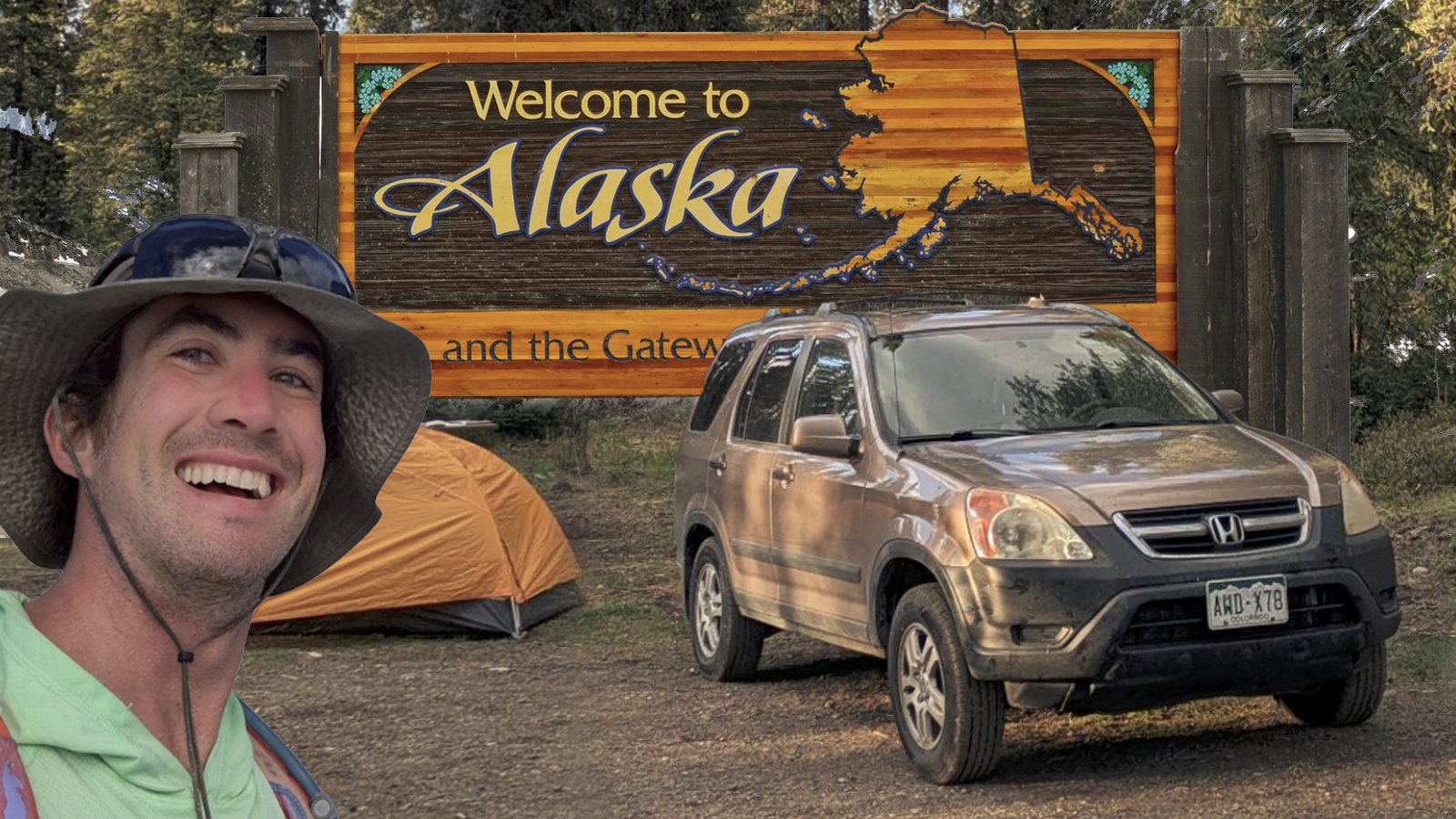
“Have you ever gotten the whole car to shake like it’s on rumble strips at around 50mph?”
“Oh yeah that happens. You diagnosed that for me. Something about not really switching gears or something.”


It’s been only three hours since I left home. I’m on the phone with a friend whose 2003 Honda CR-V I have borrowed for an ill-conceived solo road trip to Alaska — CR-V whose automoatic transmission seems ready, willing, and able to abandon me on some lonesome roadside near the 60th parallel in a remote part of Canada.
I am not a very smart man.

[Ed Note: Daniel Tsvankin is an Autopian member who told us on The Autopian’s member-Discord that he was doing an epic trip in a CR-V. We asked him to write about it for us. If you’re not an Autopian member hanging out with other members and us authors on the Discord, please consider joining the club! -DT]
How Did I Get Here?
Last summer, I spent a one-week vacation in Alaska, staying at a remote cabin belonging to the family of one of my best friends, Alex. Afterward I swore I’d find a way to spend a whole summer at that cabin. (Admittedly, a small part of the allure was an automotive project already conveniently located on the property; see below.)

For the first time in my life, I wanted to live unbound from any schedule, to give in to wanderlust, to cosplay as Henry David Thoreau, with a dose of occasionally waking up and saying “yep, I’m hanging out on a glacier today.”

This spring, I articulated the desire to Alex’s family and got an unequivocal yes. I could spend a long summer at the cabin, which is located near the former ghost town of McCarthy, a six-hour drive east of Anchorage. Even better, Alex (who lives in Denver) decided she was getting rid of her old Honda and accepted my offer to first add 5,000 miles to it by road tripping it from my home in suburban Denver to Alaska. Not that she quite gave my idea a ringing endorsement:

Terrific! It would happen this year. I’d drive Alex’s 2003 Honda CR-V from Denver to Anchorage, stock up on supplies, and then drive out to McCarthy to live at the cabin for the summer. At the end of this Alaska sabbatical, I’d sell the CR-V in Anchorage and fly home.
The Route
Over the course of almost 4,000 miles and 70 driving hours, the plan was:
– Head west to visit friends in Ogden, Utah
– Head even further west to drive up the Oregon coast. I’d somehow never set foot in Oregon before!
– Spend a weekend in Seattle visiting more friends.
– Beeline to Anchorage, first through British Columbia on the Steward-Cassiar Highway and then linking up with the Alaska Canada (ALCAN) highway in the Yukon.
It’s my first time driving a long enough distance that Google Maps has to zoom all the way out to globe view.

America to Canada feat. Swedish Death Cleaning
Grizzly bears. Poisonous plants. Big scary bears. Falling into an abandoned mineshaft. Dying of boredom. No, really, bears.
Whenever I shared my plan with someone, their first instinct was to ask if I was concerned about some grave danger, either on the road or over the long summer at the cabin. It got to me. Maybe I needed to acknowledge that risk, and prepare for its consequences. I needed to confront my mortality.
First came Swedish death cleaning, the practice of getting rid of your extra belongings so the people you love don’t have to deal with them in case you suddenly can’t. Like many gearheads, my extra belongings were mostly cars.
Goodbye Ioniq 6, commuter extraordinaire. I hope someone appreciates your 5 mi/kWh efficiency and Tatra T87-esque curves.

Goodbye Datsun 280ZX project car, back to your original family. I can no longer pretend your blown head gasket is just a cooling system problem, and I hope your L28 naturally aspirated straight six gets the rebuild it deserves. In the meantime, at least my dad was finally rid of the “eyesore” I’d parked next to his house for a year.

Next, I got medical power of attorney forms notarized, designating my brother. Then a few nights before departure, I was in his living room, having a conversation about death. About how I would want to be treated in the event of incapacitation, my minimum standard of living, and if there was no chance of recovery to that standard, how I would want to die. Really cheery stuff. But genuinely important, and serious, and scary, and yes, sometimes awkward.
I finally had to confront the mortality of my loved ones and experience some grief. My grandparents’ health decline accelerated from rapid to precipitous this year. I genuinely didn’t know if they will both be around when the trip was done.
The Saturday before departure, I wasn’t chasing vacuum leaks. I was spending time with my grandparents, telling them I loved them with some extra vigor, and finally driving back home with the twisting, nauseous feeling of maybe having told someone goodbye for the last time.
I don’t Wanna Drive it all Night Long
It’s Monday morning, Day One of the trip and my first time ever behind the wheel of this loaner CR-V. Alex has dropped it off at my place in suburban Denver with a gas tank half full. Time to load up and head north.
Turning on the stereo cues up the CD that’s been left inside.
Ridin’ down the street in my CR-V
Picking up my homies in my CR-V
Kick it with my boo thang in my CR-V
Ridin’ down the street in my Honda SUV
Alex has left behind a CD comprising the rap song “CR-V” burned ten straight times. Our longtime road trip rule is that once a CD starts, it plays start to finish. No skips. I am by myself, but I am a man of honor and integrity, so the CD keeps playing.
I start to wish every modern car interior was even 10% this tactile and this richly brown.

I’ve been riding down the street in my Honda SUV for a good three minutes when it first happens: the whole car starts convulsing and shaking at 45 mph, roughly 2,000 RPM. I mash the throttle a bit and the transmission ends its tantrum. Over the next four hours, I diagnose the transmission rumbling as a grumpy torque converter lockup clutch. On a phone call, Alex reminds me that she’s told me about this already, years ago apparently. I’d mis-diagnosed the issue without having ever driven the car.
I arrive that night at a friend’s home in Ogden to the slight smell of burnt clutch, probably from an overheating torque converter lockup clutch whose solenoid I’d felt banging and chattering its way through town. The housemates at least take pity on me.

I choose to solve my transmission problem by ignoring it and pressing on.
This Land
If you find yourself in the American West and are comfortable without amenities, you’re rarely more than 30 miles from a free place to camp on a beautiful patch of public land. And if you have something like iOverlander installed on your phone, many of those places have been marked and reviewed for you by helpful fellow travelers.
After leaving Ogden, I spend the following night camped on the Oregon side of the Snake River in America’s deepest gorge, Hells Canyon. I have a beautiful BLM land campsite to myself and begin a nightly routine called Taking Photos of the CR-V at the Campsite From Very Far Away.

The next day, still hundreds of miles from Portland, I pull up to a truck stop and notice that the EV chargers are bumping. Four brand new full-size SUVs are juicing up, people are milling around, and…beagles? Beagles! I’ve stumbled onto Operation Frodo!

That night, near the Oregon coast, I set up camp on a ridge in Tillamook State Forest. I regret to inform people that, despite Tillamook’s eponymous creamery, the trees are made of wood, not cheese.

I ultimately detour to the Tillamook Creamery for a quick guided tour and tasting. On a solo road trip, the lingering taste of 10-year aged cheddar is a good driving companion.

After driving up the Oregon coast, I stay on Washington Department of Natural Resources forest land. I see and hear no one else that night, then wake up inside a cloud the next morning.

A quirk of these public lands’ multi-use nature, and of their origins in managing logging access (among other things), is that camping isn’t the only thing happening out here.
In Tillamook State Forest, I was woken up at 7:30am to the blasts of two guys sighting in their hunting rifles 50 feet from my sleeping location. In Washington, my morning alarm was logging equipment rumbling to life on the other side of my hill at the same hour.
I Did Not Stop for Timbits
On a Monday morning one week after I’ve departed Denver, I start the day on an air mattress in a friend’s spare room in Seattle after a weekend of catching up, ready to load up and start the Canadian leg of this journey.

I walk out to the CR-V, and nothing. No lights, no sounds, no response to the fob. The headlights have been left on all night, and the battery is dead.
A dead battery isn’t inherently a problem; I’ve packed a clearance-aisle lithium ion jump pack that just barely gets the CR-V back to displacing 2.4 liters of fuel-air mixture per two crankshaft revolutions. The real problem is vibes. I’ve managed to screw up despite being comfortable, well-fed, and well-rested all weekend — poor omen for two days from now when none of those things is true.
After crossing into Canada, my route snakes north hundreds of miles until reaching Highway 37, the Stewart-Cassiar scenic byway.

It’s a bucket list drive. Black bear cubs sitting next to the road, amiably watching traffic go by. Soaring peaks, fearsome rivers, sparkling lakes, towering trees. All viewable from the car window during the day and from within 50 feet of my campsite that night.

After almost 500 miles through British Columbia, the Stewart-Cassiar ends at the ALCAN, which takes me through the Yukon toward Alaska.

Canada Lesson #1: Range anxiety is not entirely exclusive to EVs. Five miles past the town of Dease Lake, I realize I’m on the Stewart-Cassiar’s longest stretch of gas station-free road: 247 kilometers (154 miles). I shamefully U-turn back to town to fill up, despite my tank being over half full.
Also: With enough patience and gumption, this whole journey is doable by EV. There are BC Hydro 50kW charging stations scattered along even the most remote chunks of the drive.

Canada Lesson #2: You can often find a vast cross-section of humanity within just two miles of home, but you can certainly find it 2,000 miles away from home. Indian college students goofing around in a Prince George convenience store. Australians whose working holiday took them to an inn partway up the Stewart-Cassiar. The Quebecois accents flying around a food truck park in Whitehorse, which is a shockingly charming city with a nice riverwalk.

Four days after leaving Seattle and one day before Juneteenth, I ride a highway built in part by thousands of African-American soldiers into Alaska. I’m on the ALCAN with a mission: to finish this last 12-hour leg to Anchorage today, with a night of sleep on a real mattress (my first in 10 days) at Alex’s parents’ house as my reward. My butt is numb and my legs seem to be permanently cramped. I’m scarfing down Scandinavian Swimmers with the vigor of a Katmai grizzly bear prepping for hibernation. I do not slow down or cancel cruise control for the tsunami-sized frost heaves or the hot tub-sized potholes.

About 240 hours after setting off from Denver, I reach my destination. I arrive in Anchorage to warm hugs and hot Thai food, collapse into a mattress, and pass out for 11 hours. Part 1 of this summer’s journey is complete.
OK I Guess we Need to Talk About the Picnic Table
Tell a group of gearheads that you’re taking a 20-year-old, beige-over-beige compact crossover with a four-speed automatic transmission on a camping road trip, and the crowd will go mild. But mention that it’s a Honda CR-V?
“OMG are you gonna use the table?”
“Hope you’re putting the CR-V picnic table to good use.”
“Show us your CR-V table.”
These are real quotes from three different, very real people.

Even the highly sophisticated strata of society known as Autopian Members apparently goes crazy when an automaker builds a picnic table into their best-selling compact crossover.
Fine. Here you go. Ugh.

But is the Picnic Table Good?
It’s perfectly cromulent! The picnic table forms nearly the entire load floor of the CR-V’s pleasingly cuboidal cargo area. It’s removed by pulling a handle up to unlatch it, then really yanking up and sliding the table out. Putting it back is the reverse process and is also unexpectedly hassle-free. The table self-aligns in its groove and latches back in snugly.

It’s also a packaging triumph.
In the back of this generation CR-V, you’ll find not only a picnic table snuck underneath the cargo area’s carpeting, but a deep spare tire well beneath it. A full-size spare is lashed to the side-opening hatch. In an era of “here’s a can of fix-a-flat, have fun”, this whole cargo area is a delight. And early 2000s Honda definitely knew what they had.

The drawback of a picnic table load floor is that you’re unloading the entire car if you have the audacity to try actually using your CR-V’s picnic table.
On my first night using the table, I tried to cheat and only unload the heavy items occupying the cargo area’s center while leaving perimeter items be. As soon as I pulled the picnic table out, the carpet on top collapsed into the spare tire well. Water jugs tipped and leaked. Cookware clattered. Nerves frazzled. You can see the implosion in the background of this photo, taken on Picnic Table Night 1 in Oregon.

Lesson learned: the CR-V picnic table is not to be used on a whim. You can’t just pull into a suitable field in the middle of a drive and have a picnic like you’re in a Chrysler Cordoba brochure or something. If you want to use the table, you must commit to all the unloading that precedes using the table.
But once you do commit, it’s pretty good! You get a shockingly stable cubic yard of real estate to cook with, and it’ll seat four in a pinch. I was doing little more than eating camp ramen and reading Annie Dillard’s Pilgrim at Tinker Creek at this table, but it clearly has the potential for greater things.
So What’s the Punctum of This Trip?
I face death before driving a single mile, awake to gunfire in the woods of the American West, and marvel at the beauty of both nature and the human condition in Canada…but you people just want table pics.
Top graphic images: Daniel Tsvankin; DepositPhotos.com


We had the same CRV in manual. It was great, and we miss it nowadays when cars are boring. We used the table, loved the flip up glass door for our dogs. Loved how useful it was.
Best memory was when the alternator died as we were on a road trip: The car slowly shut down systems and yet kept going. First the radio cut out, then the power windows stopped working, then we had reduced power when the fuel injection was losing power. We coasted off an exit, got a battery and got to camp and fixed the alternator the next day.
Great story! My parents were the orignal owner of a white CR-V and it had about 240K literally trouble free miles. From day one, my mom said she was keeping it until 300K. There was no stopping that thing – except for a drunk driver at about 2pm in the afternoon. Of course he didn’t have insurance. Their full size truck hit the A pillar on the driver side after running a stop sign. A fraction of a second later and my mom likely wouldn’t have walked away from the impact.
During the bicentennial my wife was the advance person for a small family circus that headed up from Los Angeles to Alaska; she would travel ahead, set up a venue, do publicity, make sure about power, the “Water for Elepants”, etc. She drove and lived in a Datsun station wagon with dodgy electrics up the then-unpaved Alcan to Anchorage. She’s got stories.
Today she drives a 2004 CR-V. I’m sure there’s a moral to this story somewhere.
I thought “small family circus” was a euphemism (one I can very much relate to), then you said “publicity” and suddenly I knew this was the real deal.
The Aristocrats!
/ No, no, definitely not what was meant.
What a delightful story (so far) told well! Regarding choice of vehicle, I’ll quote a fellow motorcyclist:
An adventure is what you get when things don’t go right. Y’all can keep
your “adventure tourers”, I’ll keep riding my “dual sport”.
Excellent choice of a an almost indestructible car. My sister has almost the exact car that will not die and refuses to be a anything but reliable. The only thing that might give it a run for its reliability is a 90s Toyota. It needed brake pads at about 80k mi and a cv at maybe 85k mi. It goes about 8 years between batteries. The transmission filter and fluid get changed every 50k that’s about the hardest maintenance. I wish all cars had the maintenance set up as those especially the headlights. About 20 seconds to change a bulb. Same era GM or German car you are taking the whole front end off. It still has its new car smell after 23 years. I don’t understand that. My daughter’s stupid Subaru had new car smell for about a week.
Most car companies are reducing the VOCs that cause new car smell, including Subaru, because they’re toxic.
Sure but there is still a smell for a period. Maybe not from the plastic or foam but carpets and fabric. Subaru nothing. Newer Honda’s still have a new car smell that lasts for a significant period.
They’re reducing them, they can’t completely move away from them yet.
Great stuff, and a big nudge to me finally paying my dues so I can keep reading great stuff like this (not a car guy but appreciate them, plus good writing and am also the proud owner of a boring, table-less CR-V).
But this burning clutch issue, which would have given saner men pause, you just kept on going and, nothing came of it? Blatant disregard of Checkov’s first principle, although the play may not be over yet.
When I was a kid for one family vacation I flew with my parents to Seattle. Then rented a car, a 1990 or 1991 Geo Prisim and we drove to Alaska and back in two weeks. I was 13 at the time and annoyed I wouldn’t get an opportunity to share in any of the driving.
As you can imagine nearly the entire trip was in British Colombia. The scenery ranged from mostly beautiful to at times breath-taking.
And the roads in BC seemed to tend to maximize taking advantage of the rivers, meaning the road bed would follow along the rivers, which had the effect of making the mountains taller vs mountain roads in the US side of the Rockies which seemed to more commonly take a brute force and blast into the side of the mountains or through them.
On that trip is the 1st time I remember ‘calling a loon’ from the middle of this seemingly giant lake on a misty morning close to us. We wanted to get a picture of it taking off, so once it was close, we through a small pebble near it. And that is when we learned Loons dont usually take flight when they are scared, instead it dove under the water for a solid 90 seconds and popped back up where we didn’t expect. We repeated this a few more times and not once did the loon pop up where we expected it would…
There also was 1 night we stayed in a legit logging camp in metal trailers bc where we were there really wasn’t another option that night other than sleeping in the car.
And I remember seeing a ‘turquoise’ like blue color in a mountain lake that was so gorgeous Ive yet to find an equal, nearly 40 years later.
If you are up for a bit of an adventure and have or are willing to make some time… it will be a lifetime memory.
I learned that in the US Rockies anytime a railroad and a road were traveling along the same river or pass, the railroad got the good side.
The railroads were there decades before and got first pick.
Later the engineers designing the roads had to work around that they got the more difficult land to work with.
That makes a lot of sense
Just a small pet peeve – Henry David Thoreau wasn’t actually very far from civilization- maybe a couple of miles from the town center, and he had a train going by a few dozen yards from his front door. I think the interpreter at the cabin said his mother did his laundry while he was in the woods. Thus if you want to emulate his simple life you just need to find a bit of woods anywhere you can and setup camp – remote locations are not needed. He was also good friends with the pretentious Ralph Waldo Emerson, who owned the woods and cabin near Walden Pond.
That’s on me, I should’ve articulated what I meant by “cosplaying as Thoreau” instead of accidentally perpetuating the myth. The cosplaying Thoreau bit, for me, is about making the time and space for contemplation, not some survivalist escape. So you’re right, I didn’t need to be thousands of miles from home to do this. Sounds like you’ve been to Walden Pond, which is very cool.
The meditative stuff does seem spot on, and a good thing. The mindful outdoors folks have studies that show reduced signs of stress from time in nature – especially in the woods.
Apparently trees emit phytoncides which, among other things, can reduce your blood pressure, reduce cortisol levels, and help with depression. I am not familiar enough with the research to know if this varies by type (hardwood/softwood) or species – but the resulting advice is the same – get out in the woods.
I have been afraid to return to Alaska after a long tourist trip many years ago on the fear that I might not come back, the nature is great and the can-do culture of getting anything done with your head and whatever is available is enticing. Of course this is offset by some of the extreme personalities – the stereotypical advice to single women was “the odds are good, but the goods are odd;” which does have some basis in reality.
Having lived in Alaska in my 20’s, I can attest that the “odds were good, but the goods were odd” was on both sides. But it was a fun time and I would do it again. You just have to like to be outside in the winter.
Sigh, I should have read your comment before leaving mine. As any pencil geek can tell you, Henry David Thoreau was also one of those people who invented processes during the industrial revolution we take for granted, in his case the modern pencil.
About 16 years ago I flew out of McCarthy airport to do some field work out at May Creek where we stayed in an old forest service cabin. If you want another automotive challenge there is an old Land Rover that was parked beside the cabin slowly becoming part of the scenery. Curious if it is still there?
Torque converter issues? Ha! If only there was a superior transmission design that didn’t even hassle with such a finicky part…
Next time you even think of making such a trip, be sure to be properly prepared. You know how I mean.
The Jatco Xtronic has a TC, so I guess that would have to be a manual in this case.
Circa 1993, my brother and I planned the same trip. Drive cheap car to Alaska, sell car, fly home.
Alas the cheap car we chose was a 1964 IH Travelall with 160k miles on it. We paid $450 for it… then a hundo here and a hundo there fixing issues. At around a $1000 and still unreliable, we borrowed my folks ‘87 Grand Marquis instead and circumnavigated the west.
Great trip – but I still want to drive the AlCan.
Having now driven part of it, I’ll second my friend’s original advice to me: it’s a drive best done with weeks of time on hand.
Great write up and an awesome trip! I don’t understand how everything is a crossover now but they are getting more boring instead of more interesting with diversification…no side opening gates, or clamshells, or separate opening glass, or exterior spares, or tables…
I can live without a lot of those features, but for a long trip through remote areas like this, the availability of a full-size spare was surprisingly clutch for my sanity.
I DIDN’T KNOW ABOUT THE TABLE UNTIL TODAY
Between you and me, I only found out about it when the CR-V was getting dropped off with me for this trip. I don’t know how so many people just know about this.
Hi do you know what website you are on?? Weird minutiae is our specialty!
#thisisgoodautopia
67 hours?!?!? What?
Mind blown.
Seattle was a shockingly big detour! The straightest shot from Denver to Anchorage would’ve been 54 hours on the road.
Pretty cool. Reminds me of the aughts
Huh, today I learned people find it weird to hear gunshots when outside, I hear it all the time from my backyard.
I’m used to it in the woods! It just sounded like it was coming from literally right next to my tent, which was quite the wake-up call.
Yeah but at 7:30 50 feet from the car? How rude!
I’ve been to McCarthy in my ’81 Toyota 2-wheel drive pickup, during the seven years I lived in Anchorage. An interesting place. A CR-V sounds like a luxury ride!
I had a 79 Toy P/U 2 wheel drive in the mid 80’s in FBKS. Drove that thing all over the Interior. It handled a 3 wheeler in the back at 70 mph down various dirt highways nice and stable.
Table pics or GTFO
The pics in the article are the ones you get for free, all the saucier table pics require an RCL membership.
Okay but tell us about the chairs? You can’t fit 4 people at a table without chairs.
If I was really committed to the CRV life, I would’ve unbolted the rear seats and used those with the picnic table. Alas, I brought a camping chair instead.
Great write up!
I appreciate you mentioning whether this is doable in an EV. A Rivian with camp mode (yes I like my creature comforts) sounds like an ideal way to do this drive.
Doable, but ouch that 50kw max would hurt. Under best case conditions your there for at least 2 hours.
I watched a YouTube video of a guy that effectively turned his F150 lightning in to an erev by strapping a very nice gas generator in the front of the bed & plugged into the ‘in bed’ 220v outlet.
He could remotely turn it on from the cab while driving significantly extending his range.
Oh man that’s awesome back of the napkin math says that could easily extend the range 30% at moderate speeds. I wonder how he got it to charge while driving, usually automakers lock out that feature. Either Ford allows it or someone was good with code.
I was wondering the same unfortunately he didn’t elaborate
There is a YouTube channel ‘Trucked Up Evs’ he’s from Canada and also has annF150 lightning. In a recent video he Did go in to some detail for a similar set up. I think the shop he’s working with is considering selling a kit (allowing a regular in bed generator to recharge the vehicle while driving)…
Here it is…
https://youtube.com/watch?v=mshFE9cj8T4&is=OdFiwv9m_zHaVsTl
Why would they do that? Asking honestly!
If asking why people would set up an F150 lighting as their own DIY erev, I think it is partially peace of mind, though for the few like Trucked Up Ev, I think it is a practical solution since the F150 Lightning is particularly range constrained and in the great wide expanses of the Western North American continent while 120v electricity connections are all over whereever people live, at times even finding 240v for level 2 charging can be challenging, let alone finding level 3 rapid charging.
Sadly in the US at least you have really 2 decent truck ev options if using the vehicle frequently for longer trips:
1. Chevy Silverado Ev (+GMC equilivant), thanks to its honking huge 220 kwh battery pack
2. Rivian R1T
The F150 Lightning sure could be used for longer trips too, its just better suited due to its more limited range as an around the same large metro area kind of vehicle
I have always wondered why this design was not used more often especially after The Geoffrey. The original hybrid.
I saw an F-150 lightning juicing up on the Stewart-Cassiar and an R1T charging in Beaver Creek (last town in the Yukon along the ALCAN before it enters Alaska), so there are definitely folks out there doing it.
You’re not getting from Seattle to Anchorage in four days in an EV, but if I did this drive again I wouldn’t want to. It’s the kind of drive that’s better done in short legs at a leisurely pace. Stop for an hour to charge, have a drink, maybe make friends with a stranger, see the scenery, and off you go for another few hours.
Yep, everywhere I stopped had credit card readers. The pumps weren’t networked though, so I did have to go in afterward and tell them how much gas I got.
This trip sounds like a real ‘table rasa’ moment in your life. Look forward to updates.
True adventure folks know the key accessory isn’t the table, it’s the genuine melly.
McCarthy is a true adventure town. On my list of adventures, but sadly likely to now never happen, is the Alaska Wilderness Ski Classic. The Wrangell range routes start from McCarthy. Such a great place to get to spend time. Thanks for sharing.
Great spot on the melly! McCarthy is a special place. Not just the scenery but the people. There’s plenty of adventure to be had now, but the stories from folks living out here 50 years ago are WILD.
Alaska Mountain Wilderness Classic also ran Nabesna to McCarthy many times. I moved to Alaska because of the mountains as well as the outdoor adventurers who did those kinds of races and other adventures and blended the outdoors into their careers as science professors.
The Haul Road would eat that CR-V and leave nothing behind. Alaskan roads, especially dirt roads, are an entirely different beast than lower 48 dirt roads.
If the cabin owners have a bear gun, take it. You will not be close to the top of the food chain anywhere outside of the big cities. And Anchorage has plenty of moose and bear. If they do not have bear guns, visit Costco and buy a few packages of bear spray.
When my siblings and I went up to Fairbanks to spread my Dad’s ashes a couple of years ago, my anti-gun sister made me borrow a 44 Mag for the hike. I was only concerned about moose on that hike, wrong time of the year for bears in that area. But I still got to carry a 44 Mag.
Above all, remember to be prepared for the conditions. McCarthy area is not what you can call real warm.
Imagine saying “do you feel lucky, punk?” to a moose or bear! I know that’s not the exact quote but that’s how most people remember it.
“You gotta ask yourself, Do I feel lucky? Well, do ya, punk?!”
/ I think I got that right.
It is more like you have a potential 5 rounds on a 44 Mag revolver. One is always empty, and is where the firing pin rests. That leaves 3 rounds for the bear/moose, and one for you when you have missed said charging animal.
With an old fashion single action – yes, leave one chamber empty. With a modern gun with a transfer bar you can load them all.
Alaskans go for tried and true, especially in the gun area. I figure he has had that gun for 30 years, and before that he had a 44 Mag with a shorter barrel. If you meet a party of Alaskans in the bush, at least half of them are carrying something under the jacket.
The Ruger Super Blackhawk has had a transfer bar safety since 1973.
Sorry to say this doesn’t appear to be anything but a person trying to make a mountain out of a molehill. No real challenges YET I’d prefer a litany of the interesting people you have met along the way.
No, he’s making an adventure out of a Honda CRV, one of the most reliable cars; and there’s nothing wrong with that.
It’s much more of an adventure than most of the people reading will accomplish this summer, and that makes it a bit inspiring for most of us.
Maybe you should instead tell us, or even propose to the editors to write up, what you did this summer (from a car perspective )? I look forward to hearing about your even greater adventure!
Alaska is an amazing and weird place.
Keep heading north to Osaka Restaurant in Utqiagvik (formerly known as Barrow) Alaska – the Northernmost Sushi Bar on the planet.
It’s only open during the summer.
My Parents once did an excursion on the Alaska Highway from Fairbanks to Cold Foot.
Out in the middle of nowhere the driver stopped the van, went in back, pulled out a roll of carpet and unfurled it. There was a white line on it and he told them to stand on the other end of the carpet.
When asked what this was – he said “This is the Arctic Circle. Say Cheese”
There’s a sushi restaurant in Svalbard that almost certainly has it beat. Not that means someone shouldn’t head to Utqiaqvik…