


There are many vehicles you can reasonably expect to see at EAA AirVenture Oshkosh each year. Anything that flies is a safe assumption to make, as would be seeing Volkswagen Beetles with chopped-off roofs, thousands of RVs, and military trucks. Something you won’t usually see is a mail truck, yet there was one just randomly parked in one of the showplane areas during AirVenture 2026. This is Project Airmail, and it’s no typical mail truck. Instead of delivering mail, this truck delivers aircraft-grade horsepower with a Lycoming R-680 nine-cylinder radial engine. Yes, this truck is functional, and oh yeah, it moves.
Project Airmail’s positioning during EAA AirVenture Oshkosh 2026 was honestly hilarious. It was located just north of Boeing Plaza, parked next to the aerobatic aircraft of the International Aerobatic Club. The truck stopped me in my tracks at first, because it was such a weird thing to find only feet away from an Airbus A350 and a bunch of Extras.


If you walked up to the truck from the front, you might have wondered, like I did, why a random mail truck was parked in a high-traffic area of an air show. But a short walk to the rear answers all, just to generate many more questions. At some point in this truck’s past, someone gutted the interior, and in the space that once carried mail sits a rather sizable Lycoming R-680 aircraft radial. I had the same questions as everyone who stood around me. Does it run? How does the transmission work? Who built this madness?

Sadly, some of the owners of the showplanes parked at AirVenture don’t really hang around their aircraft all day, and the Airmail truck was no different. I stopped by the truck multiple times, but never identified its owner. I’ve been able to figure out some details by examining the truck for about an hour, but I wasn’t satisfied. Thankfully, digital creator Jon Uelsmann lucked out and got to talk with the owner, so now I have much more of the story of how this rig came to be.
A Predecessor To The Grumman LLV
Let’s start with the base vehicle.
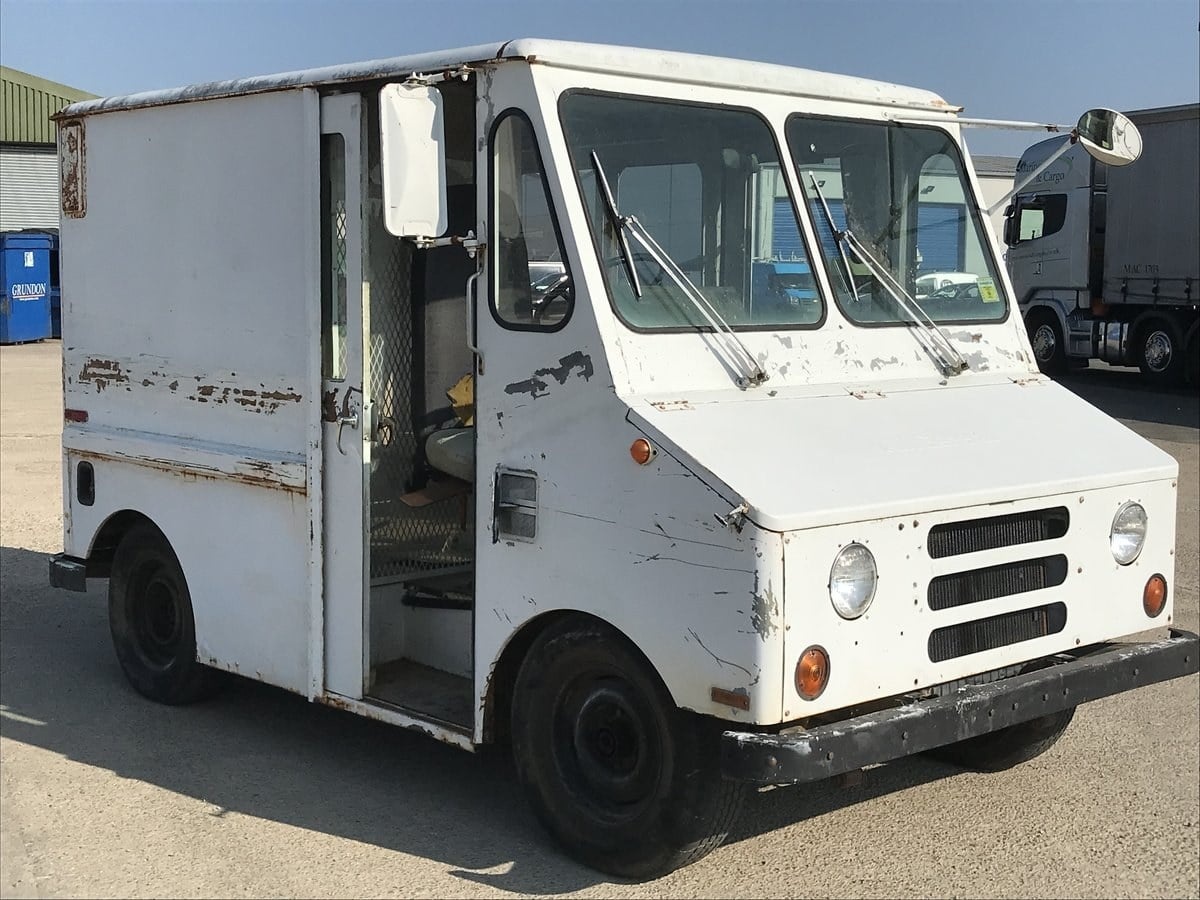
The builder, Ron, says that the truck is a “1984 GMC Mail Truck,” but I think there’s a bit more going on there. The body is that of an AM General FJ-8C mail truck, which was built in 1984. The FJ-8C had a chassis by AM General, an AMC 258 cubic-inch straight-six, a three-speed automatic, and parts commonality with Jeep CJs and J-series trucks. In stock form, you’re talking about 115 horsepower of package delivery fury.
These trucks were used alongside Jeep DJ Dispatchers in the era before the legend of the Grumman LLV. Like those other mail trucks of old, the AM General FJ-8C does not have an aluminum body, and instead it rocks steel.
After their mail service careers, many FJ-8Cs were turned into food trucks, local delivery vans, and even hot rods. It’s possible that, at some point in this truck’s past, the AMC gear was removed for GMC power. I highly recommend checking out some AM General FJ-8C builds, because they get really awesome. But I think Project Airmail might be the build to rule them all.
Project Airmail

Ron found this example rusting away in a field. He dragged it home and decided to do something different with this build. After cleaning up the body, he sourced a Lycoming R-680 nine-cylinder radial engine.
These mills were built beginning in 1929 and were notable for being the first production aero engine by Lycoming Engines. Notable for its reliable power, the R-680 became a standard in general aviation and military trainers for years. R-680s were placed in everything from the 1930s Stinson Airliner to the 1930s Waco S Series biplane. Lycoming built more than 26,000 examples of these engines, and they can still be found in use today. This example is said to have been taken from a Stearman/Boeing PT-13 Model 75, which was used as a military training biplane in the 1930s and the 1040s.

The R-680 was a solid piece of engineering for its day. In 1930, Aviation Week described how it was built:
A quieting curve on the cam ring, and the employment of a rotary induction system have contributed to the smooth operation. All oil pipes have been eliminated, both the pressure and return oiling systems operating either through cored or drilled holes in the castings.
Delicate gear-trains and high speed rotary parts have been, as far as possible, eliminated. Ignition is furnished by one dual type vertical magneto with’ two independent distributors. The whole ignition system can easily be shielded, should it be desirable. The lubrication system consists of one pressure pump and two scavenger pumps built into one complete unit. Starter and generator drives are mounted in easily accessible parts of the engine and starter operates directly on an extension of the crankshaft. The generator drive is such that it may be withdrawn for inspection.

At launch, the 680.04 cubic-inch, nine-cylinder R-680 made a verified 210 HP at 2,000 RPM and had a weight-to-power ratio of 2.24 pounds per horsepower. As placed in a Stearman PT-13, the R-680 made 220 HP. We’ll get back to that in a moment.

Since a radial engine is meant to spin a propeller and not the input shaft of a transmission, Ron devised a Rube Goldberg-style pulley system to drive both the transmission and accessories. A thick belt on a large-diameter pulley filters down to a smaller pulley that drives the alternator or generator, and one more pulley is on the input shaft of the transmission. The radial engine is air-cooled, so no radiator or related ancillaries are present. However, since there isn’t a ton of airflow inside of a truck, every cylinder has its own cooling fan. An inertia starter spins the engine over.

As there isn’t a propeller or anything else acting as a flywheel, timing had to be pulled from 30 degrees to 15 degrees so the engine would stay running. The pulleys of different sizes were used because, like typical aircraft piston engines, the R-680 doesn’t rev much higher than the 2,000 RPM range where it makes peak power. Having the big pulley at the top and the small pulley on the transmission is supposed to make the power a bit more usable.
That transmission, or more accurately, transaxle, came from a Chrysler Concorde, which is front-wheel drive. Normally, this unit has four forward speeds, but in Project Airmail, the only available gears are reverse and second. Ron didn’t have an explanation for this, but this transmission is computer-controlled, and I found no module. The transmission may be just stuck in second because it doesn’t have a control unit. Apparently, that doesn’t matter as, per Ron, the radial has so much torque that the truck could probably do a wheelie in the one gear it has, anyway.

Other Concorde bits include the axle shafts, hubs, and brakes. Everything else, from the engine cradle to the unique cantilever rear suspension with 750-pound springs, was designed in CAD and cut on a plasma table.
Something I really love about the truck is its attention to detail. On the right wall sit two 500-pound “bombs” on a rack with a background of the engine’s schematics.

But they aren’t just there for show. One is a fuel tank, and the other is an oil tank. The amazing part is that the engine is said to run on 87-octane pump gas just fine, so long as there isn’t ethanol in the fuel.

The details aren’t just in the tanks, either. The exhaust ducting is simply metal art, and I giggled so much at the mailbox taillights. Honestly, had I not been told that this truck was once a rust bucket, I would never have known.
Maybe I’m crazy, but this is actually a cool implementation of a steering yoke:

I also like the front end, which gets its grille from a 1950s Ford, the headlight buckets from a 1939 Chevy, and the headlight trim rings from a 1949 Studebaker. The cutouts around the headlights, taillights, and grille were all done by Ron. The front end works so well to make the truck look like a vehicle that you might find in a Fallout game. Apparently, the fenders come from a 1937 Chevrolet, and the steering yoke is 3D-printed. Oh yeah, the interior is full of even more of that incredible metalwork.
Before you ask, of course there’s video of this beauty running! I wouldn’t have published this article if I didn’t have a clip for you. Sadly, I didn’t see it leave Oshkosh, but YouTube came to the rescue (click here if you don’t see the embed):
Move Over, Grumman LLV
Oh, what a glorious way to lose hearing. While Ron has not fully documented the build, you can click here to see some videos and shorts from the truck’s build.
While I never got to meet Ron, I’d like to believe he’d have great gearhead stories to tell. This is a guy who saw a dilapidated mail truck and could have done the same slammed V8 builds that everyone else does. Look, that’s not a knock on LS builds. I respect anyone who can make something with their own two hands. But the creativity of this one is off the charts. Ron shoved a radial engine in this thing and sent it. I don’t even care that there’s technically only double the horsepower from stock; I can only imagine it’s 100 times the fun.
I’ve been a fan of the Grumman LLV since I was a kid, and you know what, I think I have a new dream mail truck. Forget a Chevy S-10 with an aluminum body; I’d love to run around in Project Airmail! This build now makes me wonder about the craziest road-going vehicle that could benefit from radial power.
Top graphic images: Mercedes Streeter


There’s always this MR2: https://youtu.be/EaKXCAx5YGs
They never managed to get the power from the engine to wheels reliably enough for endurance racing and kept breaking chains, 90 degree adapters, or just about anything they could try.
I actually used a 1997 P38 GM mail truck for my delivery truck. It was actually bought by a medical facility tricked out to power medical devices during health fairs. I bought it in 2013 with 38,000 miles. It had a diesel, and all kinds of fancy stuff. Nothing better than the block heater that I plugged into my porch light that allowed me to start up the truck and have instant heat at 3am when it was below zero outside. The all aluminum body had no rust. Unfortunately the brain of the transmission wasn’t all aluminum.
Nothing says, “America, f**k yeah!!” like a giant eagle on the side of a mail truck powered by an aircraft engine. (Hell of a build, though.)
It’s majestic.
All hail the Air Mail!