

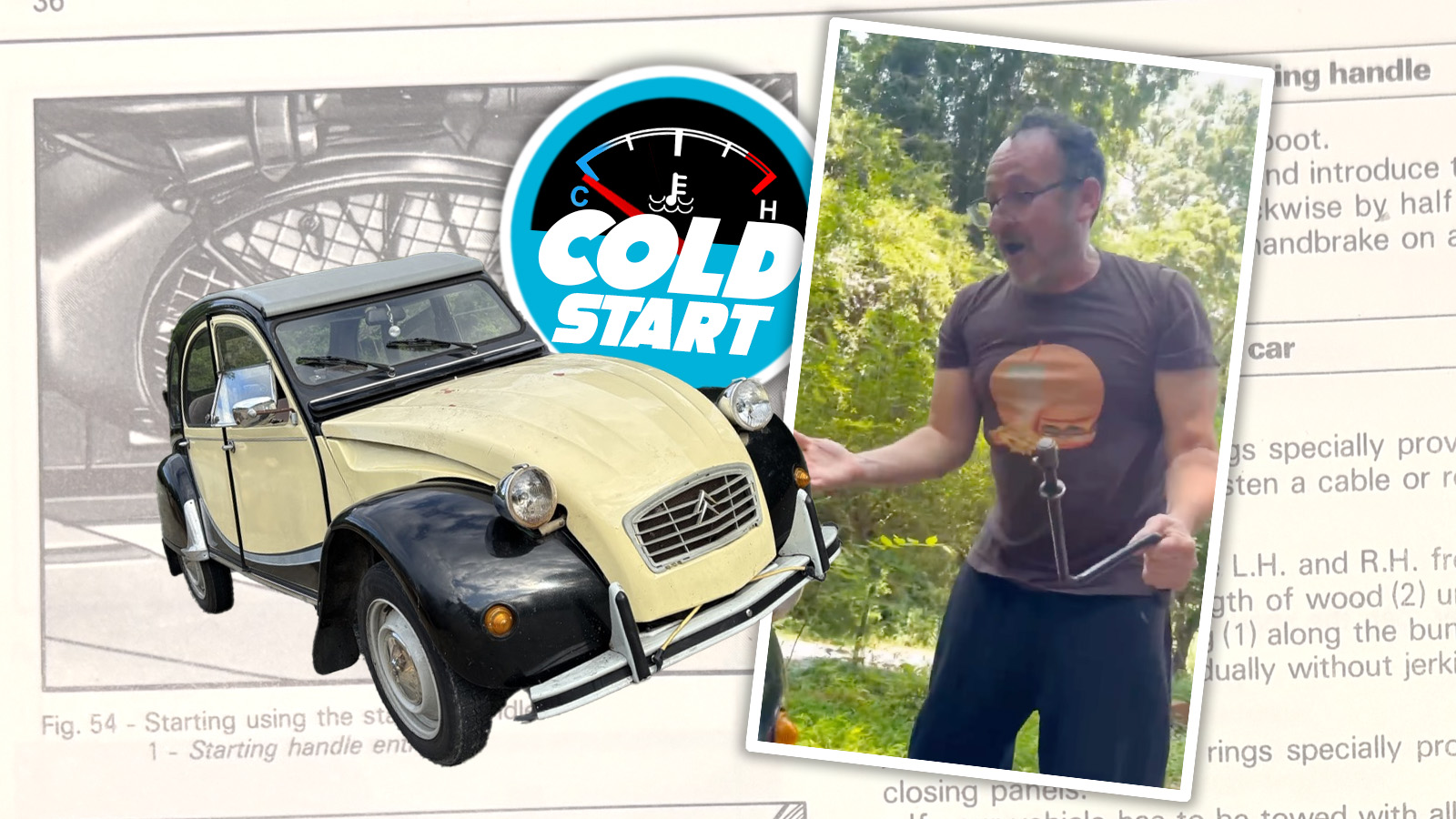
If you have a car with a unique feature, even if that feature is not especially useful, at some point you have to use that feature. If you don’t, you’re only half-living your life, automotive or otherwise, and that just won’t do. You’ve got to try whatever the hell that thing is at least once. That’s why I drove my Citroën 2CV recently with a huge grandfather clock sticking out of the roof, and it’s also why I finally started my 2CV with a hand crank.
Yes, one of the things I love about the gleefully minimal and willfully primitive 2CV is that it retained its ability to be started via a hand crank throughout the duration of its long production run, from 1948 to 1990. Every 2CV built in that time came with a crank designed to provide an alternate means to start the car, should the battery or starter fail on you.


Luckily for you, and, let’s be honest, global history, I was able to capture this staggering moment on video:
View this post on Instagram
Dazzling, right? I was genuinely delighted when the thing finally caught and started. That’s not Instagram-fueled fake emotion there that you’re seeing; that’s genuine glee.
I think I could have gotten it started a bit quicker if I was able to keep the fan mesh in place, as it has a special – well, the owner’s manual says “orifice,” which sounds needlessly biological to me – to insert the crank, which helps keep it oriented properly and engaged with the dogs on the end of the crankshaft designed to take the crank end.
Here’s the page from the owner’s manual about crank starting, if you’re curious:
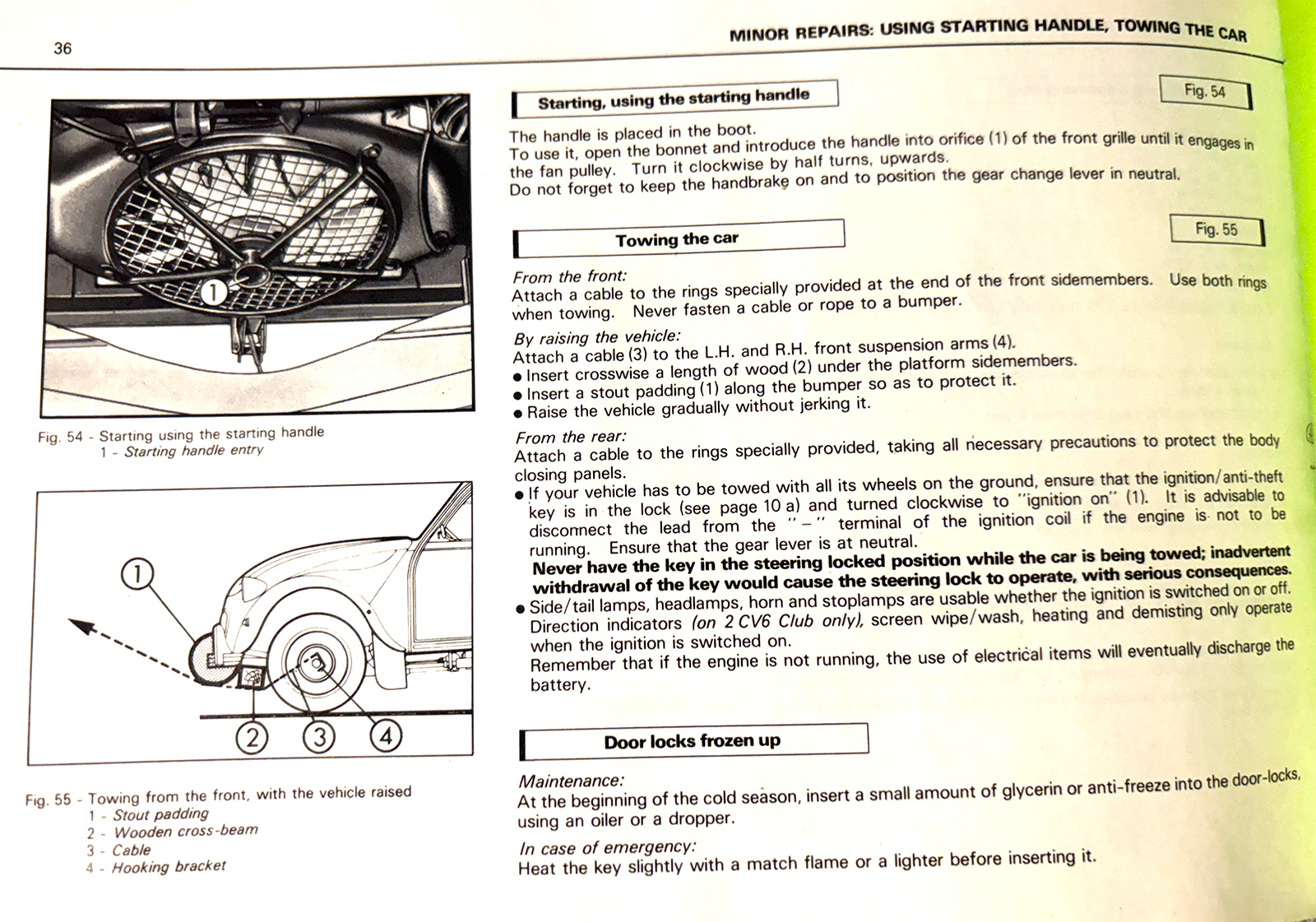
They also just call the hole the “entry” in the caption; “orifice” is limited to the explanatory text.
Also interesting on this page are the towing instructions; this may be the only owner’s manual I’ve had that specifically asks for a “length of wood” to go under the car and “stout padding” to protect the bumper. Ii wonder what they picture when they say “stout padding?” I wonder if it was made of stoat pudding?
The starting crank handle is actually the same tool as the crank for the jack and the other end of that same tool is the wheel lug nut wrench, too. But for some reason I can’t explain, the crank handle that came with my car had a little screw stuck into one of the little tabs at the end:
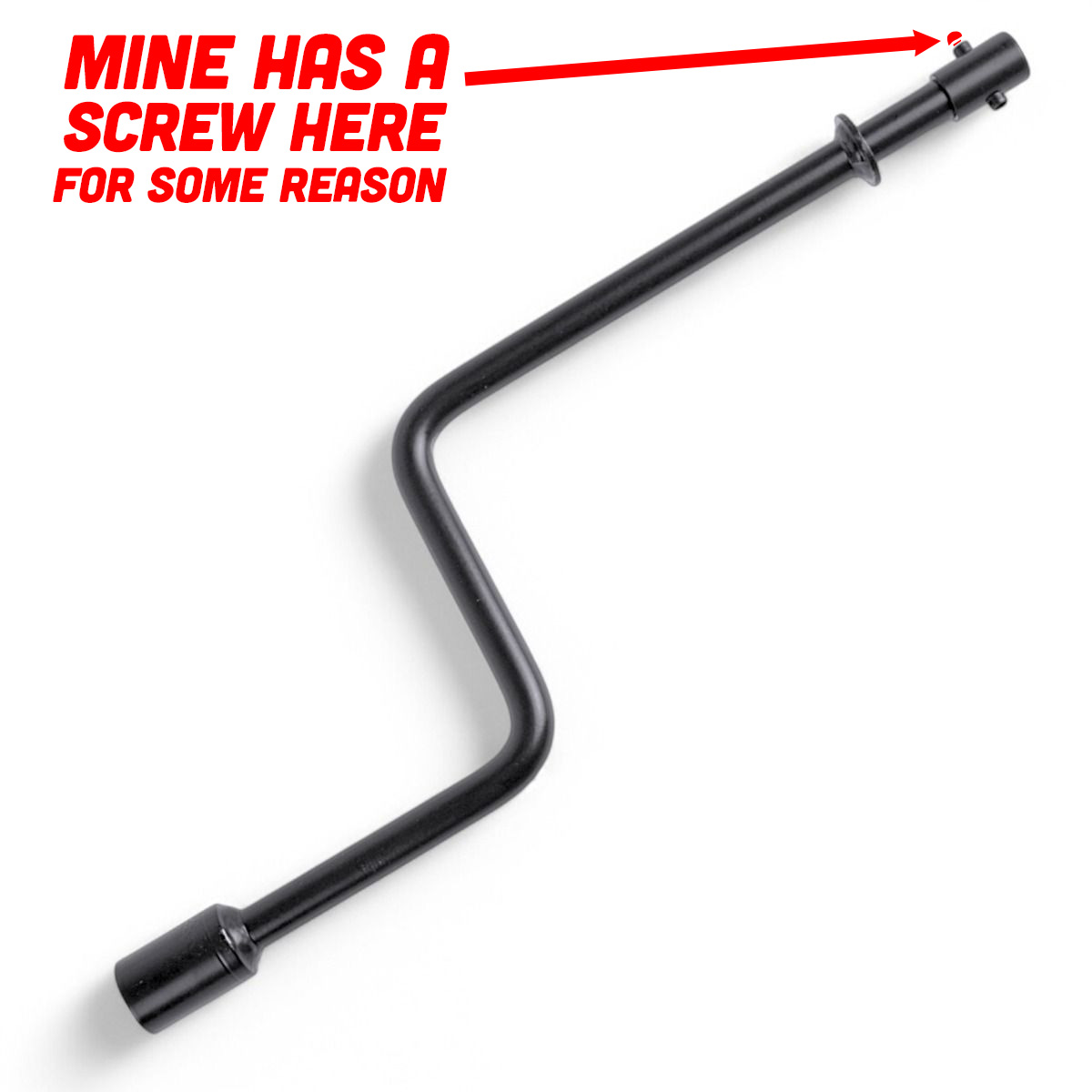
I have no idea why that screw is in there; I tried to get it out, but it was jammed up in there pretty good. As a result, the end wouldn’t go through that “orifice” which meant I had to remove the fan grate, and that made it a bit tricky to keep the crank aligned properly in the socket.
All of this is just to say that I suspect it may have started quicker if I had been able to keep that fan grate on. I mean, I think so, because keeping the crank aligned in that socket I think was part of the problem. But, eventually, it did work, and once it did catch, I was pleased with how quickly it started up.
I’m sure this is going to come in handy at some point; I feel like I’ve had to deal with dead batteries in cars many times, and have made many clumsy push-starts over the course of my automotive life. Being able to start a car with a dead battery while keeping the car stationary feels downright decadent.
While the 2CV was definitely one of the last cars to be sold that still came with a starting crank, it wasn’t the last. I think that honor goes to the Lada Niva, which retained a crank-start capability all the way up to 1997. Here’s a Niva getting cranked:
I drove a Niva in Iceland years ago, and loved it, but I didn’t get to crank start it then. I also attempted to crank start a Metz Plan Car once, but was unable to get it going, and the owner, the wonderful Paul Greenstein, didn’t hesitate to make fun of me as he got it started:
Oh well. The point is now I have successfully crank-started a car, even if it’s only a 602cc 2CV, and I can now relax knowing that my life is that much more complete.


This is so awesome!
“length of wood”
That’s what she said…
The enjoy hoist I bought from Mr. Willie has become a community item locally. I have loaned it out to at least 3 or 4 people now in addition to the 5 or so engine’s I have replaced with it. I have enjoyed telling people that it was originally bought to remove and reinstall the engine on a 2CV, and also sending them links to the articles about said 2CV.
errr, engine hoist
Jason, I’m always late reading articles, but this really put a smile on my face. How cool to be able to do that, and the glee with which you approached it, then the excitement when it worked, I felt that in my bones. Never change.
what a peach, thank you!
I hand-cranked an UAZ 4×4 when I lived in that part of the world. A dead battery is an inconvenience in most of the world… in Siberia it could mean death. There’s a reason hand-cranks stuck around so much longer up there.
Stout padding needed? Perfect use case for some convenient canned hams!
https://www.jalopnik.com/can-you-use-a-canned-ham-as-a-bumper-guard-1667080394/
Cool, can’t be too many people around who have crank started their car.
As far as the towing thing, standard equipment on an old school sling style wrecker is a 4×4 or two to be used as shown in the picture for many cars back in the day. Padding not so much that was what the rubber sling was for.
Here is a video of towing with a sling wrecker. https://www.youtube.com/watch?v=7oknfHyrw74
Good job. I see decades of hand cranking the Onan really paid off.
Nothing beats practice.
Most are experts, the rest are liars.
Very enjoyable but I think push starts are safer depending on where you parked. I would carry an electric drill with a right sized bit before attempting hard cranking.
Interesting idea Mercedes is going to the air show maybe she can get some videos of hand cranking an airplane motor