

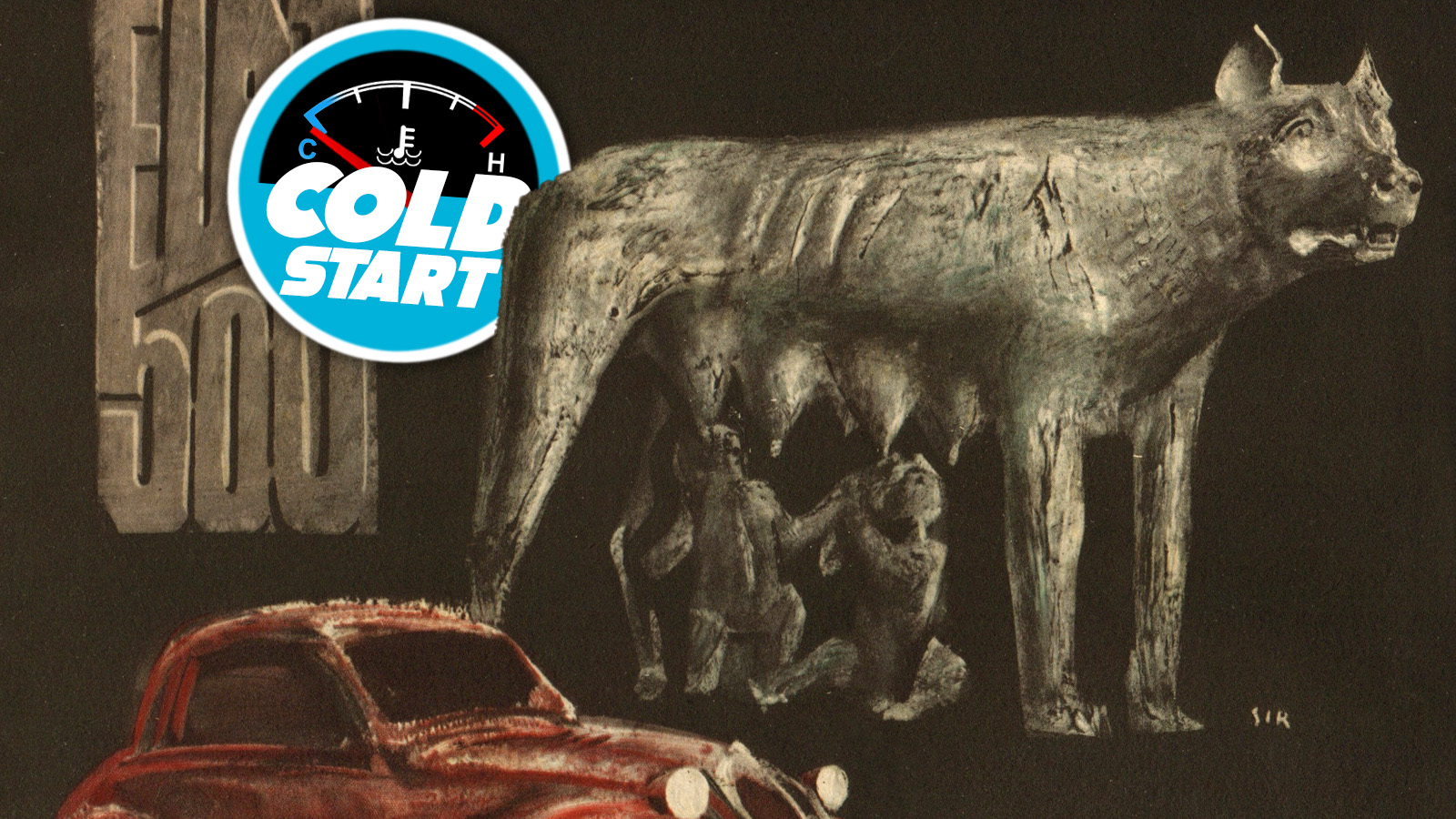
Take a note of your calendars, my friends, and note the date, because it will be important. Today is the first time in the history of our site that the word “teats” has been used in a headline, after four years of somehow avoiding it! And it’s for something important, because I’m pretty sure this 1938 Fiat brochure is the only brochure in Automobilia that has on the cover, prominently, a pair of infants nursing from a she-wolf.
I suspect that many of you will recognize both the wolf and the babies: the kids are Romulus and Remus, and the she-wolf is the one who raised them. Romulus and Remus are, famously, the mythical founders of Rome. Romulus got to name the city after himself thanks to an agreement between him and his brother where (checks notes, in Latin) he killed Remus.


All of this, the she-wolf (the depiction is based on the famous Capitoline Wolf statue), the teats, the babies, the everything on the cover of this Dutch-market brochure for the Fiat 500, I think is to emphasize the Italian-ness of the little car. Even the art style of the cover seems to be emulating the fresco-like painting style of paintings like the ones found in the ruins of Pompeii:
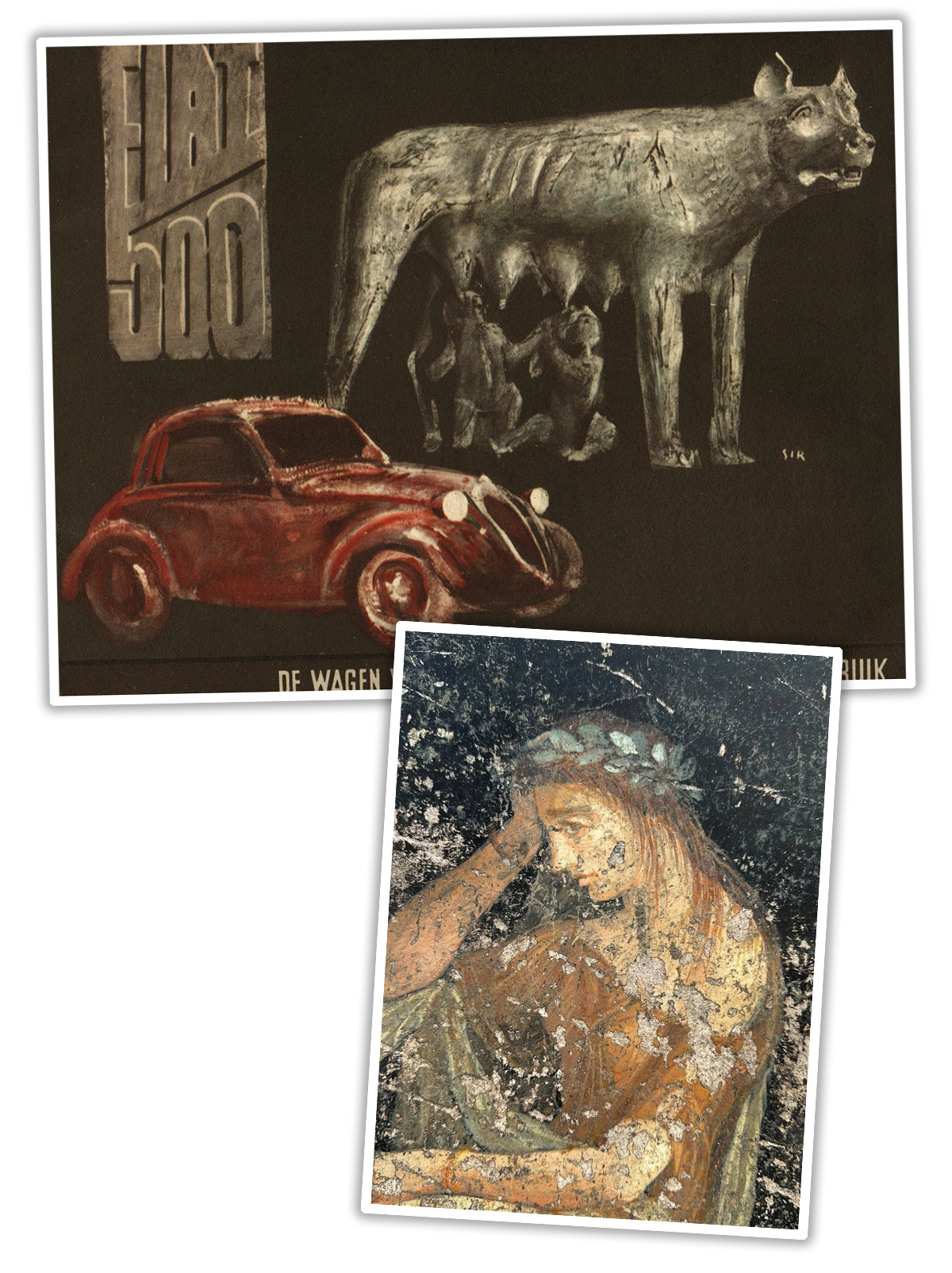
This art style is limited to the cover, but I guess that was enough to get the idea across. The interior illustrations are more precise and conventional for the era, and are, of course, beautifully executed.

One of these is a cutaway of the car, which gives a really good look at what made this original Fiat 500 (also called the Topolino, which means “little mouse,” which is what they called Mickey Mouse in Italy, which is what they thought the car resembled, somehow) so novel and special.
The Topolino was one of the earliest of the “people’s cars,” (I think the Ford Model T, starting in 1908, was the first, then maybe the Austin 7 of 1922, then the Topolino in 1936, then after the war we get the VW Beetle, Citroën 2CV, and so on) and in some ways one of the strangest, because it was only officially a two-seater, at least in its original forms.
Look at that cutaway up there: the Topolino is a small car, which was one of the main ways that Fiat was able to keep its price relatively low. Mechanically, it was fairly conventional, with a longitudinally-mounted 569cc inline-four driving the rear wheels.
Interestingly, the engine was ahead of the radiator, which seems odd to our eyes but back in the day wasn’t that uncommon, being used extensively by Renault and, later, two-stroke DKW engines and all their derivatives.

Also, look how the hood opens on a Topolino! I’m not sure I’ve noticed that before. Also note how much of that hood is devoted to containing the passenger’s legs.

But let’s get back to the two-seaterness of the Topolino; remember, this was supposed to be a car that put Italy on wheels, and that means a car for families and not just couples, so the lack of a back seat seems like an odd choice. But the truth is that of course that back area, with its little carpeted shelf, was absolutely used for more than just the dogs you see up there.
Plenty of kids and even adults were crammed back there, and finally, in 1948, Fiat released a little wagon version of the car with a folding back seat and more cargo room:

But, for the first 12 years of the car’s life, it was just the ostensibly two-seater Topolino, in two variants:

… the sedan, with a fixed roof, and the Cabrio-limousine …

… which had a folding canvas roof that likely made being crammed on the back shelf a lot more tolerable, if the weather was nice.
Despite the lack of official seating, over 500,000 Topolinos were made between 1936 and 1955, making the car a considerable success and paving the way for the Nuova 500, the rear-engined, true-four-seat successor to the Topolino.
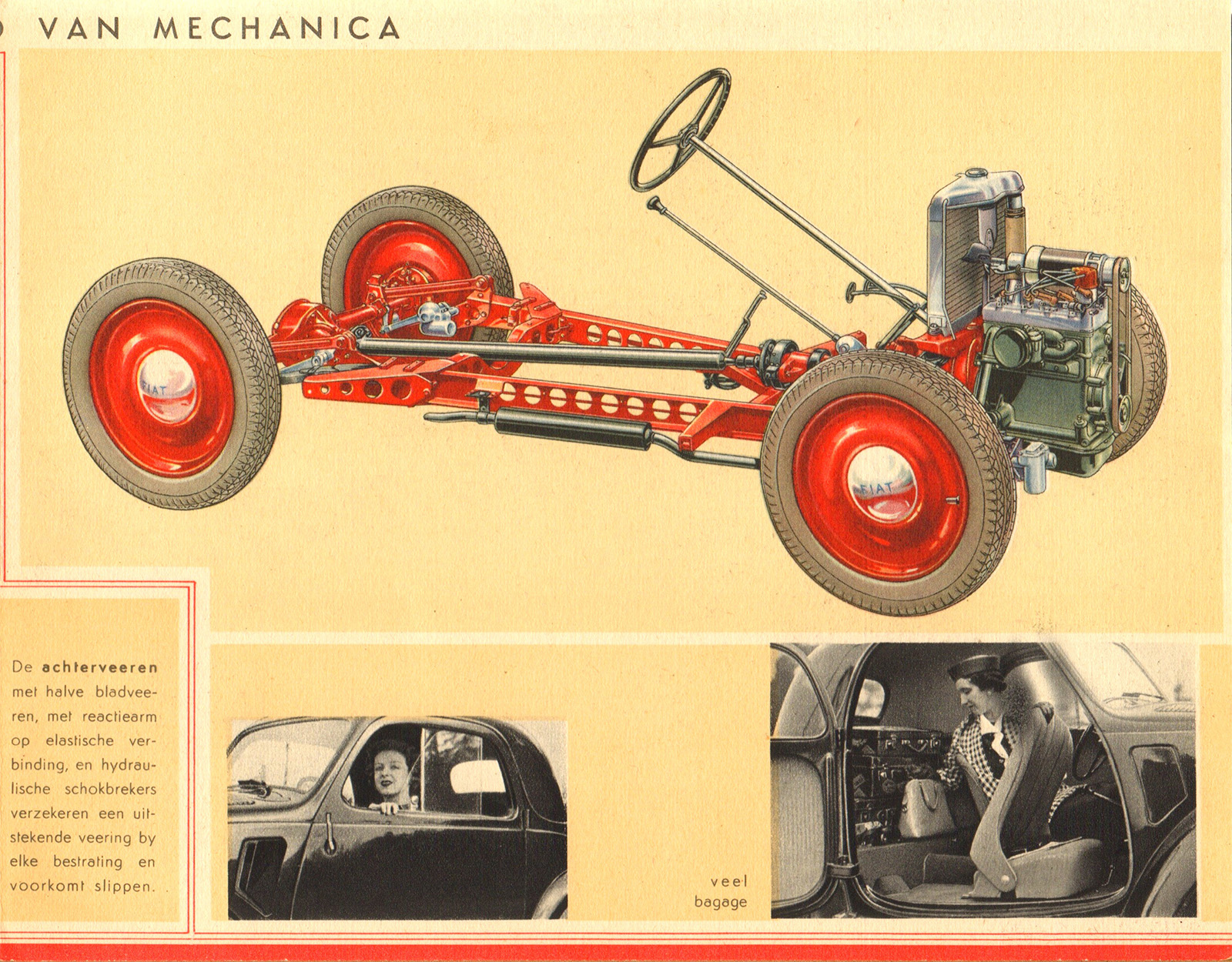
The 500 made 13 horsepower, which was adequate to move the little car at speeds that most people likely thought were plenty fast. The suspension was simple and clever, using a transverse leaf spring setup at both ends, as well as plenty of speed holes in the chassis rails.

This Dutch lady sure is excited about the Topolino, using that dramatically-archaic-looking phone to shout, in cursive, that the car is a small big automobile, which I suppose it was, metaphorically.
Not literally, though. It was a small, small automobile.
Top graphic image: Fiat



I wonder how the steering linkage works. The cutaway shows the steering column disappearing somewhere adjacent to the bellhousing. The transmission takes up much of the area between the wheels. Does the linkage curve up and over the transmission?
There is a duplicate of that statue at the Beeches in Rome NY.
It’s adorable. That black and red coupe is the bee’s knees!
That cabrio Topolino is glorious. I want one.
I like how they were so obsessed with making the “hood” as long as possible that they ended up with the windshield placed within finger-crushing distance of the top of the steering wheel. That’s some proper commitment to the bit. Makes you wonder if the cars were taxed based on how many cubic centimeters of air that the passenger cabin could envelop.