


As a Powertrain Design Engineer, the first time you design a cylinder head is a huge challenge. You have to contain gasses at 1200°C (2200°F), coolant at over boiling temperature that can’t be allowed to boil, hot oil at pressures high enough to send a flammable jet across a room, and air passages that have to have minimum flow disruption despite being completely blocked by a valve 60 times a second. Plus all of that in a single lump that mounts the valvetrain, inlet manifold, exhaust system and anything else that’s nearby in one big complex casting, while being bent by thousands of explosions every minute. And oil drains, mustn’t forget oil drains (my very first job on a cylinder head was to add oil drains that the previous guy had forgotten – it’s a very complex part).
By the time you’ve designed a few (they can each take months or even year) and had several of them binned when projects got cancelled, it just starts to feel like routine work. What makes it feel even more just like routine work is that OEM’s have standards for everything, and often they are legacy habits from a time when there wasn’t CAD, or they used inches as a unit, or had lazy designers who weren’t exactly terrific.


[Dave Larkman is a mechanical design engineer who had a 25-year career at Lotus Cars and Lotus Engineering (the consultancy business that worked for other OEMs), eventually becoming Lead Engineer of Powertrain Design. He has also been a semi-pro drifter, rides sports bikes, and used to feel ashamed about his taillight collection until he found Jason Torchinsky on the internet. Wait, why am I writing this in third person? It’s me, Dave, writing my own bio. – DL [Ed note within ed note: Sorry, Dave. I’ve got a Jeep to fix and no time to write bios. -DT] ]
This particular project had a cast bolt boss-standard that was simple, logical, and boring. A bolt boss is any feature on a casting that you fit a bolt or a screw into (fun way to make engineers fight: ask them to agree on a definition of what makes either a bolt or a screw). You need the boss to be deep enough for the screw thread, which will have a minimum length based on the material and how it’s made, and wide enough to have enough material around it to not only be strong enough, but to not leak (castings can be a bit porous, and there is often an oil passage running right next to your bolts). All of that has to take into account the manufacturing tolerances on the tooling, the casting and the machining. So it’s low risk to just look up an M6 boss or whatever and copy the dimensions down.
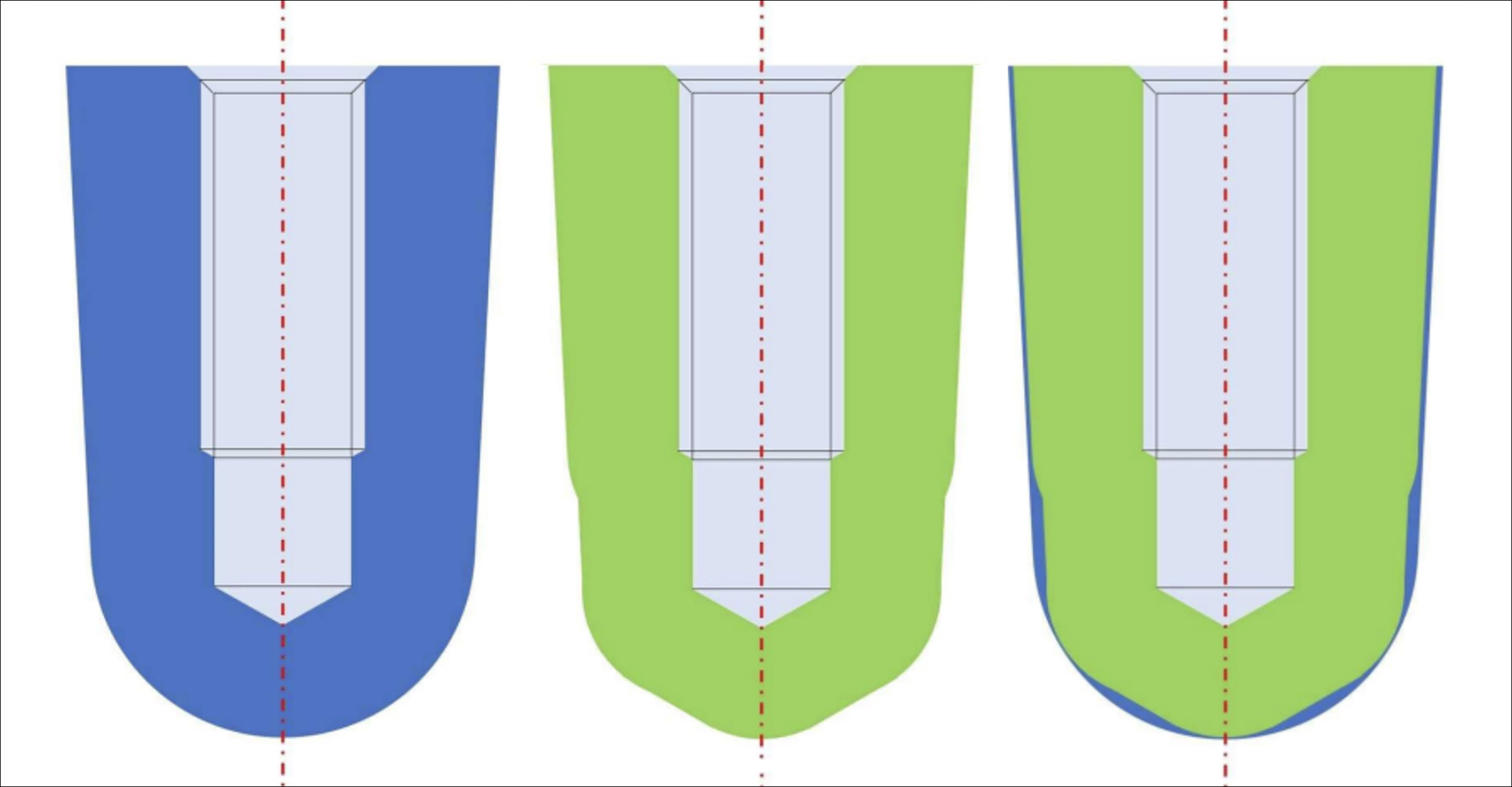
However, it’s a bit dull, because it’s just a slightly tapered cylinder with a spherical end, like this:
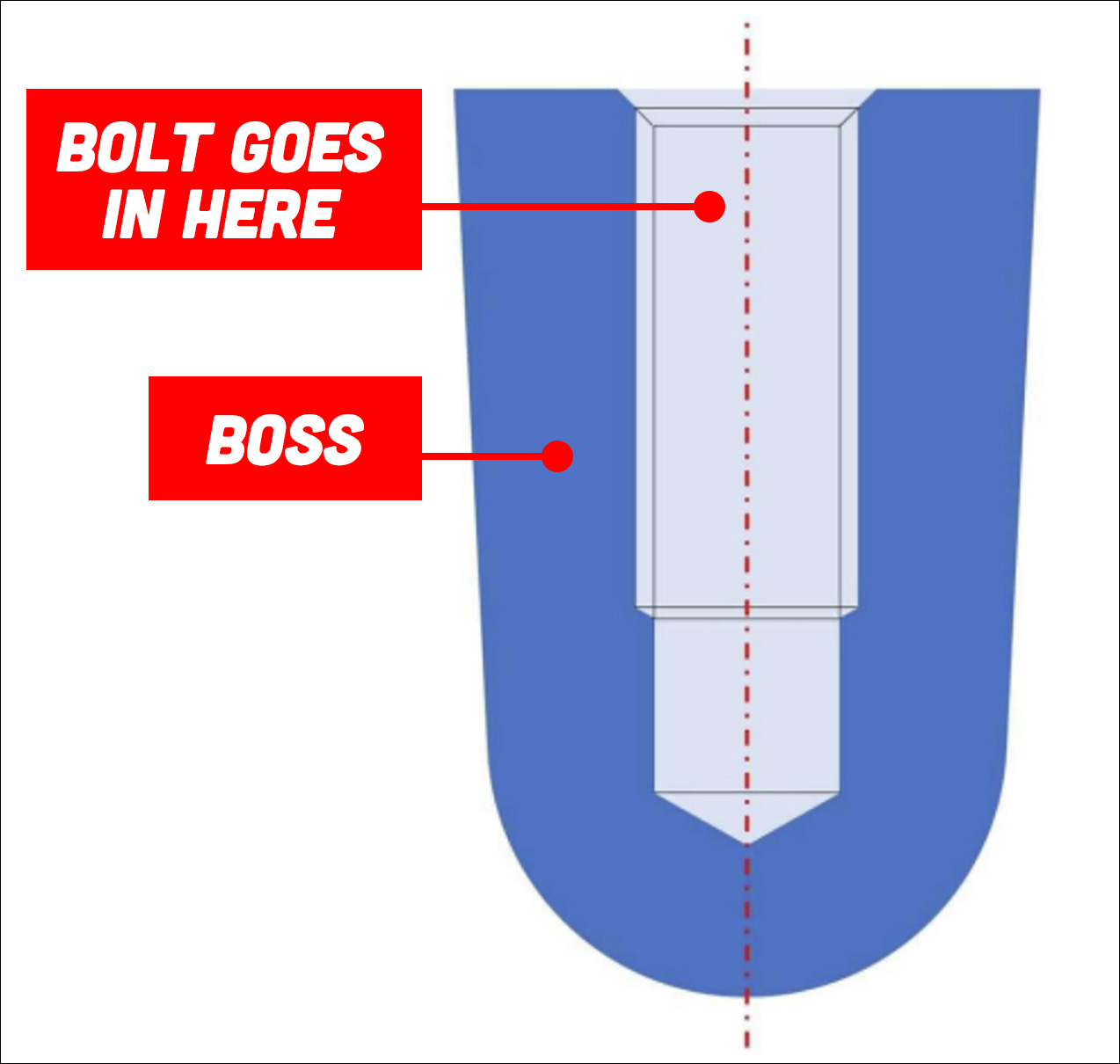
The actual machined feature is a drilled hole with a cone on the end, then a slightly wider, slightly shorter thread. I thought, why not take the minimum wall thickness from the standard boss and offset that from the feature I actually need? It’ll be no harder to make, but lighter and therefore cheaper, but most importantly it won’t be the same ball-ended blob I’ve been modeling for ages.
So I quietly came up with this pointy, stepped blob and threw it all over the place.
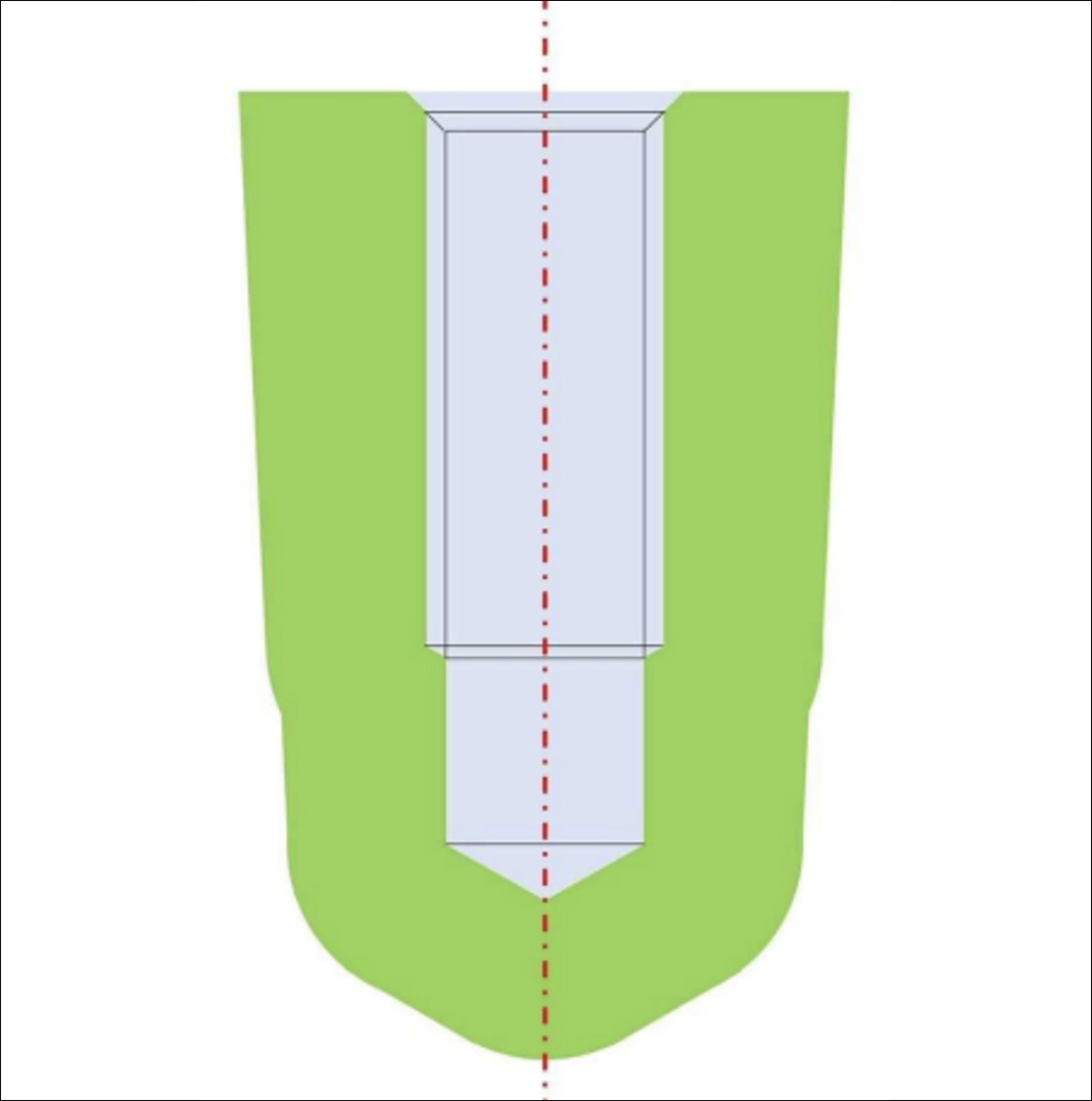
There was no justification for doing this; it was already under the mass and cost targets by enough to get a little pat on the head, and still chunky enough to zip through durability testing without getting a massive kick in the groin for failing and costing the client millions. But, you know, bored.
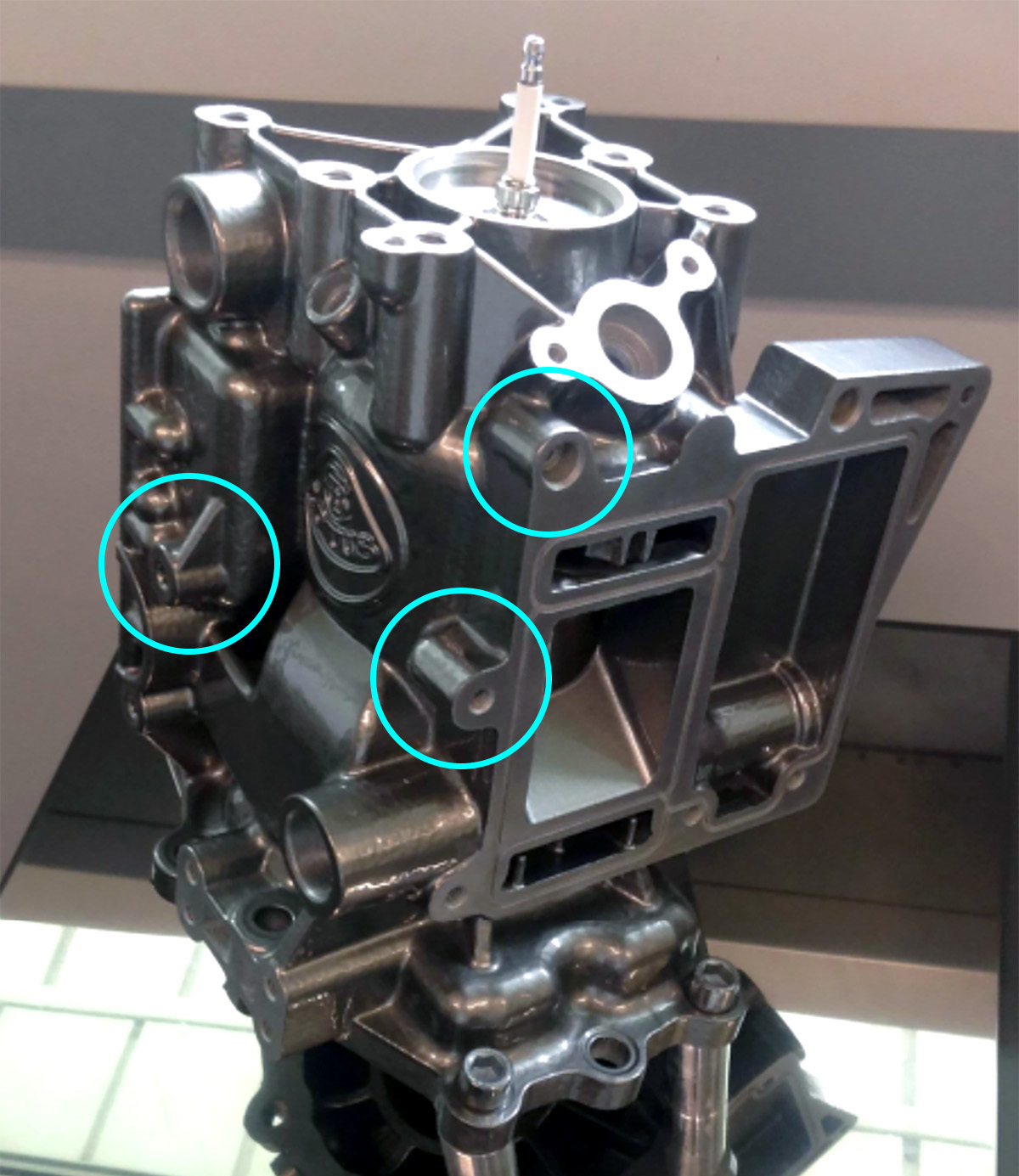
Now would be a great time to show you a picture of the actual cylinder head, but, as my confidentiality clause is still both valid and terrifying, I’ll show you a picture of something else to give you some context. This chunk of metal is the monoblock (a combined cylinder head and block) of Lotus’ Omnivore research engine from 2009, which is a single-cylinder two-stroke engine and therefore relatively simple; and it’s covered in bolt bosses. [Ed note: I circled three of ’em – Pete]
My new cylinder head and comedy-bolt bosses went through the design review without a murmur and passed testing with no problems, at which point my job was done. It then went into production, made no great impression on the world and, several years later, went out of production with no internet-verifiable reputation for massive cylinder head failures. Phew.
Years later, I was explaining this whole thing to a fresh, shiny, new engineer in the hope that they might strive to avoid lazy design, and they asked how much weight this actually saved. I had no idea, so I checked, but not before correcting them on the use of weight, which is variable, instead of mass, which is not. So I modeled up the standard blob and my slightly better version to compare the two…
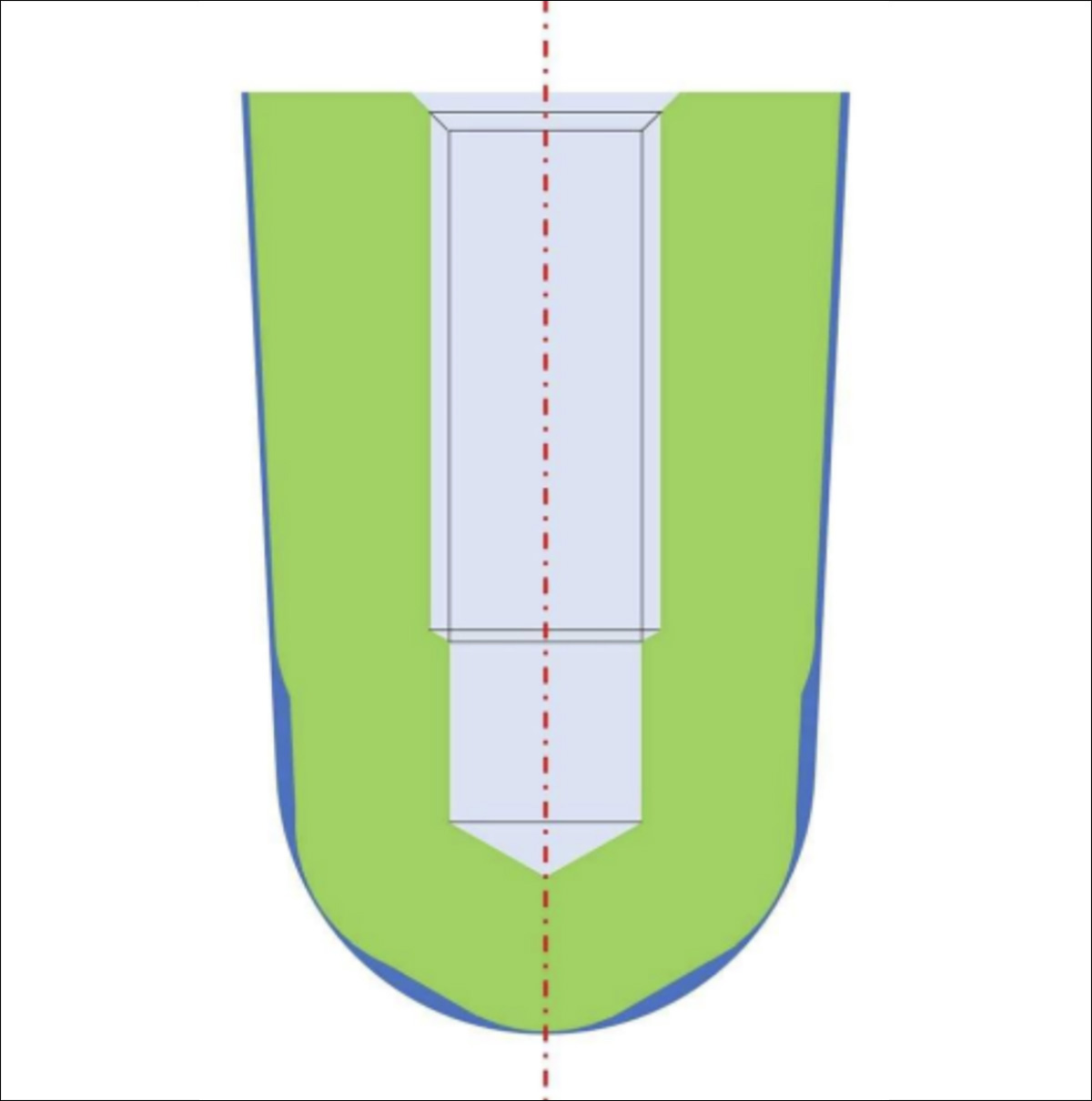
It saved just 0.7 grams, which is 0.0015lb. But wait, you lose about half that saving because the bosses tend to be blended into a wall. So it saved just 0.35 grams, which is the approximate mass of the air in a small sigh of disappointment.
However, when you multiply that by the number of bosses per head, then multiply that by the number of heads made before someone else came in and redesigned it for the next version of the engine, you get a mass saving of 10,214kg, or 22,518lb. Over ten metric tons of aluminium that didn’t have to be mined, transported or smelted. I’m not going to do the maths on the environmental impact of that because it’s too hard, and I’m not going to cheat and get Google’s AI to guess a value, like I did earlier with the mass of the air in a small sigh of disappointment.
But if every car that engine went into did 100,000 miles before it died, then 1,021,400,000 kg-miles were saved (yes, I know that unit is a horrible mess of metric and imperial, welcome to the UK, where we sell fuel in litres but measure fuel consumption in gallons). If the average mass of my cars was about 1,200kg (which it is, I have a spreadsheet, obvs) and my average yearly mileage is 10,000 miles, then the kg miles saved is the equivalent of 85 years of me driving around (very roughly speaking). A few minutes of boredom has offset my personal transport needs for life, assuming I don’t keep driving until I’m 102 years old, which seems like a reasonable assumption.
I’m going to ignore the obviously egregious skewing of the figures that results from nine years daily driving an S1 Elise. And the three years in a 2CV. And whatever additional environmental harm the RX7 caused. Hope you don’t mind.
Top graphic images: Dave Larkman; DepositPhotos.com




Good lord that intro was META
Delightful!
Great article, thanks. As others have said, well written, interesting, and a good (enjoyable) technical balance to the (enjoyable) shenanigans.
Small correction: if you ever revisit this for a book or whatever, the middle view in that final three-bosses image is scaled a little larger than the other two, so it looks like you added material rather than deleted.
It is bigger, and shouldn’t be.
That wasn’t me, but I’m very grateful to whoever it was who fixed the clunky mess this all was in my layout.
I’d actually done all of this in CATIA with on-screen mass data and everything, but it all got lost in the great redundination of 2025.
It was meeeeeeeee
Sorry Dave!
Thanks Peter, you’re the best!
As a Powertrain Design Engineer, the first time you design a cylinder head is a huge challenge…
…
…it’s a very complex part).
Which is why as my first day as a Powertrain Design Engineer tasked with designing a cylinder head I would quickly draw up a 1940’s flat head slab of iron, cash my big fat check and run like Hell.
My very first part was a valve collet. Literally starting small. It’s half a hollow cone that’s smaller than a Hotwheels wheel.
That project got cancelled after I’d worked my way up through valvetrain bits to modelling hydroformed exhaust manifolds (where you need to design the tooling that makes the bits that go in to the other tooling to make the geometry you actually want).
I basically got addicted to complex geometry. It’s why I’d work so long for so little.
“Design you a hyperbolic paraboloid mister? Only a tenner. Oh go on, I’ve already started the sketch”
I prefer to approximate my horses (or cows) as spheres.
https://en.wikipedia.org/wiki/Spherical_cow
The maths are MUCH easier!
Given their rate of hay consumption, I suspect our horses are trying to do the same thing.
At least the maths will be easier.
Does it need to be a parametric model? No, but future me is going to love doing a DoE and only having to change a couple of parameters before hitting regenerate.
Just don’t make those parameter changes too large or the model will fall apart, even if it can hit those numbers if you increment your way there.
Hyperbolic paraboloid is a term I’d never expected to run into again! Gawd the agonies of engineering math, physics, right hand rules, toroidal field fluxes and electron hole densities in doped semiconductor junctions.
Make it stop!!!!
Really enjoyed the article by the way! Welcome to the asylum.
When the author snacks, he only eats Pringles.
Crunchy Engineering of Pringles’ Hyperbolic Paraboloid Shape
We used to call them hyperbolic underpants for some weird reason. Probably a combination of too little sleep and too much coffee.
I swear i didn’t see your comment, I’ll just saddle up and giddy up out of here.
Here, we call them Pringles.
Machinist here. It is amazing how a little radius here and chamfer there makes a big difference. Usually it is the guy building the part who has to convince the engineer to make the change. Nice job on being that engineer that works proactively.
Yea this is like seeing a cat walk on it’s hind legs. Not common.
Have you heard of this thing called Youtube?
My first job after graduating with my shiny new degree in Engineering Design was two years of working nights fixing machines and occasionally making parts.
You learn a lot about design fixing broken stuff.
Tool and die maker here. The best engineers that I’ve ever worked with had spent time working out on the shop floor before they let them design a single part. A shop I worked for had a minimum of 6 months on the floor. It made life so much easier on the guys doing the assembly in the shop and especially the guys doing the install out in the field. The parts were being engineered from the beginning with a thought towards assembly and maintenance, because they got to see and do it themselves.
This is a really fun and educational read! I too have lived the life of a bored engineer who then fidgets with things to see what would happen. That’s how I ended up designing a race winning motorcycle tyre and also how I accidentally ran a Fanuc robot into the ceiling. Win some, lose some.
Ummmm holy heck guys, who is Dave Larkman (I know I read the bio) and can we have him write many things for the site?! What a treat to read on a very boring corporate lunch break.
Absolutely. You’ll be seeing more from Dave and from other industry professionals, especially after I’m done with the Jeep project. (It’s made editing freelance pieces a challenge, but I’ll make time for Dave and Zero Entropy and other enginerds!).
I don’t know, adding another Dave will be confusing. Maybe if we called him The Lark, or Junior or something.
Yayayayay
The engineering articles from industry folks have all been outstanding, because you picked engineers who can write really clearly and entertainingly.
Sweeeeeet! Thanks David! 🙂
This is a great answer. Reason to be glad I just subscribed.
10K kg of aluminum saved is a lot, but makes me wonder: if that can be achieved so relatively easily, what are we NOT doing that could save more? And in THAT context, 10K kg is probably reduced to a rounding error.
A lot of automotive design is done with “that’s what we’ve always done” as a standard. Actually a lot of design in general, but on cars there are so many thousands of parts to go through for a new vehicle that it it’s logistically possible to look at every part (much less every feature of every part). A lot of times a group with be assembled specifically to look at cost reduction (either a standalone group or the group designing a car will have some time baked in) but they are usually looking for dollars, not fractions of a cent.
And then a lot of times you go and find a bunch of little things that add up to the bigger numbers they are targeting, and it all gets brushed under the rug to move on to something else – no one actually cared, they just wanted to say it was done, go work on a new product.
And if the cost saving doesn’t pay for itself in this financial year it won’t get approved. We used to save up the big ideas for April…
We used to have a “Value Engineering of the Year Award” that was basically a fight for honorable mention, because interior design would walk away with the top honors by a huge huge margin.
You can change all the bolts/screws you want into clips and you’ll never touch cutting $25 out of a seat or $40 out of a dashboard.
We’d work for weeks saving a few grams on supercharger brackets and then the Interiors guys would win by just making the heated seat elements a cost option.
Bad idea in the contest rules. Charging extra doesn’t save money unless people will pay the cost. Plus new marketing brochures, web design, figure out how you know how many people want it and don’t want it and the cost of two separate production results along with other options. Just adding a new want this or not want this adds so much complexity to the production process $25 savings would actually result in an increase in price
Is this why seats are largely ass as far as comfort goes now? Decades ago, it was rare for me to even notice a seat unless I was in it for 4+ hours, now it seems almost everything has bottom cushions that turn to stone after an hour or two. If they wanted to find a place to save money, they could lose the stupidly restrictive bottom bolsters that seem sized for smaller middle schoolers that nobody needs in cars with bunker doors, Hummer H1 center consoles, and gravity keeping anyone from going anywhere in anything less than a track car on track.
Maybe your butt has evolved.
While I’m sure it has to some degree, there are still some comfortable seats, they’re just rare rather than normal, unnecessary bottom seat bolsters are more prevalent because even a CUV that only .01% of drivers will ever exceed .3gs in needs some fake Nurburgring cred, and space is restricted by interior hard surfaces in spite of the much larger footprints.
I’m not sure. I’d guess it’s a combo of changing tastes (a big fluffy couch is comfy up until your back starts hurting because of the terrible posture) and probably to some degree crash requirements (making sure a test dummy is where you think it will be). But it is surprising that companies will still offer a manual seat, a power 2-way, a power 8-way, ventilated, non-ventilated, etc all on the same car. There’s obviously some big cost cutting going into the seats to allow for all that.
That’s the old land yacht seats. They were awesome for a short time, but the backs with missing lumbar support sucked after a while. I rarely have an issue with seat backs in anything else, so I’m not sure what they’re doing to the bottoms now to make them so tiring. I imagine it’s due to the use of cheaper foam, maybe thickness, but I’ve sat in comfortable seats that weren’t noticeably thicker. Good upholstery foam certainly isn’t cheap (especially over thousands of units), so I could see cost cutting the quality of foam being the reason, even if it’s not only cheap cars that I don’t like. I’ve had ’80s economy cars that were more comfortable for longer than most of the vehicles I’ve been in built this century. Maybe cushion material was cheaper then or they use some kind of more environmentally friendly foam today that’s not as good, IDK, but it’s something I’ve been wondering for years as knowing what it is means I could fix it. Even if I could just find data on what was used for different cars as far as densities and thickness goes, perhaps even S-spring specs, I could try to replicate it. I wish I had saved at least one of my favorite old seats so I could figure it out myself, but I didn’t realize I’d have a need to at the time.
I’m not an engineer, the closest I ever got was running the little train set around the Christmas tree during the season. And there are a lot of engineers here. But I think I have heard too many stories about saving a nickel and what it cost in human lives. I think any savings groups need to be involved in the whole project to avoid say bad tire choices on an SUV?
While reinstalling an interior rear quarter panel of my Prius v after attaching sound deadening to the metal, I broke one of the positioning tabs.
I can’t foresee a universe where the 4 bolts holding the panels in aren’t enough to stop that tab from making a difference between someone or dying or not in some kind of accident, but little things like that do make me wonder if the number of clips they use in, say, the door panels is overkill or if it’s just that it’s more “safety” than “the minimum number to make it secure” or something.
I’ve wondered about that. Whenever I have to take apart some plastic crap toy/alarm clock/whatever, I inevitably loose or give up on a few of the dozen little screws. Never once could detect any difference. But, they designed them that way so there must be a reason, right?
Trim pieces generally rely on molded tabs for some combination of positioning and securing. It’s possible the tab existed just for positioning (and remember you need to control position in multiple directions without over constraining the part), just for a temporary hold (so it can be put in place and then screwed/bolted in another step, as an actual attachment point, or a combo of one of those 3. My guess on a door panel is mostly positioning (since it can hang from the sheetmetal where it hooks over the top) and it probably just makes lining up the fasters easier.
Door cards are tough because they are large and made up of multiple pieces. So tolerances are relatively large, but you’re trying to keep tight gaps to the pillar trim or dash when you close the door, and you need to control that position as tightly as you can to close up that gap.
They use more clips than necessary because you’ll break half of them removing and reinstalling the panel.
It’s eye opening. As an outsider, I assumed these multibillion dollar companies have found every possible efficiency. To hear they work just like the rest of us is equally relatable and a bit depressing.
One simply word is topology optimization which has unfortunately been called AI design in current times.
One of the tests mandated by the DOT for tyres is the plunger test where you mount the tyre, inflate it to a standardised pressure and then poke it hard and slow with a standardised phallus. If you can hit a specific energy level five times in a row without it blowing, you pass.
This often results in more material being placed in the centre of the tyre to help with it, which can cause accelerated wear, or potential delamination in a hypersports tyre. The plunger test has been adopted worldwide, but was introduced in 1967 for use on bias ply tyres, not radial ply tyres and there is still ongoing debate as to if it is needed at all for radial ply tyres.
Poke it with a standardized phallus? Now is that a hard erection phallus, a chubby, or damn it’s cold in here? And how do you apply for such a job? And does the company provide Cealis for the phallus or is that something I bring from home? Also are fluffers provided for overtime? Is overtime considered anything over 3 hours?
C’mon, you’d think with a name like Rod Millington you would realize the important information. Or is it more the Millington thing? Just kidding
“ poke it hard and slow with a standardised phallus. If you can hit a specific energy level five times in a row without it blowing, you pass.”
Sounds like my high school dating life.
How about using a uniform standard on the non design parts. Headlight bulbs, oil filters, batteries I mean how many different bolts are used in cars that don’t do anything different or better than any other bolts used? It would use less time, equipment, and testing and simplify auto repair and part purchases.
I was laughed at by a supplier for wanting to delete something weighing about that much and claiming it toward my weight savings goals, how i wish i could have pointed them to an article like this!
To quote Depeche Mode, everything counts in large amounts.
Are you trying to summon Adrian?
IT’S A COMPETITIVE WORLD
That’s definitely the time you need to then talk about how the savings scale with production volume. If you save $0.10 per item and you make 10000 of them per day, the savings add up very fast. But people think, it’s only ten cents.
Same with energy efficiency. Yeah it saves 0.05 gallons per car. Sell 50k of them a year and that’s 2500 gallons less of burned gas. For a popular car over a 5 year run that’s a lot of gas.
But then again supply the measure not just the results. We see so many factors where they are given a bonus over actual results for things like it’s an EV or other unrelated things.
or like if Apple figured out a way to make its charging bricks 2% more efficient when in standby mode. Your personal savings over the life of the product will be less than a penny (CA residents excluded), but on a global scale that’s probably a whole power plant or two.
But wait, there’s more. It’s not just gallons, but imperial gallons.
It was so humiliating for me to have to convert kW power targets to bhp so I’d know how hard the project was going to be.
The units in the UK are a mess, but at least no one ever expects me to measure a 1/32 of anything.
Touche.
What are tread depths on tyres measured in the UK? Pounds, grams, grandad’s, stones, litres, pences, wooblygooks? I mean really can we get one for the same thing? Lol
Dave Larkman. I would first like to welcome you and congratulate you on your first published piece at The Autopian. Secondly, I’d like to say that this is exactly the reason why I come to this site and read daily. The mix of mainstream, offbeat, and engineering stories here are unlike no other publisher’s works.
I really think that you nailed the competing interests of describing something complex, and distilling it down enough for the average reader to comprehend. That’s a fine needle to thread.
I also geek out when we get the occasional piece form Huibert Mees – The Autopian’s resident suspension engineer.
Thank you! I’ve been daydreaming about this for a long time.
I love Huibert’s stories!
Also, you should see if Hardigree could at least give you free member status so you don’t have to see ads here at a minimum. If not, the comments section will give him tons of crap.
I don’t think Hardibro is in the habit of awarding membership. It is odd to see contributors show up in the comments without that little banner. Forbes, I believe, is in that category.
In fairness: this account only got created today. I’ve been lurking since the start (since the other place even), I really should have paid already.
Good man good name
If it is down to the average reader what does that make me when I couldn’t even figure out what happened to the bolt in his design?
I’ll add to the chorus of praise for content like this. Also great illustration of how much small, insignificant changes can add up when applied over a multi-year production run.
Very interesting read! Please give us more content like this!
this was surprisingly fascinating to read.
Brilliant!
Great story, great write up.
But did it cause you physical pain to see how Pete spelled aluminium?
I worked in the US for a couple of months, I got used to it. It’s a lovely country, and well worth a few spelling issues. I actually like the short version of colour.
The dropped “h” in “herb” and the missing syllable in “mirror” on the other hand never stopped bugging me. I used to call people at home and ask them to say “squirrel” for me. And send me jaffa cakes.
I totally get where you’re coming from on this. I’m American, but work for a UK-based team remotely from Indiana. Surprisingly, I’m even able to understand my manager’s Welsh accent too.
I was in Indiana!
In winter.
I hear it’s lovely when it’s not under a few feet of snow.
Try Vermont
Indiana!
‘The wagon broke, so we stayed.’
As an Australian, married to an American, who previously lived in the US for 9 years, this stuff never gets old.
The most entertaining word to get my partner to say is mop but make it have the o sound instead of mahp.
Mop is for floors mahp is for directions
I can get jaffa cakes from my local HEB, I enjoy that squidgy orange bit 🙂
Jaffa cakes at Aldi too, at times.
Please explain why I could understand English from the best Top Gear team yet struggled to understand English of the B Team.
When I meet any woman with a Russian accent, I always ask them to say, “I’ll get you, moose and squirrel!”
And they always do.
“the mass of the air in a small sigh of disappointment.”
This is a wonderful turn of phrase!
If you’d been there when I first calculated the saving per boss you’d understand how I thought of the phrase.
Oh, it totally makes sense!
Lot of Lotus engines in use on other planets or moons are there?
Cool anecdote and article.
I can make myself weightless by jumping. The weight of a piston in a running engine is a nightmare to calculate, but it’s mass is constant.
This is a different definition of the term than I learned in engineering school many years ago.
That said, I hope to read more from you here.
The Lotus drawing border has the weight measured in kilograms. Weight is measured in Newtons, mass is kg.
It was a source of endless frustration. I think they kept doing it just to mess with me.
At least at Lotus the measurements for the conversion of Lucas electronics system measurements is easy. No matter what system everything is ZERO
Here are some weightless Lotus race cars.
https://www.youtube.com/watch?v=VpQ1R3JqV3g
But seriously… it may be negligible, but gravity varies depending on how far you are from the center of the Earth, so technically you don’t have to go to the moon to demonstrate the difference between weight and mass. 🙂
Porsche once built a frame for a race car so light it was pressurized and had a pressure gauge mounted.
I’m an entirely different kind of engineer, so bear with me here… but I don’t think 10,214kg is “Over ten thousand metric tons of aluminium.”
I’m English, I had to put something in there I could continually apologise for.
Queue for apologies starts back there.
I’m so sorry.
shuffles to the back of the queue
On the off chance that this exchange doesn’t read like the good-natured joking it was intended as, this was a great article, and you should be proud of the giant pile of metal we can’t agree how to spell you saved.
I love the writers here, but the thing that always amazes me is how nice the comments section is. It’s a very rare thing on the internet.
And by nice I mean both pleasant and punctilious.
Hey I am already here get behind me. Lol
This exchange has more COTD material than the combined mass of 10,000 small sighs of disappointment.
10,214kg is just over 10 metric tons, not just over 10,000.
Yep, sorry.
Looks like a typo to me, unless production volumes suddenly spiked.
Ooops, that’s a “thousand” that shouldn’t be there.
I’m great with 3D geometry, terrible with wordingness.
Whenever I make a mistake like that, I always just tell myself NASA inadvertently shelled Mars because of a unit mix-up and at least my mistake isn’t that big. Whats a few extra zeros anyways?
Depends on whether those zeros are significant. I’ve spent my entire career fighting scientific notation and leading zeros in Excel. Dear Microsoft, I put those zeros there for a reason, please don’t whack them like a Mafia boss. I’m already paying into your protection racket for Office 365.
Woops. My bad for not catching that. I’ll fix!
The kind of weight-saving measure a Miata engineer would probably do ????
Dave, as a cylinder hear engineer at Lotus, were you in the team that worked on the redesign of the old Chevy 250 engine for the Brazilian Omega A in the late 90s? I’m asking this because word on the street is that Lotus had developed a whole new OHC (or DOHC) head for it that would completely change the power figures of that old and tired engine, but it was scrapped due to cost reasons, and I can tell you this Lotus head’s “folklore” still is one of the biggest “What ifs” within the Brazilian Chevy circles.
Before my time sadly.
Colin Chapman would be proud.
I never met him, but I suspect he’d be more proud if it had somehow made him money. Or won a race.
What is your defination of a bolt vs a screw?
A bolt is when your date leaves you at the door. A screw is when she doesn’t.
I’m here all week.
“ A screw is when she doesn’t.”
A screw can also be when you get divorced.
I call them both “fasteners”. I’ve had the fight beaten out of me.
I’m trying to think of how I would define this, because I’ve never really thought about it.
My first thought is that it’s sort of a size descriptor (like a pebble versus a rock), but that depends on context (a lot of people would call a small hex-head faster a bolt even though it’s next to a phillips head machine screw that’s larger). So then I thought about head type, but cap screws really screw that up. Then I thought about material, but lag bolts screw that up (and are sometimes called lag screws anyway).
This sounded like a fun mental exercise and then got annoying quickly.
very close to is-a-hotdog-a-sandwich territory.
My personal canon is that a screw threads directly into the material that it fastens, and a bolt threads into a nut on the other side.
Which makes both of them Schrodingers fastener until they get assembled one way or another.
I like to think of it as potential. If it wants to strive hard and be a screw, that’s great. If it wants to take it easy and be a bolt, fantastic! You do you, fastener. Don’t let expectations cloud your future.
My company’s design guideline states nuts should only be used as a last resort. Every time I encounter a nut I think the design engineers got lazy (I’m not talking about road bridges, where there is a good reason to use a nut).
The worst is the factory installed fan on my sprinter: a bolt going through the roof with a nut on the other side. Sprinter vans are large- you’d need a pair of 10 foot arms to tighten that bolt yourself. It boggles my mind that Mercedes designed a fan that requires 2 people to install it, but there’s a lot of Mercedes design decisions that make no sense to me.
My point of view as well.
When the previous owner of a thing strips the threads out and “fixed” the problem by driving a wood screw in, I now get to call it a “wood bolt”
My personal definition is that if it’s constant diameter it’s a bolt, if it tapers, it’s a screw. Which at least makes most fasteners for wood ‘screws’, and ones for metal as ‘bolts’, but I’m sure there’s exceptions.
Unfortunately, that is definitely not the definition of a screw:
cap screws | McMaster-Carr
You make me sad 🙁
I thought similarly, except I stuck to just ‘has a pointy end’ vs ‘has a flat end’. I like yours better.
This is the definition I remember from Machinery’s Handbook. I know of no more credible source than that publication
An agent of chaos eh Michael?
My current definition is that it’s a screw if the entire shank is threaded, and a bolt if it’s not.
It’s difficult to settle on anything when even the name of a product stops you from choosing one definition or another. See socket head cap screws.
I can’t tell you. I’ve never been bolted before.
Pointy end goes in to material (to be fastened to…) equals screw
Blunt end goes in to a nut (captive / built in or free standing on the other side of some material) equals bolt.
Of course you could always call them both spilling inclined planes just for fun 😉
And this is why we come to The Autopian!
Damn, I love this kind of nerdery that exponentially grows to make some sort of meaningful difference. Bored engineers, keep on making the world a better place.