

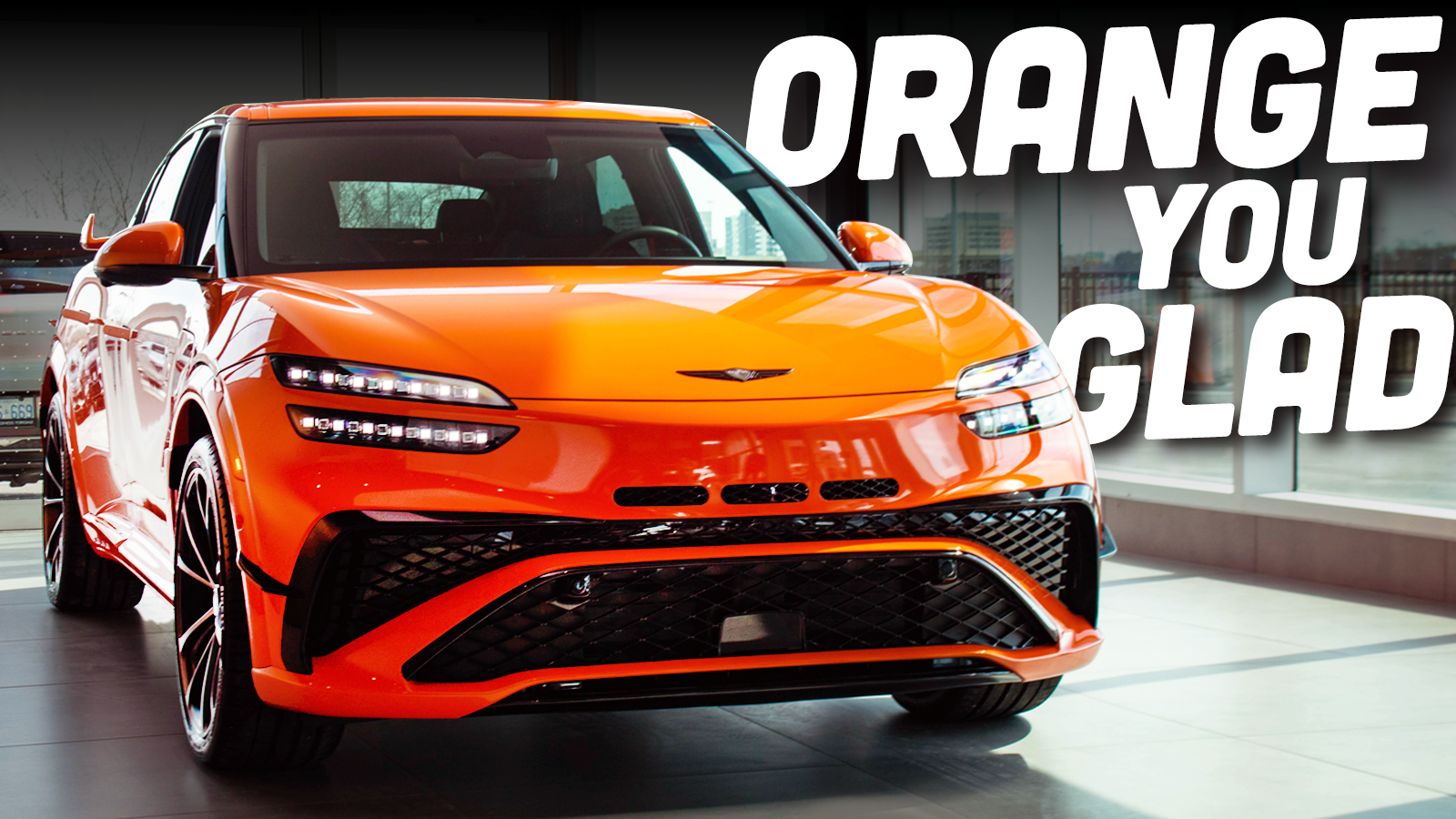
These days, it’s easy to feel like all the luxury performance cars you want to drive have already been made. Not only are the days of manual gearboxes and natural aspiration thoroughly in the rearview mirror, many of the fast cars today are a touch disappointing on paper. A BMW M5 that weighs more than a crew cab F-150 and a four-cylinder Mercedes-AMG C 63 may put down big numbers, but they don’t get everyone going. So what about something completely different? The Genesis GV60 Magma isn’t just the first performance car from the Korean marque, it’s also an electric crossover. An unusual move, but if it’s any indication of where performance cars are going, it makes me want to stick around for the future.
Just like how BMW has M, Genesis has Magma, a Dr. Evil-esque name for cars that go properly fast. The GV60 Magma is the five-pepper variant of the marque’s smallest EV, and here are the headline figures: Dual-motor all-wheel-drive, 601 horsepower normally, 641 horsepower in boost mode, an electronically variable limited-slip rear differential, drift mode, heaps of cooling, and thoroughly reworked suspension. It’s all rather tempting, so let’s take a closer look.


The first impression of the GV60 Magma is that it’s almost unbelievably orange from its roof to its monoblock brake calipers. So orange, you’ll likely miss the functional dive planes and barge boards at first glance. Yes, barge boards, like on a race car. This is the wildest factory aero package I’ve seen on a crossover in ages, one that certainly reads like a letter of intent. In theory, this is the smallest, most recently-developed high-output electric car from Hyundai Motor Group, and it’s no shrinking violet.

Mind you, even though the GV60 Magma is more than three inches shorter than a Hyundai Ioniq 5 N, don’t expect it to be light. The Korean-market model tips the scales at 4,938 pounds. That’s 254 pounds lighter than the new Audi RS5 and 591 pounds lighter than a BMW M5 Touring, but still, oof. That sort of mass requires a lot of tire and suspension to control, so the GV60 Magma gets stroke-sensing adaptive dampers, 275-section Pirelli summer tires, and a whole host of proper suspension geometry tricks.

While the ride height of the GV60 Magma sits eight-tenths of an inch lower than standard, roll centers have been lowered by 3.17 inches up front and 3.52 inches out back for more gradual weight transfer. The track width is four-tenths of an inch wider at each axle, the effective arm up front is millimetrically longer, but the big party piece is how the caster trail’s been increased by 0.63 inches or 53 percent for a variety of sweet gains. Better steering centering, heavier steering weight, increased negative camber on the outside front wheel when it’s loaded up in a turn, all without the straight-line tire wear and grip penalties of increasing static negative camber. Promising stuff.

Of course, all of that’s theoretical until I put tire to tarmac, but I can definitely talk about sound. Genesis promises increased serenity thanks to measures like thicker insulated door glass and reworked door seals, but I bet that’s not what you’re curious about on the GV60 Magma.

Like the Hyundai Ioniq 5 N and the Dodge Charger Daytona EV, the Genesis GV60 Magma lets you toggle simulated engine sounds. However, Genesis doesn’t have a dedicated high-performance road car engine, and when you’re essentially starting from scratch in a digital audio workstation, why not aim for something slightly unusual? Something like, say, a 9,000 RPM V6.
View this post on Instagram
It would’ve been all too easy to get this completely wrong, especially considering how there are still racing video games being released in which the cars sound like Hoovers, but Genesis seems to have threaded the needle well. There’s a real crescendo to the soundtrack, from a low bass rumble at idle through a charming mid-range growl to the way it comes on cam for the last 2,000 simulated RPM. Intensity varies based on how far down you press the accelerator pedal, and though it’s a touch saccharine up top, it’s an interesting piece of sound design. Think McLaren Artura with a touch of autotune.

Of course, this simulation of an actual engine isn’t the only thing to take in once you’re sitting inside the GV60 Magma. The front seats are fabulously bolstered heated, ventilated, power, memory-equipped units. That three-spoke steering wheel is the right sort of diameter and thickness, the driving position feels better than on the standard model, and multi-tone stitching on the seats and door card inserts almost has a touch of tartan to its orientation. Even the key is orange, because of course it is.

Beyond that, you really get the sense that Genesis threw everything at the GV60 Magma. The sueded headliner finish comes all the way down the B-pillars, almost every surface chest-height and up is covered in some sort of stitched material, brightwork gets swapped out for black chrome, and almost every toy imaginable is present and accounted for. A Bang & Olufsen sound system, a high-res suite of parking cameras, advanced driver assistance, a head-up display, you name it.

It all makes you wonder: what does the GV60 Magma actually compete with? The Cadillac Optiq-V is down 122 horsepower on the GV60 Magma and doesn’t have nearly the same quantity of go-fast bits as the Genesis. The Tesla Model Y Performance is almost as rapid on paper but nowhere near as luxurious. Genesis hasn’t released pricing, but a similarly potent Porsche Macan Electric will almost certainly command a premium large enough to buy a typical compact car. Until something like a BMW iX3 M shows up, the closest competitors to the GV60 Magma will be its own E-GMP sibling, the bar-brawler Hyundai Ioniq 5 N. For those who care more about performance than luxury, perhaps manual seats and normal plastics are worth the savings.

Regardless, there’s something endearing about the form of the GV60 Magma. I like the three hole-punched nostrils in the front bumper. I like the lairy barge boards and the way the interior stitching has a bit of hot hatch flair. I like how the spoiler end plates form horns that make the whole car feel like it’s the imp on your shoulder, daring you to mash the skinny pedal into the carpet. But most of all, I like how it’s not afraid to have a sense of humor.

Sitting still, the GV60 Magma feels experimental, consciously designed to not be a high-volume model. It might be too much for some people or too weird for others, but that seems to be on purpose. Unless you’re Uniqlo, it’s hard to build a reputation by aiming for normal. Between this and the GMR-001 Le Mans Hypercar, Magma is off to an interesting start. The only thing left to find out is how the hottest GV60 actually feels on the road. With sales starting this summer, that shouldn’t take too long.


Top graphic image: Thomas Hundal


Dr Evil voice – “LIQUID HOT MAG-MA”
God its hideous looking. I so do not like the era we’re in for vehicle designs.
Yeah it really looks weird. The ioniq 3 looks a bit better, but I’d much rather have a traditional fastback shape like a model S or a small hatch affair. This thing just looks weird. They gave thing 21″ wheels only to complement the 61″ height too, which sucks.
Genesis ASBO
https://www.youtube.com/watch?v=emhHXaRLHYQ
This is pretty fun, but if I’m buying one of these guys with a fun look, I think the AWD performance trim in white with the sky blue interior clears this by a good margin, and the aqua green on aqua green is in second ahead of the bright orange. Put this kind of wild trim on the Kia or Hyundai, or at least give this a nice racing green option to class it up a bit.