


As a Powertrain Design Engineer, the first time you design a cylinder head is a huge challenge. You have to contain gasses at 1200°C (2200°F), coolant at over boiling temperature that can’t be allowed to boil, hot oil at pressures high enough to send a flammable jet across a room, and air passages that have to have minimum flow disruption despite being completely blocked by a valve 60 times a second. Plus all of that in a single lump that mounts the valvetrain, inlet manifold, exhaust system and anything else that’s nearby in one big complex casting, while being bent by thousands of explosions every minute. And oil drains, mustn’t forget oil drains (my very first job on a cylinder head was to add oil drains that the previous guy had forgotten – it’s a very complex part).
By the time you’ve designed a few (they can each take months or even year) and had several of them binned when projects got cancelled, it just starts to feel like routine work. What makes it feel even more just like routine work is that OEM’s have standards for everything, and often they are legacy habits from a time when there wasn’t CAD, or they used inches as a unit, or had lazy designers who weren’t exactly terrific.


[Dave Larkman is a mechanical design engineer who had a 25-year career at Lotus Cars and Lotus Engineering (the consultancy business that worked for other OEMs), eventually becoming Lead Engineer of Powertrain Design. He has also been a semi-pro drifter, rides sports bikes, and used to feel ashamed about his taillight collection until he found Jason Torchinsky on the internet. Wait, why am I writing this in third person? It’s me, Dave, writing my own bio. – DL [Ed note within ed note: Sorry, Dave. I’ve got a Jeep to fix and no time to write bios. -DT] ]
This particular project had a cast bolt boss-standard that was simple, logical, and boring. A bolt boss is any feature on a casting that you fit a bolt or a screw into (fun way to make engineers fight: ask them to agree on a definition of what makes either a bolt or a screw). You need the boss to be deep enough for the screw thread, which will have a minimum length based on the material and how it’s made, and wide enough to have enough material around it to not only be strong enough, but to not leak (castings can be a bit porous, and there is often an oil passage running right next to your bolts). All of that has to take into account the manufacturing tolerances on the tooling, the casting and the machining. So it’s low risk to just look up an M6 boss or whatever and copy the dimensions down.
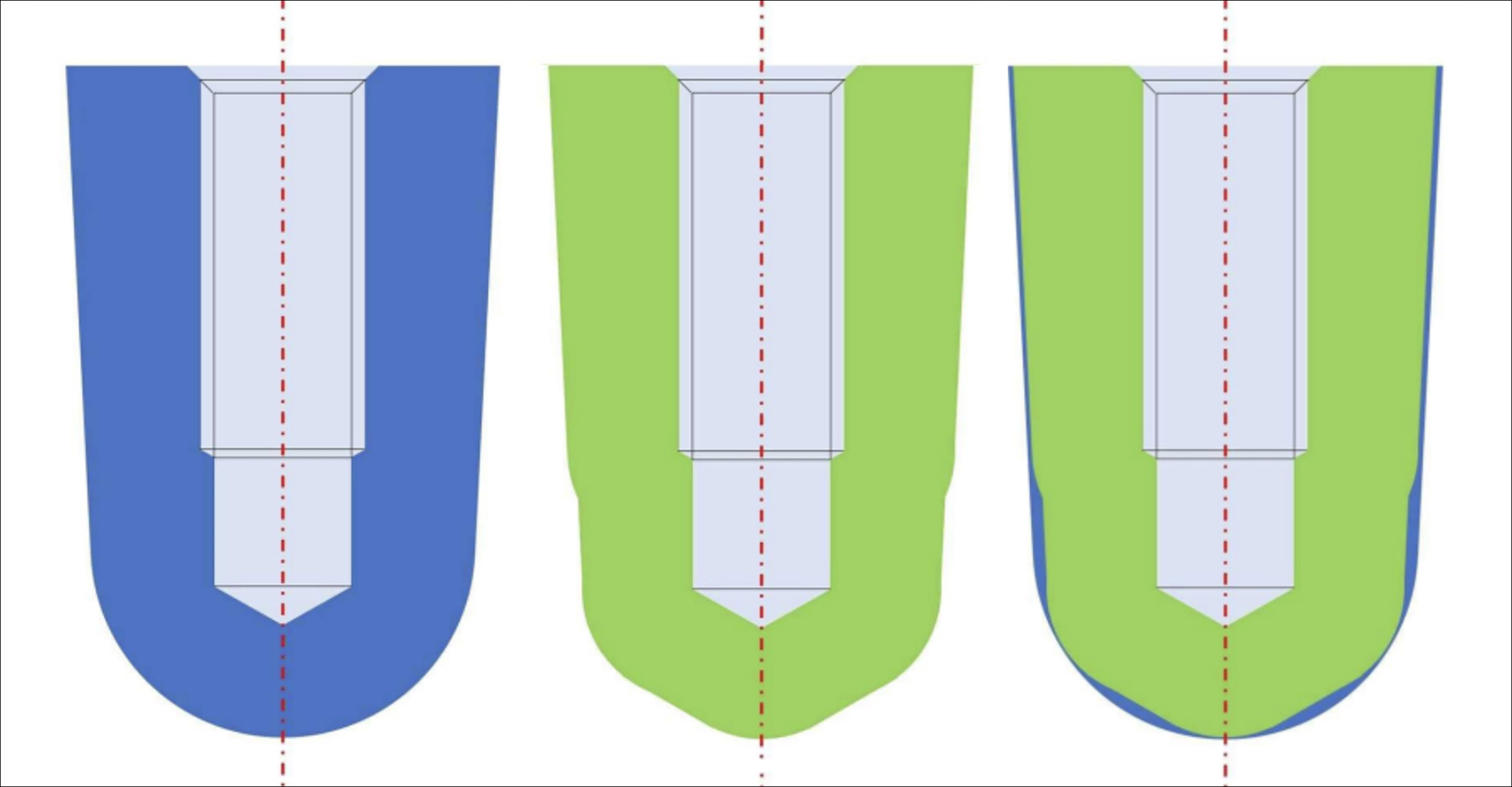
However, it’s a bit dull, because it’s just a slightly tapered cylinder with a spherical end, like this:
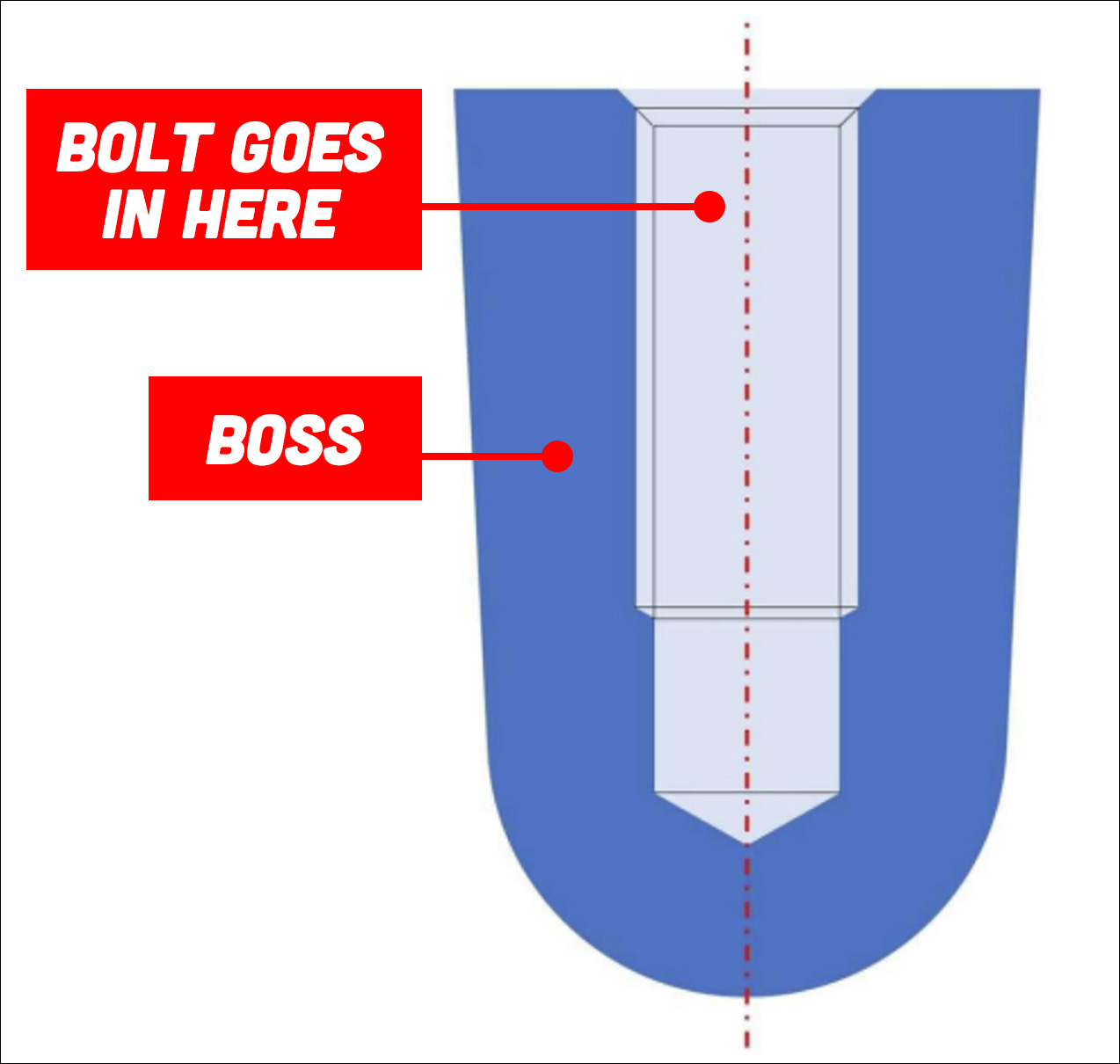
The actual machined feature is a drilled hole with a cone on the end, then a slightly wider, slightly shorter thread. I thought, why not take the minimum wall thickness from the standard boss and offset that from the feature I actually need? It’ll be no harder to make, but lighter and therefore cheaper, but most importantly it won’t be the same ball-ended blob I’ve been modeling for ages.
So I quietly came up with this pointy, stepped blob and threw it all over the place.
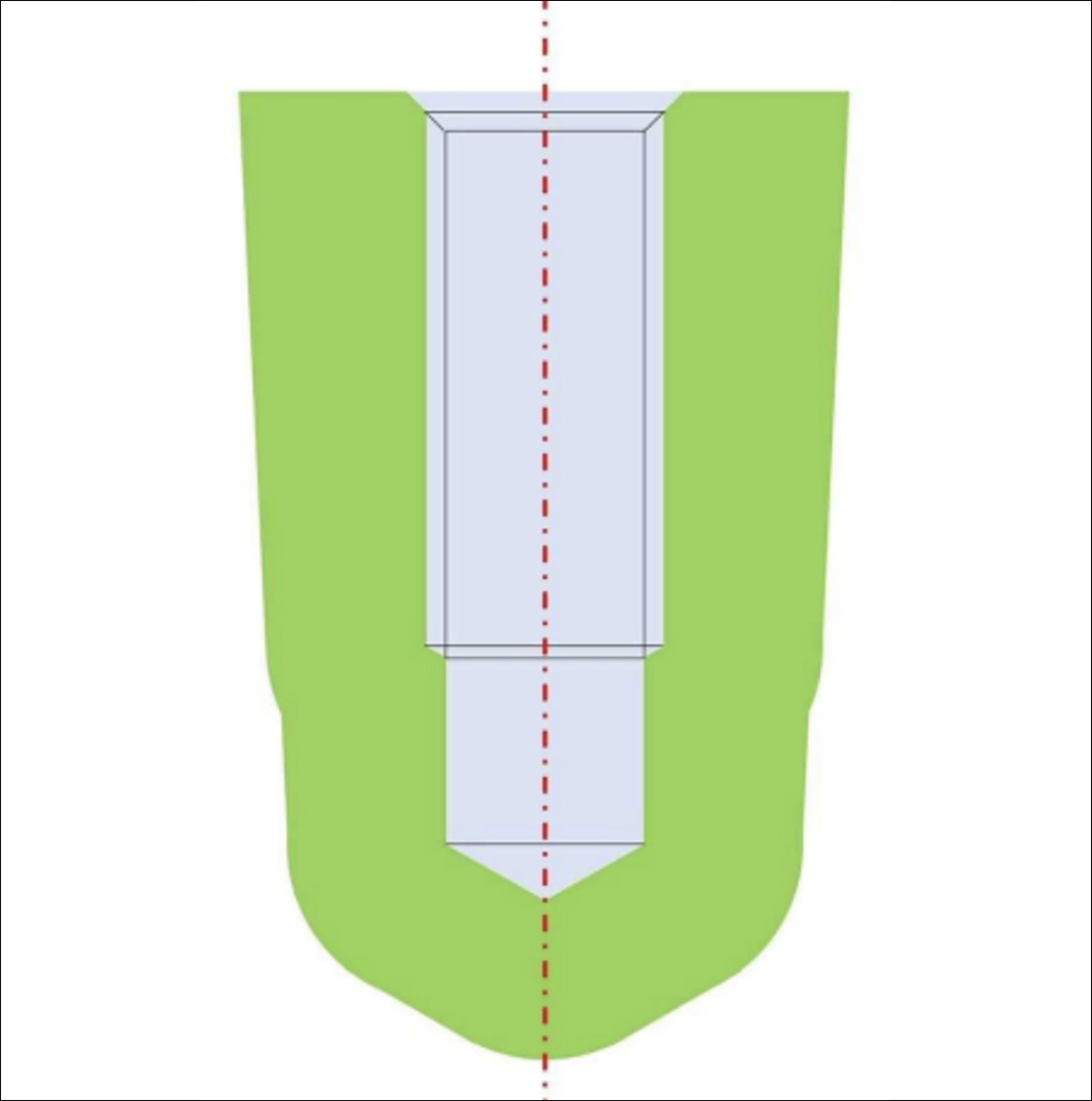
There was no justification for doing this; it was already under the mass and cost targets by enough to get a little pat on the head, and still chunky enough to zip through durability testing without getting a massive kick in the groin for failing and costing the client millions. But, you know, bored.
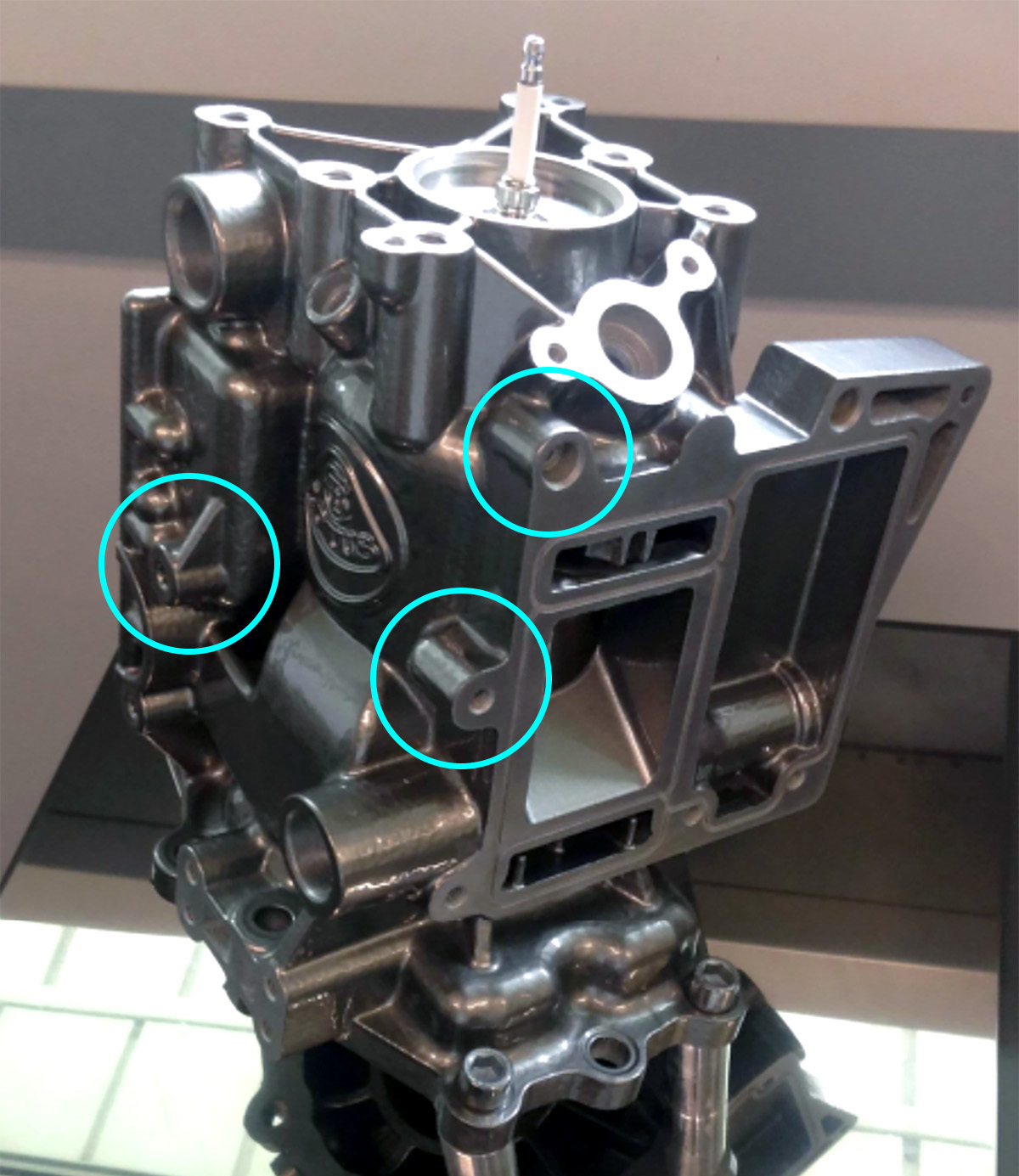
Now would be a great time to show you a picture of the actual cylinder head, but, as my confidentiality clause is still both valid and terrifying, I’ll show you a picture of something else to give you some context. This chunk of metal is the monoblock (a combined cylinder head and block) of Lotus’ Omnivore research engine from 2009, which is a single-cylinder two-stroke engine and therefore relatively simple; and it’s covered in bolt bosses. [Ed note: I circled three of ’em – Pete]
My new cylinder head and comedy-bolt bosses went through the design review without a murmur and passed testing with no problems, at which point my job was done. It then went into production, made no great impression on the world and, several years later, went out of production with no internet-verifiable reputation for massive cylinder head failures. Phew.
Years later, I was explaining this whole thing to a fresh, shiny, new engineer in the hope that they might strive to avoid lazy design, and they asked how much weight this actually saved. I had no idea, so I checked, but not before correcting them on the use of weight, which is variable, instead of mass, which is not. So I modeled up the standard blob and my slightly better version to compare the two…
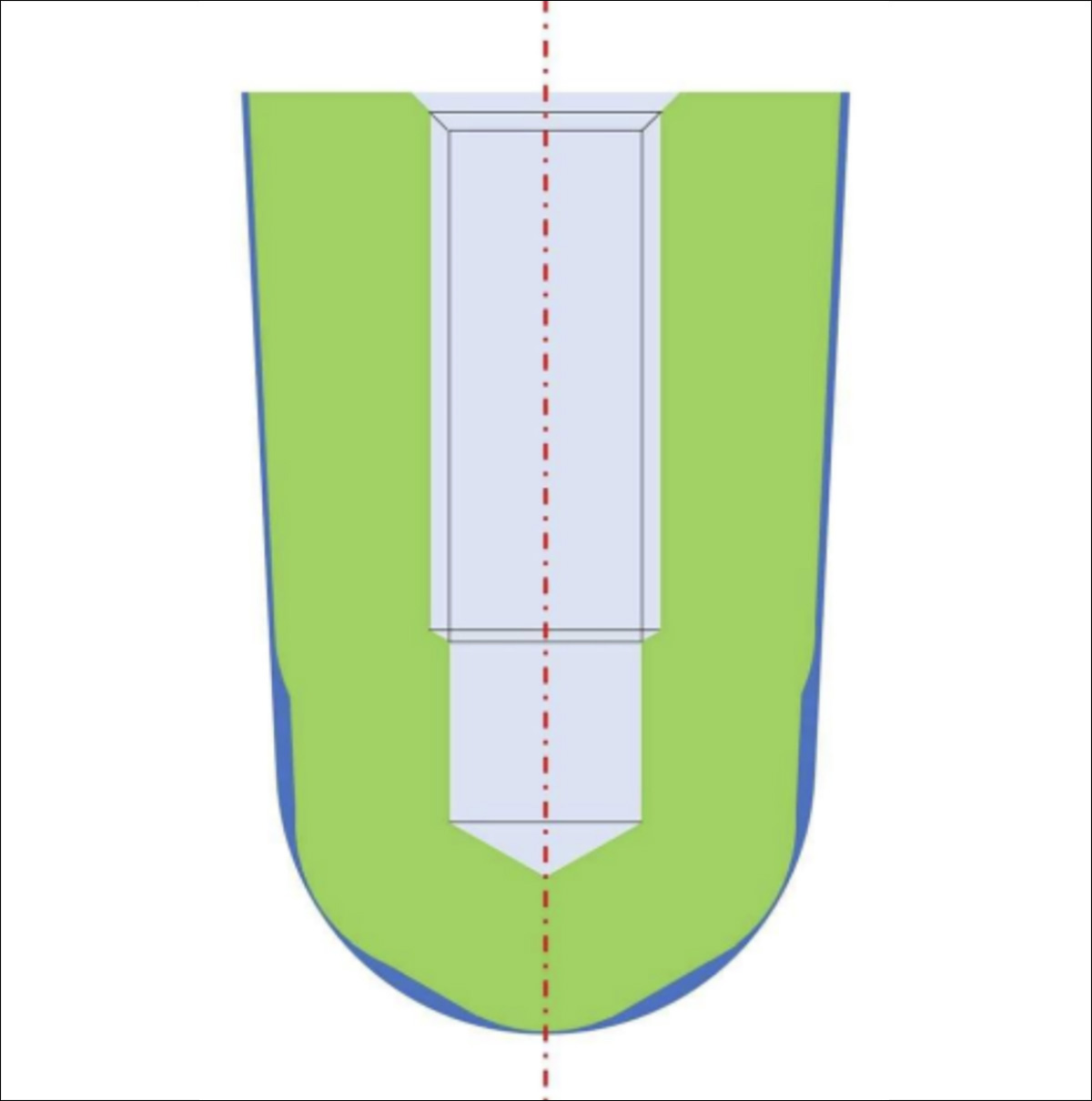
It saved just 0.7 grams, which is 0.0015lb. But wait, you lose about half that saving because the bosses tend to be blended into a wall. So it saved just 0.35 grams, which is the approximate mass of the air in a small sigh of disappointment.
However, when you multiply that by the number of bosses per head, then multiply that by the number of heads made before someone else came in and redesigned it for the next version of the engine, you get a mass saving of 10,214kg, or 22,518lb. Over ten metric tons of aluminium that didn’t have to be mined, transported or smelted. I’m not going to do the maths on the environmental impact of that because it’s too hard, and I’m not going to cheat and get Google’s AI to guess a value, like I did earlier with the mass of the air in a small sigh of disappointment.
But if every car that engine went into did 100,000 miles before it died, then 1,021,400,000 kg-miles were saved (yes, I know that unit is a horrible mess of metric and imperial, welcome to the UK, where we sell fuel in litres but measure fuel consumption in gallons). If the average mass of my cars was about 1,200kg (which it is, I have a spreadsheet, obvs) and my average yearly mileage is 10,000 miles, then the kg miles saved is the equivalent of 85 years of me driving around (very roughly speaking). A few minutes of boredom has offset my personal transport needs for life, assuming I don’t keep driving until I’m 102 years old, which seems like a reasonable assumption.
I’m going to ignore the obviously egregious skewing of the figures that results from nine years daily driving an S1 Elise. And the three years in a 2CV. And whatever additional environmental harm the RX7 caused. Hope you don’t mind.
Top graphic images: Dave Larkman; DepositPhotos.com




Love this Dave! More please!
Engineering articles are always fun.
They help me to see Engineers as people, instead of malevolent spectres haunting trucks and buses, placing every fastener and bracket juuust out of reach.
The difference between a bolt and a screw? As a technician, I’ve never been bolted by an Engineer.
More of these articles, please!
The difference between a bolt and a screw? As a technician, I’ve never been bolted by an Engineer.
Ha!
We laser-scanned in the arm of the tallest tech holding their longest Snap-On spanner and then make sure it still doesn’t quite reach. Or at least not without a razor sharp edge to lean the wrist on.
You people are like bugs to us.
I’m kidding. My first two years of work were fixing machines on a night shift, all wired up in identical grey wires, and assembled with a mix of metric and imperial fasteners. You become a much better designer after you’ve learned to hate bad design.
Hah! It feels like it sometimes.
The most egregious design flaw I’ve encountered was in a 60ft articulated New Flyer bus. In order to replace an A/C hard line (leak in an integral muffler, non-servicable), we had to cut open the fibreglass body panels, physically cut out part of the structure of the bus and then re-weld it back in. Then fix the fibreglass.
This is especially problematic since low-floor transit buses are basically a unibody/spaceframe setup. They have no central frame rails for support.
Great article, Keep up the great work.
gtu
I’ll pile on to the praise for this piece. In addition to what’s been said, when I open the hood and look down at the impossible jumble of components I often think “who made all this work and how?” It all just looks so impossibly complex. All I can imagine is some super engineers doing wizardry. This article gave me an entirely different perspective. Still no idea how how it can all come together, but this helps humanize the process.
I used to have the same feeling driving past the Chevron-Phillips refinery east of Houston in Baytown. They went through an expansion a few years back and at one point I think there were 14 cranes in use on the project. From the design to the fabrication of the parts to the assembly, it was really mind-numbing to think about.
I know an excellent joke about the difference between bolting and screwing and the exigencies that would make one desire to engage in one or the other, but the decorum of the autopian and my inability to make it a bit less horrifically offensive prevent me from placing it in the comments. But trust me, it’s funny.
Also, you think you were bored, how about those fourteen and a half million holes bored in some number of heads, and would they be enough to fill the Albert Hall?
Thinking about that many holes is enough to make a man blow his mind out in a car.
That lyric does refer to a Lotus.
I read that in the news today, oh boy
> my confidentiality clause is still both valid and terrifying
Said clause: “remove internal organs, then add lightness.”
Has anyone else rewritten an NDA?
The one I was handed essentially covered everything I might think, say or create forever.
All the time – I had one case where I spent $1K+ on my lawyer and six months later the whole project fell apart…
Yikes!
It Peter d out?
Ha!
Such an excellent article. Please write more!
Very pleased to see you writing here, Dave! We need to reconnect.
Awesome guest piece!
Brilliant article. Love the details.
And top marks for the RX7. Had one in the 90s. Have another one now. Zoom zoom.
Q. Do you know the difference between a screw and a bolt?
A. Have you ever been bolted?
YOU KNOW THE ANSWER TO THIS, DAVE. WE ALL DO.
Great read, thank you. I love the Autopian giving these technical deep dives.
‘Semi-pro drifter’ as in Dark Stranger of the Plains?
Or something to do with cars?
Either way, great story!
I was a sponsored driver in the British Drift Championship for a couple of years.
If there’s a more fun way to drive than sideways I’ve not found it.
I’m baffled by drifting on asphalt since I spent early driving in a car with more power than tires, so it was the best way to push it. I spent most turns like that.
I got enough control that I looked into driving for film.
Once I got a modern sports car, I instantly shifted my style though, since sideways only seems to make sense in rally driving once you have that traction on asphalt.
They didn’t call it drifting then, but rather ‘careless driving’.
Driving a prosaic vehicle past its limits is still a different kind of skill. There’s even training for what is sometimes called tactical driving.
I understand why you like it.
I have no idea why anyone watches it though.
Great article! More stuff like this.. along with all the other “normal” stuff of course..
It’s just like something I heard from Williams’ F1– the races are all won nipping at the margins of the rules. Small things add up if everyone has the same mindset.
As an engineer, can confirm there’s no better lunchtime conversation than the classic “bolt vs. screw” debate. Some honorable mentions include the similar “gear vs. cog vs. sprocket” debate, the theoretical “why does multiplying two negative numbers equal a positive number” question, and the zany “which vegetable is best” (that one was today, and it was garlic)
Incremental gains are how Team Sky claimed to have won the Tour de France so many times. Pay no attention to dodgy TUEs and Bradley Wiggins’ mysterious jiffy bag.
But seriously this is a good explanation of how to optimize something and how little things add up, like salami slice embezzlement. Welcome to The Autopian and I look forward to more adventures in casting design
They weren’t lying- it was incremental gains in doping that got them there. Just find a way to continually nibble at the edges of the biological passport process here and there, and scrape a tiny advantage.
What a great article. Well-written and amazing engineering content. Nothing like hearing stories about engineering stuff, would buy Dave beers all night to hear him tell away.
I slur terribly half way though the third beer.
How much did you save by not having a bolt in yours or how much did it cost to add one later because you forgot?
Hm. 10,214kg/0.35g. Figure 10 bosses per head? = ~3 million cylinder heads.
Guess I should be be on the lookout, because that engine should be quite common.
I mean if you want to make it really fun, you could calculate out the raw bauxite mass that had to be mined and then calculate out how much energy it required to reduce it. Though it would depend on how much recycled aluminum was in there.
Also subtract the recycling profit after it is done. Kind of like a deposit return
Mech Eng here. Two “Units” stories. Way back at the University of Waterloo in Ontario the policy on tests was you couldn’t be marked down by more than 10% for arithmetic errors. Cue to a Thermodynamics mid-term exam. The prof had set questions with the basic data in wildly inconsistent units – a holy mess of metric and imperial. The answers were multiple choices of different numeric answers. So I turned the paper over, defined the variables, wrote out the formulas and reduced them. I got 9/10 on every answer. You need to take advantage of the loopholes.
At an early job the older guys from Europe worked in “metric”. But they used odd units like kP/cm^2, which is numerically almost identical to the kgf/cm^2 they were used to. Newtons are an awkward unit for engineering use resulting in constructs like MPa or insane scientific notation indices for Young’s modulus.
The main problem with MPa is autocorrect
“Uhh, could you repeat the part about the stuff you said about those, things”?
– Homer S.
Wow yeah that’s a lot of soda cans LOL
Nice work Dave! I think?
This is brilliant and super fun! If only all manufacturers would apply a gram strategy think of how much we’d save!