


I have a few media guilty pleasures. One of them is that I spend several hours a week watching police chases to analyze where criminals mess up. Another is a fresher obsession with watching Antiques Roadshow. Anyway, what would happen if Jason Torchinsky ended up on the show?
Jason wrote a Cold Start about the weird Citroën 2CV painting that he made long ago. Bodnar:


Scene: ANTIQUES ROADSHOW – Charlotte, NC
[Appraiser examines the piece, turning it over carefully]
“Well, this is quite something. What we have here is a mixed-media panel painting, acrylic on wood, it appears executed in a deliberately archaizing style. The artist, signed here as ‘Torch,’ has done something genuinely clever. This is a modern annunciation painting, a genre with roots going back to the 13th century, but rendered in a thoroughly contemporary vernacular.
The iconographic program is immediately legible to anyone familiar with the tradition, your angelic messenger descending in divine light, your scroll-as-speech-balloon, your decorative border work mimicking manuscript illumination. Technically, the artist has done their homework. The stylized trees, the flattened perspective, the stiff expressionless faces, that’s not incompetence, that’s intentional medievalism.
Now, the twist, and this is where it gets fun, the Angel Gabriel has been replaced by the ghost of comedian Sam Kinison, who was tragically killed by a drunk driver in 1992, warning a man beside a Citroën 2CV not to drive drunk. The caption is rendered in Pig Latin rather than Church Latin, which I think shows a real wit.
Is it worth anything? In the current folk art and outsider art market, a piece this conceptually layered and technically accomplished – honestly, I’d put this somewhere between $800 and $1,400. But I suspect you’re not selling it.”

I wrote about the new Smart #2. Reader Grey alien in a beige sedan perfectly illustrates why Smart’s new “Hashtag” naming scheme is really dumb:
“The #2 looks a lot like the #1, but a #1 that spent too much time in the wash.”
–Mercedes StreeterI don’t know about you, but my #1 looks NOTHING like my #2.
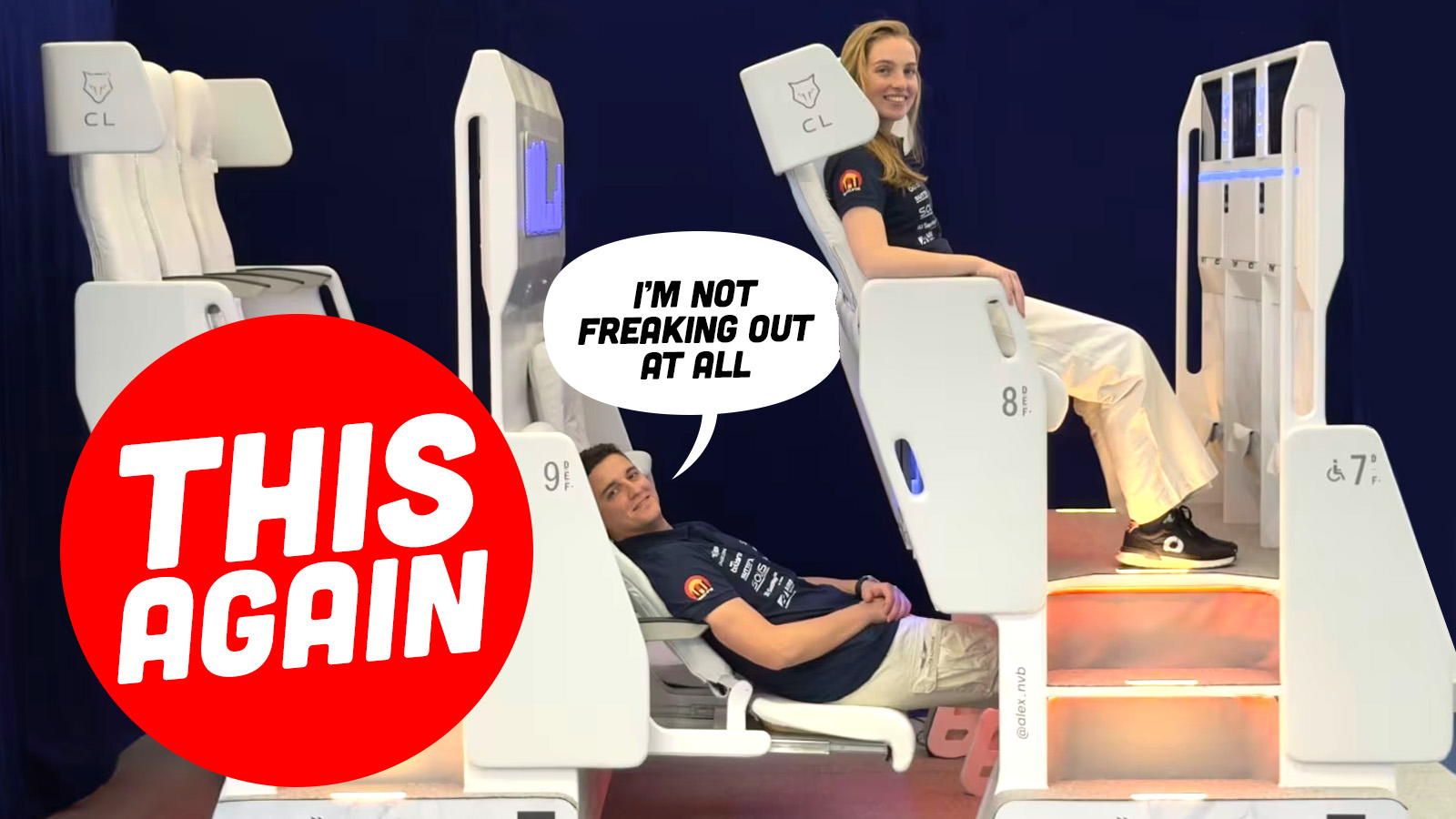
I also wrote about the latest version of the nutty double-decker plane seat. Expert Paul B chimed in:
Dude with 30+ years experience in airplane design here, including seats:
This will never happen. Reasons (other than passenger acceptance):
- Weight of the seats themselves. Seats must be rated to 16g. The second level will create a huge moment, requiring a structure that will be much heavier.
- No aircraft have seat tracks that can accomodate the loads of these things. Seat tracks are usually a primary structural element of an aircraft. Modifying them is a massive undertaking that could easily get into the 10’s of millions of dollars per aircraft model. They will also be heavier.
- The aircraft will need more emergency exits. Same impact as above about the seat tracks.
- The floor itself would have to be made stronger as they are designed with a passenger load. More weight.
- You will need more lavatories. More lavatories need a larger holding tank. Once again weight is added.
- Head impacts: most seats are designed so that the seat back can fold forward during a 16g event. This is to absorb energy of a passenger’s head hitting it, reducing the severity of injuries. Rigid seat backs exist, but the spacing is increased to avoid head impacts (think of the extra legroom if you get a bulkhead seat). This design would need airbags. Yes, once again, that pesky more weight issue.
- All this extra weight of structure, extra doors & lavs will add significant cost to the aircraft, easily in the millions per aircraft. A lavatory will run you about $100K, I’d guess a door about the same or more. An emergency exit slide is 20-50K each.
Now to the weight issue: Aircraft are rated to a maximum takeoff weight. The airlines can juggle the weight of passengers, weight of cargo/baggage or weight of fuel, but the 3 pieces must be less than the max weight.
We’ve added significant weight to the aircraft itself, much higher passenger weight, and more passengers means higher weight for baggage. This means less fuel capacity, reducing the aircraft’s operating range significantly. I’m not an aircraft performance guy, but I’d ballpark at least 30% less range, possibly much higher.
This concept always gets laughs at the office when it appears.
I love it when experts chime in. Have a great evening, everyone!


I saw a police chase recently where they tried to force the fugitive off the road.
They swung wildly, then recovered control over and over.
At one point, nearly took out the police car.
Impressive stuff!
“I spend several hours a week watching police chases to analyze where criminals mess up.”
If the 5-0 hasn’t already brought you in for questioning, which of your passenger vehicles would you use if you were the getaway driver? Not that I’m planning one last job…
Her wife’s Prius.
It is such a good getaway vehicle that Toyota made a commercial about it.
“I don’t know about you, but my #1 looks NOTHING like my #2.”
I guess you aren’t old enough to go through the fun part of having a Colonoscopy. Because that is the goal the night before.
PS, when it is time, get a colonoscopy. The “prep” work isn’t fun, but the procedure isn’t anything bad at all. Missing 3 days of eating peanut butter and having a day of drinking nothing but yellow Gatorade and Colonblow is a small price to pay to avoid the Big C.
Had a colonoscopy last year actually. The prep is worse than the procedure for sure. Also, they gave me Super Colon Blow instead of the standard stuff. One dose of that is equivalent to the fiber content in over two and a half million bowls of your standard oat bran cereal.
They always give you super colon blow. If you have a family history of cancer (like I do), you might as well install a seat belt on the toilet.
Ok, joking aside, get one of those electric bidet toilet seats. Those are life changing for, um, seismic events like super colon blow. Your pooperhole will thank you.
The prep almost wouldn’t be so bad, other than the shitting yourself dry part, if it just tasted bitter and mediciney. Instead, I never thought a flavor profile could fall into the Uncanny Valley so perfectly.
I-used-to-be-cool Aid tastes sweet but awful.
Each doc has different preps. My current one tells you to go to Sam’s Club or Costco and get a two pack of Miralax. Mix a bottle with it with a bottle of your choice of light colored sports drink and get it down within an hour. As long as you don’t get that crappy Glacial Cherry flavor, it’s not too bad.
Colonoscopies are no biggie unless you have to get a SECOND one because they didn’t have some tool to see way up there and a week or so later you get sepsis and they have to take out eight inches of your lower intestine.
Ask me how I know.
Sounds like a case to refer to a lawyer.
The worse thing to happen to me was a vein stopped running when they tried to knock me out and they had to quickly run a new IV. I ended up with a bruise on the back of my hand.
“This concept always gets laughs when it appears,” which makes me smile but then frown about two seconds later.
Do the designers not talk to the engineers, ever? It seems like this one response would make the rounds with the various groups that ever take up aircraft interior architecture, and you’d never ever see the stacked-passenger model again. A poster of this would go up on an office wall somewhere and, like the Cadillac Cimarron, be boldly emblazoned, “NEVER AGAIN.”
This is advertising. They have so many eyes on their business right now, and if some rich investor wants to give them money, their bank account accepts cash, check, wire transfers, stocks, bonds, Venmo, Applepay, bitcoin, and Krugerrands.
Maybe the designer guy looked around until he found engineers willing to make the contraption without too much protest? Well, that seems to be his goal, anyway!
Trust me, aircraft interiors designers often live in their own world, especially on biz jets.
For these seats, they technically could be built, but the business case will never work.
Think of these like those wild concept cars we see at auto shows, except in the automotive world, the designers know it will never go beyond the dream stage.
Ah. The Franco Sbarro approach.
“Yes it’s batshit crazy, but it’s really just for looking at anyway.”
Nobody ever talks to the engineers. We are a grumpy lot because nobody ever listens to us, even if they do talk to us.
“We are a grumpy lot because nobody ever listens to us, “
What? Did you say something?
LOL
Some reason people get defensive when we Engineers shoot their ‘grand ideas’ full of holes in 30 seconds.
Oh, you didn’t want our opinion? My bad.
Yeah, they hate it when stupid stuff like Physics get in the way.
My thoughtful discourse on biologically created waste media made me internet famous today! Thanks Mercedes!